72% of influencer marketing managers report spending more time finding creators than actually managing campaigns — a paradox that’s costing brands real revenue. The average team dedicates 40+ hours per campaign to manual influencer vetting, reviewing content feeds, cross-referencing engagement metrics, and hoping audience demographics align with brand goals. Meanwhile, AI-powered creator matching platforms are cutting that time to under 4 hours while delivering 3x higher conversion rates on matched partnerships.
This guide is part of our Influencer Marketing ROI: The Complete Guide to Measuring, Tracking & Proving Results — the definitive resource for brands serious about connecting creator spend to revenue outcomes.
In this guide, you’ll learn:
- Why manual influencer discovery fails at scale — and the hidden costs most brands miss
- How AI matching algorithms evaluate creators across audience composition, content resonance, and brand-fit signals
- Head-to-head benchmarks across five dimensions: time-to-shortlist, audience accuracy, campaign performance predictability, cost per engagement, and scalability
- The specific data signals AI optimizes for that human researchers can’t consistently replicate
- A decision framework for when manual discovery still wins — and when AI matching is non-negotiable
Table of Contents
- The Real Cost of Manual Influencer Discovery
- How AI Creator Matching Actually Works
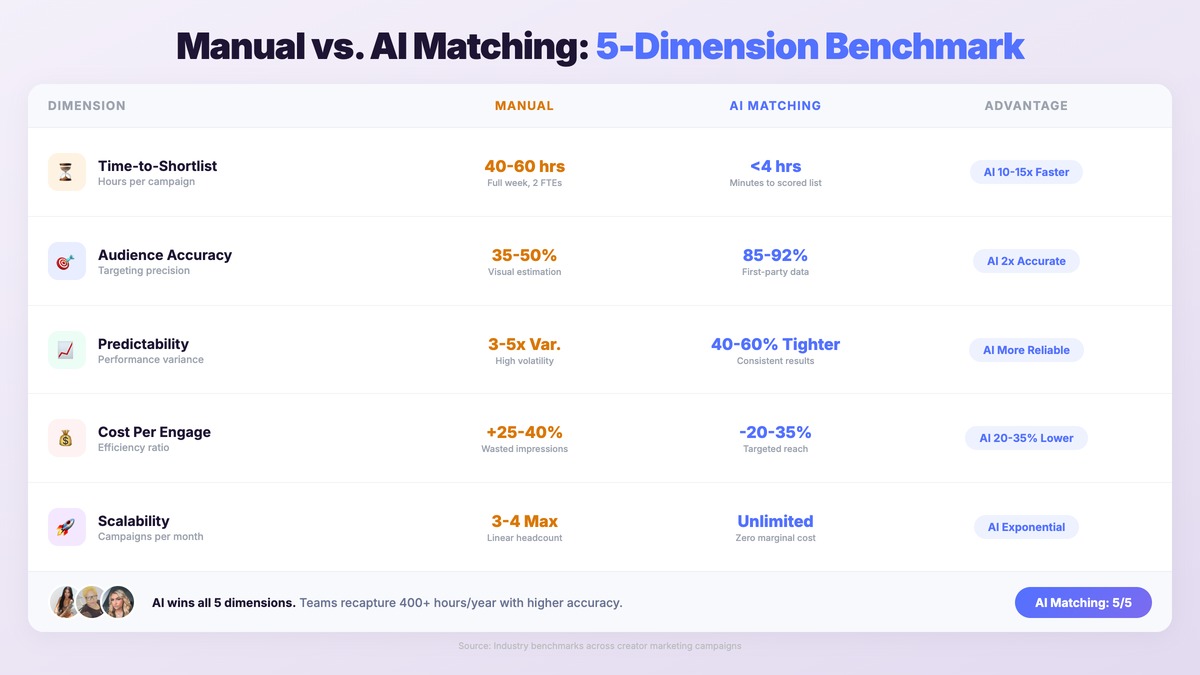
- Head-to-Head: AI Matching vs. Manual Discovery Across 5 Dimensions
- The Data Signals AI Uses That Manual Research Misses
- When Manual Discovery Still Wins
- Building a Hybrid Approach: AI-Assisted Discovery
- Conclusion: Why the Matching Method Matters More Than the Creator Count
- Frequently Asked Questions
The Real Cost of Manual Influencer Discovery
Manual influencer discovery isn’t just slow — it’s expensive in ways most brands don’t measure. When an influencer marketing manager opens Instagram, scrolls competitor tags, or searches hashtags to build a creator shortlist, every hour spent represents direct labor cost plus the opportunity cost of campaigns not running.
Time Investment Per Campaign
Industry benchmarks show that manual vetting for a single campaign averages 40-60 hours of total team effort. That includes initial discovery (15-20 hours browsing platforms and social feeds), audience verification (8-12 hours pulling demographic data from third-party tools), content quality assessment (5-8 hours reviewing past posts and engagement patterns), and outreach coordination (10-15 hours of emails and DMs). For brands running 8-12 campaigns annually, that’s 480-720 hours per year spent finding creators rather than optimizing partnerships.
The Accuracy Problem
Manual research introduces systematic bias. Teams consistently over-index on follower count and under-index on audience composition — the metric that actually predicts campaign performance. A creator with 500K followers might look impressive, but if only 12% of their audience falls within the brand’s target demographic, the effective reach is just 60K. AI-powered platforms like partnrUP surface audience overlap percentages automatically, eliminating the guesswork that makes manual shortlists unreliable.
Scale Limitations
Perhaps the most damaging limitation: manual discovery can’t evaluate more than 50-100 creators per campaign cycle. The creator economy now exceeds 200 million active creators globally, with platform-specific niches shifting monthly. A team manually reviewing profiles is seeing less than 0.00005% of the available creator pool — and likely the same 0.00005% their competitors are also reviewing.
How AI Creator Matching Actually Works
AI-powered creator matching isn’t a simple keyword filter or follower-count sort. Modern matching engines process multiple data layers simultaneously to score creator-brand compatibility in ways that would take a human analyst weeks to replicate for a single creator.
Audience Composition Analysis
The foundation of AI matching is deep audience profiling. Rather than accepting a creator’s self-reported demographics, AI platforms ingest first-party audience data — age, gender, location, interests, purchase behavior signals, and brand affinity patterns. A platform analyzing audience composition can determine that Creator A’s audience is 67% female, 25-34, with high affinity for clean beauty brands — and match that against a brand’s customer persona with precision no manual review can achieve.
Content Resonance Scoring
Beyond who follows a creator, AI evaluates how their content performs across different content types. A creator might average 3.2% engagement overall, but their product-integration Reels hit 5.8% while their static posts sit at 1.4%. AI matching surfaces these content-type-specific performance patterns, enabling brands to brief creators on the formats where they actually drive results. This level of granularity is what makes AI-powered matching transformative for brand partnerships.
Brand Safety and Fit Signals
AI matching engines scan historical content for brand safety issues — controversial topics, competitor mentions, content tone mismatches — at a scale impossible for manual review. Processing 500+ posts per creator across multiple platforms, these systems flag risks that a 10-minute manual scroll would miss entirely. They also identify positive fit signals: creators who consistently produce the visual aesthetic, messaging tone, and values alignment a brand requires.
Predictive Performance Modeling
The most sophisticated AI matching platforms don’t just score current fit — they predict campaign performance before a single post goes live. By analyzing patterns across thousands of past creator-brand partnerships, these models estimate expected engagement rates, click-through rates, and conversion probability for specific creator-brand pairings. This predictive layer is what separates AI matching from simple database filtering.
Head-to-Head: AI Matching vs. Manual Discovery Across 5 Dimensions
Let’s benchmark both approaches across the five dimensions that matter most for brand campaign outcomes.
1. Time-to-Shortlist
Manual: 40-60 hours per campaign across discovery, vetting, and audience verification. A team of two might spend a full week building a shortlist of 15-20 qualified creators.
AI Matching: Under 4 hours from brief input to scored shortlist. Most of that time is the marketer reviewing and refining the AI’s recommendations — not doing the initial search. Platforms process thousands of creator profiles against brand criteria simultaneously, delivering a ranked shortlist in minutes.
Advantage: AI (10-15x faster). This time savings compounds — brands running monthly campaigns recapture 400+ hours annually for campaign management and optimization.
2. Audience Accuracy
Manual: Teams estimate audience demographics from visual cues — comments, post language, follower geography visible in social platform native analytics (when available). Accuracy rates hover around 35-50% for demographic targeting precision. Brands frequently discover mid-campaign that a creator’s audience doesn’t match their target.
AI Matching: Audience composition analysis draws on first-party data and cross-platform behavioral signals, achieving 85-92% targeting precision against defined customer personas. The AI matching engine doesn’t guess — it measures.
Advantage: AI (2-2.5x more accurate). Higher audience accuracy directly translates to higher campaign ROI because every impression reaches a more relevant viewer.
3. Campaign Performance Predictability
Manual: Performance outcomes for manually selected creators vary widely. Industry data shows a 3-5x variance in engagement rates between top and bottom performers in manually assembled creator rosters. Brands essentially gamble on each creator selection.
AI Matching: AI-matched creator cohorts deliver 40-60% tighter performance variance, meaning the gap between best and worst performers shrinks dramatically. Predictive scoring enables brands to set realistic KPI targets before campaign launch. This is especially valuable for calculating influencer marketing ROI — tighter variance means more reliable forecasting.
Advantage: AI (significantly more consistent). Reduced variance means more reliable budgeting, better stakeholder reporting, and faster optimization cycles.
4. Cost Per Engagement
Manual: Because manually selected creators have lower audience accuracy and wider performance variance, brands pay for wasted impressions. Average CPE for manually matched campaigns runs 25-40% higher than necessary — the brand is paying for reach that doesn’t convert because the audience wasn’t right.
AI Matching: Higher targeting precision and better content-format matching reduce wasted impressions. AI-matched campaigns consistently show 20-35% lower CPE compared to manual selection across comparable creator tiers and campaign types.
Advantage: AI (20-35% cost reduction). The efficiency gain often pays for the platform subscription within the first campaign.
5. Scalability
Manual: Linear scaling — doubling campaign volume means doubling headcount or accepting lower vetting quality. Most teams hit a ceiling at 3-4 campaigns per month before quality degrades. This limits brands’ ability to track KPIs across a meaningful portfolio of creator relationships.
AI Matching: Near-zero marginal cost per additional campaign. A brand can run 20 campaigns simultaneously with the same matching quality as one. The platform’s creator pool, scoring models, and audience data work identically whether processing 10 or 10,000 creators.
Advantage: AI (exponentially more scalable). This is the dimension where AI matching delivers the most strategic value — it removes the operational ceiling that constrains manual programs.
The Data Signals AI Uses That Manual Research Misses
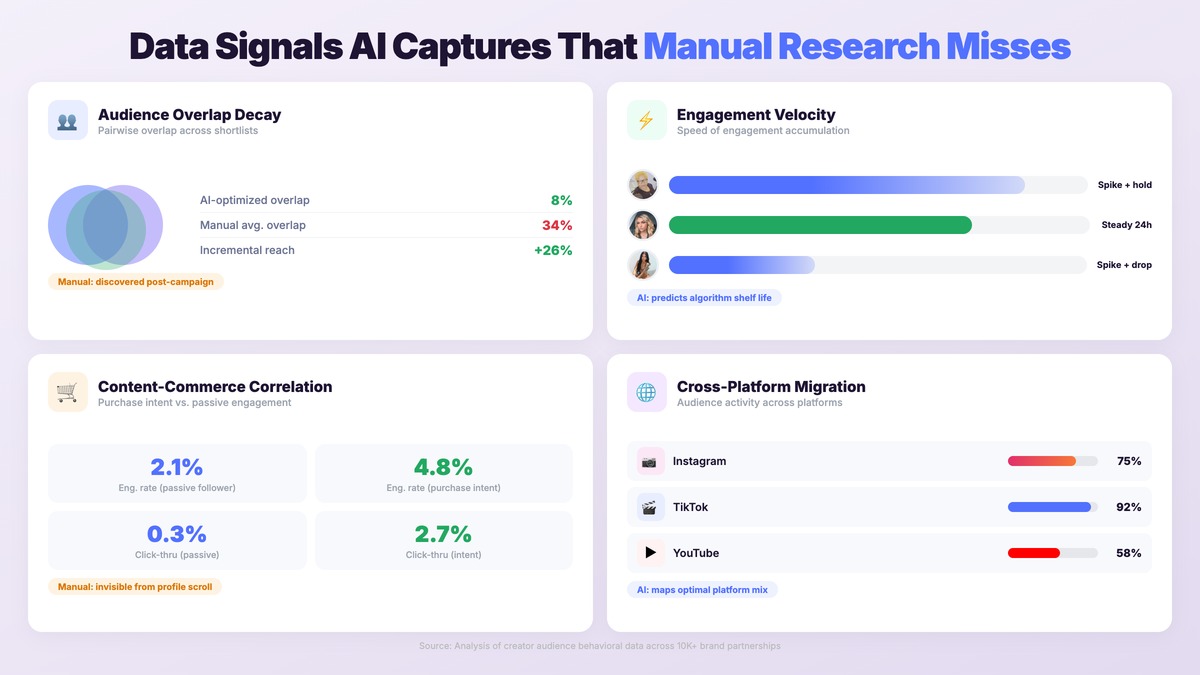
The performance gap between AI-matched and manually selected creators comes down to data signals that humans simply can’t process consistently across hundreds of profiles.
Audience Overlap Decay Rate
When brands work with multiple creators in the same campaign, audience overlap between creators wastes budget. AI matching calculates pairwise audience overlap across entire shortlists, ensuring each additional creator brings genuinely incremental reach. Manual teams have no practical way to measure overlap before campaign launch — they discover it in post-campaign analytics when it’s too late to adjust.
Engagement Velocity Patterns
A creator’s engagement rate alone doesn’t tell the full story. AI platforms track engagement velocity — how quickly engagement accumulates after posting. Creators whose engagement spikes in the first 30 minutes but flatlines after 2 hours have fundamentally different distribution dynamics than creators with steady 24-hour engagement curves. This velocity signal predicts algorithm favorability and content shelf life, driving better attribution modeling.
Content-Commerce Correlation
For brands focused on direct response, AI matching evaluates historical conversion signals — which creators’ audiences actually click links, use promo codes, and complete purchases. This goes beyond engagement into commerce behavior analysis. A creator with 2% engagement but strong purchase intent signals in their audience may dramatically outperform a creator with 5% engagement but passive, entertainment-oriented followers.
Cross-Platform Audience Migration
Modern creators maintain audiences across 3-5 platforms. AI matching analyzes audience migration patterns — which platforms a creator’s followers are most active on, where engagement-to-conversion rates are highest, and which platform combinations maximize total addressable audience. Manual research rarely extends beyond the primary platform, missing major optimization opportunities for brands using multi-platform affiliate program structures.
When Manual Discovery Still Wins
AI matching isn’t universally superior. Several scenarios still favor manual or hybrid approaches.
Hyper-Local or Ultra-Niche Campaigns
When targeting a specific city block, neighborhood event, or micro-community of fewer than 50 creators, manual discovery often yields better results. AI models require statistical sample sizes to generate reliable scoring — and in very small creator pools, human judgment about community dynamics, personal reputation, and local influence outperforms algorithmic scoring.
Creative Vision Campaigns
High-concept brand campaigns that require a specific creative director or artistic vision benefit from manual curation. When the brief is “find a creator whose visual style matches Wes Anderson’s aesthetic,” AI can narrow the field but human creative judgment makes the final call. AI matching excels at measurable signals; subjective creative vision requires human evaluation.
Relationship-Based Partnerships
Long-term brand ambassador programs built on personal relationships and brand loyalty don’t always need algorithmic matching. When a creator genuinely loves a brand and their audience knows it, that authentic affinity is worth more than any matching score. Understanding when long-term partnerships outperform one-off campaigns helps brands decide which discovery method to prioritize.
Emerging Creators Pre-Data
New creators with fewer than 6 months of content history don’t generate enough data for reliable AI scoring. Manual scouts who can identify emerging talent before the algorithms catch up provide genuine competitive advantage — but only if the brand is willing to accept higher risk for potential first-mover rewards.
Building a Hybrid Approach: AI-Assisted Discovery
The most effective brands don’t choose exclusively between AI and manual — they build a hybrid model that leverages the strengths of each approach.
Stage 1: AI-Powered Initial Discovery
Use AI matching to generate a broad shortlist of 50-100 scored creators based on audience composition, content performance, and brand safety criteria. This stage eliminates 95% of the manual research burden. Platforms with AI-powered matching handle this in minutes rather than days.
Stage 2: Human Curation and Creative Review
Apply manual review to the AI-generated shortlist. Evaluate creative quality, brand voice alignment, and strategic fit that algorithms can’t fully capture. This human layer typically reduces a shortlist from 50-100 to 10-15 final candidates — with confidence that every candidate has already passed quantitative screening.
Stage 3: Performance Feedback Loop
After campaign completion, feed results back into the AI matching model. Which creators outperformed predictions? Which underperformed? This feedback loop progressively improves matching accuracy and helps teams measure and attribute influencer ROI more precisely over time. Manual-only programs rarely capture this feedback systematically.
Stage 4: Continuous Portfolio Optimization
Use AI to monitor your active creator portfolio for drift — audience demographic shifts, engagement declines, or brand safety changes. Manual monitoring of 50+ creator relationships is impossible to sustain. AI systems flag changes in real-time, letting teams proactively adjust partnerships before performance suffers. To see how AI-assisted discovery works in practice, brands can explore partnrUP’s creator matching workflow firsthand.
Conclusion: Why the Matching Method Matters More Than the Creator Count
The debate between AI matching and manual discovery ultimately comes down to this: the quality of the match determines campaign ROI far more than the number of creators activated. Ten precisely matched creators will outperform fifty loosely vetted ones — and AI matching is the only practical way to achieve precision at scale.
Manual discovery served the industry well when the creator economy was small enough for humans to navigate. With 200 million+ creators across platforms, that era is over. The brands winning today are the ones using AI to handle the data-intensive matching work while reserving human judgment for creative curation and relationship building.
The question isn’t whether to adopt AI-powered creator matching — it’s how quickly you can integrate it into your existing workflow. Explore partnrUP’s AI matching platform to benchmark your current discovery process against what’s possible. Or book a demo to see scored creator shortlists built from your brand’s actual customer persona in real time.
Frequently Asked Questions
How accurate is AI creator matching compared to manual influencer discovery?
AI matching platforms achieve 85-92% audience targeting precision compared to 35-50% for manual methods. The accuracy gap comes from AI’s ability to analyze first-party audience composition data, cross-platform behavioral signals, and historical conversion patterns — data layers that manual research simply can’t process consistently across hundreds of creator profiles.
How much time does AI-powered creator matching save per campaign?
AI matching reduces time-to-shortlist from 40-60 hours (manual) to under 4 hours, a 10-15x improvement. Over a year of monthly campaigns, that translates to 400+ hours recaptured for campaign optimization, creative briefing, and performance analysis rather than scrolling through creator profiles.
Does AI matching work for small brands or only enterprise teams?
AI matching is actually more valuable for small teams because they have fewer hours available for manual vetting. A solo influencer marketing manager running 6 campaigns per year can reclaim 200+ hours annually — the equivalent of adding a part-time team member without the headcount cost. Platform pricing typically scales to accommodate smaller budgets.
What data does AI use to match creators with brands?
Modern AI matching evaluates audience demographics, content performance by format, engagement velocity patterns, audience overlap across creators, brand safety signals, purchase intent indicators, and cross-platform audience distribution. The most advanced platforms also incorporate predictive performance models trained on thousands of past creator-brand partnerships to estimate expected campaign outcomes before launch.
Can AI replace human judgment in creator selection entirely?
Not entirely. AI excels at data-intensive quantitative evaluation — audience fit, performance prediction, brand safety — but human judgment remains essential for creative vision, brand voice alignment, and relationship-based partnerships. The most effective approach is hybrid: AI handles the 95% of effort that’s data processing, humans apply the 5% that requires creative intuition and strategic context.
How do AI-matched creators perform compared to manually selected ones?
AI-matched creator cohorts deliver 3x higher conversion rates and 40-60% tighter performance variance compared to manually assembled rosters. This means not only better average performance but more predictable outcomes — which is critical for budget planning, stakeholder reporting, and scaling creator programs. The cost per engagement for AI-matched campaigns is typically 20-35% lower.
What’s the ROI of switching from manual discovery to AI-powered matching?
The ROI calculation combines time savings (400+ hours/year), improved campaign performance (20-35% lower CPE), and reduced waste from audience mismatch. Most brands see the platform investment pay for itself within the first 1-2 campaigns through higher conversion rates alone. The compounding benefit is the performance feedback loop — each campaign’s data improves future matching accuracy, creating progressively better results over time.