




Back to blog

Austin Rosenthal
June 18, 2026

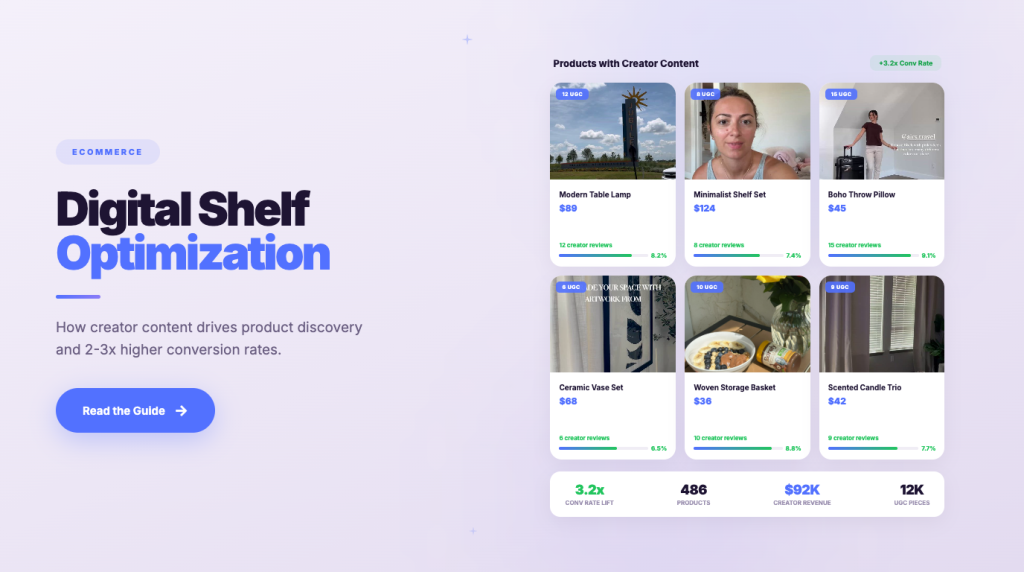
Digital Shelf Optimization: How Creator Content Drives Product Discovery & Conversions

Share on:

The digital shelf is the new physical shelf , except it’s infinite, always on, and increasingly driven by creator content. Walk into any retail store and prime shelf placement determines what gets noticed, picked up, and purchased. Online, that same dynamic plays out across TikTok search results, Amazon product listings, Google Shopping carousels, and Instagram Explore feeds.

The difference? Any brand , regardless of budget , can win shelf space online. But it takes a different strategy than the traditional digital playbook.

Brands winning the digital shelf in 2026 aren’t just running ads. They’re flooding the discovery zone with authentic creator content that educates, entertains, and converts browsers into buyers. A TikTok tutorial from a trusted micro-creator carries more purchase intent than a polished brand video. A YouTube review ranks for product searches long after a campaign ends. An Instagram reel showing “before and after” results drives conversions on Amazon listings it never even linked to.

This guide is your complete playbook for digital shelf optimization. We’ll cover what the digital shelf actually is (it’s bigger than most brands think), why creator content has become its most valuable asset, and exactly how to build a program that shows up where your customers are looking, and converts when they arrive.

Whether you’re a DTC brand trying to break through on TikTok, an ecommerce company looking to dominate Amazon search, or a CPG brand navigating the shift from retail to social discovery. This is the framework you need. You’ll also want to bookmark our guide on influencer marketing in e-commerce, which pairs perfectly with everything we cover here.
Digital Shelf Optimization: How Creator Content Wins Product Discovery

What Is the Digital Shelf?

The digital shelf is every online touchpoint where a consumer can discover, evaluate, and decide to buy a product. The term comes from retail, that physical shelf where placement, packaging, and positioning drive sales: applied to the online world.

The traditional digital shelf looked like this:

  • Amazon product listings and search results
  • Google Shopping ads and organic product results
  • Brand website product pages
  • Retailer websites (Target.com, Walmart.com, etc.)

But the digital shelf has expanded dramatically. Today it also includes:

  • TikTok search results: where millions of users search for product reviews, tutorials, and “best [product category]” recommendations
  • Instagram Explore and Reels: where algorithm-driven discovery surfaces products to users who never searched for them
  • YouTube recommendations: where long-form reviews rank in search and drive purchase decisions weeks or months after publication
  • Pinterest product pins: still a major driver for home, fashion, and beauty discovery
  • Reddit and community forums: organic word-of-mouth that shapes high-consideration purchases

What ties all of these together? Creator content.

On every modern digital shelf surface, creator-generated content , reviews, tutorials, unboxings, before/afters , outperforms brand-generated content. Consumers trust real people over brand messaging. Algorithms favor authentic engagement. And creator content has the unique ability to show up in search results, feeds, and recommendation engines simultaneously.

Understanding your full digital shelf means mapping every platform where your potential customers search for and discover products like yours, and then asking: what content exists there, and is it ours?

How the Digital Shelf Has Evolved in 2026

Three years ago, “digital shelf optimization” mostly meant Amazon SEO. Get your title right, optimize your bullets, run Sponsored Products ads. That was the game.

In 2026, that’s table stakes. The real shelf battle is happening on social. And if you want a sense of how fast the landscape is shifting, the influencer marketing stats tell a pretty clear story.

Social Search Is Overtaking Google for Product Discovery

A 2024 Adobe study found that 64% of Gen Z users prefer searching TikTok over Google for product recommendations. By 2026, that preference has deepened, and it’s no longer just Gen Z. Millennials are using Instagram and YouTube search as primary discovery tools for beauty, fitness, food, and home categories.

The implication is significant: if your brand isn’t appearing in TikTok and Instagram search results, you’re invisible to a growing portion of your addressable market, even if you rank #1 on Google.

TikTok as a Search Engine

TikTok’s search functionality has evolved from a novelty to a full product discovery engine. Users are typing queries like “best protein powder for beginners,” “clean skincare routine under $50,” and “honest [product] review” directly into TikTok search. They expect video results, and they trust creator voices over brand accounts.

This shift has created a new category of digital shelf real estate: TikTok search results pages. Brands that seed creator content optimized for these queries are capturing purchase intent at the exact moment it forms.

The Creator Review Economy

Consumers increasingly expect video proof before purchasing. Not product photos: video. Not brand claims , creator testimonials. The rise of TikTok Shop, Instagram Shopping, and Amazon’s Inspire feature has made the path from “creator video” to “purchase” shorter than ever.

A consumer in 2026 might discover a product via a TikTok creator, watch a YouTube long-form review for validation, check Amazon ratings, and convert , all within a single shopping session. This is why shoppable video has become such a critical piece of the modern brand’s discovery strategy.

UGC as Purchase-Decision Content

User-generated and creator-generated content has moved from “nice to have” to essential purchase-decision infrastructure. It’s not just about social proof anymore: it’s about answering the specific questions consumers have at the moment of evaluation. Does this foundation cover hyperpigmentation? Is this protein powder gritty? Does this air fryer fit a whole chicken?

Brands that flood their digital shelf with creator content answering these questions win the conversion. Brands that don’t lose it to competitors who do. This dynamic is especially pronounced in categories like beauty , if you want a concrete example of how creator content functions as digital shelf infrastructure, check out how we think about beauty brand digital shelf strategy.
Creator Content Strategy for Digital Shelf Dominance

Creator Content as a Digital Shelf Asset

Not all creator content is equal as a digital shelf asset. Understanding which content types drive discovery and conversion, and why: is the foundation of any effective strategy.

Content Types That Work on the Digital Shelf

Product reviews are the cornerstone of digital shelf content. Authentic, specific, opinionated reviews rank in search, build trust, and address purchase objections. The best reviews don’t just describe: they answer “is this right for me?” for specific use cases.

Demos and tutorials show the product in action. For anything with a learning curve , tech products, cooking tools, beauty devices , demos dramatically reduce purchase hesitation. They also rank well for “how to use [product]” searches.

Unboxings capture the anticipation and first-impression phases of the purchase experience. They’re particularly effective for premium products where packaging and presentation matter.

Comparison content (“X vs Y”) captures high-intent searchers who are already in the consideration phase. A creator comparison video for your product vs. the category leader can steal shelf position at the most valuable moment in the buying journey.

Before/after transformations provide visual proof of results. Essential in beauty, fitness, home improvement, and similar categories.

Routine integrations (“what’s in my skincare routine”) create aspirational context and associate your product with trusted lifestyles and habits.

How Creator Content Appears in Platform Search Results

Creator content earns shelf placement through a combination of engagement signals, keyword optimization, and algorithm relevance scoring. On TikTok, content that uses relevant keywords in captions, on-screen text, and spoken audio gets indexed for those search terms. On YouTube, titles, descriptions, and transcripts drive search ranking. On Instagram, hashtags and caption keywords influence Explore placement.

The key insight: creator content occupies search result positions that brand content rarely achieves, because algorithms favor authentic engagement: real saves, shares, comments , over polished brand content that users scroll past.

Shelf Life of Creator Content

Different content types have dramatically different shelf lives. Understanding this shapes how you invest:

  • Trending content (challenges, sounds, viral formats) , peak lifespan of days to weeks, high impression volume while trending, then drops off sharply
  • Review content: medium shelf life of 3–12 months, consistent traffic, degrades as product updates or competitors respond
  • Tutorial/educational content: long shelf life of 1–2+ years if the information stays relevant, compounds over time as it accumulates engagement
  • Comparison content: long shelf life until a better alternative emerges

Smart digital shelf strategy balances trending content for reach with evergreen content for sustained discovery.

Content Rights and the Digital Shelf

Here’s a critical point most brands miss: creator content you don’t have rights to is a liability, not an asset. If a creator posts an amazing review of your product, you can’t run it as an ad, embed it on your product page, or use it in email campaigns without usage rights.

Building a digital shelf content library requires acquiring clear usage rights at the time of content creation. This means working with creators through structured programs, not just hoping for organic mentions, and securing digital, paid, and white-label rights that let you deploy content across every shelf surface. For a real-world look at how brands do this effectively, see our breakdown of UGC for paid social.
Get Started Free →

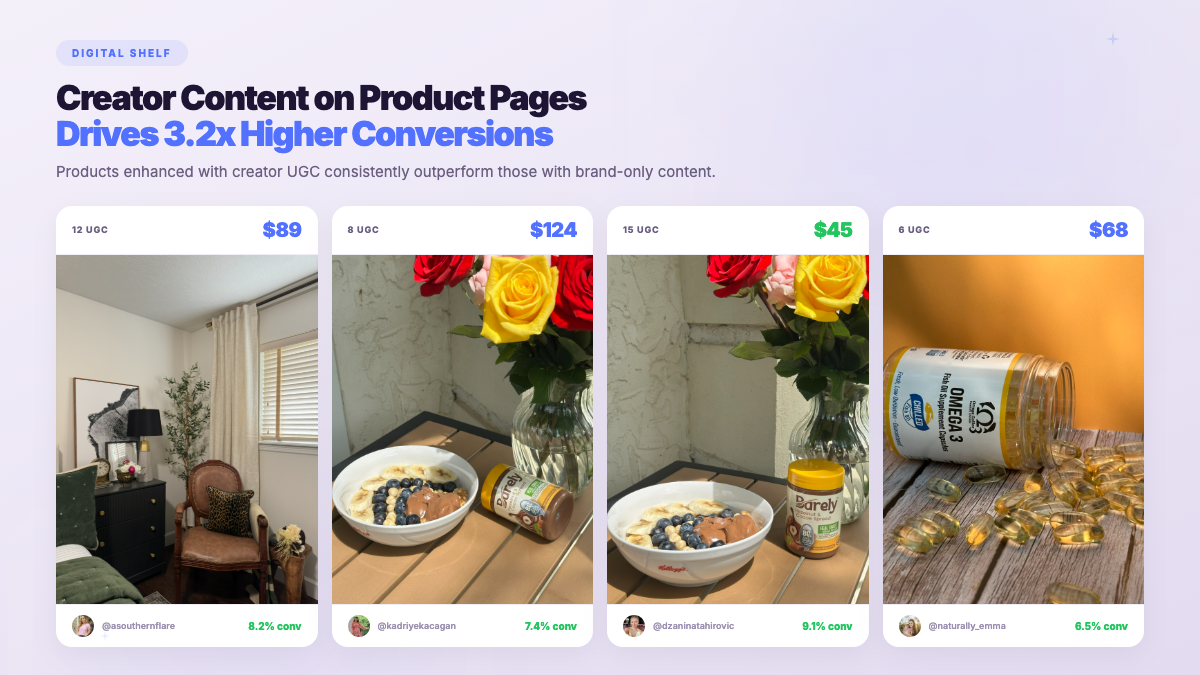
Digital Shelf Optimization - real creator campaign content with performance attribution data and engagement metrics
Real creator campaigns tracked with performance metrics and revenue attribution.

Digital Shelf Strategy for Brands

Winning the digital shelf requires strategy, not just content volume. Here’s the framework, and the good news is, you don’t need a massive budget to execute it.

Step 1: Map Your Digital Shelf Presence

Start with an audit. Search for your product category on every major platform:

  • TikTok: “[product category] review,” “best [product],” “honest [product] review”
  • YouTube: “[product] review 2026,” “[product] vs [competitor],” “how to use [product]”
  • Instagram: explore and hashtag search for your category
  • Google Shopping: your product name and category keywords
  • Amazon: your product listing and category search

Document: Who’s showing up? Is it your brand, your competitors, or unaffiliated creators? What’s missing? Where are the gaps?

Step 2: Content Gap Analysis

Once you’ve mapped your presence, identify the gaps. Common ones include:

  • No creator content for your highest-converting search queries
  • Competitor-owned comparison content (“X vs [your brand]” where the competitor wins)
  • Unanswered consumer questions that appear in search suggestions
  • Missing visual proof for key product benefits
  • Platform gaps (strong on YouTube, invisible on TikTok)

Prioritize gaps by search volume and purchase intent. A gap in “honest [product] review” queries is worth more than a gap in a trend that peaks and fades.

Step 3: Build a Creator Content Calendar Aligned to Product Launches

The most effective digital shelf programs are built around product launch windows. Creator content that goes live 2–4 weeks before a launch seeds the shelf before customers arrive. Content published during launch captures peak purchase intent. Post-launch content sustains momentum and handles the long tail of consideration.

For each launch, plan:

  • Pre-launch: early reviews, unboxings, teaser content from select creators
  • Launch week: tutorial, demo, and “is it worth it?” review content in volume
  • Post-launch: comparison content, routine integration, before/after results

For more on building out a structured creator program around launches, our guide to creator partnerships covers the full relationship-building process from outreach to ongoing management.

Step 4: Integrate Creator Content with Product Pages

Creator content shouldn’t live only on social. Deploy it across every purchase-proximity surface:

  • Amazon A+ content: embed creator videos and UGC imagery in your listing
  • Brand website product pages: add creator reviews, video demos, and social proof modules
  • Email campaigns: creator social proof in cart abandonment and nurture flows
  • Paid social ads: creator content typically outperforms brand creative 2–3x on ROAS

Step 5: Syndicate Creator Content Across Channels

One piece of creator content can work on multiple shelves simultaneously. A TikTok review can be repurposed as a YouTube Short, embedded in an email, used as a paid social ad, and displayed on your product page. This “one content, many shelves” approach multiplies your shelf presence without proportionally increasing production costs.

This syndication strategy is only possible if you have usage rights, which brings us back to the importance of structured creator programs. And before you scale up, make sure you’re not falling into any of the common creator content mistakes that derail otherwise solid digital shelf programs.

TikTok Search Optimization for Product Discovery

TikTok has become the product discovery engine for an entire generation of consumers. If you’re serious about digital shelf optimization, TikTok search is a core piece of the puzzle: not a bonus.

How TikTok Search Works for Products

TikTok’s search algorithm indexes content based on:

  • Keywords in captions and hashtags
  • On-screen text and graphics
  • Spoken words in the audio (processed by automatic speech recognition)
  • Engagement signals: completion rate, saves, shares, comments
  • Profile and content history relevance

When a user searches “best SPF for oily skin,” TikTok surfaces videos that match those keywords and have strong engagement signals. Creator content from trusted voices in the beauty space consistently outranks brand content in these results.

Creator Content + TikTok SEO

To optimize creator content for TikTok search, brief your creators on these tactics:

  • Front-load keywords in captions: the first 15 words matter most for search indexing
  • Use on-screen text: the algorithm reads it; viewers expect it
  • Speak the keywords: audio is indexed; creators should say the product name and category explicitly
  • Use specific hashtags: #skincarereview, #proteinpowdertiktok, not just #fyp
  • Structure for completion: high completion rates signal relevance and push content up in search

TikTok Shop Product Discovery

TikTok Shop has integrated shopping directly into the search and discovery experience. Creator content linked to TikTok Shop product pages appears in search results with a “Shop Now” tap. For brands on TikTok Shop, seeding creator content is direct revenue generation, not just brand building. This is one of the key ecommerce trends for 2026 you don’t want to miss.

Seeding Content to Appear in TikTok Search

The most reliable way to occupy TikTok search results for your product is to systematically seed creator content optimized for your target queries. This means:

  • Identifying your top 10–20 product search queries on TikTok
  • Briefing creators to create content that naturally addresses those queries
  • Publishing a volume of content (5–15 pieces per keyword cluster) to establish shelf presence
  • Monitoring search results and refreshing content as engagement decays

Volume matters. One creator video might rank briefly; 10–15 pieces of optimized creator content across multiple creators creates a durable shelf presence that’s hard for competitors to displace.
Measuring Digital Shelf Performance with Influencer Content

Amazon + Creator Content

Amazon remains the largest product discovery platform by purchase intent. Creator content strategy for Amazon is distinct from social, but the two are deeply interconnected. Your ecommerce influencer strategies should treat Amazon and social as one connected ecosystem, not separate channels.

UGC in Amazon Listings

Amazon’s algorithm rewards listings with strong engagement signals: clicks, time on listing, and conversion rate. Creator content embedded in listings: particularly video , dramatically improves all three metrics.

For Amazon listings, prioritize:

  • Video demonstrations: the “top video” placement on product pages drives significant conversion lift
  • Creator review imagery: real-life usage photos outperform studio shots in the image carousel
  • Q&A seeding: have creators address common purchase questions in the Amazon Q&A section

Amazon Creator Connections and Amazon Inspire

Amazon’s creator programs give brands direct tools to connect with creators for content and affiliate distribution. Amazon Creator Connections allows brands to set commission rates and content briefs for Amazon-native creators. Amazon Inspire: the TikTok-like feed within the Amazon app , surfaces creator content to in-app shoppers with immediate purchase intent.

Both programs represent digital shelf real estate that most brands aren’t fully utilizing.

How Off-Platform Creator Content Drives Amazon Conversions

One of the most powerful digital shelf dynamics is the “social-to-Amazon” conversion path. A consumer discovers a product via a TikTok creator, searches for it on Amazon, and converts: attributing the sale to organic Amazon search rather than the creator who created the intent.

This “dark attribution” makes creator content’s impact on Amazon conversions systematically underreported. Brands that measure it through incrementality testing consistently find that creator content seeding campaigns drive measurable Amazon sales lifts, even with no direct link between the content and the Amazon listing.

The Social Proof Transfer

Even when consumers convert on Amazon rather than directly through a creator link, the creator’s social proof transfers. A consumer who watched three TikTok reviews before going to Amazon arrives with high purchase confidence , driving higher conversion rates, fewer returns, and better reviews, which in turn improve Amazon shelf placement. The flywheel compounds.

Finding Creators for Digital Shelf Programs

Not every creator is a good digital shelf asset. The criteria for selecting creators for shelf-optimization programs differ significantly from awareness or brand-building programs.

Content Creators Who Rank in Search

For digital shelf programs, prioritize creators whose content actually appears in search results. You can test this manually: search your target queries on TikTok and YouTube, and see whose content appears. Creators who consistently rank in search for your category are more valuable for shelf programs than creators with large followings who don’t generate searchable content.

Tutorial and Review Creators vs. Lifestyle Creators

Lifestyle creators: aspirational, trend-focused, broad appeal , are excellent for brand awareness but often weaker for digital shelf optimization. Tutorial and review creators , educational, specific, search-optimized , generate content with longer shelf life and stronger purchase intent signals. Both have a place; the mix depends on your goals.

Micro-Creators Dominate Niche Product Searches

A micro-creator with 15,000 followers who is the go-to voice for “sensitive skin skincare” will generate more digital shelf value in that niche than a macro-creator with 500,000 followers and a broad beauty audience. Niche authority drives niche search placement. For digital shelf programs, think about category authority, not just audience size. This is a key principle behind strong fashion digital shelf strategy as well , niche creators consistently outperform mega-influencers on conversion-driving metrics.

How AI Matching Identifies Discovery-Optimized Creators

Traditional creator discovery looks at follower count, engagement rate, and demographic overlap. AI creator matching adds a layer of content analysis: which creators’ content actually drives discovery behavior? Which generates saves and shares (intent signals) rather than just likes? Which content ranks in relevant searches?

AI-powered discovery surfaces creators who are genuinely discovery-optimized for specific product categories: reducing the manual research burden and dramatically improving the quality of digital shelf programs.

Find Your Discovery Creators →
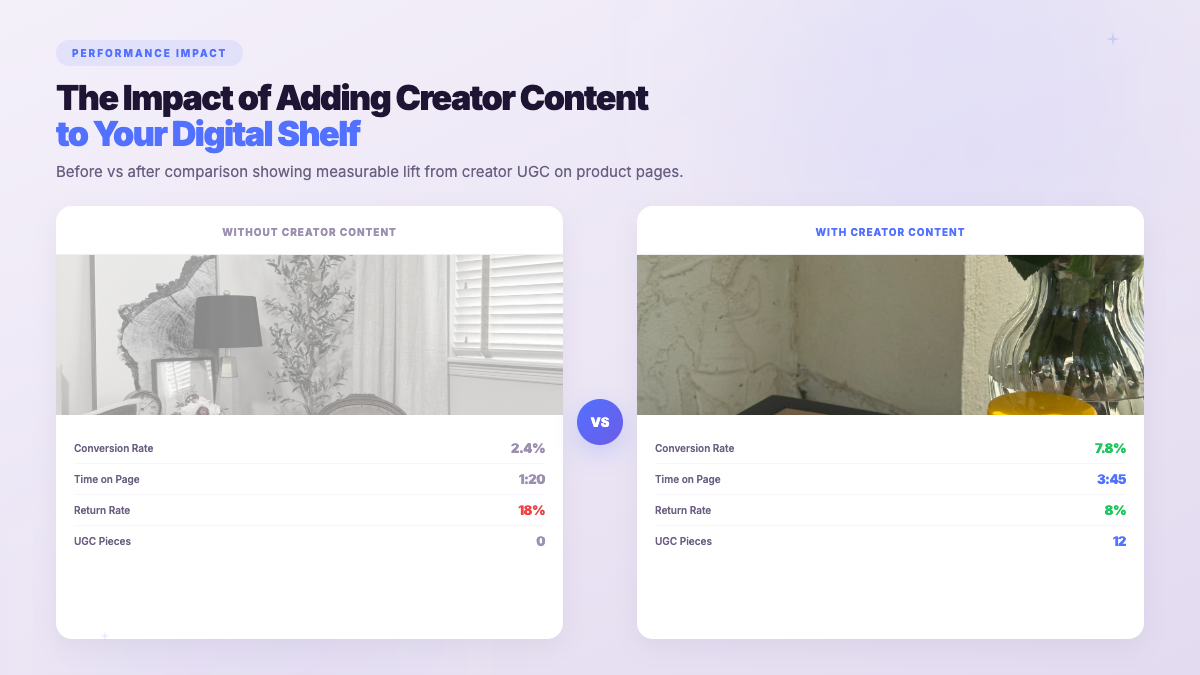
Digital Shelf Optimization - creator campaign results showing measurable ROI across platforms
Measurable creator campaign results across multiple platforms and content formats.

Measuring Digital Shelf Performance

Digital shelf measurement requires a broader framework than standard influencer campaign metrics. You’re measuring shelf presence, not just campaign performance. If you haven’t already built out your measurement infrastructure, our guide to influencer platform ROI is the right place to start.

Share of Search

Share of search measures what percentage of creator content appearing in relevant search results is associated with your brand. Search “[your category] review” on TikTok, YouTube, and Google. Count how many results in the top 20 feature your product. That’s your share of shelf. Track it monthly against competitors.

Organic Creator Content Impressions

Beyond paid or seeded content, track how much organic creator content mentions your brand, and what search terms that content appears for. Tools like Brandwatch, Sprout Social, and platform-native analytics can surface this data.

Attribution from Social Discovery to Purchase

The hardest and most important measurement challenge. Approaches include:

  • UTM parameters: trackable links in creator content that trace directly to conversion
  • Unique promo codes: creator-specific codes that attribute revenue directly
  • Incrementality testing: geographic or audience holdout groups to measure the lift from creator content programs
  • Amazon attribution links: for products selling on Amazon, these trace off-platform creator traffic to Amazon conversions
  • Survey attribution: “how did you hear about us?” data consistently reveals more creator influence than click-based attribution

Content Volume vs. Content Quality Metrics

A common mistake: optimizing for volume at the expense of quality. Ten pieces of high-quality, search-optimized creator content will outperform 100 pieces of low-quality content on every digital shelf metric. Quality signals: saves, shares, comments, completion rate , determine algorithmic shelf placement. Track both, but don’t sacrifice quality for volume.

Building a Creator Content Library for Digital Shelf

A sustainable digital shelf strategy requires building a creator content library , an owned, licensable asset base of creator content deployable across every shelf surface. Think of it like inventory: you want a deep, well-organized stockpile that you can pull from on demand.
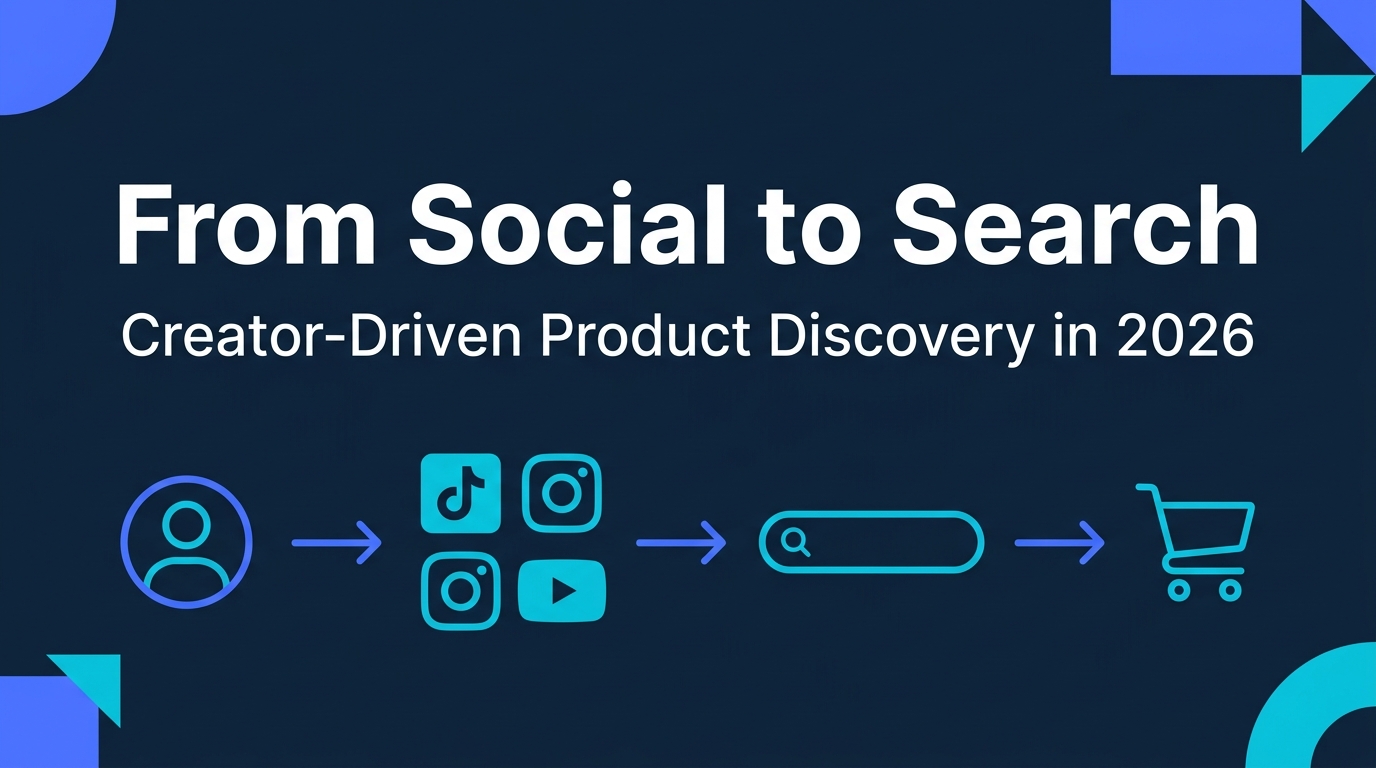
From Social to Search: Creator-Driven Product Discovery in 2026

Program Structure: Seeding + Paid + Affiliate

Most effective digital shelf programs use three creator tiers:

Product seeding: sending product to creators in exchange for honest content, with clear expectations but no payment. Best for volume and discovery of new creator voices. Content rights are typically limited.

Paid partnerships: structured agreements with specific creators for deliverables, timelines, and usage rights. Higher cost, higher quality, full rights. The core of your content library.

Affiliate programs: performance-based partnerships where creators earn commission on sales they drive. Aligns incentives, generates ongoing content, and provides direct attribution. Excellent for long-tail shelf coverage.

Most brands need all three tiers working in parallel to build meaningful shelf coverage.

Content Brief Framework for Discovery-Optimized Content

Briefs for digital shelf programs should specify:

  • Target search query: what query should this content appear for?
  • Key product claims to cover: what should the creator address about the product?
  • Preferred format: review, tutorial, comparison, before/after?
  • Platform optimization requirements: caption keywords, on-screen text, specific hashtags
  • Authenticity parameters: what honest limitations can the creator acknowledge?
  • Usage rights required: specify paid, digital, white-label rights upfront

Avoid overly prescriptive briefs that produce inauthentic content. Creator authenticity is the asset: the brief should direct without constraining.

Usage Rights and Content Library Management

Every piece of content in your library needs a rights record: what’s licensed, for how long, on which platforms, and for what uses. This is operational work that brands consistently underinvest in: until a creator demands takedown of their content being used in ads without permission.

Best practice: build a rights management process at program launch, not after the content is already deployed. License terms should be negotiated before content is created, not after.

Refreshing Content: When to Retire, When to Repurpose

Digital shelf content has a natural lifecycle. Refresh triggers include:

  • Engagement rates declining below category benchmarks
  • Product updates that make existing content inaccurate
  • Competitor content overtaking your search positions
  • Trend shifts that make existing formats feel dated

Before retiring content, evaluate repurposing potential. A long-form YouTube review can be cut into YouTube Shorts. A TikTok tutorial can be reformatted for Instagram Reels. Good creator content has more shelf life than most brands extract from it.

Frequently Asked Questions About Digital Shelf Optimization

What exactly is the digital shelf?

The digital shelf is every digital touchpoint where consumers can discover, evaluate, and purchase a product. It includes traditional surfaces like Amazon, Google Shopping, and brand websites, and newer surfaces like TikTok search, Instagram Explore, YouTube recommendations, and social commerce features. Creator content is increasingly the primary currency on these surfaces.

How is digital shelf optimization different from SEO?

Traditional SEO optimizes content to rank on Google search. Digital shelf optimization is broader: it covers visibility across all discovery platforms, including social search (TikTok, YouTube), algorithmic feeds (Instagram, TikTok Explore), and commerce platforms (Amazon, TikTok Shop). Creator content is the primary lever for social shelf optimization, while written content and technical SEO drive traditional search shelf presence.

Why is creator content more valuable than brand content for the digital shelf?

Algorithms on social platforms favor content that generates authentic engagement — saves, shares, genuine comments, high completion rates. Creator content consistently outperforms brand content on these signals because audiences trust and engage with real people over brand voices. Additionally, creators have established audiences and content formats optimized for their platforms, reducing the discoverability gap that brand accounts face.

How many creators do I need for effective digital shelf coverage?

It depends on your product category breadth and the number of search queries you’re targeting. For a single product line, a program of 10–20 active creators generating 3–5 pieces of content each per quarter can meaningfully move your shelf presence. For broad product portfolios, programs of 50–100+ creators are more common. Start with your highest-intent search queries and expand from there.

Should I focus on TikTok or YouTube for digital shelf optimization?

Both, ideally, but prioritize based on your category and audience. TikTok dominates for Gen Z and Millennial discovery in beauty, fashion, food, and fitness. YouTube is stronger for high-consideration, research-heavy purchases (tech, appliances, health). For most consumer brands, TikTok delivers faster shelf presence; YouTube builds more durable long-term shelf equity.

How do I measure if my digital shelf strategy is working?

Key metrics include: share of search (what percentage of relevant search results feature your brand), organic creator content volume, platform-specific engagement on creator content, and attributed conversions via UTMs, promo codes, or incrementality tests. Track these monthly against a pre-program baseline to measure shelf presence growth.

How do usage rights work for digital shelf content?

Usage rights define what you can do with creator content beyond their original post. For digital shelf optimization, you typically need: digital rights (display on your website, Amazon listing, email), paid amplification rights (use as paid social ads), and a defined term length. These rights must be negotiated and agreed before or at the time of content creation: not after. Usage rights significantly affect creator compensation, so factor this into your budget planning.

What’s the difference between UGC and creator content for the digital shelf?

UGC (user-generated content) is organic content created spontaneously by real customers — typically lower production quality but highly authentic. Creator content is produced by individuals with established audiences and content creation skills, often through structured brand programs. Both are valuable for the digital shelf: UGC provides authentic social proof, while structured creator content provides optimized, rights-cleared, consistent shelf coverage. Most effective programs leverage both.

How does TikTok Shop change digital shelf strategy?

TikTok Shop integrates the shopping experience directly into TikTok’s discovery surface. Creator content linked to TikTok Shop listings appears in search results with direct purchase capabilities. This collapses the traditional “discovery → consideration → purchase” funnel into a single surface. For brands on TikTok Shop, digital shelf optimization directly drives in-app conversions, making it one of the highest-ROI creator content use cases.

Can small brands win on the digital shelf against larger competitors?

Yes. This is one of digital shelf optimization’s most significant opportunities. Large brands often have legacy content strategies built for traditional digital shelf (Google SEO, Amazon ads) and are slower to adapt to creator-driven social shelf optimization. A small brand with a smart micro-creator seeding program can own TikTok search results for its category even against much larger competitors. Agility and authentic creator relationships are the advantage: not budget.

Build Your Digital Shelf Now

The brands winning the digital shelf in 2026 aren’t waiting for a perfect strategy. They’re out there seeding creator content, testing what ranks, and building content libraries that compound over time.

Creator-driven digital shelf optimization is no longer optional for brands competing in social commerce. It’s the difference between showing up where your customers are looking, and being invisible.

partnrUP helps brands build and scale creator content programs purpose-built for digital shelf performance. From AI creator matching to usage rights management to content syndication, it’s the infrastructure behind some of the fastest-growing creator-driven brands online.

Ready to build your digital shelf? See how partnrUP works →

Related guides: Shoppable Video & Social Commerce | Creator Commerce for Brands | AI-Powered Creator Matching | Influencer Marketing in E-Commerce | 3 Costly Brand Mistakes

‍

Read More On Our Blog
How To Do An Influencer Search?

When planning an influencer marketing campaign, one of the most challenging parts is often finding the right influencers. Partnering with the right influencers makes all the difference in your campaign, but many marketers don’t know how to find them in the sea of creators producing content on social media.

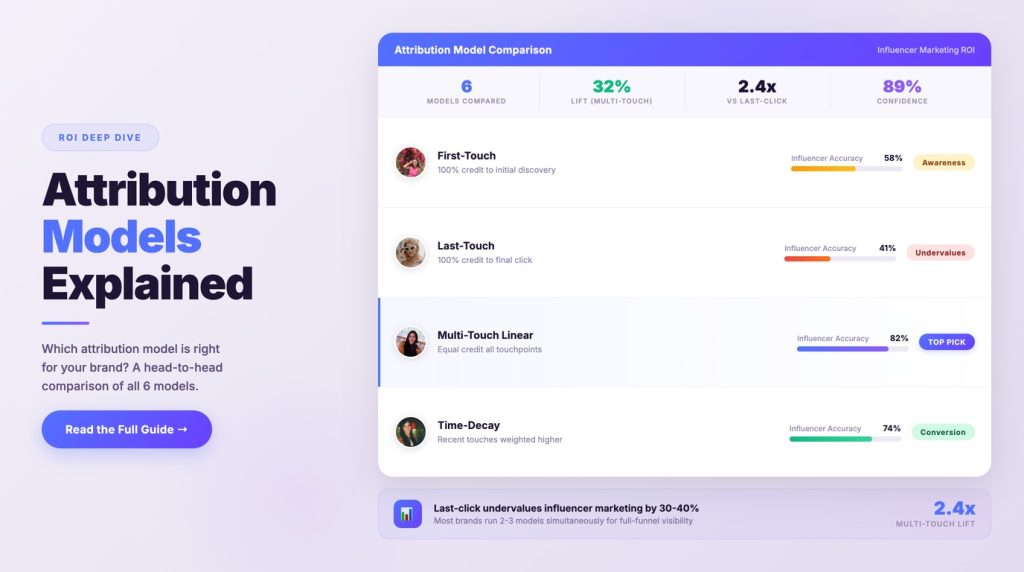
Influencer Marketing Attribution Models: Which One Is Right for Your Brand?

You've decided to measure influencer marketing ROI — good. Now you face the next challenge: which attribution model do you use? First-touch? Last-touch? Multi-touch? Incrementality? Each model tells a different story about your campaigns, and choosing the wrong one can lead to decisions that hurt performance.

Creator Commerce Is Becoming the Operating Model for Influencer Marketing

Influencer marketing used to be easier to define. A brand hired a creator, the creator made content, the content was published, and the campaign was measured.

partnrUP’s Agentic Influencer Marketing Platform Cuts Campaign Development Time by More Than 99%

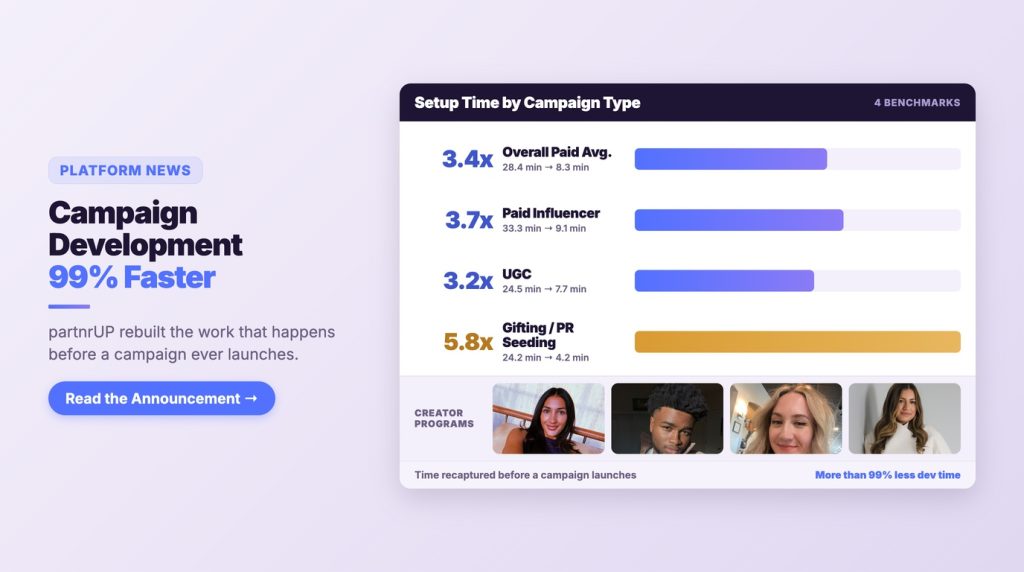
The rebuilt platform reduces more than 24 hours of manual campaign development work to minutes, while making paid creator campaign setup 3.4x as fast across influencer and UGC programs.

Influencer Marketing Industry Report H2 2026: What’s Working Right Now

Marketers expect their influencer budgets to grow this year, and 72.2% of them expect that growth to be 50% or more. But when the same survey asks how they measure success, brand awareness is the most selected KPI at 55.1% — while 65.9% expect their creator spend to pay back within a single month.

Influencer Marketing Metrics That Actually Matter in 2026

Nearly 88% of marketers plan to increase their influencer marketing budgets in 2026, according to the Influencer Marketing Hub 2026 Benchmark Report. The same report found that brand awareness is the single most-selected KPI, chosen by 55.1% of respondents — while revenue and sales KPIs are selected less frequently. Budgets are climbing toward a forecast $44 billion in US creator ad spend, and the metric most teams report against is the one least able to justify the spend.

Social Commerce vs Traditional E-commerce: What Brands Need to Know

US social commerce sales will surpass $100 billion in 2026 — a milestone that sounds enormous until you set it beside the $1.5 trillion Americans will spend on retail ecommerce overall. Social commerce is growing far faster, but it is still roughly one dollar in every fifteen spent online. That gap is the single most misunderstood fact in ecommerce strategy right now, and it explains why the “social is replacing your website” pitch keeps failing brands that believe it.

How AI Agents Are Replacing Traditional Influencer Marketing Workflows

87.49% of marketers expect their influencer marketing budget to increase in 2026, and 72.22% plan increases of 50% or more (Influencer Marketing Hub 2026 Benchmark Report, 600+ respondents). At the same time, 66.3% run their programs entirely in-house. That combination is the whole story: dramatically more money flowing through influencer programs, managed by the same small teams using the same manual workflows they built when the channel was a pilot. Something has to give — and what is giving is the workflow itself.

Insights on the Future of Creator Marketing

Explore strategies, trends, and thought leadership from the team building the next generation of influencer marketing.

View More

How To Do An Influencer Search?

When planning an influencer marketing campaign, one of the most challenging parts is often finding the right influencers. Partnering with the right influencers makes all the difference in your campaign, but many marketers don’t know how to find them in the sea of creators producing content on social media.

Learn More

Influencer Marketing Attribution Models: Which One Is Right for Your Brand?

You've decided to measure influencer marketing ROI — good. Now you face the next challenge: which attribution model do you use? First-touch? Last-touch? Multi-touch? Incrementality? Each model tells a different story about your campaigns, and choosing the wrong one can lead to decisions that hurt performance.

Learn More

Creator Commerce Is Becoming the Operating Model for Influencer Marketing

Influencer marketing used to be easier to define. A brand hired a creator, the creator made content, the content was published, and the campaign was measured.

Learn More

partnrUP’s Agentic Influencer Marketing Platform Cuts Campaign Development Time by More Than 99%

The rebuilt platform reduces more than 24 hours of manual campaign development work to minutes, while making paid creator campaign setup 3.4x as fast across influencer and UGC programs.

Learn More

Influencer Marketing Industry Report H2 2026: What’s Working Right Now

Marketers expect their influencer budgets to grow this year, and 72.2% of them expect that growth to be 50% or more. But when the same survey asks how they measure success, brand awareness is the most selected KPI at 55.1% — while 65.9% expect their creator spend to pay back within a single month.

Learn More

Influencer Marketing Metrics That Actually Matter in 2026

Nearly 88% of marketers plan to increase their influencer marketing budgets in 2026, according to the Influencer Marketing Hub 2026 Benchmark Report. The same report found that brand awareness is the single most-selected KPI, chosen by 55.1% of respondents — while revenue and sales KPIs are selected less frequently. Budgets are climbing toward a forecast $44 billion in US creator ad spend, and the metric most teams report against is the one least able to justify the spend.

Learn More

Social Commerce vs Traditional E-commerce: What Brands Need to Know

US social commerce sales will surpass $100 billion in 2026 — a milestone that sounds enormous until you set it beside the $1.5 trillion Americans will spend on retail ecommerce overall. Social commerce is growing far faster, but it is still roughly one dollar in every fifteen spent online. That gap is the single most misunderstood fact in ecommerce strategy right now, and it explains why the “social is replacing your website” pitch keeps failing brands that believe it.

Learn More

How AI Agents Are Replacing Traditional Influencer Marketing Workflows

87.49% of marketers expect their influencer marketing budget to increase in 2026, and 72.22% plan increases of 50% or more (Influencer Marketing Hub 2026 Benchmark Report, 600+ respondents). At the same time, 66.3% run their programs entirely in-house. That combination is the whole story: dramatically more money flowing through influencer programs, managed by the same small teams using the same manual workflows they built when the channel was a pilot. Something has to give — and what is giving is the workflow itself.

Learn More

How to Vet Creators for Brand Sponsorships: The Complete Brand Guide

Nearly 88% of marketers plan to increase their influencer budgets in 2026, according to the Influencer Marketing Hub 2026 Benchmark Report — yet creator discovery and vetting remains the most frequently outsourced function in the industry. The reason is simple: picking the wrong creator doesn’t just waste budget. It damages brand credibility, derails campaign timelines, and produces content that sits in a folder no one opens.

Learn More

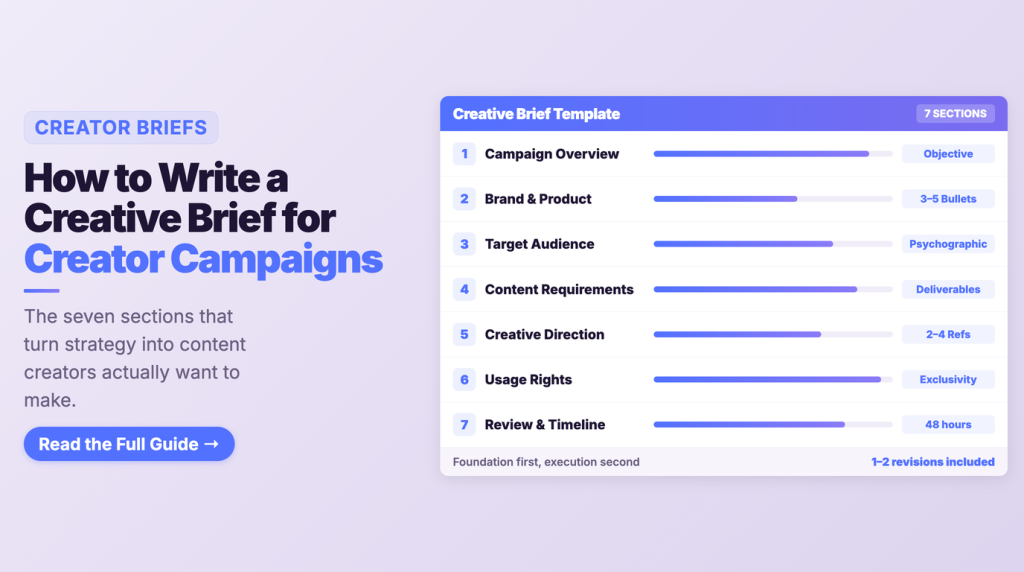
How to Write a Creative Brief for Creator Campaigns

72% of creators say a poorly written brief is the number one reason campaign content misses the mark, according to a 2026 Creator Compensation & Workflow Report by IZEA. Yet most brand teams spend less than 15 minutes writing them — copying last quarter’s brief, swapping out product names, and hoping for the best.

Learn More

Brand Lift Studies for Influencer Marketing: Do They Actually Work?

Nearly 88% of marketers plan to increase their influencer budgets in 2026, according to the Influencer Marketing Hub Benchmark Report — yet fewer than one in five can confidently attribute upper-funnel brand impact to specific creator campaigns. The gap between spending and proving brand value is where brand lift studies enter the picture. But here’s the question most marketing teams avoid: do these studies actually work for influencer marketing, or are they an expensive vanity exercise?

Learn More

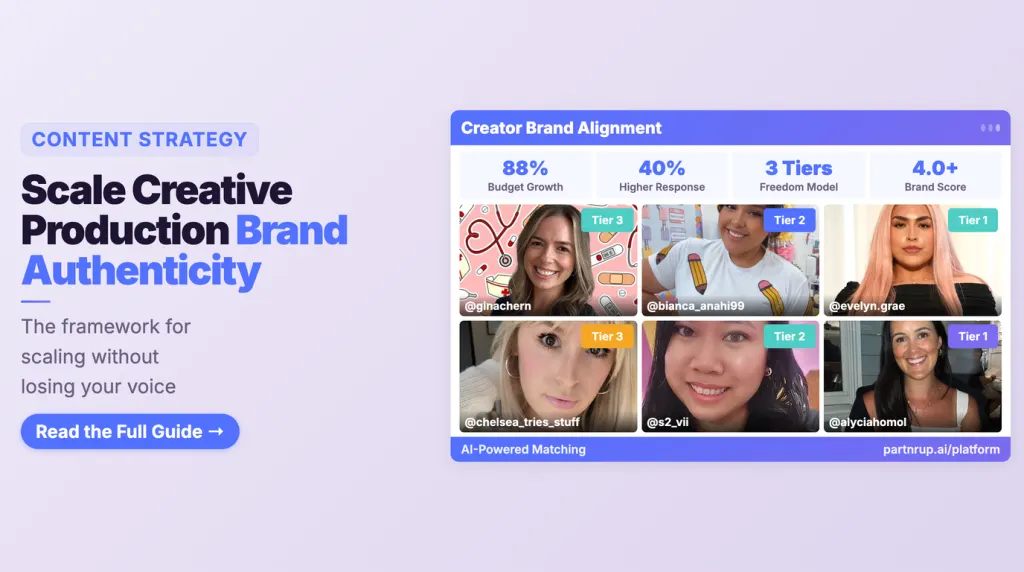
How to Scale Creative Production Without Losing Brand Authenticity

Nearly 88% of marketers plan to increase their influencer budgets in 2026, according to the Influencer Marketing Hub 2026 Benchmark Report — yet two-thirds of brands now run programs entirely in-house, according to the same report — meaning internal teams bear the full weight of scaling creative output while maintaining brand consistency. The gap between ambition and operational capacity is where most programs stall: more creators, more content, more channels, and brand voice slowly eroding with each new partnership.

Learn More

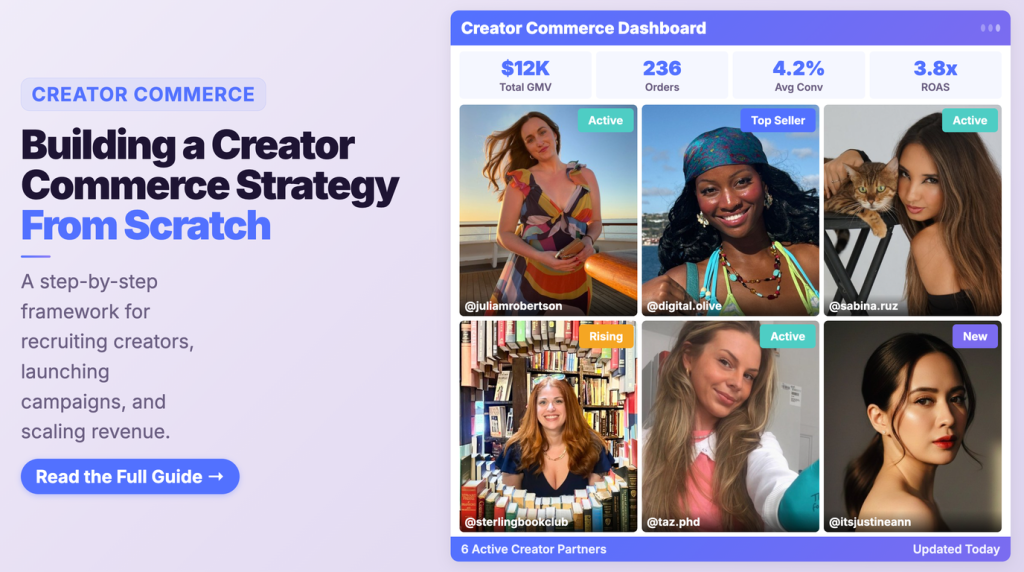
Building a Creator Commerce Strategy From Scratch

Nearly 88% of marketers plan to increase their influencer budgets this year, according to the Influencer Marketing Hub 2026 Benchmark Report — yet most brands still lack a repeatable framework for turning creator partnerships into actual revenue. The gap isn’t enthusiasm. It’s execution. Creator commerce sits at the intersection of influencer marketing, social commerce, and performance marketing, and building a strategy from scratch requires more than picking creators and hoping products sell.

Learn More

How AI Agents Are Transforming Influencer Marketing Operations

Nearly 88% of marketers plan to increase their influencer budgets in 2026 (Influencer Marketing Hub 2026 Benchmark Report), yet two-thirds of those programs are run entirely in-house — often by teams of three or fewer people. The math doesn’t work. More budget, more creators, and more content demand cannot scale on spreadsheets and manual outreach. That’s where AI agents are stepping in — not as chatbots answering questions, but as autonomous systems that execute the repetitive operational tasks that slow influencer programs down.

Learn More

How to Calculate Influencer Marketing ROI: A Step-by-Step Formula for Brands

Nearly 88% of marketers plan to increase their influencer marketing budgets in 2026, according to Influencer Marketing Hub’s 2026 Benchmark Report — yet most still can’t answer a simple question: what’s the actual return? The gap between spending and measuring isn’t a data problem. It’s a formula problem. Without a repeatable, step-by-step calculation framework, every campaign lives in a fog of vanity metrics and gut feelings.

Learn More

Creator Commerce Metrics: What to Track, What to Ignore

Nearly 88% of marketers plan to increase their influencer marketing budgets in 2026, according to the Influencer Marketing Hub Benchmark Report — yet fewer than half can confidently tie creator-driven sales back to the content that generated them. The gap between spending and measurement has never been wider, and brands pouring money into creator commerce without tracking the right metrics are flying blind.

Learn More

9 Aspire Alternatives: Modern Influencer Marketing Platforms for Every Budget

67% of brands plan to increase their influencer marketing budgets in 2026 — yet many are stuck on platforms that charge enterprise pricing for mid-market features. If your team has outgrown Aspire (formerly AspireIQ) or simply needs a better fit for your workflow and budget, you’re not alone.

Learn More

The Creator Economy in 2026: Key Stats and Trends Every Brand Needs to Know

The creator economy surpassed $250 billion in total market value in 2025, and by every major industry forecast, 2026 is the year it reshapes how brands allocate marketing budgets entirely. Yet most marketing leaders still treat creator partnerships as a line item — not a growth channel. The gap between brands that understand the creator economy in 2026 and those still running one-off sponsorships is widening fast, and the data makes it impossible to ignore.

Learn More

How to Scale Creative Production Without Losing Authenticity

Brands running creator programs hit a wall around 15-20 active partnerships: content quality starts slipping, messaging drifts off-brand, and the team spends more time managing revisions than building relationships. A 2026 CreatorIQ benchmark report found that brands scaling beyond 25 creators per quarter saw a 34% increase in revision cycles — yet those that implemented structured creative systems maintained approval rates above 85% even at 100+ partnerships.

Learn More

How AI Matches Creators to Brands: Beyond Follower Count

82% of marketers who switched from follower-based selection to AI-powered creator matching saw campaign ROI improve by 3x or more — yet most brands still choose influencers the same way they did in 2019: scrolling feeds, counting followers, and guessing. The gap between “good enough” creator selection and genuinely predictive matching is now the single biggest lever in influencer marketing performance.

Learn More

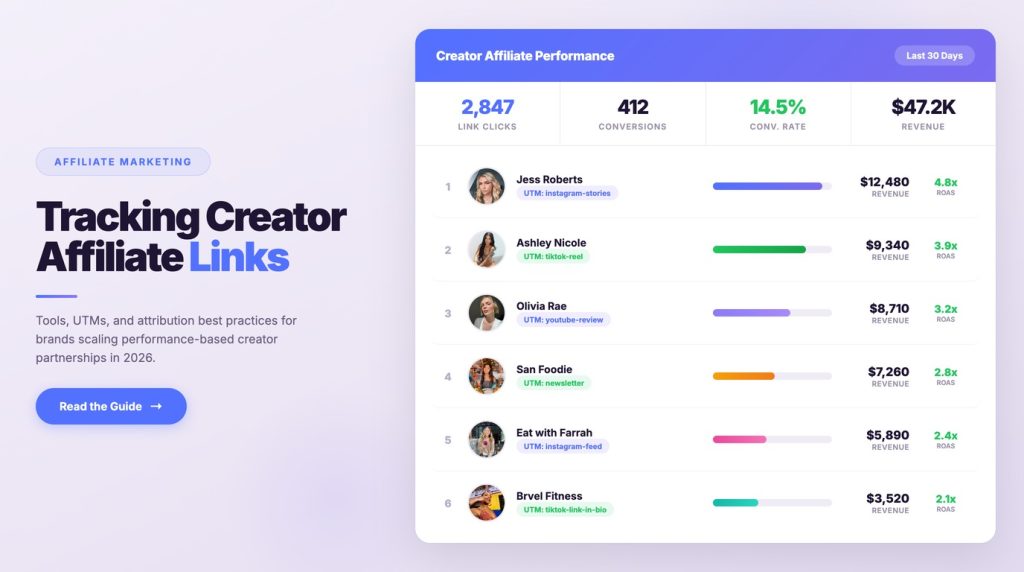
Tracking Creator Affiliate Links: Tools, UTMs, and Attribution Best Practices

63% of brands running creator affiliate programs say their biggest challenge is tracking which creator actually drove a conversion. Not finding creators. Not negotiating rates. Tracking. The gap between “a creator posted about our product” and “that post generated $47,000 in revenue” is where most programs either scale or stall.

Learn More

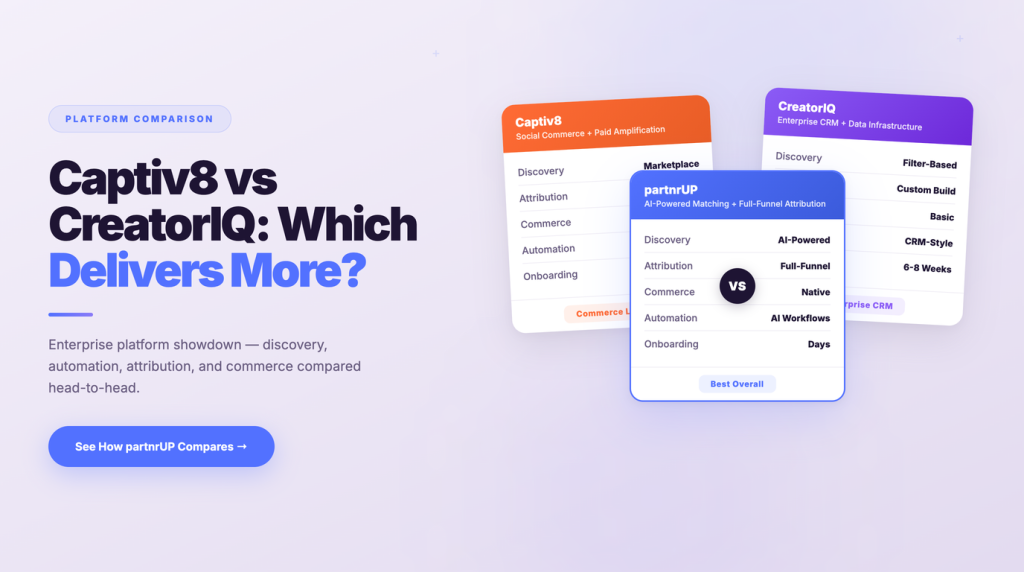
Captiv8 vs CreatorIQ (vs partnrUP): Which Enterprise Platform Delivers More?

The influencer marketing industry surpassed $24 billion in 2024 according to Influencer Marketing Hub — and choosing the wrong one can lock your team into 12-month contracts with tools that don’t match your workflow. When you’re evaluating Captiv8 vs CreatorIQ, the differences aren’t obvious from feature pages alone. Both platforms target enterprise brands, both claim AI-powered discovery, and both come with price tags that demand executive approval.

Learn More

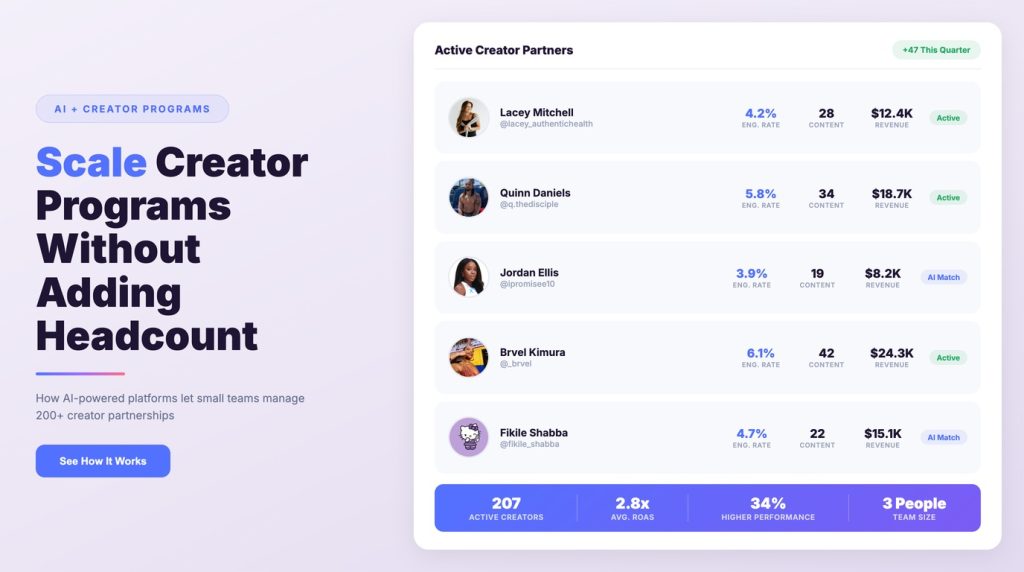
How Brands Are Using AI to Scale Creator Programs Without Adding Headcount

63% of marketing teams managing creator programs say they’ve hit a ceiling — not because of budget, but because of bandwidth. The average brand partnership manager juggles 47 creator relationships simultaneously, spending 11 hours per week on manual outreach alone. Meanwhile, the brands that are scaling to 200+ active creators without hiring additional staff share one thing in common: they’ve moved their workflow backbone to AI.

Learn More

AI Creator Matching vs. Manual Influencer Discovery: A Head-to-Head

72% of influencer marketing managers report spending more time finding creators than actually managing campaigns — a paradox that’s costing brands real revenue. The average team dedicates 40+ hours per campaign to manual influencer vetting, reviewing content feeds, cross-referencing engagement metrics, and hoping audience demographics align with brand goals. Meanwhile, AI-powered creator matching platforms are cutting that time to under 4 hours while delivering 3x higher conversion rates on matched partnerships.

Learn More

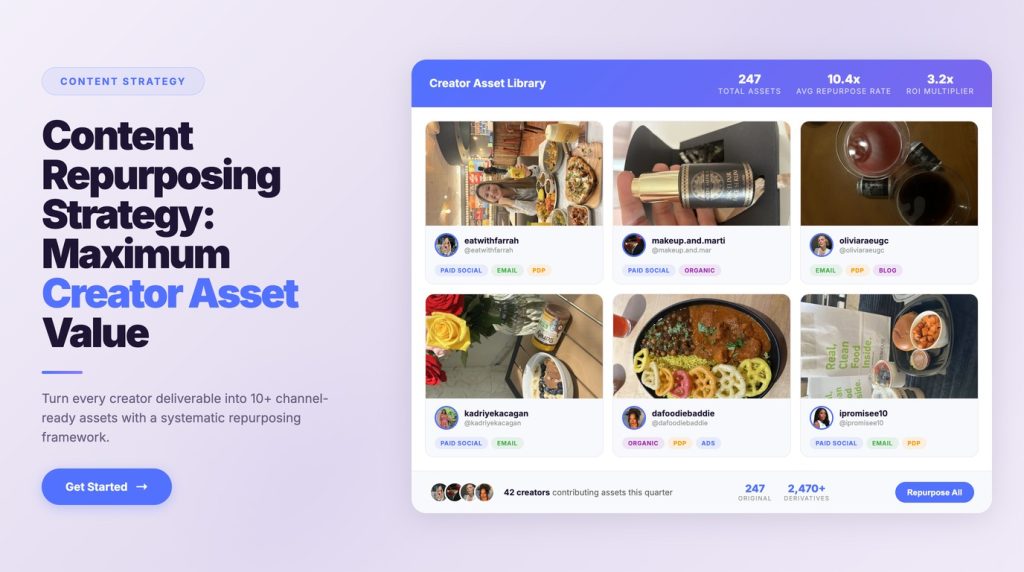
Content Repurposing Strategy: Getting Maximum Value from Creator Assets

Brands that repurpose creator content across channels see 3x more engagement per dollar spent than those using assets once — yet 68% of marketing teams still treat every creator deliverable as a single-use asset. The result? Thousands of dollars in high-performing content sitting unused in shared drives, never reaching the audiences that would convert.

Learn More

How to Structure Creator Affiliate Programs That Actually Convert

Brands that structure their creator affiliate programs with clear commission tiers, performance tracking, and dedicated creator support generate 3.2x more affiliate revenue than those running ad-hoc partnerships. Yet the majority of ecommerce teams still launch affiliate programs with flat-rate commissions, generic tracking links, and zero onboarding — then wonder why creators stop posting after week two.

Learn More

GRIN Pricing 2026: What You’ll Actually Pay and a Smarter Alternative

Enterprise influencer software pricing is one of the least transparent topics in martech — and GRIN is no exception. A 2024 Forrester survey found that 67% of marketing technology buyers list “lack of transparent pricing” as their top frustration with SaaS vendors. When it comes to influencer marketing platforms, that problem is even more pronounced: almost every vendor hides their actual cost behind a “contact sales” wall.

Learn More

How Brands Are Winning on TikTok Shop in 2026

TikTok Shop’s U.S. GMV surpassed $20 billion in the first half of 2026, making it the fastest-growing social commerce channel in the market. Brands that cracked the code early are now generating 15-30% of their DTC revenue through the platform — while their competitors are still debating whether TikTok is “right for their brand.”

Learn More

7 Aspire Alternatives: Modern Influencer Marketing Platforms for Every Team

67% of brands plan to increase their influencer marketing budgets in 2026 — yet many are stuck on platforms that charge enterprise pricing for mid-market features. If your team has outgrown Aspire (formerly AspireIQ) or simply needs a better fit for your workflow and budget, you’re not alone.

Learn More

Creator Affiliate Tracking: Best Tools and Methods for Brands in 2026

Brands lose an estimated 20-30% of their creator-driven revenue to poor attribution — sales that actually happened but were never tracked back to the creator who drove them. In a channel where proving ROI is already the top challenge, leaky tracking infrastructure turns a winnable argument into an unwinnable one.

Learn More

Influencer Marketing KPIs Every Brand Should Track in 2026

76% of marketing leaders say measuring influencer marketing performance is their biggest challenge, yet the problem isn’t a lack of data — it’s tracking the wrong metrics. Brands that still evaluate creators by follower count and likes are optimizing for vanity while their competitors optimize for revenue.

Learn More

Long-Term Creator Partnerships vs One-Off Campaigns: Which Wins?

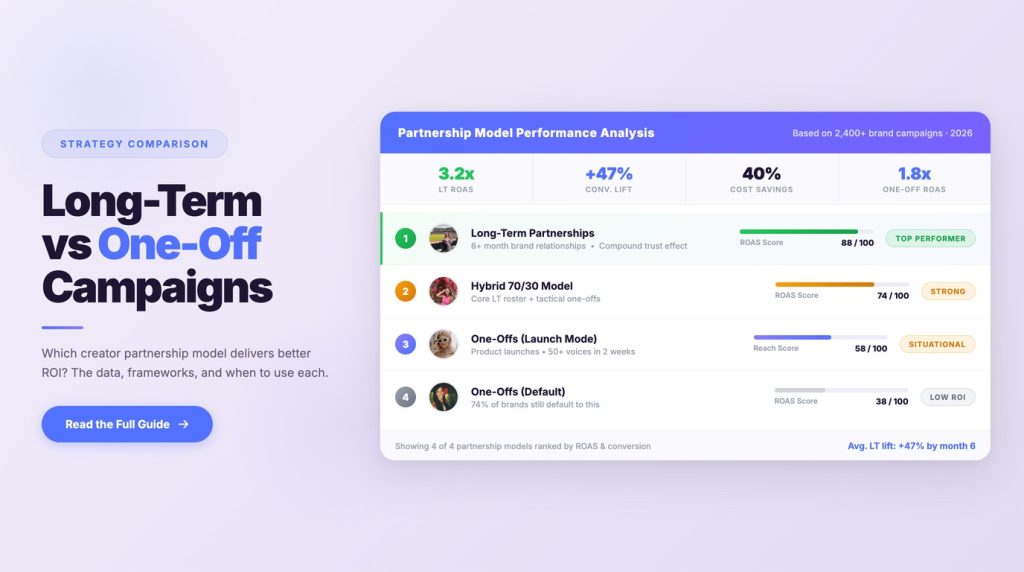
Brands that maintain creator partnerships for 6+ months see 47% higher ROI than those running one-off campaigns, according to recent industry data. Yet the majority of influencer marketing budgets still go toward transactional, campaign-by-campaign engagements — a structural inefficiency that leaves significant performance on the table.

Learn More

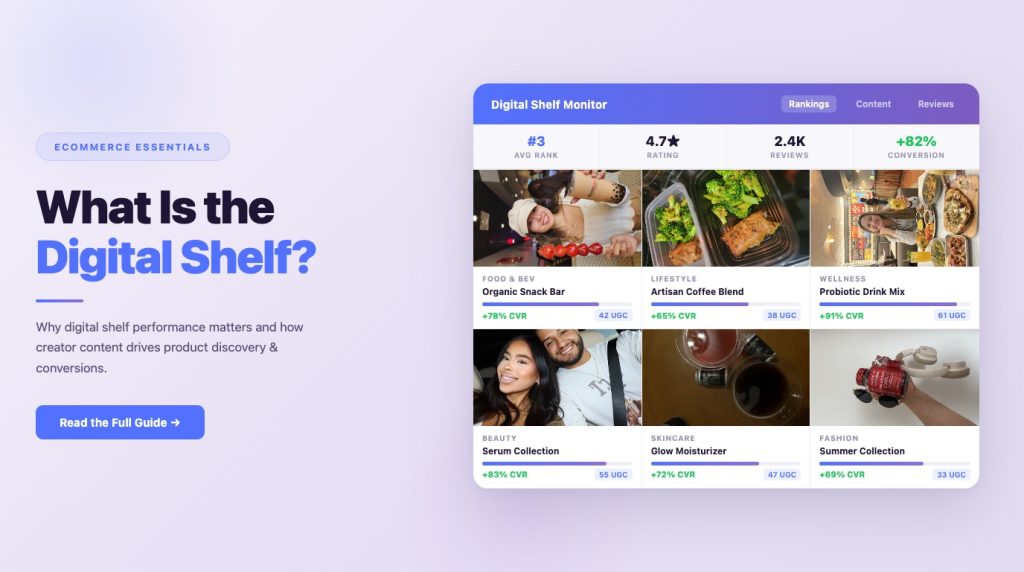
What Is the Digital Shelf and Why Should Brands Care?

85% of consumers research products online before purchasing — even when they buy in-store, making the digital shelf the most important real estate in modern retail. Yet most brands still manage their digital shelf presence as an afterthought, treating product pages as static catalogs rather than dynamic, content-rich experiences that drive discovery and conversion.

Learn More

How Affiliate Influencer Marketing Works: Performance-Based Models

Performance-based influencer partnerships now account for 43% of all influencer marketing spend, up from just 18% three years ago. The shift is unmistakable: brands are moving from paying for posts to paying for results, and affiliate influencer marketing is the model driving that transformation.

Learn More

How to Calculate Influencer Marketing ROI: A Step-by-Step Formula for Brands

Nearly 88% of marketers plan to increase their influencer marketing budgets in 2026, according to Influencer Marketing Hub’s 2026 Benchmark Report — yet most still can’t answer a simple question: what’s the actual return? The gap between spending and measuring isn’t a data problem. It’s a formula problem. Without a repeatable, step-by-step calculation framework, every campaign lives in a fog of vanity metrics and gut feelings.

Learn More

How to Write a Creative Brief for Creator Campaigns That Gets Results

68% of creators say unclear briefs are the number one reason campaigns underperform, yet most brands still approach creative briefs as afterthoughts — vague one-pagers filled with brand guidelines but devoid of the strategic direction creators actually need to produce content that converts.

Learn More

Shoppable Video Best Practices: What Actually Converts in 2026

Brands using shoppable video report conversion rates 3-5x higher than traditional product pages, yet 72% of marketing teams say they’re still experimenting with the format rather than running optimized programs. The gap between early adopters and everyone else is widening — and the playbook for what actually converts has become clearer than ever.

Learn More

What Is Creator Commerce? The Brand’s Essential Guide for 2026

Creator commerce is projected to drive over $32 billion in U.S. retail sales by the end of 2026, yet most brands still treat creator partnerships as a top-of-funnel awareness play rather than a direct revenue channel. That disconnect is costing them market share — and fast.

Learn More

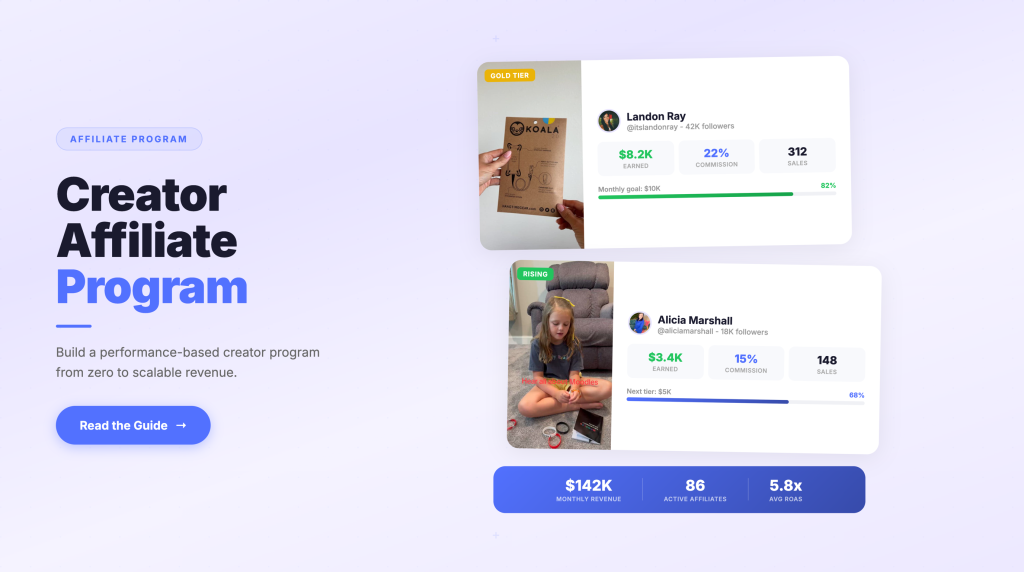
How to Build a Creator Affiliate Program: From Zero to Scale

Creator affiliate programs now drive 3-5x higher conversion rates than traditional affiliate networks — yet most brands still haven’t built one. They’re stuck between expensive influencer platforms that charge flat fees regardless of performance, generic affiliate networks designed for coupon sites, and manual outreach that doesn’t scale past a handful of creators.

Learn More

GRIN Review 2026: Is This Creator Management Platform Right for Your Brand?

Considering GRIN for your influencer marketing program? This review covers everything you need to make an informed decision — features, pricing, G2 scores, real user feedback, and an honest take on who GRIN is (and isn’t) built for.

Learn More

Influencer Marketing ROI: The Complete Attribution Guide for Brands in 2026

Influencer marketing ROI is real — but proving it requires more than checking likes and follower counts. If you’re running influencer campaigns without a clear attribution strategy, you’re flying blind on one of your most significant marketing investments.

Learn More

7 GRIN Alternatives: AI-Powered Influencer Marketing Solutions for 2026

GRIN has built a solid reputation in the creator management space — but it’s not the right fit for every brand. Whether it’s the pricing, the complexity, the enterprise-only focus, or the support experience, brands increasingly find themselves searching for GRIN alternatives that deliver more for their specific needs.

Learn More

Influencer Marketing Platform Comparison 2026: Which One Is Right for Your Brand?

78% of brands say they’ve switched influencer marketing platforms at least once — and most cite the same reason: the platform promised discovery, but couldn’t deliver execution.

Learn More

15 Best Influencer Marketing Platforms for Brands in 2026

From AI-powered discovery to full-funnel creator commerce — here are the platforms brands are using to run smarter influencer programs in 2026.

Learn More

partnrUP is the Easiest to Use Creator Marketing Platform and Easiest to Do Business With Influencer Agency Based on G2 Summer 2026 Reports

Validation Meets Velocity: When agentic workflows assist influencer marketing managers to do high-quality work at scale

Learn More

Branded Content Creation: From Strategy to Production to Distribution

Branded content is the antidote to ad fatigue. While traditional advertising interrupts consumers mid-scroll, mid-show, or mid-article, branded content earns their attention. It delivers genuine value , entertainment, education, inspiration, with a brand’s fingerprints on it. The result? Audiences that choose to engage rather than skip.

Learn More

The State of Influencer Marketing in 2026: Trends, Data & Industry Insights

Influencer marketing isn’t a nice-to-have anymore: it’s a core budget line for brands across every category. What started as gifting products to bloggers has evolved into a sophisticated, performance-driven channel with its own metrics, technology stack, and organizational function. In 2026, the industry hasn’t just matured , it has fundamentally transformed.

Learn More

Brand Sponsorships & Creator Partnerships: The Definitive Playbook

Brand sponsorships and creator partnerships sit at the heart of modern influencer marketing, but most brands approach them the wrong way. They fire off one-off deals, chase follower counts, and wonder why the results don’t stick. The brands winning in 2026 are doing something different: they’re building systems for creator partnerships, not just buying placements.

Learn More

Creator Content Strategy: Building a Scalable Creative Program for Your Brand

Most brands treat creator content as a tactic , a one-off campaign here, a reactive brief there, no system connecting any of it. They find a creator, approve some posts, watch the metrics for a week, and move on. Then they do it again from scratch next quarter.

Learn More

Shoppable Video & Social Commerce: The Complete Guide for Brands in 2026

Shoppable video is collapsing the funnel. Where brands used to run awareness campaigns and hope buyers remembered them days later, shoppable video turns every creator post into a direct buying opportunity. A viewer watches a skincare creator apply a serum, taps the product tag, and checks out , all without leaving TikTok. Discovery and transaction happen in the same breath.

Learn More

Digital Shelf Optimization: How Creator Content Drives Product Discovery & Conversions

The digital shelf is the new physical shelf , except it’s infinite, always on, and increasingly driven by creator content. Walk into any retail store and prime shelf placement determines what gets noticed, picked up, and purchased. Online, that same dynamic plays out across TikTok search results, Amazon product listings, Google Shopping carousels, and Instagram Explore feeds.

Learn More

Creator Commerce: How Brands Win in the New Social Shopping Era

Creator commerce isn’t just influencer marketing with a new name — it’s a fundamental shift in how products get discovered, evaluated, and purchased. And if your brand hasn’t started paying attention, you’re already playing catch-up.

Learn More

Affiliate Influencer Marketing: The Complete Brand Playbook for 2026

Affiliate influencer marketing is one of the highest-ROI creator strategies available to brands right now, and it’s still widely underutilized. Instead of paying creators a flat fee upfront and hoping for results, you tie compensation to actual sales. Creators earn when they drive conversions. You only pay when the program delivers.

Learn More

Influencer Marketing ROI: The Complete Guide to Measuring, Tracking & Proving Results

Every marketing leader faces the same question at budget time: “What did we actually get from our influencer spend?” It’s the question that’s launched a thousand spreadsheets and ended more than a few campaigns prematurely. And according to influencer marketing statistics, more than 70% of brands say proving influencer ROI is their single biggest measurement challenge.

Learn More

Influencer Marketing Platform Comparison Guide: How to Choose the Right Tool in 2026

Picking the wrong influencer marketing platform is an expensive mistake—and not just in the obvious way. We’re not just talking about buyer’s remorse. We’re talking about six-figure contracts, locked-in data, months of onboarding, and a team that just learned a tool you now need to rip out and replace.

Learn More

How AI-Powered Creator Matching Is Transforming Brand Partnerships in 2026

78% of brands say finding the right creator is their #1 challenge in influencer marketing: yet most are still sorting through spreadsheets, scrolling Instagram, and trusting their gut to make decisions that cost five to six figures per campaign.

Learn More

The Complete Guide to Influencer Platform ROI: Where Your Brand Should Invest in 2026

With TikTok, Instagram, YouTube, LinkedIn, and dozens of emerging platforms all competing for your media spend, the decision of where to invest isn’t just a channel preference: it’s a make-or-break budget call. Yet most brands make platform decisions based on gut feel or whatever channel their competitors are on, not actual ROI data.

Learn More

3 Costly Mistakes Brands Make When Working with Video Creators (And How to Avoid Them)
Whether it’s missed deadlines, off-brand content, or campaigns that simply don’t convert, the challenges are real. But here’s the thing – most of these failures aren’t due to bad creators or unrealistic brand expectations. They stem from three critical mistakes that are completely avoidable.

Learn More

Fashion Influencer Marketing Trends and Tactics for 2026

Influencer Marketing in Fashion: Tactics, Trends, Tools & Opportunities for 2026

Learn More

PayPal to Stripe Connect: What the Upgrade Means for Influencer Marketing Payments

Today, we’re excited to roll out an important upgrade in Creator payment flexibility with Stripe Connect.

Learn More

Fashion Influencer Marketing Strategies That Drive ROI

Influencer Marketing for Fashion Brands: ROI, Funnels & Execution Best Practices

Learn More

Influencer Marketing for Fashion Brands

Influencer Marketing for Fashion Brands: The Complete Strategy Guide (2026)

Learn More

Gaming Influencer Marketing Trends and Tactics for 2026

Gaming Influencer Marketing in 2026: Tactics, Trends, Tools & Opportunities

Learn More

Gaming Influencer Marketing Strategies That Drive ROI

Influencer Marketing for Gaming Brands: ROI Funnels, Measurement & Execution Best Practices

Learn More

Influencer Marketing for Gaming Brands

Influencer Marketing for Gaming Brands: The Ultimate Guide (2026)

Learn More

SaaS and Technology Influencer Marketing Trends and Tactics for 2026

Influencer Marketing for SaaS & Technology: Tools, Mistakes, Opportunities & Forward-Looking Trends

Learn More

SaaS and Technology Influencer Marketing Strategies That Drive ROI

Influencer Marketing for SaaS & Technology Brands: ROI, Funnels, and Execution Best Practices

Learn More

Influencer Marketing for SaaS and Technology Brands

Influencer Marketing for SaaS and Technology Brands: The Complete Strategy Guide

Learn More

Travel and Hospitality Influencer Marketing Trends and Tactics for 2026

Influencer Marketing in Travel & Hospitality: 2026 Trends, Tools, Mistakes & Opportunities
Learn More

Travel and Hospitality Influencer Marketing Strategies That Drive ROI

Influencer Marketing for Travel & Hospitality Brands: ROI Funnels, Measurement & Execution Best Practices

Learn More

From Support to Simplicity: The Shift Redefining Influencer Marketing Platforms

There’s a shift happening in influencer marketing, and the Spring 2026 G2 reports make it clear.

Learn More

We Just Launched a Massive Upgrade to partnrUP: Improved Influencer Marketing & Creator Workflow Management

We’ve been hard at work behind the scenes, and today, we’re excited to roll out one of the biggest updates to partnrUP yet.

Learn More

Influencer Marketing for Travel and Hospitality Brands

Influencer Marketing for Travel and Hospitality Brands: The Complete 2026 Strategy Guide

Learn More

Ecommerce Influencer Marketing Trends and Tactics for 2026

The Future of Influencer Marketing in Ecommerce: Tools, Trends, and Tactical Strategies for 2026

Learn More

Ecommerce Influencer Marketing Strategies That Drive ROI

The Complete Guide to Influencer Marketing ROI for Ecommerce Brands: Measurement, Funnels & Execution Best Practices

Learn More

Influencer Marketing for Ecommerce Brands

Influencer Marketing for Ecommerce Brands: The Complete Guide to Scaling Sales with Creator Partnerships

Learn More

Real Estate Influencer Marketing Trends and Tactics for 2026

Influencer Marketing for Real Estate Agents: The Complete 2026 Guide to Creator Partnerships and Property Marketing Success

Learn More

Influencer Marketing for Real Estate Brands

Real estate marketing is evolving. Traditional methods like open houses, yard signs, and MLS listings still matter, but today’s home buyers and sellers are spending more time scrolling through Instagram and TikTok than reading newspaper ads. This shift presents a massive opportunity for real estate brands willing to meet their audience where they already are, through influencer marketing for real estate.

Learn More

Real Estate Influencer Marketing Strategies That Drive ROI

How to Measure Influencer Marketing ROI for Real Estate Brands: Complete Guide to Funnels, Metrics & Best Practices

Learn More

Finance and Fintech Influencer Marketing Trends and Tactics for 2026

Influencer Marketing for Finance and Fintech: The Complete Guide to Tools, Mistakes, Opportunities, and Future Trends

Learn More

Finance and Fintech Influencer Marketing Strategies That Drive ROI

The Complete Guide to Influencer Marketing ROI for Finance and Fintech Brands: Measurement, Funnels, and Execution Best Practices

Learn More

Influencer Marketing for Finance and Fintech Brands

Influencer Marketing for Finance and Fintech Brands: The Complete Guide to Compliant, High-ROI Campaigns

Learn More

Food and Beverage Influencer Marketing Trends and Tactics for 2026

Influencer Marketing for Food and Beverage Brands: Tools, Mistakes, Opportunities & Trends for 2026

Learn More

Food and Beverage Influencer Marketing Strategies That Drive ROI

The Complete Guide to Food & Beverage Influencer Marketing ROI: Measurement Funnels and Execution Best Practices

Learn More

Influencer Marketing for Food and Beverage Brands

Influencer Marketing for Food and Beverage Brands: The Complete Strategy Guide

Learn More

Fitness and Wellness Influencer Marketing Trends and Tactics for 2026

Influencer Marketing for Fitness and Wellness Brands: 2026 Tactics, Trends, Tools & Opportunities

Learn More

Fitness and Wellness Influencer Marketing Strategies That Drive ROI

How to Measure Influencer Marketing ROI for Fitness and Wellness Brands: Complete Guide to Metrics, Funnels & Best Practices

Learn More

Influencer Marketing for Fitness and Wellness Brands

Influencer Marketing for Fitness and Wellness Brands: The Complete 2026 Guide

Learn More

Beauty and Skincare Influencer Marketing Trends and Tactics for 2026

Influencer Marketing for Beauty and Skincare Brands: 2026 Trends, Tools, Mistakes & Opportunities
Learn More

Beauty and Skincare Influencer Marketing Strategies That Drive ROI

Maximizing ROI from Beauty and Skincare Influencer Marketing: Full-Funnel Measurement, Attribution Strategy, and Execution Best Practices

Learn More

Influencer Marketing for Beauty and Skincare Brands

Influencer Marketing for Beauty and Skincare Brands: The Complete 2026 Strategy Guide

Learn More

Family and Parenting Influencer Marketing Trends and Tactics for 2026

Family and Parenting Influencer Marketing 2026: Tactical Strategies, Essential Tools, and Forward-Looking Opportunities

Learn More

Family and Parenting Influencer Marketing Strategies That Drive ROI

Maximizing ROI from Family and Parenting Influencer Marketing: Full-Funnel Measurement, Attribution Strategy, and Execution Best Practices

Learn More

Influencer Marketing for Family and Parenting Brands

Influencer Marketing for Family and Parenting Brands: The Complete Guide to Building Trust and Driving Sales

Learn More

Pets Influencer Marketing Trends and Tactics for 2026

Pet Influencer Marketing Trends 2026: Tactical Strategies, Essential Tools, and Forward-Looking Opportunities

Learn More

Pets Influencer Marketing Strategies That Drive ROI

Maximizing ROI from Pet Influencer Marketing: Full-Funnel Measurement, Attribution Strategy, and Execution Best Practices

Learn More

Influencer Marketing for Pets Brands

The pet industry has experienced explosive growth in influencer marketing, with approximately 63% of pet owners now following at least one pet influencer on Instagram or TikTok. As pet humanization trends continue to reshape consumer behavior and the global pet care market surpasses $350 billion, pet brands face a critical question: How can you leverage creator partnerships to drive measurable growth in an increasingly competitive marketplace?

Learn More

Fashion Influencer Marketing Trends and Tactics for 2026

The fashion industry stands at a pivotal moment in influencer marketing. With creator marketing budgets experiencing a 171% increase in 2025 and continuing to grow in 2026, fashion brands face both unprecedented opportunities and complex challenges in this evolving landscape. While traditional advertising channels continue to decline in effectiveness, authentic creator partnerships have become the cornerstone of modern fashion marketing strategies.

Learn More

Fashion Influencer Marketing Strategies That Drive ROI

Fashion brands invest billions in influencer marketing annually, yet most struggle to answer a critical question: What’s the actual return on investment? While competitors chase vanity metrics like follower counts and likes, leading fashion brands are building sophisticated influencer marketing ROI frameworks that connect creator partnerships directly to revenue, customer acquisition, and long-term brand value.

Learn More

Influencer Marketing for Fashion Brands: A Complete Guide to Building Profitable Partnerships

The fashion industry has undergone a seismic shift in how brands connect with consumers. Gone are the days when expensive magazine spreads and celebrity endorsements were the only paths to visibility. Today, influencer marketing for fashion brands has become the cornerstone of modern marketing strategies, delivering authentic connections, measurable ROI, and scalable growth.

Learn More