




Nearly 88% of marketers plan to increase their influencer budgets in 2026, according to the Influencer Marketing Hub Benchmark Report — yet fewer than one in five can confidently attribute upper-funnel brand impact to specific creator campaigns. The gap between spending and proving brand value is where brand lift studies enter the picture. But here’s the question most marketing teams avoid: do these studies actually work for influencer marketing, or are they an expensive vanity exercise?
This guide is part of our Influencer Marketing ROI: The Complete Guide to Measuring, Tracking & Proving Results — a comprehensive resource covering every dimension of measuring creator-driven business impact.
In this guide, you’ll learn:
- What brand lift studies measure and why they matter for influencer programs
- How to design a brand lift study that produces statistically valid results
- The real costs, timelines, and sample size requirements brands need to plan for
- Which metrics brand lift studies can (and can’t) reliably capture
- How to integrate brand lift data into your broader influencer ROI attribution framework
Table of Contents
- What Are Brand Lift Studies?
- Why Brand Lift Matters for Influencer Marketing
- How Brand Lift Studies Work: Methodology Breakdown
- Designing a Brand Lift Study for Creator Campaigns
- Costs, Timelines, and Sample Size Requirements
- Limitations of Brand Lift Studies and Better Alternatives
- Integrating Brand Lift into Your ROI Framework
- Conclusion
- FAQ
What Are Brand Lift Studies?
A brand lift study measures the incremental impact of an advertising campaign on consumer perceptions — specifically awareness, consideration, favorability, and purchase intent. Unlike direct-response metrics (clicks, conversions, ROAS), brand lift captures what happens in a consumer’s mind before they ever visit your site or add something to cart.
The Core Mechanism: Exposed vs. Control Groups
Every brand lift study follows the same fundamental design. You divide your target audience into two groups:
- Exposed group: People who saw your influencer content
- Control group: A matched audience that did not see the content
Both groups receive the same survey questions about your brand. The difference in responses between the two groups — the “lift” — represents the incremental effect of your creator campaign. A well-executed study isolates the campaign’s contribution from organic brand awareness growth, competitive activity, and other marketing channels running simultaneously.
What Brand Lift Studies Measure
Most brand lift studies evaluate four to six key metrics:
- Unaided awareness: Can the respondent name your brand without prompting?
- Aided awareness: Does the respondent recognize your brand from a list?
- Ad recall: Does the respondent remember seeing your content?
- Consideration: Would the respondent consider purchasing from your brand?
- Favorability: How positively does the respondent view your brand compared to alternatives?
- Purchase intent: How likely is the respondent to buy in the next 30 to 90 days?
Why Brand Lift Matters for Influencer Marketing
Influencer marketing sits in a unique position within the marketing mix. Brand awareness is the most selected KPI among influencer marketers, according to the IMH 2026 Benchmark Report, with 55.1% of respondents selecting it as a primary goal — ahead of revenue or sales metrics. Yet proving awareness impact has always been the hardest attribution challenge in the channel.
The Attribution Gap That Brand Lift Fills
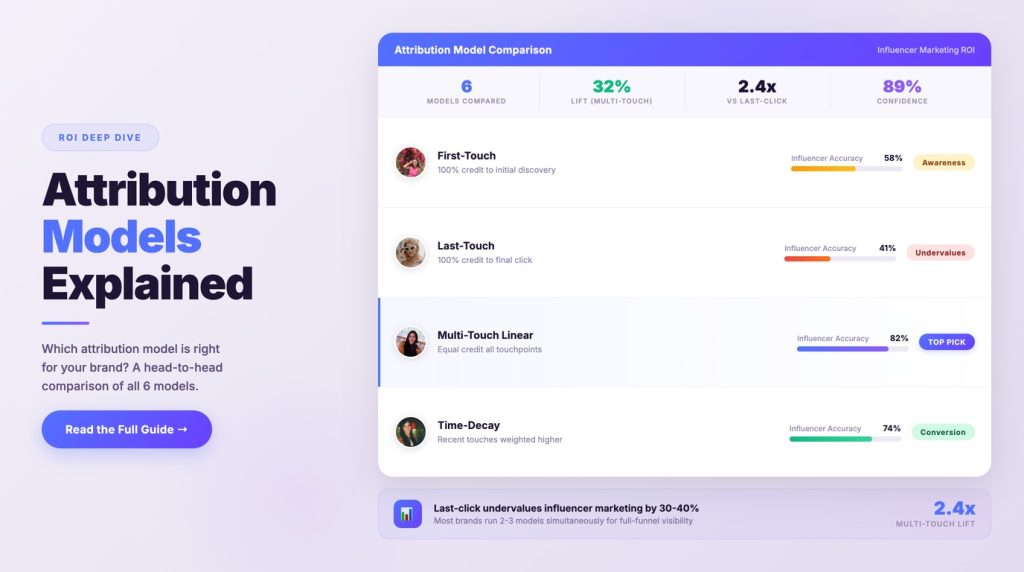
Standard attribution models — last-click, first-touch, multi-touch — capture downstream actions. They tell you who clicked, who converted, who used a promo code. But they’re blind to the consumer who watched a creator’s Instagram Story, didn’t click anything, and then searched your brand name on Google three days later. That delayed brand search is the single most common path to purchase from influencer exposure, and it’s invisible to click-based attribution.
Brand lift studies bridge this gap by directly surveying consumers about their perceptions — capturing the upper-funnel value that traditional ROI calculations miss entirely.
Why Influencer Content Outperforms Traditional Ads in Brand Lift
Creator content has structural advantages for brand lift that traditional display and video ads don’t share:
- Trust transfer: When a creator a consumer already follows endorses your brand, the perception shift is more pronounced than a cold ad impression
- Contextual integration: Influencer content appears within organic feeds, not interruptive ad placements — driving higher ad recall
- Extended engagement: A 60-second creator video holds attention longer than a 15-second pre-roll, giving the brand message more processing time
- Social proof amplification: Comments, shares, and saves on creator content reinforce brand perceptions beyond the initial view
How Brand Lift Studies Work: Methodology Breakdown
Platform-Native Brand Lift Tools
The major social platforms offer built-in brand lift measurement:
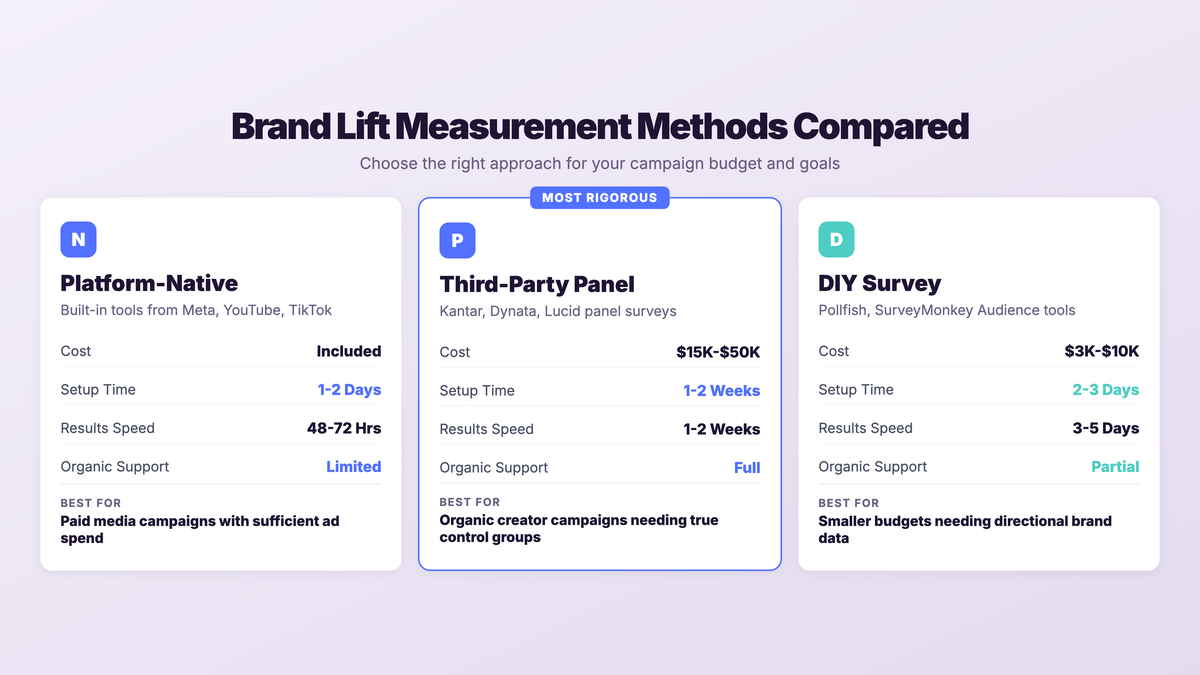
- Meta Brand Lift (Facebook/Instagram): Available for campaigns spending above a minimum threshold (varies by region and objective). Uses randomized control trials within Meta’s ecosystem. Results typically available within 48 to 72 hours after the campaign reaches sufficient survey responses.
- YouTube Brand Lift (Google Ads): Integrated into Google Ads for YouTube campaigns. Measures ad recall, awareness, consideration, favorability, and purchase intent. Requires a minimum spend that varies by market.
- TikTok Brand Lift Study: Available through TikTok’s measurement partners. Leverages TikTok’s in-feed survey technology to measure brand impact.
Important limitation: Platform-native tools typically require the campaign to run through the platform’s paid advertising system. Organic influencer posts — which is how most creator partnerships deliver content — may not be eligible for the platform’s native brand lift tools unless the posts are boosted or whitelisted as paid media.
Third-Party Brand Lift Solutions
For organic influencer campaigns, third-party survey-based solutions provide an alternative:
- Panel-based surveys: Companies like Kantar, Dynata, and Lucid maintain large consumer panels that can be segmented into exposed and control groups based on digital behavior data
- Mobile survey intercepts: Services that serve surveys to mobile users who have been exposed to creator content based on device-level ad exposure data
- Post-campaign recall surveys: Simpler (and cheaper) approach that surveys your target audience after the campaign to measure recall and perception — though without a true control group, the “lift” calculation is less rigorous
Emerging Methodologies
Search lift analysis is gaining traction as a proxy for brand lift that doesn’t require surveys at all. By measuring the incremental increase in branded search volume during and after a creator campaign, brands can infer awareness and consideration impact. Google Trends data, Google Search Console, and platform analytics dashboards make this approach accessible to teams without research budgets. The correlation between search lift and surveyed brand lift is well-documented, though the causal relationship requires careful isolation of other variables.
Designing a Brand Lift Study for Creator Campaigns
Step 1: Define Clear Hypotheses
Every brand lift study should start with a specific hypothesis, not a vague “did it work?” question. Strong hypotheses look like:
- “Exposure to creator content from fitness influencers will increase unaided brand awareness among women 25 to 34 by at least 5 percentage points”
- “A three-week creator campaign across Instagram and TikTok will lift purchase intent among our target demo by 8 to 12 percentage points over the control group”
Why this matters: Without a pre-defined threshold for “success,” you’ll be interpreting results after the fact — which introduces bias and makes it harder to justify future investment.
Step 2: Build Your Control Group Properly
The control group is where most influencer brand lift studies fail. Unlike paid media campaigns where platforms can automatically create holdout groups, organic influencer content doesn’t have a built-in exclusion mechanism. Options include:
- Geographic holdouts: Run the campaign in select markets and use non-campaign markets as control. Works well for national brands with regional creator activations.
- Platform-based holdouts: If running on Instagram only, survey matched audiences on a platform where the campaign didn’t appear.
- Temporal holdouts: Survey audiences before the campaign launches (baseline) and after (post-exposure). Less rigorous than simultaneous control, but practical for smaller budgets.
Step 3: Write Survey Questions That Don’t Lead
Brand lift surveys need to be short (5 to 7 questions maximum) and neutrally worded. Leading questions inflate lift metrics and produce data that won’t hold up to internal scrutiny.
- Bad: “After seeing [Creator]’s post about [Brand], how likely are you to purchase?”
- Good: “Which of the following brands have you seen or heard of recently?” (randomized brand list)
Step 4: Set Sample Size Requirements
Minimum viable sample: Most statisticians recommend at least 500 respondents per group (exposed and control) for a brand lift study to detect a 5-point lift with 95% confidence. For smaller expected lifts (2 to 3 points), you’ll need 1,500 or more per group. Under-sampling is the number one reason brand lift studies return inconclusive results — and the number one waste of research budget.
Step 5: Time Your Measurement Window
Brand effects from influencer content don’t peak at the same time as engagement metrics. Ad recall peaks within 48 hours. Consideration and favorability shifts may take 7 to 14 days to stabilize. Purchase intent effects can persist for 30 days or more. Run your post-exposure survey 7 to 10 days after the campaign’s final post to capture the full range of upper-funnel effects.
Costs, Timelines, and Sample Size Requirements
Budget Ranges for Brand Lift Studies
Brand lift study costs vary dramatically based on methodology:
- Platform-native tools (Meta, YouTube): Included with qualifying ad spend — effectively free beyond the media budget, though minimum spends apply
- Third-party panel surveys: Typically range from $15,000 to $50,000 for a standard two-cell study (exposed vs. control) with 1,000 respondents per cell
- Full-service research firms (Kantar, Nielsen): Enterprise-grade studies can run $50,000 to $150,000 or more, depending on market scope, number of cells, and additional analytics
- DIY survey tools (Pollfish, SurveyMonkey Audience): Budget-friendly option at $3,000 to $10,000, though you sacrifice methodology rigor and statistical support
Timeline Expectations
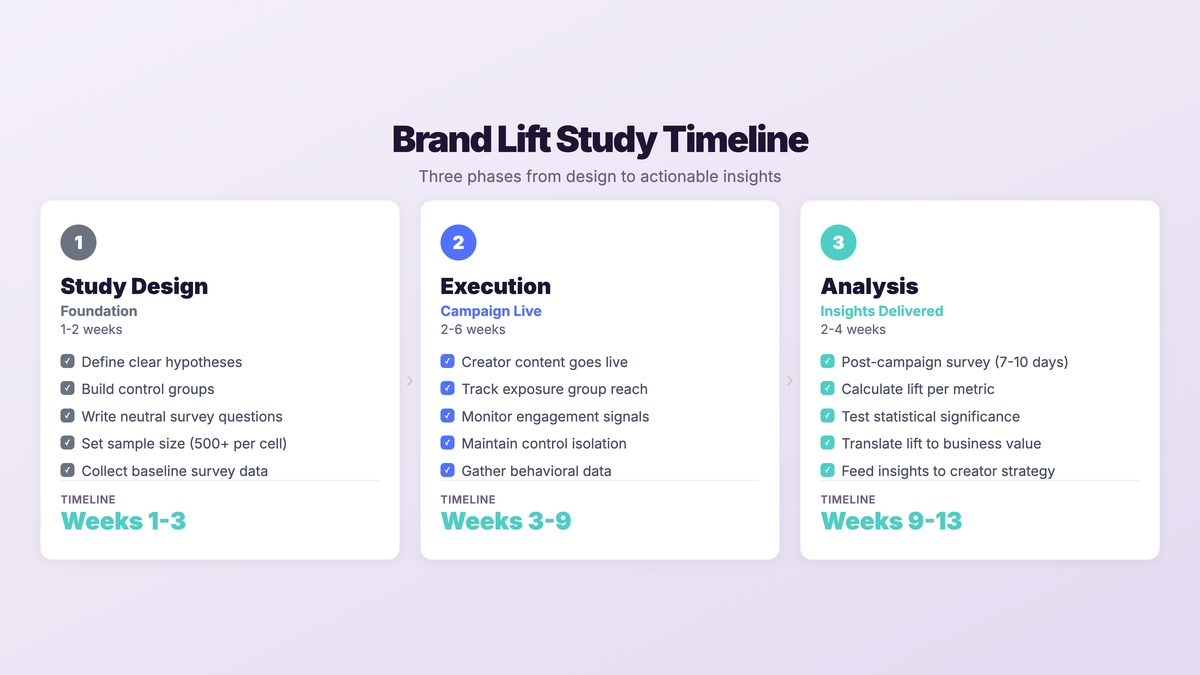
A typical brand lift study timeline for an influencer campaign:
- Study design and survey scripting: 1 to 2 weeks
- Baseline survey (pre-campaign): 1 week for data collection
- Campaign execution: 2 to 6 weeks (your standard influencer activation)
- Post-campaign survey: 1 to 2 weeks for data collection
- Analysis and reporting: 1 to 2 weeks
- Total: 6 to 13 weeks from kickoff to final report
When the Investment Makes Sense
Brand lift studies deliver the most value when:
- Your influencer budget exceeds $100,000 per campaign — below this, the study cost as a percentage of spend becomes hard to justify
- Awareness is your primary KPI — if you’re optimizing for direct sales, standard ROI formulas are more appropriate
- You need executive buy-in for scaling — brand lift data speaks the language of CMOs and CFOs who evaluate upper-funnel impact
- You’re comparing channels — brand lift provides an apples-to-apples comparison between influencer, display, TV, and other awareness-driving channels
Limitations of Brand Lift Studies and Better Alternatives
Where Brand Lift Studies Fall Short
Brand lift studies are not without significant drawbacks:
- Survey fatigue and low response rates: Consumer willingness to complete in-platform surveys is declining, which can skew results toward more engaged respondents
- Attribution isolation is imperfect: If you’re running multiple channels simultaneously (and you should be), isolating the influencer campaign’s contribution from TV, paid social, and organic requires careful design
- Cross-platform exposure leakage: A consumer in your “control” group on Instagram may have seen the same creator’s TikTok content, contaminating the control
- Small lifts may not be statistically significant: Influencer campaigns for already well-known brands may produce genuine lifts of 2 to 3 percentage points — below the detection threshold for under-powered studies
- Recall ≠ action: A consumer can recall your brand perfectly and still never purchase. Brand lift doesn’t predict revenue.
Complementary and Alternative Approaches
Smart brands don’t rely on brand lift studies alone. Pair them with these approaches for a complete picture:
- Search lift analysis: Monitor branded search volume during and after campaigns using Google Trends and Search Console. Low cost, high signal.
- Social listening sentiment: Track brand mention volume and sentiment shifts during creator campaigns using tools like Brandwatch or Sprout Social
- Multi-touch attribution with UTM tracking and affiliate links: Captures the consumers who do click, bridging upper-funnel lift with lower-funnel action
- Incrementality testing: Geographic or audience-based holdout experiments that measure incremental sales (not just perceptions) — the gold standard for proving ROI
- Share of voice tracking: Measure your brand’s share of influencer content in your category relative to competitors over time
Integrating Brand Lift into Your ROI Framework
Building a Multi-Layer Measurement Stack
Brand lift studies should be one layer in a comprehensive influencer marketing ROI framework, not the entire framework. The most effective measurement stacks combine:
- Bottom layer — Direct attribution: Promo codes, affiliate links, UTM parameters. Captures immediate conversions. The IMH 2026 Benchmark Report shows 45.9% of brands use promo/discount codes and 26% use affiliate links for attribution.
- Middle layer — Behavioral signals: Website traffic lifts, search volume increases, social engagement trends, email list growth during campaigns
- Top layer — Perception measurement: Brand lift studies, social sentiment analysis, share of voice tracking
How to Report Brand Lift to Leadership
CFOs and CMOs don’t want to hear “we got a 7-point lift in consideration.” They want to know what that means in dollars. Translate brand lift into business language:
- Awareness lift → Total addressable market expansion. “Our campaign reached 2.4 million consumers in our target demo. The 9-point awareness lift means approximately 216,000 additional consumers now know our brand — at a cost per incremental aware consumer of $0.46.”
- Consideration lift → Pipeline value. “The 6-point consideration lift among our target audience translates to an estimated 144,000 new consumers actively considering our product. At our average conversion rate from consideration to purchase, that represents $X in projected pipeline value.”
- Purchase intent lift → Forecast impact. “Purchase intent increased by 4 points. Industry benchmarks suggest approximately 15 to 25% of stated purchase intent converts to actual purchase within 90 days.”
Using Brand Lift Data to Optimize Creator Selection
One of the most underutilized applications of brand lift data is using it to refine your creator strategy. When you run brand lift studies across multiple creator activations, you can identify:
- Which creator tiers (nano, micro, macro) drive the highest per-impression lift
- Which content formats (Stories vs. Reels vs. long-form video) produce the strongest recall
- Which audience segments show the largest perception shifts
- Whether exclusivity (one brand per category) matters for lift magnitude
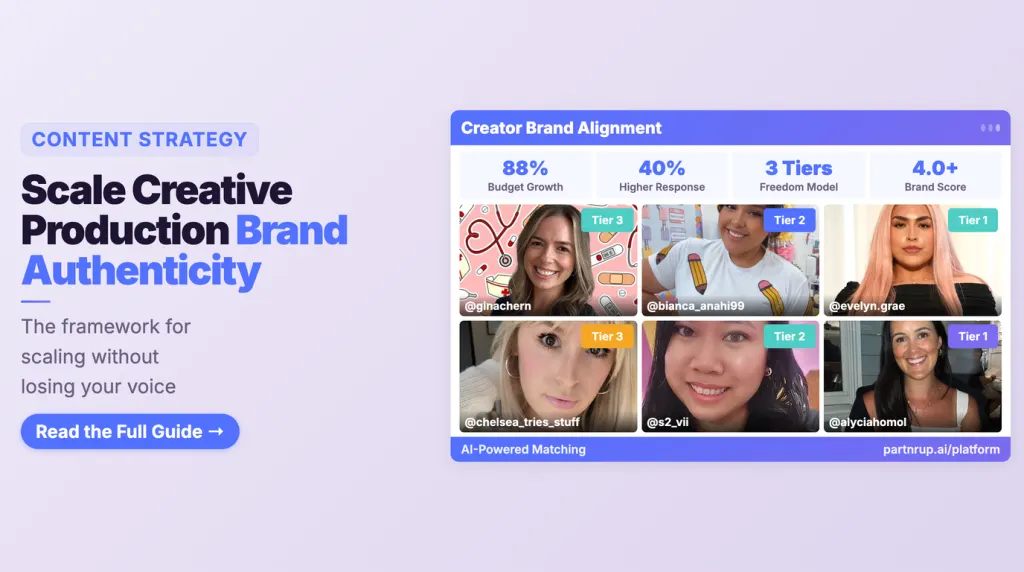
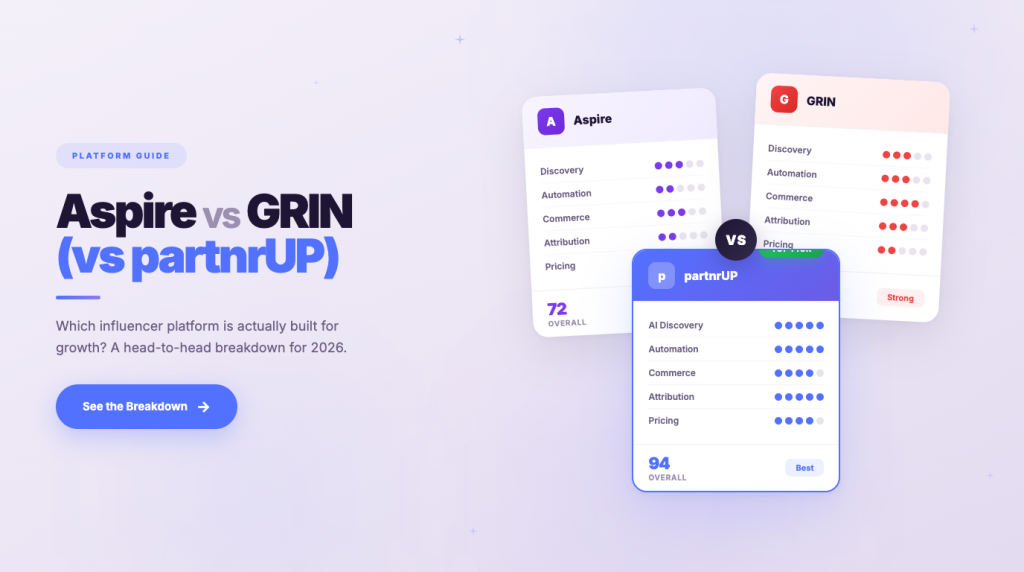
Platforms like partnrUP that use AI-powered creator matching can incorporate brand lift insights into their matching algorithms — selecting creators not just for reach and engagement, but for their demonstrated ability to shift brand perceptions in your target demo. When your measurement data feeds back into your creator selection process, every subsequent campaign compounds the learning.
Conclusion
Brand lift studies for influencer marketing work — but only when they’re designed rigorously, funded adequately, and interpreted within a broader measurement framework. They’re the best available tool for quantifying the upper-funnel impact that click-based attribution misses, and they give marketing leaders the evidence they need to justify and scale creator investments.
The reality is that most brands either skip brand lift entirely (and can’t prove awareness impact) or run under-powered studies that return inconclusive results (and waste budget). The sweet spot is combining brand lift studies on your largest campaigns with lighter-weight proxies — search lift, social sentiment, behavioral signals — for everyday measurement.
If you’re managing multiple creator partnerships and need to connect upper-funnel brand impact with downstream performance, partnrUP’s platform handles the operational complexity — from AI-powered creator matching to automated tracking — so your team can focus on strategy and measurement. Book a demo to see how brands are building full-funnel creator measurement programs.
Frequently Asked Questions
What is a brand lift study in influencer marketing?
A brand lift study measures the incremental change in consumer perceptions — awareness, consideration, favorability, and purchase intent — caused by exposure to influencer content. It works by comparing survey responses from an exposed group (people who saw the creator content) against a control group (matched audience that didn’t), with the difference representing the campaign’s brand impact.
How much does a brand lift study cost for an influencer campaign?
Costs range from essentially free (platform-native tools like Meta Brand Lift, included with qualifying ad spend) to $3,000 to $10,000 for DIY survey tools, $15,000 to $50,000 for third-party panel studies, and $50,000 to $150,000 or more for full-service research firms. The right investment level depends on your campaign budget — most practitioners recommend spending no more than 10 to 15% of campaign media cost on measurement.
What sample size do I need for a reliable brand lift study?
For a standard two-cell brand lift study, most statisticians recommend a minimum of 500 respondents per group (exposed and control) to detect a 5-point lift with 95% confidence. For smaller expected lifts of 2 to 3 points, you’ll need 1,500 or more respondents per group. Under-sampling is the most common reason brand lift studies produce inconclusive results.
Can I run a brand lift study on organic influencer content?
Yes, but it requires third-party survey solutions rather than platform-native tools (which typically require paid media). Panel-based surveys from providers like Kantar or Dynata can segment respondents into exposed and control groups based on digital behavior and social media usage data. Alternatively, geographic or temporal holdout designs provide a control without needing platform-level exposure data.
How long does a brand lift study take from start to finish?
A complete brand lift study typically takes 6 to 13 weeks: 1 to 2 weeks for study design, 1 week for baseline survey, 2 to 6 weeks for the campaign itself, 1 to 2 weeks for post-campaign survey, and 1 to 2 weeks for analysis. The key insight is to start the study design before the campaign launches — retroactive brand lift measurement is possible but methodologically weaker.
What’s the difference between brand lift and sales lift studies?
Brand lift measures changes in consumer perceptions (awareness, consideration, purchase intent) using surveys. Sales lift measures the incremental revenue or transactions driven by a campaign using actual purchase data. Brand lift is better for upper-funnel awareness campaigns; sales lift is better for direct-response and commerce-driven creator programs. The most comprehensive measurement programs run both.
Are brand lift studies worth it for smaller influencer budgets?
For campaigns under $50,000, formal brand lift studies are generally not cost-effective — the study itself may cost 20 to 40% of the campaign budget. Instead, use lighter-weight proxies: monitor branded search volume before, during, and after the campaign using Google Trends; track social mention volume and sentiment; survey your email list or social followers directly; and measure organic website traffic from brand searches. These approaches capture directional brand impact at a fraction of the cost.