63% of brands running creator affiliate programs say their biggest challenge is tracking which creator actually drove a conversion. Not finding creators. Not negotiating rates. Tracking. The gap between “a creator posted about our product” and “that post generated $47,000 in revenue” is where most programs either scale or stall.
This guide is part of our Affiliate Influencer Marketing: The Complete Brand Playbook for 2026 — the comprehensive resource covering every aspect of performance-based creator partnerships, from program structure to measurement.
The difference between brands spending $500K/year on creator affiliates and those spending $5M isn’t creativity — it’s attribution confidence. When you can prove exactly which creator drove which sale through which channel, budget conversations shift from “can we justify this?” to “how fast can we scale?”
In this guide, you’ll learn:
- The three core tracking methods (affiliate links, UTM parameters, and promo codes) and when to use each
- How to structure UTM taxonomies that scale across hundreds of creators without breaking your analytics
- Multi-touch attribution approaches that give creators fair credit across the full customer journey
- Common tracking failures that silently destroy your program data — and how to prevent them
- Platform and tool recommendations for brands at every stage of affiliate program maturity
Table of Contents
- Why Tracking Creator Affiliate Links Matters More Than Ever
- The Three Core Tracking Methods: Links, UTMs, and Promo Codes
- Building a UTM Taxonomy That Scales Across Hundreds of Creators
- Multi-Touch Attribution: Giving Creators Fair Credit
- 5 Common Tracking Failures That Silently Destroy Program Data
- Tools and Platforms for Creator Affiliate Tracking
- Conclusion: Build the Tracking Infrastructure Before You Scale
- Frequently Asked Questions
Why Tracking Creator Affiliate Links Matters More Than Ever
Creator affiliate marketing has moved from experimental side channel to core revenue driver. Brands using performance-based creator partnerships report 3-5x higher ROAS compared to flat-fee sponsorships — but only when they can actually measure it. Without reliable tracking, you’re flying blind with real budget.
The Attribution Gap Is Costing Brands Millions
Here’s what happens without proper tracking: a creator posts a product recommendation, a customer sees it on TikTok, searches the brand name two days later on Google, and converts through a branded search ad. Your Google Ads dashboard claims the credit. The creator who sparked the entire journey gets nothing — and you conclude that creator partnerships don’t work.
This isn’t hypothetical. Brands with mature tracking systems attribute 30-40% more revenue to creator channels than brands using basic last-click models. The revenue was always there — the tracking just wasn’t capturing it.
Why 2026 Makes Tracking Harder (and More Important)
Three shifts have made creator affiliate tracking significantly more complex:
- Multi-platform content distribution — A single creator posts across TikTok, Instagram, YouTube, and a newsletter. Each touchpoint needs tracking.
- Privacy regulations and cookie deprecation — Third-party cookies are unreliable. Server-side tracking and first-party data have become essential.
- Longer purchase consideration cycles — Especially in DTC and ecommerce, customers interact with 4-7 touchpoints before purchasing. Last-click attribution dramatically undervalues top-of-funnel creator content.
Brands that invest in proper tracking infrastructure before scaling their creator programs see measurably higher returns — not because the creators perform better, but because the measurement captures what’s actually happening.
The Three Core Tracking Methods: Links, UTMs, and Promo Codes
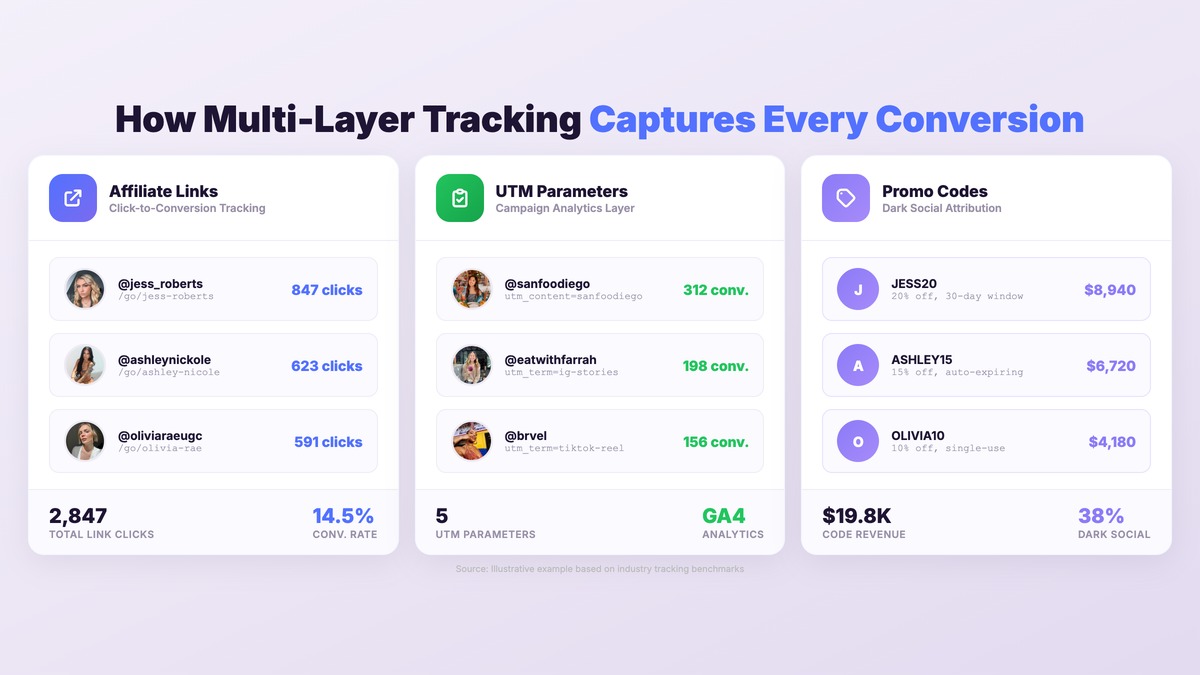
Every creator affiliate tracking system is built on three foundational methods. Most brands need all three working together — not a single approach in isolation.
Unique Affiliate Links
Each creator gets a distinct URL that routes through your tracking system before landing on your site. This is the backbone of affiliate tracking because it ties the click directly to the creator at the moment of interaction.
How they work: The link contains a unique identifier (e.g., partnrup.ai/go/creator-handle) that logs the click, sets a first-party cookie, and redirects to the product page. When the visitor converts within the cookie window (typically 30 days), the sale attributes to that creator.
Strengths: Precise click-to-conversion tracking, real-time data, easy to implement at scale with automated link generation tools.
Limitations: Link-in-bio constraints on some platforms, user resistance to clicking unfamiliar URLs, cookie expiration gaps.
UTM Parameters
UTM (Urchin Tracking Module) parameters are tags appended to URLs that tell your analytics platform where traffic came from and why. For creator affiliate programs, UTMs add a layer of campaign-level context that plain affiliate links don’t capture.
A properly structured creator UTM looks like:
https://yourbrand.com/product?utm_source=creator&utm_medium=affiliate&utm_campaign=summer-2026&utm_content=creator-handle&utm_term=instagram-stories
Strengths: Works in Google Analytics, layers with affiliate link data, enables campaign-level analysis.
Limitations: Doesn’t track conversions on its own — needs your analytics stack to close the loop. Long URLs look messy in creator content.
Promo Codes
Creator-specific discount codes (e.g., SARAH20) serve dual purposes: they incentivize purchase and provide attribution even when links aren’t clicked. A customer might see a creator’s video, remember the code, and type it at checkout three weeks later.
Strengths: Works across all platforms (including podcasts and offline), captures “dark social” attribution, memorable and shareable.
Limitations: Code sharing dilutes attribution accuracy, can’t track upper-funnel engagement, limited data on the path to purchase.
The Stacked Approach
The most effective programs use all three simultaneously: affiliate links for real-time click tracking, UTMs for campaign analytics, and promo codes as a fallback attribution layer. When a sale comes through an affiliate link with UTMs, you get the full picture. When someone uses a promo code without clicking a link, you still capture the creator connection. This redundancy is intentional — it closes the gaps that any single method leaves open.
Building a UTM Taxonomy That Scales Across Hundreds of Creators
UTMs are only valuable if they’re consistent. One of the most common tracking failures in growing affiliate programs is UTM entropy — where every team member, agency, and creator uses slightly different naming conventions until the data becomes unusable.
The Five-Parameter Framework
Lock down these five parameters before onboarding your next creator:
- utm_source — The platform:
instagram,tiktok,youtube,newsletter. Always lowercase, no variations (IG,Insta,Instagramall fragment your data). - utm_medium — The relationship type:
affiliate,ambassador,ugc. This lets you segment creator-driven traffic from paid and organic in GA4. - utm_campaign — The initiative:
summer-launch-2026,always-on-affiliate. Time-bound campaigns get date ranges; evergreen programs get descriptive names. - utm_content — The creator identifier:
sarah-jones,fitnesswithmark. Use their handle or a standardized internal ID. This is how you attribute at the individual creator level. - utm_term — The content format:
stories,reel,feed-post,link-in-bio. This reveals which format converts best per creator.
Naming Convention Rules
Enforce these from day one — retrofitting messy UTMs is exponentially harder than starting clean:
- All lowercase, always. No exceptions.
- Hyphens as word separators (not underscores, not spaces).
- No special characters, no emoji, no spaces.
- Creator handles must match exactly across all campaigns. Build a master list.
- Document every allowed value per parameter in a shared sheet. If it’s not on the list, it can’t be used.
Automating UTM Generation
Manual UTM creation doesn’t scale. At 50+ creators, someone will misspell a handle, use uppercase, or forget a parameter. Platforms like partnrUP auto-generate tracked links with pre-configured UTM structures, eliminating human error from the equation. If you’re building in-house, create a URL builder tool that validates inputs against your naming convention before generating the link.
Multi-Touch Attribution: Giving Creators Fair Credit
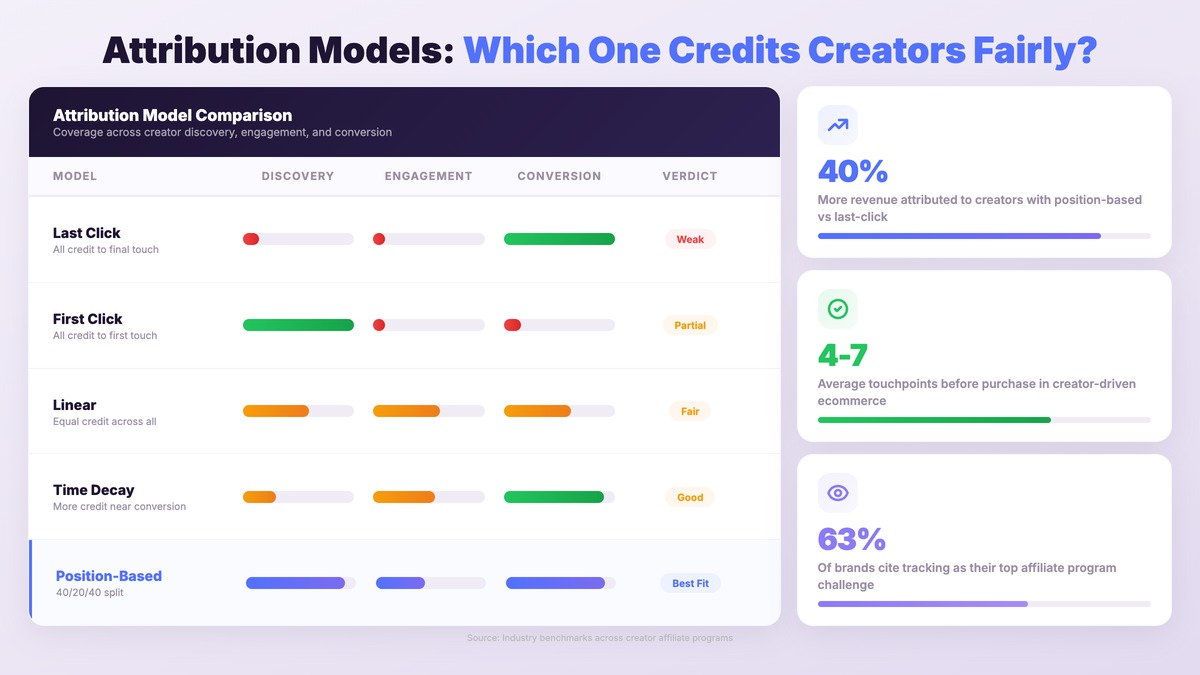
Last-click attribution is the single biggest reason brands undervalue their creator affiliate programs. A customer’s journey from discovery to purchase almost never happens in one click — and the creator who introduced the brand often gets zero credit under last-click models.
Why Last-Click Fails for Creator Programs
Consider a typical ecommerce purchase path:
- Customer discovers the brand through a creator’s TikTok video (creator touchpoint)
- Customer visits the website but doesn’t buy (direct traffic)
- Customer sees a retargeting ad on Instagram (paid social)
- Customer searches the brand name and clicks a Google Shopping ad (paid search)
- Customer converts
Under last-click, Google Shopping gets 100% of the credit. Under first-click, TikTok gets 100%. Neither tells the true story. The creator sparked the entire journey, paid media closed it, and both deserve attribution.
Attribution Models That Work for Creator Programs
Linear attribution distributes credit equally across all touchpoints. Simple, but doesn’t account for the outsized impact of discovery vs. closing touchpoints.
Time-decay attribution gives more credit to touchpoints closer to conversion. Better for short purchase cycles, but undervalues the creator discovery moment that started everything.
Position-based (U-shaped) attribution gives 40% credit to the first touch, 40% to the last touch, and distributes 20% across middle interactions. This is the most popular model for creator affiliate programs because it rewards both discovery (often the creator) and conversion (often paid or direct) while acknowledging assist touchpoints.
Data-driven attribution uses machine learning to assign credit based on actual conversion patterns in your data. Requires significant volume (typically 300+ conversions/month) but produces the most accurate picture. Choosing the right model depends on your program maturity and data volume.
Implementing Multi-Touch Tracking
Moving beyond last-click requires infrastructure changes:
- Server-side tracking — Client-side cookies are unreliable. Server-side event capture persists across sessions and devices.
- Cross-device identity resolution — Customers see creator content on mobile but often convert on desktop. Without identity stitching, these appear as separate users.
- UTM + cookie stacking — When a visitor arrives via a creator link, store the creator ID server-side. If they convert later through a different channel, the original creator touchpoint is preserved.
- Conversion API integrations — Meta CAPI, TikTok Events API, and Google’s Enhanced Conversions send conversion data server-to-server, reducing attribution loss from ad blockers and browser privacy features.
5 Common Tracking Failures That Silently Destroy Program Data
These aren’t edge cases — they’re happening right now in the majority of creator affiliate programs. Each one erodes attribution accuracy without generating obvious error messages.
1. Cookie Window Mismatches
Your affiliate platform sets a 30-day cookie. Your analytics uses a 7-day lookback. Sales that convert between day 8 and day 30 attribute to the creator in your affiliate dashboard but not in your analytics — creating conflicting reports that undermine stakeholder confidence. Fix: align cookie windows across all tracking systems, or document the discrepancy and report from one source of truth.
2. UTM Stripping on Social Platforms
Some platforms strip or modify UTM parameters when users click links. Instagram’s in-app browser and TikTok’s redirect handling can drop UTMs entirely. Always test your tracked links on each platform’s actual mobile experience — not just in a desktop browser. Use server-side click logging as a backup when UTMs are unreliable.
3. Duplicate Conversion Firing
Thank-you page loads, page refreshes, and order confirmation emails can each fire a conversion pixel. Without deduplication logic tied to order IDs, a single purchase can register as 2-3 conversions, inflating ROAS calculations and overpaying creators. Implement order-ID-based deduplication at the tracking pixel level.
4. Cross-Device Attribution Gaps
A customer clicks a creator’s link on their phone, then buys on their laptop hours later. Without cross-device identity resolution, this shows as an unattributed direct conversion on desktop and an abandoned click on mobile. First-party login data and email-based matching close this gap — require account creation or email capture early in the funnel.
5. Promo Code Leakage
Creator-specific promo codes get shared on coupon sites within hours of being published. A code meant for attribution becomes a discount channel for deal-seekers who never saw the creator’s content. Monitor coupon aggregator sites weekly, use single-use codes for high-value campaigns, and consider auto-expiring codes that reset every 7-14 days to limit leakage windows.
Tools and Platforms for Creator Affiliate Tracking
Your tracking stack depends on program maturity and scale. Here’s what works at each stage, from startups managing 10 creators to enterprise teams running 500+.
Early Stage (1-25 Creators)
At this stage, manual tracking is feasible but you need to build the foundation right:
- Google Analytics 4 — Free, powerful UTM reporting, custom audiences based on creator traffic
- Shopify/WooCommerce native affiliate features — Built-in discount code tracking, order-level attribution
- Spreadsheet-based reconciliation — Monthly manual matching of affiliate link clicks → promo code usage → conversions
Cost: $0-200/month. Works until manual reconciliation takes more than 4 hours per week.
Growth Stage (25-100 Creators)
This is where manual processes break and automation becomes essential:
- Dedicated affiliate platforms — Automated link generation, real-time dashboards, payout calculation
- Server-side tracking — Move beyond client-side cookies to conversion APIs
- Automated UTM generation — Pre-built link builders that enforce naming conventions
Platforms like partnrUP handle the operational complexity of tracking at this scale — from automated link generation with embedded UTMs to AI-powered creator matching that pairs brands with creators most likely to drive measurable conversions. When tracking is automated at the platform level, your team focuses on strategy instead of spreadsheet reconciliation.
Enterprise Scale (100+ Creators)
At enterprise scale, tracking becomes a data engineering challenge:
- Data warehouse integration — Push affiliate data into Snowflake, BigQuery, or Redshift alongside all other marketing data
- Multi-touch attribution modeling — Custom models trained on your conversion data, not one-size-fits-all rules
- Real-time fraud detection — Automated monitoring for click fraud, bot traffic, and promo code abuse
- API-first architecture — Every tracking system feeds into a unified reporting layer via APIs, not manual exports
The goal at this stage is a single source of truth that ties every creator touchpoint to revenue impact — from first click to repeat purchase lifetime value.
Conclusion: Build the Tracking Infrastructure Before You Scale
Tracking creator affiliate links isn’t a technical detail to figure out later — it’s the foundation that determines whether your program can scale with confidence. Every dollar of creator investment needs clear attribution. Every creator partnership needs measurable outcomes. Every budget increase needs defensible data.
The brands seeing 5x+ ROAS from creator affiliates didn’t get there by finding better creators — they got there by building tracking systems that capture what’s actually happening across every touchpoint, device, and attribution window.
Start with the stacked approach: affiliate links for real-time click tracking, UTMs for campaign analytics, promo codes for dark social capture. Enforce naming conventions from day one. Move to multi-touch attribution before your program outgrows last-click. And invest in server-side tracking before privacy regulations make client-side cookies fully unreliable.
Explore partnrUP’s automated tracking and attribution tools to see how brands are scaling creator affiliate programs with full-funnel visibility — from first touch to revenue. Or book a demo to see the platform in action with your specific program requirements.
Frequently Asked Questions
What is the best way to track creator affiliate links?
The most effective approach is stacking three methods: unique affiliate links for click-to-conversion tracking, UTM parameters for campaign analytics, and promo codes for attribution when links aren’t clicked. Each method covers gaps the others miss. Affiliate links capture real-time click data, UTMs feed your analytics platform with campaign-level context, and promo codes catch “dark social” conversions from viewers who remember a code but never clicked a link.
How should I structure UTM parameters for creator affiliate campaigns?
Use a five-parameter framework: utm_source (platform), utm_medium (affiliate), utm_campaign (initiative name), utm_content (creator handle), and utm_term (content format). Enforce all-lowercase naming, hyphen separators, and maintain a master list of allowed values. Automated UTM generation prevents the naming inconsistencies that fragment analytics data as programs grow beyond 50 creators.
What attribution model works best for creator affiliate programs?
Position-based (U-shaped) attribution is the most widely adopted model for creator affiliate programs because it gives 40% credit to the first touch (typically the creator discovery moment) and 40% to the last touch (the closing conversion), with 20% distributed across middle interactions. This balances the value of creator-driven awareness with conversion-closing touchpoints. Brands with 300+ monthly conversions should consider data-driven models that learn from their actual conversion patterns.
How do I prevent promo code leakage to coupon sites?
Three strategies reduce code leakage: auto-expiring codes that reset every 7-14 days limit the window coupon aggregators can exploit; single-use codes for high-value campaigns prevent sharing entirely; and weekly monitoring of sites like RetailMeNot, Honey, and CouponCabin lets you identify and deactivate leaked codes before they erode margins. Some brands also use cart-level logic that limits code stacking with other promotions.
What’s the difference between first-party and third-party cookies for affiliate tracking?
First-party cookies are set by your own domain and remain relatively reliable across browsers. Third-party cookies, set by third-party tracking domains, are being blocked by Safari, Firefox, and increasingly Chrome. For creator affiliate tracking, this means affiliate links should set first-party cookies on your domain (not redirect through a third-party tracking domain), and server-side event tracking should back up any cookie-based attribution to ensure no conversions are lost.
How long should my affiliate cookie window be?
The standard range is 30-90 days for most ecommerce products, though it depends on your purchase consideration cycle. Fast-moving consumer goods may convert within 7 days; high-ticket items like mattresses or electronics often take 60-90 days. The key rule: align your cookie window across every tracking system. If your affiliate platform uses 30 days but GA4 uses a 7-day lookback, you’ll get conflicting revenue reports that undermine credibility with stakeholders.
Can I track creator affiliate performance across multiple platforms?
Yes — cross-platform tracking requires platform-specific links with consistent UTM structures. Each platform link gets the same creator ID in utm_content but a different utm_source (instagram, tiktok, youtube, newsletter). This lets you see which platforms drive the most conversions per creator. Server-side tracking and conversion API integrations close the gap for platforms where UTMs are unreliable, ensuring attribution persists regardless of which channel the creator posts on.