Influencer marketing ROI is real — but proving it requires more than checking likes and follower counts. If you’re running influencer campaigns without a clear attribution strategy, you’re flying blind on one of your most significant marketing investments.
This guide is part of our Influencer Marketing ROI: The Complete Guide to Measuring, Tracking & Proving Results — a comprehensive resource for brands looking to build effective creator partnerships at scale.
This guide breaks down everything you need to know about influencer marketing attribution in 2026: the models, the tools, the measurement approaches, and the practical steps to connect creator content to revenue. Whether you’re justifying budget to leadership or optimizing spend across channels, this is the framework you need.
Why Influencer Marketing Attribution Is Hard (But Necessary)
Attribution in influencer marketing is notoriously difficult for a few reasons:
- Multi-touch journeys — a customer might see an influencer post, browse your website, see a retargeting ad, and then convert. Which touchpoint gets credit?
- Platform limitations — TikTok, Instagram, and YouTube don’t always pass through UTM parameters cleanly, especially on mobile
- Dark social — viewers who screenshot a product, search for it later, and buy without any trackable referral link
- Long consideration cycles — especially in B2B or high-ticket categories, influencer-driven awareness can take weeks or months to convert
- Creator content diversity — some creators drive direct clicks; others build brand affinity that shows up later in branded search volume
Despite these challenges, modern influencer marketing statistics consistently show that brands using structured attribution frameworks report 2-3x better ROI visibility than those measuring only vanity metrics. The gap is in the methodology, not the channel.
The Core Attribution Methods for Influencer Marketing
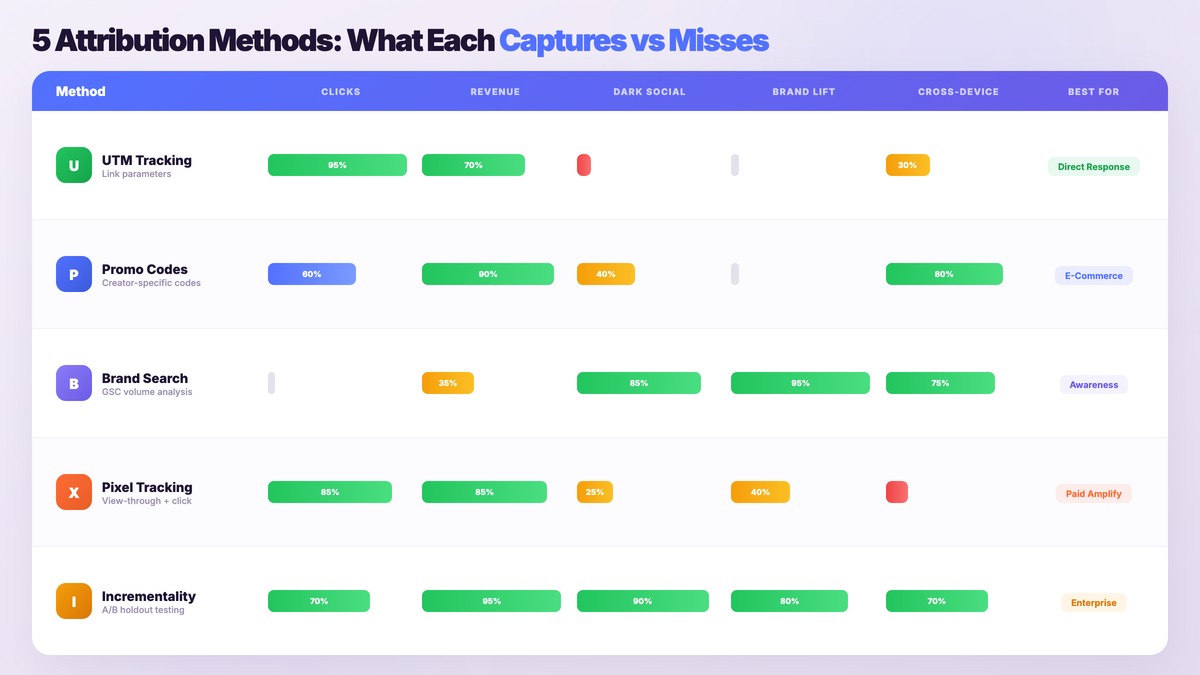
1. UTM Parameter Tracking
The most widely used attribution method. Every link a creator shares gets a unique UTM string that tracks source, medium, campaign, and individual creator.
Example structure:
https://yourbrand.com/product?utm_source=instagram&utm_medium=influencer&utm_campaign=summer2026&utm_content=creatorname
What it captures: Clicks, sessions, conversions, and revenue from tracked links
What it misses: Dark social, organic search that follows influencer exposure, in-store purchases influenced by content
Best for: Direct response campaigns where the creator’s call-to-action is “click this link”
2. Creator-Specific Promo Codes
Unique discount codes assigned to each creator (e.g., CREATOR20). When a customer uses the code at checkout, the sale is attributed to that creator regardless of how they found the site.
What it captures: Motivated purchasers who were influenced by the creator and needed an extra nudge (discount) For more on this topic, explore our affiliate influencer marketing playbook.
What it misses: Customers who were influenced but didn’t use the code, customers who shared the code with others
Best for: E-commerce campaigns where conversions are the primary KPI and you want granular creator-level attribution
3. Branded Search Volume Analysis
One of the most underutilized attribution signals. When you run influencer campaigns, monitor your branded search volume in Google Search Console. A spike in “your brand name” searches during and after a campaign is a strong signal of influencer-driven awareness.
What it captures: Top-of-funnel brand awareness that eventually converts through direct/organic channels
Best for: Brand awareness campaigns, new product launches, campaigns targeting audiences who aren’t familiar with your brand
4. Pixel-Based Attribution
If a creator’s content is boosted as a paid ad (whitelisting/dark posts), you can use platform pixels (Meta Pixel, TikTok Pixel) to track view-through and click-through conversions. This gives you data that’s comparable to your paid social benchmarks.
What it captures: Full purchase funnel data when creator content is amplified via paid channels — the same data you’d get from any paid ad
Best for: Brands using creator content for paid amplification (often called UGC for paid ads)
Our UGC attribution case study with Lifeboost Coffee is a real-world example of how pixel-based attribution from creator content can outperform traditional ad creative.
5. Incrementality Testing
The gold standard for understanding true ROI. Incrementality testing splits your audience into exposed and unexposed groups and measures the difference in conversion rates. This tells you how much of your sales lift is actually caused by influencer campaigns versus what would have happened anyway.
What it captures: True causal impact of influencer campaigns on revenue
What it requires: Significant scale, statistical rigor, and a measurement partner or in-house data science capability
Best for: Brands spending $500K+ on influencer marketing annually who need CFO-grade proof of ROI
Building Your Attribution Stack
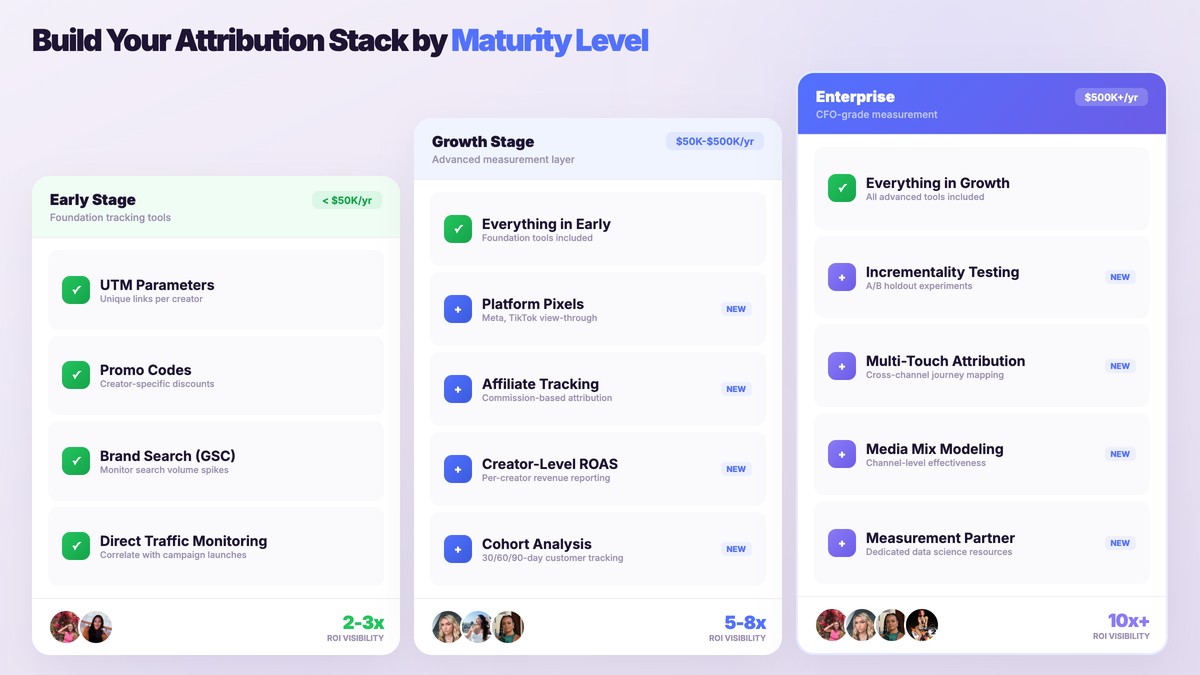
Most brands should use a combination of methods rather than relying on a single approach. Here’s a practical attribution stack for different maturity levels:
Early Stage (Under $50K influencer spend/year)
- UTM parameters on all creator links
- Unique promo codes for every creator
- Track branded search volume in GSC before/during/after campaigns
- Monitor direct traffic spikes coinciding with campaign launches
Growth Stage ($50K–$500K/year)
- All of the above, plus:
- Platform pixels for any whitelisted/boosted content
- Affiliate tracking for creator partnerships with commission components
- Creator-level ROAS reporting in your influencer management platform
- Cohort analysis to track influencer-acquired customers over 30/60/90 days
Enterprise ($500K+/year)
- All of the above, plus:
- Incrementality testing for major campaigns
- Multi-touch attribution modeling (MTA) to understand cross-channel journey
- Media mix modeling (MMM) to quantify influencer’s contribution to overall marketing effectiveness
- Dedicated measurement partner or data science resources
Setting Up First-Party Attribution Infrastructure
Before choosing an attribution model, you need the plumbing in place to collect data. Most brands skip this step and end up with incomplete attribution that undervalues creator partnerships by 30-50%.
Pixel implementation: Install your conversion pixel on all purchase confirmation pages, add-to-cart events, and key consideration signals (product page views, pricing page visits). For creator campaigns specifically, ensure the pixel fires on landing pages that creators link to — not just your homepage. Each creator should drive traffic to a trackable entry point.
UTM standards for creator campaigns: Establish a consistent UTM structure before your first campaign launches. Recommended format: utm_source=creator&utm_medium={platform}&utm_campaign={campaign_name}&utm_content={creator_handle}. The most common mistake is inconsistent naming — “tiktok” vs “TikTok” vs “tt” across campaigns makes analysis impossible. Document your conventions and enforce them through your platform or brief templates.
Cookie window decisions: Your attribution window directly impacts how much credit creators receive. A 7-day window captures impulse purchases but misses considered buys. A 30-day window captures more conversions but may over-attribute. For most consumer brands, 14 days balances accuracy with credit — but test this against your actual purchase cycle data. If your average time-to-purchase from first touch is 9 days, a 7-day window is losing credit on nearly half your conversions.
iOS privacy impact: Apple’s App Tracking Transparency reduced cross-app attribution accuracy by 40-60% for many brands. The practical implication for influencer measurement: in-app purchases on iOS are significantly harder to attribute to specific creator content. Counterstrategies include server-side tracking, promo code attribution (which survives privacy restrictions), and post-purchase surveys asking “how did you hear about us?” — low-tech but surprisingly accurate at scale when combined with quantitative data.
Attribution Windows by Campaign Type
Awareness campaigns (brand lift, reach focus): Use a 30-day window with view-through attribution enabled. Creators driving awareness may not generate immediate clicks, but their content plants seeds that convert weeks later through branded search. Without view-through, you’ll attribute these conversions to Google brand campaigns instead of the creator who actually drove the intent.
Consideration campaigns (reviews, tutorials, comparisons): A 14-21 day window with click-through attribution captures the research-and-return pattern. Consumers watch a creator’s product review, research alternatives, then return to purchase through the creator’s link or a branded search. Multi-touch models work best here because the purchase journey has 3-5 touchpoints.
Conversion campaigns (promo codes, limited offers, live shopping): A 3-7 day window with last-click attribution is appropriate because these campaigns drive immediate action. If someone uses a promo code 3 weeks after seeing the content, the urgency signal wasn’t strong enough — that conversion likely would have happened regardless.
Key Metrics to Track by Campaign Type
Not all campaigns have the same goal, and your attribution metrics should reflect that. Here’s how to align metrics to campaign objectives, based on the complete influencer platform ROI framework:
| Campaign Type | Primary KPI | Attribution Method | Success Benchmark |
|---|---|---|---|
| Brand Awareness | Branded search lift, reach | GSC tracking, survey | 10-30% search increase |
| Product Launch | Traffic, trial/purchase | UTM + promo codes | 3-5x baseline traffic |
| Direct Response | Conversions, ROAS | Promo codes, UTMs | Positive ROAS vs. benchmark |
| UGC for Paid | Ad performance vs. control | Pixel attribution | Beat control creative by 20%+ |
| Ambassador Program | Lifetime revenue, retention | Cohort analysis | Creator LTV vs. other channels |
Common Attribution Mistakes to Avoid
Even experienced marketers fall into these traps. See our guide on costly creator mistakes for more context:
- Last-click bias — attributing all conversion value to the last touchpoint before purchase, ignoring influencer’s role in the journey
- Not setting a baseline — forgetting to measure where traffic, sales, and branded search were before the campaign
- Counting gross reach as ROI — reach and impressions are inputs, not outcomes; always tie to conversion metrics
- Ignoring delayed conversions — especially for higher-ticket items, conversions may happen 2-4 weeks after a creator posts; set your attribution windows accordingly
- Using the wrong comparison — comparing influencer ROAS to paid social ROAS without accounting for the awareness-driving value of creator content
Mistake #5: Ignoring post-purchase attribution signals. The customer journey doesn’t end at checkout. Creator-acquired customers who return for repeat purchases, leave reviews, or refer friends represent compounding value that single-transaction attribution misses entirely. Track 90-day LTV by acquisition source. Brands that do this consistently find creator-acquired customers are worth 15-25% more over their lifetime — a data point that transforms how you evaluate campaign ROAS.
Mistake #6: Treating all platforms equally in attribution. A view on TikTok and a view on YouTube represent fundamentally different levels of intent and attention. TikTok views are passive (auto-play in feed). YouTube views are active (user clicked and chose to watch). Weighting them equally in multi-touch attribution distorts reality. Apply platform-specific multipliers: YouTube views should carry 2-3x the weight of TikTok views in consideration-phase attribution.
How Platform Choice Affects Attribution Quality
The influencer marketing platform you use directly affects your attribution capabilities. Modern platforms with AI creator matching don’t just help you find the right creators — they build in tracking frameworks that connect creator activity to real business outcomes. Tools like partnrUP’s platform help brands automate this at scale.
Look for platforms that:
- Generate unique UTM parameters and promo codes automatically for each creator
- Integrate with your e-commerce platform to pull actual purchase data
- Track the full conversion window (not just 24-hour click-through)
- Allow creator-level ROAS reporting in a single dashboard
- Connect to Google Analytics, Shopify, and your ad platforms
For a deeper look at B2B-specific attribution considerations, see our breakdown of B2B influencer ROI — the measurement approaches differ significantly from DTC. Book a demo to see how leading brands are implementing this.
Frequently Asked Questions
What is influencer marketing attribution?
Influencer marketing attribution is the process of connecting influencer campaign activity — posts, views, clicks — to real business outcomes like website traffic, leads, and revenue. It answers the question: “Did this influencer actually help us sell more?”
What is the best way to track influencer ROI?
The most effective approach combines UTM tracking, unique promo codes, and branded search monitoring for most brands. For brands running at scale, adding pixel-based tracking for boosted content and cohort analysis for customer lifetime value gives a more complete picture.
How do I measure influencer marketing ROI without a promo code?
Without a promo code, rely on UTM-tracked links, post-campaign branded search volume analysis, direct traffic spikes, and time-correlated conversion analysis. Surveying customers about where they heard about you also captures dark social attributions that tracking tools miss.
What attribution window should I use for influencer campaigns?
A 30-day attribution window is standard for most influencer campaigns. For high-consideration products (travel, technology, B2B), extend to 60-90 days. For impulse-purchase categories (beauty, food), a 7-day window may suffice.
How does dark social affect influencer attribution?
Dark social refers to traffic from private sharing (screenshots, DMs, copy-paste links) that appears as “direct” in analytics. It’s a known limitation. Branded search volume is the best proxy for capturing dark social influence, since users who discover your brand through an influencer often search for it directly later.
Can I compare influencer ROAS to paid social ROAS?
You can, but be careful. Paid social ROAS is typically measured on last-click, while influencer’s value often includes upper-funnel awareness that pays off in other channels. A better comparison: look at total channel ROAS including influencer-assisted conversions, not just last-click direct.
Attribution gets easier when your influencer platform is built for it. partnrUP connects creator activity to real business outcomes — with automatic UTM generation, creator-level ROAS reporting, and integrations that actually work.