Branded content is the antidote to ad fatigue. While traditional advertising interrupts consumers mid-scroll, mid-show, or mid-article, branded content earns their attention. It delivers genuine value , entertainment, education, inspiration, with a brand’s fingerprints on it. The result? Audiences that choose to engage rather than skip.
But here’s the uncomfortable truth: most branded content programs fail. Not because the creative is bad, or because consumers don’t want branded content: they do. They fail because there’s no system. Brands confuse content creation with content strategy. They execute a campaign, get decent views, struggle to measure anything meaningful, and then wonder why it didn’t move the needle.
The brands winning with branded content have a repeatable process: a strategy that defines who they’re reaching and why, a production framework that gets the right content made efficiently, and a distribution machine that ensures that content actually reaches, and converts: the intended audience.
This guide is that system. Whether you’re launching your first branded content program or scaling an existing one, you’ll find a complete framework here, from first creative strategy session to live distribution. We’ll cover what branded content actually is (and isn’t), how to build a strategy, produce creator content that performs, write briefs that get great work, distribute it across every channel, and measure what matters.
By the end, you’ll have everything you need to build a branded content program that doesn’t just look good , it performs.
What Is Branded Content?
Branded content is content funded by a brand that delivers genuine value to an audience: entertainment, education, utility, or inspiration, with the brand playing a supporting rather than starring role. The goal isn’t to advertise; it’s to earn attention through something worth paying attention to.
This definition has three key components:
- Brand-funded: The brand pays for or commissions the content, unlike earned media or organic UGC.
- Audience-valuable: The content must provide genuine value independent of its brand association. If you strip the brand logo and the content still works, you’re doing it right.
- Brand-secondary: The story, the creator, the entertainment value , these come first. The brand association is present but not the point.
How Branded Content Differs from Advertising
Traditional advertising is interruption-based. You pay for placement, and the placement interrupts someone doing something they actually want to do. The entire relationship is transactional: you paid for seconds of attention; the consumer tolerates it.
Branded content inverts this dynamic. Instead of buying attention, you earn it. Instead of interrupting, you contribute. The brand is associated with something the audience actively chose to engage with, which creates an entirely different kind of brand impression.
How Branded Content Differs from UGC
User-generated content (UGC) is organic: consumers creating content about brands without a brief, a budget, or brand direction. Branded content involves the brand in the creative process. A creator produces content under a brand’s brief, following brand guidelines, with agreed-upon messaging. The brand has creative direction; in UGC, they don’t.
This distinction matters for quality control, brand consistency, and content rights. Branded content can be licensed; UGC requires separate permissions.
The Branded Content Spectrum
Branded content exists on a spectrum from lightly branded to deeply integrated:
- Sponsored blog post or article: Editorially-driven content with brand sponsorship disclosed
- Creator integration: Creator includes brand mention or product use within their regular content
- Dedicated creator post: Full video or post built around a brand, but in the creator’s style
- Co-produced content series: Brand and creator collaborate on multi-part content with shared creative ownership
- Branded entertainment: Full-scale productions (documentaries, mini-series) funded by the brand
Why Branded Content Outperforms Traditional Advertising
The case for branded content isn’t philosophical: it’s statistical. Consumer behavior has shifted, and the data reflects it.
Ad Blocking and Banner Blindness
Over 40% of internet users now use ad blockers. Banner blindness: the phenomenon where users unconsciously tune out anything that looks like an ad: is documented and growing. Traditional display ads have average click-through rates below 0.1%. Even video pre-roll ads see 70%+ skip rates when skipping is an option.
Branded content can’t be blocked or skipped. If it’s good enough to watch, it gets watched.
The Attention Economy: Earning vs. Buying
Attention has never been more expensive to buy and more valuable to earn. CPMs across digital channels continue rising as inventory stays flat and advertiser demand grows. Meanwhile, creator content, when it resonates , commands minutes of engaged attention rather than seconds of tolerant exposure.
A 60-second creator video where someone watches to the end represents 60× more brand exposure than a 1-second ad view. Quality of attention matters.
Trust: Creator-Fronted vs. Brand-Fronted
Consumers trust creators more than they trust brands. Study after study confirms that peer recommendations and trusted voice endorsements outperform brand messaging on every credibility metric. Creator-fronted branded content benefits from the creator’s established trust with their audience: trust that took years to build, and that a brand can access through partnership.
This is particularly pronounced with Gen Z and younger Millennial audiences, for whom influencer recommendations carry more weight than traditional celebrity endorsements or brand advertising.
Content Longevity
A paid ad stops working the moment the budget runs out. Branded content lives on. A well-produced creator video continues generating views, driving search traffic, and earning brand impressions months or years after it was published. The cost amortizes over time in a way that paid ads never can.
This is the “content as an asset” argument, and it’s particularly compelling when you factor in rights and repurposing. Branded content you own can become website content, ad creative, email assets, and sales enablement material. The production cost funds multiple downstream uses. Learn more about how to measure and prove influencer marketing ROI to build the business case internally.
Types of Branded Content
Branded content isn’t one format: it’s a category that spans formats, platforms, and production scales. Understanding the full landscape helps you choose the right type for your audience and objective.
1. Creator-Produced Video (Sponsored Social Content)
The most common form of branded content today: a creator produces a video featuring or mentioning the brand, distributed on their social channels (TikTok, Instagram Reels, YouTube Shorts, YouTube). The creator’s production style, personality, and audience relationship are the vehicle. The brand provides the brief, messaging requirements, and compensation.
Best for: brand awareness, product launches, reaching new audiences, building social proof.
2. Long-Form Produced Content
YouTube series, brand documentaries, mini-series, and episodic content produced at higher production values. Often co-created between brand and creator or production company. Longer shelf life, deeper storytelling, more brand integration.
Best for: brand storytelling, category authority building, audiences with longer attention spans (YouTube, streaming).
3. Written Branded Content
Sponsored articles, branded newsletters, thought leadership content, native advertising placements in publications. Less visual, more SEO-friendly, longer lifecycle, often more credibility with B2B audiences.
Best for: B2B brands, complex products requiring explanation, audiences who read rather than watch.
4. Podcast Integrations
Host-read sponsorships, branded podcasts, episode sponsorships. Audio-native branded content benefits from deep audience trust in podcast hosts and the captive attention of listeners. Host-read ads significantly outperform producer-read ads in recall and conversion.
Best for: niche audience targeting, brand recall, products requiring explanation.
5. Interactive Branded Content
Branded quizzes, tools, calculators, AR filters, experiences. The audience participates rather than passively consumes. Higher time-on-experience, higher engagement, highly shareable.
Best for: audience data collection, viral mechanics, product education.
6. Live Branded Content
Brand-sponsored live events, livestreams, creator live sessions. The urgency of live drives attention and engagement; the brand is present but contextually natural. Popular for product launches, gaming, fitness, beauty.
Best for: community building, product demonstrations, event-driven campaigns.
Building a Branded Content Strategy
Strategy is what separates branded content programs that build brand equity from those that produce content for content’s sake. Every element of a branded content strategy should answer a deliberate question.
Define Your Audience: The Viewer, Not the Buyer
Branded content strategy starts with a different audience question than advertising. Instead of “who is my target customer?” ask “who is my target viewer?” These are related but not identical. Your target viewer is the person who will actively choose to watch, read, or engage with your content. They have specific interests, platform habits, and content preferences that define what kind of content will earn their attention.
Define: demographics, psychographics, content consumption habits, platform behavior, interest clusters. Then ask: what content does this person already love? That’s where your branded content needs to live.
Choose the Right Format for Your Audience and Budget
Format decisions should be driven by audience behavior, not brand preference. Where does your target viewer spend time? What format do they engage with? A Gen Z beauty audience consumes TikToks and Reels, not YouTube documentaries. A B2B SaaS audience reads thought leadership and listens to podcasts.
Budget shapes your format options. Creator-produced short-form video is accessible at almost any budget. Long-form branded series requires significant production investment and works best when amortized across multiple distribution channels.
Narrative Strategy: What Story Does Your Brand Need to Tell?
Every brand has a story only they can tell. What is yours? Narrative strategy asks: what does your brand stand for beyond the product? What belief, value, or perspective can you put into the world through content that’s genuinely interesting?
The brands that win with branded content have a point of view, not just a product. Red Bull doesn’t sell energy drinks in its content; it sells a worldview about human performance and exploration. GoPro doesn’t sell cameras; it sells the feeling of living adventurously. What does your brand sell beyond the literal product?
Platform Selection
Platform selection flows from audience and format. Key considerations:
- TikTok: Discovery-first. Great for organic reach, Gen Z/Millennial audiences, short-form video.
- Instagram: Engagement-first. Strong for aesthetics, lifestyle, influencer integration, Reels distribution.
- YouTube: Search-and-subscribe. Best for long-form, how-to content, and content with long shelf life.
- Podcasts: Trust-first. High engagement, niche audiences, host-read integrations convert well.
- LinkedIn: B2B-first. Thought leadership, professional audiences, sponsored content.
Budget Allocation
A common mistake is over-investing in production and under-investing in distribution. Rule of thumb for creator content programs: allocate budget roughly as follows:
- Creator fees: 40–50%
- Paid distribution/amplification: 30–35%
- Production support/tools: 10–15%
- Measurement and analytics: 5–10%
The most common failure mode: spend everything on production, have nothing left to distribute, get minimal reach.
Setting KPIs
Branded content KPIs must match the campaign objective. Awareness campaigns shouldn’t be judged on conversions; conversion campaigns shouldn’t be considered successful on views alone.
- Awareness: Reach, unique views, brand recall lift (if measured)
- Engagement: Watch time, engagement rate, saves/shares
- Conversion: Click-through rate, promo code redemptions, attributed revenue
- Content value: Earned media value, content licensing value, repurpose velocity
The Production Process for Creator-Produced Branded Content
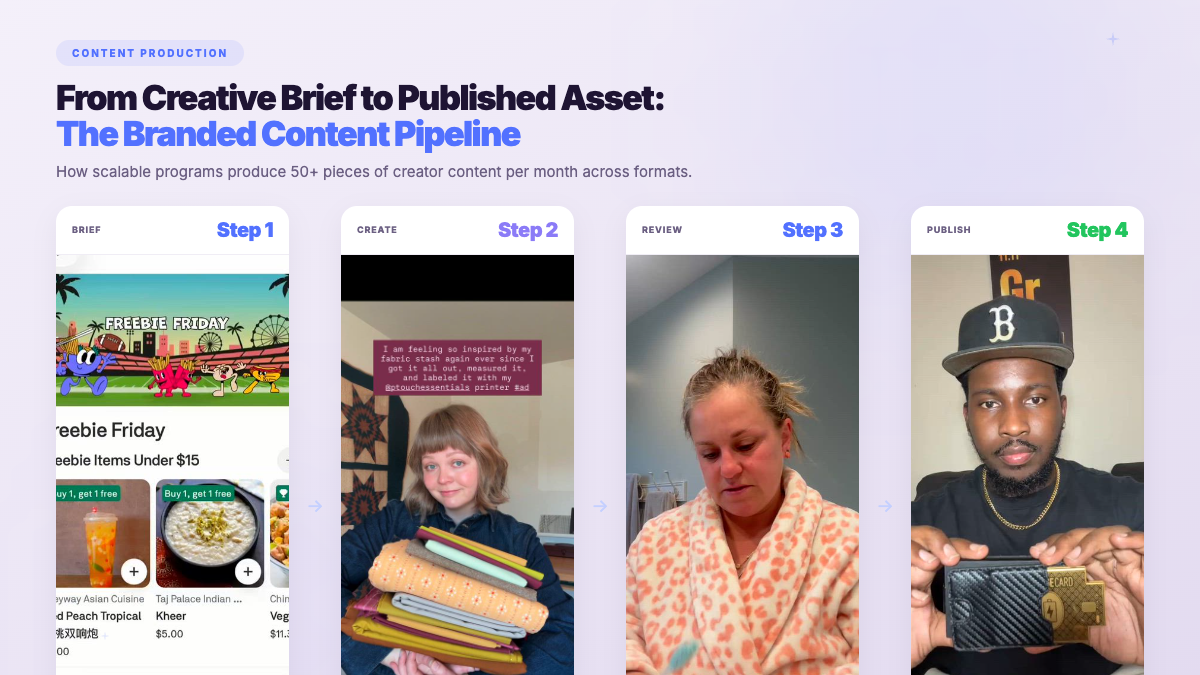
Creator-produced content has a distinct production process that differs from traditional brand content production. The creator is both the talent and the production team. Your job is to brief well, cast right, and approve efficiently: not to direct.
Pre-Production: Brief, Casting, Platform Alignment
Pre-production for creator content is primarily about the brief and casting. You need to define:
- What you need: format, platform, deliverables, timeline
- What the content must communicate: key message, required mentions, restrictions
- What you’re NOT prescribing: give the creator creative latitude within your brief
Casting happens at this stage too. The creator you choose shapes everything about the content. The right creator for a TikTok campaign looks different from the right creator for a YouTube series. Match creator style, audience, and platform to your content objective.
The Creative Brief: The Difference Between Good and Bad Content
A good brief enables great content. A bad brief produces mediocre content, or causes rounds of revisions that erode the creator relationship and push timelines.
The biggest brief mistake: over-specifying. Brands that write scripts and expect creators to read them get stiff, inauthentic content. Brands that write tight briefs with clear objectives and creative latitude get native, high-performing content.
Casting the Right Creator
Creator casting criteria go beyond follower count. The right creator for branded content has:
- Audience alignment: Their audience matches your target viewer profile
- Content style fit: Their natural content style aligns with your brand’s narrative
- Engagement quality: Real, engaged community: not inflated metrics
- Brand affinity: They actually like or use products in your category
- Brand safety: Content history is brand-appropriate
AI-powered creator matching platforms like partnrUP make this analysis faster and more accurate than manual vetting. Instead of scrolling through creator profiles, AI matches based on audience data, content analysis, and performance history. Learn more about how AI creator matching transforms brand partnerships.
Production: Creator-Led vs. Brand-Directed
The most effective branded content production gives creators genuine ownership of execution. This means:
- Providing a tight brief, then stepping back
- Trusting the creator to interpret the brief for their audience
- Not requesting pre-production approvals that slow timelines
- Reserving your input for compliance issues, not style preferences
Brand-directed content , where the brand essentially writes the script and uses the creator as a talent for hire , produces content that feels like an ad regardless of who delivers it. Creator-led content benefits from authenticity that brand-directed content can’t replicate.
The Approval Process
Define your approval process in the contract before production begins. Standard best practices:
- Maximum 2 rounds of revisions
- 24–48 hour review window (creators plan their content calendars)
- Clear distinction between mandatory changes (legal/compliance) and optional preferences
- Legal review happens in round 1 only : don’t loop in legal at the end
Brands that slow-walk approvals, ask for 4+ revision rounds, or provide vague feedback damage creator relationships and get put at the bottom of the creator’s priority list for future campaigns. See also: 3 costly mistakes brands make working with video creators.
Post-Production: Native vs. Polished
For social creator content, resist the urge to over-polish. Native-feeling content consistently outperforms over-produced branded content on social platforms. Audiences can tell the difference between authentic creator content and brand-polished content, and authenticity is what drives the trust dividend of branded content.
Exception: content you plan to use as paid ads may benefit from production upgrades. If you’re running a creator’s video as a paid social ad, slight production enhancements (better captions, brand end card) are often worth it.
Content Brief Mastery
The creative brief is the single most important document in branded content production. A tight, clear, creator-friendly brief produces better content than any amount of revision feedback. Here’s the complete template:
Complete Branded Content Brief Template
Brand Story and Positioning
2–3 sentences: what does the brand do, who is it for, what’s the brand’s personality? Don’t write a mission statement: write something the creator can actually use to understand your brand.
Campaign Objective
What is this specific content trying to achieve? Be specific: “drive traffic to our new product page” or “increase brand awareness among 25–34 fitness enthusiasts” , not “build brand awareness.”
Target Viewer
Describe the person you want watching this content. Age range, interests, what they care about, what motivates them. This helps creators calibrate their approach for resonance.
Key Message (One Message Only)
If the viewer takes away one thing from this content, what should it be? One message. The discipline of choosing one message is what separates effective briefs from diluted ones. Brands that try to communicate five things communicate zero things memorably.
Tone and Style Guidelines
Describe the feeling, not the execution. “Warm, relatable, genuine” rather than “use this script.” Include brand words to use and avoid. Provide examples of content you love.
What NOT to Include
Be explicit about restrictions: competitive mentions, certain claims, topics that are brand-sensitive. This prevents compliance issues without over-scripting.
Platform and Format Specs
Exact specifications: platform, video length, aspect ratio, caption requirements, disclosure language, posting time requirements, any required hashtags.
Deliverables and Timeline
What exactly gets delivered, when. Draft due date, review window, live date. No ambiguity.
Usage Rights
How will the brand use this content? Duration, channels, whitelisting permissions. Usage rights must be defined before content is produced , retrofitting rights after the fact is expensive and damages creator relationships.
Brief Review Checklist
Before sending a brief to a creator, confirm:
- ☐ One key message only
- ☐ Tone described in feelings, not scripts
- ☐ Platform specs explicitly stated
- ☐ Usage rights defined
- ☐ Review timeline specified
- ☐ “What NOT to include” section completed
- ☐ A brand human has read this and can answer creator questions
Distribution Strategy for Branded Content
Content without distribution is a tree falling in an empty forest. The best branded content program invests nearly as much in distribution as production. There are four distribution channels, and the most effective programs use all four in combination.
1. creator-owned channels (Primary Distribution)
When a creator publishes branded content on their channel, you access their audience: the audience they’ve built, nurtured, and whose trust they hold. This is the most valuable distribution channel for branded content, and it’s the primary reason you work with creators rather than producing the content yourself.
Protect it: don’t ask creators to publish at awkward times, don’t over-police captions, and don’t require so many brand elements that the content feels foreign to their audience.
2. Brand-Owned Channels (Owned Amplification)
Repurpose and republish creator content across your brand’s channels: website, social accounts, email newsletters, YouTube channel, sales decks. This requires usage rights (which you secured in the brief). Brand-owned amplification extends the content’s life and reach beyond the creator’s audience.
3. Paid Distribution (Whitelisting and Dark Posting)
Paid social amplification of creator content: either boosting organic posts or running creator content as ads from the creator’s handle (whitelisting) or from the brand’s account (dark posting). This is one of the highest-ROI uses of paid social budget because the content benefits from creator authenticity while receiving algorithmic amplification. More on this in the dedicated section below.
4. Earned Distribution (Shares and Organic Virality)
Great branded content gets shared , by the creator’s audience, by media outlets covering branded content trends, by other creators inspired by it. Earned distribution can’t be bought or guaranteed, but it can be planned for: content that’s genuinely surprising, useful, or emotionally resonant earns shares in a way that straightforwardly promotional content never will.
Cross-Platform Content Adaptation
Each platform has distinct content norms. Content produced for TikTok shouldn’t be repurposed raw for LinkedIn. Build adaptation into your distribution plan: same core message, platform-native execution. A creator video becomes:
- A TikTok (vertical, 15–60 seconds, trending audio, captions)
- An Instagram Reel (same format, Instagram-native caption)
- A YouTube Short (may need slight edit for YouTube norms)
- A website embed (with additional context)
- An email embed or GIF (static frame with play button)
Whitelisting and Dark Posting
Whitelisting and dark posting are among the most powerful, and most underused: tactics in branded content distribution. They let brands run paid advertising using creator content, combining creator authenticity with the targeting precision of paid social.
What Creator Whitelisting Is
Creator whitelisting (also called allowlisting) is when a creator grants a brand access to run paid ads from the creator’s social account. The ad appears to come from the creator , their profile picture, their name, but the brand controls the targeting, budget, and distribution. The audience sees creator content in their feed, not a brand ad.
This combination , creator authenticity + brand targeting , consistently outperforms both pure organic creator content and brand-run paid ads on click-through and conversion metrics.
How to Set Up Whitelisting
Meta (Instagram/Facebook): Creator grants brand access via Meta Business Manager. Brand then runs ads using creator’s handle and content in Ads Manager. The creator’s account must be set up as a creator account with branded content permissions enabled.
TikTok: Creator enables “Ad Authorization” in their TikTok app settings. Brand receives a code to input in TikTok Ads Manager. Whitelisted posts can then be amplified as Spark Ads.
Dark Posting: Running Ads from Creator Handles
Dark posting is a variation where the brand runs ads using the creator’s handle, but the content doesn’t appear on the creator’s organic feed: it only appears as a paid placement. This allows brands to test multiple variations of creator content in paid distribution without flooding the creator’s feed.
Performance Benchmarks
Whitelisted creator content typically outperforms standard brand ads by:
- 30–50% higher CTR
- 20–40% lower CPM (algorithm rewards high-quality content)
- Significantly higher ROAS for direct-response campaigns
For more on brand-creator partnership structures that enable whitelisting, see our complete playbook.
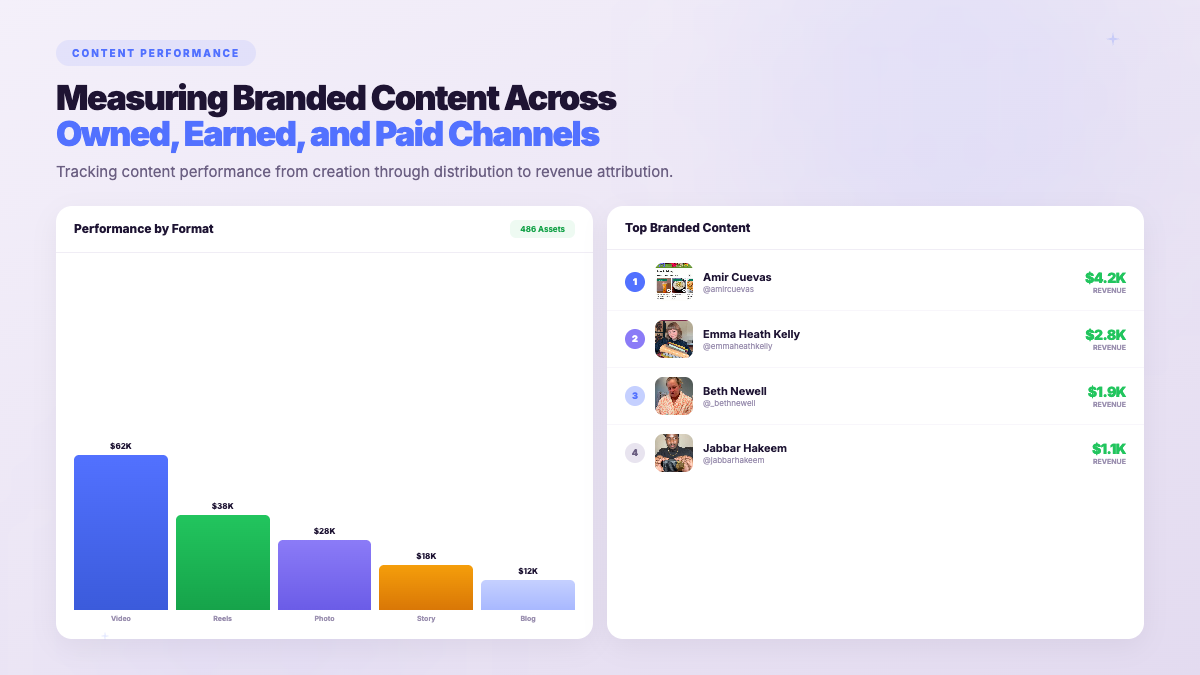
Measuring Branded Content Performance
Measurement is where most branded content programs fall apart. Vanity metrics (views, likes) make it easy to feel like something’s working when nothing meaningful is happening. Real measurement connects content activity to business outcomes.
Awareness Metrics
- Reach: Unique accounts reached by the content
- Impressions: Total content views (one account can generate multiple)
- Video views: Per platform definition (3-second view on Meta, varies by platform)
- Brand recall lift: Survey-based measure of whether content improved brand recognition
- Share of voice: Your brand mentions vs. competitors over the campaign period
Engagement Metrics
- Watch time / completion rate: Strongest signal for video content quality
- Saves: High-intent engagement: user wants to return to this content
- Shares: Active advocacy , user endorses content to their network
- Comments: Quality of comments matters more than volume
Conversion Metrics
- Link clicks: Traffic driven from content to destination
- Promo code redemptions: Directly attributable to specific creator/content
- Attributed revenue: Revenue from UTM-tagged traffic or affiliate tracking
- ROAS: Return on ad spend for whitelisted/paid amplification
Content Value Metrics
- Earned Media Value (EMV): What equivalent paid media would cost for the same reach
- Content licensing value: If the brand reuses creator content as ad creative, what did they save on production?
- Content lifespan: How long is this piece continuing to generate views/value?
For a deeper dive into attribution models and ROI frameworks, see The Complete Guide to Influencer Marketing ROI.
Repurposing Branded Content for Maximum Value
The best branded content programs don’t produce and publish: they produce, publish, and multiply. A single creator video can generate 10× its initial value through strategic repurposing.
Getting 10× Use Out of One Creator Piece
One creator video can become:
- Original TikTok/Reel (creator’s channel)
- Whitelisted paid ad (Meta or TikTok)
- Brand social repost (Instagram, TikTok, YouTube Shorts)
- Website embed (product page, landing page, homepage)
- Email campaign content (GIF or embed)
- Sales enablement asset (deck, proposal)
- PR material (social proof for press outreach)
- Paid display ad (static frame pull)
- Testimonial snippet (quote from video caption or audio)
- A/B test variation (test different creator clips as ad creative)
Platform Adaptation
Each platform has format and norm requirements. Adapting content for each platform: rather than posting the same file everywhere , meaningfully improves performance. TikTok content adapted for YouTube Shorts needs different caption treatment. Instagram Reels adapted for LinkedIn requires a completely different framing.
Evergreen vs. Campaign-Specific Reuse
Not all branded content ages equally. Tutorial content, product demonstration content, and “how it works” content can be repurposed indefinitely. Trend-driven, campaign-specific, or time-sensitive content has a shorter repurposable life. Build your content library with this distinction in mind: evergreen content is your highest-ROI asset for long-term repurposing.
Content Library Management
As your branded content program scales, library management becomes critical. A content library should track: asset location, usage rights (channels, duration, restrictions), performance data, repurpose history, and expiration dates. Without this system, great assets get lost or used beyond their rights window.
Building a Scalable Branded Content Program
Moving from one campaign to an always-on branded content program is a meaningful operational shift. The creative work is the same; the infrastructure is different.
From Campaign-Based to Always-On
Always-on branded content programs have a consistent content cadence, not just bursts around launches or seasonal moments. This requires:
- A content calendar that plans creator content alongside owned content
- A creator roster (not one-off casting) : a stable of creators who know the brand and can activate quickly
- Streamlined brief and approval processes that don’t require reinvention every campaign
- Standing usage rights agreements rather than one-off negotiations
Building a Creator Roster
A creator roster: a group of trusted, vetted creators with standing brand partnerships , is a significant competitive advantage. Roster creators know your brand, your brief style, your approval process. They deliver faster, with less friction, and often with better results than first-time collaborations.
Build your roster by identifying top performers from each campaign and converting them to ongoing relationships. Prioritize creators who are: reliable, brand-aligned, audience-matched, and professionally easy to work with.
See also: Creator Content Strategy: Building a Scalable Creative Program for a complete framework.
Content Volume Planning
How much content do you need? The answer depends on distribution strategy and audience. A rule of thumb for a mid-market brand running an always-on creator program:
- 4–8 creator pieces per month for organic awareness
- Additional volume for paid amplification testing (more pieces = more creative testing data)
- 1–2 “hero” pieces per quarter for brand storytelling
Team Structure and Tool Stack
Scaling branded content requires infrastructure:
- Creator management platform: Discovery, outreach, contracts, payments, reporting in one place
- Content management system: Track all assets, rights, performance
- Brief templates: Standardized but customizable
- Approval workflow: Defined stakeholders, deadlines, revision limits
Platforms like partnrUP handle creator discovery, brief delivery, contract management, and performance tracking: reducing the operational overhead that kills branded content programs at scale. The influencer marketing platform comparison guide covers the full tool landscape.
Quality Control at Scale
As volume increases, quality control becomes the primary operational challenge. Key mechanisms:
- Standardized briefs reduce brief-to-brief variability
- Creator scoring by campaign : track performance per creator over time
- Tiered creator relationships (hero vs. micro network) with different oversight levels
- Quarterly content audits: what’s working, what’s not, what needs to change
Frequently Asked Questions
What’s the difference between branded content and sponsored content?
The terms are often used interchangeably, but there’s a subtle distinction. Sponsored content typically refers to a specific paid placement: a sponsored post, a sponsored article , where the brand pays for visibility in an existing content format. Branded content is broader: it refers to content where the brand is the creative initiator, often with more original storytelling. In practice, most creator-produced branded content is also sponsored content.
How much does branded content creation cost?
Costs vary enormously based on creator size, platform, deliverable type, and usage rights. A nano-creator TikTok integration might cost $200–$500; a macro creator YouTube integration might cost $20,000–$100,000+. Most mid-market brands working with micro-creators should budget $1,000–$5,000 per creator piece, all-in, including production, talent, and rights.
How do you disclose branded content?
FTC guidelines in the US require clear disclosure of material connections between brands and creators. This means “#ad,” “#sponsored,” or “paid partnership” disclosures that are conspicuous: not buried in hashtags or below the fold. Platform-native paid partnership labels (Meta’s “Paid Partnership” tag, TikTok’s “Promotional Content” label) satisfy disclosure requirements when properly set up.
Does disclosure hurt performance?
Research consistently shows that disclosure has minimal negative impact on branded content performance, and sometimes increases it by signaling brand investment in the creator relationship. Consumers have sophisticated media literacy; they expect creators to have brand partnerships. The quality and authenticity of the content matters far more than the presence of a disclosure.
How long should a branded content video be?
Platform norms and audience behavior dictate optimal length more than brand preference. TikTok/Reels: 15–60 seconds for most content, up to 3 minutes for tutorials. YouTube Shorts: under 60 seconds. YouTube long-form: 8–20 minutes for mid-funnel content. The video should be exactly as long as it needs to be: no longer. Padded content kills completion rates.
What’s a good engagement rate for branded content?
Engagement rates vary significantly by creator size (smaller creators have higher rates) and platform. Rough benchmarks: TikTok 3–8% is solid for micro-creators; Instagram 1.5–3.5% for mid-tier; YouTube completion rate above 40% is strong for branded content. Don’t compare engagement rate across platforms: the definitions and audience behaviors are too different.
Can you use branded content as paid ads?
Yes, and you should. This is called whitelisting (running ads from the creator’s handle) or dark posting (running ads from the brand handle using creator creative). Both require explicit usage rights agreements in the creator contract. Whitelisted creator content typically outperforms brand-produced ad creative significantly on CTR and ROAS.
How many revision rounds should you allow in the approval process?
Best practice: 2 rounds maximum. More than 2 rounds suggests either the brief was unclear, the creator was miscast, or the brand is trying to direct rather than guide. Build revision limits into the creator contract. If you frequently need 3+ rounds, the problem is in the brief: fix that first.
How do you measure ROI on branded content that’s primarily awareness-focused?
Awareness ROI is harder to measure than conversion ROI, but not impossible. Methods include: brand lift studies (survey panels measuring recall before/after campaign), share of voice tracking (brand mention volume vs. competitors), search volume for branded terms (does branded content correlate with increased brand search?), and earned media value comparisons. For brands without budget for formal brand lift studies, tracking organic search performance for brand terms over time provides a useful proxy.
What platforms should I start with for branded content?
Start where your audience is: not where you’re most comfortable. For most consumer brands in 2026, TikTok and Instagram are the highest-reach, highest-organic-potential platforms for creator-produced branded content. YouTube delivers better for tutorial, review, and longer-consideration products. B2B brands often find LinkedIn and podcasts more effective than social video. If you’re genuinely unsure, test one creator piece on each of two platforms with equivalent budgets and compare results.
Ready to Build a Branded Content Program That Performs?
Branded content is one of the most powerful marketing channels available to brands today, but only when it’s built on a real system. A clear strategy, the right creators, tight briefs, intelligent distribution, and rigorous measurement are what separate branded content programs that move the needle from those that produce content for content’s sake.
partnrUP makes the creator side of this equation — finding the right creators, briefing them, managing production, and distributing content — dramatically faster and more effective. AI-powered creator matching identifies the creators most likely to resonate with your specific audience. Built-in workflow tools handle briefs, approvals, contracts, and payments. And performance tracking connects content activity to real business outcomes.
If you’re ready to stop guessing at branded content and start building a real program, see how partnrUP works.