78% of brands say finding the right creator is their #1 challenge in influencer marketing: yet most are still sorting through spreadsheets, scrolling Instagram, and trusting their gut to make decisions that cost five to six figures per campaign.
That’s not a strategy. That’s guesswork with a budget attached.
AI-powered creator matching is changing the equation. Brands that have moved beyond manual creator discovery are reporting faster campaign launches, higher content quality, and measurably better ROI , because they’re matching on what actually drives performance, not just what looks good in a pitch deck.
In this guide, you’ll learn:
- Why traditional creator discovery consistently fails brands
- How AI creator matching actually works under the hood
- The 7 metrics AI analyzes that humans routinely miss
- How to evaluate whether an AI matching platform is built to convert
- A practical framework for implementing AI-assisted creator selection
Table of Contents
- The Real Cost of Getting Creator Selection Wrong
- How AI-Powered Creator Matching Works
- The 7 Metrics AI Analyzes That Humans Miss
- What to Look for in an AI Matching Platform
- Implementing AI Creator Matching: A Step-by-Step Framework
- Conclusion: The Brands That Win in 2026
- Frequently Asked Questions
The Real Cost of Getting Creator Selection Wrong
Let’s be direct about what bad creator matching actually costs.
When a brand picks the wrong creator, even a talented one with great engagement: it doesn’t just waste the partnership budget. It delays campaign timelines while briefs get rewritten. It creates content that doesn’t land with the intended audience. It burns internal bandwidth on back-and-forth revisions. And it erodes trust in the influencer marketing channel altogether, making the next campaign harder to get approved.
Research from the influencer marketing industry consistently shows that brand-creator fit drives roughly 60% of campaign performance variance. You can have the best brief, the most generous usage rights deal, and a flawless content strategy, but if the creator’s audience doesn’t match your customer profile, you’re broadcasting to the wrong room.
The traditional approach to solving this problem is manual and slow. A brand manager exports a list of creators from a database, filters by category and follower count, manually reviews profiles, checks a few posts for tone and quality, and makes a judgment call. This process takes days. It introduces massive subjective bias. And it ignores 90% of the data that actually predicts whether a partnership will perform.
AI changes all of this , not by replacing human judgment, but by giving it something real to work with.
How AI-Powered Creator Matching Works
At its core, AI-powered creator matching uses machine learning models to analyze structured and unstructured data across both brand profiles and creator catalogs, and surface partnerships most likely to drive results.
Here’s how the matching process typically works:
Step 1: Brand Profile Ingestion
The AI ingests your brand’s parameters: product category, target customer demographics, content tone, past campaign performance data, competitor positioning, and campaign objectives. This creates a dynamic “brand DNA” model that goes well beyond a simple category tag.
Step 2: Creator Content Analysis
The system analyzes each creator’s library at scale, not just their latest posts, but their content history. Natural language processing evaluates tone, vocabulary, and topic clustering. Computer vision analyzes visual aesthetics, production quality, and brand-safety signals. Engagement pattern analysis strips out inflated metrics to assess genuine audience interaction.
Step 3: Audience Intelligence Layer
This is where the real differentiation happens. AI matching platforms pull audience demographic and psychographic data , age distribution, geographic concentration, purchasing behavior signals, and content consumption patterns, and map creator audiences against your ideal customer profile.
Step 4: Fit Scoring and Ranking
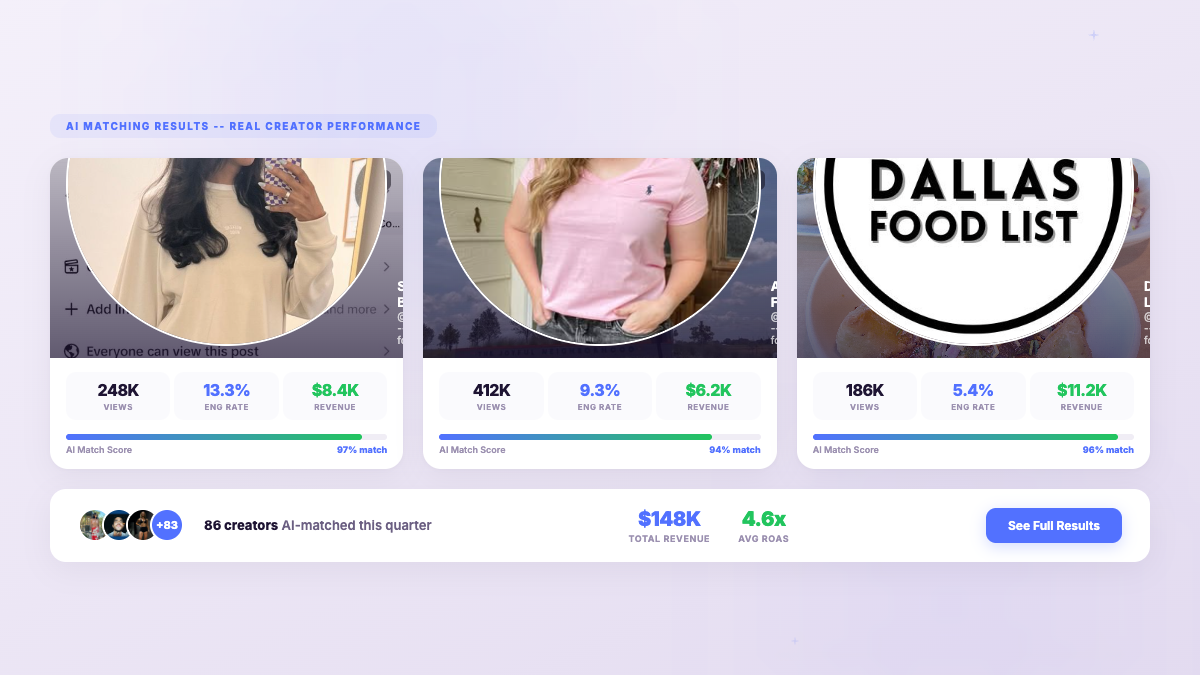
The system generates a multi-dimensional fit score for each potential creator-brand pairing and surfaces the highest-confidence matches with supporting data. Instead of a list of creators to evaluate, you get a ranked shortlist with clear rationale for each recommendation.
What makes this different from a basic search filter is the model’s ability to find non-obvious matches. A fitness apparel brand might get matched with a productivity creator whose audience overlaps heavily with their target demographic , a connection no human would surface from a keyword search but one the AI identifies through audience behavior patterns.
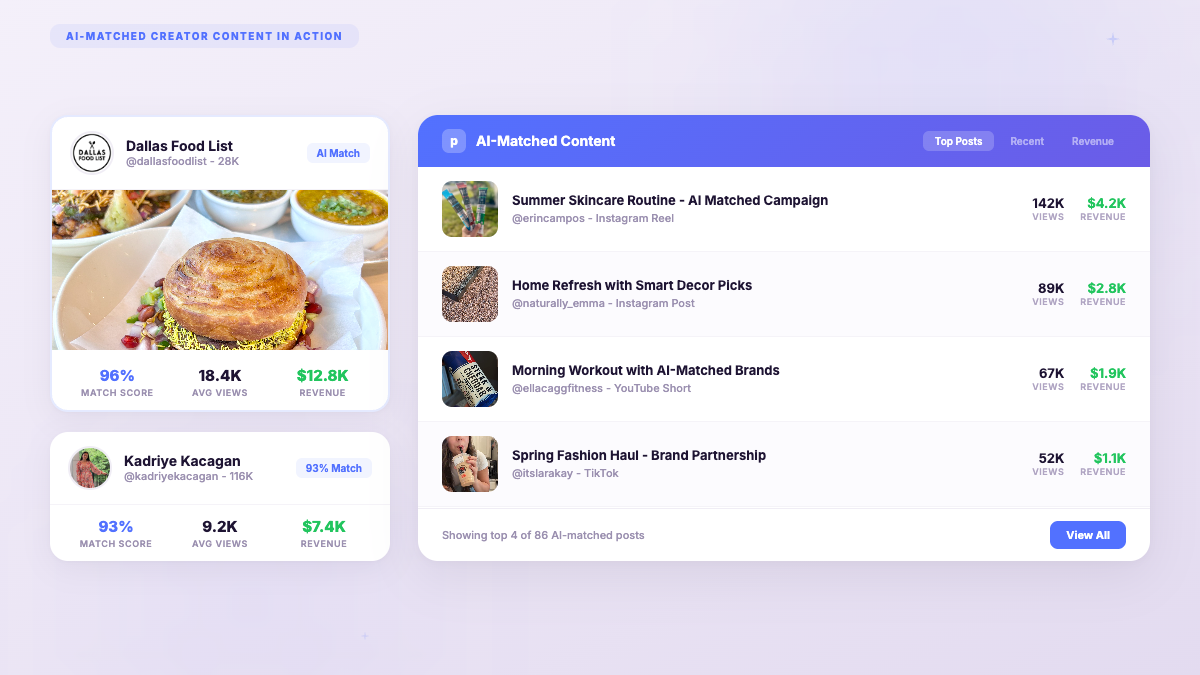
Platforms like partnrUP are built specifically around this kind of intelligent matching , connecting brands with video creators whose audiences, content styles, and performance histories actually align with campaign goals.
The 7 Metrics AI Analyzes That Humans Miss
Manual creator evaluation tends to focus on the metrics that are easy to see: follower count, average likes, and whether the content “looks right.” AI-powered matching digs into the signals that actually predict performance:
1. Audience Authenticity Score
AI models detect follower growth anomalies, engagement velocity patterns, and comment quality signals that indicate whether a creator’s audience is real and engaged, or inflated through pods, purchased followers, and automated activity.
2. Content-Brand Alignment Index
Beyond category matching, AI measures semantic similarity between a creator’s content themes and a brand’s messaging. A creator who makes content “about travel” may actually skew heavily toward budget backpacking: a very different audience signal than luxury travel audiences.
3. Audience Psychographic Overlap
Demographics tell you who a creator’s audience is. Psychographics tell you how they think and what they buy. AI platforms analyze behavioral signals to map creator audiences against consumer psychology profiles rather than just age/gender splits.
4. Historical Performance Consistency
A creator’s best-performing content is easy to find. AI evaluates performance consistency over time , identifying creators with reliable, repeatable results versus those with one viral outlier skewing their averages.
5. Competitive Brand Exposure
AI scans creator content history to surface past partnerships with competitor brands. This catches conflicts your manual review would likely miss, especially from older content that’s moved off the feed.
6. Content Velocity and Saturation
A creator posting 15 paid partnerships per month is a different proposition than one posting two. AI tracks sponsored content frequency to identify creators whose audiences are saturated with branded posts , reducing the likely impact of your campaign.
7. Conversion Signal Alignment
Where available, AI platforms incorporate purchase-intent signals and click-through data from past partnerships to identify creators whose audiences not only engage with content, but act on it.
These aren’t metrics you can pull manually at scale. AI does the work in seconds across thousands of creator profiles, and delivers a shortlist based on what drives results, not what looks impressive on a media kit.
What to Look for in an AI Matching Platform
Not all “AI-powered” creator platforms are the same. Many apply basic filtering algorithms and call it AI. Here’s how to evaluate whether a platform is actually built for performance:
Data depth and freshness: How often is audience data refreshed? Platforms that pull audience data weekly versus monthly will give you meaningfully different accuracy. Stale data leads to mismatches.
Audience-level (not just creator-level) analysis: The platform should show you audience intelligence for each creator, not just creator-level metrics. A creator with 500K followers in your target demo is more valuable than one with 2M in the wrong market.
Explainability: Can the platform tell you why it’s recommending a match? The best AI tools provide reasoning, not just scores. You should be able to understand the logic behind each recommendation so you can apply judgment on top of it.
Niche depth vs. surface breadth: Platforms optimized for specific content types , particularly video , tend to outperform general-purpose influencer databases. Video content is structurally different from static posts and requires different performance models.
Workflow integration: An AI match is only useful if it speeds up your workflow. Look for platforms that take you from match to brief to contract in a single flow rather than forcing you to export CSVs and manage outreach manually.
partnrUP is designed specifically for branded video , matching brands with video creators whose content style, audience composition, and brand-safety history align with campaign needs. The platform handles the full workflow from discovery through delivery, eliminating the operational friction that slows most branded content programs down. Book a demo to see it in action.
Implementing AI Creator Matching: A Step-by-Step Framework
Moving from manual to AI-assisted creator selection doesn’t require a wholesale process overhaul. Here’s a practical framework:
Phase 1: Define Your Matching Criteria
Before you touch any platform, get explicit about what a “good match” means for this specific campaign. Define target customer demographics, content tone requirements, geographic priorities, past brand partnership restrictions, and minimum performance thresholds. The more specific your inputs, the more accurate the AI outputs.
Phase 2: Run Discovery With Intent
Use the AI platform to run your initial match. Don’t immediately filter to the smallest possible shortlist: generate a broader set (30–50 creators) and review the match rationale for each. You’ll learn more about what the AI is seeing in the data, and you’ll surface non-obvious matches worth exploring.
Phase 3: Human Layer Review
Narrow to a shortlist of 10–15 and apply human judgment to the remaining variables the AI can’t fully assess: creative voice, personal brand direction, how the creator communicates, whether their public persona aligns with your brand values. This is where your team adds value.
Phase 4: Pilot and Measure
For your first AI-matched campaign, run a pilot with 3–5 creators rather than a full roster. Measure performance against your historical benchmarks. The data you collect feeds back into your matching criteria for every subsequent campaign.
Phase 5: Iterate the Criteria
After each campaign, update your matching parameters with performance data. Which audience segments drove the most conversions? Which content formats over-indexed on engagement? This feedback loop is what separates brands that get incrementally better at creator marketing from those that keep starting from scratch each quarter.
Conclusion: The Brands That Win in 2026
The influencer marketing landscape has become too competitive and too complex for manual creator selection at scale. The brands winning right now aren’t the ones with the biggest rosters or the highest spend: they’re the ones that match precisely, brief efficiently, and optimize relentlessly.
AI-powered creator matching is the infrastructure behind that precision. It takes the guesswork out of discovery, surfaces the performance signals that matter, and frees your team to focus on strategy and creative direction rather than spreadsheet management.
The shift from manual to AI-assisted isn’t coming: it’s already here. The question is whether you’re using it or falling behind competitors who are. See how partnrUP’s platform works or book a demo to get started.
Frequently Asked Questions
What is AI-powered creator matching?
AI-powered creator matching is a technology-driven approach to influencer selection that uses machine learning to analyze brand profiles, creator content, and audience data: surfacing the partnerships most likely to drive campaign results. It replaces manual filtering and gut-instinct selection with data-backed recommendations.
How is AI creator matching different from a standard influencer database search?
A standard database search filters by basic parameters like category, follower count, and location. AI matching goes deeper, analyzing audience psychographics, engagement authenticity, content-brand alignment, and historical performance consistency — then scores and ranks matches based on predicted fit, not just surface-level attributes.
Can AI-powered matching work for video creator campaigns specifically?
Yes, and video-specific platforms are particularly effective because they can analyze visual aesthetics, production quality, storytelling structure, and sponsorship integration style within video content, providing a richer picture of creator fit than platforms built primarily around static post analysis.
How long does AI creator matching take compared to manual discovery?
Manual creator discovery typically takes 3–10 days of internal research for a campaign roster. AI-powered matching can surface a data-backed shortlist in minutes, with the human review layer bringing total time from days to hours.
What data does AI creator matching use to make recommendations?
Typical inputs include creator audience demographics and psychographics, engagement rate and pattern analysis, content topic and tone analysis, historical sponsored content performance, follower authenticity signals, past brand partnership history, and geographic audience distribution.
Is AI creator matching suitable for small brands with limited budgets?
AI matching is particularly valuable for smaller brands where wasted partnership spend is more costly. Precise matching reduces the risk of budget allocated to underperforming partnerships, making limited influencer marketing budgets go further.
How does partnrUP use AI for creator matching?
partnrUP’s platform is built specifically for branded video content, matching brands with video creators based on audience fit, content style alignment, and brand-safety analysis. The platform handles the full workflow from AI-matched discovery through brief delivery and content approval — learn more at partnrUP.ai/platform.