




Among marketers who answered the question, 66.3% report running their influencer programs entirely in-house, according to the Influencer Marketing Hub 2026 Benchmark Report. That statistic is usually read as a story about budgets and control. Read it as a story about approvals instead: in two out of three programs, the person reviewing creator content is a marketer with other responsibilities, no dedicated review process, and no one to escalate to.
This guide is part of our Branded Content Creation: From Strategy to Production to Distribution pillar — it covers the review stage specifically, after the brief is written and the content comes back.
Most advice about creator approvals is really advice about briefs. Write a better brief, the argument goes, and approvals take care of themselves. Better briefs do reduce revision volume, but they do not eliminate the review step, and they say nothing about how to behave once content you did not expect is sitting in your inbox with a posting date attached.
That moment is where authenticity actually dies. Not in the brief, and not in the strategy deck. It dies in a comment thread where four people who were not part of the original conversation each ask for one small change.
In this guide, you'll learn:
- Why approval processes degrade content even when every individual note is reasonable
- How to separate the two kinds of feedback that must never be mixed
- Who should hold approval authority, and why committees produce worse content than individuals
- How to write revision requests a creator can act on without flattening their voice
- What to cap, what to measure, and when to walk away from a piece instead of fixing it
Table of Contents
- Why Approval Processes Flatten Content
- The Two Kinds of Feedback
- Who Holds Approval Authority
- The Compliance Floor You Cannot Negotiate
- How to Write a Revision Request
- Revision Caps and What to Measure
- Frequently Asked Questions
Why Approval Processes Flatten Content
No one sets out to make creator content worse. The degradation is structural, and it comes from three mechanics that operate independently of anyone's taste or intentions.
Every Reviewer Adds, No Reviewer Subtracts
A reviewer's job, as most reviewers understand it, is to catch things. Catching something produces a visible contribution; approving as-is produces nothing to point at. So each person in the chain adds a note, and nobody is incentivized to remove one. Five reviewers each contributing one "small" change produce a piece of content with five changes, none of which any single person would have called significant.
The creator does not experience it that way. They experience a list.
Feedback Converges on Brand Language
Asked to improve a sentence, most marketers will move it toward language they recognize as correct — which is the language of their own brand materials. This is a reasonable instinct applied to the wrong artifact. The reason the creator's audience responds to the creator is that they do not sound like a brand. Each edit that makes a caption sound more like the website removes a little of the thing you paid for.
The Posting Date Does Not Move
Revision rounds consume the creator's time, but the deadline is usually fixed. A piece that comes back three times gets progressively less of the creator's actual attention, because they are now working against a clock on content they have already mentally finished. The third revision is almost always worse than the second, even when it technically satisfies the note.
The scaling side of this problem is well understood — tiering content by impact, giving proven creators more latitude. What follows is the review loop itself.
The Two Kinds of Feedback
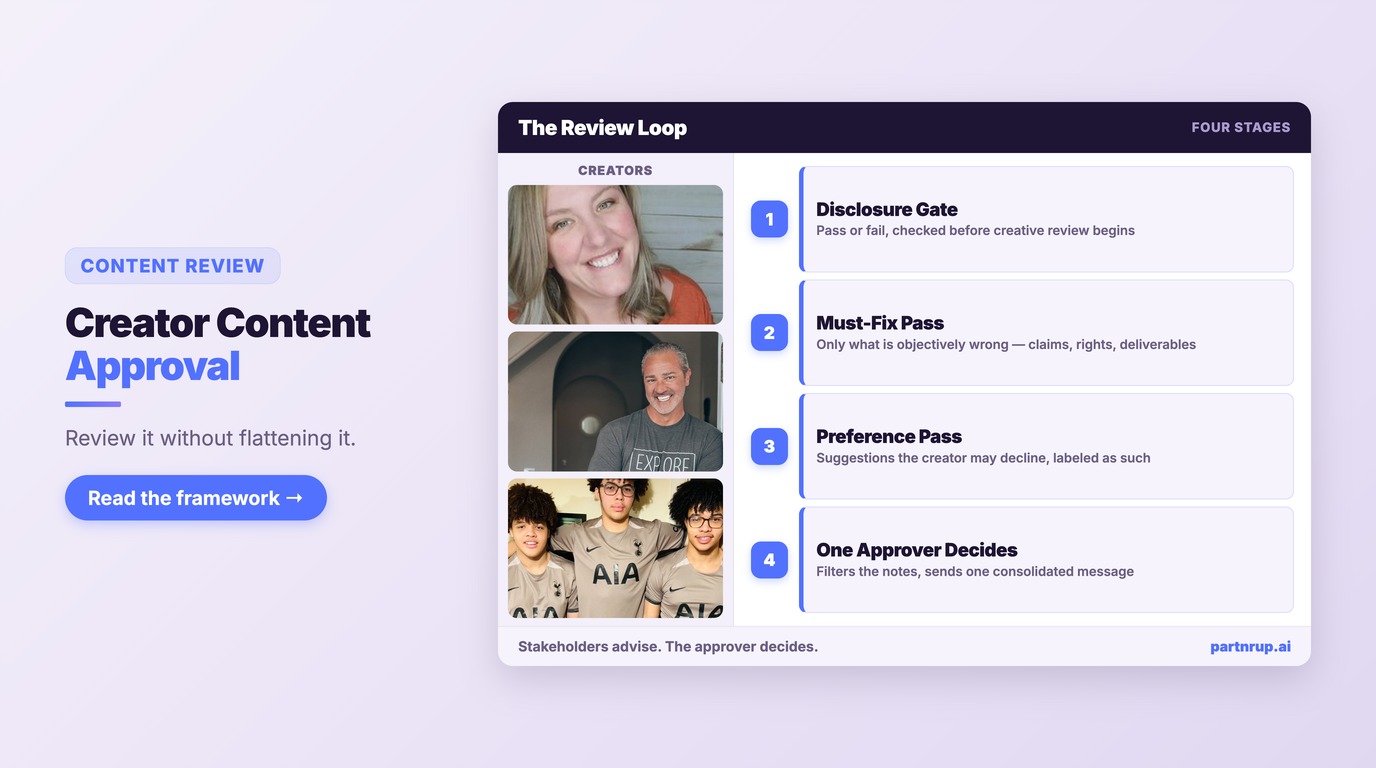
Almost every bad approval process has the same root cause: it treats all feedback as one category. There are two, they have different authority levels, and mixing them is what makes creators feel managed rather than partnered.
Category One: Must-Fix
A must-fix is feedback where the content is wrong, not suboptimal. It has an objective test. Someone outside the marketing team could rule on it.
- A factual claim about the product that is not true
- A missing or inadequate sponsorship disclosure
- A competitor product visible in frame
- A regulated claim the brand cannot substantiate
- Wrong product, wrong SKU, wrong offer, wrong link
- Contractual deliverable missing — the brief asked for 30 seconds, the file is 12
Must-fix notes are non-negotiable and should be rare. If you are generating many of them, the problem is upstream in how the brief was written, not in the creator's execution.
Category Two: Preference
Preference is everything else. The thumbnail you would have picked. The hook you find slow. The word you would not have used. Preferences can be real improvements — and they are still preferences, because there is no test that settles them other than someone's authority.
The rule: must-fix notes are instructions; preference notes are requests. Send them in the same message, unlabeled, and the creator cannot tell which is which. They will either treat everything as mandatory, in which case your preferences overwrite their judgment wholesale, or treat everything as optional, in which case your must-fix gets ignored.
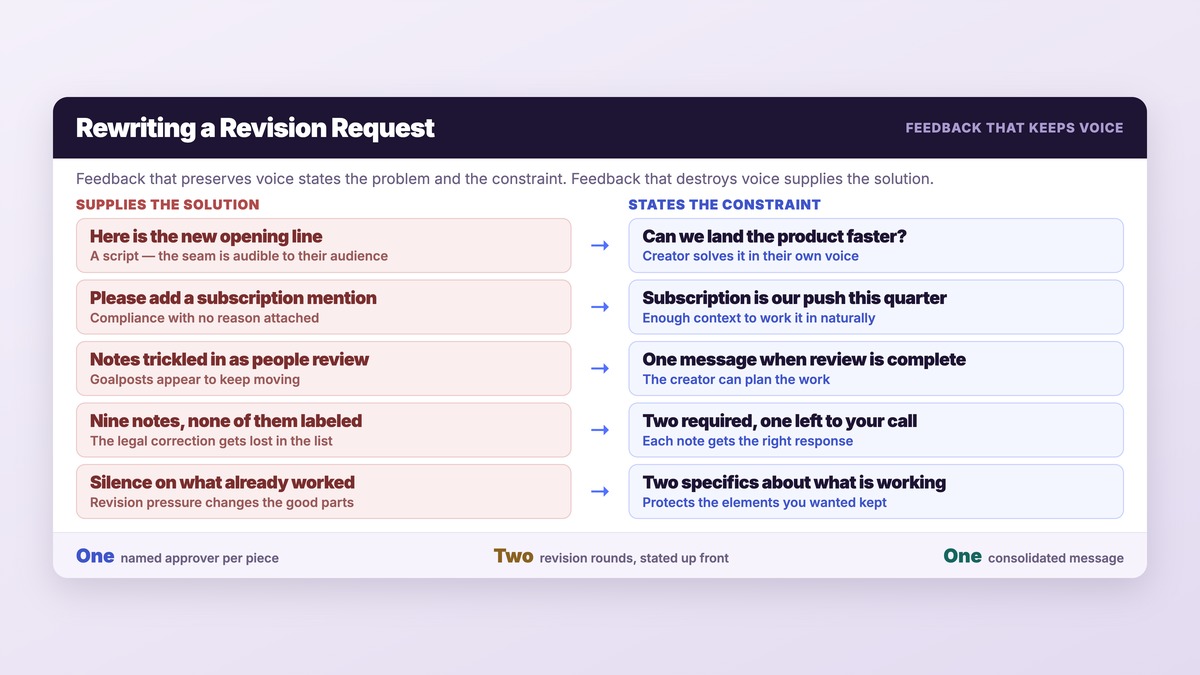
Label them explicitly. "Two required changes, and one thing I'd suggest but leave to you" is a sentence that takes four seconds to write and changes the entire character of the exchange.
The Ratio Is the Signal
Track the ratio of preference notes to must-fix notes across a campaign. A program running eight preferences for every must-fix is not doing quality control — it is doing taste enforcement, at the cost of the creator relationship and the content's performance. Healthy programs skew the other way, with preferences reserved for the small number of pieces where the gap is genuinely large.
Who Holds Approval Authority
The single highest-leverage change most programs can make is also the least technical: name one approver per piece of content.
Why Committees Produce Worse Content
Approval by committee has no mechanism for rejecting a note. When four people review in parallel and all notes flow to the creator, the output is the union of four people's preferences — strictly more feedback than any one of them thought was warranted. There is no editor, because editing means telling a colleague their note is not going through, and parallel review gives nobody standing to do that.
A named approver creates that standing. Their job is explicitly to filter, not to collect: gather input from whoever needs to see the content, then decide what actually goes to the creator. Stakeholders are consulted; the approver decides.
Who the Approver Should Be
The approver should be the person closest to the creator relationship — usually whoever wrote the brief. They know what was asked for, so they can tell the difference between a creator deviating from the brief and a reviewer who never read it. Seniority is the wrong selection criterion here; context is the right one.
What Legal and Compliance Review Is For
Legal review belongs in the must-fix lane only. A compliance reviewer rules on whether content creates exposure. They should not be asked whether the hook is strong, and their notes should not arrive mixed in with creative preferences — that is how a legitimate legal correction becomes one item on a list of nine and gets lost.
For programs running enough volume that a single approver becomes a bottleneck, the answer is tiering by risk rather than adding reviewers. Routine always-on content gets spot-checked; a launch asset gets a full review. Platforms like partnrUP handle the coordination layer — tracking submissions, feedback, and collaboration in a centralized workspace — which removes the administrative reason programs add reviewers in the first place.
The Compliance Floor You Cannot Negotiate
Disclosure is the one category where "let the creator decide" is not available to you, and where the exposure runs in a direction many brands get backwards.
The Brand Is the Primary Enforcement Target
The FTC's Endorsement Guides: What People Are Asking addresses this directly: "If law enforcement becomes necessary, our focus usually will be on advertisers or their ad agencies and public relations firms. However, action against an individual endorser might be appropriate in certain circumstances — for example, if the endorser hasn't made required disclosures despite warnings."
Advertiser first, endorser in certain circumstances. A brand that approves content with a missing disclosure has not transferred the risk to the creator by virtue of the creator having posted it. This is the structural argument for having an approval step at all.
What the Guidance Actually Requires
The FTC's Disclosures 101 for Social Media Influencers is specific about placement and wording, and it is worth reviewing against your own checklist rather than relying on a general sense of what is required:
- Placement: "The disclosure should be placed with the endorsement message itself." Disclosures "are likely to be missed if they appear only on an ABOUT ME or profile page, at the end of posts or videos, or anywhere that requires a person to click MORE."
- Don't bury it in hashtags: "Don't mix your disclosure into a group of hashtags or links."
- Video: "If making an endorsement in a video, the disclosure should be in the video and not just in the description uploaded with the video."
- Live streams: the disclosure "should be repeated periodically so viewers who only see part of the stream will get the disclosure."
- Acceptable wording: terms like "advertisement," "ad," and "sponsored" are sufficient. Vague terms are not — the guidance names "sp," "spon," and "collab" as examples to avoid.
- Platform tools are not sufficient alone: "Don't assume that a platform's disclosure tool is good enough, but consider using it in addition to your own, good disclosure."
That last point catches brands running paid amplification. Instagram's paid partnership label is a useful signal, but the FTC's guidance treats it as a supplement rather than a substitute. If your whitelisting workflow assumes the platform label covers you, the in-caption disclosure still needs to be there.
Make It a Gate, Not a Note
Disclosure should be checked before creative review begins, as a binary pass/fail, by someone who is not also forming an opinion about the hook. Reviewers evaluating creative quality reliably miss a missing #ad, because they are looking at a different layer of the content. One pass for compliance, then a separate pass for everything else.
How to Write a Revision Request
Feedback that preserves voice has a consistent shape: it states the problem and the constraint, and leaves the solution to the creator. Feedback that destroys voice supplies the solution.
Give the Problem, Not the Replacement Line
"Change the opening to: 'Looking for a better way to manage your mornings?'" is a script. The creator will deliver it, it will sound like a brand wrote it, and their audience will hear the seam.
"The opening takes about eight seconds to get to the product — can we land it faster?" is a constraint. The creator solves it in their own voice, and the fix is usually better than the line you would have supplied, because they know what their audience will sit through.
The test: does your note describe an outcome or specify words? Specifying words is appropriate for legal language and product claims. Everywhere else it is the mechanism by which creator content comes to sound like brand content.
Say Why
A note with a reason attached can be solved intelligently. A note without one can only be complied with. "Can we mention the subscription option — it's the main thing we're trying to drive this quarter" gives the creator enough context to work it in naturally. "Please add a mention of the subscription option" produces a line that sounds bolted on, because it was.
Consolidate Into One Message
Send all feedback at once, from one person, in one message. Trickling notes in as stakeholders get around to reviewing is the single most damaging pattern in creator approvals: the creator cannot plan the work, cannot tell when they are done, and experiences each new message as a goalpost moving. Hold everything until review is complete, then send once.
Name What's Working
This is not a politeness convention. A creator who does not know which parts you liked will, under revision pressure, change things you wanted kept. Two specific sentences about what is working protect those elements more reliably than any instruction not to change them.
Revision Caps and What to Measure
An approval process without a stated limit is an open-ended claim on the creator's time, and it is one of the few parts of a campaign where the brand's internal habits directly consume the creator's margin.
Cap the Rounds in the Agreement
State the number of revision rounds in the brief and the contract — not as a threat, but as a definition of done that both sides can see. A two-round structure works well: one substantive round, one confirmation that the changes landed. Content needing a third round usually has a brief problem or a casting problem, and a third round will not fix either.
Set a Review SLA and Honor It
Creators plan production around posting dates. A brand that takes a week to return feedback on a three-day turnaround has consumed the creator's buffer and will get rushed work. Commit to a specific window, make it visible, and treat a missed SLA as the brand's failure rather than the creator's problem.
The Four Numbers Worth Tracking
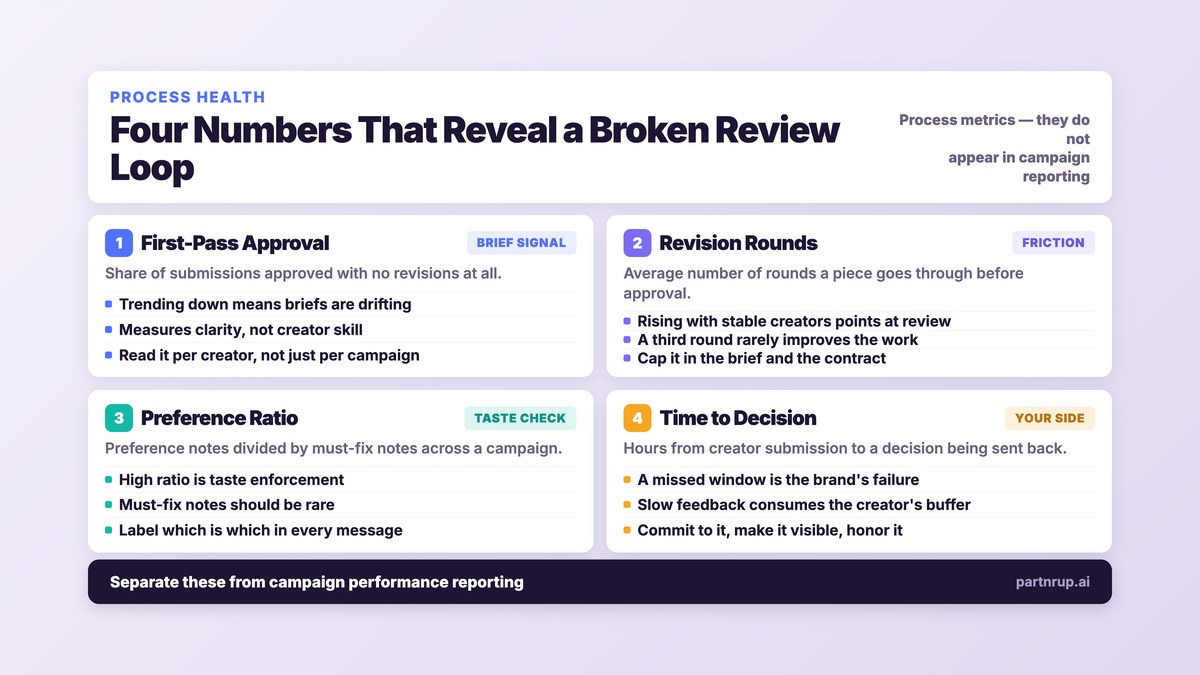
- First-pass approval rate — share of submissions approved with no revisions. Trending down means your briefs are drifting from what you actually want.
- Average revision rounds per piece — the direct measure of process friction. Rising numbers with stable creators point at the review step, not the talent.
- Preference-to-must-fix ratio — whether you are running quality control or taste enforcement.
- Time from submission to decision — your side of the bargain, and the one creators remember.
These are process metrics, not performance metrics, and they are worth separating from campaign reporting. A program can hit its engagement targets while quietly burning every creator relationship it has through a slow, additive review loop — and the campaign dashboard will not show it.
Know When to Kill Instead of Fix
Some content should not be revised. If a piece misses badly enough that fixing it would require rebuilding the concept, revising is worse than paying the fee, releasing the creator, and reshooting or reassigning. Three rounds of notes on a piece that was wrong from the start produces content nobody is proud of and a creator who will not take your next brief. Build the kill option into the budget so that using it is not a political decision.
Conclusion
The approval step is where brands decide, in practice rather than in strategy, how much creator judgment they actually want. Three changes carry most of the value: name one approver per piece, label must-fix separately from preference, and cap the rounds in writing.
The operational overhead is what pushes programs toward committees and open-ended revision loops in the first place — chasing stakeholders, tracking what is still outstanding, keeping a record of who approved what. partnrUP handles that coordination layer so the review conversation stays between the approver and the creator, and the broader content program stays consistent as volume grows. If you want to see how the approval workflow fits your team's structure, book a demo.
Frequently Asked Questions
How many revision rounds should a creator agreement include?
Two is a workable default: one substantive round of feedback and one confirmation pass. State it in the brief and the contract so both sides share a definition of done. If pieces routinely need a third round, the cause is usually an unclear brief or a casting mismatch, and another round of notes will not resolve either.
What is the difference between a must-fix note and a preference note?
A must-fix has an objective test — a false product claim, a missing disclosure, a competitor in frame, a missing contractual deliverable. A preference is anything settled only by someone's taste or authority. Must-fix notes are instructions; preference notes are requests. Labeling which is which in the message lets the creator respond appropriately to both.
Who should have final approval on creator content?
One named person per piece, ideally whoever wrote the brief, because they know what was asked for. Other stakeholders provide input to that person rather than sending notes directly to the creator. The approver's job is to filter feedback, not to forward all of it — which is exactly the function parallel committee review lacks.
Is the brand or the creator responsible if a sponsored post lacks a disclosure?
The FTC states that when enforcement becomes necessary, its focus "usually will be on advertisers or their ad agencies and public relations firms," with action against an individual endorser appropriate "in certain circumstances." Approving content with an inadequate disclosure does not shift that exposure to the creator. Treat disclosure as a pass/fail gate before creative review rather than as one note among many.
Does Instagram's paid partnership label satisfy FTC disclosure requirements on its own?
The FTC's guidance for influencers says not to assume a platform's disclosure tool is good enough, and to consider using it in addition to your own disclosure. Platform labels are a supplement. The in-content disclosure still needs to be present, placed with the endorsement message, and kept out of a block of hashtags.
How do I give feedback without making the content sound like my brand wrote it?
Describe the problem and the constraint; let the creator supply the words. "The opening takes eight seconds to reach the product — can we get there faster?" preserves voice. Handing over a replacement line does not. Supplying exact wording is appropriate for legal language and substantiated product claims, and counterproductive everywhere else.
What should I measure to tell whether my approval process is working?
Four numbers: first-pass approval rate, average revision rounds per piece, the ratio of preference notes to must-fix notes, and time from submission to decision. They are process metrics and will not appear in campaign reporting — which is why a program can hit its engagement goals while steadily damaging its creator relationships without anything on the dashboard changing.