



Back to blog

Austin Rosenthal
June 18, 2026

Influencer Marketing Platform Comparison Guide: How to Choose the Right Tool in 2026

Share on:

Picking the wrong influencer marketing platform is an expensive mistake—and not just in the obvious way. We’re not just talking about buyer’s remorse. We’re talking about six-figure contracts, locked-in data, months of onboarding, and a team that just learned a tool you now need to rip out and replace.

The influencer marketing platform landscape in 2026 is crowded. Dozens of tools compete for your budget, each promising to be the single solution for discovery, relationship management, campaign execution, analytics, and everything in between. Most of them were built for a world that no longer exists—where influencer marketing meant managing a spreadsheet of celebrity endorsers, not running always-on creator programs across TikTok, YouTube, and Instagram Reels.

This guide cuts through the noise. We’ve mapped every major platform category, broken down the key players head-to-head, and built a decision framework based on your actual situation—not a feature checklist designed to sell you the most expensive tier. According to recent influencer marketing statistics, over 60% of brands have switched platforms at least once—often after realizing they overpaid for complexity they didn’t need.

Whether you’re a fast-growing DTC brand running your first real creator program, a mid-market company that outgrew your current tool, or an enterprise team trying to rationalize a bloated tech stack, this comparison will help you make a confident decision.

Let’s start with what most comparison guides won’t tell you.
How to Choose the Right Influencer Marketing Platform in 2026

Why Choosing the Wrong Platform Costs More Than You Think

The sticker price is the easy part. A $2,000/month platform contract feels manageable. What doesn’t show up in that number is everything else.

Switching Costs Are Real and Brutal

Once you’ve onboarded a team, uploaded your creator relationships, set up campaign workflows, and integrated with your data stack—switching platforms means doing all of that again. Industry estimates put the average time-to-productivity on a new enterprise marketing platform at 3–6 months. That’s not just IT time. That’s lost productivity across your entire influencer marketing team.

Data lock-in makes it worse. Many legacy platforms make it intentionally difficult to export your creator contact history, campaign performance data, and relationship notes. Some charge export fees. Others let the data go stale if you don’t maintain active status. When you finally decide to leave, you may be starting from scratch.

If you’re curious about the hidden pitfalls of influencer marketing that most brands don’t see coming, platform lock-in is near the top of that list.

The Feature Overload Trap

Enterprise platforms love to sell features. The demo is always impressive: CRM integrations, advanced attribution dashboards, contract management, compliance monitoring, affiliate tracking, gifting portals, and a creator marketplace with 10 million profiles. You buy for the features you think you’ll use.

The reality: most mid-market brands use roughly 20% of what they’re paying for in a full-suite enterprise platform. The other 80% sits idle—or worse, creates complexity that slows your team down.

The right question isn’t “does this platform have everything?” It’s “does this platform make my core workflow faster?”

The Cost Reality

To put this in concrete terms: enterprise influencer marketing platform contracts typically run $30,000–$100,000+ per year, not including implementation fees, training costs, or the integrations you’ll need to make it actually work. For mid-market platforms, you’re looking at $12,000–$36,000/year. That’s real budget—budget that should be driving creator partnerships, not paying for a tool your team barely uses.

For a full breakdown of what you should actually be spending, read our complete guide to influencer platform ROI.

The 5 Categories of Influencer Marketing Platforms in 2026

Not all platforms are built for the same job. Before you evaluate any specific tool, it helps to understand which category it belongs to—because tools within the same category compete on features, but tools from different categories are solving different problems.

1. Enterprise Suites

Examples: GRIN, Aspire, CreatorIQ, Traackr

These platforms were built for large teams managing hundreds of creator relationships simultaneously. They offer robust CRM-style features, dedicated customer success teams, deep reporting, contract management, and integrations with enterprise marketing stacks. They’re powerful—and priced accordingly.

Enterprise suites make sense if you have a dedicated influencer marketing team of 3+ people, an annual creator spend of $500K+, and complex compliance or attribution requirements. For everyone else, you’re paying for complexity you don’t need.

2. Mid-Market Platforms

Examples: Upfluence, Social Cat

These platforms try to bridge the gap between enterprise suites and lighter tools. They often start at accessible price points and promise to scale with you. Some do this well. Many oversell—layering on features to justify pricing tiers without the depth or support of true enterprise solutions.

Mid-market platforms can work well for brands with a dedicated marketing manager handling creator programs, an established relationship list, and a need for basic campaign reporting.

3. AI-Native Platforms

Examples: partnrUP

A newer category built around AI-powered creator matching rather than relationship management. Instead of giving you a searchable database to manually comb through, AI-native platforms do the matchmaking for you—surfacing creators who are actually a fit for your brand, product, and audience.

The fundamental difference: legacy platforms assume you know who you’re looking for. AI-native platforms help you find creators you didn’t know existed. This shift in approach changes the ROI math significantly—you spend less time searching and more time running campaigns.

4. Niche and Vertical Tools

Agency-focused platforms, affiliate-first tools, and vertical-specific solutions for industries like beauty, gaming, or CPG. These work well within their niche but often can’t scale across diverse brand needs.

5. DIY / Manual

Spreadsheets, Instagram DMs, and homemade tracking systems. This still happens more than the industry admits—especially at early-stage brands. It works until it doesn’t. The breaking point is usually when a single campaign requires coordinating 15+ creators and you realize you have no idea what’s performing.

Platform-by-Platform Breakdown

Here’s an honest look at each major platform—what they’re good at, where they fall short, and who they’re actually built for.

GRIN

Best for: DTC ecommerce brands with dedicated influencer teams and Shopify integration needs

GRIN is one of the most recognized names in the space, particularly among ecommerce brands. Its Shopify integration is genuinely strong, and its creator management features (contracts, gifting, payments) are mature. The platform has invested heavily in its CRM-style relationship management tools.

Key strengths: Shopify/WooCommerce integration, creator gifting workflow, payment processing, content rights management

Key weaknesses: Discovery is database-based, not AI-powered—you’re searching through a static index rather than getting matched. Pricing is opaque and typically requires a demo before you learn the number. Onboarding can take weeks. Not well-suited for brands that don’t already have an established creator list to bring over.

Pricing range: ~$25,000–$50,000+/year for most mid-to-large deployments

G2 rating: ~4.6/5

Who chooses it: Established DTC brands, ecommerce-first companies, brands with in-house creator marketing managers

👉 See our full GRIN vs Upfluence comparison and GRIN vs Aspire breakdown for deeper head-to-head analysis.

Aspire

Best for: Mid-to-large brands wanting a full-stack platform with a marketplace component

Aspire positions itself as a full lifecycle platform covering everything from creator discovery through payment and reporting. Its creator marketplace lets brands post campaigns and receive inbound applications—a feature that appeals to brands who want creators to come to them rather than sourcing manually.

Key strengths: Creator marketplace with inbound applications, content approval workflows, solid reporting dashboard, brand safety tools

Key weaknesses: The inbound marketplace model can flood your inbox with under-qualified applicants. Discovery quality depends heavily on how well you write your brief. Relationship management features lag behind GRIN’s depth. Customer support quality reportedly inconsistent at scale.

Pricing range: ~$2,000–$5,000+/month depending on plan and features

G2 rating: ~4.4/5

Who chooses it: Brands who want creators to apply to their programs, marketing teams that value content workflow tools

👉 See how Aspire stacks up in our Aspire vs CreatorIQ comparison.

CreatorIQ

Best for: Enterprise brands with complex compliance, measurement, and multi-brand requirements

CreatorIQ is the enterprise tier of influencer marketing platforms—built for Fortune 500 companies managing massive creator programs across multiple brands and markets. Its analytics and measurement capabilities are genuinely best-in-class for enterprise use cases, and its integration with major media and brand safety tools is deep.

Key strengths: Enterprise-grade analytics and measurement, fraud detection, multi-brand management, API integrations with major data platforms

Key weaknesses: Steep price point, complex onboarding, overkill for most brands. The tool is built for teams with dedicated measurement and analytics functions—not something a lean marketing team can pick up and run. Discovery is still largely search-based.

Pricing range: $60,000–$150,000+/year for enterprise contracts

G2 rating: ~4.5/5

Who chooses it: Fortune 500s, global brands, agencies managing enterprise accounts

👉 See all the top CreatorIQ alternatives and our full CreatorIQ pricing breakdown.

Upfluence

Best for: Brands that want an all-in-one platform with affiliate tracking built in

Upfluence has positioned itself as a strong option for brands running hybrid influencer + affiliate programs. Its discovery engine is database-based but reasonably large, and its affiliate tracking features help brands measure performance-based creator partnerships alongside traditional sponsored content.

Key strengths: Affiliate + influencer in one platform, ecommerce integrations (Shopify, WooCommerce, BigCommerce), creator email outreach tools, reasonable mid-market pricing

Key weaknesses: The platform tries to do everything and ends up being best-in-class at nothing. Discovery quality varies. UI can feel dated. Customer support responsiveness is a common complaint. Not built for video-first campaigns.

Pricing range: ~$12,000–$30,000+/year

G2 rating: ~4.2/5

Who chooses it: Ecommerce brands with affiliate programs, mid-market marketers who want one platform for both channels

👉 Read our full Upfluence review, check the full Upfluence pricing breakdown, or see the top Upfluence alternatives.

Traackr

Best for: Enterprise brands focused on influencer program measurement and brand safety

Traackr is a measurement-first platform that has carved out a strong position with enterprise teams that need to prove influencer marketing ROI to senior stakeholders. Its reporting and analytics infrastructure is robust, and its Brand Vitality Score (a proprietary share-of-voice metric) is genuinely useful for competitive benchmarking.

Key strengths: Influencer program benchmarking, share-of-voice measurement, brand safety analysis, strong analytics and reporting

Key weaknesses: Campaign execution features are weaker than its measurement capabilities. Not designed for fast-moving teams. Heavy lift to implement and maintain. Pricing reflects its enterprise positioning.

Pricing range: ~$30,000–$80,000+/year

G2 rating: ~4.3/5

Who chooses it: Enterprise brands with dedicated measurement teams, companies running large always-on influencer programs

👉 See our in-depth Traackr review for a full analysis.

Social Cat

Best for: Small brands and startups running micro-influencer gifting campaigns

Social Cat is the lightest-weight option on this list—and that’s intentional. It’s built for small brands that want to run product gifting campaigns with micro-influencers without the overhead of an enterprise platform. Low price point, simple workflow, modest creator database.

Key strengths: Accessible pricing, simple gifting workflow, good for nano and micro-influencer campaigns, minimal learning curve

Key weaknesses: Limited creator discovery beyond its own database, minimal analytics, no campaign management depth, won’t scale to mid-market or enterprise needs

Pricing range: ~$49–$299/month

G2 rating: ~4.6/5

Who chooses it: Early-stage DTC brands, startups testing influencer marketing for the first time

👉 Read our full Social Cat review for a complete breakdown.

partnrUP

Best for: Growth-stage brands and mid-market companies that want AI-powered creator matching without enterprise complexity or price

partnrUP was built from the ground up as an AI-native platform—meaning creator matching is the core of the product, not an add-on feature bolted onto a CRM. The platform uses AI to analyze your brand, your products, and your campaign objectives, then surfaces creators who are genuinely aligned with your audience—not just creators who match a keyword search.

Key strengths: AI-powered creator matching (no manual searching), fast campaign setup, video-first platform built for TikTok/YouTube/Reels, transparent pricing, no lengthy onboarding or implementation

Key weaknesses: Newer platform—not as battle-tested as legacy enterprise tools. Less suited for brands that need heavy-duty CRM features for managing 500+ long-term creator relationships.

Pricing range: Transparent, accessible pricing—no six-figure contracts required

G2 rating: ~4.8/5

Who chooses it: DTC brands, growth-stage companies, marketing teams that want results fast without a 3-month implementation
Key Features That Actually Matter in Influencer Marketing Platforms

Get Started Free →

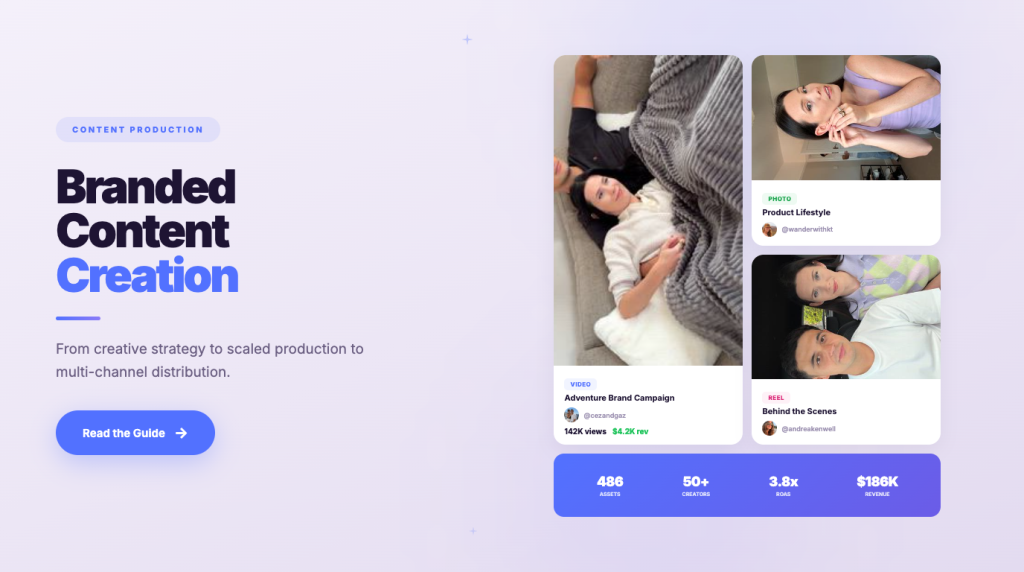
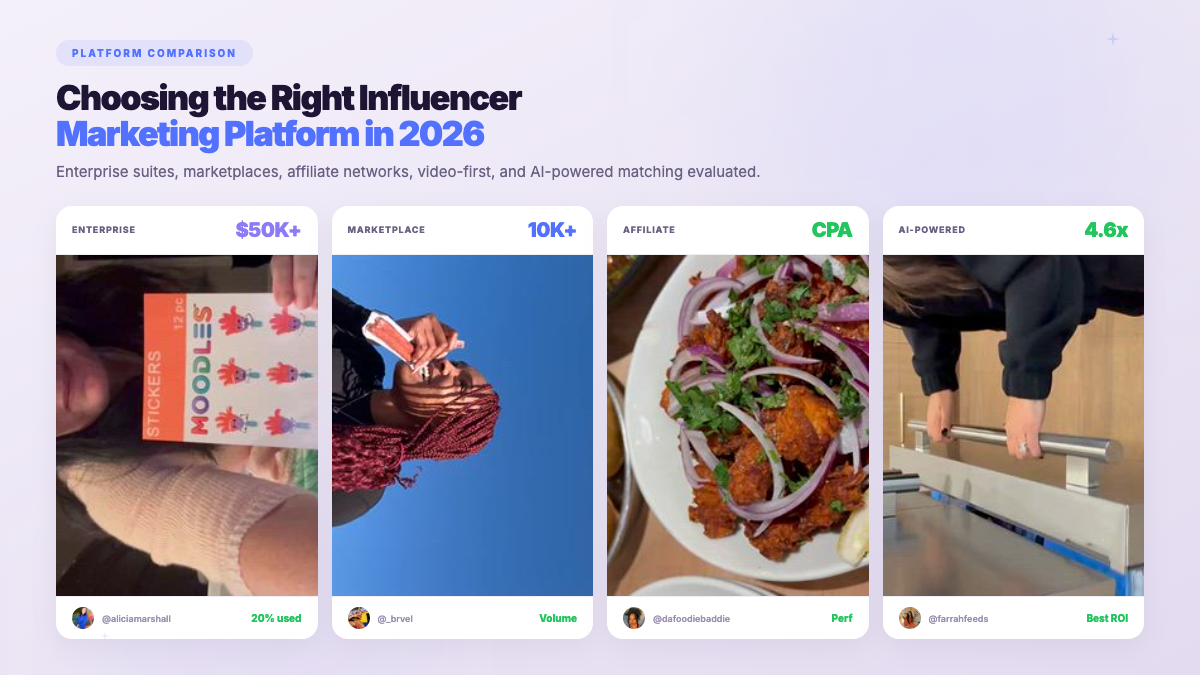
Platform Comparison Guide - real creator campaign content with performance attribution data and engagement metrics
Real creator campaigns tracked with performance metrics and revenue attribution.

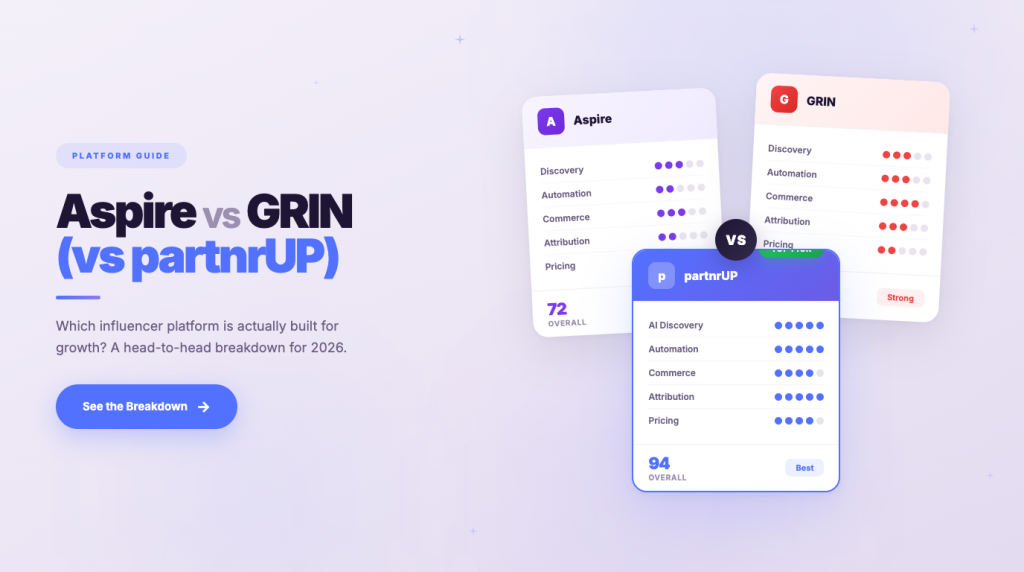
The Comparison Table

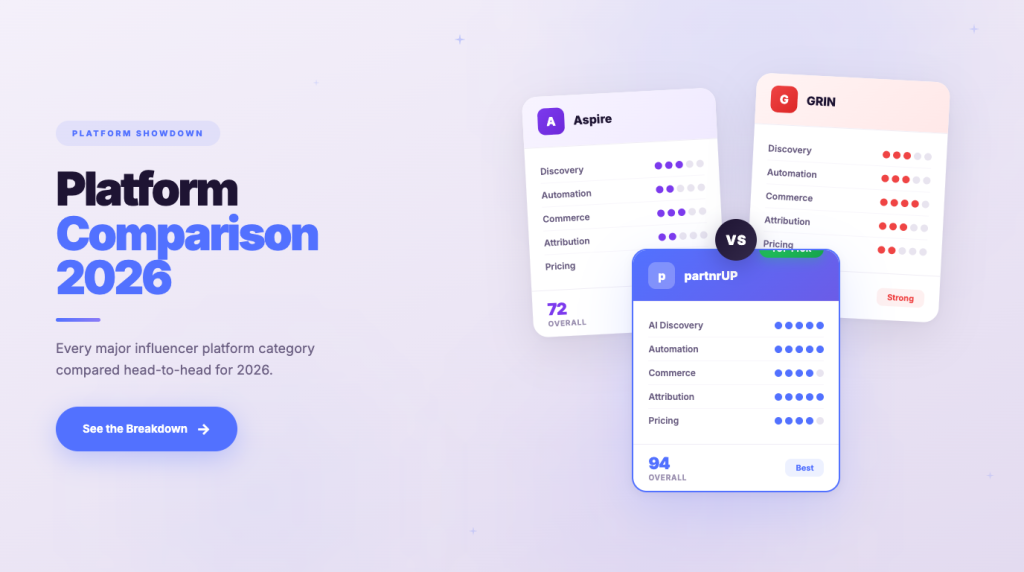
PlatformStarting PriceDiscovery MethodWorkflow AutomationAnalytics DepthContract MgmtBest ForGRIN~$25K+/yearDatabase searchStrong (Shopify-native)GoodYes (full)DTC ecommerce brandsAspire~$2K+/monthMarketplace + searchModerateGoodYesBrands wanting inbound creator applicationsCreatorIQ~$60K+/yearDatabase search + APIAdvancedBest-in-class (enterprise)Yes (full)Fortune 500s, multi-brand enterpriseUpfluence~$12K+/yearDatabase searchModerateModerateYesBrands with affiliate + influencer programsTraackr~$30K+/yearDatabase searchLimitedExcellent (measurement-focused)BasicEnterprise measurement teamsSocial Cat~$49/monthOwn databaseBasicBasicNoSmall brands, gifting campaignspartnrUPTransparent / accessibleAI-powered matchingStrong (video-native)GoodYesGrowth brands, DTC, mid-market
Influencer Marketing Platform Pricing: What Brands Need to Know

5 Questions to Ask Before Choosing a Platform

Before you request a single demo, answer these five questions. Your answers will eliminate half the options on the market immediately.

1. What’s Your Monthly Creator Volume?

Are you working with 5–10 creators at a time, or managing 100+? This matters because platforms designed for high-volume relationship management (GRIN, CreatorIQ) add overhead that slows down small programs. Conversely, lightweight tools like Social Cat break down quickly once you’re running more than a handful of simultaneous campaigns.

Rule of thumb: Under 20 active creators/month → you don’t need an enterprise platform. Over 100 → you might.

2. Do You Need CRM-Style Relationship Management?

Some brands build deep, long-term ambassador relationships with the same 50 creators. Those brands need CRM features—contact history, notes, relationship health tracking, contract archives. Other brands run transactional campaigns with new creators each time. Those brands don’t need CRM depth—they need fast, accurate discovery.

Be honest about which camp you’re in. Most growth-stage brands are in the second camp, even if they think they’re in the first.

3. How Important Is Creator Discovery vs. Campaign Management?

The two big jobs of an influencer marketing platform are finding creators and managing campaigns. Most platforms do both—but nearly every platform is better at one than the other. Legacy platforms built their strengths in campaign management. AI-native platforms like partnrUP lead with AI-powered creator matching and discovery.

If your biggest pain point is finding the right creators, prioritize discovery. If you already have your creator roster locked in and just need to run programs more efficiently, prioritize workflow.

4. What Does Your Team Actually Look Like?

A three-person growth marketing team and a 15-person influencer marketing department have radically different needs. An enterprise platform deployed to a small team creates complexity that kills momentum. A simple tool handed to a large team creates bottlenecks as the program scales.

Match the platform to your team’s actual capacity—not your aspirational capacity in 18 months.

5. Are You Running Affiliate/Performance Programs?

If performance-based creator partnerships (affiliate tracking, commission structures, sales-attributed payments) are a core part of your program, that’s a specific feature set that narrows your options significantly. Upfluence alternatives and a few other platforms have invested in making affiliate + influencer work together. Most platforms haven’t.

Use Case Scenarios: Which Platform Wins

Theory is useful. Real scenarios are more useful. Here’s how the decision plays out across four common situations.

Scenario 1: Fast-Growing DTC Brand, $50K–$100K Annual Creator Budget

You’re a DTC brand that’s been running influencer campaigns manually—DMing creators, tracking performance in a spreadsheet, doing payments via Venmo. You know you need a platform, but you don’t have a dedicated influencer marketing manager. You need something that works fast, doesn’t require a 90-day onboarding, and surfaces quality creators without manual research.

Winner: partnrUP. AI-powered matching gets you to the right creators without the manual search overhead. Transparent pricing means no six-figure surprise. Fast setup means you’re running campaigns in days, not months.

Scenario 2: Fortune 500 Brand Managing 500+ Creator Relationships

You have a full influencer marketing team, a dedicated budget of $2M+, complex legal and compliance requirements, and multi-brand programs running simultaneously across multiple markets. You need enterprise infrastructure, not a nimble startup tool.

Winner: CreatorIQ or GRIN. At this scale and complexity, you need the depth that enterprise platforms provide. The cost is justified by the team size and program scale. Make sure you’re using most of those features before you sign. Explore the full list of CreatorIQ alternatives before committing to enterprise pricing.

Scenario 3: Mid-Market Brand Testing Influencer for the First Time

You’ve been doing paid social and SEO. Influencer marketing is the next channel you want to test. You have a modest budget ($30K–$80K for the year), a marketing team of two who will be managing this alongside other channels, and no existing creator relationships to bring over.

Winner: partnrUP. Starting from zero means discovery is your primary need—and AI-powered matching is where partnrUP has a structural advantage over legacy platforms. You’re not bringing 200 creator relationships to port over into a CRM. You need the platform to help you find the right people, fast.

Scenario 4: Agency Managing Multiple Brand Clients

You run an influencer marketing agency with 10+ brand clients, each with different verticals, budgets, and objectives. You need multi-brand workspace management, strong reporting you can white-label, and a platform flexible enough to handle diverse use cases.

Winner: Upfluence or a custom stack. Agency use cases often need multi-client workspace features that most platforms don’t prioritize. Upfluence has invested in this. Alternatively, many agencies build hybrid stacks: a discovery/outreach tool + a separate reporting layer + their own CRM.

How to Evaluate and Switch Influencer Marketing Platforms

Get Started Free →

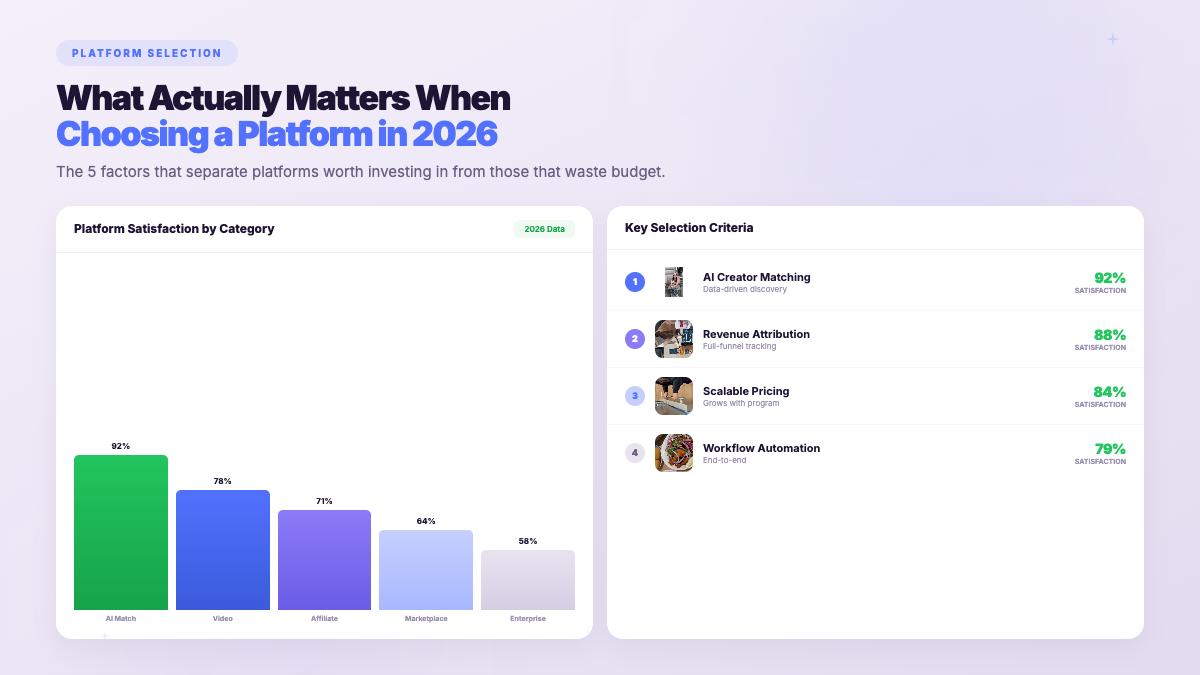
Platform Comparison Guide - creator campaign results showing measurable ROI across platforms
Measurable creator campaign results across multiple platforms and content formats.

Why Brands Are Moving to AI-Native Platforms in 2026

The shift toward AI-native platforms isn’t hype—it reflects a structural change in how influencer marketing actually works.

Legacy Platforms Were Built for a Different Problem

The original use case for influencer marketing platforms was managing relationships with a known list of influencers—mostly celebrities and macro-influencers with agents, contracts, and multi-year partnerships. CRM-style tools made sense for that world.

That world is gone. Today’s highest-ROI influencer programs run with nano and micro-creators—people with 5,000 to 200,000 followers who produce authentic content for deeply specific audiences. Finding those people manually, at scale, is effectively impossible. The database-search model that legacy platforms use requires you to know what you’re looking for before you search. AI matching removes that constraint entirely.

AI Matching Changes the ROI Math

When your platform can match your brand to the right creator automatically, you spend less time searching (hours → minutes), fewer campaigns fail due to audience mismatch, and your team’s attention goes to campaign strategy and creative—not creator research.

The ROI difference between a well-matched creator and a poorly-matched one is enormous. A creator with 50K followers who speaks directly to your target customer will outperform a creator with 500K followers who talks to the wrong audience every single time. AI matching tilts the odds in your favor from the start.

partnrUP’s Approach

partnrUP was purpose-built around this insight. Instead of giving you a database to search through, the platform analyzes your brand positioning, your product, and your campaign brief—then surfaces creators who are genuinely aligned. It’s the difference between searching for a needle in a haystack and having the right needle handed to you.

For brands that want to move fast, keep overhead low, and get better creator fits from the start, that’s a meaningful structural advantage over legacy tools. And based on the latest influencer marketing statistics, brands using AI-powered matching see measurably higher campaign performance across the board.

Frequently Asked Questions

How much do influencer marketing platforms cost?

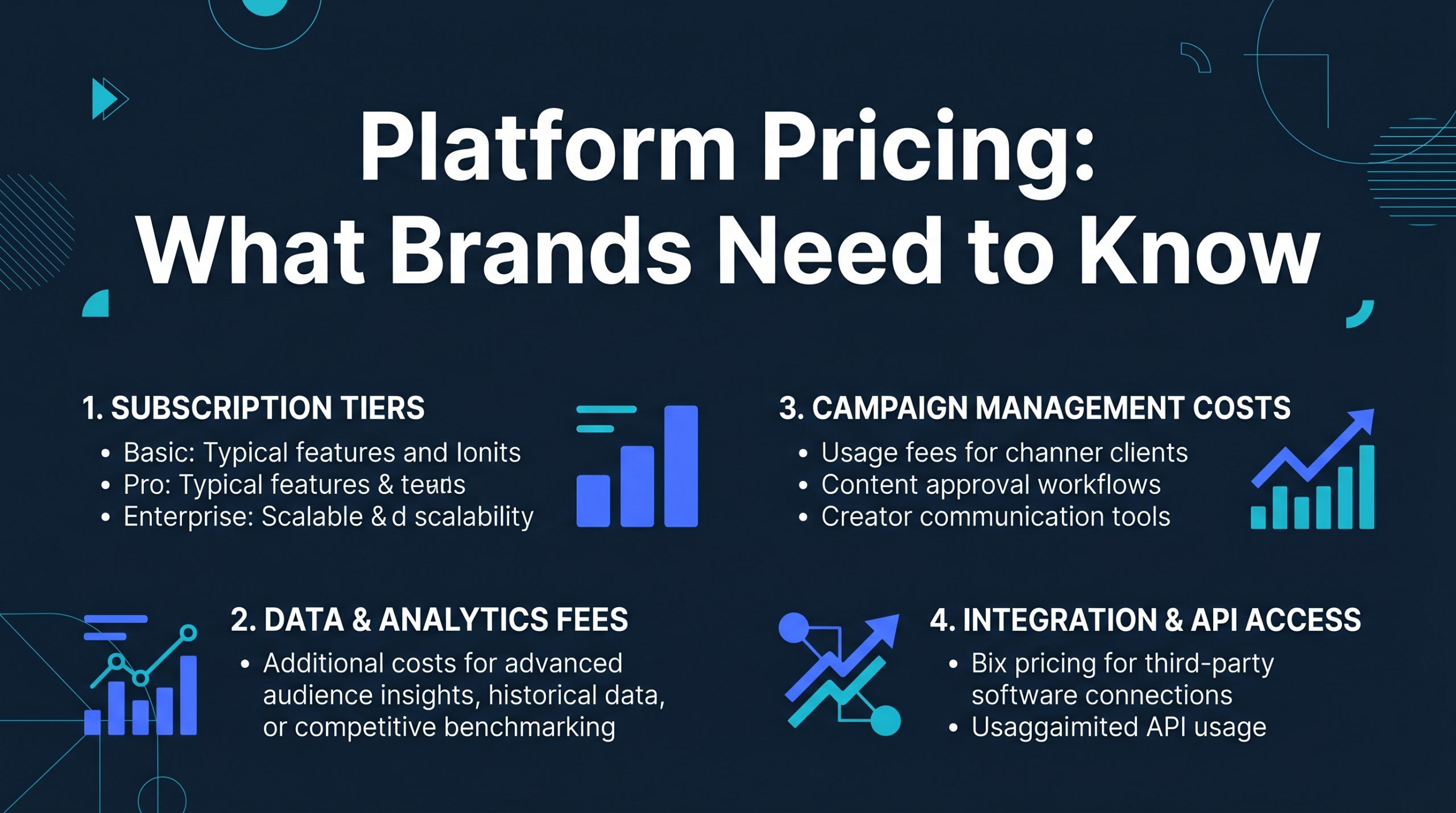
Pricing ranges dramatically by platform category. Enterprise suites (GRIN, CreatorIQ, Traackr) typically run $30,000–$150,000+/year. Mid-market platforms (Upfluence, Aspire) run $12,000–$60,000/year. AI-native platforms like partnrUP offer accessible, transparent pricing without enterprise-tier contracts. Entry-level tools like Social Cat start under $100/month. The key variable is what’s included—many platforms charge additional fees for advanced analytics, extra seats, or creator database access beyond base limits.

Do influencer marketing platforms offer free trials?

Some do, most don’t—at least not at the enterprise tier. Platforms that gatekeep pricing behind a demo rarely offer free trials. Mid-market and AI-native platforms are more likely to offer trial periods or self-serve onboarding. Always ask about sandbox access or pilot programs before committing to an annual contract.

How difficult is it to switch platforms?

Switching costs vary significantly. The main pain points are: (1) data portability—getting your creator list, campaign history, and contact notes out of your current platform; (2) team retraining; (3) integration rebuilds if you’ve connected your platform to your data stack. Budget for a 1–3 month transition period and confirm your data export rights before signing any new contract.

How do I measure ROI from influencer marketing platforms?

Platform ROI should be measured in two ways: the value the platform adds to your program (better creator matches = higher campaign performance, time saved = lower operational cost), and the campaign ROI generated through it (attributed sales, earned media value, audience reach). Most enterprise platforms include attribution dashboards; lighter tools may require third-party tracking. Our complete guide to influencer platform ROI walks through the full measurement framework.

Is there a difference between influencer marketing platforms for enterprise vs. SMB?

Absolutely—and this is one of the most important distinctions to get right. Enterprise platforms are built for scale, compliance, and team management. SMB and mid-market platforms are built for speed and simplicity. The mistake most growth brands make is buying enterprise tools before they actually need them. You’ll spend months onboarding a platform you’ve outgrown before you’ve ever fully deployed it.

What’s the best influencer marketing platform for DTC brands?

For DTC brands, the decision usually comes down to two factors: ecommerce integration depth and creator discovery quality. GRIN has the strongest Shopify integration. partnrUP has the strongest AI-powered discovery for video creators. If your DTC brand runs primarily on TikTok Shop or YouTube, partnrUP’s video-native approach wins. If your core channel is Instagram and you have an established creator roster, GRIN vs Upfluence is worth comparing first.

Can I use an influencer marketing platform for both organic and paid campaigns?

Yes—most modern platforms support both. For paid (boosted creator content/whitelisting), look for platforms with direct integration into Meta’s Content Publishing API. For affiliate/performance, platforms like Upfluence and its alternatives have the deepest feature set. For organic brand-funded content at scale, partnrUP’s workflow is purpose-built for this use case.

What’s the difference between an influencer marketplace and an influencer marketing platform?

A marketplace connects brands and creators directly—creators apply to campaigns or brand offers, and brands select from applicants. A platform provides infrastructure for the full campaign lifecycle: discovery, outreach, contracts, payments, reporting. Most full-suite platforms now include a marketplace component, but it’s typically just one feature within a larger system. Aspire’s marketplace (see our Aspire vs CreatorIQ comparison) is one of the better-known examples of the inbound application model.

How many creators does each platform have in their database?

Database sizes are marketing numbers—treat them as such. CreatorIQ claims 20M+ creators. GRIN, Aspire, and Upfluence are in the 5–10M range. What matters more than database size is match quality: how accurately does the platform surface creators who align with your brand? A smaller database with better matching outperforms a massive database with poor filtering every time.

Do I need an influencer marketing platform if I’m just starting out?

If you’re running fewer than 5–10 creator campaigns per month and your budget is under $5,000/month in creator spend, a full platform may be overkill. Start manually, build your process, then evaluate platforms once you hit the inflection point where manual tracking is creating bottlenecks. The right time to invest in a platform is when the platform’s efficiency gains clearly exceed its cost—not before.

Ready to See How partnrUP Stacks Up?

If you’ve made it through this guide, you know more about the influencer marketing platform landscape than most of the brands currently paying six figures for tools they barely use.

Here’s the bottom line: if you’re a growth-stage or mid-market brand looking for the fastest path to high-quality creator partnerships—without the enterprise overhead, lengthy onboarding, or opacity of legacy platforms—partnrUP was built for you.

AI-powered matching means you spend less time searching and more time running campaigns. Transparent pricing means no surprises. Video-native workflow means your content is built for the channels where audiences actually watch.

See partnrUP in action →

‍

Read More On Our Blog
How To Do An Influencer Search?

When planning an influencer marketing campaign, one of the most challenging parts is often finding the right influencers. Partnering with the right influencers makes all the difference in your campaign, but many marketers don’t know how to find them in the sea of creators producing content on social media.

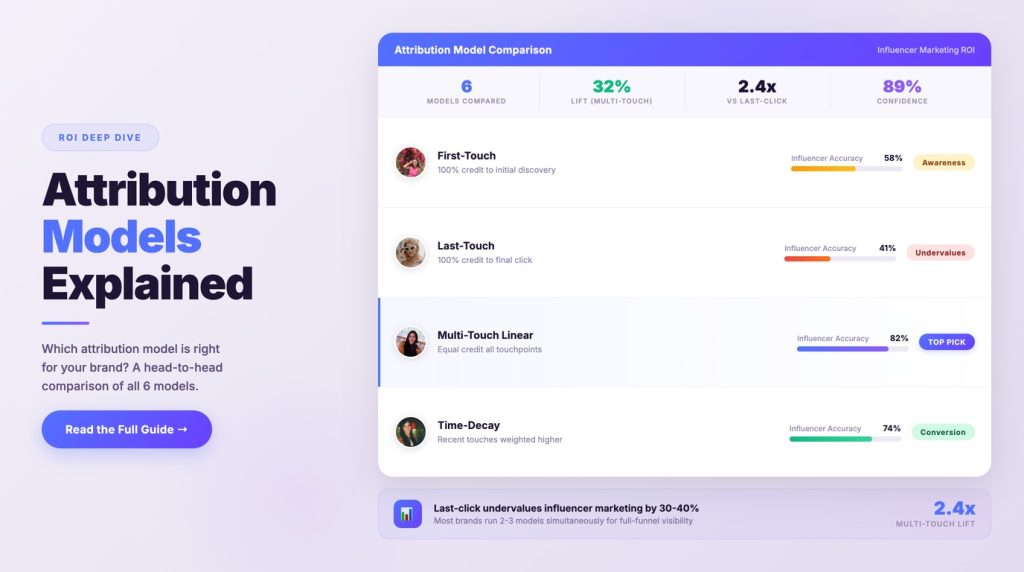
Influencer Marketing Attribution Models: Which One Is Right for Your Brand?

You've decided to measure influencer marketing ROI — good. Now you face the next challenge: which attribution model do you use? First-touch? Last-touch? Multi-touch? Incrementality? Each model tells a different story about your campaigns, and choosing the wrong one can lead to decisions that hurt performance.

Creator Commerce Is Becoming the Operating Model for Influencer Marketing

Influencer marketing used to be easier to define. A brand hired a creator, the creator made content, the content was published, and the campaign was measured.

partnrUP’s Agentic Influencer Marketing Platform Cuts Campaign Development Time by More Than 99%

The rebuilt platform reduces more than 24 hours of manual campaign development work to minutes, while making paid creator campaign setup 3.4x as fast across influencer and UGC programs.

Influencer Marketing Industry Report H2 2026: What’s Working Right Now

Marketers expect their influencer budgets to grow this year, and 72.2% of them expect that growth to be 50% or more. But when the same survey asks how they measure success, brand awareness is the most selected KPI at 55.1% — while 65.9% expect their creator spend to pay back within a single month.

Influencer Marketing Metrics That Actually Matter in 2026

Nearly 88% of marketers plan to increase their influencer marketing budgets in 2026, according to the Influencer Marketing Hub 2026 Benchmark Report. The same report found that brand awareness is the single most-selected KPI, chosen by 55.1% of respondents — while revenue and sales KPIs are selected less frequently. Budgets are climbing toward a forecast $44 billion in US creator ad spend, and the metric most teams report against is the one least able to justify the spend.

Social Commerce vs Traditional E-commerce: What Brands Need to Know

US social commerce sales will surpass $100 billion in 2026 — a milestone that sounds enormous until you set it beside the $1.5 trillion Americans will spend on retail ecommerce overall. Social commerce is growing far faster, but it is still roughly one dollar in every fifteen spent online. That gap is the single most misunderstood fact in ecommerce strategy right now, and it explains why the “social is replacing your website” pitch keeps failing brands that believe it.

How AI Agents Are Replacing Traditional Influencer Marketing Workflows

87.49% of marketers expect their influencer marketing budget to increase in 2026, and 72.22% plan increases of 50% or more (Influencer Marketing Hub 2026 Benchmark Report, 600+ respondents). At the same time, 66.3% run their programs entirely in-house. That combination is the whole story: dramatically more money flowing through influencer programs, managed by the same small teams using the same manual workflows they built when the channel was a pilot. Something has to give — and what is giving is the workflow itself.

Insights on the Future of Creator Marketing

Explore strategies, trends, and thought leadership from the team building the next generation of influencer marketing.

View More

How To Do An Influencer Search?

When planning an influencer marketing campaign, one of the most challenging parts is often finding the right influencers. Partnering with the right influencers makes all the difference in your campaign, but many marketers don’t know how to find them in the sea of creators producing content on social media.

Learn More

Influencer Marketing Attribution Models: Which One Is Right for Your Brand?

You've decided to measure influencer marketing ROI — good. Now you face the next challenge: which attribution model do you use? First-touch? Last-touch? Multi-touch? Incrementality? Each model tells a different story about your campaigns, and choosing the wrong one can lead to decisions that hurt performance.

Learn More

Creator Commerce Is Becoming the Operating Model for Influencer Marketing

Influencer marketing used to be easier to define. A brand hired a creator, the creator made content, the content was published, and the campaign was measured.

Learn More

partnrUP’s Agentic Influencer Marketing Platform Cuts Campaign Development Time by More Than 99%

The rebuilt platform reduces more than 24 hours of manual campaign development work to minutes, while making paid creator campaign setup 3.4x as fast across influencer and UGC programs.

Learn More

Influencer Marketing Industry Report H2 2026: What’s Working Right Now

Marketers expect their influencer budgets to grow this year, and 72.2% of them expect that growth to be 50% or more. But when the same survey asks how they measure success, brand awareness is the most selected KPI at 55.1% — while 65.9% expect their creator spend to pay back within a single month.

Learn More

Influencer Marketing Metrics That Actually Matter in 2026

Nearly 88% of marketers plan to increase their influencer marketing budgets in 2026, according to the Influencer Marketing Hub 2026 Benchmark Report. The same report found that brand awareness is the single most-selected KPI, chosen by 55.1% of respondents — while revenue and sales KPIs are selected less frequently. Budgets are climbing toward a forecast $44 billion in US creator ad spend, and the metric most teams report against is the one least able to justify the spend.

Learn More

Social Commerce vs Traditional E-commerce: What Brands Need to Know

US social commerce sales will surpass $100 billion in 2026 — a milestone that sounds enormous until you set it beside the $1.5 trillion Americans will spend on retail ecommerce overall. Social commerce is growing far faster, but it is still roughly one dollar in every fifteen spent online. That gap is the single most misunderstood fact in ecommerce strategy right now, and it explains why the “social is replacing your website” pitch keeps failing brands that believe it.

Learn More

How AI Agents Are Replacing Traditional Influencer Marketing Workflows

87.49% of marketers expect their influencer marketing budget to increase in 2026, and 72.22% plan increases of 50% or more (Influencer Marketing Hub 2026 Benchmark Report, 600+ respondents). At the same time, 66.3% run their programs entirely in-house. That combination is the whole story: dramatically more money flowing through influencer programs, managed by the same small teams using the same manual workflows they built when the channel was a pilot. Something has to give — and what is giving is the workflow itself.

Learn More

How to Vet Creators for Brand Sponsorships: The Complete Brand Guide

Nearly 88% of marketers plan to increase their influencer budgets in 2026, according to the Influencer Marketing Hub 2026 Benchmark Report — yet creator discovery and vetting remains the most frequently outsourced function in the industry. The reason is simple: picking the wrong creator doesn’t just waste budget. It damages brand credibility, derails campaign timelines, and produces content that sits in a folder no one opens.

Learn More

How to Write a Creative Brief for Creator Campaigns

72% of creators say a poorly written brief is the number one reason campaign content misses the mark, according to a 2026 Creator Compensation & Workflow Report by IZEA. Yet most brand teams spend less than 15 minutes writing them — copying last quarter’s brief, swapping out product names, and hoping for the best.

Learn More

Brand Lift Studies for Influencer Marketing: Do They Actually Work?

Nearly 88% of marketers plan to increase their influencer budgets in 2026, according to the Influencer Marketing Hub Benchmark Report — yet fewer than one in five can confidently attribute upper-funnel brand impact to specific creator campaigns. The gap between spending and proving brand value is where brand lift studies enter the picture. But here’s the question most marketing teams avoid: do these studies actually work for influencer marketing, or are they an expensive vanity exercise?

Learn More

How to Scale Creative Production Without Losing Brand Authenticity

Nearly 88% of marketers plan to increase their influencer budgets in 2026, according to the Influencer Marketing Hub 2026 Benchmark Report — yet two-thirds of brands now run programs entirely in-house, according to the same report — meaning internal teams bear the full weight of scaling creative output while maintaining brand consistency. The gap between ambition and operational capacity is where most programs stall: more creators, more content, more channels, and brand voice slowly eroding with each new partnership.

Learn More

Building a Creator Commerce Strategy From Scratch

Nearly 88% of marketers plan to increase their influencer budgets this year, according to the Influencer Marketing Hub 2026 Benchmark Report — yet most brands still lack a repeatable framework for turning creator partnerships into actual revenue. The gap isn’t enthusiasm. It’s execution. Creator commerce sits at the intersection of influencer marketing, social commerce, and performance marketing, and building a strategy from scratch requires more than picking creators and hoping products sell.

Learn More

How AI Agents Are Transforming Influencer Marketing Operations

Nearly 88% of marketers plan to increase their influencer budgets in 2026 (Influencer Marketing Hub 2026 Benchmark Report), yet two-thirds of those programs are run entirely in-house — often by teams of three or fewer people. The math doesn’t work. More budget, more creators, and more content demand cannot scale on spreadsheets and manual outreach. That’s where AI agents are stepping in — not as chatbots answering questions, but as autonomous systems that execute the repetitive operational tasks that slow influencer programs down.
Learn More

How to Calculate Influencer Marketing ROI: A Step-by-Step Formula for Brands

Nearly 88% of marketers plan to increase their influencer marketing budgets in 2026, according to Influencer Marketing Hub’s 2026 Benchmark Report — yet most still can’t answer a simple question: what’s the actual return? The gap between spending and measuring isn’t a data problem. It’s a formula problem. Without a repeatable, step-by-step calculation framework, every campaign lives in a fog of vanity metrics and gut feelings.

Learn More

Creator Commerce Metrics: What to Track, What to Ignore

Nearly 88% of marketers plan to increase their influencer marketing budgets in 2026, according to the Influencer Marketing Hub Benchmark Report — yet fewer than half can confidently tie creator-driven sales back to the content that generated them. The gap between spending and measurement has never been wider, and brands pouring money into creator commerce without tracking the right metrics are flying blind.

Learn More

9 Aspire Alternatives: Modern Influencer Marketing Platforms for Every Budget

67% of brands plan to increase their influencer marketing budgets in 2026 — yet many are stuck on platforms that charge enterprise pricing for mid-market features. If your team has outgrown Aspire (formerly AspireIQ) or simply needs a better fit for your workflow and budget, you’re not alone.

Learn More

The Creator Economy in 2026: Key Stats and Trends Every Brand Needs to Know

The creator economy surpassed $250 billion in total market value in 2025, and by every major industry forecast, 2026 is the year it reshapes how brands allocate marketing budgets entirely. Yet most marketing leaders still treat creator partnerships as a line item — not a growth channel. The gap between brands that understand the creator economy in 2026 and those still running one-off sponsorships is widening fast, and the data makes it impossible to ignore.

Learn More

How to Scale Creative Production Without Losing Authenticity

Brands running creator programs hit a wall around 15-20 active partnerships: content quality starts slipping, messaging drifts off-brand, and the team spends more time managing revisions than building relationships. A 2026 CreatorIQ benchmark report found that brands scaling beyond 25 creators per quarter saw a 34% increase in revision cycles — yet those that implemented structured creative systems maintained approval rates above 85% even at 100+ partnerships.

Learn More

How AI Matches Creators to Brands: Beyond Follower Count

82% of marketers who switched from follower-based selection to AI-powered creator matching saw campaign ROI improve by 3x or more — yet most brands still choose influencers the same way they did in 2019: scrolling feeds, counting followers, and guessing. The gap between “good enough” creator selection and genuinely predictive matching is now the single biggest lever in influencer marketing performance.

Learn More

Tracking Creator Affiliate Links: Tools, UTMs, and Attribution Best Practices

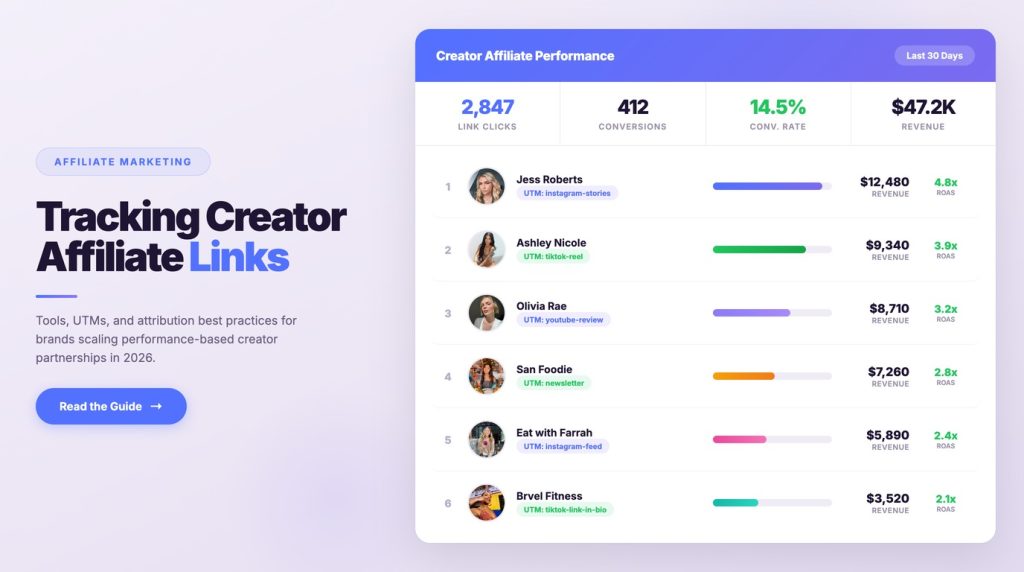
63% of brands running creator affiliate programs say their biggest challenge is tracking which creator actually drove a conversion. Not finding creators. Not negotiating rates. Tracking. The gap between “a creator posted about our product” and “that post generated $47,000 in revenue” is where most programs either scale or stall.

Learn More

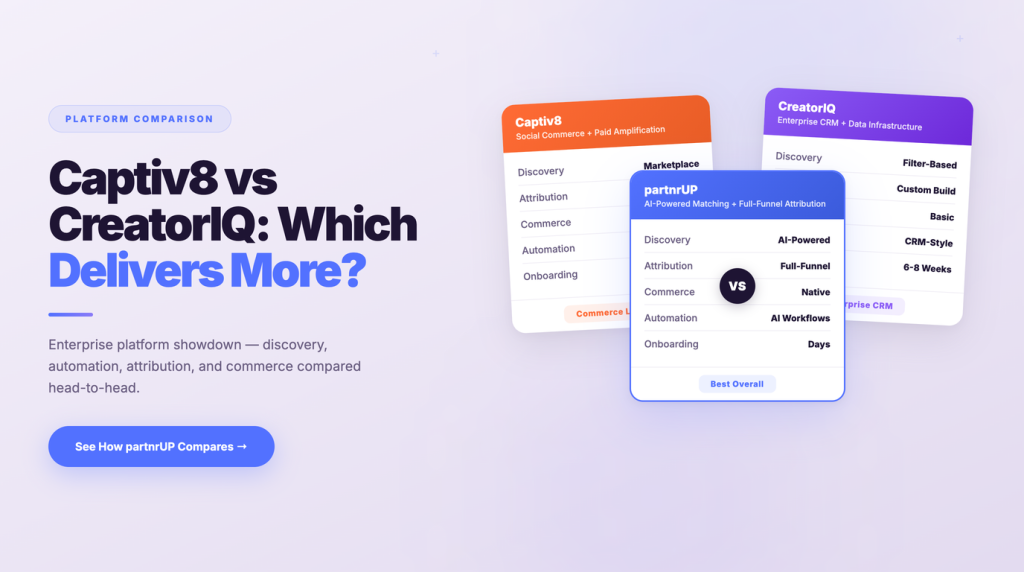
Captiv8 vs CreatorIQ (vs partnrUP): Which Enterprise Platform Delivers More?

The influencer marketing industry surpassed $24 billion in 2024 according to Influencer Marketing Hub — and choosing the wrong one can lock your team into 12-month contracts with tools that don’t match your workflow. When you’re evaluating Captiv8 vs CreatorIQ, the differences aren’t obvious from feature pages alone. Both platforms target enterprise brands, both claim AI-powered discovery, and both come with price tags that demand executive approval.

Learn More

How Brands Are Using AI to Scale Creator Programs Without Adding Headcount

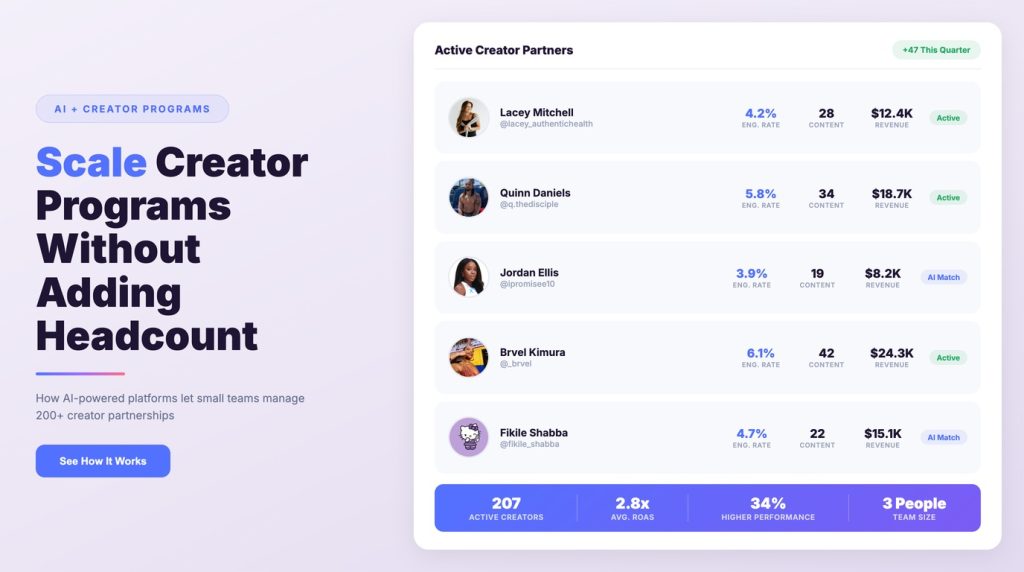
63% of marketing teams managing creator programs say they’ve hit a ceiling — not because of budget, but because of bandwidth. The average brand partnership manager juggles 47 creator relationships simultaneously, spending 11 hours per week on manual outreach alone. Meanwhile, the brands that are scaling to 200+ active creators without hiring additional staff share one thing in common: they’ve moved their workflow backbone to AI.
Learn More

AI Creator Matching vs. Manual Influencer Discovery: A Head-to-Head

72% of influencer marketing managers report spending more time finding creators than actually managing campaigns — a paradox that’s costing brands real revenue. The average team dedicates 40+ hours per campaign to manual influencer vetting, reviewing content feeds, cross-referencing engagement metrics, and hoping audience demographics align with brand goals. Meanwhile, AI-powered creator matching platforms are cutting that time to under 4 hours while delivering 3x higher conversion rates on matched partnerships.

Learn More

Content Repurposing Strategy: Getting Maximum Value from Creator Assets

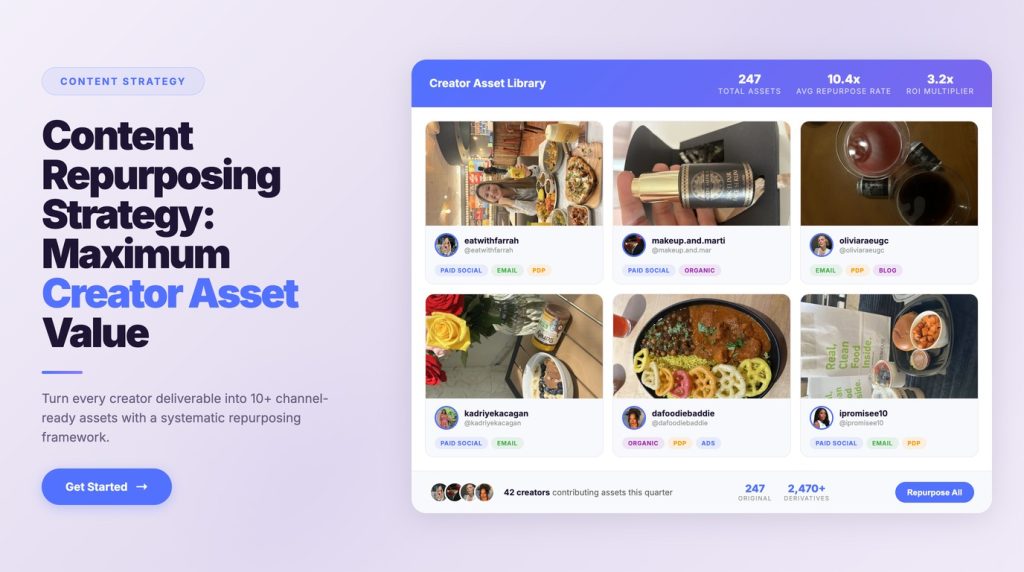
Brands that repurpose creator content across channels see 3x more engagement per dollar spent than those using assets once — yet 68% of marketing teams still treat every creator deliverable as a single-use asset. The result? Thousands of dollars in high-performing content sitting unused in shared drives, never reaching the audiences that would convert.

Learn More

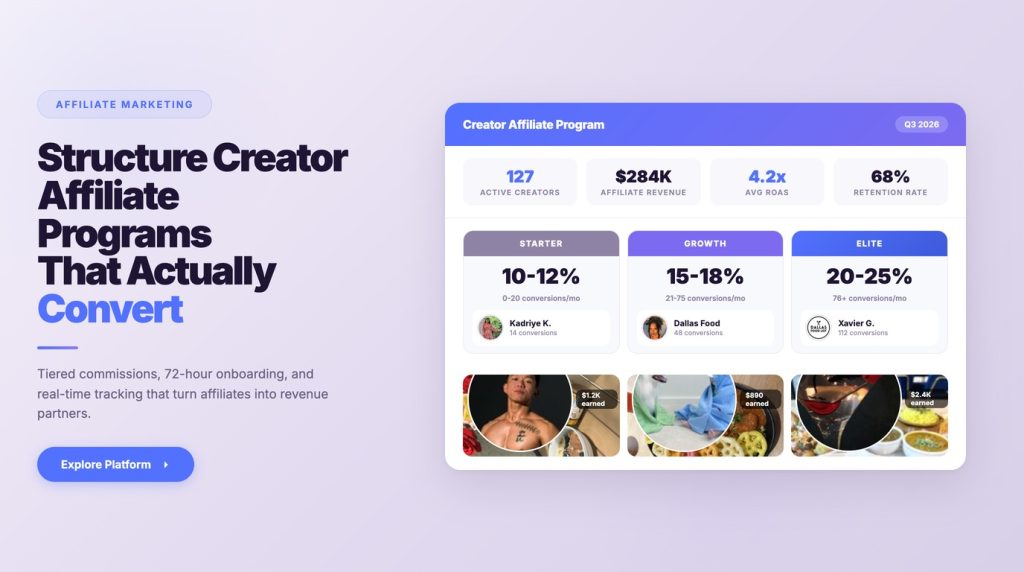
How to Structure Creator Affiliate Programs That Actually Convert

Brands that structure their creator affiliate programs with clear commission tiers, performance tracking, and dedicated creator support generate 3.2x more affiliate revenue than those running ad-hoc partnerships. Yet the majority of ecommerce teams still launch affiliate programs with flat-rate commissions, generic tracking links, and zero onboarding — then wonder why creators stop posting after week two.

Learn More

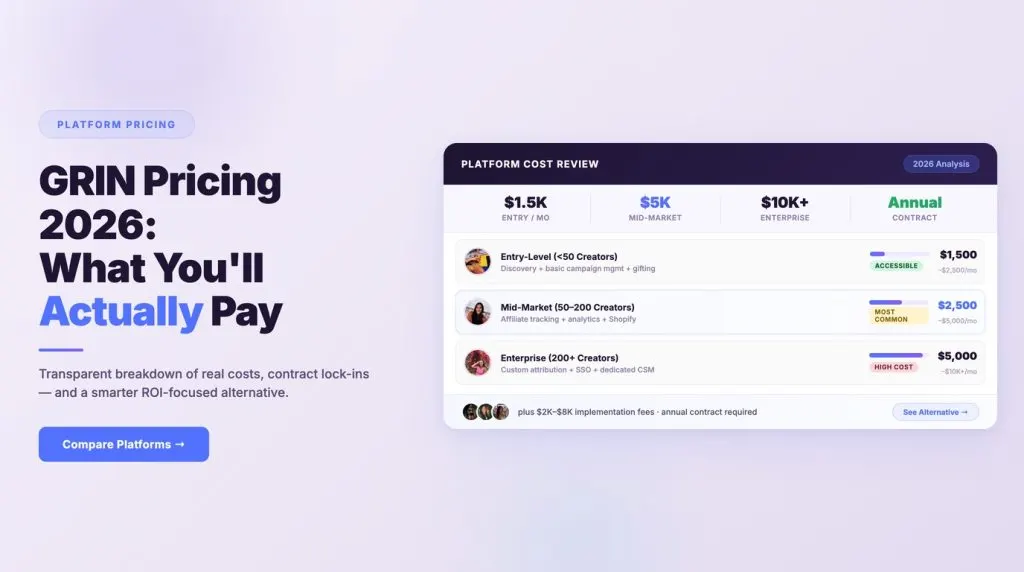
GRIN Pricing 2026: What You’ll Actually Pay and a Smarter Alternative

Enterprise influencer software pricing is one of the least transparent topics in martech — and GRIN is no exception. A 2024 Forrester survey found that 67% of marketing technology buyers list “lack of transparent pricing” as their top frustration with SaaS vendors. When it comes to influencer marketing platforms, that problem is even more pronounced: almost every vendor hides their actual cost behind a “contact sales” wall.

Learn More

How Brands Are Winning on TikTok Shop in 2026

TikTok Shop’s U.S. GMV surpassed $20 billion in the first half of 2026, making it the fastest-growing social commerce channel in the market. Brands that cracked the code early are now generating 15-30% of their DTC revenue through the platform — while their competitors are still debating whether TikTok is “right for their brand.”

Learn More

7 Aspire Alternatives: Modern Influencer Marketing Platforms for Every Team

67% of brands plan to increase their influencer marketing budgets in 2026 — yet many are stuck on platforms that charge enterprise pricing for mid-market features. If your team has outgrown Aspire (formerly AspireIQ) or simply needs a better fit for your workflow and budget, you’re not alone.

Learn More

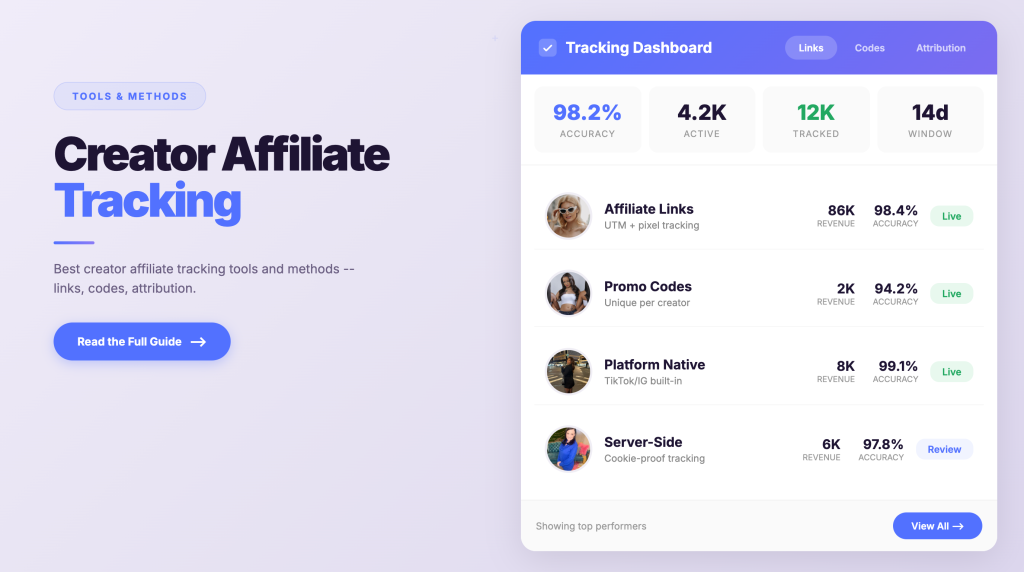
Creator Affiliate Tracking: Best Tools and Methods for Brands in 2026

Brands lose an estimated 20-30% of their creator-driven revenue to poor attribution — sales that actually happened but were never tracked back to the creator who drove them. In a channel where proving ROI is already the top challenge, leaky tracking infrastructure turns a winnable argument into an unwinnable one.

Learn More

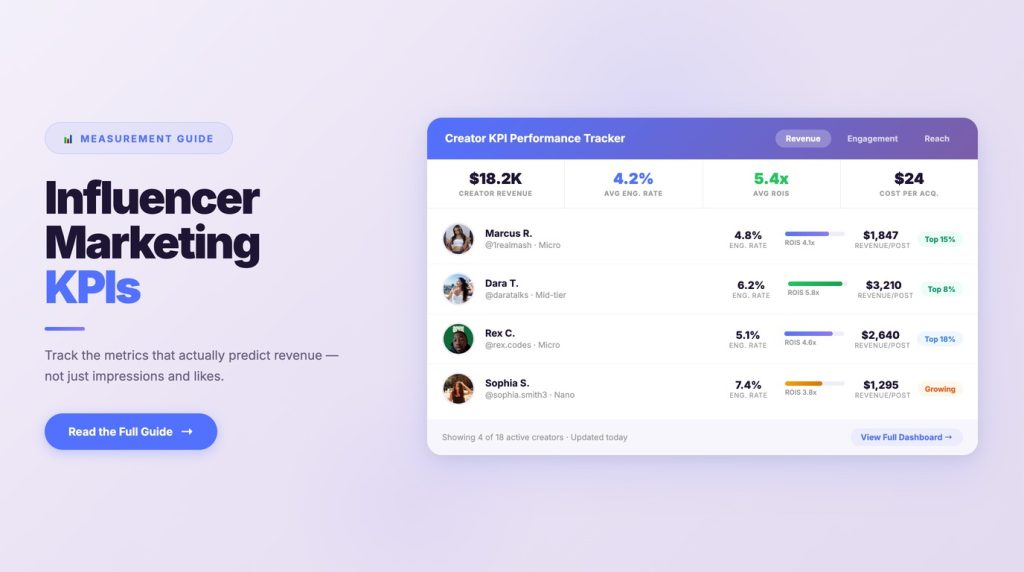
Influencer Marketing KPIs Every Brand Should Track in 2026

76% of marketing leaders say measuring influencer marketing performance is their biggest challenge, yet the problem isn’t a lack of data — it’s tracking the wrong metrics. Brands that still evaluate creators by follower count and likes are optimizing for vanity while their competitors optimize for revenue.

Learn More

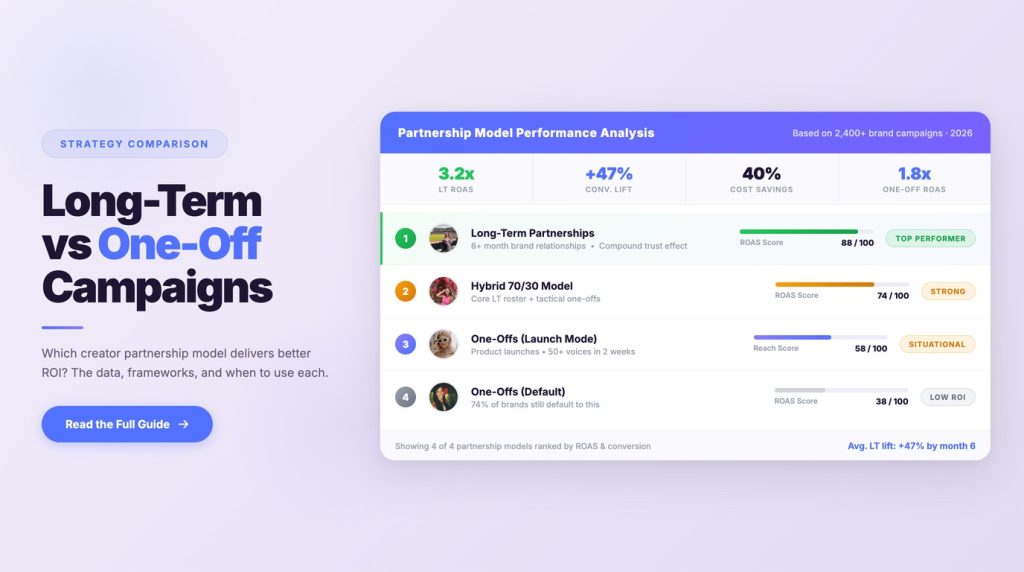
Long-Term Creator Partnerships vs One-Off Campaigns: Which Wins?

Brands that maintain creator partnerships for 6+ months see 47% higher ROI than those running one-off campaigns, according to recent industry data. Yet the majority of influencer marketing budgets still go toward transactional, campaign-by-campaign engagements — a structural inefficiency that leaves significant performance on the table.

Learn More

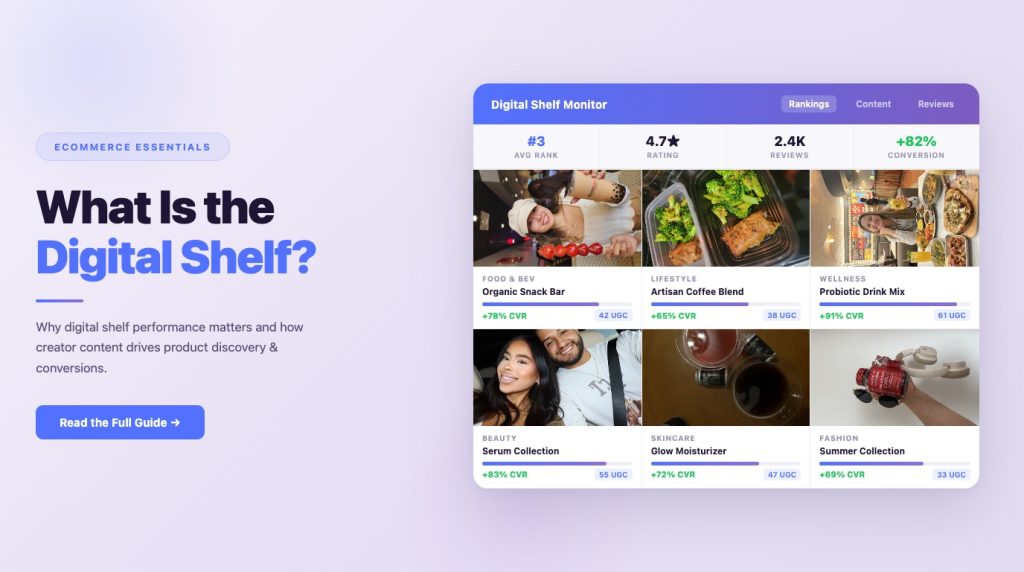
What Is the Digital Shelf and Why Should Brands Care?

85% of consumers research products online before purchasing — even when they buy in-store, making the digital shelf the most important real estate in modern retail. Yet most brands still manage their digital shelf presence as an afterthought, treating product pages as static catalogs rather than dynamic, content-rich experiences that drive discovery and conversion.

Learn More

How Affiliate Influencer Marketing Works: Performance-Based Models

Performance-based influencer partnerships now account for 43% of all influencer marketing spend, up from just 18% three years ago. The shift is unmistakable: brands are moving from paying for posts to paying for results, and affiliate influencer marketing is the model driving that transformation.

Learn More

How to Calculate Influencer Marketing ROI: A Step-by-Step Formula for Brands

Nearly 88% of marketers plan to increase their influencer marketing budgets in 2026, according to Influencer Marketing Hub’s 2026 Benchmark Report — yet most still can’t answer a simple question: what’s the actual return? The gap between spending and measuring isn’t a data problem. It’s a formula problem. Without a repeatable, step-by-step calculation framework, every campaign lives in a fog of vanity metrics and gut feelings.

Learn More

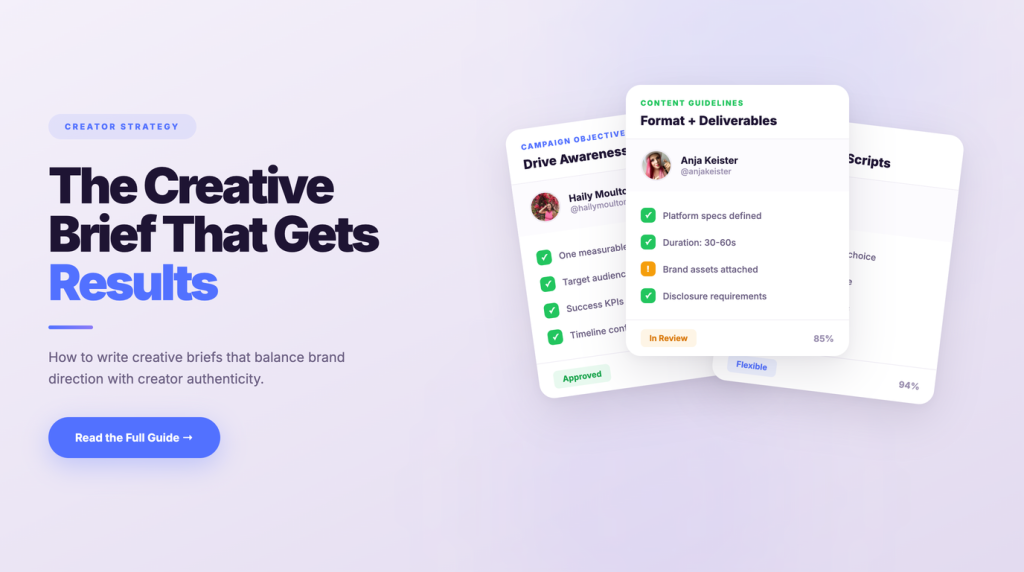
How to Write a Creative Brief for Creator Campaigns That Gets Results

68% of creators say unclear briefs are the number one reason campaigns underperform, yet most brands still approach creative briefs as afterthoughts — vague one-pagers filled with brand guidelines but devoid of the strategic direction creators actually need to produce content that converts.

Learn More

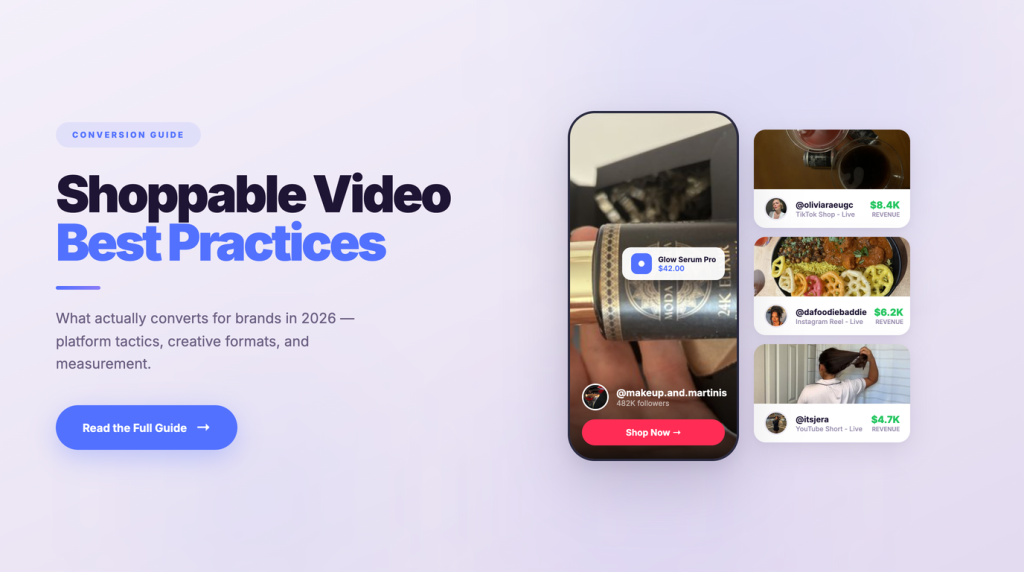
Shoppable Video Best Practices: What Actually Converts in 2026

Brands using shoppable video report conversion rates 3-5x higher than traditional product pages, yet 72% of marketing teams say they’re still experimenting with the format rather than running optimized programs. The gap between early adopters and everyone else is widening — and the playbook for what actually converts has become clearer than ever.

Learn More

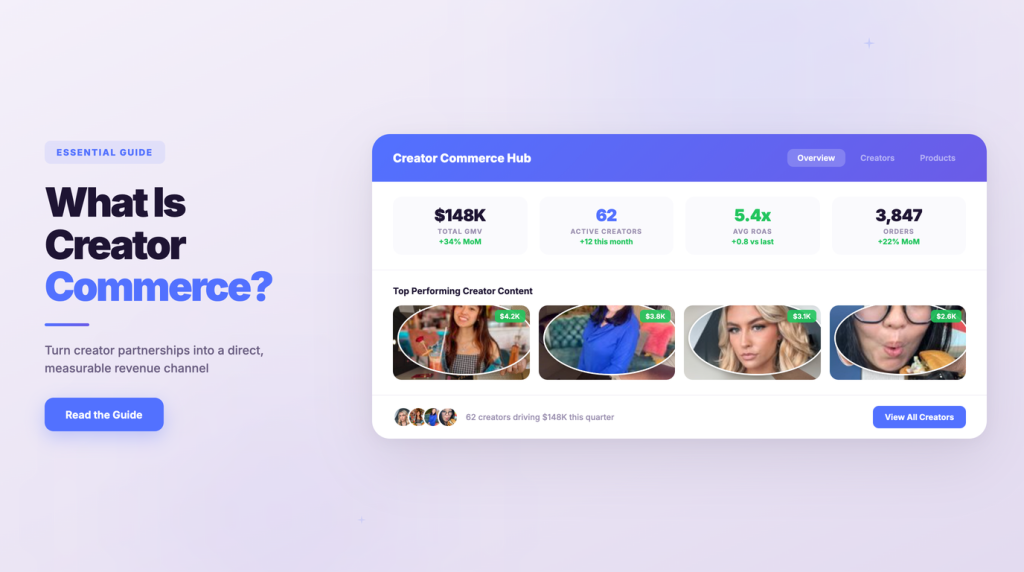
What Is Creator Commerce? The Brand’s Essential Guide for 2026

Creator commerce is projected to drive over $32 billion in U.S. retail sales by the end of 2026, yet most brands still treat creator partnerships as a top-of-funnel awareness play rather than a direct revenue channel. That disconnect is costing them market share — and fast.

Learn More

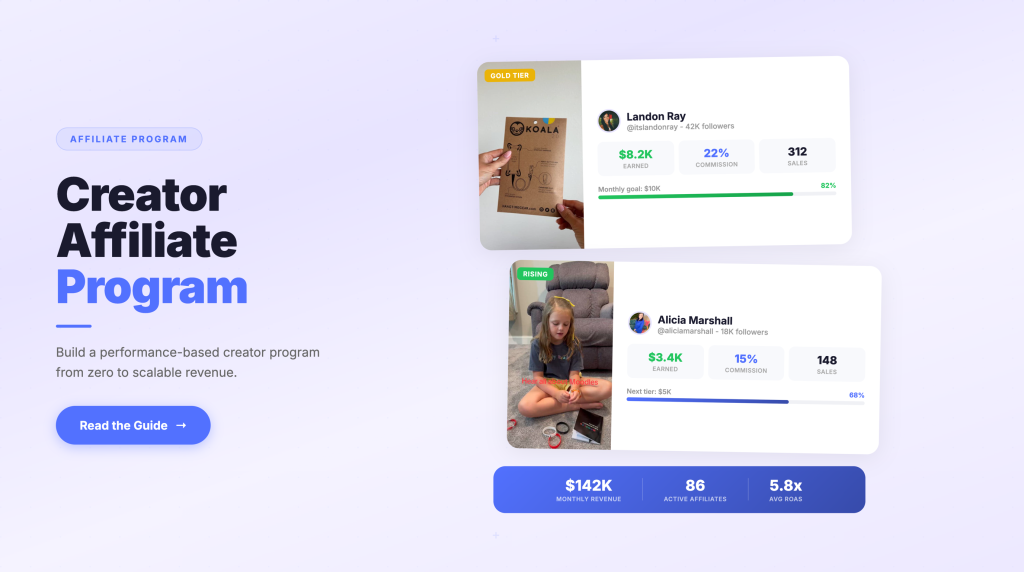
How to Build a Creator Affiliate Program: From Zero to Scale

Creator affiliate programs now drive 3-5x higher conversion rates than traditional affiliate networks — yet most brands still haven’t built one. They’re stuck between expensive influencer platforms that charge flat fees regardless of performance, generic affiliate networks designed for coupon sites, and manual outreach that doesn’t scale past a handful of creators.

Learn More

GRIN Review 2026: Is This Creator Management Platform Right for Your Brand?

Considering GRIN for your influencer marketing program? This review covers everything you need to make an informed decision — features, pricing, G2 scores, real user feedback, and an honest take on who GRIN is (and isn’t) built for.

Learn More

Influencer Marketing ROI: The Complete Attribution Guide for Brands in 2026

Influencer marketing ROI is real — but proving it requires more than checking likes and follower counts. If you’re running influencer campaigns without a clear attribution strategy, you’re flying blind on one of your most significant marketing investments.

Learn More

7 GRIN Alternatives: AI-Powered Influencer Marketing Solutions for 2026

GRIN has built a solid reputation in the creator management space — but it’s not the right fit for every brand. Whether it’s the pricing, the complexity, the enterprise-only focus, or the support experience, brands increasingly find themselves searching for GRIN alternatives that deliver more for their specific needs.

Learn More

Influencer Marketing Platform Comparison 2026: Which One Is Right for Your Brand?

78% of brands say they’ve switched influencer marketing platforms at least once — and most cite the same reason: the platform promised discovery, but couldn’t deliver execution.

Learn More

15 Best Influencer Marketing Platforms for Brands in 2026

From AI-powered discovery to full-funnel creator commerce — here are the platforms brands are using to run smarter influencer programs in 2026.

Learn More

partnrUP is the Easiest to Use Creator Marketing Platform and Easiest to Do Business With Influencer Agency Based on G2 Summer 2026 Reports

Validation Meets Velocity: When agentic workflows assist influencer marketing managers to do high-quality work at scale

Learn More

Branded Content Creation: From Strategy to Production to Distribution

Branded content is the antidote to ad fatigue. While traditional advertising interrupts consumers mid-scroll, mid-show, or mid-article, branded content earns their attention. It delivers genuine value , entertainment, education, inspiration, with a brand’s fingerprints on it. The result? Audiences that choose to engage rather than skip.

Learn More

The State of Influencer Marketing in 2026: Trends, Data & Industry Insights

Influencer marketing isn’t a nice-to-have anymore: it’s a core budget line for brands across every category. What started as gifting products to bloggers has evolved into a sophisticated, performance-driven channel with its own metrics, technology stack, and organizational function. In 2026, the industry hasn’t just matured , it has fundamentally transformed.

Learn More

Brand Sponsorships & Creator Partnerships: The Definitive Playbook

Brand sponsorships and creator partnerships sit at the heart of modern influencer marketing, but most brands approach them the wrong way. They fire off one-off deals, chase follower counts, and wonder why the results don’t stick. The brands winning in 2026 are doing something different: they’re building systems for creator partnerships, not just buying placements.

Learn More

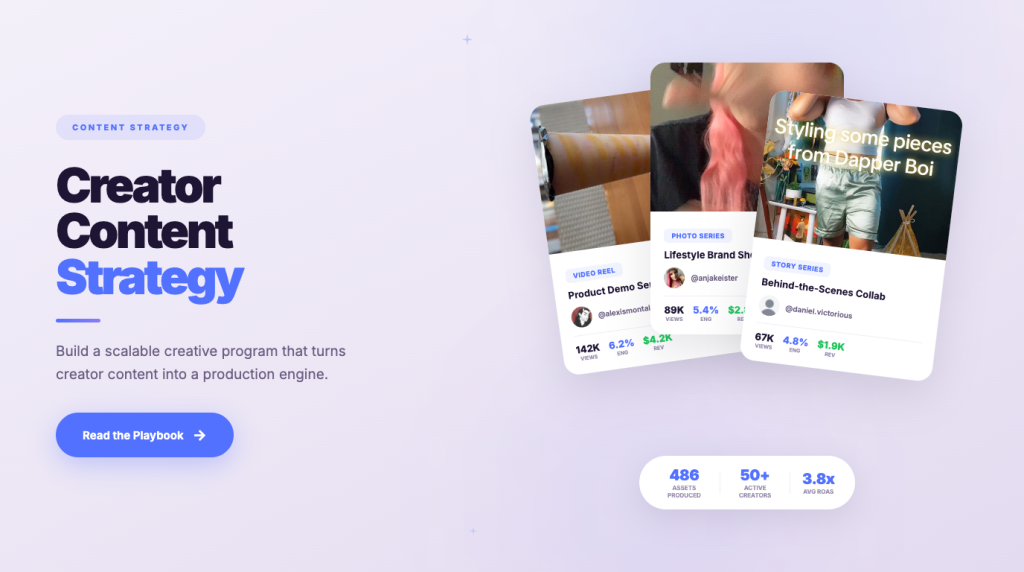
Creator Content Strategy: Building a Scalable Creative Program for Your Brand

Most brands treat creator content as a tactic , a one-off campaign here, a reactive brief there, no system connecting any of it. They find a creator, approve some posts, watch the metrics for a week, and move on. Then they do it again from scratch next quarter.

Learn More

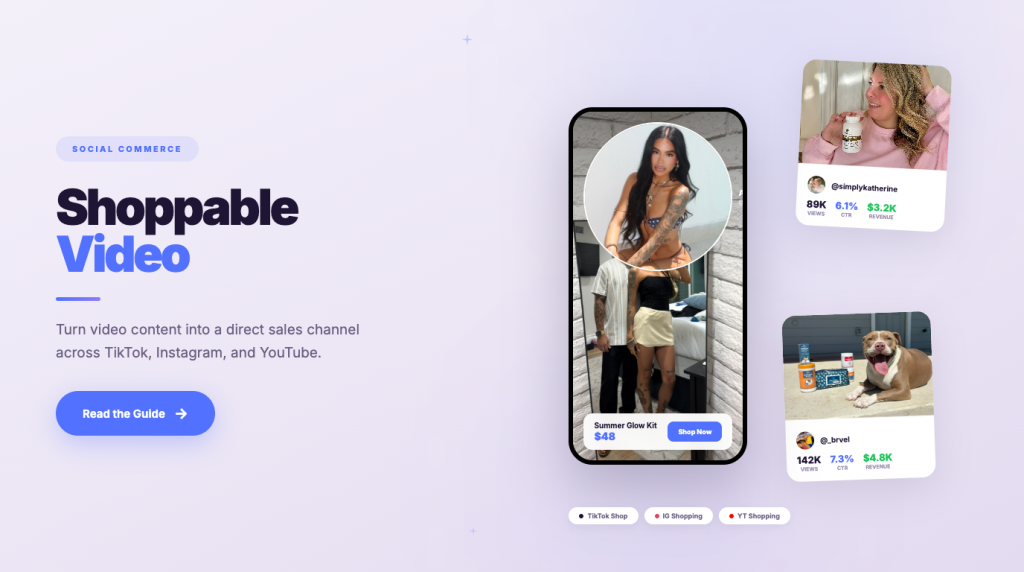
Shoppable Video & Social Commerce: The Complete Guide for Brands in 2026

Shoppable video is collapsing the funnel. Where brands used to run awareness campaigns and hope buyers remembered them days later, shoppable video turns every creator post into a direct buying opportunity. A viewer watches a skincare creator apply a serum, taps the product tag, and checks out , all without leaving TikTok. Discovery and transaction happen in the same breath.

Learn More

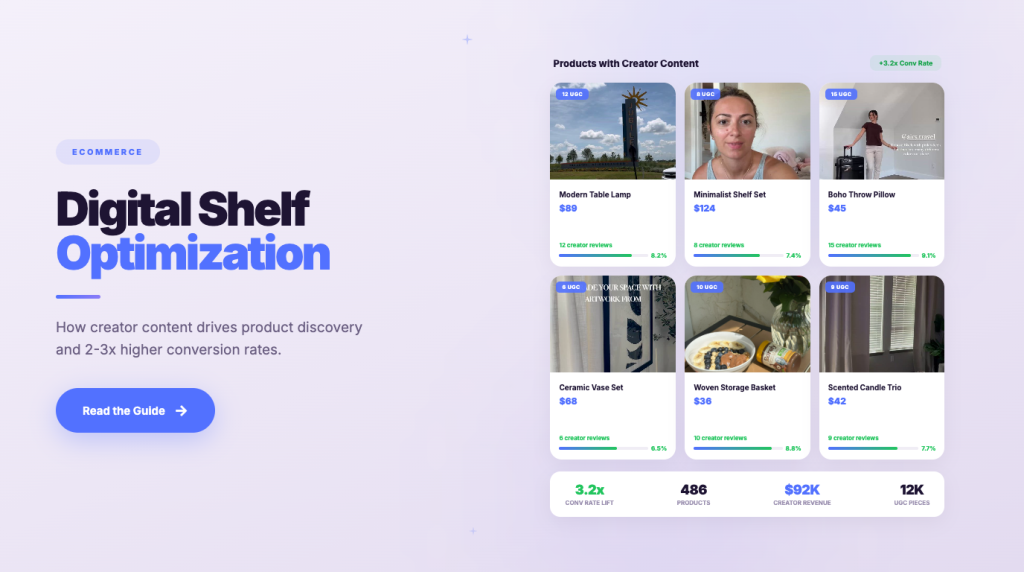
Digital Shelf Optimization: How Creator Content Drives Product Discovery & Conversions

The digital shelf is the new physical shelf , except it’s infinite, always on, and increasingly driven by creator content. Walk into any retail store and prime shelf placement determines what gets noticed, picked up, and purchased. Online, that same dynamic plays out across TikTok search results, Amazon product listings, Google Shopping carousels, and Instagram Explore feeds.

Learn More

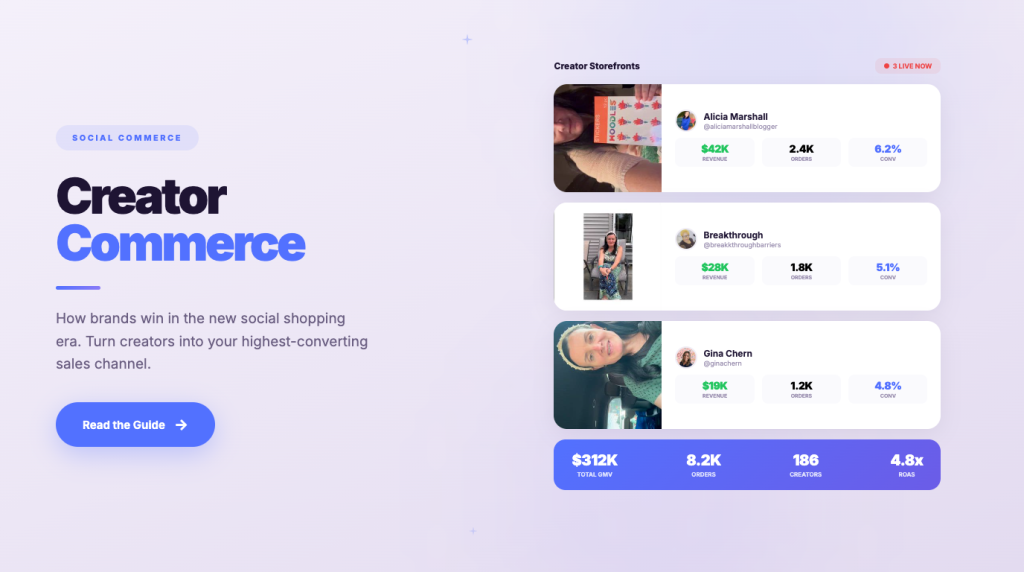
Creator Commerce: How Brands Win in the New Social Shopping Era

Creator commerce isn’t just influencer marketing with a new name — it’s a fundamental shift in how products get discovered, evaluated, and purchased. And if your brand hasn’t started paying attention, you’re already playing catch-up.

Learn More

Affiliate Influencer Marketing: The Complete Brand Playbook for 2026

Affiliate influencer marketing is one of the highest-ROI creator strategies available to brands right now, and it’s still widely underutilized. Instead of paying creators a flat fee upfront and hoping for results, you tie compensation to actual sales. Creators earn when they drive conversions. You only pay when the program delivers.

Learn More

Influencer Marketing ROI: The Complete Guide to Measuring, Tracking & Proving Results

Every marketing leader faces the same question at budget time: “What did we actually get from our influencer spend?” It’s the question that’s launched a thousand spreadsheets and ended more than a few campaigns prematurely. And according to influencer marketing statistics, more than 70% of brands say proving influencer ROI is their single biggest measurement challenge.

Learn More

Influencer Marketing Platform Comparison Guide: How to Choose the Right Tool in 2026

Picking the wrong influencer marketing platform is an expensive mistake—and not just in the obvious way. We’re not just talking about buyer’s remorse. We’re talking about six-figure contracts, locked-in data, months of onboarding, and a team that just learned a tool you now need to rip out and replace.

Learn More

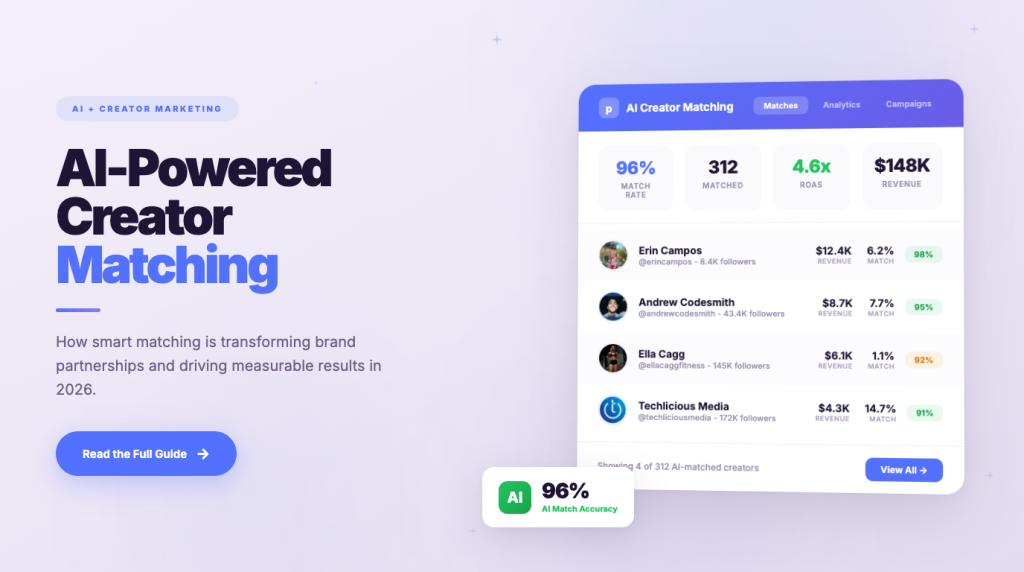
How AI-Powered Creator Matching Is Transforming Brand Partnerships in 2026

78% of brands say finding the right creator is their #1 challenge in influencer marketing: yet most are still sorting through spreadsheets, scrolling Instagram, and trusting their gut to make decisions that cost five to six figures per campaign.

Learn More

The Complete Guide to Influencer Platform ROI: Where Your Brand Should Invest in 2026

With TikTok, Instagram, YouTube, LinkedIn, and dozens of emerging platforms all competing for your media spend, the decision of where to invest isn’t just a channel preference: it’s a make-or-break budget call. Yet most brands make platform decisions based on gut feel or whatever channel their competitors are on, not actual ROI data.

Learn More

3 Costly Mistakes Brands Make When Working with Video Creators (And How to Avoid Them)

Whether it’s missed deadlines, off-brand content, or campaigns that simply don’t convert, the challenges are real. But here’s the thing – most of these failures aren’t due to bad creators or unrealistic brand expectations. They stem from three critical mistakes that are completely avoidable.

Learn More

Fashion Influencer Marketing Trends and Tactics for 2026

Influencer Marketing in Fashion: Tactics, Trends, Tools & Opportunities for 2026

Learn More

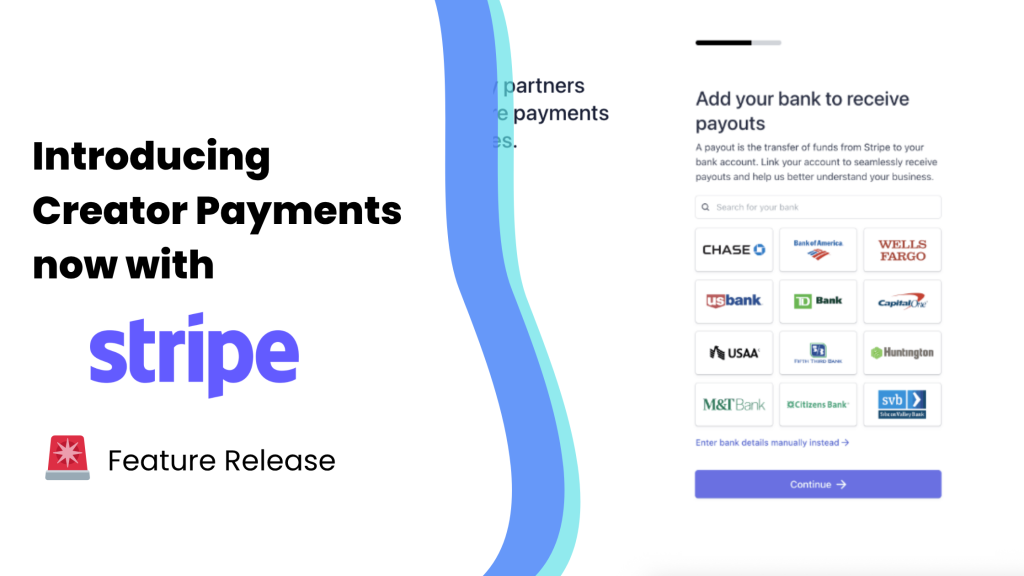
PayPal to Stripe Connect: What the Upgrade Means for Influencer Marketing Payments

Today, we’re excited to roll out an important upgrade in Creator payment flexibility with Stripe Connect.

Learn More

Fashion Influencer Marketing Strategies That Drive ROI

Influencer Marketing for Fashion Brands: ROI, Funnels & Execution Best Practices

Learn More

Influencer Marketing for Fashion Brands

Influencer Marketing for Fashion Brands: The Complete Strategy Guide (2026)

Learn More

Gaming Influencer Marketing Trends and Tactics for 2026

Gaming Influencer Marketing in 2026: Tactics, Trends, Tools & Opportunities

Learn More

Gaming Influencer Marketing Strategies That Drive ROI

Influencer Marketing for Gaming Brands: ROI Funnels, Measurement & Execution Best Practices

Learn More

Influencer Marketing for Gaming Brands

Influencer Marketing for Gaming Brands: The Ultimate Guide (2026)

Learn More

SaaS and Technology Influencer Marketing Trends and Tactics for 2026

Influencer Marketing for SaaS & Technology: Tools, Mistakes, Opportunities & Forward-Looking Trends

Learn More

SaaS and Technology Influencer Marketing Strategies That Drive ROI

Influencer Marketing for SaaS & Technology Brands: ROI, Funnels, and Execution Best Practices

Learn More

Influencer Marketing for SaaS and Technology Brands

Influencer Marketing for SaaS and Technology Brands: The Complete Strategy Guide

Learn More

Travel and Hospitality Influencer Marketing Trends and Tactics for 2026

Influencer Marketing in Travel & Hospitality: 2026 Trends, Tools, Mistakes & Opportunities

Learn More

Travel and Hospitality Influencer Marketing Strategies That Drive ROI

Influencer Marketing for Travel & Hospitality Brands: ROI Funnels, Measurement & Execution Best Practices

Learn More

From Support to Simplicity: The Shift Redefining Influencer Marketing Platforms

There’s a shift happening in influencer marketing, and the Spring 2026 G2 reports make it clear.

Learn More

We Just Launched a Massive Upgrade to partnrUP: Improved Influencer Marketing & Creator Workflow Management

We’ve been hard at work behind the scenes, and today, we’re excited to roll out one of the biggest updates to partnrUP yet.

Learn More

Influencer Marketing for Travel and Hospitality Brands

Influencer Marketing for Travel and Hospitality Brands: The Complete 2026 Strategy Guide

Learn More

Ecommerce Influencer Marketing Trends and Tactics for 2026

The Future of Influencer Marketing in Ecommerce: Tools, Trends, and Tactical Strategies for 2026

Learn More

Ecommerce Influencer Marketing Strategies That Drive ROI

The Complete Guide to Influencer Marketing ROI for Ecommerce Brands: Measurement, Funnels & Execution Best Practices

Learn More

Influencer Marketing for Ecommerce Brands

Influencer Marketing for Ecommerce Brands: The Complete Guide to Scaling Sales with Creator Partnerships

Learn More

Real Estate Influencer Marketing Trends and Tactics for 2026

Influencer Marketing for Real Estate Agents: The Complete 2026 Guide to Creator Partnerships and Property Marketing Success

Learn More

Influencer Marketing for Real Estate Brands

Real estate marketing is evolving. Traditional methods like open houses, yard signs, and MLS listings still matter, but today’s home buyers and sellers are spending more time scrolling through Instagram and TikTok than reading newspaper ads. This shift presents a massive opportunity for real estate brands willing to meet their audience where they already are, through influencer marketing for real estate.

Learn More

Real Estate Influencer Marketing Strategies That Drive ROI

How to Measure Influencer Marketing ROI for Real Estate Brands: Complete Guide to Funnels, Metrics & Best Practices

Learn More

Finance and Fintech Influencer Marketing Trends and Tactics for 2026

Influencer Marketing for Finance and Fintech: The Complete Guide to Tools, Mistakes, Opportunities, and Future Trends

Learn More

Finance and Fintech Influencer Marketing Strategies That Drive ROI

The Complete Guide to Influencer Marketing ROI for Finance and Fintech Brands: Measurement, Funnels, and Execution Best Practices

Learn More

Influencer Marketing for Finance and Fintech Brands

Influencer Marketing for Finance and Fintech Brands: The Complete Guide to Compliant, High-ROI Campaigns

Learn More

Food and Beverage Influencer Marketing Trends and Tactics for 2026

Influencer Marketing for Food and Beverage Brands: Tools, Mistakes, Opportunities & Trends for 2026

Learn More

Food and Beverage Influencer Marketing Strategies That Drive ROI

The Complete Guide to Food & Beverage Influencer Marketing ROI: Measurement Funnels and Execution Best Practices

Learn More

Influencer Marketing for Food and Beverage Brands

Influencer Marketing for Food and Beverage Brands: The Complete Strategy Guide

Learn More

Fitness and Wellness Influencer Marketing Trends and Tactics for 2026

Influencer Marketing for Fitness and Wellness Brands: 2026 Tactics, Trends, Tools & Opportunities

Learn More

Fitness and Wellness Influencer Marketing Strategies That Drive ROI

How to Measure Influencer Marketing ROI for Fitness and Wellness Brands: Complete Guide to Metrics, Funnels & Best Practices

Learn More

Influencer Marketing for Fitness and Wellness Brands

Influencer Marketing for Fitness and Wellness Brands: The Complete 2026 Guide

Learn More

Beauty and Skincare Influencer Marketing Trends and Tactics for 2026

Influencer Marketing for Beauty and Skincare Brands: 2026 Trends, Tools, Mistakes & Opportunities

Learn More

Beauty and Skincare Influencer Marketing Strategies That Drive ROI

Maximizing ROI from Beauty and Skincare Influencer Marketing: Full-Funnel Measurement, Attribution Strategy, and Execution Best Practices

Learn More

Influencer Marketing for Beauty and Skincare Brands

Influencer Marketing for Beauty and Skincare Brands: The Complete 2026 Strategy Guide

Learn More

Family and Parenting Influencer Marketing Trends and Tactics for 2026

Family and Parenting Influencer Marketing 2026: Tactical Strategies, Essential Tools, and Forward-Looking Opportunities

Learn More

Family and Parenting Influencer Marketing Strategies That Drive ROI

Maximizing ROI from Family and Parenting Influencer Marketing: Full-Funnel Measurement, Attribution Strategy, and Execution Best Practices

Learn More

Influencer Marketing for Family and Parenting Brands

Influencer Marketing for Family and Parenting Brands: The Complete Guide to Building Trust and Driving Sales

Learn More

Pets Influencer Marketing Trends and Tactics for 2026

Pet Influencer Marketing Trends 2026: Tactical Strategies, Essential Tools, and Forward-Looking Opportunities

Learn More

Pets Influencer Marketing Strategies That Drive ROI

Maximizing ROI from Pet Influencer Marketing: Full-Funnel Measurement, Attribution Strategy, and Execution Best Practices

Learn More

Influencer Marketing for Pets Brands

The pet industry has experienced explosive growth in influencer marketing, with approximately 63% of pet owners now following at least one pet influencer on Instagram or TikTok. As pet humanization trends continue to reshape consumer behavior and the global pet care market surpasses $350 billion, pet brands face a critical question: How can you leverage creator partnerships to drive measurable growth in an increasingly competitive marketplace?

Learn More

Fashion Influencer Marketing Trends and Tactics for 2026

The fashion industry stands at a pivotal moment in influencer marketing. With creator marketing budgets experiencing a 171% increase in 2025 and continuing to grow in 2026, fashion brands face both unprecedented opportunities and complex challenges in this evolving landscape. While traditional advertising channels continue to decline in effectiveness, authentic creator partnerships have become the cornerstone of modern fashion marketing strategies.

Learn More

Fashion Influencer Marketing Strategies That Drive ROI

Fashion brands invest billions in influencer marketing annually, yet most struggle to answer a critical question: What’s the actual return on investment? While competitors chase vanity metrics like follower counts and likes, leading fashion brands are building sophisticated influencer marketing ROI frameworks that connect creator partnerships directly to revenue, customer acquisition, and long-term brand value.

Learn More

Influencer Marketing for Fashion Brands: A Complete Guide to Building Profitable Partnerships

The fashion industry has undergone a seismic shift in how brands connect with consumers. Gone are the days when expensive magazine spreads and celebrity endorsements were the only paths to visibility. Today, influencer marketing for fashion brands has become the cornerstone of modern marketing strategies, delivering authentic connections, measurable ROI, and scalable growth.

Learn More