
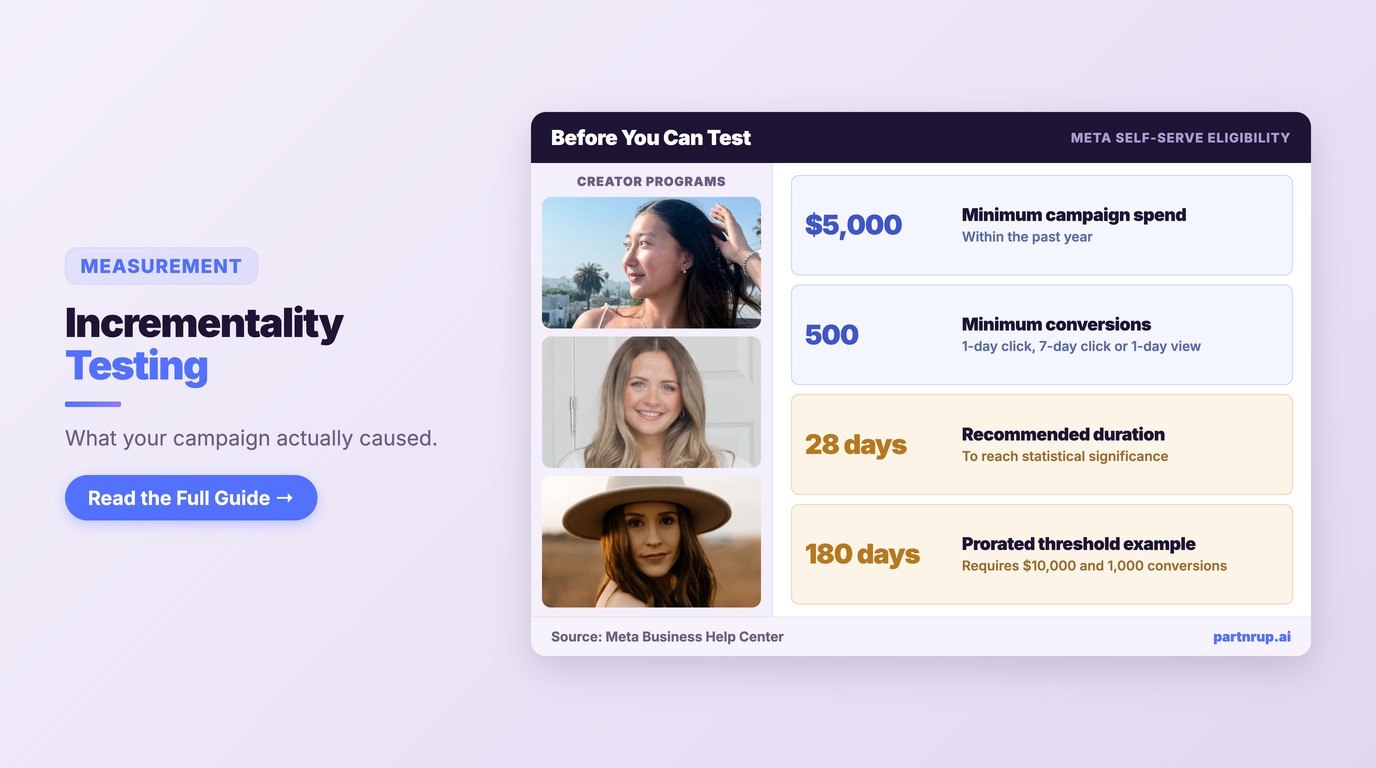




Meta will not run a conversion lift test on an account unless a campaign from the past year spent $5,000 USD or more and produced at least 500 conversions. That single eligibility rule is the most useful thing in influencer measurement, because it tells you the one thing no attribution dashboard will: incrementality testing has a cost of entry, and most creator programs are not yet paying it.
Attribution tells you which touchpoint got credit. Incrementality tells you what would have happened anyway. The gap between those two numbers is where influencer budgets get defended or cut, and it is almost always the number a CFO actually asked for.
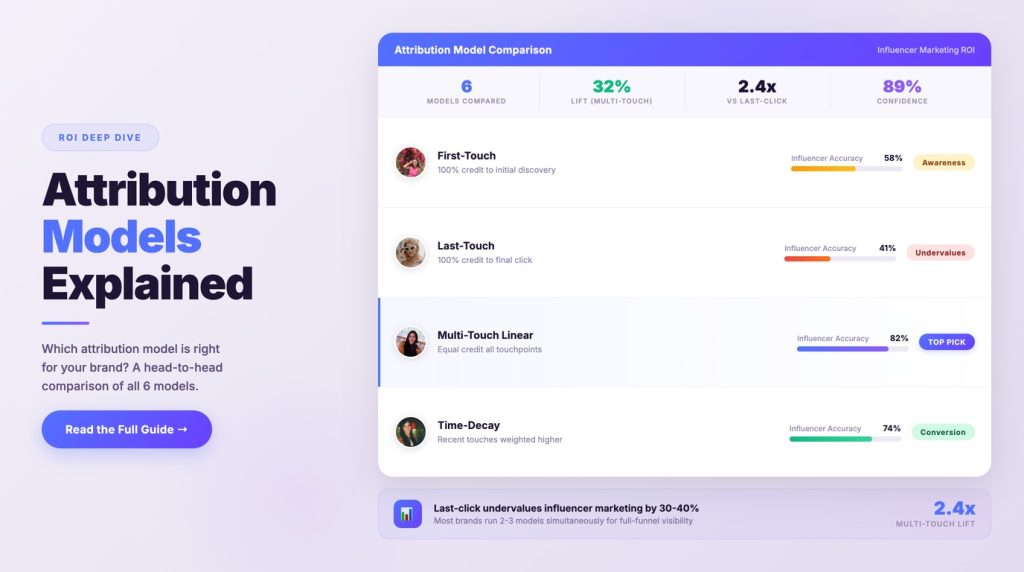
This guide is deliberately narrow. It is not another explainer on why incrementality matters, and it is not a survey-methodology piece — our guide to brand lift studies covers the awareness side, and our attribution models breakdown covers credit assignment. What follows is the operational layer: how a test is actually designed, how long it has to run, what makes a result trustworthy, and the specific ways creator campaigns break experimental design in ways paid social does not.
Table of Contents
- What Incrementality Testing Actually Measures
- The Three Test Designs Available to Brands
- Platform Eligibility: What You Need Before You Can Test
- Designing the Test: Hypothesis, Holdout, Duration
- Why Creator Campaigns Break Standard Test Design
- Reading the Result Without Fooling Yourself
- Five Pitfalls That Invalidate a Test
- Operationalizing Incrementality as a Habit
- Frequently Asked Questions
What Incrementality Testing Actually Measures
An incrementality test is a controlled experiment. You take the audience you intended to reach, split it at random, show the campaign to one group, deliberately withhold it from the other, and measure the difference in the outcome you care about.
Meta describes the structure plainly in its documentation on lift and holdouts: "The people who match your ad audience but are intentionally withheld from seeing your ads are your holdout group (also referred to as control group)." The mechanism depends entirely on that withholding being random and enforced. Everything else in this guide is about protecting that one property.
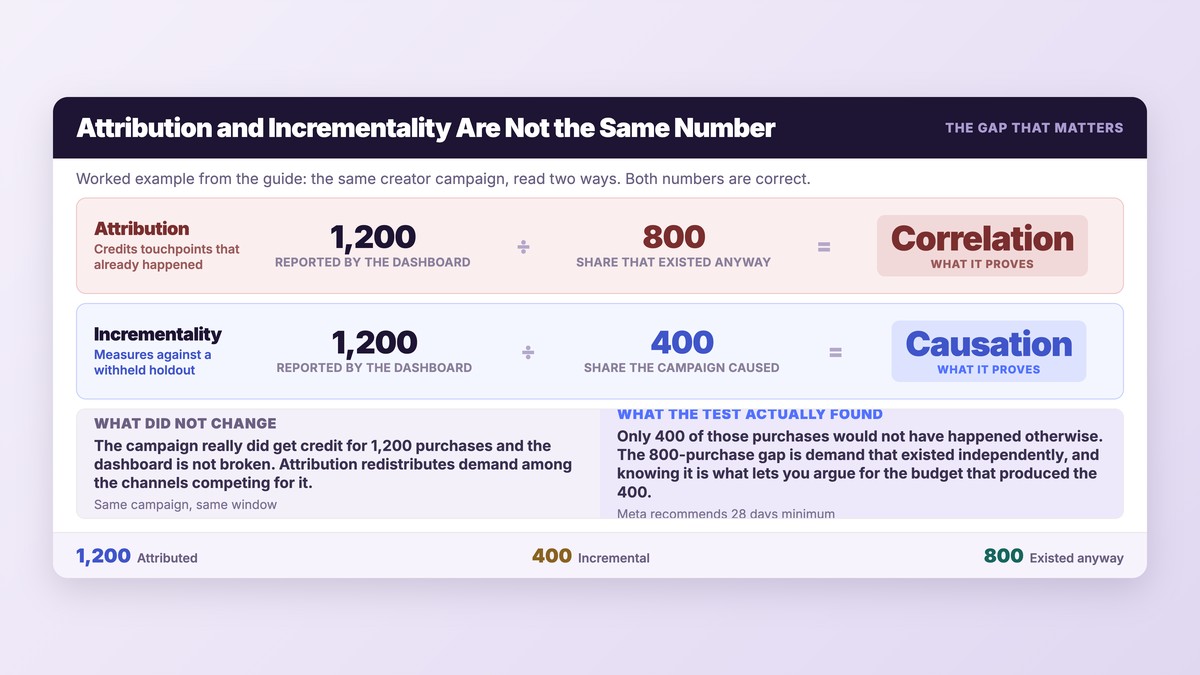
The distinction worth internalizing is causal rather than statistical. Attribution models redistribute credit among touchpoints that already happened. An incrementality test constructs a world where the campaign did not happen and compares it to the one where it did. Those answer different questions, and only the second one survives a hostile budget review.
Lift is a difference, not a total
A common misread: a brand runs a creator campaign, sees 1,200 attributed purchases, runs a holdout test, and gets a lift result implying 400 incremental purchases. The instinct is to call the dashboard wrong. It is not wrong — it is answering a different question. The 800-purchase gap is the share of demand that existed independently of the campaign. Knowing that number is what lets you argue for the budget that produced the 400.
What a test will not tell you
It will not tell you which creator drove the lift unless you designed the test around that question. It will not tell you anything about long-term brand equity inside a four-week window. And it will not rescue a measurement setup where the conversion signal itself is broken — a point that becomes concrete in the eligibility requirements below.
The Three Test Designs Available to Brands
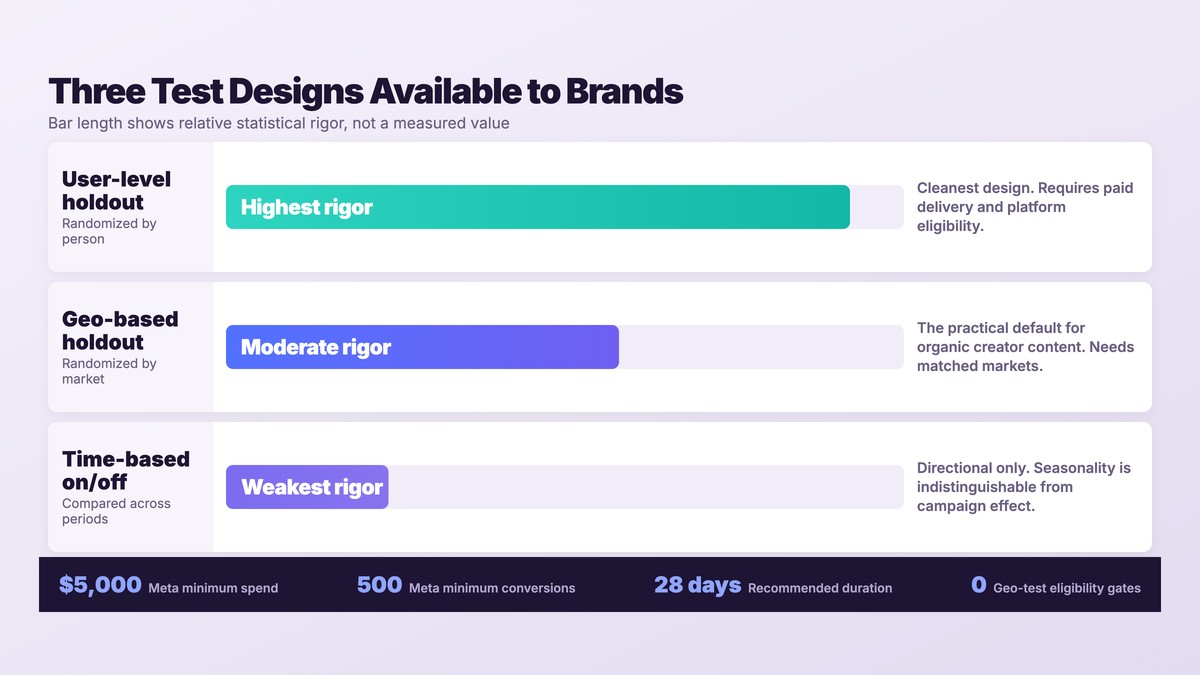
Three structures cover nearly every creator incrementality test a brand will realistically run. They differ in rigor, cost, and what they can isolate.
User-level holdout
The platform randomly assigns individuals to test and holdout groups and controls delivery accordingly. This is the most statistically clean option because randomization happens at the level of the person. It is also the most constrained: it requires running creator content as paid media through a platform that offers the test, and it requires meeting that platform's spend and conversion thresholds.
Meta's Conversion Lift is the canonical example. It uses what the documentation calls an "intent-to-treat approach, to estimate the impact of ads on outcomes that matter to your business in an unbiased manner" — meaning the test group is defined by eligibility to see the ad, not by having actually seen it. That design choice matters more than it sounds, and we return to it when reading results.
Geo-based holdout
Instead of splitting people, you split markets. Run the campaign in one set of geographies, withhold it in a comparable set, compare outcomes. Geo tests are the practical answer for organic creator content, which cannot be withheld from an individual the way an ad can — a creator's post is visible to whoever finds it.
The cost is statistical power. You are no longer comparing thousands of randomized individuals but a handful of markets, each with its own seasonality, competitive pressure, and retail footprint. Geo tests need longer windows and larger effects to detect anything, and they need markets matched on pre-period behavior rather than on population alone.
Time-based on/off
Run the campaign for a period, pause it for a comparable period, compare. This is the weakest design and the only one available to many brands, so it is worth stating its limits honestly: anything that changed between the two windows — a competitor promotion, a seasonal shift, a pricing change — is indistinguishable from campaign effect. Treat an on/off result as a directional signal that justifies a real test, not as a finding.
Platform Eligibility: What You Need Before You Can Test
This is the section most incrementality content skips, and it is where most programs actually stall. Meta publishes its self-serve requirements, and they are specific.
From Meta's Conversion Lift documentation: "to run a Conversion Lift test, your ad account must have a campaign that started in the past year with a spend of $5,000 USD or more. In addition, this campaign needs to have a minimum of 500 conversions with a 1-day click, 7-day click or 1-day view attribution setting." Longer campaigns scale against the same bar — the documentation notes that for campaigns exceeding 90 days results are prorated, giving the example that "a campaign running for 180 days would require $10,000 USD and 1,000 conversions."
There is a second gate that trips up creator programs specifically. Meta requires the account to meet a signal-quality condition: either it has "Adopted Conversions API (CAPI) and is sending any event with an Event Match Quality (EMQ) score greater than 5," or it uses a supported data source to send a low-funnel or app-install event.
Read together, those requirements say something unwelcome and useful. A brand running $8,000 of creator gifting with UTM links and no server-side conversion feed is not one decision away from an incrementality test — it is several infrastructure steps away. The honest sequence is: fix conversion signal, accumulate paid spend behind creator content, then test. Not the reverse.
If you do not meet the bar
Geo testing has no platform eligibility gate because you are not asking a platform to withhold delivery — you are controlling where you spend. That makes it the default entry point for programs below the threshold, and the reason geo design deserves more attention than it usually gets in creator measurement.
Designing the Test: Hypothesis, Holdout, Duration
A test is only as good as the decision it was built to inform. Four choices determine whether the result will be usable.
Write the hypothesis as a decision, not a question
"Does creator content work?" is unanswerable. "If creator-boosted content drives at least a 10% lift in purchases, we move 20% of paid social budget into creator amplification next quarter" is a hypothesis, because it names the threshold and the action. Write the decision before the test, or you will rationalize whatever number arrives.
Size the holdout against the effect you expect, not against comfort
The holdout is foregone reach, which makes it feel like waste, which makes brands shrink it. Shrinking it is how tests end inconclusive — the most expensive outcome, because you paid the full cost and bought no information. A holdout large enough to detect a plausible effect is cheaper than a test that cannot conclude.
Give it the full window
Meta's setup guidance is explicit on duration: "We recommend a minimum budget of $5,000 USD and a duration of at least 28 days to increase the likelihood of achieving statistical significance." Twenty-eight days is a floor for paid social with user-level randomization. A geo test on a considered-purchase product needs materially longer, because the purchase cycle itself has to fit inside the measurement window.
Lock the measurement window before you start
Decide the conversion window up front and do not extend it to chase a result. Meta warns against one specific version of this: "While we offer the option, we do not recommend using the post-test conversion window for calculating results. Leveraging post-test windows without maintaining holdout groups may result in increased variance and reduced effect during the post-test period." Once the holdout stops being withheld, the comparison stops being valid.
Why Creator Campaigns Break Standard Test Design
Everything above is standard experimental practice. Creator campaigns introduce four complications that paid social does not have, and they are the reason generic incrementality advice underperforms here.
Organic reach cannot be withheld
A platform can withhold an ad from a user. No one can withhold a creator's organic post from someone who follows that creator. Any test on organic creator content is therefore a geo test or a time test by necessity — user-level holdout is simply unavailable. Brands that try to force user-level design onto organic content end up with a contaminated holdout and a result that understates lift.
Creator audiences overlap with your retargeting pools
If the same people sit in a creator's audience and in your retargeting segment, your holdout group may be seeing your brand constantly through a different channel. The test then measures the incremental value of creator content on top of existing brand exposure, which is a legitimate question but not the one most brands think they are asking. Name which one you want before you design.
The content outlives the test window
Paid delivery stops when you stop paying. A creator's post stays up, keeps accumulating views, and keeps converting after your 28-day window closes. This biases a test toward understating creator impact. It is a real limitation, not a reason to skip testing — but it belongs in how you present the result, because a lift number from creator content is closer to a floor than a ceiling.
Creator-level effects need creator-level design
A single test across twelve creators gives you one number about twelve creators. If the actual question is which creators to re-sign, the test needs cells, and each cell needs enough volume to conclude on its own. That is usually the point at which brands discover that their roster is too wide and too thin to measure, which is itself the finding.
Reading the Result Without Fooling Yourself
A lift test returns more than a percentage, and the percentage is the least informative part.
Meta's documentation describes the output as including "a lift percentage specific to your selected business objectives, a confidence percentage (or power calculation) which represents the causality of your test, and other information about the results of your test." The platform also notes that beyond the point estimate it provides "statistics to help you determine how much weight to put on the evidence in the experiment including intervals representing the range of most probable outcomes."
Three reading habits separate useful interpretation from theater.
Read the interval, not the point. A 12% lift with a range spanning roughly zero to twenty-five is not a 12% finding. It is an inconclusive test with a convenient midpoint. Report the range to stakeholders, or someone will plan against the midpoint as though it were measured.
Understand what the test group means. Because Meta uses intent-to-treat, the test group includes people who were eligible to see the ad but never did — the documentation distinguishes an "Exposed Audience" who actually saw the ad from an "Unexposed Audience" who did not, "e.g. due to delivery constraints or because they didn't scroll to the ad." This makes the measured lift deliberately conservative, which is the correct direction for a number you plan to defend.
Treat a null result as information. A test showing no detectable lift on a channel you believed in is the highest-value output in the whole exercise, provided the test had the power to detect an effect. A null from an underpowered test says nothing at all. Those two outcomes look identical on a slide and must never be reported the same way.
Five Pitfalls That Invalidate a Test
Each of these produces a number. None of them produces a finding.
1. Stopping the test when the result looks good. Peeking at interim results and ending early inflates apparent effects. The duration was chosen for a reason; honor it.
2. Changing the campaign mid-test. Swapping creative, adding creators, or shifting budget mid-flight means the thing you measured at the end is not the thing you started measuring. If something must change, the test restarts.
3. Letting the holdout leak. Email, retargeting, retail promotion, or an organic creator post reaching the control group all contaminate the comparison. Audit every channel touching the holdout geography or segment before launch, not after.
4. Running a test the sample size cannot support. Small effects need large samples. A test designed to detect a 40% lift will return "no significant effect" on a real 8% lift, and someone will read that as proof the channel does not work.
5. Testing without a pre-period baseline. This is the one that quietly ruins geo tests. Markets matched on population but not on pre-period conversion behavior were never comparable, so the difference you measure at the end includes a difference that existed at the start.
Operationalizing Incrementality as a Habit
One test produces a number. A testing cadence produces a measurement capability, and the difference shows up in how fast a program can defend itself.
The practical cadence for most brands is one properly powered test per quarter on the channel carrying the most budget, with the hypothesis written at the start of the quarter rather than the end. That rhythm is slow enough to respect test duration and frequent enough that results stay relevant to live decisions.
What makes the cadence survive contact with reality is operational, not analytical. A test requires knowing which creators ran which content in which markets on which dates, with conversion data attached — and that record has to exist before the test, not be reconstructed after. The most common reason a planned test cannot be analyzed is that nobody can reliably say what shipped where.
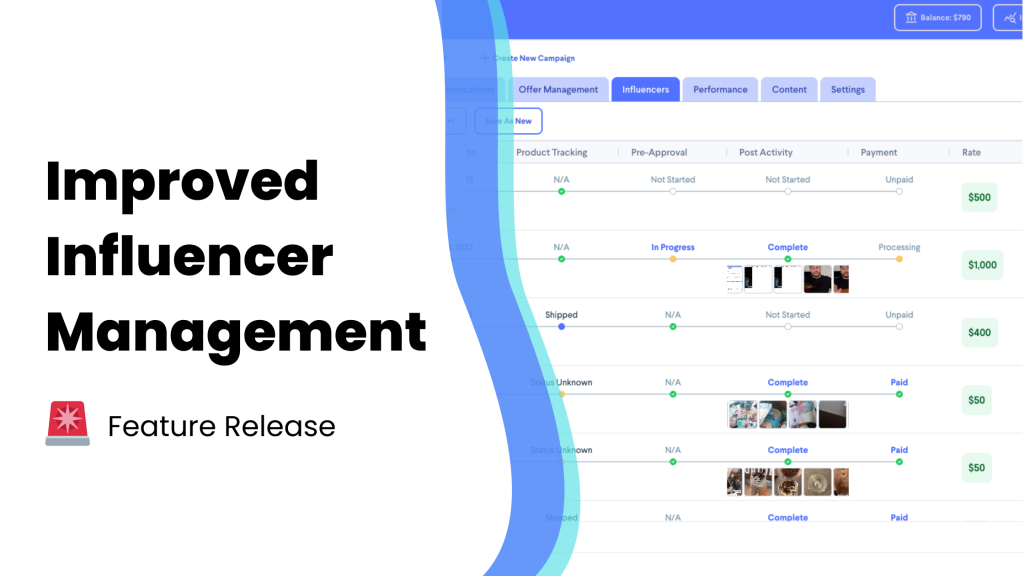
This is the layer partnrUP is built for. The platform handles campaign management — "Plan, launch, and manage every campaign with speed and structure" — alongside creator management that tracks "conversations, content, and contracts in one streamlined workspace," which is the record a test design depends on. AI-powered creator discovery and brief generation reduce the setup cost of running structured campaigns in the first place. The experiment itself still runs in the ad platform; what partnrUP removes is the operational drag that keeps most brands from ever getting to a testable campaign.
If you are building the measurement foundation underneath this, start with our complete guide to influencer marketing ROI, then tighten the inputs with creator affiliate link tracking and the metrics that actually matter. For the KPI frame your tests should map onto, see influencer marketing KPIs, and for roster decisions that follow a result, long-term partnerships versus one-off campaigns.
Conclusion
Incrementality testing is less a technique than a discipline: decide what you would do differently at each possible result, build a comparison honest enough to produce one, and then live with the number. The hard parts are not statistical. They are the willingness to withhold reach, the patience to let a window close, and the conversion infrastructure that makes a test eligible at all.
The brands that get this right do not run better tests than everyone else. They run tests at all, on a schedule, with the operational record to analyze them — and that is a lower bar than it looks from the outside.
Launch a campaign with partnrUP to build the campaign record your next test will need, or book a demo to see how the workflow fits your measurement stack.
Frequently Asked Questions
What is the difference between incrementality testing and attribution?
Attribution assigns credit among touchpoints that already occurred. Incrementality testing constructs a counterfactual — a comparable group that did not see the campaign — and measures the difference. Attribution tells you where credit landed; incrementality tells you what the campaign actually caused.
What do I need before I can run a conversion lift test on Meta?
Meta's published self-serve requirement is a campaign started within the past year with at least $5,000 USD in spend and a minimum of 500 conversions using a 1-day click, 7-day click, or 1-day view attribution setting. The account must also meet a signal-quality condition, such as sending Conversions API events with an Event Match Quality score above 5. Campaigns running past 90 days are prorated against those thresholds.
How long should an incrementality test run?
Meta recommends a minimum of 28 days alongside a minimum $5,000 budget to improve the likelihood of reaching statistical significance. Geo-based tests and considered-purchase categories generally need longer, because the purchase cycle has to fit inside the measurement window.
Can I test organic creator content for incrementality?
Not with a user-level holdout, because an organic post cannot be withheld from an individual who follows the creator. Organic creator content is tested with geo-based holdouts or, less reliably, time-based on/off comparisons. Geo testing is the practical default for organic programs.
How large should the holdout group be?
Large enough to detect the smallest effect that would change a decision. Undersizing the holdout to preserve reach is the most common cause of inconclusive tests, which cost the full price of the experiment and return no information.
What does a null result mean?
If the test had enough power to detect a plausible effect, a null is a real finding and should change budget. If the test was underpowered, a null means nothing — the experiment simply could not see an effect of that size. Always check power before interpreting a null.
Why is my measured lift lower than my attributed conversions?
Usually because it should be. Attributed conversions include demand that would have converted without the campaign. For creator content there is a second reason: posts keep converting after the test window closes, so a lift figure measured inside a fixed window tends to understate creator impact rather than overstate it.