Every marketing leader faces the same question at budget time: “What did we actually get from our influencer spend?” It’s the question that’s launched a thousand spreadsheets and ended more than a few campaigns prematurely. And according to influencer marketing statistics, more than 70% of brands say proving influencer ROI is their single biggest measurement challenge.
Here’s the honest truth: influencer marketing sits at a strange intersection of brand building and direct response. It can do both, but measuring either one cleanly requires more rigor than most teams apply. Too often, brands lean on vanity metrics (likes, impressions, follower counts) that look great in a deck but say nothing about business impact.
This guide changes that. Whether you’re a DTC brand tracking affiliate code conversions, a SaaS company measuring brand lift, or an ecommerce team running incrementality tests. This is your complete playbook for influencer marketing ROI. We’ll cover attribution models, platform benchmarks, dashboard setup, common mistakes, and how AI is reshaping what’s possible. By the end, you’ll have a measurement framework you can put to work immediately.
Why Influencer Marketing ROI Is So Hard to Measure
Before we dig into solutions, it’s worth understanding why influencer ROI is genuinely difficult: not because marketers haven’t tried hard enough, but because the structure of the problem requires intentional frameworks to solve.
The Multi-Touch Attribution Problem
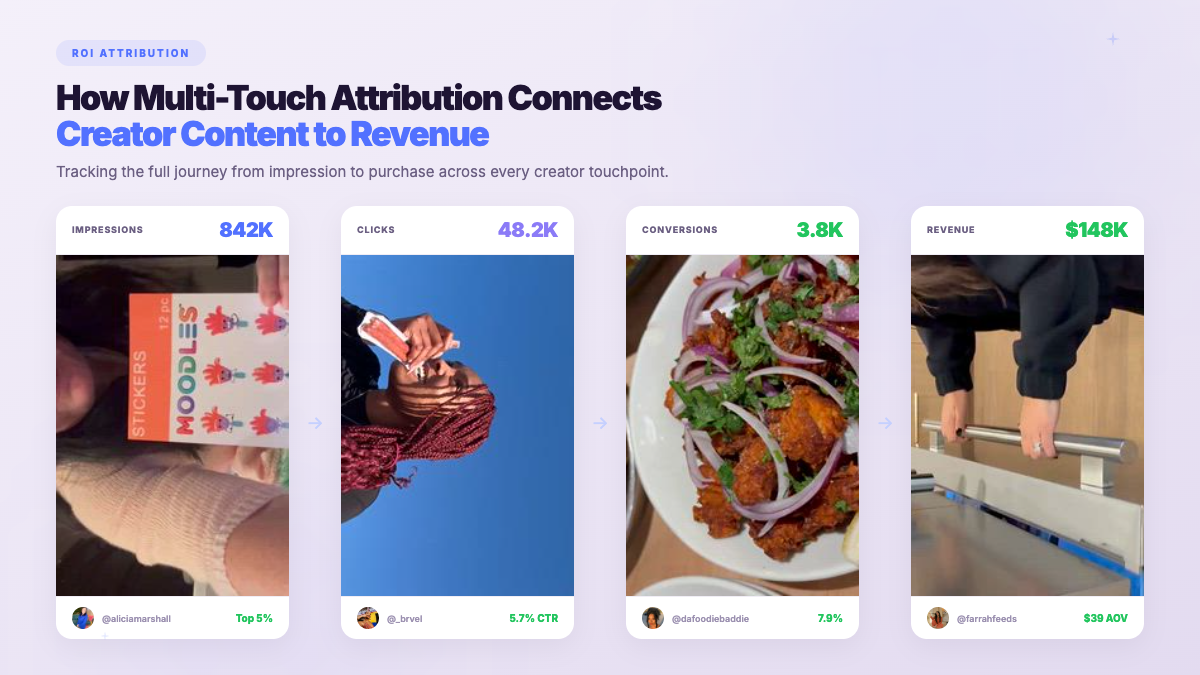
Modern customers don’t convert in a straight line. Someone might see an influencer’s TikTok on Tuesday, Google the brand Thursday, see a retargeting ad Friday, then convert via email Saturday. Which touchpoint gets credit? In most analytics setups, the email gets last-touch credit and the influencer gets nothing, even though it sparked the entire journey.
This is the core attribution challenge. Without intentional multi-touch tracking, influencer impact is routinely undercounted by 30–50% or more. It’s one of the common influencer marketing mistakes that leads brands to cut budgets they should be growing.
Dark Social: The Invisible Channel
When someone screenshots an influencer’s Story and sends it to a friend in a DM, that’s a real marketing action, but it shows up nowhere in your analytics. This “dark social” problem is massive in influencer marketing, where shares, saves, and direct messages are often the highest-intent signals. Instagram Stories views, TikTok shares to DMs, and WhatsApp forwards are effectively invisible to standard tracking.
Brand Lift vs. Direct Response: Two Different Animals
An influencer post that generates 500K impressions and makes 200K people more likely to consider your brand is doing real work, but that work doesn’t show up as a line item in your ROAS dashboard. Brand lift and direct response ROI require completely different measurement approaches, and conflating them is a major source of confusion.
The Correlation vs. Causation Trap
Sales went up 15% during the influencer campaign. Did the campaign cause it? Maybe. But maybe it was also a seasonal trend, a competitor going out of stock, or a paid social surge running simultaneously. Without proper experimental design: specifically, holdout groups , you can’t know for sure.
The most sophisticated brands don’t just track metrics. They design campaigns to generate causal proof from the start. More on that in the attribution models section below.
The 4 Types of Influencer Marketing ROI
Before you can measure ROI, you need to define which type you’re going after. These aren’t interchangeable , each requires different campaign design, tracking infrastructure, and success benchmarks.
1. Direct Response ROI
This is the most familiar type: influencer drives traffic, traffic converts, you track the revenue. Direct response ROI is measured through affiliate codes, UTM-tracked links, conversion pixels, and promo codes. It’s the cleanest type to measure and the one most DTC brands optimize for.
Best suited for: Product launches, limited-time offers, affiliate-based campaigns, and any situation where immediate conversion is the goal.
Core metrics: Revenue attributed, ROAS, cost per acquisition, promo code redemption rate, affiliate click-through rate.
2. Brand Awareness ROI
Awareness campaigns don’t convert immediately: they create the conditions for future conversion. ROI here is measured in reach, share of voice, and brand lift: the statistical increase in brand awareness, consideration, or purchase intent you can attribute to the campaign.
Best suited for: New market entry, repositioning, product category creation, and reaching audiences that are currently unaware of your brand.
Core metrics: Reach and impressions, estimated earned media value (EMV), brand lift surveys, share of voice, unaided brand recall.
3. Content ROI
This is one of the most undervalued types of influencer ROI. When creators produce content for your campaign, that content has a life beyond the initial post. You can license it for paid social ads, website hero images, email campaigns, and retail displays: often at a fraction of professional production cost.
A single high-performing piece of creator content can deliver 10–20x its original value when repurposed. Check out our guide on UGC in Meta Ads to see exactly how this plays out in practice.
Best suited for: Brands with high content volume needs, paid social advertisers, and anyone running UGC-based creative strategies.
4. Long-Term Brand Equity ROI
The hardest to measure but potentially the highest-value type. Long-term influencer partnerships build trust, category authority, and customer lifetime value in ways that compound over time. A brand authentically embedded in a creator’s content over 12 months builds a different kind of equity than a one-off sponsored post.
Best suited for: Brand ambassador programs, long-term creator partnerships, category leadership plays.
Core metrics: Customer LTV from influencer-acquired cohorts, NPS changes, organic mention growth, creator audience loyalty metrics.
Key Metrics to Track at Every Stage of the Funnel
ROI measurement isn’t a single number: it’s a stack of signals across the customer journey. Here’s what to track at each stage, and why it matters:
Awareness Stage Metrics
- Reach: Total unique accounts that saw the content. More meaningful than impressions, which count the same person multiple times.
- Impressions: Total views including repeat viewers. Useful for frequency analysis.
- Estimated Earned Media Value (EMV): What the reach would have cost as paid media. A useful benchmark, though methodology varies by tool.
- Share of Voice: Your brand’s share of total conversation in a category, tracked via social listening tools.
- Branded search lift: Did branded Google searches increase during or after the campaign? This is a real signal that creator content is driving discovery.
Engagement Stage Metrics
Not all engagement is equal. Here’s the quality hierarchy to keep in mind:
- Saves: The highest-intent engagement signal on Instagram and TikTok. A save means the viewer plans to return: that’s purchase consideration behavior.
- Shares: Distribution signal. High shares mean content resonates enough to pass along, amplifying organic reach.
- Comments: Quality over quantity. Fifty genuine comments about the product are worth more than 500 emoji reactions.
- Engagement rate: (Total engagements / Reach) × 100. Compare against creator benchmarks by tier and platform.
- Video completion rate: On TikTok and YouTube, the percentage of viewers who watched to completion is a strong signal of content quality.
Conversion Stage Metrics
- Click-through rate (CTR): Clicks on tracked links / Total reach. Stories swipe-ups average 0.5–1.5%; feed post link-in-bio averages 0.1–0.5%.
- Promo code redemption rate: Codes redeemed / Total reach. Tracks direct purchase attribution.
- Attributed revenue: Revenue traceable to influencer traffic via UTMs or affiliate platforms.
- Cost per acquisition (CPA): Total campaign spend / Number of attributed conversions.
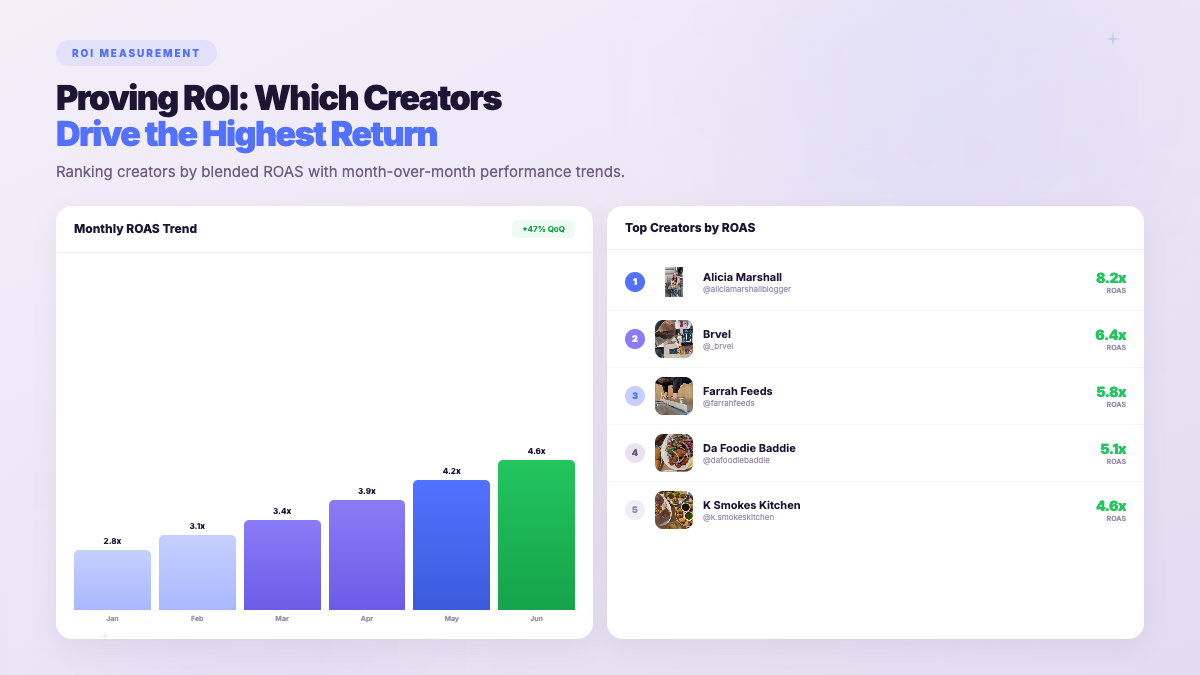
- Return on ad spend (ROAS): Attributed revenue / Campaign spend. For influencer campaigns, 2–4x ROAS is typical for DTC; 6x+ indicates exceptional performance.
Retention Stage Metrics
- Repeat purchase rate from influencer cohorts: Do customers acquired via influencer campaigns come back at higher or lower rates than other channels? This reveals audience quality.
- Customer LTV by acquisition source: Influencer-acquired customers often have higher LTV when the creator’s audience is well-matched to the brand.
- Referral rate: Are influencer-acquired customers more likely to refer friends? High referral rates signal strong audience-brand alignment.
Attribution Models for Influencer Marketing
How you assign credit for a conversion determines whether influencer marketing looks like a winner or a waste. Here are the main attribution models and when to use each: particularly relevant if you’re thinking about B2B influencer ROI where sales cycles are long.
First-Touch Attribution
How it works: 100% of credit goes to the first touchpoint in the customer journey.
When it helps influencer marketing: If influencers are typically first in the journey (discovery channel), first-touch gives them full credit. This tends to favor awareness-focused campaigns.
Limitation: Ignores everything that happened between discovery and conversion. Overvalues top-of-funnel touchpoints.
Last-Touch Attribution
How it works: 100% of credit goes to the final touchpoint before conversion.
When it hurts influencer marketing: Almost always. If a customer discovers you via influencer, bounces, gets retargeted by a paid ad, and converts via email: the email gets all the credit. Influencer gets zero. This is one of the costly mistakes brands make with creators: defaulting to last-touch and concluding influencer doesn’t work.
Multi-Touch Attribution (Linear, Time-Decay, Position-Based)
Linear: Equal credit distributed across all touchpoints. Simple and fair, but doesn’t reflect that not all touchpoints are equally influential.
Time-decay: More recent touchpoints get more credit. Useful for short sales cycles where recency matters.
Position-based (U-shaped): 40% credit to first touch, 40% to last touch, 20% split among middle touchpoints. A reasonable default that values both discovery and conversion.
Recommendation: For most brands, position-based attribution is the best starting point. It acknowledges the discovery role influencers play while still crediting conversion-focused channels. See our influencer platform ROI guide for how different platforms handle attribution out of the box.
Incrementality Testing (Holdout Groups)
This is the gold standard, and the only way to establish true causal proof of influencer ROI.
How it works: Randomly split your target audience into two groups. One sees the influencer campaign. The other (holdout group) doesn’t. After the campaign, compare conversion rates. The difference is the incremental lift caused by the campaign.
Why it matters: It eliminates the correlation vs. causation problem entirely. If both groups convert at the same rate, the campaign generated zero incremental ROI. If the exposed group converts higher, you have proof.
When to use it: For campaigns with meaningful budgets ($50K+), for proving ROI to skeptical executives, and for comparing influencer ROI against other channels on equal footing.
How to Set ROI Benchmarks Before You Launch
Walking into a campaign without predefined benchmarks is one of the most avoidable errors in influencer marketing. Without them, you have no basis for evaluating success, and you’ll measure whatever looks best in retrospect.
Industry Benchmarks by Platform
These are directional benchmarks based on 2025–2026 industry data. Use them as starting points, not absolutes. For deeper data, see our roundup of influencer marketing statistics by platform and industry.
| Platform | Avg. Engagement Rate | Avg. CTR (Link) | Typical ROAS Range |
|---|---|---|---|
| Instagram (Feed) | 1.5–3.5% | 0.1–0.5% | 2–5x |
| Instagram Stories | N/A (swipe-up) | 0.5–2% | 3–6x |
| TikTok | 3–8% | 0.3–1.2% | 2–6x |
| YouTube (long-form) | 1–3% | 0.5–3% | 4–10x |
| YouTube (Shorts) | 2–5% | 0.2–0.8% | 2–4x |
Benchmarks by Creator Tier
Creator tier dramatically affects the engagement vs. reach tradeoff:
| Tier | Followers | Avg. Engagement Rate | Best For |
|---|---|---|---|
| Nano | 1K–10K | 5–10% | Hyper-targeted niches, high trust |
| Micro | 10K–100K | 3–6% | Niche audiences, strong conversion |
| Mid-tier | 100K–500K | 2–4% | Balance of reach and engagement |
| Macro | 500K–1M | 1.5–3% | Scale, brand awareness |
| Mega/Celebrity | 1M+ | 0.5–1.5% | Mass awareness, cultural moments |
The key insight: nano and micro creators consistently deliver higher engagement rates and conversion rates per impression than macro creators: at a fraction of the cost. For most DTC and ecommerce brands, a portfolio of 20–50 micro creators will outperform a single mega-influencer deal on both reach efficiency and conversion rate. When choosing where to invest, our influencer platform ROI guide breaks down the tradeoffs in detail.
Setting Realistic Targets: Awareness vs. Conversion Campaigns
Set your benchmarks based on campaign objective first:
- Awareness campaign targets: CPM (cost per thousand impressions), estimated EMV vs. spend, brand lift % (if measuring via survey)
- Conversion campaign targets: Target CPA vs. your blended channel CPA, target ROAS vs. your paid social ROAS, promo code redemption rate floor
- Content campaign targets: Cost per piece of usable content vs. production alternatives, creative performance score in paid placements
A good rule of thumb: if your blended paid social CPA is $45, your influencer CPA target should be $60–80 (higher is acceptable because influencer content has brand lift and content value that paid social doesn’t). If you hold influencer campaigns to the same CPA standard as bottom-of-funnel retargeting, you’ll always conclude they don’t work.
Building Your Influencer ROI Dashboard
A good ROI dashboard doesn’t require enterprise-level tooling. It requires clear thinking about what you’re measuring and consistent data collection. Here’s how to build one, and how what to look for in a platform affects your measurement capabilities out of the box.
Real-Time Metrics (Track During Campaign)
- Post live status and initial engagement velocity (first 24–48 hours)
- Promo code redemptions (daily)
- UTM-tracked clicks and landing page sessions
- Affiliate dashboard conversions
- Branded search volume changes
Post-Campaign Metrics (Track at 7, 30, 90 Days)
- Total attributed revenue by creator and campaign
- Customer LTV of influencer-acquired cohorts (30/90 day)
- Content repurposing performance (paid social CTR, email open rate with creator content)
- Organic mention volume and sentiment changes
- Repeat purchase rate from influencer cohorts
Tools and Infrastructure
Native platform analytics: Instagram Insights, TikTok Analytics, YouTube Studio. Free and accurate for owned content, but siloed and limited for cross-platform reporting.
UTM tracking: Build consistent UTM parameters for every influencer campaign (source=influencer, medium=creator, campaign=[campaign name], content=[creator handle]). Route everything through Google Analytics 4 or your CDP. This is table stakes: if you’re not UTM-tagging influencer links, you’re flying blind.
Affiliate platforms: Impact, ShareASale, or native affiliate programs built into your influencer platform. These handle code generation, tracking, and payouts automatically.
Influencer marketing platforms: Tools like partnrUP provide unified dashboards that aggregate creator performance, track content across platforms, and connect to your conversion data in one place. If you’re evaluating options, our influencer platform alternatives guide walks through what to compare.
Survey tools: For brand lift measurement, Pollfish, Lucid, or platform-native brand lift studies (Meta Brand Lift, YouTube Brand Lift) can quantify awareness and consideration changes.
Reporting Cadence
- Weekly: Operational metrics , posts live, engagement velocity, code redemptions, clicks
- Monthly: Performance summary , attributed revenue, CPA, ROAS, top-performing creators and content
- Quarterly: Strategic review , channel ROI vs. alternatives, creator portfolio performance, content repurposing value, LTV analysis
Case Studies: Brands Measuring Influencer ROI the Right Way
Case Study 1: DTC Beauty Brand: Affiliate Codes + UTMs
Situation: A mid-size DTC skincare brand was running influencer campaigns but couldn’t prove ROI to their CFO. They relied on engagement metrics and gut feel.
Approach: They restructured their entire influencer program around measurability. Every creator received a unique promo code (10% off, tracked to creator) and a UTM-tagged link for bio and Stories. They integrated their affiliate platform with Shopify, enabling automatic revenue attribution to each creator handle.
Results: Within 90 days, they had clean data on every creator’s revenue contribution. Their top 5 micro-creators (15K–60K followers) drove 68% of attributed revenue despite representing only 30% of their creator spend. They reallocated budget away from two macro creators who looked great on reach but showed minimal conversion. Overall ROAS improved from 1.8x to 4.2x in one quarter.
Key lesson: Attribution infrastructure is a one-time setup investment that pays back immediately in optimization decisions.
Case Study 2: B2B SaaS: Brand Lift via Surveys
Situation: A project management SaaS wanted to break into the SMB market via LinkedIn and YouTube creator partnerships. Direct conversion tracking was impractical , their sales cycle was 45–90 days and involved multiple stakeholders. (Sound familiar? See our deep-dive on B2B influencer ROI.)
Approach: They partnered with five YouTube creators in the operations/productivity space. Before and after each campaign flight, they ran 2-week brand lift surveys targeting their ICP (operations managers at SMBs). They also tracked branded search volume and monitored demo request form sources.
Results: After three months, unaided brand recall among their target audience increased from 8% to 23%. Branded search volume increased 41%. Demo requests via organic search increased 28%. The team was able to show the CFO a statistical causal link between creator investment and pipeline growth.
Key lesson: For long sales cycles, proxy metrics (brand lift, branded search) are valid leading indicators of future pipeline ROI when measured rigorously.
Case Study 3: Ecommerce Brand: Incrementality Testing
Situation: A home goods ecommerce brand had been running influencer campaigns for two years but was constantly challenged: “How do we know those sales wouldn’t have happened anyway?”
Approach: They designed a geo-based incrementality test. They identified 20 comparable DMAs and randomly assigned 10 to a heavy influencer campaign flight and 10 as holdout markets. The campaign ran in test markets only.
Results: Test markets showed 22% higher sales velocity than holdout markets during the campaign period. The lift persisted at 11% for 4 weeks post-campaign. True incremental ROAS: 5.1x , stripping out baseline sales that would have happened regardless. Influencer budget increased 3x in Q3.
Key lesson: Incrementality testing requires upfront planning, but it produces the only truly defensible ROI numbers. It’s also how the best brands use a platform comparison to justify platform switches: they run the numbers, not the vibes.
Common ROI Mistakes Brands Make (And How to Avoid Them)
Mistake 1: Not Setting Goals Before Launch
If you don’t define success before the campaign, you’ll define it in retrospect based on whatever performed best. This is confirmation bias, not measurement. Every campaign needs a primary KPI, a target value, and a measurement methodology: all locked in before the first post goes live.
Mistake 2: Using Engagement Rate as the Primary Success Metric
Engagement rate is a diagnostic metric, not a success metric. A post can have a 12% engagement rate and drive zero conversions. It can also have a 0.8% engagement rate and generate significant revenue. Engagement rate tells you about content resonance , it says nothing about business impact. Use it as a quality signal, not a KPI.
Mistake 3: Ignoring Content Reuse Value
Most brands calculate influencer ROI based solely on a post’s direct performance. But creator content licensed for paid social can generate 3–10x the original post’s reach, and authentic creator content consistently outperforms studio-produced ads in CTR and conversion rate. Include content production value in your ROI calculation. It changes the math significantly. Our analysis of UGC in Meta Ads shows exactly how much.
Mistake 4: Using Last-Touch Attribution
As discussed in the attribution section, last-touch systematically undercounts influencer impact. If your analytics default to last-touch and you’re comparing influencer ROI against paid search or email, influencer marketing will always look worse than it is. Switch to position-based or multi-touch attribution before drawing any conclusions about channel performance.
Mistake 5: Not Accounting for Creator Relationship Value
A creator who has been partnering with your brand for 18 months has built genuine audience trust in your product. Their 8th post about you will outperform their 1st: because their audience has seen authentic, ongoing endorsement, not a one-time paid mention. Long-term creator partnerships are an asset that compounds. Evaluating every individual post in isolation misses this entirely.
Mistake 6: Measuring Too Early
Influencer content has a long tail. A TikTok can go viral weeks after posting. A YouTube review drives search traffic for years. Instagram content gets reshared and saved long after the initial post. Measure at 7 days, 30 days, and 90 days, not just the first 48 hours. You’ll often find that 40–50% of total attributed conversions happen in the weeks after a campaign ends.
How AI Is Changing Influencer ROI Measurement
The biggest barrier to influencer ROI has never been the measurement tools: it’s been finding creators whose audiences actually convert. Even perfect attribution infrastructure can’t fix a mismatch between your brand and the creator’s audience.
This is where AI in influencer marketing is making the most meaningful impact.
AI-Powered Creator Matching: Solving the Upstream Problem
Traditional influencer discovery relies on follower counts, niche categories, and gut feel. AI-powered creator matching goes deeper: it analyzes creator content, audience demographics, engagement patterns, brand affinity signals, and historical performance data to predict which creators are most likely to convert for a specific brand and campaign type.
The ROI impact is significant. When you start with better-matched creators, every downstream metric improves: engagement rates, click-through rates, conversion rates, and content quality. The measurement problem becomes easier because the signal is cleaner.
Predictive Performance Scoring
Modern AI tools can score creator performance predictions before a campaign launches: estimating expected reach, engagement, and conversion probability based on historical campaign data across thousands of creator-brand relationships. This shifts ROI planning from reactive (“let’s see how it did”) to predictive (“here’s what we expect and here’s the confidence interval”).
Automated Performance Reporting
AI-powered platforms like partnrUP automate the data collection and aggregation that previously consumed hours of analyst time. Instead of manually pulling data from five platform dashboards and reconciling it in a spreadsheet, you get a unified performance view that updates in real time, with attribution logic applied consistently across all creators and campaigns.
The downstream effect: your team spends less time on data collection and more time on optimization decisions. And optimization decisions made with clean data produce measurably better ROI.
partnrUP’s Approach to ROI-First Creator Discovery
partnrUP is built from the ground up around ROI measurement. Our AI doesn’t just match creators to brands: it surfaces creators based on performance signals that correlate with conversion, not just reach. Combined with our campaign management and reporting infrastructure, brands get the measurement foundation they need to prove influencer ROI to any stakeholder.

Frequently Asked Questions About Influencer Marketing ROI
What is a good ROI for influencer marketing?
Industry benchmarks suggest a 3–6x ROAS is strong for DTC/ecommerce brands focused on conversion. However, “good ROI” depends on your campaign objective. For awareness campaigns, ROI is better measured as CPM efficiency vs. paid media alternatives (influencer CPMs typically run 30–60% lower than comparable paid social). For content campaigns, compare the cost of influencer-produced content against professional production alternatives.
How long should I measure influencer marketing ROI?
At minimum, track for 90 days post-campaign. Influencer content has a long tail: TikToks can resurface weeks later, YouTube videos drive search traffic for months or years, and Instagram content gets reshared over time. For brand lift campaigns, measure 2–4 weeks post-campaign to capture the full consideration window. For LTV analysis, you need 6–12 months of customer cohort data.
What tools do you need to track influencer ROI?
At minimum: UTM link tracking (free via Google Analytics 4), unique promo codes per creator, and a spreadsheet to aggregate results. For more sophisticated tracking: an affiliate platform (Impact, ShareASale), an influencer marketing platform with built-in reporting (like partnrUP), and a survey tool for brand lift measurement (Pollfish, Lucid). Enterprise brands may add a multi-touch attribution platform (Northbeam, Triple Whale). When comparing options, our influencer platform alternatives guide covers the major players.
What’s the difference between ROI and ROAS in influencer marketing?
ROAS (Return on Ad Spend) = Attributed Revenue / Campaign Spend. It measures revenue efficiency of the campaign dollars. ROI = (Net Profit from Campaign – Campaign Cost) / Campaign Cost × 100%. It accounts for margins, not just revenue. A 5x ROAS with 20% margins is a 0% ROI. Always know both numbers.
Should I use the same ROI benchmarks for nano vs. mega influencers?
No. Nano and micro creators typically deliver higher ROAS but lower total revenue per creator (because their audiences are smaller). Mega creators deliver lower ROAS but higher total reach. Use cost-normalized benchmarks (CPA, CPM, cost per engagement) for fair comparison across tiers. The right benchmark is “what does it cost to achieve X outcome with this tier”: not absolute revenue numbers.
How do I measure influencer ROI without affiliate codes or trackable links?
When direct attribution isn’t possible (e.g., offline retail, no trackable link mechanic), use proxy metrics: branded search volume lift (Google Search Console), “how did you hear about us?” survey responses, website traffic spikes correlated to post timing, and SKU-level sales lift in markets with creator activity. These aren’t as precise as direct attribution, but they provide defensible evidence of impact.
What is earned media value (EMV) and is it a valid ROI metric?
Earned Media Value estimates what the influencer’s organic content would have cost as paid advertising. It’s a useful benchmark for awareness campaigns but shouldn’t be treated as actual revenue. EMV is best used as a comparison metric: “we generated $200K in EMV from a $30K influencer spend” , rather than a substitute for conversion-based ROI. See our influencer marketing statistics guide for EMV benchmarks by platform and industry.
How does influencer marketing ROI compare to paid social?
Direct ROAS comparison often favors paid social because it’s entirely bottom-of-funnel optimized. But influencer marketing delivers value that paid social can’t: trust signals, authentic storytelling, content that lives beyond the campaign, and brand equity that accumulates over time. The right comparison is influencer + paid social (using creator content as ad creative) vs. paid social alone. Brands using influencer UGC in paid social consistently see 20–50% higher CTR and lower CPAs. For a full channel comparison, see our influencer platform ROI guide.
What are the biggest red flags in an influencer’s analytics?
Red flags that signal low ROI potential: follower-to-engagement ratio far below platform benchmarks (suggests bought followers), engagement that is all generic comments or emoji (suggests engagement pods), sudden follower spikes with no content explanation (suggests purchased followers), audience demographics that don’t match claimed niche, and high reach-to-saves ratio (lots of passive viewers but no one who cares enough to save). Learn more about common influencer marketing mistakes before your next campaign.
How do I convince my CFO that influencer marketing ROI is real?
Three things CFOs respond to: (1) Attribution infrastructure that ties influencer spend to revenue, not just engagement. Show them the UTM data and affiliate dashboard: real dollars, not impressions. (2) Incrementality data when available. If you’ve run a holdout test, you have causal proof, not correlation. (3) Full-stack ROI that includes content value, LTV of acquired cohorts, and brand lift impact on paid search efficiency. When you present influencer ROI in language CFOs already understand . CPA, ROAS, LTV: the conversation changes.
The Bottom Line: ROI Is a System, Not a Metric
Influencer marketing ROI isn’t something you measure: it’s something you engineer. The brands that consistently prove and improve their influencer ROI share a common approach: they define what success looks like before launch, build the tracking infrastructure that makes attribution possible, choose attribution models that fairly represent influencer’s role in the customer journey, and measure over the full lifetime of the content and the customer.
The good news: none of this requires a massive tech stack or a dedicated data science team. A clear goal, UTM tracking, a unique promo code per creator, and 90 days of patience will get you most of the way there.
What it does require is starting with the right creators. The cleanest attribution infrastructure in the world can’t fix a fundamental mismatch between your brand and a creator’s audience. When you get creator-brand fit right, everything downstream , engagement, conversion, LTV — improves dramatically. That’s what AI-powered creator matching is built to solve.
partnrUP’s AI identifies the creators most likely to convert for your specific brand, campaign type, and audience — before you spend a dollar. Combined with our campaign management and reporting tools, you get the end-to-end infrastructure to run influencer campaigns you can measure, optimize, and scale with confidence.