Most brands treat creator content as a tactic , a one-off campaign here, a reactive brief there, no system connecting any of it. They find a creator, approve some posts, watch the metrics for a week, and move on. Then they do it again from scratch next quarter.
The brands winning with creator content in 2026 operate differently. They’ve built creator content into a core marketing channel, with its own strategy, dedicated budget, creative infrastructure, and feedback loops that get better over time. The output isn’t a handful of sponsored posts. It’s a content engine that runs continuously, scales with demand, and compounds in value.
This guide shows you how to build that engine. Whether you’re launching your first creator program or trying to systematize something that’s grown organically, the principles are the same: define your objectives, build your brief, recruit the right creators, distribute strategically, measure what matters, and optimize relentlessly.
And if you want to see what influencer marketing statistics tell us about the channel’s trajectory, the data is clear: creator content isn’t slowing down. It’s accelerating.
What Is a Creator Content Strategy?
A creator content strategy is a systematic approach to briefing, producing, and distributing creator-made content. It’s the difference between “we work with influencers sometimes” and “we have a creator program.”
It’s worth distinguishing this from a broader content marketing strategy. Content marketing typically refers to brand-produced editorial content: blog posts, email newsletters, whitepapers, social copy. Creator content strategy specifically governs content made by third-party creators: video, short-form social posts, Stories, Reels, TikToks, YouTube reviews, and similar formats.
The two strategies can and should inform each other, but they require different infrastructure, different partners, and different creative approaches. Whether you’re in fashion influencer strategy, beauty brand creator strategy, or food & beverage creator content, the fundamentals below apply.
The Creator Content Flywheel
A well-built creator program operates as a flywheel:
- Brief: You define the objective, audience, key messages, and creative direction
- Create: Creators produce content within your parameters (not a script)
- Distribute: Content goes live natively on creator channels, then gets repurposed across brand channels
- Measure: You track performance against the goals you set in the brief
- Optimize: You update your brief, creator selection, and distribution based on what performed
- Repeat: The next round starts smarter than the last
Most brands get stuck at “create” and never close the loop. They brief, get content, post it, and that’s the end. No measurement framework, no brief iteration, no compounding knowledge. Each campaign starts from zero.
Why Most Brands Fail at Creator Content
The three most common failure modes:
- No brief quality: Vague direction produces vague content. If creators don’t know what you need, they’ll improvise, and that improvisation may or may not serve your brand.
- No system: Each campaign is a fire drill. New creators, new briefs, no institutional knowledge, no process. High effort, low output.
- No feedback loop: Content gets posted, metrics get glanced at, nothing changes for next time. The flywheel never spins.
The Business Case for Creator Content in 2026
Before building any system, you need to believe in the channel. Here’s why the numbers support creator content investment.
Creator Content Outperforms Brand-Produced Content on Social
Study after study shows that creator-made content drives higher engagement rates than brand-produced content: often 4x to 8x higher. The reason isn’t production quality. It’s authenticity. Audiences trust a real person’s recommendation more than a polished ad. They’ve been trained by years of social media to spot brand speak instantly.
Creator content operates in the same format language as organic content. It doesn’t look like an ad. That’s the point.
The Cost Per Piece Advantage
A professional video shoot for a 30-second ad can run $20,000–$100,000+ when you factor in production, talent, studio, and post-production. A micro-creator partnership producing the same 30-second video costs $200–$2,000 , often including usage rights for paid amplification.
This isn’t a quality-vs-cost tradeoff for every use case. For TV spots and high-production hero content, professional production still wins. But for the continuous feed of social content most brands need to stay relevant , creator content is dramatically more cost-effective.
The Content Volume Advantage
One TV commercial gives you one asset. Fifty micro-creator partnerships give you fifty unique pieces of content, each tailored to a slightly different audience segment, using different hooks, different settings, different storytelling styles. Some will perform. Some won’t. But you’ll learn faster, and you’ll have content that resonates across a broader audience than any single production could achieve.
Content Longevity
Creator content: especially YouTube reviews and evergreen TikToks , continues driving discovery and conversion long after publish. A product review on YouTube can generate referral traffic for years. Check out how YouTube creator discovery is transforming how brands find and activate creators on that platform.
Defining Your Creator Content Objectives
Every creator content decision flows from your objective. Too many brands brief creators without a clear goal, and “brand awareness” without specifics isn’t a goal.
Awareness (Top of Funnel)
Goal: Reach new audiences who don’t know you exist. Build brand recognition in new categories or demographics.
Content type: Short-form video, trending formats, creator-native storytelling
Success metrics: Reach, impressions, view-through rate, new follower growth
Creator profile: Larger audiences, strong brand-fit, niche authority in relevant category
Consideration (Middle of Funnel)
Goal: Educate potential buyers. Build trust through product demos, reviews, comparisons.
Content type: Reviews, tutorials, unboxings, “vs” comparisons, Q&As
Success metrics: Watch time, click-through rate, saves, link clicks
Creator profile: High trust with audience, relevant vertical, demonstrated product authority
Conversion (Bottom of Funnel)
Goal: Drive purchases. Close the loop between discovery and transaction.
Content type: Shoppable posts, promo codes, demo videos, limited-time offer content
Success metrics: Conversion rate, attributed revenue, promo code redemption
Creator profile: Micro/nano creators with high-converting engaged audiences, strong product-audience fit
A great example: UGC for paid social: see how Lifeboost Coffee turned creator content into top-performing Meta ads.
Retention
Goal: Keep existing customers engaged. Build community around your brand.
Content type: Community-focused content, loyal customer stories, brand culture posts
Success metrics: Repeat purchase rate, LTV of creator-acquired customers, community engagement
Matching Content Type to Objective
| Objective | Best Formats | Platform Mix | Creator Tier |
|---|---|---|---|
| Awareness | Short-form video, trending audio | TikTok, Instagram Reels | Macro + hero micro |
| Consideration | Reviews, tutorials, comparisons | YouTube, Instagram | Niche micro + mid-tier |
| Conversion | Demos, shoppable, promos | TikTok Shop, Instagram Shopping | Nano + micro |
| Retention | Community, brand culture | Instagram, YouTube | Brand advocates |
Building Your Creator Content Brief
The brief is the single highest-leverage document in your creator content program. A great brief produces great content. A bad brief produces bad content, or good content that serves the creator’s audience but not your brand goals.
The Anatomy of a Great Creator Brief
1. Brand context
Who you are, what you make, who you’re for, and what makes you different. Two paragraphs max. The creator should understand your brand in 60 seconds.
2. Campaign objective and KPIs
What are you trying to achieve with this specific campaign? Reach a new demographic? Drive trial? Promote a launch? Be specific. Include the metric you’ll use to measure success.
3. Target audience
Who is the content for? Age range, interests, pain points, platform behavior. If the creator’s audience matches your target, this section helps them calibrate their messaging naturally.
4. Key messages (what must come through)
The two or three things you need communicated. Not a script: a list of required truths. Example: “Must communicate that the product is plant-based and ships in 2 days.”
5. Creative direction (what to show, what to avoid)
Visual references, tone guidance, competitor mentions to avoid, and any hard brand rules (logos, color, disclaimers). This is direction, not a prescription.
6. Platform and format requirements
TikTok vs. Instagram vs. YouTube. Vertical vs. horizontal. Duration. Caption requirements. Hashtag guidance.
7. Deliverables and timeline
How many videos/posts. Draft review deadline. Publish date. Revision rounds (limit these).
8. Usage rights
Do you want rights to repurpose this content in paid ads? On your website? In email? Specify this upfront , it affects creator compensation and their comfort level.
The #1 Brief Mistake: Over-Scripting
The most common mistake brands make is writing a script and calling it a brief. Word-for-word scripts strip creators of their voice: the same voice their audience trusts. The result: stiff, unconvincing content that audiences immediately recognize as an ad. For a deeper look at what goes wrong, read about the pitfalls of influencer marketing most brands don’t catch until it’s too late.
How to Give Direction Without Killing Authenticity
- Use reference content, not scripts: “Here’s a post we loved from another creator: notice how they used their own words to explain the benefit”
- Brief the outcome, not the path: “We need the audience to understand why this supplement is different from what they’ve tried before” , not “Say ‘this supplement changed my life’”
- Limit must-mentions to 2–3 items: If everything is required, nothing feels natural
- Build in a review round, not approval veto: Review for accuracy and compliance, not for conformity to a vision they’ll never execute
→ Related: costly creator content mistakes brands make when working with video creators
Content Formats by Platform
TikTok
TikTok is the dominant short-form platform in 2026. Creator content here lives or dies on the first two seconds. The best-performing branded TikToks don’t lead with the brand: they lead with a hook that earns attention, then introduce the brand as part of the story.
- Best formats: Tutorial + reveal, storytime, trend participation, product demo
- Optimal length: 30–60 seconds for most branded content; 7–15 seconds for awareness
- Sound: Use trending audio where it fits naturally: don’t force it
- TikTok Shop: If you’re on TikTok Shop, commission-based creator content is a native fit
Instagram offers the most format versatility of any platform. Reels for reach, carousels for engagement, Stories for time-sensitive offers, static posts for polished brand moments. If you’re in a visual category, check out what’s working for promoting your brand on social media specifically in fashion and apparel.
- Reels: Best for awareness and reach , algorithm actively distributes to non-followers
- Stories: 24-hour ephemeral content, great for swipe-up links and time-limited offers
- Carousels: Highest save rate of any format , use for educational content
- Static posts: Declining reach but still valuable for aesthetic-first brands
YouTube
YouTube is the long-form consideration engine. A 10-minute product review can drive sales for years. It requires a different content investment than short-form: longer scripts, more production, but the content compounding effect is unmatched.
- Best formats: Reviews, tutorials, hauls, vlogs with product integration
- Shorts: Growing fast; repurpose your best TikTok/Reels content here
- Integration style: Mid-roll integrations with creator-read copy outperform pre-roll
Choosing Your Platform Mix
Don’t try to be everywhere. Choose platforms based on where your target audience spends time, where your content format excels, and where you have resources to execute consistently. A focused presence on two platforms outperforms a diluted presence on five.
Building a Creator Roster for Content Scale
One-off creator campaigns don’t compound. A roster does.
A creator roster is a curated group of creators you work with repeatedly: not transactionally, but as ongoing creator partnerships. They understand your brand. Their audiences become familiar with you. Their content gets better each time because the creator knows what worked.
Why a Roster Beats One-Off Campaigns
- Efficiency: Briefing gets faster; creators already know your brand standards
- Consistency: Recurring posts build familiarity with creator audiences
- Trust: Audiences trust creators who endorse brands consistently over time, not just once
- Data: You have historical performance data to predict what will work
Tier Strategy: Hero + Micro Network + Nano Amplifiers
Hero creators (1–5 per program): Mid-to-macro creators (100K–1M followers) who anchor the program. Used for major launches, high-reach moments, and brand credibility building.
Micro network (10–30 creators): The workhorse tier. 10K–100K followers. High engagement, strong niche authority, cost-effective. These creators drive the most consistent conversion performance.
Nano amplifiers (50–200+ creators): Under 10K followers. Often customer advocates, employees, or passionate community members. Lowest cost, highest trust-per-follower. Used for volume, diversity, and authentic product advocacy.
How Many Creators You Need by Content Volume Goal
| Monthly Content Goal | Recommended Roster Size | Tier Mix |
|---|---|---|
| 10–20 pieces/month | 10–15 creators | 5 micro + 10 nano |
| 20–50 pieces/month | 25–40 creators | 2 hero + 15 micro + 20 nano |
| 50–100 pieces/month | 50–75 creators | 3 hero + 25 micro + 45 nano |
| 100+ pieces/month | 100+ creators | Platform required |
Managing a Roster: Communication, Briefing, Approval
At small scale (under 20 creators), a shared Google Sheet and email communication is manageable. At scale, you need a platform that handles brief distribution, content review, approvals, payments, and performance tracking in one place. This is where AI-powered creator matching comes in: automating discovery so you’re spending time on strategy, not searching.
Creative Direction Without Creative Control
The central tension in creator content is between brand consistency and creator authenticity. Get this balance wrong in either direction and you lose. Too much control: stiff, unconvincing content that doesn’t perform. Too little direction: off-brand content that embarrasses the company.
What Brands Can Control
- Required mentions and key messages
- What NOT to say (competitor mentions, unverified claims)
- Platform, format, and duration requirements
- Disclosure requirements (FTC compliance)
- Approval before publish (review, don’t rewrite)
What Brands Should Let Go
- Exact wording and delivery
- Tone and personality (within brand-fit parameters)
- Storytelling structure and hook
- Camera style, editing choices, background aesthetic
- Caption copy (they know their audience’s language)
The Feedback and Revision Process
Build a feedback process that protects brand integrity without micromanaging. Two revision rounds maximum: one for accuracy, one for final approval. On round one, flag factual errors, compliance issues, and hard brand rules. On round two, approve or give go-ahead. If you’re on round three, the brief was the problem.
Good Brief vs. Over-Prescribed Brief
Good brief message instruction: “Help your audience understand why plant-based protein is different , focus on taste and convenience, not just ingredient lists.”
Over-prescribed: “Open by saying ‘I’ve tried a lot of protein powders but this one changed everything.’ Hold up the bag at the 0:08 mark. Read the following three sentences word-for-word…”
The first produces authentic content. The second produces an awkward paid commercial that audiences will skip.
Content Calendar for Creator Programs
Creator content needs editorial discipline. Without a calendar, you’ll find yourself scrambling for content the week of a launch, pressuring creators with impossible timelines, and producing reactive rather than strategic work.
Planning Creator Content Like Editorial
Treat your creator content calendar with the same rigor as a media schedule. Map out:
- Product launches and campaigns that need creator support
- Seasonal moments (holidays, back-to-school, summer, etc.)
- Cultural moments relevant to your category
- Always-on evergreen content slots
Lead Times by Content Type
| Content Type | Ideal Lead Time | Rush Minimum |
|---|---|---|
| Short-form social (TikTok/Reels) | 2–3 weeks | 5 days |
| Instagram carousel / static | 2 weeks | 3 days |
| YouTube integration (mid-roll) | 4–6 weeks | 2 weeks |
| YouTube dedicated review | 6–8 weeks | 3 weeks |
| Multi-creator launch campaign | 6–8 weeks | Not recommended |
Evergreen vs. Timely Content Balance
Aim for roughly 60% evergreen content (product demos, category education, brand story) and 40% timely/seasonal content. Evergreen content continues generating value long after publish. Timely content captures high-intent moments but has a limited shelf life.
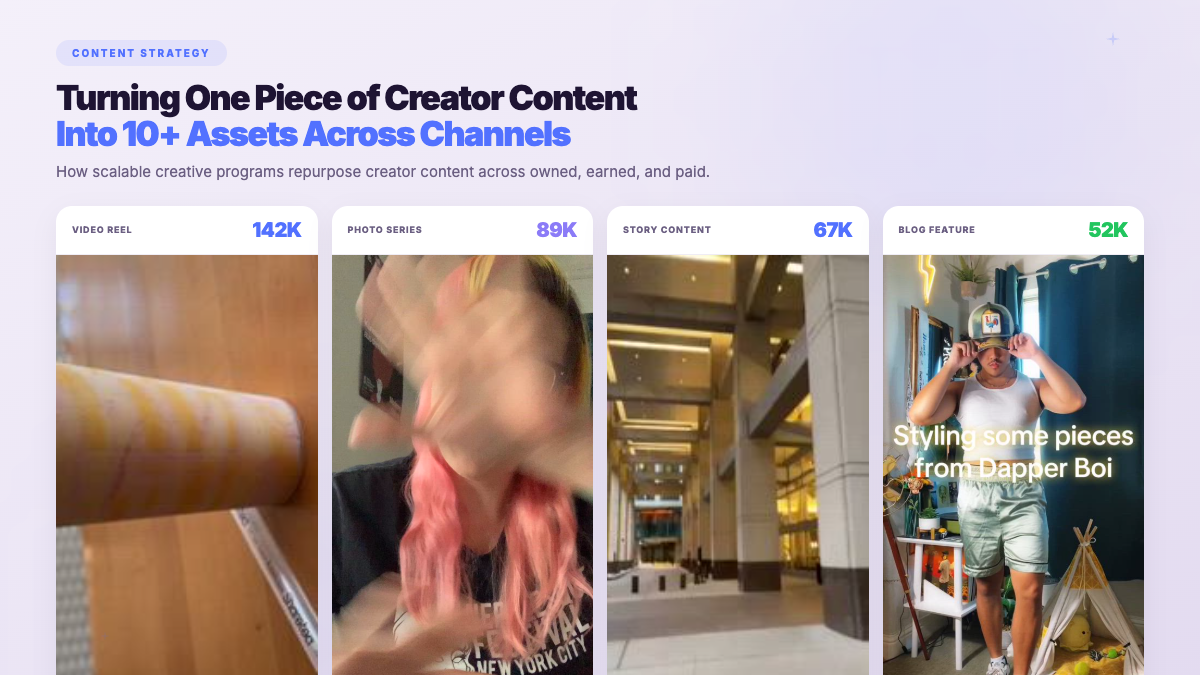
Distributing and Repurposing Creator Content
Creator content that only lives on the creator’s channel is leaving money on the table. The full distribution strategy multiplies the value of every piece.
Native Distribution (Creator Posts to Their Own Channel)
This is the base layer. The creator posts to their audience, who trusts them. This is where the organic reach, authentic engagement, and discovery happens. Don’t skip this or try to replace it with brand-channel-only posting: the trust transfer only works from the creator’s account.
Paid Amplification (Whitelisting/Boosting)
Your best-performing organic creator posts should be amplified with paid budget. Whitelisting (running ads from the creator’s handle) maintains the authentic, non-ad appearance while dramatically extending reach. High-performing organic post + paid amplification = efficient acquisition at scale. To understand the influencer content ROI math on this, check our full breakdown.
Brand Channel Repurposing
- Social ads: Top-performing creator content often outperforms brand-produced creative in Meta/TikTok ads
- Email: Creator video clips embedded in promotional emails drive higher click-through rates than static imagery
- Website: Social proof sections, product pages, and landing pages all benefit from authentic creator testimonials
Product Pages and PDPs
Creator-generated content on product pages: real people using your product in real contexts , drives significant lift in conversion rates. Shoppers want to see the product in use before buying, and creator content is more credible than professional photo shoots.
Usage Rights: What You Need to Legally Repurpose
Specify usage rights in your contract before the partnership begins. Standard rights tiers:
- Organic use only: Creator posts, you can share/repost. No paid amplification.
- Organic + paid: You can run the content as an ad via the creator’s handle (whitelisting) or your own.
- Full usage rights: Unlimited use across all channels, paid and organic, for a defined period (typically 12–24 months).
Broader usage rights = higher creator fee. Build this into your budget upfront.
Measuring Creator Content Performance
Metrics by Objective
| Objective | Primary Metrics | Secondary Metrics |
|---|---|---|
| Awareness | Reach, impressions, view rate | Follower growth, share of voice |
| Consideration | Watch time, saves, click-through rate | Comments, link clicks |
| Conversion | Attributed revenue, promo redemption, ROAS | AOV, new customer rate |
| Retention | Repeat purchase rate, LTV | Community engagement, brand mentions |
Platform-Native Analytics vs. External Tools
Platform-native analytics (TikTok Creator Marketplace, Instagram Insights, YouTube Studio) give you post-level performance data. They’re sufficient for small programs. At scale, you need UTM tracking, affiliate link attribution, and a unified dashboard that aggregates performance across creators and platforms.
Content Scoring: What Makes a Post “Successful”
Define your success threshold before a campaign launches. Example: “A successful micro-creator post delivers 4%+ engagement rate and drives at least 50 link clicks.” Without a benchmark, every post looks like a success or failure depending on your mood.
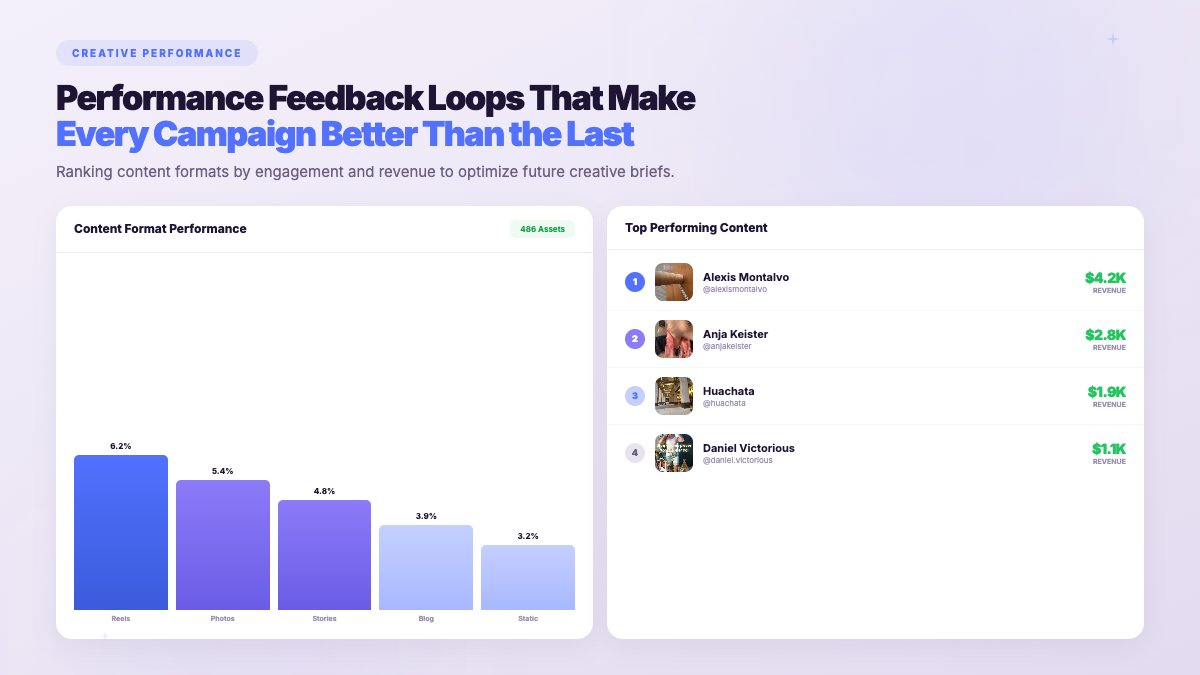
The Feedback Loop: What to Brief Differently Next Time
After every campaign, document:
- Which creators overperformed? What did their content have in common?
- Which content formats drove the most conversion?
- Which key messages resonated most (comments, saves)?
- What should be cut from the next brief?
- What new direction should be added?
This document becomes the foundation of your next brief. The flywheel spins.
Scaling from 10 to 100 Content Pieces/Month
The infrastructure required to produce 10 pieces of creator content per month is completely different from what’s required to produce 100. Plan for scale early: retrofitting systems is painful.
Infrastructure: Platform Tools, Brief Templates, Approval Workflows
At 10 pieces/month: email, shared docs, manual spreadsheet tracking.
At 30 pieces/month: dedicated creator management platform, templated briefs, structured approval workflow.
At 100 pieces/month: full platform with creator discovery, brief distribution, automated contracts, payment processing, and performance analytics in one place.
Team Structure: Who Manages Creator Relationships
Creator relationships don’t manage themselves. Someone needs to own creator communication, brief delivery, content review, and performance reporting. At early scale, this is one person wearing multiple hats. At 50+ creator relationships, you need dedicated creator partnership manager(s).
Budget Allocation at Scale
| Program Size | Creator Fees | Platform/Tools | Paid Amplification |
|---|---|---|---|
| Early stage ($5K/mo) | 70% | 10% | 20% |
| Growth ($20K/mo) | 60% | 10% | 30% |
| Scale ($50K+/mo) | 50% | 10% | 40% |
Quality Control at Volume
At 100 pieces/month, you can’t personally review every post in detail. Build a quality framework: define the 5–10 non-negotiables that every piece must meet. Assign review responsibilities. Create a fast-track approval process for creators who have consistently delivered on-brief.
Automation Opportunities
- Brief distribution and deadline tracking
- Contract generation (templated, parameterized)
- Payment processing and tax documentation
- Performance data aggregation
- Reorder/renewal workflows for top-performing creators
AI-powered platforms like partnrUP automate the discovery, matching, and workflow layers: so your team spends time on strategy and creative, not spreadsheet management.
Frequently Asked Questions
How much does creator content cost?
Pricing varies enormously by creator tier. Nano creators ($0–$200 per post), micro creators ($200–$2,000), mid-tier ($2,000–$10,000), macro ($10,000–$50,000+). Most brands building scalable programs focus budget on micro/nano tiers for volume and efficiency, with selective macro investment for major launches.
How many creators do I need for a scalable program?
Start with 10–15 creators across micro and nano tiers. This gives you enough volume to identify patterns, test content approaches, and build institutional knowledge without the overhead of managing hundreds of relationships. Scale from there based on what works.
How long before we see results from creator content?
Awareness metrics (reach, impressions) are visible within days. Conversion metrics typically need 30–90 days to develop meaningful data across multiple posts. For SEO and long-tail content compounding (especially YouTube), expect 6–12 months for the full picture.
Should we use an agency or manage creator content in-house?
Agencies are valuable for initial strategy development and for running complex multi-creator campaigns you don’t have bandwidth to manage. Long-term, in-house management with platform support is more efficient: your institutional knowledge stays internal, relationships are owned by your team, and you’re not paying agency margins on every activation.
What platform should we use to manage creator content?
Depends on your scale and objectives. Early-stage programs can use lightweight tools. At 30+ creators, you need a dedicated platform with brief management, contract automation, and performance tracking. See our Influencer Marketing Platform Comparison Guide for a full breakdown.
How do we find creators who are a good fit?
The most common mistake is filtering by follower count. Better filters: engagement rate, audience demographics, content-brand fit, and past brand collaboration performance. AI-powered creator matching can match creators based on audience overlap with your customer profile, which is dramatically more predictive of campaign performance than reach alone.
How do we handle creators who go off-brief?
Prevention is better than correction. Build a pre-production step into your workflow where creators submit a concept or outline for approval before filming. Most off-brief situations happen because the brief was ambiguous: clarify before production, not after. If a creator consistently goes off-brief after clear direction, they’re not the right partner.
Do we need usage rights for all creator content?
No — only secure usage rights for content you plan to repurpose in paid ads or on your owned channels. Acquiring broad rights on every piece drives up creator fees unnecessarily. Identify your top-performing posts post-publish, then license those specifically for amplification.
What’s the difference between UGC and creator content?
UGC (user-generated content) is typically unpaid content created by customers. Creator content refers to paid/commissioned content created by professional creators with established audiences. Both have value: UGC for authenticity and social proof, creator content for reach and distribution. A strong creator content strategy often converts top-performing creator content into brand-owned UGC over time.
How do we know if our creator program is working?
Define success before you start. Set benchmarks for engagement rate, click-through rate, and attributed conversion based on your industry and creator tier. Review performance after each campaign cycle and compare to benchmarks. If you’re consistently below benchmark, the issue is usually brief quality or creator fit — not the channel itself. Our guide on influencer content ROI has benchmarks by tier and industry.
Ready to Build Your Creator Content Engine?
Creator content isn’t complicated, but it is systematic. The brands succeeding in this channel have figured out that the brief is the strategy, the roster is the asset, and the feedback loop is the competitive moat.
partnrUP helps brands build and run creator content programs end-to-end, from AI-powered creator matching to brief management to performance tracking. Whether you’re launching your first 10-creator program or scaling to 100+ pieces a month, the platform handles the operational complexity so you can focus on what performs.