Influencer marketing isn’t a nice-to-have anymore: it’s a core budget line for brands across every category. What started as gifting products to bloggers has evolved into a sophisticated, performance-driven channel with its own metrics, technology stack, and organizational function. In 2026, the industry hasn’t just matured , it has fundamentally transformed.
Brands that once dabbled in influencer marketing are now running always-on creator programs. AI has entered every layer of the workflow. And creators themselves have evolved from social media personalities into full-stack commerce operators. If you’re still treating creator marketing as an experiment, you’re already behind.
The question in 2026 isn’t whether to invest in influencer marketing: it’s how to build programs sophisticated enough to compete. This guide covers the data, the trends, and the strategic shifts that define the market right now. Whether you’re building your first creator program or scaling an existing one, here’s the context you need.
Influencer Marketing by the Numbers in 2026
Let’s start with the data. The influencer marketing industry has crossed thresholds that make it impossible to dismiss. Check out the influencer marketing statistics every brand should know for the full breakdown, but here’s the high level:
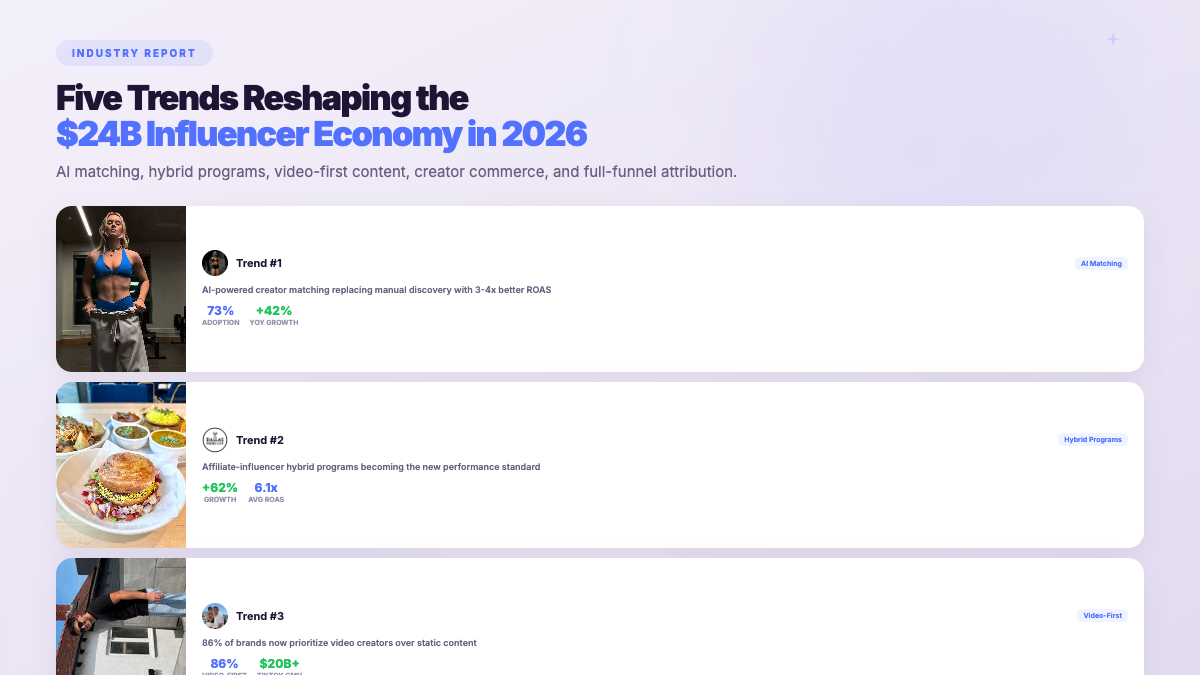
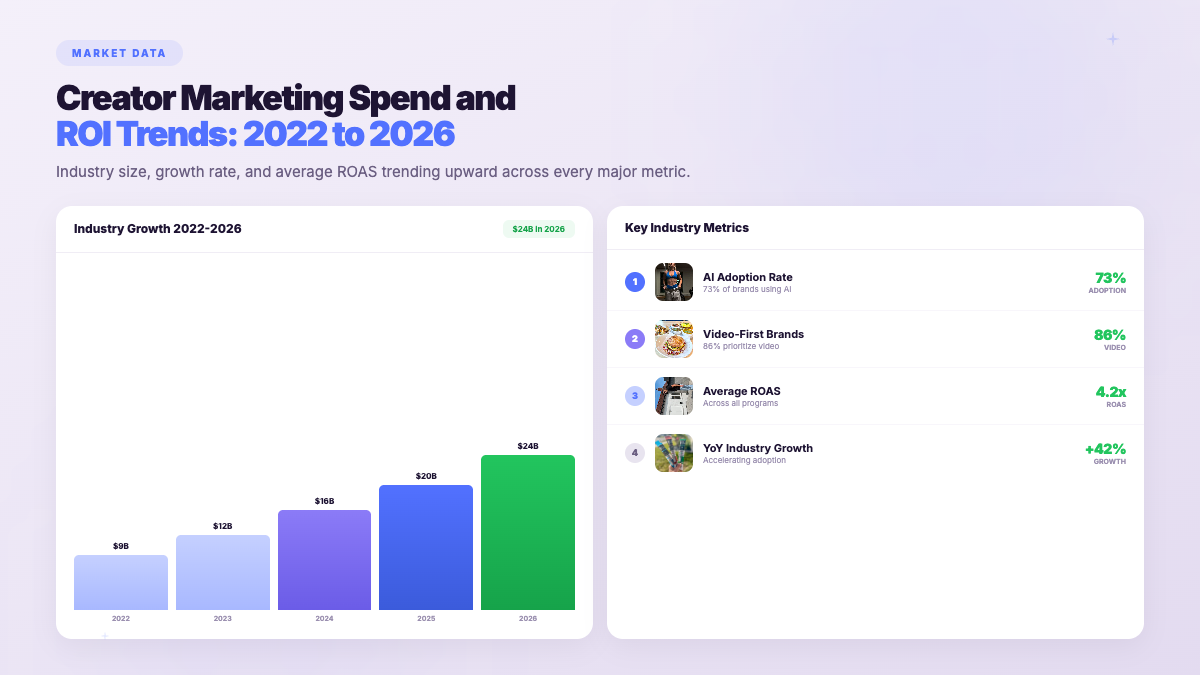
Global market size: The influencer marketing industry is valued at approximately $24 billion globally in 2026, up from roughly $21 billion in 2025. Compound annual growth rate has held steady at 13–15%, driven by platform-level commerce integration and growing brand confidence in creator content ROI.
Brand adoption: More than 85% of brands with active digital marketing budgets use some form of influencer or creator marketing in 2026. The question has shifted from “should we try it?” to “how do we scale it?”
Budget allocation: On average, brands are allocating 15–20% of their total digital marketing budget to influencer and creator content. For DTC brands, that figure frequently exceeds 30%.
ROI benchmarks: Brands running well-structured programs report an average earned media value of $5.78 per dollar spent. Performance-based creator programs are seeing ROAS of 3–6x in mature programs.
Platform spend breakdown:
- TikTok: 32% of influencer marketing spend (up from 24% in 2024)
- Instagram: 38% of spend (still #1 by volume)
- YouTube: 19% of spend (growing fast: learn more about YouTube as an influencer marketing channel)
- Other (Pinterest, LinkedIn, Twitch, podcasts): 11% combined
For a deeper dive into where brands are investing, see our complete guide to influencer platform ROI.
The 10 Biggest Influencer Marketing Trends in 2026
1. AI-Powered Creator Discovery Replacing Manual Search
The spreadsheet era of influencer research is over. Leading brands now use AI-powered creator matching that analyzes content, audience quality, brand affinity, and predicted performance, not just follower counts. The result: dramatically better creator-brand fit and less time wasted on manual research.
2. The Rise of Nano and Micro-Influencers
Bigger isn’t better. Brands running sophisticated programs have largely shifted budgets toward nano-influencers (1K–10K followers) and micro-influencers (10K–100K), who deliver higher engagement rates and better conversion. The average engagement rate for nano-influencers in 2026 sits at 5–8%, compared to 1–2% for macro-influencers. If you want to know which industries use influencer marketing most, this shift toward micro is happening across the board.
3. Creator Commerce as the Primary Use Case
Commerce has become the dominant use case for influencer marketing. Brands aren’t running awareness campaigns: they’re building shoppable creator programs with direct purchase paths via TikTok Shop, Instagram Shopping, and YouTube Shopping. Shoppable video is no longer a future trend: it’s the present reality for any brand serious about creator-driven commerce.
4. Performance-Based Deals Replacing Flat-Fee Sponsorships
The market is moving away from flat-fee sponsorships toward hybrid structures. A typical 2026 creator deal includes a modest base fee plus commission on attributed sales. This benefits brands (lower risk) and benefits creators who genuinely convert (upside potential). It also self-selects for creators who actually believe in your product.
5. Long-Term Partnerships Over One-Off Campaigns
One-post campaigns are being retired. Long-term creator partnerships: structured as 6–12 month ambassador agreements, dramatically outperform one-off activations in both credibility and ROI. When a creator posts about a brand once, it reads as an ad. When they post six times over six months, it reads as a genuine recommendation.
6. Video Dominance Across Every Platform
Every major platform has converged on short-form video. Reels, TikToks, and YouTube Shorts dominate organic reach. Brands that aren’t producing video-first creator content in 2026 are leaving significant reach on the table. Creator selection now needs to account for video production quality, not just photography.
7. B2B Influencer Marketing Going Mainstream
2026 is the year B2B influencer marketing crossed into the mainstream. LinkedIn creators, industry thought leaders, and podcast hosts are delivering measurable pipeline for B2B brands. The mechanics are different, but the fundamentals are the same: the right creator speaking authentically to the right audience outperforms traditional advertising.
8. Creator Economy Consolidation
The creator economy is consolidating around top performers. Brands competing for the best-performing creators in high-demand categories face real supply constraints. This is driving interest in emerging creator discovery: identifying rising creators before they’re expensive or fully booked.
9. Brands Building In-House Creator Programs
Large brands are taking creator programs in-house. In-house programs let you build proprietary creator relationships, own the data, control costs, and iterate faster. This shift has increased demand for platforms that enable brand-side teams to manage creator relationships directly. Understanding what brands want from influencer platforms today looks very different than it did three years ago.
10. Influencer Marketing Maturing Into a Performance Channel
Perhaps the most important trend: influencer marketing is finally being held to the same measurement standards as paid search and paid social. Brands are using incrementality testing, multi-touch attribution, and content LTV models. The “awareness is hard to measure” excuse is gone. See a G2-rated influencer marketing platform that’s built for this kind of performance accountability.
Platform-by-Platform State of Play in 2026
TikTok
TikTok’s defining development in 2026 is TikTok Shop: the commerce integration that transforms the platform from a discovery channel into a full purchase funnel. Brands running TikTok Shop programs report conversion rates 2–4x higher than comparable off-platform affiliate links. For Gen Z and younger Millennial audiences, TikTok is non-negotiable.
Instagram remains the highest-volume platform for brand partnerships in absolute terms. Reels dominate organic reach. The Collab feature: allowing brands and creators to co-publish content and split distribution, has changed how deal content is structured. If you’re running UGC for paid social, Instagram is typically your starting point.
YouTube
YouTube’s unique position in 2026 is as the long-form trust channel. Longer videos allow for product demonstrations and in-depth reviews that short-form can’t replicate. YouTube-driven purchases tend to have higher average order values and better LTV than other social channels. YouTube Shopping has expanded significantly, making it a full commerce platform, not just a discovery layer.
Pinterest, LinkedIn & Emerging Channels
Pinterest drives consistent product discovery with strong purchase intent for beauty, home decor, fashion, and food brands. LinkedIn is the breakout B2B platform of 2026. Podcasts maintain industry-leading host-read ad conversion rates. These “emerging” channels represent significant opportunity for brands willing to move beyond the dominant social platforms.
The Shift from Awareness to Performance
The most important structural change in influencer marketing over the past three years: brands stopped treating it as an awareness channel and started treating it as a full-funnel performance channel.
The historical model was loose: pay for reach, measure impressions, declare success based on vibes. The 2026 model is tight: pay for attributed results, measure ROAS and conversion rate, evaluate programs with the same rigor as paid search.
The metrics evolution has gone through three generations:
- Followers and reach (outdated)
- Engagement rate (still used, but insufficient)
- Conversion rate, attributed revenue, content LTV (where sophisticated brands are now)
If you’re still primarily measuring engagement rate, you’re operating on an outdated framework. And if you’re running programs without solid measurement, you’re likely hitting some of the pitfalls to avoid in influencer marketing that cost brands real money.
AI’s Impact on Influencer Marketing in 2026
AI has entered every layer of the influencer marketing workflow. Here’s where you’ll feel the biggest impact:
AI-powered discovery: The old approach, keyword search in a database, manual profile review, gut-feel decisions, has been replaced by AI matching systems that analyze creator content, audience composition, brand affinity signals, and historical performance. The improvement in match quality is substantial.
Predictive performance scoring: AI models can now predict, with reasonable accuracy, how a creator is likely to perform for your specific product category before any dollars are spent. This lets you allocate budgets to higher-probability matches rather than learning through expensive trial and error.
Automated workflows: Brief generation, outreach templates, content review, FTC compliance checking. AI is automating the manual work that made running large creator programs a full-time job for big teams.
AI agents in the workflow: It’s worth understanding the AI agents in influencer marketing landscape carefully, not all automation is created equal, and there are real risks to deploying AI agents without proper guardrails.
What Brands Are Getting Wrong in 2026
Despite the maturation of the industry, common mistakes persist, and they’re expensive. Here’s what to avoid. (For the full breakdown, see our post on mistakes brands make with creator content.)
Chasing follower counts. The correlation between follower count and campaign performance is weak. The right 50K-follower creator will consistently outperform the wrong 500K-follower creator. Stop paying for reach and start paying for relevance.
One-and-done campaigns. One post builds no brand association. The investment in finding the right creator should be leveraged across multiple touchpoints over time. If you’re only doing single-post campaigns, you’re paying full price for a fraction of the value.
Skipping usage rights. Usage rights negotiations are frequently overlooked in deals with smaller creators, creating legal exposure when you want to repurpose that content in paid media. And repurposing creator content in paid social is often where the highest ROI lives: don’t lose those rights upfront.
Treating influencer as a separate silo. The most common structural mistake: running influencer marketing disconnected from paid media, SEO, and broader brand strategy. Integrated programs dramatically outperform siloed approaches.
What the Best Brands Are Doing Differently
The brands generating the best results in 2026 share a set of strategic choices that separate them from the pack.
Always-on programs over campaign bursts. Top-performing brands run continuous creator programs rather than quarterly campaign activations. Always-on programs build category authority and allow for ongoing optimization. Campaign bursts produce spikes followed by silence; always-on programs produce compounding brand equity.
Treating creators as partners, not vendors. The transactional model, brief, post, pay, done, produces transactional content. Brands that invest in genuine creator relationships, give creative latitude, and treat creators as genuine partners get better content and better performance. The difference is visible in the output.
Building content libraries through usage rights. Creator-produced content is repurposed in paid social, email, website product pages, and retail listings. The ROI of a single creator partnership extends far beyond the original post when content is properly licensed and distributed.
Using data to find emerging creators early. The best-priced partnerships are with creators before they blow up. Brands with sophisticated AI-powered discovery can identify emerging creators based on content quality, audience growth velocity, and category signals, before those creators command premium rates.
The Future: 2027 and Beyond
A few dynamics will shape the next 1–3 years:
Creator-owned commerce expanding. Creators are increasingly building their own product lines and subscription services. For brands, this creates both competition and opportunity through co-creation partnerships.
AI co-creation at scale. AI-assisted video editing, script generation, and thumbnail optimization are already standard in creator workflows. This lowers production costs and accelerates output: meaning creator content supply is expanding even as the creator population stabilizes.
Tighter regulation. FTC disclosure requirements continue to tighten, with increasing enforcement. Internationally, EU’s Digital Services Act is creating more complex compliance requirements for global programs. FTC-compliance infrastructure is non-negotiable in 2026 and beyond.
Frequently Asked Questions
How big is the influencer marketing industry in 2026?
The global influencer marketing industry is valued at approximately $24 billion in 2026, growing at roughly 13–15% annually. This covers paid brand partnerships, affiliate creator programs, and platform-level creator commerce activations.
What percentage of brands use influencer marketing?
Over 85% of brands with active digital marketing budgets use some form of creator or influencer marketing in 2026. Adoption is essentially universal among DTC brands and digitally native businesses.
What’s the average ROI for influencer marketing?
Well-run programs typically generate $5–8 in earned media value per dollar spent. Performance-based programs with strong creator-brand fit are achieving 3–6x ROAS in mature programs.
Which platform delivers the best influencer marketing ROI?
It depends on your category and objective. TikTok delivers strong discovery and commerce performance for DTC brands. Instagram provides the highest volume of partnership opportunities. YouTube drives the highest-quality conversions for higher-AOV products. Platform selection should follow your audience and campaign objective.
Are micro-influencers really better than macro-influencers?
For most brands, yes: in terms of engagement rate and conversion efficiency. Micro-influencers (10K–100K followers) typically deliver 3–5x higher engagement rates and convert at better rates for commerce-focused campaigns.
How do you measure influencer marketing ROI?
Modern measurement uses UTM tracking links, unique discount codes, platform-native analytics, pixel attribution, and incrementality testing. Engagement rate alone is insufficient—you need to trace through to business outcomes.
How much should a brand budget for influencer marketing?
Industry benchmarks put influencer and creator marketing at 15–20% of total digital marketing spend for most consumer brands. DTC-first brands often allocate 25–35%.
How is AI changing influencer marketing?
AI is transforming creator discovery (from manual research to predictive matching), performance prediction, workflow automation, and brand safety review. The biggest impact is in discovery: AI can analyze millions of creators against specific campaign criteria in minutes.
What’s the biggest mistake brands make in influencer marketing?
Optimizing for follower count instead of audience relevance and conversion fit. The second biggest is running one-off campaigns instead of long-term partnerships.
Ready to Build Smarter Creator Programs?
The influencer marketing landscape in 2026 rewards brands that combine strategic intent, data-driven creator selection, and solid program infrastructure. Getting the fundamentals right: the right creators, the right structure, the right measurement—separates programs that compound over time from those that stall after a few campaigns.
partnrUP is an AI-native influencer marketing platform built to help brands find the right creators, build lasting partnerships, and measure performance that moves the business. Whether you’re launching your first creator program or scaling an existing one, partnrUP gives your team the tools to run a world-class influencer program without the enterprise price tag.