Picking the wrong influencer marketing platform is an expensive mistake—and not just in the obvious way. We’re not just talking about buyer’s remorse. We’re talking about six-figure contracts, locked-in data, months of onboarding, and a team that just learned a tool you now need to rip out and replace.
The influencer marketing platform landscape in 2026 is crowded. Dozens of tools compete for your budget, each promising to be the single solution for discovery, relationship management, campaign execution, analytics, and everything in between. Most of them were built for a world that no longer exists—where influencer marketing meant managing a spreadsheet of celebrity endorsers, not running always-on creator programs across TikTok, YouTube, and Instagram Reels.
This guide cuts through the noise. We’ve mapped every major platform category, broken down the key players head-to-head, and built a decision framework based on your actual situation—not a feature checklist designed to sell you the most expensive tier. According to recent influencer marketing statistics, over 60% of brands have switched platforms at least once—often after realizing they overpaid for complexity they didn’t need.
Whether you’re a fast-growing DTC brand running your first real creator program, a mid-market company that outgrew your current tool, or an enterprise team trying to rationalize a bloated tech stack, this comparison will help you make a confident decision.
Let’s start with what most comparison guides won’t tell you.
Why Choosing the Wrong Platform Costs More Than You Think
The sticker price is the easy part. A $2,000/month platform contract feels manageable. What doesn’t show up in that number is everything else.
Switching Costs Are Real and Brutal
Once you’ve onboarded a team, uploaded your creator relationships, set up campaign workflows, and integrated with your data stack—switching platforms means doing all of that again. Industry estimates put the average time-to-productivity on a new enterprise marketing platform at 3–6 months. That’s not just IT time. That’s lost productivity across your entire influencer marketing team.
Data lock-in makes it worse. Many legacy platforms make it intentionally difficult to export your creator contact history, campaign performance data, and relationship notes. Some charge export fees. Others let the data go stale if you don’t maintain active status. When you finally decide to leave, you may be starting from scratch.
If you’re curious about the hidden pitfalls of influencer marketing that most brands don’t see coming, platform lock-in is near the top of that list.
The Feature Overload Trap
Enterprise platforms love to sell features. The demo is always impressive: CRM integrations, advanced attribution dashboards, contract management, compliance monitoring, affiliate tracking, gifting portals, and a creator marketplace with 10 million profiles. You buy for the features you think you’ll use.
The reality: most mid-market brands use roughly 20% of what they’re paying for in a full-suite enterprise platform. The other 80% sits idle—or worse, creates complexity that slows your team down.
The right question isn’t “does this platform have everything?” It’s “does this platform make my core workflow faster?”
The Cost Reality
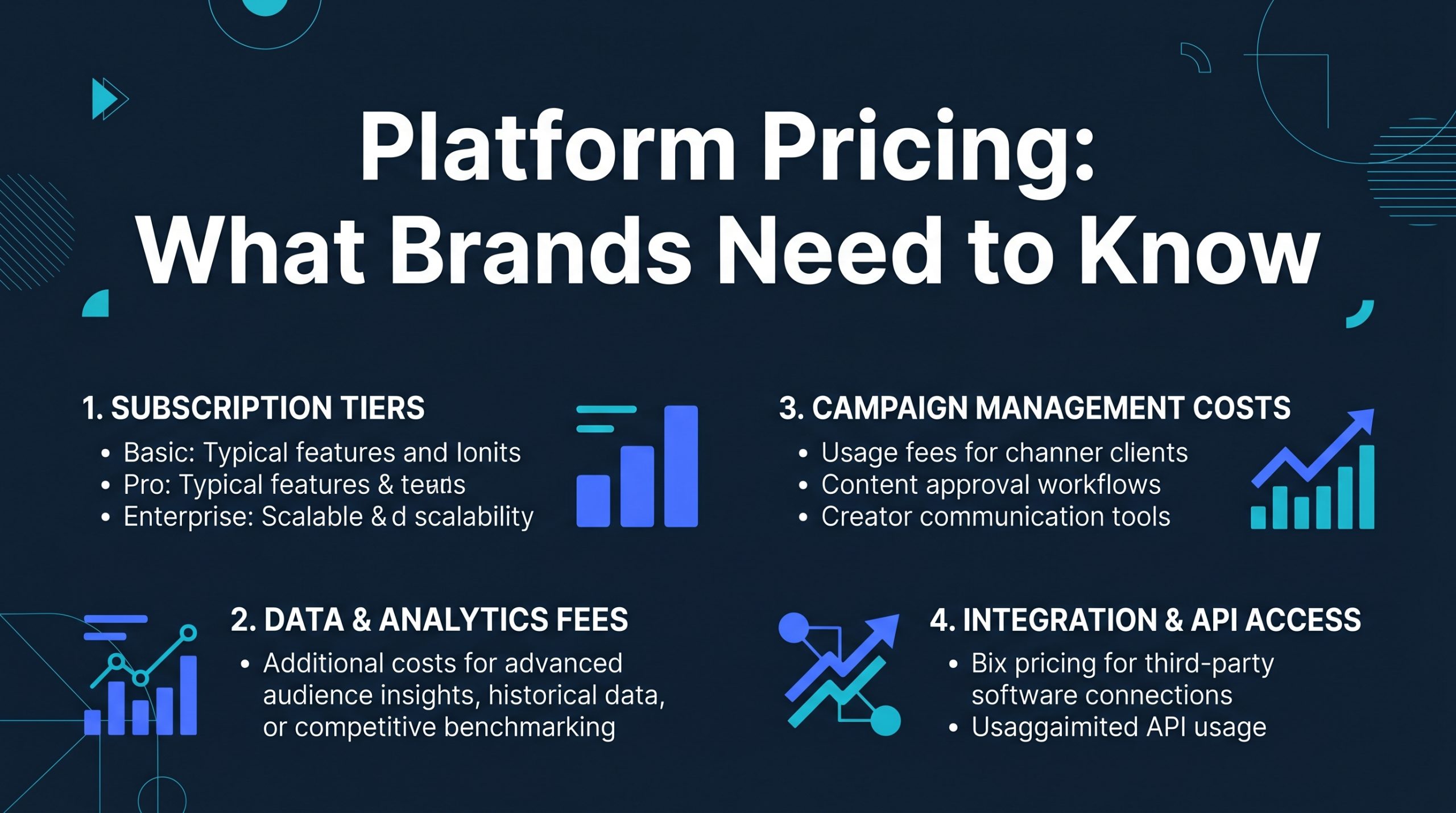
To put this in concrete terms: enterprise influencer marketing platform contracts typically run $30,000–$100,000+ per year, not including implementation fees, training costs, or the integrations you’ll need to make it actually work. For mid-market platforms, you’re looking at $12,000–$36,000/year. That’s real budget—budget that should be driving creator partnerships, not paying for a tool your team barely uses.
For a full breakdown of what you should actually be spending, read our complete guide to influencer platform ROI.
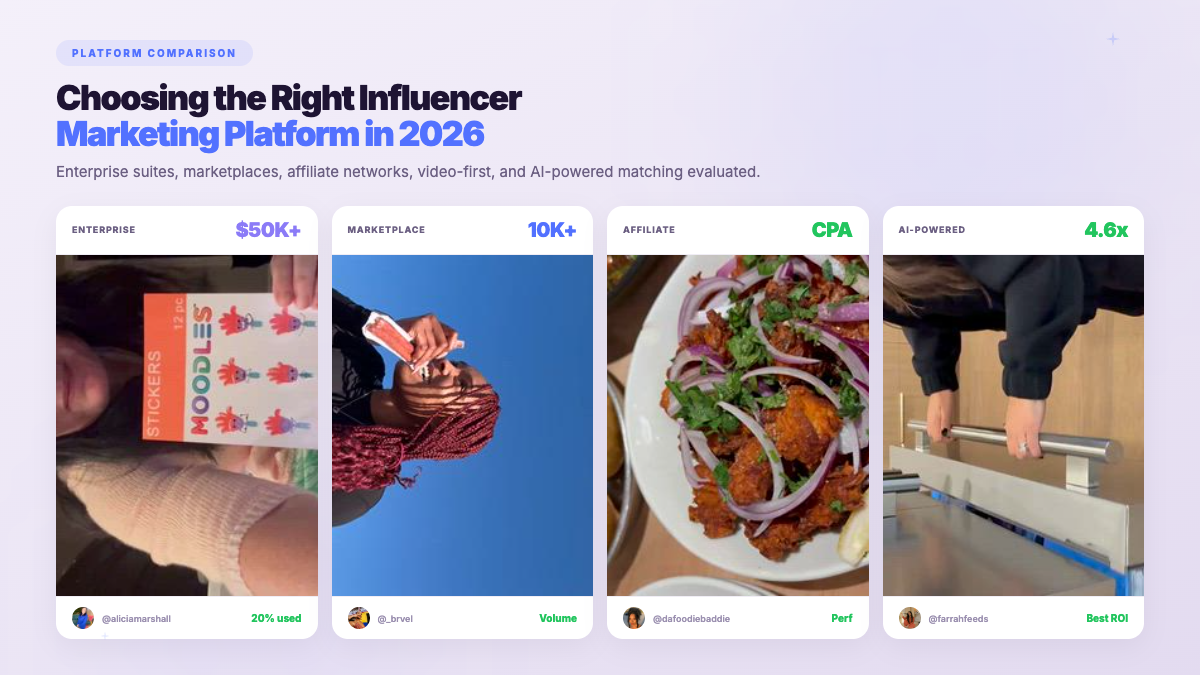
The 5 Categories of Influencer Marketing Platforms in 2026
Not all platforms are built for the same job. Before you evaluate any specific tool, it helps to understand which category it belongs to—because tools within the same category compete on features, but tools from different categories are solving different problems.
1. Enterprise Suites
Examples: GRIN, Aspire, CreatorIQ, Traackr
These platforms were built for large teams managing hundreds of creator relationships simultaneously. They offer robust CRM-style features, dedicated customer success teams, deep reporting, contract management, and integrations with enterprise marketing stacks. They’re powerful—and priced accordingly.
Enterprise suites make sense if you have a dedicated influencer marketing team of 3+ people, an annual creator spend of $500K+, and complex compliance or attribution requirements. For everyone else, you’re paying for complexity you don’t need.
2. Mid-Market Platforms
Examples: Upfluence, Social Cat
These platforms try to bridge the gap between enterprise suites and lighter tools. They often start at accessible price points and promise to scale with you. Some do this well. Many oversell—layering on features to justify pricing tiers without the depth or support of true enterprise solutions.
Mid-market platforms can work well for brands with a dedicated marketing manager handling creator programs, an established relationship list, and a need for basic campaign reporting.
3. AI-Native Platforms
Examples: partnrUP
A newer category built around AI-powered creator matching rather than relationship management. Instead of giving you a searchable database to manually comb through, AI-native platforms do the matchmaking for you—surfacing creators who are actually a fit for your brand, product, and audience.
The fundamental difference: legacy platforms assume you know who you’re looking for. AI-native platforms help you find creators you didn’t know existed. This shift in approach changes the ROI math significantly—you spend less time searching and more time running campaigns.
4. Niche and Vertical Tools
Agency-focused platforms, affiliate-first tools, and vertical-specific solutions for industries like beauty, gaming, or CPG. These work well within their niche but often can’t scale across diverse brand needs.
5. DIY / Manual
Spreadsheets, Instagram DMs, and homemade tracking systems. This still happens more than the industry admits—especially at early-stage brands. It works until it doesn’t. The breaking point is usually when a single campaign requires coordinating 15+ creators and you realize you have no idea what’s performing.
Platform-by-Platform Breakdown
Here’s an honest look at each major platform—what they’re good at, where they fall short, and who they’re actually built for.
GRIN
Best for: DTC ecommerce brands with dedicated influencer teams and Shopify integration needs
GRIN is one of the most recognized names in the space, particularly among ecommerce brands. Its Shopify integration is genuinely strong, and its creator management features (contracts, gifting, payments) are mature. The platform has invested heavily in its CRM-style relationship management tools.
Key strengths: Shopify/WooCommerce integration, creator gifting workflow, payment processing, content rights management
Key weaknesses: Discovery is database-based, not AI-powered—you’re searching through a static index rather than getting matched. Pricing is opaque and typically requires a demo before you learn the number. Onboarding can take weeks. Not well-suited for brands that don’t already have an established creator list to bring over.
Pricing range: ~$25,000–$50,000+/year for most mid-to-large deployments
G2 rating: ~4.6/5
Who chooses it: Established DTC brands, ecommerce-first companies, brands with in-house creator marketing managers
👉 See our full GRIN vs Upfluence comparison and GRIN vs Aspire breakdown for deeper head-to-head analysis.
Aspire
Best for: Mid-to-large brands wanting a full-stack platform with a marketplace component
Aspire positions itself as a full lifecycle platform covering everything from creator discovery through payment and reporting. Its creator marketplace lets brands post campaigns and receive inbound applications—a feature that appeals to brands who want creators to come to them rather than sourcing manually.
Key strengths: Creator marketplace with inbound applications, content approval workflows, solid reporting dashboard, brand safety tools
Key weaknesses: The inbound marketplace model can flood your inbox with under-qualified applicants. Discovery quality depends heavily on how well you write your brief. Relationship management features lag behind GRIN’s depth. Customer support quality reportedly inconsistent at scale.
Pricing range: ~$2,000–$5,000+/month depending on plan and features
G2 rating: ~4.4/5
Who chooses it: Brands who want creators to apply to their programs, marketing teams that value content workflow tools
👉 See how Aspire stacks up in our Aspire vs CreatorIQ comparison.
CreatorIQ
Best for: Enterprise brands with complex compliance, measurement, and multi-brand requirements
CreatorIQ is the enterprise tier of influencer marketing platforms—built for Fortune 500 companies managing massive creator programs across multiple brands and markets. Its analytics and measurement capabilities are genuinely best-in-class for enterprise use cases, and its integration with major media and brand safety tools is deep.
Key strengths: Enterprise-grade analytics and measurement, fraud detection, multi-brand management, API integrations with major data platforms
Key weaknesses: Steep price point, complex onboarding, overkill for most brands. The tool is built for teams with dedicated measurement and analytics functions—not something a lean marketing team can pick up and run. Discovery is still largely search-based.
Pricing range: $60,000–$150,000+/year for enterprise contracts
G2 rating: ~4.5/5
Who chooses it: Fortune 500s, global brands, agencies managing enterprise accounts
👉 See all the top CreatorIQ alternatives and our full CreatorIQ pricing breakdown.
Upfluence
Best for: Brands that want an all-in-one platform with affiliate tracking built in
Upfluence has positioned itself as a strong option for brands running hybrid influencer + affiliate programs. Its discovery engine is database-based but reasonably large, and its affiliate tracking features help brands measure performance-based creator partnerships alongside traditional sponsored content.
Key strengths: Affiliate + influencer in one platform, ecommerce integrations (Shopify, WooCommerce, BigCommerce), creator email outreach tools, reasonable mid-market pricing
Key weaknesses: The platform tries to do everything and ends up being best-in-class at nothing. Discovery quality varies. UI can feel dated. Customer support responsiveness is a common complaint. Not built for video-first campaigns.
Pricing range: ~$12,000–$30,000+/year
G2 rating: ~4.2/5
Who chooses it: Ecommerce brands with affiliate programs, mid-market marketers who want one platform for both channels
👉 Read our full Upfluence review, check the full Upfluence pricing breakdown, or see the top Upfluence alternatives.
Traackr
Best for: Enterprise brands focused on influencer program measurement and brand safety
Traackr is a measurement-first platform that has carved out a strong position with enterprise teams that need to prove influencer marketing ROI to senior stakeholders. Its reporting and analytics infrastructure is robust, and its Brand Vitality Score (a proprietary share-of-voice metric) is genuinely useful for competitive benchmarking.
Key strengths: Influencer program benchmarking, share-of-voice measurement, brand safety analysis, strong analytics and reporting
Key weaknesses: Campaign execution features are weaker than its measurement capabilities. Not designed for fast-moving teams. Heavy lift to implement and maintain. Pricing reflects its enterprise positioning.
Pricing range: ~$30,000–$80,000+/year
G2 rating: ~4.3/5
Who chooses it: Enterprise brands with dedicated measurement teams, companies running large always-on influencer programs
👉 See our in-depth Traackr review for a full analysis.
Social Cat
Best for: Small brands and startups running micro-influencer gifting campaigns
Social Cat is the lightest-weight option on this list—and that’s intentional. It’s built for small brands that want to run product gifting campaigns with micro-influencers without the overhead of an enterprise platform. Low price point, simple workflow, modest creator database.
Key strengths: Accessible pricing, simple gifting workflow, good for nano and micro-influencer campaigns, minimal learning curve
Key weaknesses: Limited creator discovery beyond its own database, minimal analytics, no campaign management depth, won’t scale to mid-market or enterprise needs
Pricing range: ~$49–$299/month
G2 rating: ~4.6/5
Who chooses it: Early-stage DTC brands, startups testing influencer marketing for the first time
👉 Read our full Social Cat review for a complete breakdown.
partnrUP
Best for: Growth-stage brands and mid-market companies that want AI-powered creator matching without enterprise complexity or price
partnrUP was built from the ground up as an AI-native platform—meaning creator matching is the core of the product, not an add-on feature bolted onto a CRM. The platform uses AI to analyze your brand, your products, and your campaign objectives, then surfaces creators who are genuinely aligned with your audience—not just creators who match a keyword search.
Key strengths: AI-powered creator matching (no manual searching), fast campaign setup, video-first platform built for TikTok/YouTube/Reels, transparent pricing, no lengthy onboarding or implementation
Key weaknesses: Newer platform—not as battle-tested as legacy enterprise tools. Less suited for brands that need heavy-duty CRM features for managing 500+ long-term creator relationships.
Pricing range: Transparent, accessible pricing—no six-figure contracts required
G2 rating: ~4.8/5
Who chooses it: DTC brands, growth-stage companies, marketing teams that want results fast without a 3-month implementation
The Comparison Table
| Platform | Starting Price | Discovery Method | Workflow Automation | Analytics Depth | Contract Mgmt | Best For |
|---|---|---|---|---|---|---|
| GRIN | ~$25K+/year | Database search | Strong (Shopify-native) | Good | Yes (full) | DTC ecommerce brands |
| Aspire | ~$2K+/month | Marketplace + search | Moderate | Good | Yes | Brands wanting inbound creator applications |
| CreatorIQ | ~$60K+/year | Database search + API | Advanced | Best-in-class (enterprise) | Yes (full) | Fortune 500s, multi-brand enterprise |
| Upfluence | ~$12K+/year | Database search | Moderate | Moderate | Yes | Brands with affiliate + influencer programs |
| Traackr | ~$30K+/year | Database search | Limited | Excellent (measurement-focused) | Basic | Enterprise measurement teams |
| Social Cat | ~$49/month | Own database | Basic | Basic | No | Small brands, gifting campaigns |
| partnrUP | Transparent / accessible | AI-powered matching | Strong (video-native) | Good | Yes | Growth brands, DTC, mid-market |
5 Questions to Ask Before Choosing a Platform
Before you request a single demo, answer these five questions. Your answers will eliminate half the options on the market immediately.
1. What’s Your Monthly Creator Volume?
Are you working with 5–10 creators at a time, or managing 100+? This matters because platforms designed for high-volume relationship management (GRIN, CreatorIQ) add overhead that slows down small programs. Conversely, lightweight tools like Social Cat break down quickly once you’re running more than a handful of simultaneous campaigns.
Rule of thumb: Under 20 active creators/month → you don’t need an enterprise platform. Over 100 → you might.
2. Do You Need CRM-Style Relationship Management?
Some brands build deep, long-term ambassador relationships with the same 50 creators. Those brands need CRM features—contact history, notes, relationship health tracking, contract archives. Other brands run transactional campaigns with new creators each time. Those brands don’t need CRM depth—they need fast, accurate discovery.
Be honest about which camp you’re in. Most growth-stage brands are in the second camp, even if they think they’re in the first.
3. How Important Is Creator Discovery vs. Campaign Management?
The two big jobs of an influencer marketing platform are finding creators and managing campaigns. Most platforms do both—but nearly every platform is better at one than the other. Legacy platforms built their strengths in campaign management. AI-native platforms like partnrUP lead with AI-powered creator matching and discovery.
If your biggest pain point is finding the right creators, prioritize discovery. If you already have your creator roster locked in and just need to run programs more efficiently, prioritize workflow.
4. What Does Your Team Actually Look Like?
A three-person growth marketing team and a 15-person influencer marketing department have radically different needs. An enterprise platform deployed to a small team creates complexity that kills momentum. A simple tool handed to a large team creates bottlenecks as the program scales.
Match the platform to your team’s actual capacity—not your aspirational capacity in 18 months.
5. Are You Running Affiliate/Performance Programs?
If performance-based creator partnerships (affiliate tracking, commission structures, sales-attributed payments) are a core part of your program, that’s a specific feature set that narrows your options significantly. Upfluence alternatives and a few other platforms have invested in making affiliate + influencer work together. Most platforms haven’t.
Use Case Scenarios: Which Platform Wins
Theory is useful. Real scenarios are more useful. Here’s how the decision plays out across four common situations.
Scenario 1: Fast-Growing DTC Brand, $50K–$100K Annual Creator Budget
You’re a DTC brand that’s been running influencer campaigns manually—DMing creators, tracking performance in a spreadsheet, doing payments via Venmo. You know you need a platform, but you don’t have a dedicated influencer marketing manager. You need something that works fast, doesn’t require a 90-day onboarding, and surfaces quality creators without manual research.
Winner: partnrUP. AI-powered matching gets you to the right creators without the manual search overhead. Transparent pricing means no six-figure surprise. Fast setup means you’re running campaigns in days, not months.
Scenario 2: Fortune 500 Brand Managing 500+ Creator Relationships
You have a full influencer marketing team, a dedicated budget of $2M+, complex legal and compliance requirements, and multi-brand programs running simultaneously across multiple markets. You need enterprise infrastructure, not a nimble startup tool.
Winner: CreatorIQ or GRIN. At this scale and complexity, you need the depth that enterprise platforms provide. The cost is justified by the team size and program scale. Make sure you’re using most of those features before you sign. Explore the full list of CreatorIQ alternatives before committing to enterprise pricing.
Scenario 3: Mid-Market Brand Testing Influencer for the First Time
You’ve been doing paid social and SEO. Influencer marketing is the next channel you want to test. You have a modest budget ($30K–$80K for the year), a marketing team of two who will be managing this alongside other channels, and no existing creator relationships to bring over.
Winner: partnrUP. Starting from zero means discovery is your primary need—and AI-powered matching is where partnrUP has a structural advantage over legacy platforms. You’re not bringing 200 creator relationships to port over into a CRM. You need the platform to help you find the right people, fast.
Scenario 4: Agency Managing Multiple Brand Clients
You run an influencer marketing agency with 10+ brand clients, each with different verticals, budgets, and objectives. You need multi-brand workspace management, strong reporting you can white-label, and a platform flexible enough to handle diverse use cases.
Winner: Upfluence or a custom stack. Agency use cases often need multi-client workspace features that most platforms don’t prioritize. Upfluence has invested in this. Alternatively, many agencies build hybrid stacks: a discovery/outreach tool + a separate reporting layer + their own CRM.
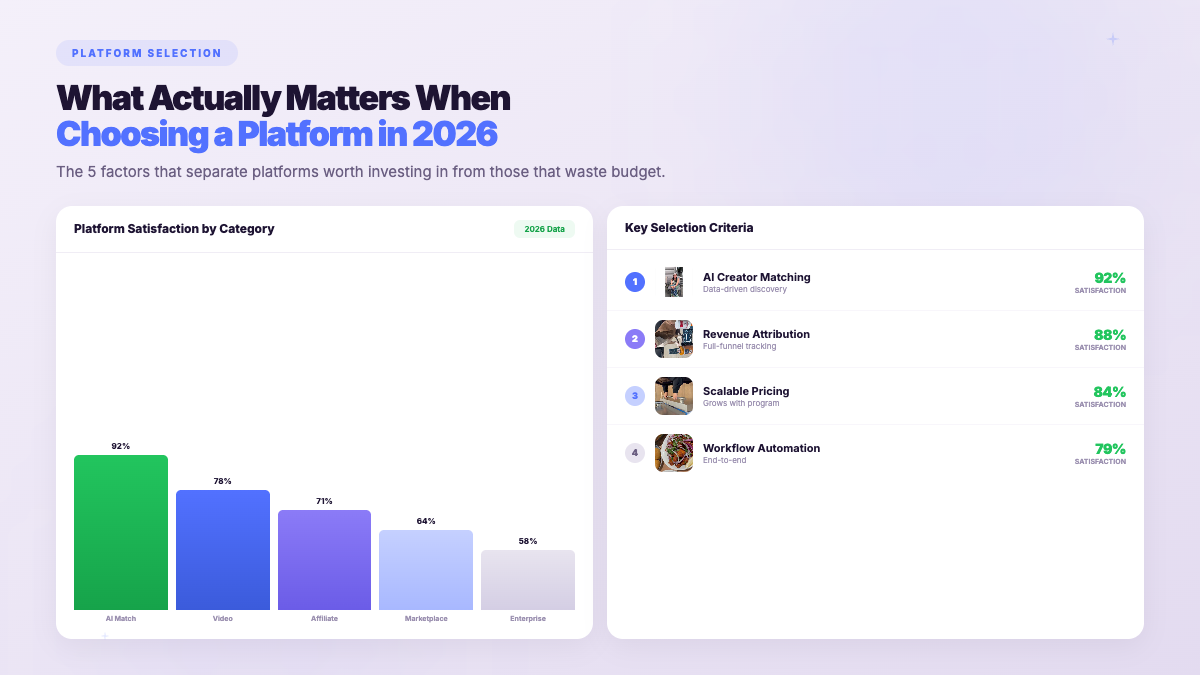
Why Brands Are Moving to AI-Native Platforms in 2026
The shift toward AI-native platforms isn’t hype—it reflects a structural change in how influencer marketing actually works.
Legacy Platforms Were Built for a Different Problem
The original use case for influencer marketing platforms was managing relationships with a known list of influencers—mostly celebrities and macro-influencers with agents, contracts, and multi-year partnerships. CRM-style tools made sense for that world.
That world is gone. Today’s highest-ROI influencer programs run with nano and micro-creators—people with 5,000 to 200,000 followers who produce authentic content for deeply specific audiences. Finding those people manually, at scale, is effectively impossible. The database-search model that legacy platforms use requires you to know what you’re looking for before you search. AI matching removes that constraint entirely.
AI Matching Changes the ROI Math
When your platform can match your brand to the right creator automatically, you spend less time searching (hours → minutes), fewer campaigns fail due to audience mismatch, and your team’s attention goes to campaign strategy and creative—not creator research.
The ROI difference between a well-matched creator and a poorly-matched one is enormous. A creator with 50K followers who speaks directly to your target customer will outperform a creator with 500K followers who talks to the wrong audience every single time. AI matching tilts the odds in your favor from the start.
partnrUP’s Approach
partnrUP was purpose-built around this insight. Instead of giving you a database to search through, the platform analyzes your brand positioning, your product, and your campaign brief—then surfaces creators who are genuinely aligned. It’s the difference between searching for a needle in a haystack and having the right needle handed to you.
For brands that want to move fast, keep overhead low, and get better creator fits from the start, that’s a meaningful structural advantage over legacy tools. And based on the latest influencer marketing statistics, brands using AI-powered matching see measurably higher campaign performance across the board.
Frequently Asked Questions
How much do influencer marketing platforms cost?
Pricing ranges dramatically by platform category. Enterprise suites (GRIN, CreatorIQ, Traackr) typically run $30,000–$150,000+/year. Mid-market platforms (Upfluence, Aspire) run $12,000–$60,000/year. AI-native platforms like partnrUP offer accessible, transparent pricing without enterprise-tier contracts. Entry-level tools like Social Cat start under $100/month. The key variable is what’s included—many platforms charge additional fees for advanced analytics, extra seats, or creator database access beyond base limits.
Do influencer marketing platforms offer free trials?
Some do, most don’t—at least not at the enterprise tier. Platforms that gatekeep pricing behind a demo rarely offer free trials. Mid-market and AI-native platforms are more likely to offer trial periods or self-serve onboarding. Always ask about sandbox access or pilot programs before committing to an annual contract.
How difficult is it to switch platforms?
Switching costs vary significantly. The main pain points are: (1) data portability—getting your creator list, campaign history, and contact notes out of your current platform; (2) team retraining; (3) integration rebuilds if you’ve connected your platform to your data stack. Budget for a 1–3 month transition period and confirm your data export rights before signing any new contract.
How do I measure ROI from influencer marketing platforms?
Platform ROI should be measured in two ways: the value the platform adds to your program (better creator matches = higher campaign performance, time saved = lower operational cost), and the campaign ROI generated through it (attributed sales, earned media value, audience reach). Most enterprise platforms include attribution dashboards; lighter tools may require third-party tracking. Our complete guide to influencer platform ROI walks through the full measurement framework.
Is there a difference between influencer marketing platforms for enterprise vs. SMB?
Absolutely—and this is one of the most important distinctions to get right. Enterprise platforms are built for scale, compliance, and team management. SMB and mid-market platforms are built for speed and simplicity. The mistake most growth brands make is buying enterprise tools before they actually need them. You’ll spend months onboarding a platform you’ve outgrown before you’ve ever fully deployed it.
What’s the best influencer marketing platform for DTC brands?
For DTC brands, the decision usually comes down to two factors: ecommerce integration depth and creator discovery quality. GRIN has the strongest Shopify integration. partnrUP has the strongest AI-powered discovery for video creators. If your DTC brand runs primarily on TikTok Shop or YouTube, partnrUP’s video-native approach wins. If your core channel is Instagram and you have an established creator roster, GRIN vs Upfluence is worth comparing first.
Can I use an influencer marketing platform for both organic and paid campaigns?
Yes—most modern platforms support both. For paid (boosted creator content/whitelisting), look for platforms with direct integration into Meta’s Content Publishing API. For affiliate/performance, platforms like Upfluence and its alternatives have the deepest feature set. For organic brand-funded content at scale, partnrUP’s workflow is purpose-built for this use case.
What’s the difference between an influencer marketplace and an influencer marketing platform?
A marketplace connects brands and creators directly—creators apply to campaigns or brand offers, and brands select from applicants. A platform provides infrastructure for the full campaign lifecycle: discovery, outreach, contracts, payments, reporting. Most full-suite platforms now include a marketplace component, but it’s typically just one feature within a larger system. Aspire’s marketplace (see our Aspire vs CreatorIQ comparison) is one of the better-known examples of the inbound application model.
How many creators does each platform have in their database?
Database sizes are marketing numbers—treat them as such. CreatorIQ claims 20M+ creators. GRIN, Aspire, and Upfluence are in the 5–10M range. What matters more than database size is match quality: how accurately does the platform surface creators who align with your brand? A smaller database with better matching outperforms a massive database with poor filtering every time.
Do I need an influencer marketing platform if I’m just starting out?
If you’re running fewer than 5–10 creator campaigns per month and your budget is under $5,000/month in creator spend, a full platform may be overkill. Start manually, build your process, then evaluate platforms once you hit the inflection point where manual tracking is creating bottlenecks. The right time to invest in a platform is when the platform’s efficiency gains clearly exceed its cost—not before.
Ready to See How partnrUP Stacks Up?
If you’ve made it through this guide, you know more about the influencer marketing platform landscape than most of the brands currently paying six figures for tools they barely use.
Here’s the bottom line: if you’re a growth-stage or mid-market brand looking for the fastest path to high-quality creator partnerships—without the enterprise overhead, lengthy onboarding, or opacity of legacy platforms—partnrUP was built for you.
AI-powered matching means you spend less time searching and more time running campaigns. Transparent pricing means no surprises. Video-native workflow means your content is built for the channels where audiences actually watch.