You’ve decided to measure influencer marketing ROI — good. Now you face the next challenge: which attribution model do you use? First-touch? Last-touch? Multi-touch? Incrementality? Each model tells a different story about your campaigns, and choosing the wrong one can lead to decisions that hurt performance.
This guide is part of our Influencer Marketing ROI: The Complete Guide to Measuring, Tracking & Proving Results — a comprehensive resource for brands looking to build effective creator partnerships at scale.
This guide breaks down every major influencer marketing attribution model — what each one measures, what it misses, and when to use it. By the end, you’ll have a clear framework for matching the right model to your brand’s goals and reporting requirements.
If you haven’t read our foundational guide on influencer marketing ROI attribution, start there for the full measurement framework before diving into the specific models.
Why Attribution Model Choice Matters
Consider this scenario: A customer sees an influencer post on Instagram, clicks the link, browses your product page, and leaves. Three days later, they see a retargeting ad, click through, and purchase. Which touchpoint gets credit for the sale?
- First-touch model → the influencer post gets 100% of the credit
- Last-touch model → the retargeting ad gets 100% of the credit
- Linear model → both get 50% of the credit
- Time-decay model → the retargeting ad gets more credit because it was closer to conversion
- Data-driven model → credit is distributed based on which touchpoints actually influenced conversions in your data
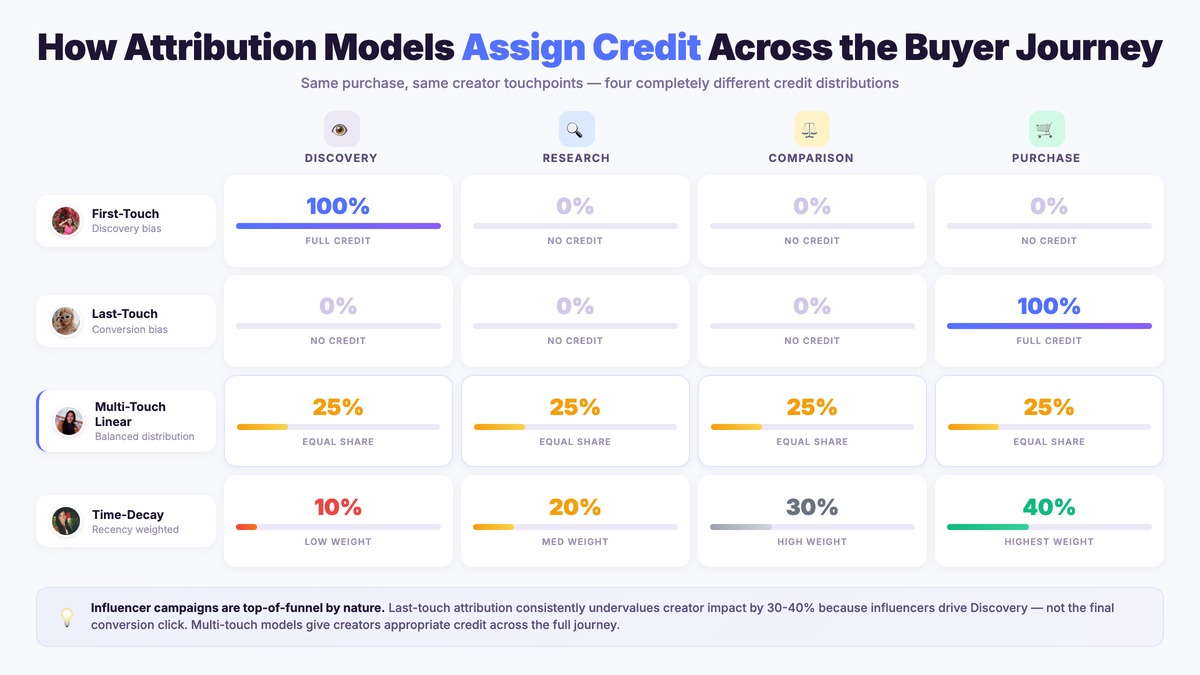
Same purchase, five completely different attribution outcomes. According to influencer stats from recent industry research, brands using last-touch attribution consistently undervalue influencer marketing by 30-40% because influencers typically operate at the top of the funnel. Your model choice directly shapes your budget decisions.
The 6 Major Attribution Models Explained
1. First-Touch Attribution
What it does: Assigns 100% of conversion credit to the first touchpoint a customer had with your brand.
Best for: Understanding which channels are best at generating new audience awareness. If influencers are consistently the first touchpoint for new customers, first-touch attribution surfaces that value clearly.
When to use it: Brand awareness campaigns, new product launches, entering new markets where influencer discovery is the primary goal.
Pros:
- Simple to implement and explain
- Highlights awareness-driving channels that last-touch models ignore
- Good for understanding acquisition sources
Cons:
- Ignores everything that happens after initial discovery
- Doesn’t reflect the reality that most purchases require multiple touchpoints
- Can over-credit channels that are good at awareness but weak at driving purchase intent
2. Last-Touch Attribution
What it does: Assigns 100% of conversion credit to the last touchpoint before purchase. For more on this topic, explore our affiliate influencer marketing playbook.
Best for: Direct response campaigns where the creator’s call-to-action drives the final conversion — “use my code at checkout” style influencer posts. For more on this topic, explore our guide to building a creator affiliate program.
When to use it: When influencer content is the bottom-of-funnel touchpoint (e.g., a creator review video that convinces an already-aware customer to buy), promo code campaigns, affiliate-style influencer programs.
Pros:
- Simple, widely understood
- Works well for direct response campaigns
- Easy to implement with UTM tracking or promo codes
Cons:
- Significantly undervalues influencers when they’re operating at the awareness stage
- Gives excessive credit to retargeting and email (which come last in the journey but were enabled by earlier touchpoints)
- The most common source of influencer marketing underfunding decisions
This is the model that causes most brands to underinvest in influencer marketing. If you’re using last-touch only, you’re likely making budget decisions based on an incomplete picture. The full ROI guide covers why this matters for budget planning.
3. Linear (Equal-Weight) Attribution
What it does: Distributes conversion credit equally across all touchpoints in the customer journey.
Best for: Brands with complex, multi-channel journeys that want a balanced view of contribution without the bias of first or last-touch models.
When to use it: Multi-channel campaigns where influencer, paid social, email, and organic search all play meaningful roles in the conversion journey.
Pros:
- Acknowledges that all touchpoints contributed
- Reduces bias toward first or last touchpoint
- More realistic for long purchase consideration cycles
Cons:
- Doesn’t account for the fact that some touchpoints matter more than others
- Can still undervalue high-impact touchpoints if the journey has many steps
- Requires full cross-channel tracking to implement accurately
4. Time-Decay Attribution
What it does: Gives more credit to touchpoints that occur closer to the conversion, with exponentially less credit to earlier touchpoints.
Best for: Short purchase cycles (days to a week) where recency is genuinely correlated with purchase intent.
When to use it: Limited-time offers, flash sales, events where recency matters — and when influencers are part of the final push (e.g., “today only” content).
Pros:
- Intuitive for short conversion cycles
- Rewards channels that close the deal
Cons:
- Systematically undervalues awareness-stage influencers in long consideration cycles
- Not appropriate for B2B or high-ticket categories where the first touchpoint planted the seed for a purchase months later
5. Position-Based (U-Shaped) Attribution
What it does: Assigns 40% credit to the first touchpoint, 40% to the last touchpoint, and distributes the remaining 20% across middle touchpoints.
Best for: Brands that believe both awareness (first touch) and conversion (last touch) are important, with middle-of-funnel touchpoints playing a supporting role.
When to use it: Brands running both awareness-focused influencer campaigns and conversion-focused retargeting, where you want to understand the value of both ends of the funnel.
Pros:
- Values both discovery and conversion
- Better reflects how most marketers intuitively think about campaign contribution
Cons:
- The 40/40/20 split is somewhat arbitrary — not based on your actual data
- More complex to implement and explain to stakeholders
6. Incrementality / Causal Attribution
What it does: Measures the true causal impact of your influencer campaigns by comparing conversion rates between audiences exposed to creator content and similar audiences who weren’t.
Best for: Brands spending significantly on influencer marketing who need to prove causality — not just correlation — to CFOs and boards.
When to use it: Major campaigns, always-on programs, when optimizing budget allocation across channels at scale.
Pros:
- The only model that actually answers “did influencer marketing cause these sales?”
- Eliminates correlation-causation confusion
- Provides defensible ROI data for executive reporting
Cons:
- Requires significant scale and data science capability
- Expensive and time-consuming to set up properly
- Not practical for small campaigns or early-stage programs
Attribution Model Comparison Table
| Model | Complexity | Best Fit | Influencer Value | Use Case |
|---|---|---|---|---|
| First-Touch | Low | Awareness campaigns | Often over-credited | New market entry |
| Last-Touch | Low | Direct response | Often under-credited | Promo code campaigns |
| Linear | Medium | Multi-channel brands | Fairly distributed | Balanced programs |
| Time-Decay | Medium | Short cycle | Often under-credited | Flash sales, events |
| Position-Based | Medium | Funnel-aware brands | Fairly distributed | Multi-stage campaigns |
| Incrementality | High | Enterprise scale | Accurately credited | Budget optimization |
Choosing the Right Model for Your Brand
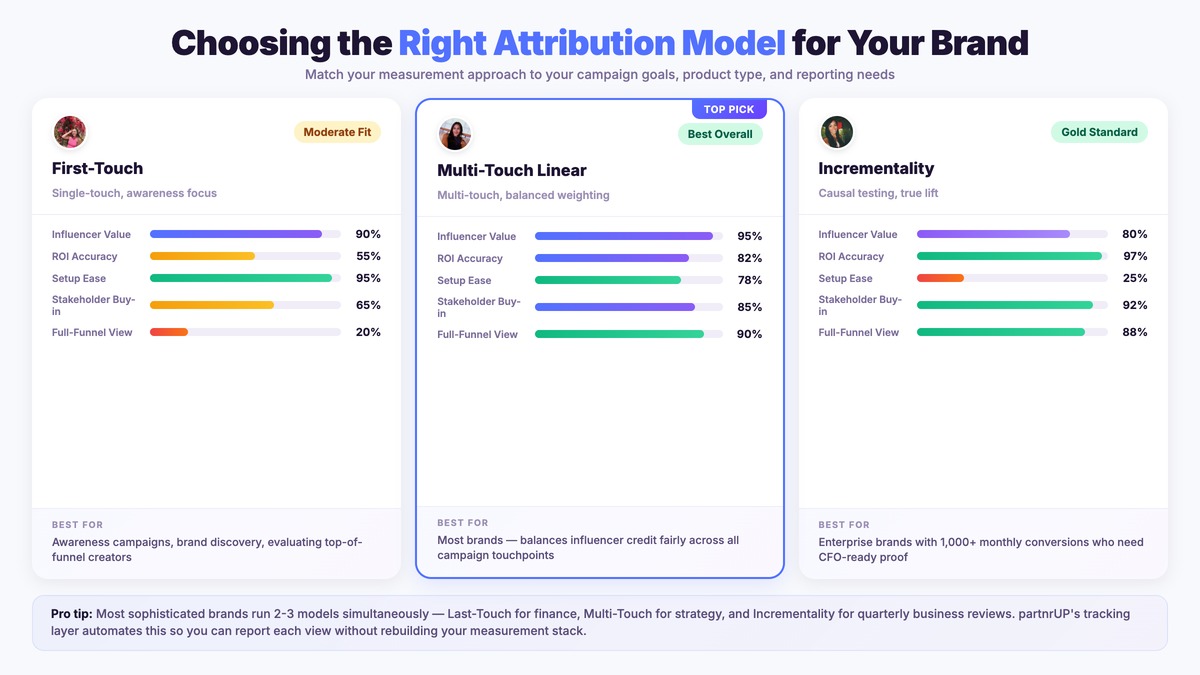
Here’s a practical decision framework: Tools like partnrUP’s platform help brands automate this at scale.
- Running a promo code or affiliate campaign? Last-touch is fine — the creator is the direct conversion driver
- Running brand awareness at the top of funnel? First-touch or linear will show influencer value more accurately
- Mixed funnel with multiple channels? Linear or position-based gives a more balanced view
- Need to prove ROI to leadership? Run incrementality tests for major campaigns; use linear for ongoing reporting
- Short consideration cycle (beauty, food, impulse)? Last-touch may work fine with promo codes
- Long consideration cycle (B2B, tech, high-ticket)? First-touch or linear essential; last-touch will massively undervalue influencers
See how this plays out in a real example in our Meta Ads attribution case study — and review our guidance on influencer marketing pitfalls to avoid the most common measurement mistakes brands make before they’ve built out a proper attribution stack. Book a demo to see how leading brands are implementing this.
Real-World Scenarios: How Each Model Changes Credit Assignment
Abstract model definitions don’t mean much until you see how they distort results on the same campaign. Consider this scenario: A skincare brand runs a campaign with three creators. Creator A posts a TikTok review (discovery). Creator B posts an Instagram Story with a swipe-up link (consideration). Creator C shares a promo code in their bio (conversion). A customer sees all three before purchasing.
Under last-click: Creator C gets 100% credit because the promo code was the final touchpoint. Creators A and B appear to have driven zero revenue — even though the customer wouldn’t have known about the product without Creator A, and wouldn’t have visited the site without Creator B’s link.
Under first-touch: Creator A gets 100% credit for introducing the customer to the brand. Creators B and C appear worthless — but without the consideration content and purchase incentive, that awareness may never have converted.
Under multi-touch linear: Each creator gets 33% credit. This feels fair but it’s actually misleading — it implies all touchpoints contributed equally, which ignores the reality that some content (the promo code) directly triggered purchase action while other content (the review) built the foundation.
Under time-decay: Creator C gets ~50% credit, Creator B gets ~30%, Creator A gets ~20%. This most closely reflects the purchase urgency pattern but systematically undervalues top-of-funnel creators over time — which means your awareness budget shrinks every quarter as you “optimize” toward last-touch creators.
Attribution Model Decision Matrix
Rather than picking one model permanently, align your choice to your current business question:
- “Which creators should I renew contracts with?” → Use multi-touch with time-decay weighting. This gives a balanced view of contribution across the journey.
- “Should I increase my influencer budget?” → Use incrementality testing. This is the only model that proves whether influencer spend generates NET NEW revenue vs. revenue that would have happened anyway.
- “How should I allocate budget across creator tiers?” → Use first-touch for awareness creators and last-click for conversion creators. Report them separately — don’t blend into one misleading ROAS number.
- “What’s my influencer CAC for the board?” → Use last-click. It’s conservative, defensible, and finance teams understand it. Just know it undervalues your true efficiency by 40-60%.
- “Which content formats drive the most value?” → Use multi-touch linear across all touchpoints, then segment by content type. This reveals whether reviews, tutorials, or lifestyle posts carry more weight in your specific funnel.
The sophistication isn’t in choosing the “best” model — it’s in knowing which model answers which question, and not using one model’s output to answer a question it wasn’t designed for.
Frequently Asked Questions
What is the most accurate attribution model for influencer marketing?
Incrementality testing is the most accurate because it measures true causality. For brands that can’t run incrementality tests, a multi-touch model (linear or position-based) combined with branded search tracking gives a more complete picture than single-touch models.
Why does last-touch attribution undervalue influencer marketing?
Influencers typically operate at the awareness stage — they introduce a brand to new audiences who then take additional steps before converting. Last-touch credits whichever touchpoint immediately precedes the purchase (often retargeting or email), even though the influencer’s content initiated the journey.
Can I use multiple attribution models at the same time?
Yes, and many sophisticated marketers do. Running last-touch alongside first-touch gives you both a conservative (last-touch) and generous (first-touch) view of influencer ROI. The truth is usually somewhere in between, and having both benchmarks informs better budget decisions.
What attribution model does Google Analytics use by default?
GA4 uses data-driven attribution by default for conversion reporting, which distributes credit based on machine learning analysis of your actual conversion paths. This is generally more accurate than rules-based models for brands with sufficient data volume (typically 1,000+ conversions per month).
How do I explain attribution models to my CMO or CFO?
Use a simple analogy: last-touch attribution is like crediting the salesperson who closed the deal without counting the marketing, events, and content that warmed up the prospect. First-touch is like crediting the cold caller who made the first contact but ignoring everything else. Multi-touch is the most complete picture because it acknowledges that every step in the journey contributed.
Does influencer platform choice affect attribution?
Significantly. Platforms that auto-generate unique UTMs and promo codes per creator, integrate with your e-commerce platform, and support longer conversion windows provide far more attribution data than basic platforms that only track vanity metrics.
Good attribution starts with the right platform — one that builds tracking into every creator relationship from day one. partnrUP makes creator-level ROI reporting straightforward, so you always know which campaigns and creators are actually driving results.