




Back to blog

Austin Rosenthal
November 19, 2026

How to Build a Shoppable Video Strategy: From Content Brief to Conversion

Shoppable Video Commerce
Ecommerce
Creator Workflow
Share on:

Most shoppable video programs do not fail at the strategy layer. They fail in the three weeks between approving a concept and getting a tagged video live — the stretch where a creative brief turns out to be missing a shot the product page needs, where nobody checked whether the product was still eligible to be tagged, and where the ad team discovers the organic post they wanted to boost was never authorized for it.

The strategy side of this is well covered. Our complete guide to shoppable video and social commerce handles format selection, platform landscape, and the measurement framework, and shoppable video best practices covers what converts. This guide is deliberately narrower: it is the operational layer those two assume you already have. Brief fields, permissions, eligibility gates, rights windows, and the review loop — the things that decide whether a good concept ever reaches a feed with a working product tag attached.

The Brief Is a Spec Sheet, Not a Mood Board

A shoppable video brief carries a job that a standard awareness brief does not: it has to produce footage that survives being watched next to a price. If the creator never shows the product doing the one thing the product page promises, the video can perform beautifully on engagement and convert nothing, because the viewer arrives at checkout with an unanswered question.

Write the brief as a spec with four required blocks.

The must-include shot list. Name the specific moments, not the vibe. Product in hand at real scale. The mechanism that justifies the price. The step where the viewer would otherwise hesitate — the assembly, the fit, the first wash. Three to five named shots is enough; a longer list reads as a shot-by-shot script and creators ignore it.

The claim boundary. List what the creator may say about the product and, more usefully, what they may not. This is where legal exposure lives, and it is cheaper to resolve in a brief than in a takedown.

The tagging mechanics. Which SKU gets tagged, which surface the tag lives on, and who has permission to apply it. This block is routinely missing, which is why so many finished videos sit unpublished while someone sorts out access.

The disclosure instruction, stated explicitly. Do not leave this to the creator's habit. FTC staff guidance on influencer disclosures is unusually specific about placement: disclosures "are likely to be missed if they appear only on an ABOUT ME or profile page, at the end of posts or videos, or anywhere that requires a person to click MORE," and the guidance adds, plainly, "Don't mix your disclosure into a group of hashtags or links." For video specifically it states that "if making an endorsement in a video, the disclosure should be in the video and not just in the description uploaded with the video." For live shopping it goes further — in a live stream "the disclosure should be repeated periodically so viewers who only see part of the stream will get the disclosure."

That last line is the one brands miss most often. A single disclosure card at the top of a two-hour live stream does not satisfy guidance written around viewers who join late.

If you are building a brief from scratch, our guide to writing a creative brief for creator campaigns covers the general structure. The four blocks above are what you add on top when the video has to sell something.
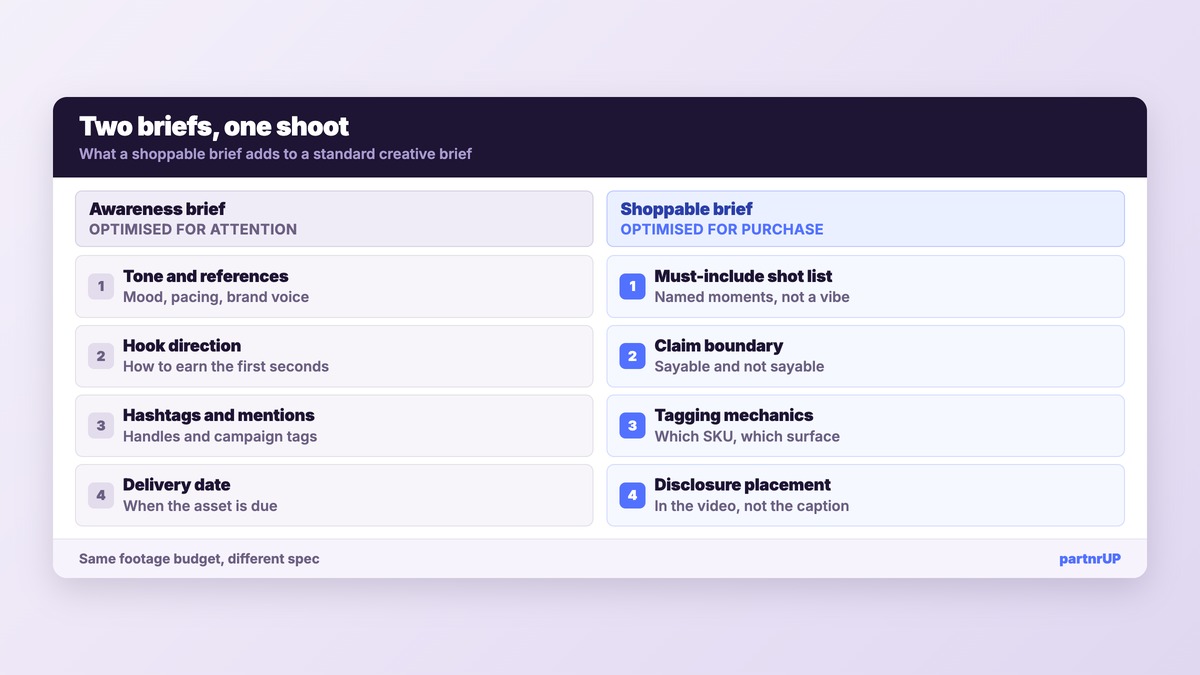
Comparison of an awareness creative brief and a shoppable video brief
A shoppable brief adds four blocks a standard creative brief does not carry.

Permissions Come Before Production, Not After

The most common scheduling failure in shoppable video is treating platform permissions as a publishing-day task. They are a pre-production task, because on both major surfaces the permission has to exist before the creator can attach a tag at all.

On Instagram, product tagging by creators runs through branded content approval. Meta's own instructions walk through it: a business sets product tags to "Allow product tags from only your branded content partners," then under Branded content taps "Approve content creators" and adds the creator's handle. Instagram's help page states the outcome directly — "Once a creator has been added as an approved account, they can tag products the same way as your Instagram account."

There is a detail in the adjacent Meta help article worth planning around: "When you allow your branded content partners to tag your business, they do not need to use the paid partnership label to tag products in their post, story or reel." That is a platform mechanic, not a legal permission. FTC disclosure obligations do not change because a platform label became optional, which is exactly why the disclosure instruction belongs in your brief rather than being delegated to a toggle.

On TikTok Shop the gate is not a toggle at all — it is a qualification check, and it runs on both sides of the relationship. TikTok's Affiliate Marketing Policy, updated 21 October 2026, sets a shop-level threshold: "Your Shop Performance Score (SPS) must be 3.5 or above," calculated on "your average performance over the last 90 days." Products are then assessed individually; the policy is explicit that "gaining shop qualification does not guarantee that all products will be enrolled into Affiliate Marketing."

Creators face their own thresholds. The same policy lists a "Promotion Performance Score (a rating of a creator's ability to drive sales) of 3.5 or higher" and a "Creator Health Rating (a score reflecting a creator's compliance with platform policies) of 150 or higher." If a creator does not clear them, TikTok says attempts to add such products "may be declined," with an automated notification explaining the rejection.

The operational consequence: a creator can be perfect for your brand, deliver excellent footage, and still be unable to attach your product. Check eligibility during casting, not during publishing.

Catalog Hygiene Is a Content Problem

Shoppable video has an unusual dependency — the content keeps running long after the campaign does, and it keeps pointing at a catalog entry that changes without telling anyone.

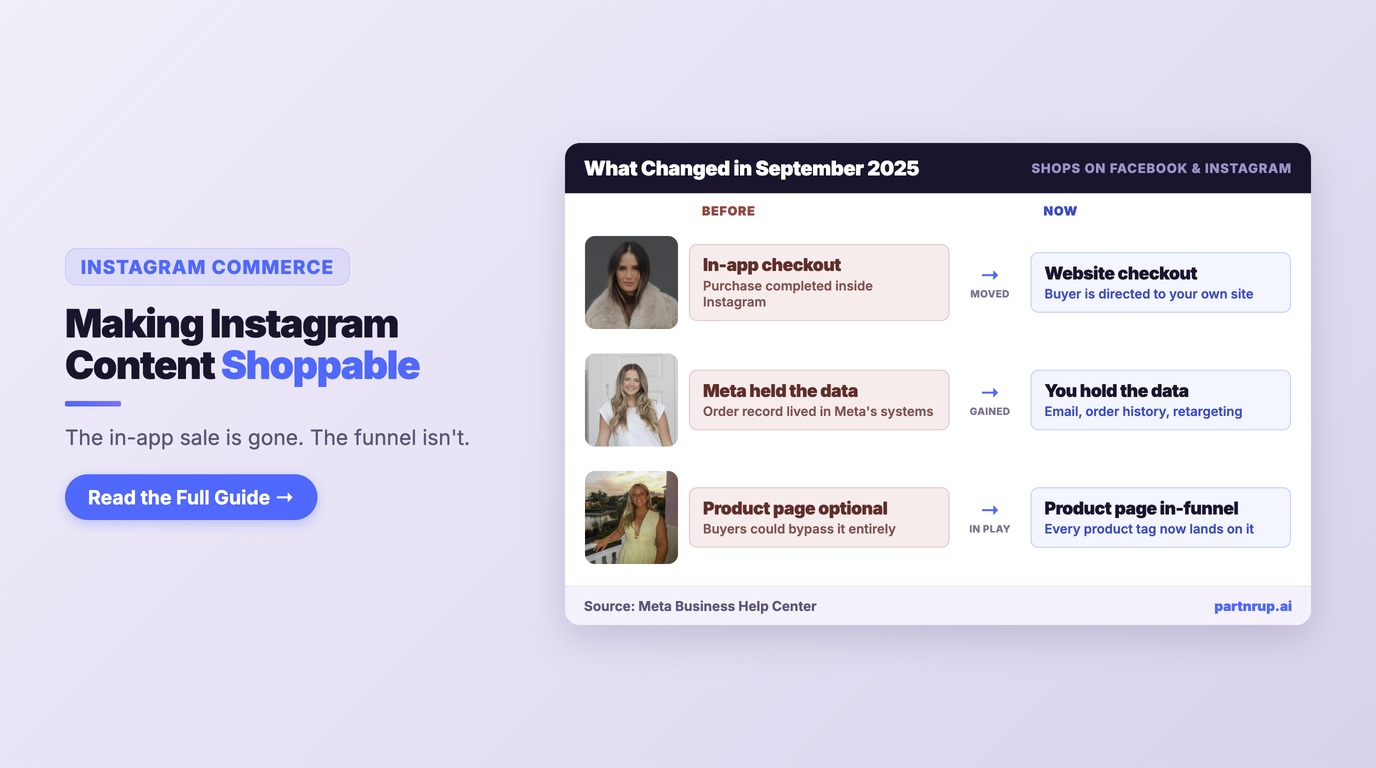
The biggest version of this already happened. Meta's Business Help Center states that "as of September 2025, Shops on Facebook and Instagram now use website checkout," and that if a shop used in-app checkout, "the checkout method has been updated or your shop is invisible." The same article notes that shops retain "rich discovery and consideration surfaces like the home page, collections and product pages, but customers are now directed to your own website to complete the purchase," and that for shops still on the old method there are required actions including creating a checkout URL.

Two things follow for anyone running shoppable video on Meta surfaces. First, the destination page is now yours, so page speed and mobile layout are inside your conversion funnel in a way they were not before. Second, Meta's note that an un-migrated shop may be "invisible" means a tag can quietly stop resolving while your creator content keeps circulating.

Build a standing check rather than a one-time migration task. Before each flight, confirm the tagged SKU is in stock, that the checkout URL resolves on mobile, and that the variant shown in the video is the variant the tag lands on. A creator demonstrating the large size while the tag points at a sold-out small is a conversion loss nothing in your analytics will label correctly.
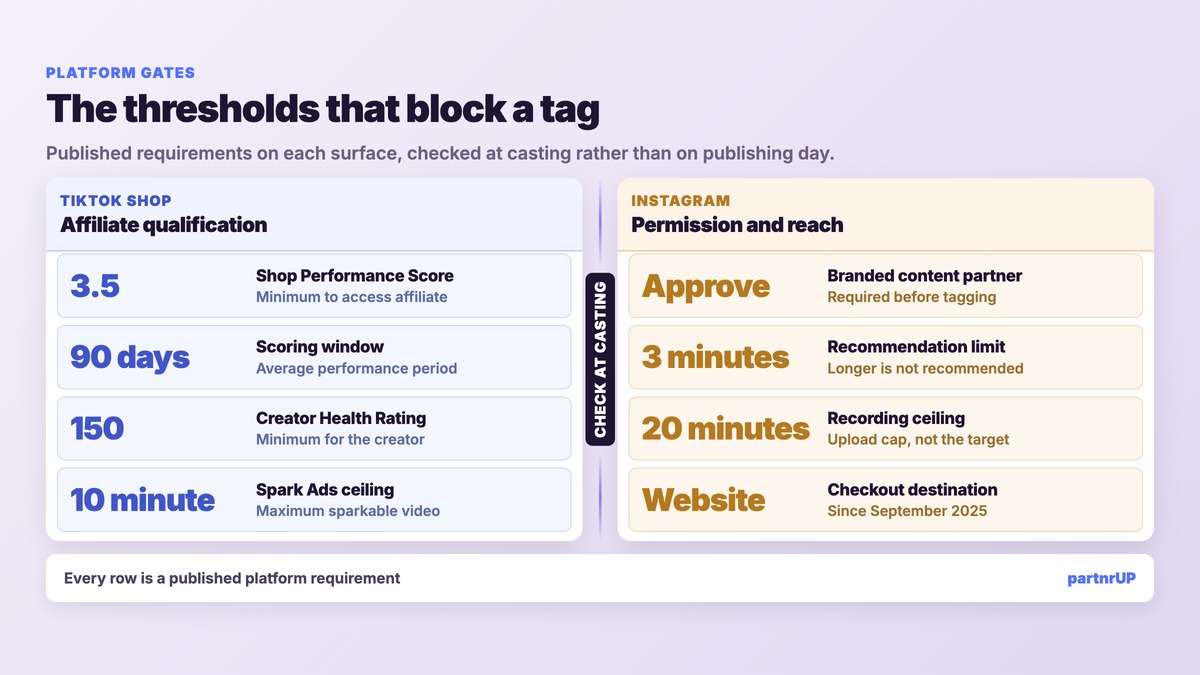
Published TikTok Shop and Instagram requirements that gate product tagging
Every row is a published platform requirement — check them at casting, not on publishing day.

Rights and Amplification: Decide Before You Shoot

Most shoppable video programs eventually want to put paid spend behind the organic post that worked. That decision is far cheaper to make before production than after, because the authorization has to come from the creator's account.

TikTok's Spark Ads format exists for this. Its help documentation describes it as a format that "uses posts from organic TikTok accounts to ensure that all views, comments, shares, likes, and follows gained from boosting the video during the promotion are attributed to your organic posts," and explicitly supports publishing "ads using organic posts made by other creators (with their authorization)."

Two specifications matter when you are planning. TikTok's page states there is "a 10 minute maximum on videos that can be sparked," and that for organic videos from any TikTok account "there are no restrictions on video ratio, video resolution, file type, video duration, bitrate, and file size." It also notes a sequencing trap: "videos need to be un-authorized as a Spark Ad before it can be deleted from the organic account."

Separately, for TikTok Shop specifically, affiliate creatives let creator posts run inside Shop Ads. TikTok's advertising help article, last updated November 2026, describes affiliate creatives as "TikTok posts created by affiliates and authorized for use in TikTok Shop Ads," and notes that "when you use a video created by an affiliate creator in your Shop Ads, affiliate creators can earn commissions when someone buys your products." Setup runs through an Open Collaboration in Seller Center, after which affiliate creators authorize their videos for Shop Ads.

On Instagram, the equivalent route is partnership ads built on branded content. Meta's help page notes that when a creator makes branded content featuring your business, "they can choose to allow business partners to boost their content into partnership ads, or to create new partnership ads within an existing post in Meta Ads Manager."

In every case the creator holds the switch. Put the amplification ask in the original agreement with a stated window, and you avoid renegotiating from a position of needing the asset.

Runtime and Format: Build to the Recommendation Limit, Not the Upload Limit

Platform length caps are a bad planning input because the cap and the useful limit are different numbers, sometimes by an order of magnitude.

Instagram's help page for recording a reel states that "you can record and edit videos up to 20 minutes with Instagram Reels" — and then adds the sentence that should actually drive your brief: "Reels over 3 minutes won't be recommended to new audiences."

For a shoppable video program, reach to non-followers is usually the entire point. Briefing to the 20-minute ceiling produces assets that can only work on an audience you already have. Three minutes is the operational maximum on that surface, and the shot list above is built for well under it.

This is the kind of detail worth re-checking each quarter rather than inheriting from a deck. Our breakdown of short-form versus long-form video goes deeper on where each length actually earns its keep.

The Review Loop Is Where Timelines Die

Brands consistently under-plan the approval stage, and the cost compounds because every round of revision lands on a creator who has already moved on to other work.

Three practices keep it contained.

Give feedback once, consolidated. Collecting notes from brand, legal, and ecommerce into a single pass respects the creator's schedule and produces a coherent edit instead of three conflicting ones.

Separate the two kinds of note. A compliance correction — an unsupported claim, a missing disclosure — is non-negotiable and should be labelled that way. A taste preference is a request, and treating the two identically is how brands burn goodwill on things that did not matter.

Cap the rounds in the agreement. Two rounds is standard and workable. An uncapped revision clause is the single clause most likely to make a strong creator decline your next campaign.

Measuring Without Fooling Yourself

Shoppable video produces unusually flattering platform-native numbers, because the tag sits directly in the content and the attributed sale lands close to the view. That closeness is real, but it is not the same as incremental.

The honest question is what would have happened without the campaign. That requires a holdout or a geo test rather than a dashboard comparison, and it is a genuinely different exercise from attribution reporting — our guide to incrementality testing for influencer campaigns covers the designs that work at creator-program scale.

One Meta-specific reporting change is worth flagging because it breaks historical comparisons. With checkout moved to the web, Meta's help article notes that metrics related to purchases on Meta technologies are no longer applicable, alongside changes to available conversion locations and conversion events. If your shoppable video benchmark predates September 2025, it is measuring a funnel that no longer exists.

Where the Operational Load Actually Goes

Read back through the sections above and a pattern shows up: almost none of it is creative work. It is eligibility checks, permission grants, rights windows, catalog verification, and consolidated review rounds — per creator, per product, per flight. At three creators it is an afternoon. At thirty it is a full-time job that nobody was hired for, and it is the reason shoppable video programs stall at exactly the point they start working.

That is the layer partnrUP is built to absorb. The discovery agent sources creators directly from social platforms rather than from a static list, the recruitment agent handles the personalized outreach and comparison on fit, reach, and engagement, and the creative agent carries brief drafting and campaign timelines. Permissions, approvals, and payment tracking live in one dashboard instead of a spreadsheet and six inboxes — which means the operational checklist in this guide runs as workflow rather than as somebody's memory.

The strategy stays yours. The administrative drag is what scales badly, and it is the part worth automating first.

Frequently Asked Questions

Can customers still check out inside Instagram?

No. Meta's Business Help Center states that as of September 2025, Shops on Facebook and Instagram use website checkout, and customers "are now directed to your own website to complete the purchase."

What stops a creator from tagging my products on TikTok Shop?

Either side can fail a qualification check. TikTok's Affiliate Marketing Policy requires a Shop Performance Score of 3.5 or above for the shop, and for creators a Promotion Performance Score of 3.5 or higher plus a Creator Health Rating of 150 or higher. Products are also assessed individually.

Do creators need the paid partnership label to tag my products on Instagram?

Meta's help page says that when you allow branded content partners to tag your business, "they do not need to use the paid partnership label to tag products in their post, story or reel." That is a platform mechanic only — FTC disclosure obligations still apply, so keep the disclosure requirement in your brief.

How long can a shoppable Reel be?

Instagram allows recording up to 20 minutes, but its help page notes that Reels over 3 minutes "won't be recommended to new audiences." If reach beyond your existing followers matters, treat three minutes as the ceiling.

Can I boost a creator's organic TikTok post?

Yes, with their authorization. TikTok's Spark Ads documentation supports publishing ads using organic posts made by other creators with authorization, and notes a 10-minute maximum on videos that can be sparked. The creator must also un-authorize a video before it can be deleted from their account.

Where should disclosures appear in a shoppable video?

In the video itself. FTC staff guidance states the disclosure "should be in the video and not just in the description uploaded with the video," should not be mixed into a group of hashtags, and in a live stream "should be repeated periodically."

What should I check before each flight goes live?

Tagged SKU in stock, checkout URL resolving on mobile, the correct variant attached to the tag, creator permissions still active, and amplification rights documented with a window. All five fail silently.
Read More On Our Blog
How to Build a Shoppable Video Strategy: From Content Brief to Conversion

The operational layer of shoppable video: brief fields, platform permissions, catalog checks, amplification rights, and the review loop that decides whether a good concept ever reaches a feed with a working product tag.

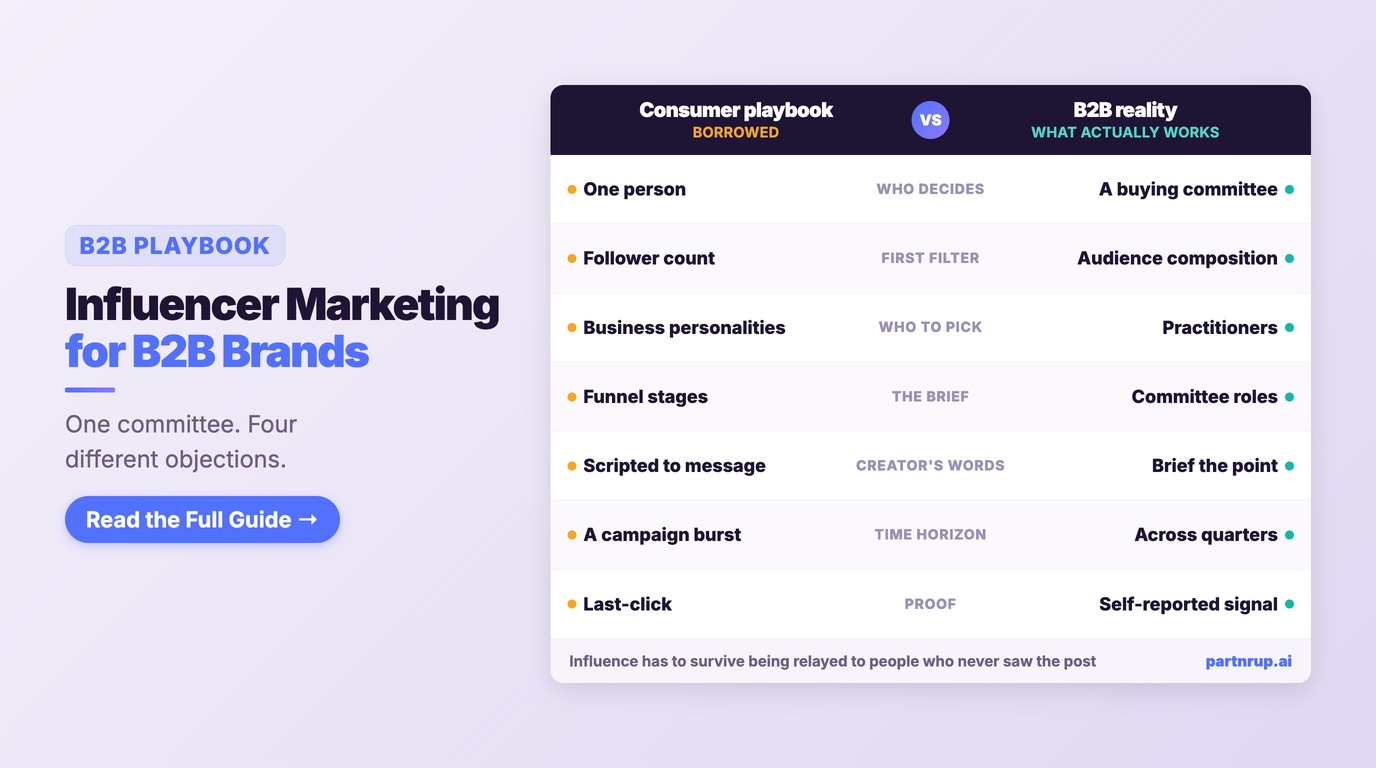
Influencer Marketing for B2B Brands: What Works and What Doesn't

B2B influencer marketing fails when it borrows a consumer playbook. What LinkedIn actually supports today, how to brief against a buying committee, and which measures survive a private relay.

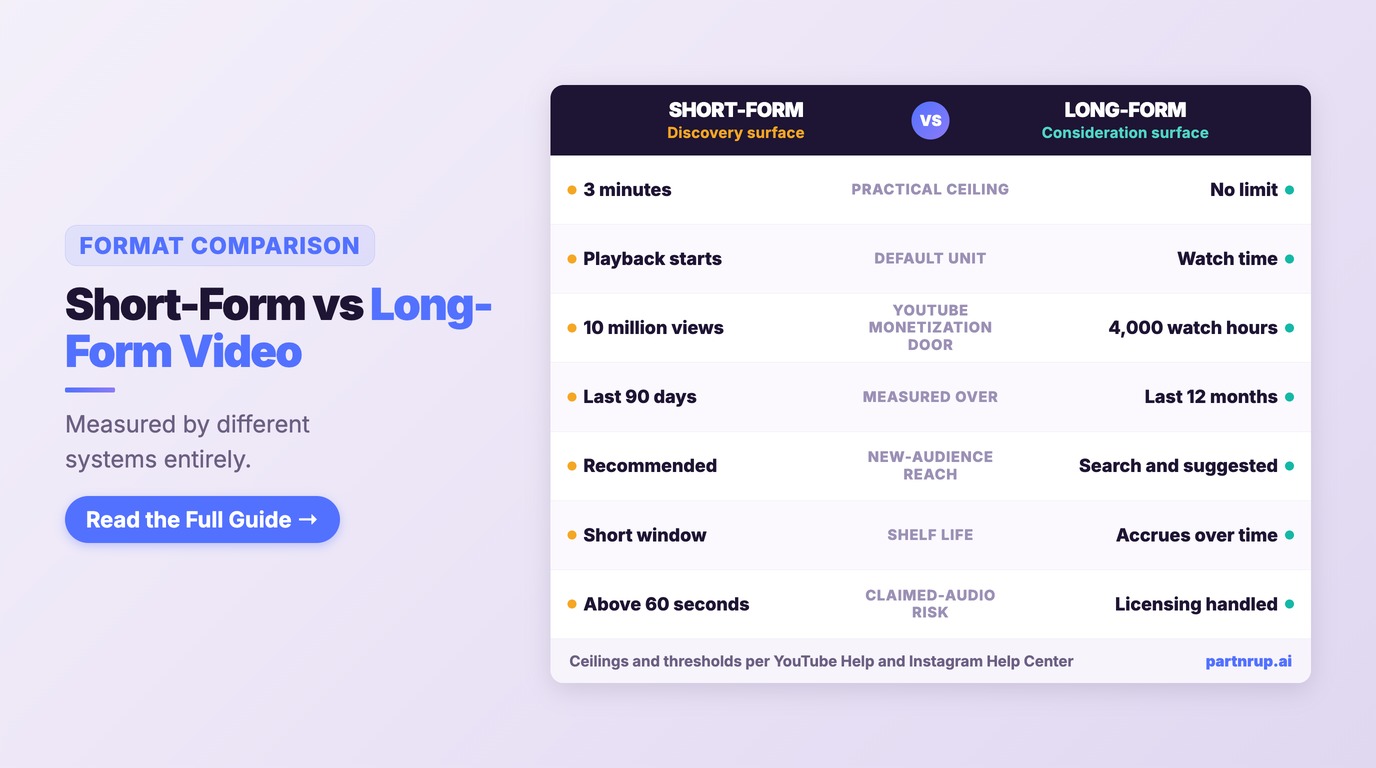
Short-Form vs Long-Form Video: Which Drives Better Brand Results in 2026?

Short-form and long-form video are measured by different systems. What the platform ceilings actually are, why a view isn't one unit, and how to pick the format from the objective.

Turn creators into a revenue channel: the finance and payout layer most affiliate programs skip
The Affiliate Influencer Playbook: How to Turn Creators Into a Revenue Channel

A finance-side playbook for affiliate creator programs: forecasting revenue, deriving a commission ceiling from margin, running payouts at scale, and the 1099 and FTC obligations you inherit as the payer.

The Future of Creator Partnerships: What Brands Need to Prepare for in 2027

The 2027 rules for creator partnerships are already written. The AI Act's 2 December 2026 deadline, automatic platform AI labels, C2PA provenance, and the FTC Reviews Rule — with what to change in your contracts now.

Organic vs Paid Influencer Content: Which Drives Better ROI?

Organic and paid influencer content overlap where ROI is decided. A mechanics-level breakdown of Spark Ads, partnership ads, permission scopes and format limits — and the sequence that follows from them.

The Complete Guide to UGC for Brands: Strategy, Rights & Distribution

Most UGC guides assume the hard part is supply. It is not - it is that your best-performing content is often something you never commissioned and cannot legally use. Here is how to acquire, scope, and distribute it.

Creator-Led Product Launches: How Shoppable Content Drives Sales

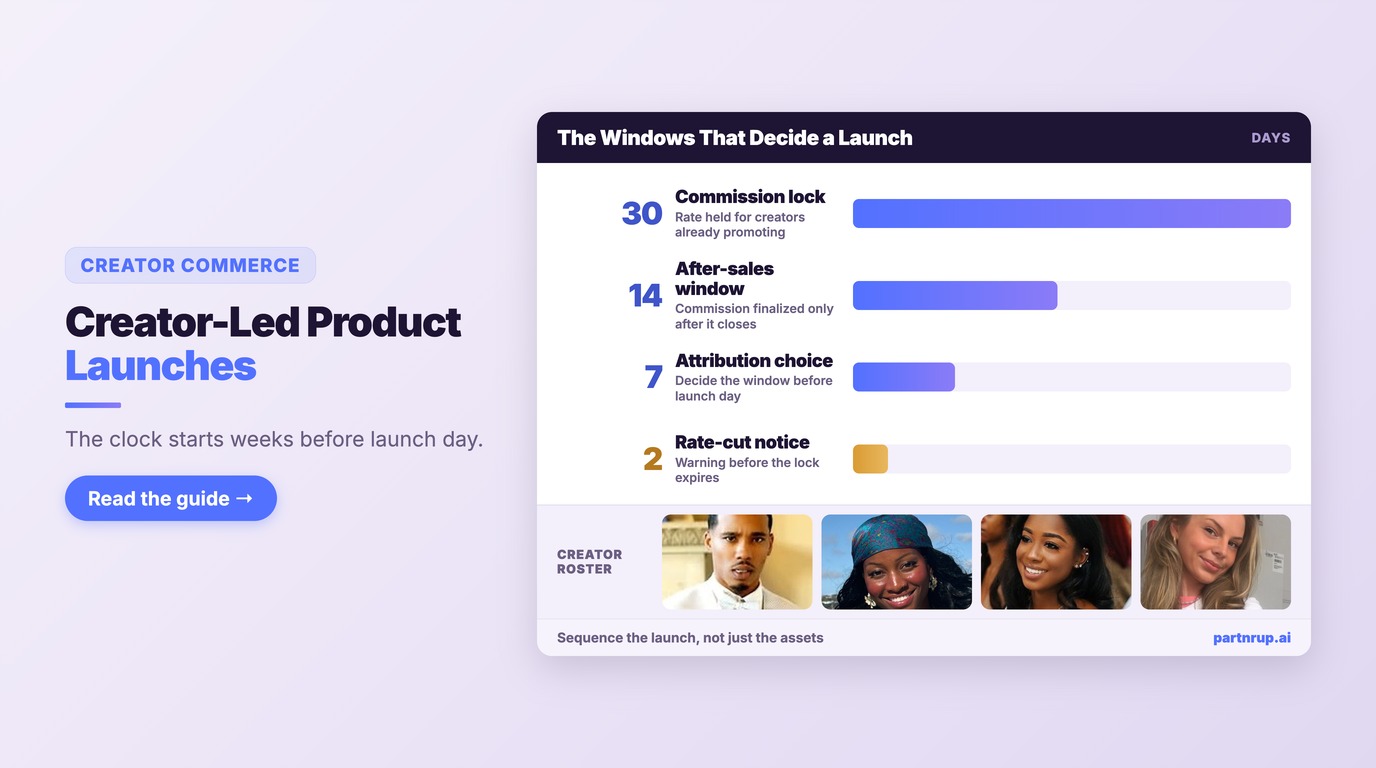
A launch-sequencing guide to creator-led product launches: the three windows, TikTok's 30-day commission lock, the 14-day after-sales payout lag, and where the purchase now completes.

Insights on the Future of Creator Marketing

Explore strategies, trends, and thought leadership from the team building the next generation of influencer marketing.

View More

How to Build a Shoppable Video Strategy: From Content Brief to Conversion

The operational layer of shoppable video: brief fields, platform permissions, catalog checks, amplification rights, and the review loop that decides whether a good concept ever reaches a feed with a working product tag.

Learn More

Influencer Marketing for B2B Brands: What Works and What Doesn't

B2B influencer marketing fails when it borrows a consumer playbook. What LinkedIn actually supports today, how to brief against a buying committee, and which measures survive a private relay.

Learn More

Short-Form vs Long-Form Video: Which Drives Better Brand Results in 2026?

Short-form and long-form video are measured by different systems. What the platform ceilings actually are, why a view isn't one unit, and how to pick the format from the objective.

Learn More
Turn creators into a revenue channel: the finance and payout layer most affiliate programs skip

The Affiliate Influencer Playbook: How to Turn Creators Into a Revenue Channel

A finance-side playbook for affiliate creator programs: forecasting revenue, deriving a commission ceiling from margin, running payouts at scale, and the 1099 and FTC obligations you inherit as the payer.

Learn More

The Future of Creator Partnerships: What Brands Need to Prepare for in 2027

The 2027 rules for creator partnerships are already written. The AI Act's 2 December 2026 deadline, automatic platform AI labels, C2PA provenance, and the FTC Reviews Rule — with what to change in your contracts now.

Learn More

Organic vs Paid Influencer Content: Which Drives Better ROI?

Organic and paid influencer content overlap where ROI is decided. A mechanics-level breakdown of Spark Ads, partnership ads, permission scopes and format limits — and the sequence that follows from them.

Learn More

The Complete Guide to UGC for Brands: Strategy, Rights & Distribution

Most UGC guides assume the hard part is supply. It is not - it is that your best-performing content is often something you never commissioned and cannot legally use. Here is how to acquire, scope, and distribute it.

Learn More

Creator-Led Product Launches: How Shoppable Content Drives Sales

A launch-sequencing guide to creator-led product launches: the three windows, TikTok's 30-day commission lock, the 14-day after-sales payout lag, and where the purchase now completes.

Learn More

Captiv8 Review 2026: Is This Enterprise Influencer Platform Right for You?

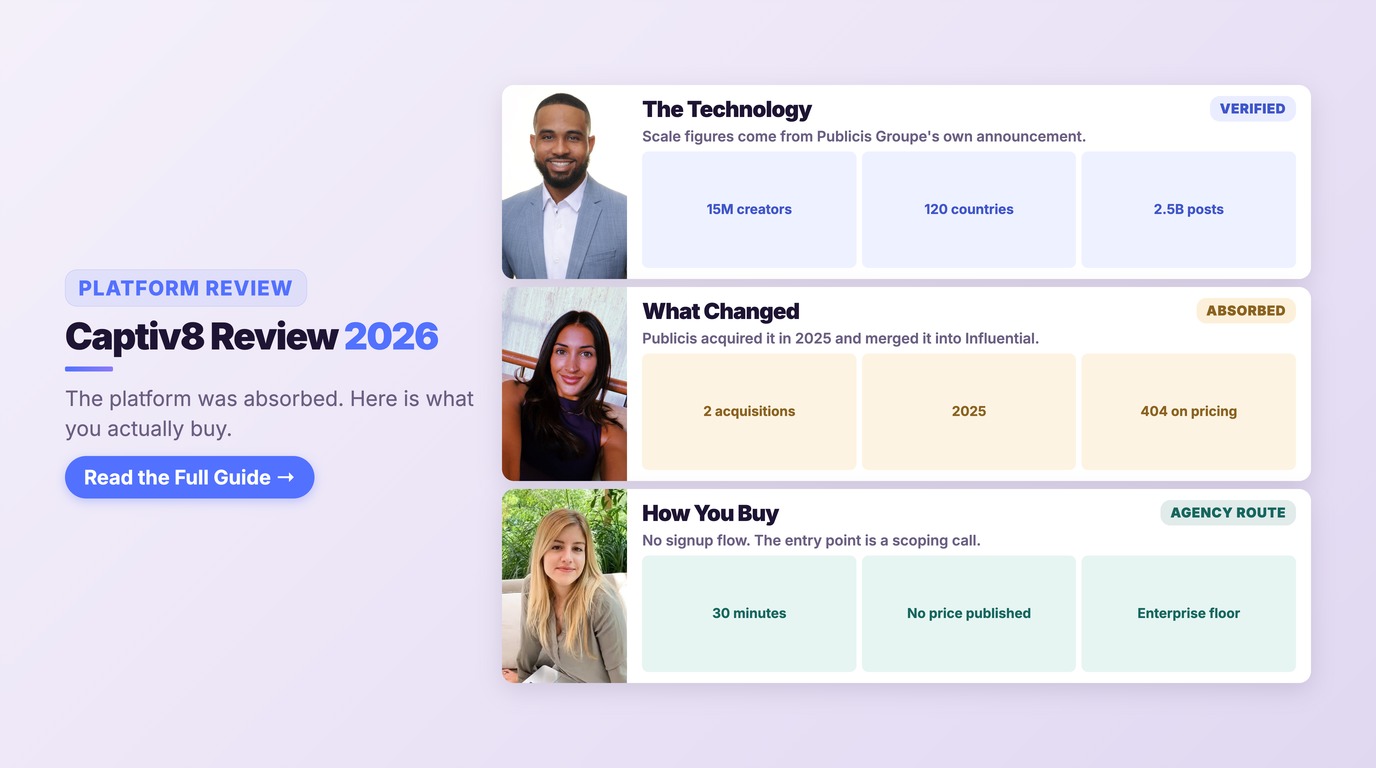
Captiv8's homepage now says it has been integrated into Influential. Here is what that means for buyers in 2026 — what survived the merge, who the platform still fits, and when to look elsewhere.

Learn More

Incrementality Testing for Influencer Campaigns: A Brand Guide

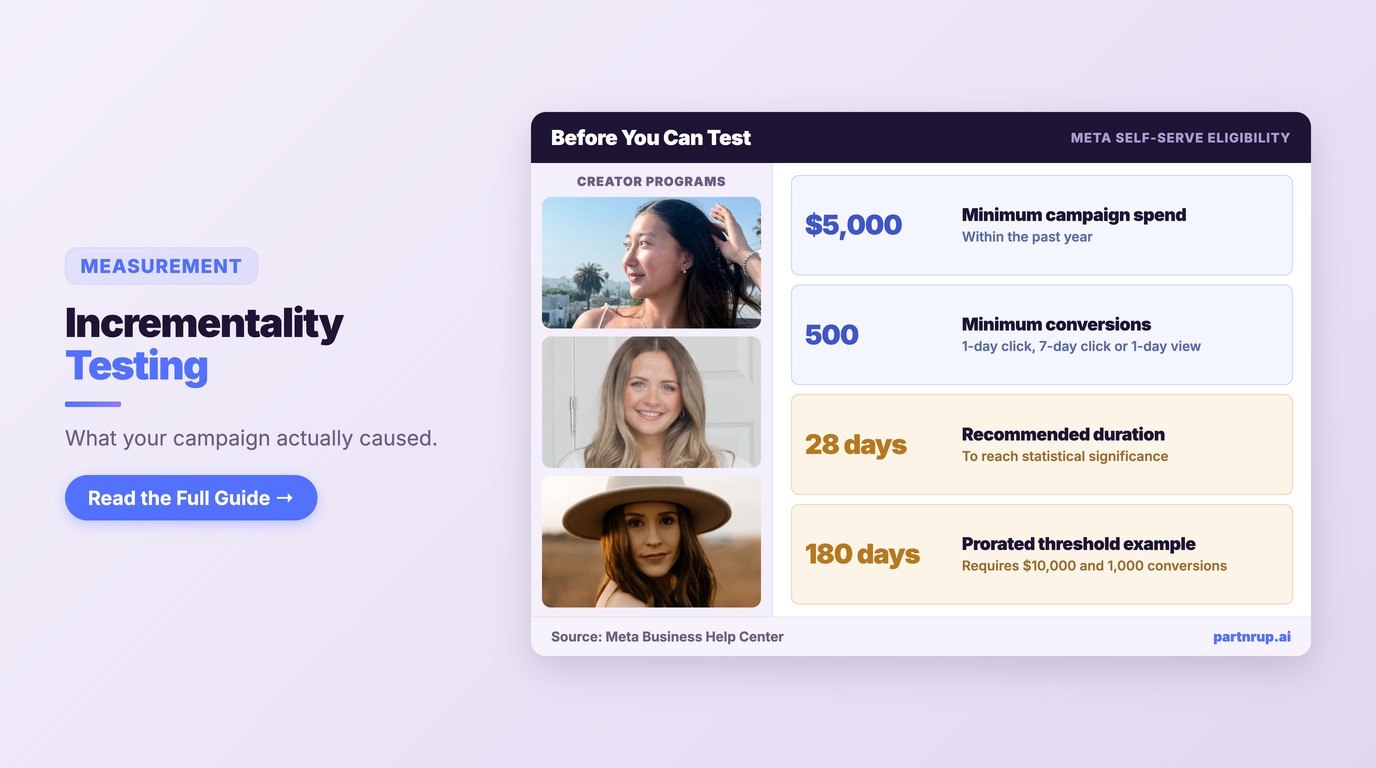
Incrementality testing shows what a creator campaign actually caused, not what got credit. A practical guide to test design, Meta's published eligibility thresholds, holdout sizing, and the four ways creator campaigns break standard experimental design.

Learn More

Live Shopping Strategy for Brands: From TikTok to Amazon Live

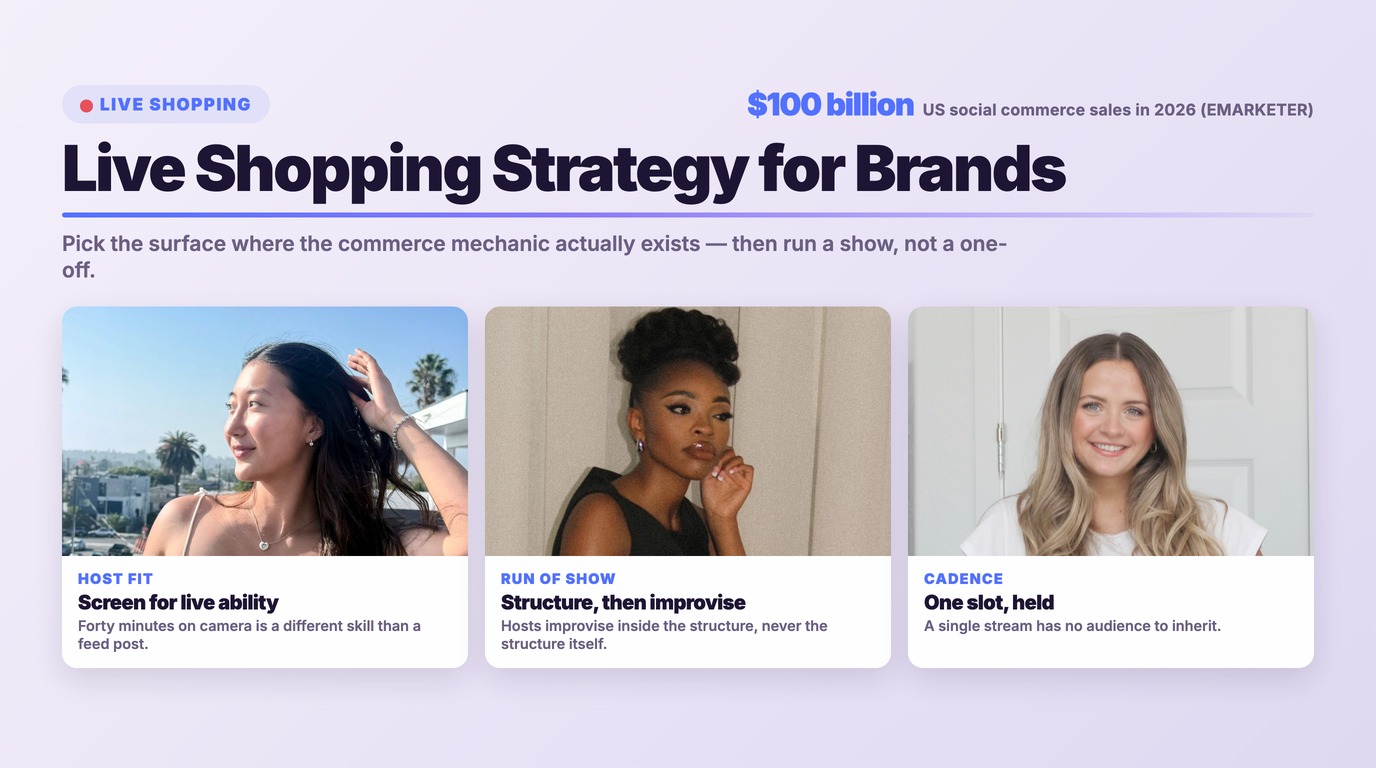
A practical live shopping guide for brands: where the commerce mechanic genuinely exists, the three show formats worth running, a forty-minute run of show, host selection, cadence, measurement, and what to do with the replay.

Learn More
AI in influencer marketing 2026: where AI actually lands across the creator workflow

AI in Influencer Marketing: What's Actually Changing in 2026

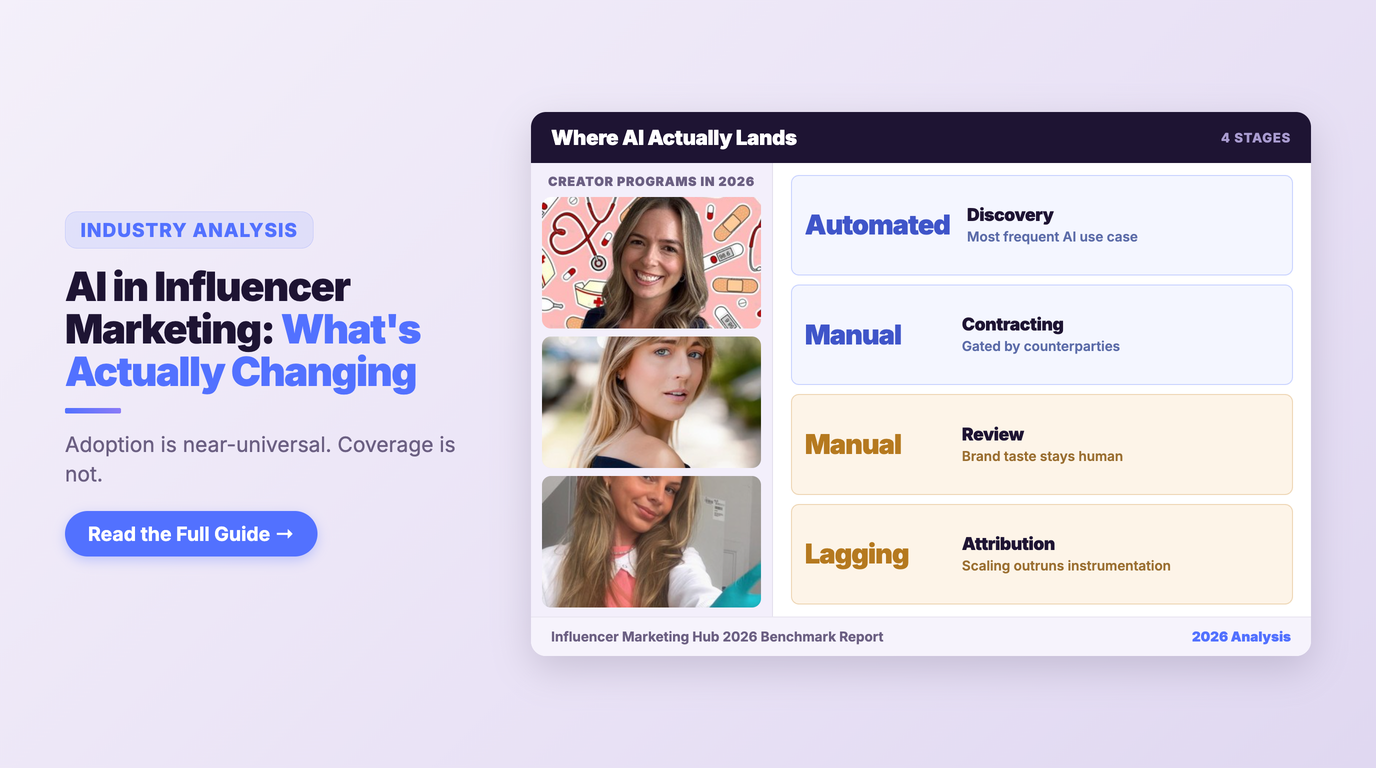
Only 10.56% of influencer marketers report no AI use at all, yet AI adoption is concentrated almost entirely in creator discovery. This guide maps where AI has actually landed in the 2026 workflow, why contracting, content review and attribution stayed manual, and the order to fix them in.

Learn More

UGC vs Professionally Produced Content: When to Use Each and Why

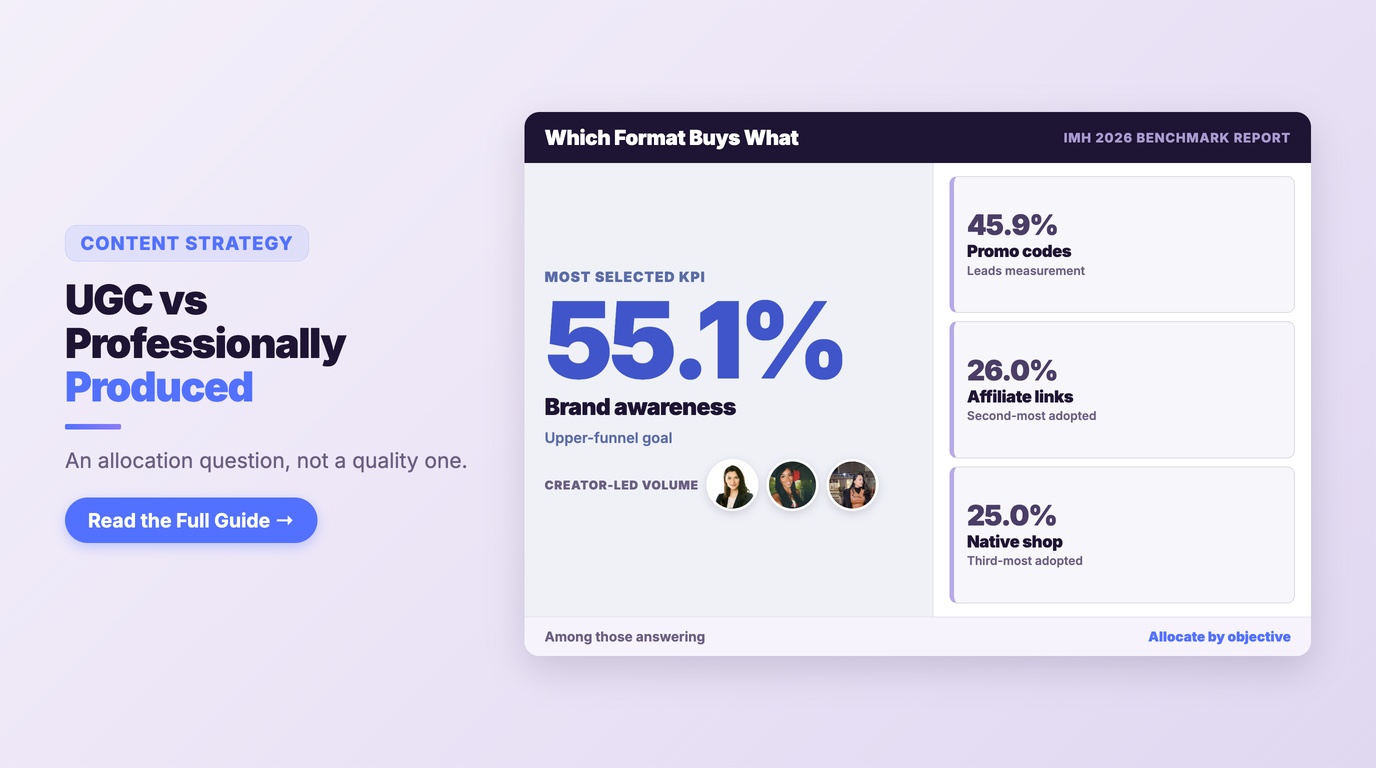
A decision framework for allocating budget between creator-shot UGC and professionally produced content by objective, platform, and campaign type.

Learn More

Digital Shelf Analytics: How Brands Use Creator Content to Win Product Search

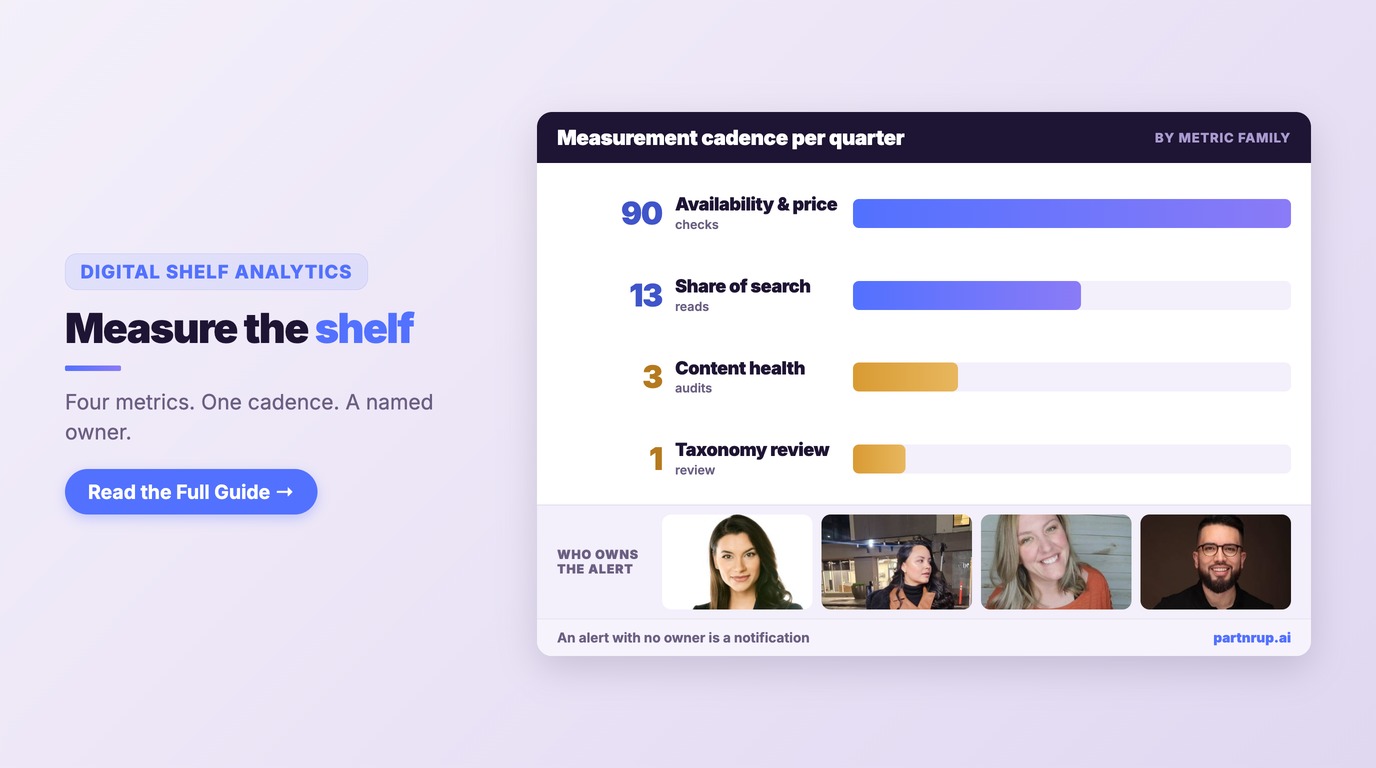
Digital shelf analytics means measuring product discovery on a defined cadence with defined action thresholds. What to track, how often, how to tell signal from noise, and where creator content fits as the response.

Learn More

How to Set Influencer Marketing Budgets Based on Expected ROI

Marketing budgets are flat at 7.7% of revenue. Instead of incrementing last year's number, work backward from the return the business needs to the spend that implies — and source the efficiency number honestly.

Learn More
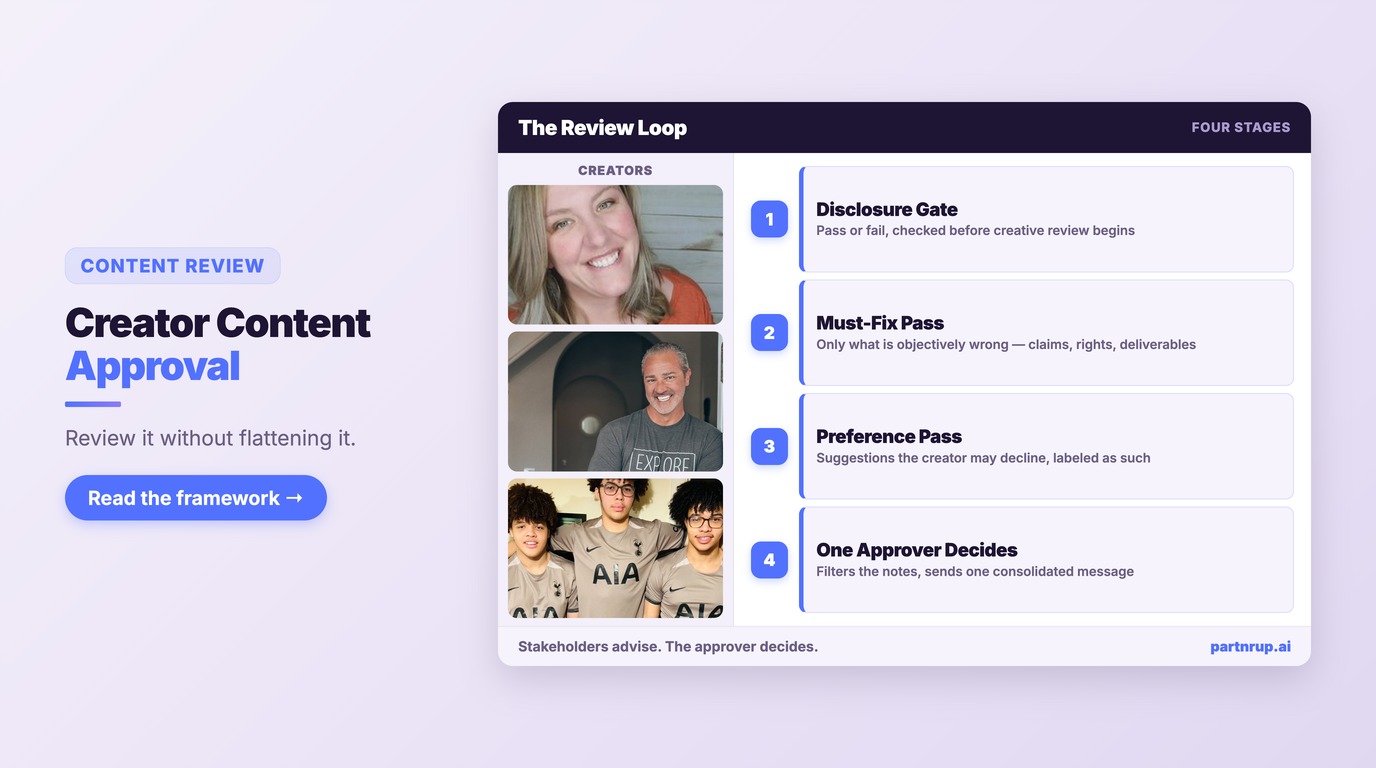
Four-stage creator content review loop: disclosure gate, must-fix pass, preference pass, one approver decides

Creator Content Approval Process: How to Review Without Killing Authenticity

Two-thirds of influencer programs run entirely in-house, which means approvals usually land on a marketer with no defined review process. This guide covers the review loop itself: separating must-fix from preference, naming one approver instead of a committee, the FTC disclosure floor the brand is accountable for, how to write revision requests that preserve voice, and the four process metrics worth tracking.

Learn More

How to Make Instagram Content Shoppable: The Brand Strategy Guide

US social commerce will pass $100 billion in 2026, but Instagram moved Shops to website checkout in September 2025 - the in-app sale is gone. This guide covers what still works: eligibility, catalog and checkout URL setup, product tagging across Reels, Stories and feed posts, approving creators as branded content partners, and measuring a funnel that now splits across two systems.

Learn More

How To Do An Influencer Search?

When planning an influencer marketing campaign, one of the most challenging parts is often finding the right influencers. Partnering with the right influencers makes all the difference in your campaign, but many marketers don’t know how to find them in the sea of creators producing content on social media.

Learn More

Influencer Marketing Attribution Models: Which One Is Right for Your Brand?

You've decided to measure influencer marketing ROI — good. Now you face the next challenge: which attribution model do you use? First-touch? Last-touch? Multi-touch? Incrementality? Each model tells a different story about your campaigns, and choosing the wrong one can lead to decisions that hurt performance.

Learn More

Creator Commerce Is Becoming the Operating Model for Influencer Marketing

Influencer marketing used to be easier to define. A brand hired a creator, the creator made content, the content was published, and the campaign was measured.

Learn More

partnrUP’s Agentic Influencer Marketing Platform Cuts Campaign Development Time by More Than 99%

The rebuilt platform reduces more than 24 hours of manual campaign development work to minutes, while making paid creator campaign setup 3.4x as fast across influencer and UGC programs.

Learn More

Influencer Marketing Industry Report H2 2026: What’s Working Right Now

Marketers expect their influencer budgets to grow this year, and 72.2% of them expect that growth to be 50% or more. But when the same survey asks how they measure success, brand awareness is the most selected KPI at 55.1% — while 65.9% expect their creator spend to pay back within a single month.

Learn More

Influencer Marketing Metrics That Actually Matter in 2026

72.2% of marketers who answered expect their influencer budgets to increase by 50% or more in 2026, according to the Influencer Marketing Hub 2026 Benchmark Report. The same report found that brand awareness is the single most-selected KPI, chosen by 55.1% of respondents — while revenue and sales KPIs are selected less frequently. Budgets are climbing toward a forecast $44 billion in US creator ad spend, and the metric most teams report against is the one least able to justify the spend.

Learn More

Social Commerce vs Traditional E-commerce: What Brands Need to Know

US social commerce sales will surpass $100 billion in 2026 — a milestone that sounds enormous until you set it beside the $1.5 trillion Americans will spend on retail ecommerce overall. Social commerce is growing far faster, but it is still roughly one dollar in every fifteen spent online. That gap is the single most misunderstood fact in ecommerce strategy right now, and it explains why the “social is replacing your website” pitch keeps failing brands that believe it.

Learn More

How AI Agents Are Replacing Traditional Influencer Marketing Workflows

87.49% of marketers expect their influencer marketing budget to increase in 2026, and 72.22% plan increases of 50% or more (Influencer Marketing Hub 2026 Benchmark Report, 600+ respondents). At the same time, 66.3% run their programs entirely in-house. That combination is the whole story: dramatically more money flowing through influencer programs, managed by the same small teams using the same manual workflows they built when the channel was a pilot. Something has to give — and what is giving is the workflow itself.

Learn More

How to Vet Creators for Brand Sponsorships: The Complete Brand Guide

72.2% of marketers who answered expect their influencer budgets to increase by 50% or more in 2026, according to the Influencer Marketing Hub 2026 Benchmark Report — yet creator discovery and vetting remains the most frequently outsourced function in the industry. The reason is simple: picking the wrong creator doesn’t just waste budget. It damages brand credibility, derails campaign timelines, and produces content that sits in a folder no one opens.

Learn More

How to Write a Creative Brief for Creator Campaigns

72% of creators say a poorly written brief is the number one reason campaign content misses the mark, according to a 2026 Creator Compensation & Workflow Report by IZEA. Yet most brand teams spend less than 15 minutes writing them — copying last quarter’s brief, swapping out product names, and hoping for the best.

Learn More

Brand Lift Studies for Influencer Marketing: Do They Actually Work?

72.2% of marketers who answered expect their influencer budgets to increase by 50% or more in 2026, according to the Influencer Marketing Hub Benchmark Report — yet fewer than one in five can confidently attribute upper-funnel brand impact to specific creator campaigns. The gap between spending and proving brand value is where brand lift studies enter the picture. But here’s the question most marketing teams avoid: do these studies actually work for influencer marketing, or are they an expensive vanity exercise?

Learn More

How to Scale Creative Production Without Losing Brand Authenticity

72.2% of marketers who answered expect their influencer budgets to increase by 50% or more in 2026, according to the Influencer Marketing Hub 2026 Benchmark Report — yet two-thirds of brands now run programs entirely in-house, according to the same report — meaning internal teams bear the full weight of scaling creative output while maintaining brand consistency. The gap between ambition and operational capacity is where most programs stall: more creators, more content, more channels, and brand voice slowly eroding with each new partnership.

Learn More

Building a Creator Commerce Strategy From Scratch

72.2% of marketers who answered expect their influencer budgets to increase by 50% or more in 2026, according to the Influencer Marketing Hub 2026 Benchmark Report — yet most brands still lack a repeatable framework for turning creator partnerships into actual revenue. The gap isn’t enthusiasm. It’s execution. Creator commerce sits at the intersection of influencer marketing, social commerce, and performance marketing, and building a strategy from scratch requires more than picking creators and hoping products sell.

Learn More

How AI Agents Are Transforming Influencer Marketing Operations

72.2% of marketers who answered expect their influencer budgets to increase by 50% or more in 2026 (Influencer Marketing Hub 2026 Benchmark Report), yet two-thirds of those programs are run entirely in-house — often by teams of three or fewer people. The math doesn’t work. More budget, more creators, and more content demand cannot scale on spreadsheets and manual outreach. That’s where AI agents are stepping in — not as chatbots answering questions, but as autonomous systems that execute the repetitive operational tasks that slow influencer programs down.

Learn More

How to Calculate Influencer Marketing ROI: A Step-by-Step Formula for Brands

72.2% of marketers who answered expect their influencer budgets to increase by 50% or more in 2026, according to Influencer Marketing Hub’s 2026 Benchmark Report — yet most still can’t answer a simple question: what’s the actual return? The gap between spending and measuring isn’t a data problem. It’s a formula problem. Without a repeatable, step-by-step calculation framework, every campaign lives in a fog of vanity metrics and gut feelings.

Learn More

Creator Commerce Metrics: What to Track, What to Ignore

72.2% of marketers who answered expect their influencer budgets to increase by 50% or more in 2026, according to the Influencer Marketing Hub Benchmark Report — yet fewer than half can confidently tie creator-driven sales back to the content that generated them. The gap between spending and measurement has never been wider, and brands pouring money into creator commerce without tracking the right metrics are flying blind.

Learn More

9 Aspire Alternatives: Modern Influencer Marketing Platforms for Every Budget

67% of brands plan to increase their influencer marketing budgets in 2026 — yet many are stuck on platforms that charge enterprise pricing for mid-market features. If your team has outgrown Aspire (formerly AspireIQ) or simply needs a better fit for your workflow and budget, you’re not alone.

Learn More

The Creator Economy in 2026: Key Stats and Trends Every Brand Needs to Know

The creator economy surpassed $250 billion in total market value in 2025, and by every major industry forecast, 2026 is the year it reshapes how brands allocate marketing budgets entirely. Yet most marketing leaders still treat creator partnerships as a line item — not a growth channel. The gap between brands that understand the creator economy in 2026 and those still running one-off sponsorships is widening fast, and the data makes it impossible to ignore.
Learn More

How to Scale Creative Production Without Losing Authenticity

Brands running creator programs hit a wall around 15-20 active partnerships: content quality starts slipping, messaging drifts off-brand, and the team spends more time managing revisions than building relationships. A 2026 CreatorIQ benchmark report found that brands scaling beyond 25 creators per quarter saw a 34% increase in revision cycles — yet those that implemented structured creative systems maintained approval rates above 85% even at 100+ partnerships.

Learn More

How AI Matches Creators to Brands: Beyond Follower Count

82% of marketers who switched from follower-based selection to AI-powered creator matching saw campaign ROI improve by 3x or more — yet most brands still choose influencers the same way they did in 2019: scrolling feeds, counting followers, and guessing. The gap between “good enough” creator selection and genuinely predictive matching is now the single biggest lever in influencer marketing performance.

Learn More

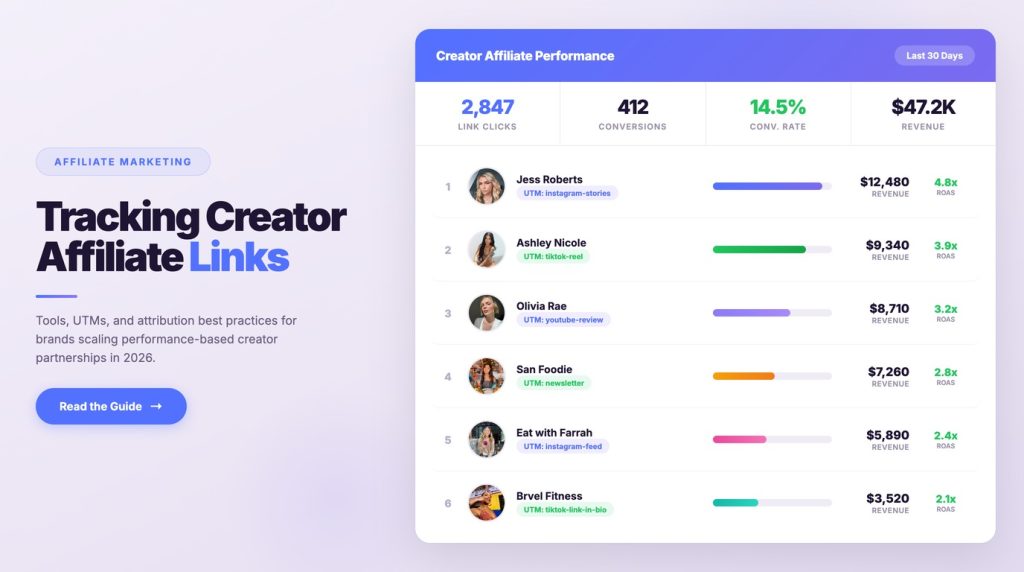
Tracking Creator Affiliate Links: Tools, UTMs, and Attribution Best Practices

63% of brands running creator affiliate programs say their biggest challenge is tracking which creator actually drove a conversion. Not finding creators. Not negotiating rates. Tracking. The gap between “a creator posted about our product” and “that post generated $47,000 in revenue” is where most programs either scale or stall.

Learn More

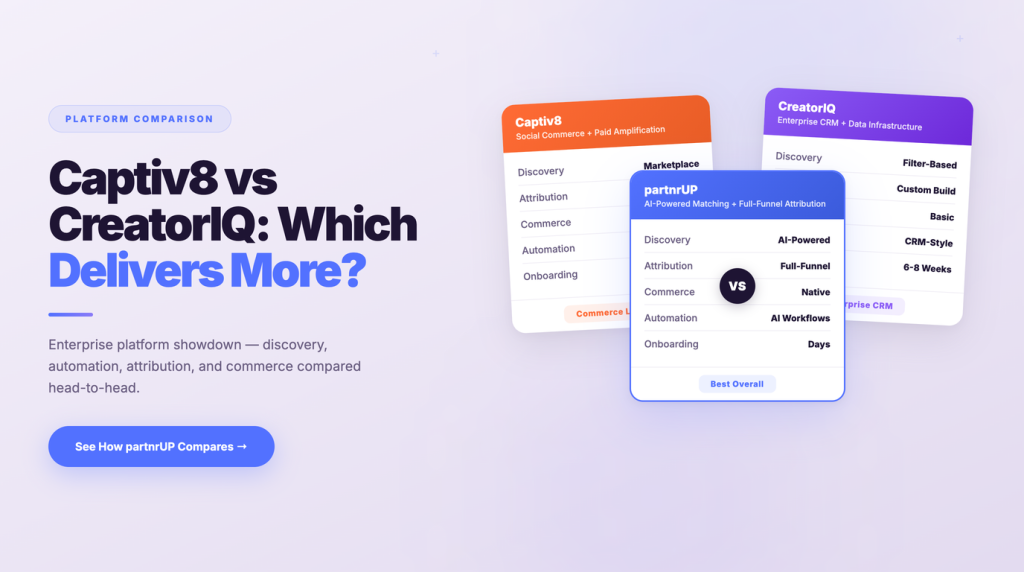
Captiv8 vs CreatorIQ (vs partnrUP): Which Enterprise Platform Delivers More?

The influencer marketing industry surpassed $24 billion in 2024 according to Influencer Marketing Hub — and choosing the wrong one can lock your team into 12-month contracts with tools that don’t match your workflow. When you’re evaluating Captiv8 vs CreatorIQ, the differences aren’t obvious from feature pages alone. Both platforms target enterprise brands, both claim AI-powered discovery, and both come with price tags that demand executive approval.

Learn More

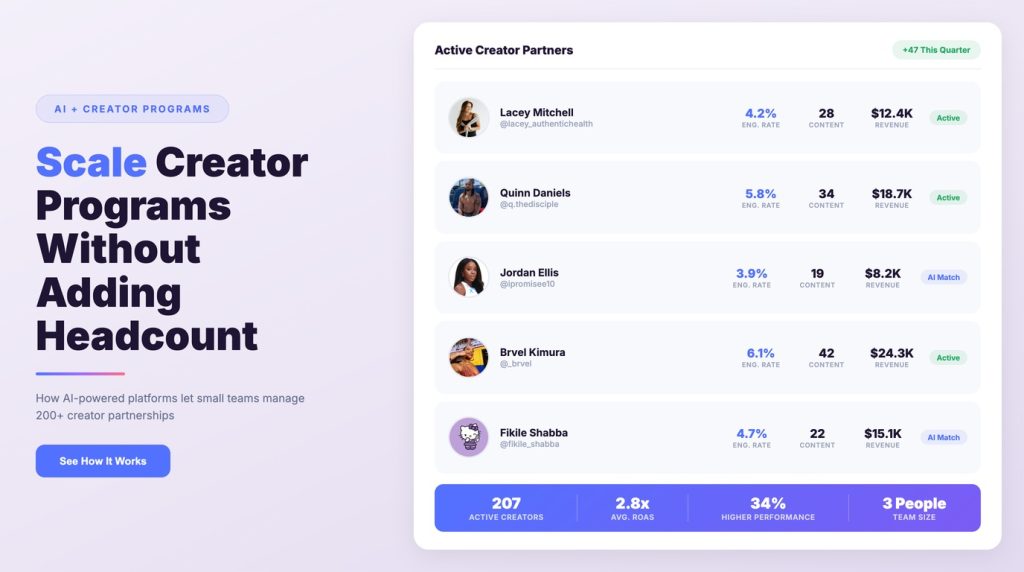
How Brands Are Using AI to Scale Creator Programs Without Adding Headcount

63% of marketing teams managing creator programs say they’ve hit a ceiling — not because of budget, but because of bandwidth. The average brand partnership manager juggles 47 creator relationships simultaneously, spending 11 hours per week on manual outreach alone. Meanwhile, the brands that are scaling to 200+ active creators without hiring additional staff share one thing in common: they’ve moved their workflow backbone to AI.

Learn More

AI Creator Matching vs. Manual Influencer Discovery: A Head-to-Head

72% of influencer marketing managers report spending more time finding creators than actually managing campaigns — a paradox that’s costing brands real revenue. The average team dedicates 40+ hours per campaign to manual influencer vetting, reviewing content feeds, cross-referencing engagement metrics, and hoping audience demographics align with brand goals. Meanwhile, AI-powered creator matching platforms are cutting that time to under 4 hours while delivering 3x higher conversion rates on matched partnerships.

Learn More

Content Repurposing Strategy: Getting Maximum Value from Creator Assets

Brands that repurpose creator content across channels see 3x more engagement per dollar spent than those using assets once — yet 68% of marketing teams still treat every creator deliverable as a single-use asset. The result? Thousands of dollars in high-performing content sitting unused in shared drives, never reaching the audiences that would convert.

Learn More

How to Structure Creator Affiliate Programs That Actually Convert

Brands that structure their creator affiliate programs with clear commission tiers, performance tracking, and dedicated creator support generate 3.2x more affiliate revenue than those running ad-hoc partnerships. Yet the majority of ecommerce teams still launch affiliate programs with flat-rate commissions, generic tracking links, and zero onboarding — then wonder why creators stop posting after week two.

Learn More

GRIN Pricing 2026: What You’ll Actually Pay and a Smarter Alternative

Enterprise influencer software pricing is one of the least transparent topics in martech — and GRIN is no exception. A 2024 Forrester survey found that 67% of marketing technology buyers list “lack of transparent pricing” as their top frustration with SaaS vendors. When it comes to influencer marketing platforms, that problem is even more pronounced: almost every vendor hides their actual cost behind a “contact sales” wall.

Learn More

How Brands Are Winning on TikTok Shop in 2026

TikTok Shop’s U.S. GMV surpassed $20 billion in the first half of 2026, making it the fastest-growing social commerce channel in the market. Brands that cracked the code early are now generating 15-30% of their DTC revenue through the platform — while their competitors are still debating whether TikTok is “right for their brand.”

Learn More

7 Aspire Alternatives: Modern Influencer Marketing Platforms for Every Team

67% of brands plan to increase their influencer marketing budgets in 2026 — yet many are stuck on platforms that charge enterprise pricing for mid-market features. If your team has outgrown Aspire (formerly AspireIQ) or simply needs a better fit for your workflow and budget, you’re not alone.

Learn More

Creator Affiliate Tracking: Best Tools and Methods for Brands in 2026

Brands lose an estimated 20-30% of their creator-driven revenue to poor attribution — sales that actually happened but were never tracked back to the creator who drove them. In a channel where proving ROI is already the top challenge, leaky tracking infrastructure turns a winnable argument into an unwinnable one.

Learn More

Influencer Marketing KPIs Every Brand Should Track in 2026

76% of marketing leaders say measuring influencer marketing performance is their biggest challenge, yet the problem isn’t a lack of data — it’s tracking the wrong metrics. Brands that still evaluate creators by follower count and likes are optimizing for vanity while their competitors optimize for revenue.

Learn More

Long-Term Creator Partnerships vs One-Off Campaigns: Which Wins?

Brands that maintain creator partnerships for 6+ months see 47% higher ROI than those running one-off campaigns, according to recent industry data. Yet the majority of influencer marketing budgets still go toward transactional, campaign-by-campaign engagements — a structural inefficiency that leaves significant performance on the table.

Learn More

What Is the Digital Shelf and Why Should Brands Care?

85% of consumers research products online before purchasing — even when they buy in-store, making the digital shelf the most important real estate in modern retail. Yet most brands still manage their digital shelf presence as an afterthought, treating product pages as static catalogs rather than dynamic, content-rich experiences that drive discovery and conversion.

Learn More

How Affiliate Influencer Marketing Works: Performance-Based Models

Performance-based influencer partnerships now account for 43% of all influencer marketing spend, up from just 18% three years ago. The shift is unmistakable: brands are moving from paying for posts to paying for results, and affiliate influencer marketing is the model driving that transformation.

Learn More

How to Calculate Influencer Marketing ROI: A Step-by-Step Formula for Brands

72.2% of marketers who answered expect their influencer budgets to increase by 50% or more in 2026, according to Influencer Marketing Hub’s 2026 Benchmark Report — yet most still can’t answer a simple question: what’s the actual return? The gap between spending and measuring isn’t a data problem. It’s a formula problem. Without a repeatable, step-by-step calculation framework, every campaign lives in a fog of vanity metrics and gut feelings.

Learn More

How to Write a Creative Brief for Creator Campaigns That Gets Results

68% of creators say unclear briefs are the number one reason campaigns underperform, yet most brands still approach creative briefs as afterthoughts — vague one-pagers filled with brand guidelines but devoid of the strategic direction creators actually need to produce content that converts.

Learn More

Shoppable Video Best Practices: What Actually Converts in 2026

Brands using shoppable video report conversion rates 3-5x higher than traditional product pages, yet 72% of marketing teams say they’re still experimenting with the format rather than running optimized programs. The gap between early adopters and everyone else is widening — and the playbook for what actually converts has become clearer than ever.

Learn More

What Is Creator Commerce? The Brand’s Essential Guide for 2026

Creator commerce is projected to drive over $32 billion in U.S. retail sales by the end of 2026, yet most brands still treat creator partnerships as a top-of-funnel awareness play rather than a direct revenue channel. That disconnect is costing them market share — and fast.

Learn More

How to Build a Creator Affiliate Program: From Zero to Scale

Creator affiliate programs now drive 3-5x higher conversion rates than traditional affiliate networks — yet most brands still haven’t built one. They’re stuck between expensive influencer platforms that charge flat fees regardless of performance, generic affiliate networks designed for coupon sites, and manual outreach that doesn’t scale past a handful of creators.

Learn More

GRIN Review 2026: Is This Creator Management Platform Right for Your Brand?

Considering GRIN for your influencer marketing program? This review covers everything you need to make an informed decision — features, pricing, G2 scores, real user feedback, and an honest take on who GRIN is (and isn’t) built for.

Learn More

Influencer Marketing ROI: The Complete Attribution Guide for Brands in 2026

Influencer marketing ROI is real — but proving it requires more than checking likes and follower counts. If you’re running influencer campaigns without a clear attribution strategy, you’re flying blind on one of your most significant marketing investments.

Learn More

7 GRIN Alternatives: AI-Powered Influencer Marketing Solutions for 2026

GRIN has built a solid reputation in the creator management space — but it’s not the right fit for every brand. Whether it’s the pricing, the complexity, the enterprise-only focus, or the support experience, brands increasingly find themselves searching for GRIN alternatives that deliver more for their specific needs.

Learn More

Influencer Marketing Platform Comparison 2026: Which One Is Right for Your Brand?

78% of brands say they’ve switched influencer marketing platforms at least once — and most cite the same reason: the platform promised discovery, but couldn’t deliver execution.

Learn More

15 Best Influencer Marketing Platforms for Brands in 2026

From AI-powered discovery to full-funnel creator commerce — here are the platforms brands are using to run smarter influencer programs in 2026.

Learn More

partnrUP is the Easiest to Use Creator Marketing Platform and Easiest to Do Business With Influencer Agency Based on G2 Summer 2026 Reports

Validation Meets Velocity: When agentic workflows assist influencer marketing managers to do high-quality work at scale

Learn More

Branded Content Creation: From Strategy to Production to Distribution

Branded content is the antidote to ad fatigue. While traditional advertising interrupts consumers mid-scroll, mid-show, or mid-article, branded content earns their attention. It delivers genuine value , entertainment, education, inspiration, with a brand’s fingerprints on it. The result? Audiences that choose to engage rather than skip.

Learn More

The State of Influencer Marketing in 2026: Trends, Data & Industry Insights

Influencer marketing isn’t a nice-to-have anymore: it’s a core budget line for brands across every category. What started as gifting products to bloggers has evolved into a sophisticated, performance-driven channel with its own metrics, technology stack, and organizational function. In 2026, the industry hasn’t just matured , it has fundamentally transformed.
Learn More

Brand Sponsorships & Creator Partnerships: The Definitive Playbook

Brand sponsorships and creator partnerships sit at the heart of modern influencer marketing, but most brands approach them the wrong way. They fire off one-off deals, chase follower counts, and wonder why the results don’t stick. The brands winning in 2026 are doing something different: they’re building systems for creator partnerships, not just buying placements.

Learn More

Creator Content Strategy: Building a Scalable Creative Program for Your Brand

Most brands treat creator content as a tactic , a one-off campaign here, a reactive brief there, no system connecting any of it. They find a creator, approve some posts, watch the metrics for a week, and move on. Then they do it again from scratch next quarter.

Learn More

Shoppable Video & Social Commerce: The Complete Guide for Brands in 2026

Shoppable video is collapsing the funnel. Where brands used to run awareness campaigns and hope buyers remembered them days later, shoppable video turns every creator post into a direct buying opportunity. A viewer watches a skincare creator apply a serum, taps the product tag, and checks out , all without leaving TikTok. Discovery and transaction happen in the same breath.

Learn More

Digital Shelf Optimization: How Creator Content Drives Product Discovery & Conversions

The digital shelf is the new physical shelf , except it’s infinite, always on, and increasingly driven by creator content. Walk into any retail store and prime shelf placement determines what gets noticed, picked up, and purchased. Online, that same dynamic plays out across TikTok search results, Amazon product listings, Google Shopping carousels, and Instagram Explore feeds.

Learn More

Creator Commerce: How Brands Win in the New Social Shopping Era

Creator commerce isn’t just influencer marketing with a new name — it’s a fundamental shift in how products get discovered, evaluated, and purchased. And if your brand hasn’t started paying attention, you’re already playing catch-up.

Learn More

Affiliate Influencer Marketing: The Complete Brand Playbook for 2026

Affiliate influencer marketing is one of the highest-ROI creator strategies available to brands right now, and it’s still widely underutilized. Instead of paying creators a flat fee upfront and hoping for results, you tie compensation to actual sales. Creators earn when they drive conversions. You only pay when the program delivers.

Learn More

Influencer Marketing ROI: The Complete Guide to Measuring, Tracking & Proving Results

Every marketing leader faces the same question at budget time: “What did we actually get from our influencer spend?” It’s the question that’s launched a thousand spreadsheets and ended more than a few campaigns prematurely. And according to influencer marketing statistics, more than 70% of brands say proving influencer ROI is their single biggest measurement challenge.

Learn More

Influencer Marketing Platform Comparison Guide: How to Choose the Right Tool in 2026

Picking the wrong influencer marketing platform is an expensive mistake—and not just in the obvious way. We’re not just talking about buyer’s remorse. We’re talking about six-figure contracts, locked-in data, months of onboarding, and a team that just learned a tool you now need to rip out and replace.

Learn More

How AI-Powered Creator Matching Is Transforming Brand Partnerships in 2026

78% of brands say finding the right creator is their #1 challenge in influencer marketing: yet most are still sorting through spreadsheets, scrolling Instagram, and trusting their gut to make decisions that cost five to six figures per campaign.

Learn More

The Complete Guide to Influencer Platform ROI: Where Your Brand Should Invest in 2026

With TikTok, Instagram, YouTube, LinkedIn, and dozens of emerging platforms all competing for your media spend, the decision of where to invest isn’t just a channel preference: it’s a make-or-break budget call. Yet most brands make platform decisions based on gut feel or whatever channel their competitors are on, not actual ROI data.

Learn More

3 Costly Mistakes Brands Make When Working with Video Creators (And How to Avoid Them)

Whether it’s missed deadlines, off-brand content, or campaigns that simply don’t convert, the challenges are real. But here’s the thing – most of these failures aren’t due to bad creators or unrealistic brand expectations. They stem from three critical mistakes that are completely avoidable.

Learn More

Fashion Influencer Marketing Trends and Tactics for 2026

Influencer Marketing in Fashion: Tactics, Trends, Tools & Opportunities for 2026

Learn More

PayPal to Stripe Connect: What the Upgrade Means for Influencer Marketing Payments

Today, we’re excited to roll out an important upgrade in Creator payment flexibility with Stripe Connect.

Learn More

Fashion Influencer Marketing Strategies That Drive ROI

Influencer Marketing for Fashion Brands: ROI, Funnels & Execution Best Practices

Learn More

Influencer Marketing for Fashion Brands

Influencer Marketing for Fashion Brands: The Complete Strategy Guide (2026)

Learn More

Gaming Influencer Marketing Trends and Tactics for 2026

Gaming Influencer Marketing in 2026: Tactics, Trends, Tools & Opportunities

Learn More

Gaming Influencer Marketing Strategies That Drive ROI

Influencer Marketing for Gaming Brands: ROI Funnels, Measurement & Execution Best Practices

Learn More

Influencer Marketing for Gaming Brands

Influencer Marketing for Gaming Brands: The Ultimate Guide (2026)

Learn More

SaaS and Technology Influencer Marketing Trends and Tactics for 2026

Influencer Marketing for SaaS & Technology: Tools, Mistakes, Opportunities & Forward-Looking Trends

Learn More

SaaS and Technology Influencer Marketing Strategies That Drive ROI

Influencer Marketing for SaaS & Technology Brands: ROI, Funnels, and Execution Best Practices

Learn More

Influencer Marketing for SaaS and Technology Brands

Influencer Marketing for SaaS and Technology Brands: The Complete Strategy Guide

Learn More

Travel and Hospitality Influencer Marketing Trends and Tactics for 2026

Influencer Marketing in Travel & Hospitality: 2026 Trends, Tools, Mistakes & Opportunities

Learn More

Travel and Hospitality Influencer Marketing Strategies That Drive ROI

Influencer Marketing for Travel & Hospitality Brands: ROI Funnels, Measurement & Execution Best Practices

Learn More

From Support to Simplicity: The Shift Redefining Influencer Marketing Platforms

There’s a shift happening in influencer marketing, and the Spring 2026 G2 reports make it clear.

Learn More

We Just Launched a Massive Upgrade to partnrUP: Improved Influencer Marketing & Creator Workflow Management

We’ve been hard at work behind the scenes, and today, we’re excited to roll out one of the biggest updates to partnrUP yet.

Learn More

Influencer Marketing for Travel and Hospitality Brands

Influencer Marketing for Travel and Hospitality Brands: The Complete 2026 Strategy Guide

Learn More

Ecommerce Influencer Marketing Trends and Tactics for 2026

The Future of Influencer Marketing in Ecommerce: Tools, Trends, and Tactical Strategies for 2026

Learn More

Ecommerce Influencer Marketing Strategies That Drive ROI

The Complete Guide to Influencer Marketing ROI for Ecommerce Brands: Measurement, Funnels & Execution Best Practices

Learn More

Influencer Marketing for Ecommerce Brands

Influencer Marketing for Ecommerce Brands: The Complete Guide to Scaling Sales with Creator Partnerships

Learn More

Real Estate Influencer Marketing Trends and Tactics for 2026

Influencer Marketing for Real Estate Agents: The Complete 2026 Guide to Creator Partnerships and Property Marketing Success

Learn More

Influencer Marketing for Real Estate Brands

Real estate marketing is evolving. Traditional methods like open houses, yard signs, and MLS listings still matter, but today’s home buyers and sellers are spending more time scrolling through Instagram and TikTok than reading newspaper ads. This shift presents a massive opportunity for real estate brands willing to meet their audience where they already are, through influencer marketing for real estate.

Learn More

Real Estate Influencer Marketing Strategies That Drive ROI

How to Measure Influencer Marketing ROI for Real Estate Brands: Complete Guide to Funnels, Metrics & Best Practices

Learn More

Finance and Fintech Influencer Marketing Trends and Tactics for 2026

Influencer Marketing for Finance and Fintech: The Complete Guide to Tools, Mistakes, Opportunities, and Future Trends

Learn More

Finance and Fintech Influencer Marketing Strategies That Drive ROI

The Complete Guide to Influencer Marketing ROI for Finance and Fintech Brands: Measurement, Funnels, and Execution Best Practices

Learn More

Influencer Marketing for Finance and Fintech Brands

Influencer Marketing for Finance and Fintech Brands: The Complete Guide to Compliant, High-ROI Campaigns

Learn More

Food and Beverage Influencer Marketing Trends and Tactics for 2026

Influencer Marketing for Food and Beverage Brands: Tools, Mistakes, Opportunities & Trends for 2026

Learn More