Brands that maintain creator partnerships for 6+ months see 47% higher ROI than those running one-off campaigns, according to recent industry data. Yet the majority of influencer marketing budgets still go toward transactional, campaign-by-campaign engagements — a structural inefficiency that leaves significant performance on the table.
This guide is part of our Brand Sponsorships & Creator Partnerships: The Definitive Playbook — a comprehensive resource for brands looking to build effective creator partnerships at scale.
The debate between long-term creator partnerships and one-off campaigns isn’t purely academic. It affects how you allocate budget, which creators you recruit, what content gets produced, and ultimately how much revenue your influencer program generates. Both models have legitimate use cases — the question is knowing when each approach makes strategic sense.
This guide provides a data-driven comparison of both approaches, with frameworks for deciding which model fits your brand’s specific situation. For the broader partnership strategy, explore our complete brand sponsorships and creator partnerships playbook.
In this guide, you’ll learn:
- The performance data comparing long-term partnerships vs. one-off campaigns
- When each model makes strategic sense for your brand
- How to structure long-term creator partnerships for maximum ROI
- The hidden costs of one-off campaign models
- Hybrid approaches that capture the best of both worlds
- How to transition from one-off campaigns to ongoing partnerships
Table of Contents
- The Performance Data: Long-Term vs One-Off
- When Long-Term Partnerships Win
- When One-Off Campaigns Make Sense
- Structuring Long-Term Partnerships
- The Hybrid Approach
- Frequently Asked Questions
The Performance Data: Long-Term vs One-Off
The data consistently favors long-term partnerships on most performance metrics — but the advantage isn’t universal across all campaign objectives.
Conversion and Revenue Metrics
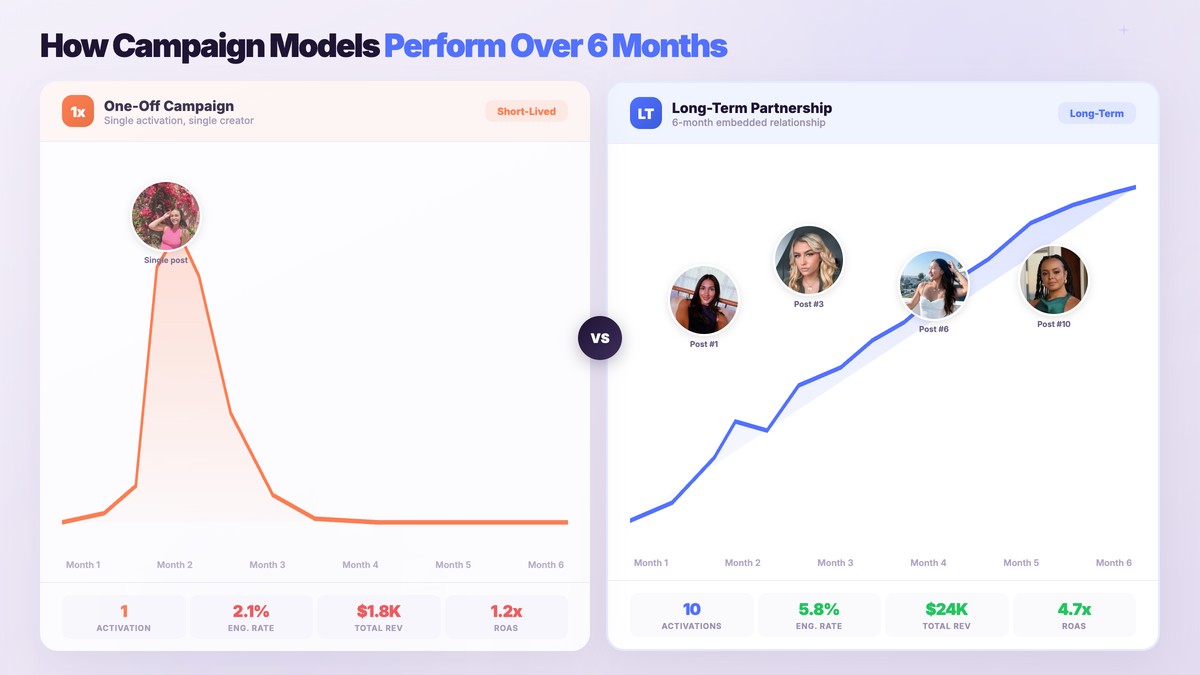
Long-term creator partnerships outperform one-off campaigns on conversion by a significant margin. Creators who have worked with a brand for 3+ months generate 35-50% higher conversion rates than first-time collaborators. The reason is straightforward: repeated exposure builds familiarity, and creators learn over time what messaging and content formats drive the best results for each specific brand.
From a revenue perspective, the economics compound. A creator’s first post for a brand generates baseline results. By the third or fourth collaboration, the creator has refined their approach based on audience response, developed authentic product knowledge, and built credibility with their audience on that specific brand. Each subsequent post builds on the trust established by previous ones.
Cost Efficiency
One-off campaigns carry hidden operational costs that inflate the true cost per collaboration. Each new creator relationship requires: discovery and vetting (2-4 hours per creator), outreach and negotiation (1-3 hours), onboarding and briefing (1-2 hours), product shipping and sampling, content review and approval cycles, and payment processing. These operational costs typically add $500-$1,500 per new creator relationship. For more on this topic, explore our AI-powered creator matching.
Long-term partnerships amortize these setup costs across multiple collaborations. After the initial onboarding, subsequent content production is faster, requires fewer revision rounds, and generates higher-quality output — effectively reducing cost per content piece by 25-40% over time. For more on this topic, explore our Creator Content Strategy guide.
Content Quality Trajectory
First-time collaborations produce content that’s technically competent but often lacks the authentic product knowledge that makes creator content genuinely persuasive. Audiences can sense when a creator is promoting something they recently received versus something they actually use and believe in. Long-term partnerships allow creators to develop genuine product expertise and authentic enthusiasm that translates into more persuasive content. For more on this topic, explore our State of Influencer Marketing 2026 report.
When Long-Term Partnerships Win
Long-term partnerships are the superior model in several common scenarios.
Always-On Brand Building
If your objective is sustained brand awareness and consideration — not just campaign-burst visibility — long-term partnerships are essential. Repeated creator endorsements over time create the kind of brand familiarity and trust that single exposures cannot. Think of it as the difference between seeing a billboard once and having a trusted friend recommend something repeatedly over months.
Affiliate and Performance Programs
Performance-based programs benefit enormously from partnership longevity. Creators learn what converts for your specific products, optimize their content accordingly, and build audience expectations around your brand. The performance data from month 1 to month 6 of an affiliate relationship typically shows 3-5x improvement as creators refine their approach. Cutting creators after a single campaign means perpetually operating at month-1 performance levels.
Complex or High-Consideration Products
Products that require education, demonstration, or trust-building (electronics, SaaS, financial services, health/wellness) benefit from creators who can speak from genuine long-term experience. A creator who has actually used your software for six months provides far more credible testimony than one who received a demo last week. This authentic expertise is impossible to fake and impossible to achieve through one-off campaigns.
Platforms like partnrUP help brands identify creators suited for long-term partnerships and manage ongoing relationships at scale — from initial matching through months of collaborative content production.
When One-Off Campaigns Make Sense
Despite the data favoring long-term partnerships, one-off campaigns remain the right choice in specific situations.
Product Launches and Seasonal Moments
When you need maximum reach in a concentrated window — a product launch, holiday campaign, or cultural moment — casting a wide net of one-off creators generates the burst visibility that long-term partnerships alone can’t match. The goal here is saturation: ensuring your target audience encounters your product from multiple creator sources in a short timeframe.
Testing and Creator Discovery
One-off campaigns serve as effective auditions for potential long-term partners. Run initial collaborations with 20-30 creators, evaluate performance, and invite the top 5-10 performers into ongoing partnerships. This test-and-graduate model combines the discovery benefits of one-off campaigns with the performance benefits of long-term relationships.
Trend-Driven and Reactive Content
When a cultural moment, trending topic, or competitor action creates a time-sensitive content opportunity, speed matters more than relationship depth. One-off engagements with creators who are already part of the conversation get content into market faster than activating long-term partners who may not be naturally connected to the trend.
Budget Constraints
Brands with limited budgets may get more strategic value from running quarterly one-off campaigns with diverse creators than committing their entire budget to 2-3 long-term partners. The tradeoff is lower per-creator performance but broader audience reach and more diverse content output.
Structuring Long-Term Partnerships for Maximum ROI
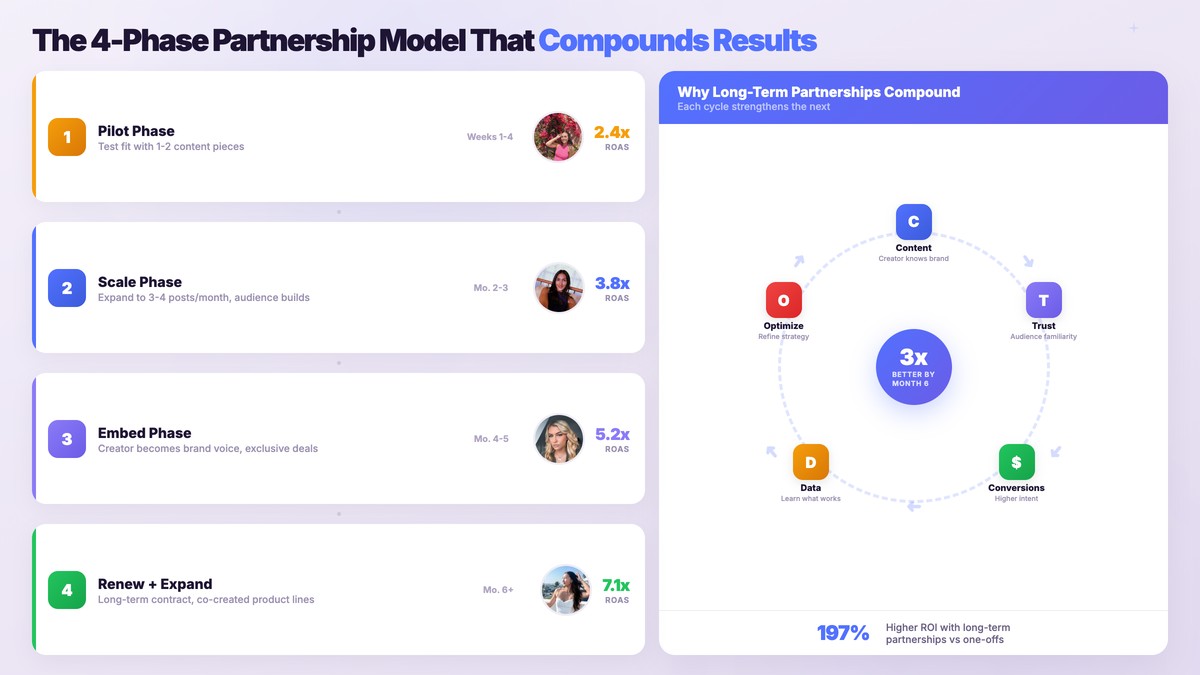
The structure of a long-term partnership determines whether it delivers compounding returns or becomes a stale, going-through-the-motions arrangement.
Partnership Tiers
Create formal partnership tiers that set expectations and rewards at each level. Tier 1 — Brand Ambassadors (3-5 creators): Exclusive, deeply integrated partnerships with highest compensation, co-creation opportunities, early product access, and brand event participation. Tier 2 — Preferred Partners (10-20 creators): Regular monthly collaborations with consistent compensation and priority access to new campaigns. Tier 3 — Active Affiliates (50-200 creators): Commission-based ongoing relationships with periodic product seeding and campaign invitations.
Content Cadence and Variety
Prevent content fatigue by varying what you ask long-term partners to create. Rotate between product reviews, lifestyle integrations, educational content, comparison posts, and behind-the-scenes access. A creator who produces the same type of sponsored post every month will see declining engagement. A creator who shares varied, authentic brand touchpoints maintains audience interest and trust.
Performance Reviews and Optimization
Schedule quarterly performance reviews with each long-term partner. Share analytics (what performed, what didn’t), discuss audience feedback, and collaborate on content strategy for the next quarter. This collaborative approach makes creators feel invested in the brand’s success and surfaces optimization opportunities that neither party would identify independently.
Ready to build long-term creator partnerships that compound in value over time? Book a demo with partnrUP to see how brands manage ongoing creator relationships at scale.
The Hybrid Approach
The most sophisticated influencer programs don’t choose between long-term partnerships and one-off campaigns — they use both strategically. Tools like partnrUP’s platform help brands automate this at scale.
The 70/30 Framework
Allocate approximately 70% of your influencer budget to long-term partnerships and 30% to one-off campaigns and testing. The 70% provides consistent, high-performing content and brand presence. The 30% funds product launch bursts, seasonal campaigns, creator discovery, and experimental content formats.
The Funnel Model
One-off campaigns at the top of the funnel generate broad awareness. Mid-funnel creator content (reviews, tutorials) comes from established partners who can speak authoritatively about your products. Bottom-funnel conversion content (affiliate posts, shoppable videos) comes from your highest-performing long-term affiliates. Each stage of the funnel uses the partnership model best suited to its objectives.
Graduating Creators
Build a systematic pipeline that discovers creators through one-off campaigns, evaluates their performance, and graduates top performers into long-term partnerships. This creates a self-renewing roster where new creators are constantly being tested and the best are retained — ensuring your program improves continuously over time.
Frequently Asked Questions
How long should a long-term creator partnership last?
Most effective partnerships run for 6-12 months minimum, with top partnerships continuing for years. Start with a 3-month trial period and extend based on performance. Avoid locking into 12-month commitments upfront — use the first quarter to validate fit before committing to longer terms.
How many long-term creator partners does a brand need?
Most brands maintain 5-20 long-term partners across tiers, depending on budget and campaign frequency. Too few (under 3) creates over-reliance on individual creators. Too many (over 30) dilutes relationship quality and management bandwidth. Scale gradually as your operational capacity grows.
What should I do if a long-term partner’s performance declines?
First, diagnose the cause. Audience fatigue? Content staleness? Creator motivation? Platform algorithm changes? Address the root cause before ending the partnership. Often, refreshing the content format, increasing compensation, or providing new products to feature re-energizes performance. If performance doesn’t recover after one quarter of intervention, transition the creator out gracefully.
How do I prevent creator exclusivity from limiting my reach?
Most long-term partnerships don’t require full exclusivity. Instead, use category exclusivity — the creator won’t promote direct competitors but remains free to work with non-competing brands. Full exclusivity commands premium compensation and is typically reserved for top-tier ambassador relationships.
Do long-term partnerships work for small brands with limited budgets?
Yes — and they may be even more important for small brands. Rather than spreading a limited budget across many one-off creators, invest in 3-5 aligned micro-creators who genuinely love your product. The depth of these relationships and the authenticity of their advocacy will outperform a larger volume of shallow, transactional content.
How do I measure the incremental value of long-term partnerships over time?
Track per-post performance metrics (engagement rate, conversion rate, revenue generated) across the lifetime of each partnership. Plot these metrics month-over-month to visualize the performance trajectory. Most brands see a clear upward curve that demonstrates the compounding value of sustained partnerships versus the flat performance line of one-off collaborations.
How do I transition from one-off campaigns to a long-term partnership model?
Start by identifying your top 5-10 performing creators from recent one-off campaigns. Reach out with a 3-month trial partnership offer at a rate 15-20% above their one-off fee. Set clear KPIs for the trial period and communicate your intent to build a longer relationship contingent on results. Most creators respond positively to the stability and predictability — expect 60-80% acceptance rates. After 90 days, evaluate performance against your KPIs and formalize the arrangement with a 6-12 month agreement for top performers. This phased approach reduces risk while systematically building your long-term roster. partnrUP’s platform makes this transition seamless with built-in partnership tiering and creator performance tracking.