85% of consumers research products online before purchasing — even when they buy in-store, making the digital shelf the most important real estate in modern retail. Yet most brands still manage their digital shelf presence as an afterthought, treating product pages as static catalogs rather than dynamic, content-rich experiences that drive discovery and conversion.
This guide is part of our Digital Shelf Optimization: How Creator Content Drives Product Discovery & Conversions — a comprehensive resource for brands looking to build effective creator partnerships at scale.
The digital shelf encompasses every digital touchpoint where consumers encounter your products: search engine results, retailer product pages, social commerce platforms, review sites, and marketplace listings. Unlike a physical shelf where placement is negotiated with retailers, the digital shelf is won through content quality, SEO optimization, and increasingly, creator-generated content that builds social proof and engagement signals.
This guide explains what the digital shelf is, why it matters more than ever in 2026, and how brands are using creator content to dominate their category’s digital presence. For a deeper dive into optimization tactics, see our complete guide to digital shelf optimization with creator content.
In this guide, you’ll learn:
- What the digital shelf is and how it has evolved
- Why digital shelf performance directly impacts revenue
- The key components of a strong digital shelf presence
- How creator content improves digital shelf rankings
- Measurement frameworks for digital shelf performance
- Common mistakes that hurt your digital shelf position
Table of Contents
- What Is the Digital Shelf?
- Why Digital Shelf Performance Matters
- Key Components of Digital Shelf Success
- How Creator Content Transforms Your Digital Shelf
- Measuring Digital Shelf Performance
- Frequently Asked Questions
What Is the Digital Shelf?
The digital shelf is the online equivalent of a retail store shelf — it’s where consumers find, evaluate, and ultimately decide to purchase your products in the digital world. But unlike a physical shelf that exists in a single location, the digital shelf spans multiple platforms, search engines, and marketplaces simultaneously.
The Components of the Digital Shelf
Your digital shelf includes: Search engine results — how your products appear when consumers Google product categories or specific items. Marketplace listings — your product pages on Amazon, Walmart.com, Target.com, and other retailers. Social commerce — how your products appear in TikTok Shop, Instagram Shopping, and other social platforms. Review ecosystems — ratings, reviews, and user-generated content across all platforms. Brand website — your own product pages, blog content, and commerce experience.
How the Digital Shelf Has Evolved
Five years ago, the digital shelf was primarily about optimizing product listings on Amazon and retailer websites — good titles, quality images, and keyword-rich descriptions. Today, the digital shelf is a dynamic, content-driven ecosystem where social proof, video content, creator endorsements, and real-time engagement signals determine visibility and conversion. For more on this topic, explore our Creator Content Strategy guide.
The shift is driven by two forces: consumer behavior (shoppers increasingly discover products through social media and creator content before visiting retailer sites) and algorithm changes (platforms increasingly prioritize content-rich listings with strong engagement signals over static, keyword-stuffed product pages). For more on this topic, explore our essential guide to creator commerce.
Why Digital Shelf Performance Matters
Digital shelf performance directly correlates with revenue — and the gap between well-optimized and poorly-optimized brands is widening. For more on this topic, explore our State of Influencer Marketing 2026 report.
Discoverability Drives Sales
Products that appear on the first page of search results (whether Google, Amazon, or retailer sites) capture 80-90% of clicks and sales. Page two and beyond is essentially invisible. Your digital shelf position determines whether consumers find your products at all — and with thousands of competitors in most categories, visibility is the fundamental challenge. For more on this topic, explore our shoppable video and social commerce guide.
Content Quality Drives Conversion
Once consumers find your products, the quality of your digital shelf content determines whether they buy. Products with video content on their listings see 80% higher conversion rates. Products with strong review profiles convert at 2-3x the rate of those with few or negative reviews. Enhanced content (A+ content on Amazon, rich media on retailer sites) increases conversion by 15-25% on average.
The Compound Effect
Digital shelf performance compounds over time. Products that rank well generate more sales, which generates more reviews, which improves rankings further, which generates more sales. This virtuous cycle means that early investment in digital shelf optimization creates durable competitive advantages that are difficult for competitors to overcome.
Key Components of Digital Shelf Success
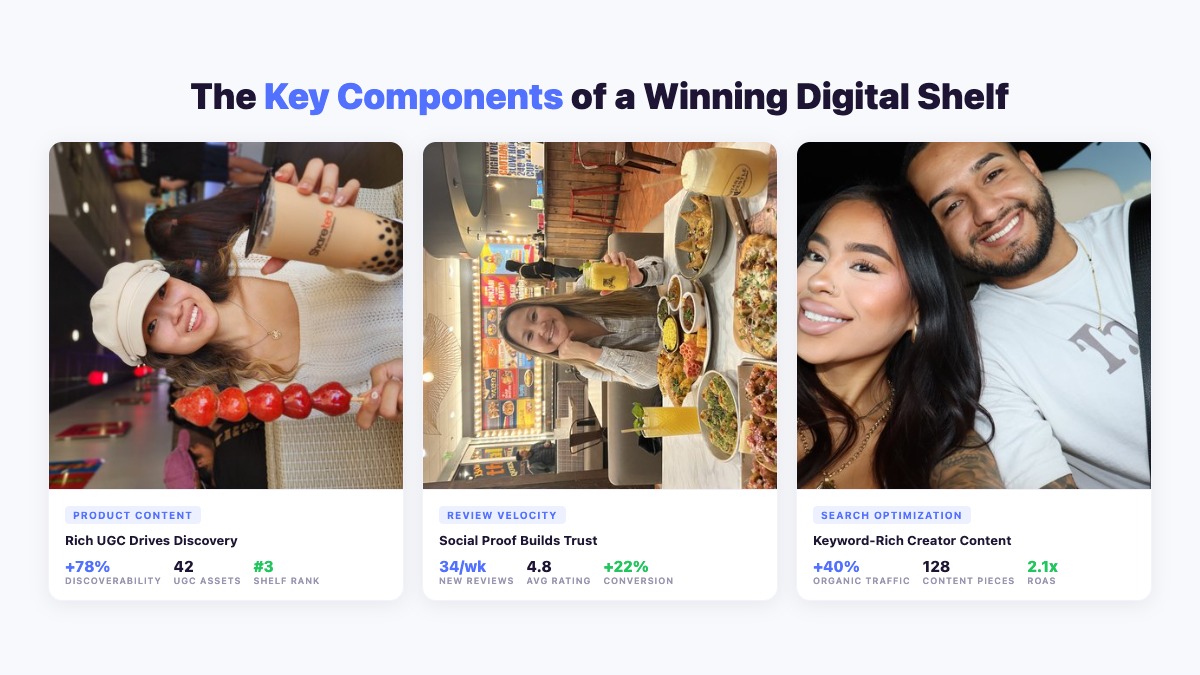
Winning the digital shelf requires excellence across multiple dimensions. No single factor is sufficient — brands need to optimize the complete package.
Product Content and Rich Media
Your product pages need more than basic titles and descriptions. Top-performing listings include: high-quality lifestyle and product images (6-8 images minimum), product demonstration videos, enhanced brand content with infographics and comparison charts, detailed specifications and feature breakdowns, and clear, benefit-focused copy that addresses buyer concerns.
Reviews and Social Proof
Reviews are the single most influential factor in digital shelf conversion. Products with 50+ reviews convert at 4.6x the rate of products with zero reviews. Focus on: generating authentic review volume through post-purchase email sequences and sampling programs, maintaining high average ratings through product quality and customer service, responding to negative reviews promptly and constructively, and incorporating UGC and creator testimonials alongside traditional reviews.
Search Optimization
Product listings must be optimized for platform-specific search algorithms. Amazon SEO, Google Shopping optimization, and retailer search all have different ranking factors. Common requirements include: keyword-rich titles that balance searchability with readability, backend keywords and search terms (platform-specific), category selection accuracy, and pricing competitiveness.
Content Freshness and Engagement Signals
Platforms increasingly factor in content freshness and engagement when determining product visibility. Products with recent reviews, new content additions, and active social media presence receive algorithmic preference over stale listings. This is where creator content becomes a powerful competitive weapon — a steady stream of creator-generated content about your products sends continuous freshness and engagement signals across the digital shelf.
How Creator Content Transforms Your Digital Shelf
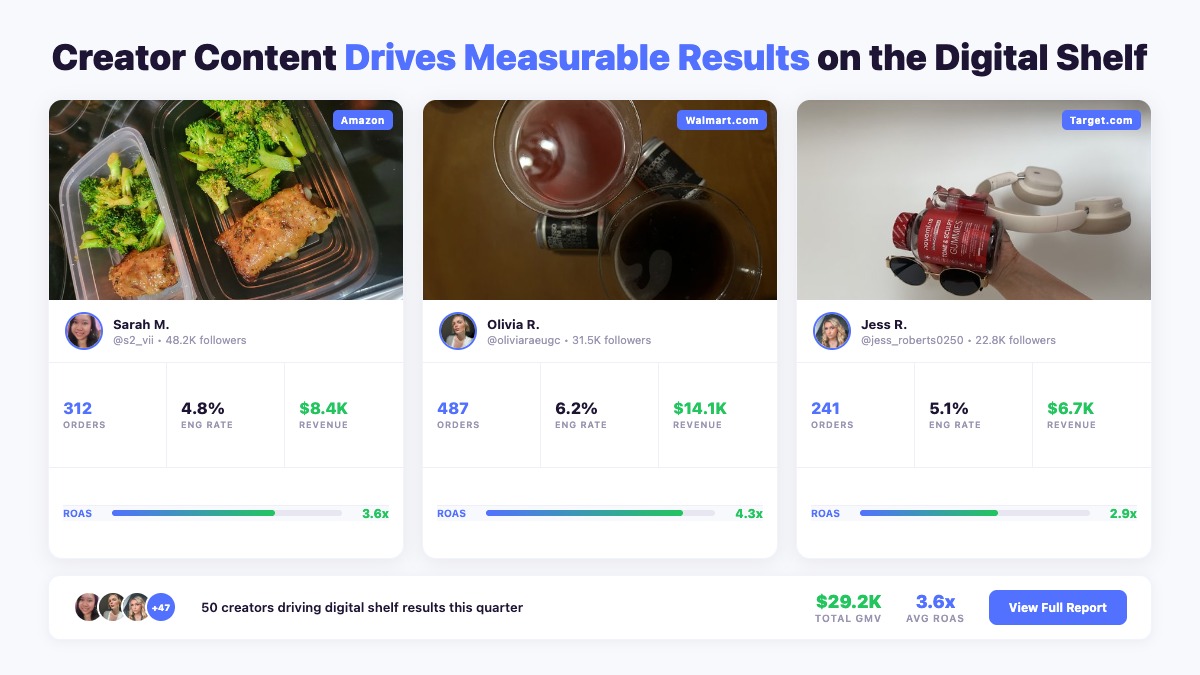
Creator content is becoming the most effective tool for improving digital shelf performance across every dimension. Here’s how brands are using creators to dominate their category’s digital presence.
Creator Reviews Drive Organic Rankings
When creators review your products on YouTube, blogs, or social media, they generate backlinks, branded search volume, and content that ranks in Google results. A single popular YouTube review can drive more branded search traffic than months of SEO optimization. This third-party content creates what SEO professionals call “topical authority” — signals that tell search engines your brand is relevant and trusted in its category.
Creator UGC for Product Pages
Creator-generated photos and videos can be repurposed (with proper licensing) for product page content on Amazon, retailer sites, and your own website. This content outperforms brand-produced imagery because it shows products in authentic, relatable contexts that consumers trust. Brands using creator UGC on product pages report 25-40% increases in conversion rate.
Social Proof Multiplication
Every creator post about your product generates comments, shares, and discussions that create layers of social proof visible across the digital shelf. When a consumer searches for your product and finds multiple creator endorsements across platforms, the cumulative effect dramatically increases purchase confidence.
Platforms like partnrUP help brands build systematic creator programs that generate the ongoing content, reviews, and social proof needed to win the digital shelf. Book a demo to see how leading brands are using creator partnerships to dominate their category’s digital presence.
Measuring Digital Shelf Performance
Effective digital shelf management requires ongoing measurement across multiple metrics and platforms.
Search Visibility Metrics
Track your share of search results for category keywords across Google, Amazon, and key retailer sites. Monitor: keyword rankings for priority terms, share of voice (your visibility versus competitors), organic traffic to product pages, and branded search volume trends. Tools like partnrUP’s platform help brands automate this at scale.
Content Performance Metrics
Measure how your product content performs relative to competitors: image and video view rates, enhanced content engagement (scroll depth, interaction rates), A/B test results on titles, images, and descriptions, and content compliance scores (are all listings fully optimized across all retailers?).
Conversion and Revenue Metrics
The ultimate digital shelf metric is conversion rate by channel. Track: product page conversion rates by retailer, add-to-cart rates, revenue per product page view, and the correlation between content improvements and conversion lift.
Review and Reputation Metrics
Monitor review health across all platforms: review volume growth rate, average rating trends, sentiment analysis on review text, response time to negative reviews, and competitive benchmarking on review metrics.
Frequently Asked Questions
What is the digital shelf in simple terms?
The digital shelf is every online place where consumers can find and buy your products — search engines, retail websites, marketplaces like Amazon, social commerce platforms, and your brand’s own website. It’s the digital equivalent of a physical store shelf, but it spans the entire internet.
How is the digital shelf different from e-commerce?
E-commerce refers to online transactions. The digital shelf is broader — it encompasses the entire online environment where consumers discover, research, compare, and evaluate products before purchasing. Digital shelf optimization includes everything that influences these pre-purchase touchpoints, not just the checkout experience.
Why does the digital shelf matter for brands that sell primarily in physical stores?
Because 85% of in-store purchases are influenced by online research. Even if your sales happen in physical retail, consumers are checking reviews, watching product videos, and comparing options online before walking into a store. A weak digital shelf presence means losing sales even in physical channels.
How does creator content help with the digital shelf?
Creator content improves the digital shelf in multiple ways: creator reviews generate backlinks and branded search traffic that improve SEO rankings; creator UGC provides authentic product imagery for listings; creator endorsements build social proof that increases conversion; and ongoing creator content sends freshness signals that algorithms reward with better visibility.
What’s the first thing a brand should do to improve its digital shelf?
Start with an audit. Catalog your product presence across all major platforms, assess content quality and completeness, benchmark review profiles against competitors, and identify the biggest gaps. The audit will reveal whether your primary challenge is discoverability (search/SEO), content quality (images/video/descriptions), or social proof (reviews/UGC).
How much does digital shelf optimization cost?
Costs vary widely based on the number of SKUs, platforms, and content requirements. A basic program (content optimization across 1-2 platforms for 20-50 SKUs) typically costs $2,000-$5,000/month. Comprehensive programs (multiple platforms, creator partnerships, ongoing content production, analytics) range from $10,000-$50,000/month depending on scale.
How long does it take to see results from digital shelf optimization?
Content and listing optimizations typically show conversion improvements within 2-4 weeks. Search ranking improvements take 1-3 months. Review profile building is a longer-term investment — plan for 3-6 months to build meaningful review volume. The compound effects of digital shelf optimization become most powerful after 6-12 months of consistent effort.