Considering GRIN for your influencer marketing program? This review covers everything you need to make an informed decision — features, pricing, G2 scores, real user feedback, and an honest take on who GRIN is (and isn’t) built for.
This guide is part of our Influencer Marketing Platform Comparison Guide: How to Choose the Right Tool in 2026 — a comprehensive resource for brands looking to build effective creator partnerships at scale.
Quick Verdict
GRIN is a capable creator management platform with strong e-commerce integrations and a well-developed feature set. It’s best suited for mid-to-large e-commerce brands with dedicated influencer marketing teams and budgets to match. If that’s you — GRIN is worth evaluating seriously.
If you’re a smaller brand, scaling team, or brand that prioritizes ease of use and support quality over feature depth, you’ll likely find GRIN unnecessarily complex and expensive. In that case, see our list of GRIN alternatives for better-fit options.
Who GRIN Is Built For
GRIN targets mid-market to enterprise e-commerce brands — think DTC companies doing $10M+ in revenue with active influencer programs. Its ideal customer has:
- A dedicated influencer marketing manager or team
- An existing Shopify, WooCommerce, or Magento store
- Budget for $20,000–$50,000+/year in platform fees
- Need for deep creator relationship management (contracts, gifting, payments) at scale
- Tolerance for a longer onboarding and learning curve
If your brand matches this profile, GRIN is genuinely competitive. If you’re outside these parameters, the complexity-to-value ratio gets unfavorable fast.
GRIN Onboarding Experience
GRIN’s onboarding process is one of the most discussed topics in G2 reviews — and opinions are split. Enterprise brands with dedicated project managers report smooth transitions (6-8 weeks to full adoption). Smaller teams without prior platform experience report frustration with the learning curve and timeline.
Timeline expectations: Plan for 4-8 weeks from contract signing to running your first campaign. Week 1-2 covers account setup, integration configuration (Shopify, WooCommerce, email), and team training. Weeks 3-4 involve importing your existing creator contacts, setting up workflows, and building your first campaign brief. Weeks 5-8 are optimization — learning the reporting dashboard, refining your discovery filters, and establishing repeatable processes.
Training requirements: GRIN assigns a customer success manager for onboarding, but the depth of support varies by your contract tier. Higher-paying customers get more hands-on training. Expect 3-5 training sessions of 45-60 minutes each. The content library and payment features have the steepest learning curves — most teams report needing 2-3 campaigns before these workflows feel natural.
Migration from other tools: If you’re switching from another platform (Aspire, CreatorIQ, or spreadsheets), expect a transition period where you’re running both systems in parallel. GRIN can import creator lists via CSV, but campaign history, conversation threads, and performance benchmarks don’t transfer. You’re essentially starting fresh on institutional knowledge — which means your first 2-3 months of GRIN data won’t have historical context for comparison.
GRIN Features Breakdown
Creator Discovery
GRIN’s creator discovery uses a database approach — brands search by category, follower range, engagement rate, and platform. The database is large (tens of millions of profiles) but discovery is largely manual and filter-based rather than AI-powered matching.
Strength: Large database, decent filtering options
Limitation: No AI matching to surface unexpectedly great fits; search quality depends heavily on how well you filter
Creator Relationship Management (CRM)
This is where GRIN genuinely shines. The platform’s CRM capabilities — managing outreach, contracts, brief delivery, content approvals, and payments — are comprehensive. Teams that run high-volume creator programs benefit from having all these workflows in one place. For more on this topic, explore our platform comparison for 2026.
Strength: End-to-end creator relationship management, strong contract and payment workflows
Limitation: The breadth of features adds complexity; simpler programs don’t need most of it
E-Commerce Integrations
GRIN’s Shopify and WooCommerce integrations are among the strongest in the category. Brands can connect their store to track sales generated by creators, automate product gifting, and see creator-attributed revenue in dashboards.
Strength: Deep e-commerce integration, solid sales attribution for connected stores
Limitation: Less valuable if you’re not running an e-commerce store or if your stack is more complex than standard Shopify
Reporting & Analytics
GRIN offers solid campaign reporting — reach, impressions, engagement, estimated media value (EMV), and sales attribution for connected stores. The dashboards are functional but not the most intuitive in the market.
Strength: Good data depth for connected campaigns
Limitation: Report building can require significant customization; out-of-box dashboards may not match your KPI structure
Content Management
GRIN includes content rights management tools — tracking what content was created, whether you have rights to repurpose it, and where approved content is being used. For brands that run UGC repurposing at scale, this is genuinely useful.
Content library management: GRIN’s content library automatically pulls and organizes all creator content from campaigns — photos, videos, Stories, Reels, and TikToks. You can filter by performance metrics, content type, and usage rights status. The library is genuinely useful for repurposing content across paid ads, email, and product pages. However, the search functionality is basic — you can’t search by visual content (e.g., “find all outdoor photos”) like some AI-native tools offer.
Payment processing: GRIN handles creator payments directly through the platform, supporting flat fees, commission-based payouts, and product gifting tracking. It integrates with PayPal and direct deposit. The automation here saves real time — once payment terms are set in the campaign, payouts trigger automatically on content approval. The limitation: international payments to creators outside the US can be slow (7-14 business days) and incur additional fees that aren’t always transparent upfront.
Reporting and analytics: GRIN provides campaign-level and creator-level reporting with metrics including EMV (earned media value), engagement rates, reach, impressions, and — if e-commerce integrations are configured — attributed revenue. The dashboards are comprehensive but not always intuitive to navigate. Custom report building requires learning their filtering system, which has a moderate learning curve. Real-time reporting isn’t truly real-time — expect 24-48 hour delays on some metrics, particularly revenue attribution.
GRIN Pricing
GRIN does not publish pricing publicly — it requires a sales call and demo. Based on market reporting and user feedback on G2, expect:
- Entry-level plans: ~$20,000/year for limited features
- Standard plans: $25,000–$45,000/year for most mid-market use cases
- Enterprise: $50,000+/year with custom terms
There is no self-serve signup or free trial. All contracts go through a sales process, which adds friction for brands that want to evaluate quickly.
GRIN G2 & Capterra Scores
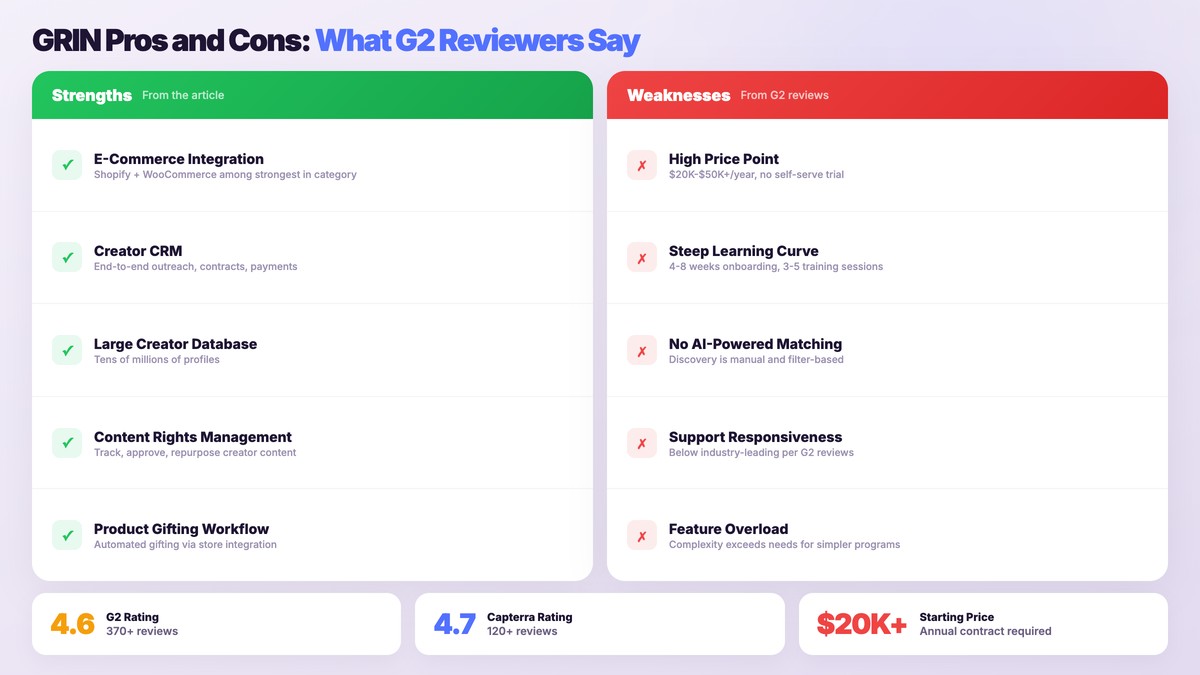
As of mid-2026:
- G2: 4.6/5 (370+ reviews)
- Capterra: 4.7/5 (120+ reviews)
GRIN scores well overall. Where it scores lower: support responsiveness and ease of setup — both areas where partnrUP has G2-verified advantages.
GRIN Pros & Cons
Pros
- Comprehensive creator management features
- Strong e-commerce integration (Shopify, WooCommerce)
- Large creator database
- Good contract and payment workflows
- Solid content rights management
Cons
- High price point — not accessible for smaller brands
- Steep learning curve; complex to onboard new team members
- No AI-powered matching — discovery is manual and filter-based
- Support responsiveness below industry-leading standards (per G2)
- No self-serve trial — requires sales process
- Feature overload for brands running simpler programs
Is There a Better Option?
For brands that don’t match the “large e-commerce brand with dedicated influencer team” profile, yes — there are meaningfully better options. The two most common concerns brands raise when they look for alternatives to GRIN are support quality and platform complexity, which is exactly what platforms like partnrUP address.
Compare how GRIN stacks up in direct platform comparisons:
- GRIN vs Upfluence — two legacy platforms compared
- GRIN vs Aspire — creator relationship management focus
The honest assessment: GRIN is a strong platform that works well for a specific profile — mid-to-large DTC brands with 100+ creator relationships, a dedicated team member for platform management, and annual budgets exceeding $20K for tooling alone. If that’s you, GRIN delivers.
But the majority of brands don’t fit that profile. Here’s where alternatives clearly win:
- Teams under 5 people managing creator programs: partnrUP and SARAL offer 80% of GRIN’s functionality at 30% of the cost and complexity. The time-to-value is days, not weeks.
- Brands prioritizing affiliate commerce: GRIN’s affiliate tracking requires workarounds. Platforms like partnrUP and Impact.com built affiliate-first, meaning tracking, commission management, and creator recruitment are native — not bolted on.
- Companies that need AI-powered discovery: GRIN’s discovery relies on its opt-in database. If you want the platform to proactively surface creators you’d never find manually — based on audience purchase behavior, content performance patterns, and brand affinity signals — AI-native platforms are a generation ahead.
- Brands scaling TikTok Shop: GRIN’s TikTok integration covers content tracking but doesn’t support Shop-specific features (affiliate marketplace, live shopping, commission tiers). Newer platforms purpose-built for social commerce fill this gap.
GRIN’s Competitive Position in 2026
GRIN occupies a specific market position: the established mid-market platform for DTC brands that have outgrown spreadsheets but don’t need enterprise-grade tools like CreatorIQ. It does this job adequately. The problem is that the mid-market has gotten dramatically more competitive since 2023.
Three years ago, brands choosing between GRIN and spreadsheets had an easy decision. Today, those same brands can choose between GRIN at $25K+/year and newer platforms offering equivalent (or superior) features at a fraction of the price with faster onboarding. The value proposition that justified GRIN’s pricing in 2022 has eroded as competitors caught up on features while maintaining lower price points.
GRIN’s response has been to add features — AI-powered search, expanded analytics, TikTok integrations. But adding features to an existing architecture isn’t the same as building AI-native from the ground up. The search improvements are incremental. The analytics additions are functional but not transformative. Brands evaluating GRIN in 2026 should test these newer features against purpose-built alternatives and decide whether GRIN’s brand recognition and stability justify the premium over hungrier, more innovative competitors.
The bottom line: GRIN remains a safe, defensible choice for brands already on the platform. For new buyers, the calculus has shifted. Run a 30-day parallel evaluation with at least two alternatives before signing an annual contract. The market has moved too fast to default to name recognition alone.
partnrUP vs. GRIN: A Direct Comparison
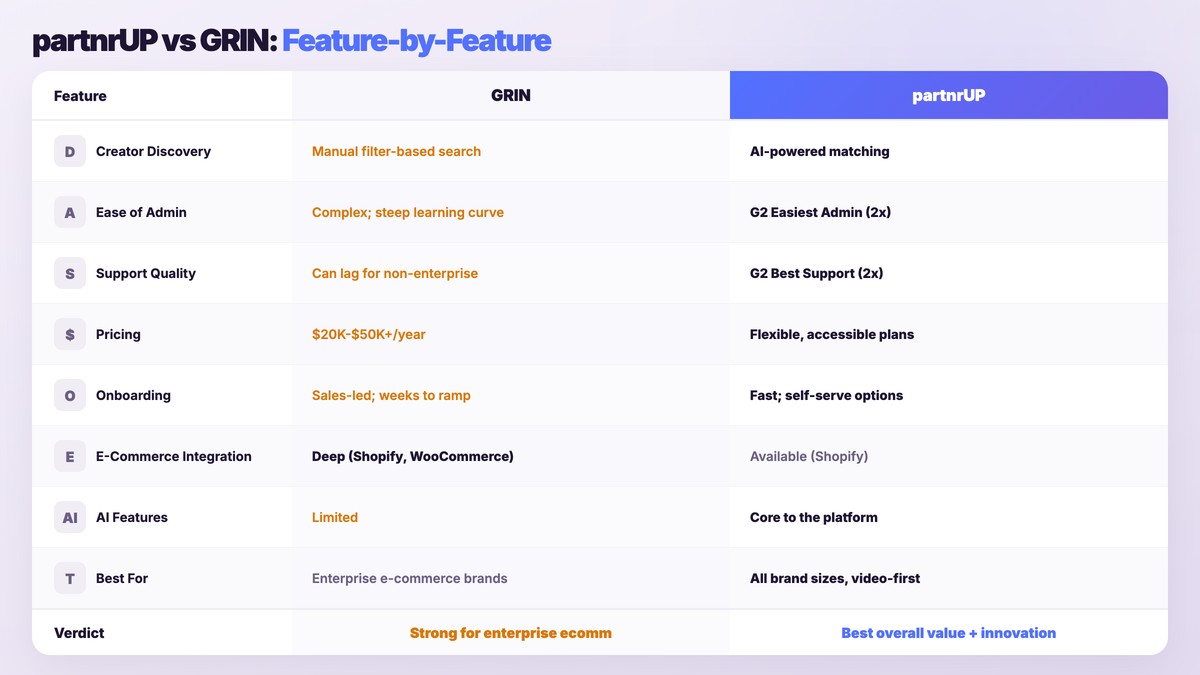
| Feature | GRIN | partnrUP |
|---|---|---|
| Creator Discovery | Manual filter-based search | AI-powered matching |
| Ease of Admin | Complex; steep learning curve | G2 Easiest Admin (2x) |
| Support Quality | Good; can lag for non-enterprise | G2 Best Support (2x) |
| Pricing | $20K–$50K+/year | Flexible, accessible plans |
| Onboarding | Sales-led; weeks to ramp | Fast; self-serve options |
| E-Commerce Integration | Deep (Shopify, WooCommerce) | Available (Shopify) |
| AI Features | Limited | Core to the platform |
| Best For | Enterprise e-commerce brands | All brand sizes, video-first |
If your priority is getting up and running quickly, having responsive support, and using AI to find the right creators instead of manually filtering databases, partnrUP is the stronger choice. Its AI-powered platform surfaces creator matches that go far beyond what manual search delivers. Tools like partnrUP’s platform help brands automate this at scale.
Also worth comparing: Upfluence review and Traackr review for additional platform context. Book a demo to see how leading brands are implementing this.
Frequently Asked Questions
How much does GRIN cost in 2026?
GRIN doesn’t publish pricing, but based on market feedback, plans typically range from $20,000 to $50,000+ per year depending on usage and features. All pricing is determined through a sales process.
Is GRIN good for small businesses?
Generally not. GRIN’s pricing and complexity are designed for mid-market to enterprise e-commerce brands with dedicated influencer marketing teams. Small businesses and startups typically get better value from more accessible platforms like partnrUP or Social Cat.
Does GRIN have a free trial?
No. GRIN requires going through a sales demo and proposal process. There is no self-serve free trial or public pricing.
What integrations does GRIN support?
GRIN integrates with Shopify, WooCommerce, Magento, Salesforce, HubSpot, PayPal, and various social platforms. Its e-commerce integrations are among the strongest in the category.
What are the main complaints about GRIN?
The most common G2 complaints about GRIN include: high price point for mid-market brands, complex interface that requires significant training, support that can be slow for non-enterprise tiers, and the lack of AI-powered discovery.
How does GRIN compare to partnrUP?
GRIN has deeper e-commerce integrations and more feature breadth for enterprise programs. partnrUP wins on ease of use, support quality (G2-verified), AI-powered creator matching, and accessible pricing. The right choice depends on your brand’s scale and priorities.
What is GRIN’s G2 rating?
As of mid-2026, GRIN holds a 4.6/5 on G2 based on 370+ reviews. It scores well on overall satisfaction and features, but below average on ease of setup and support responsiveness compared to top-rated alternatives.
If you’re evaluating GRIN and want to compare the experience of a platform built for ease of use and exceptional support, partnrUP is ready when you are. No 6-week sales process — just a straightforward path to your first campaign.