The creator economy surpassed $250 billion in total market value in 2025, and by every major industry forecast, 2026 is the year it reshapes how brands allocate marketing budgets entirely. Yet most marketing leaders still treat creator partnerships as a line item — not a growth channel. The gap between brands that understand the creator economy in 2026 and those still running one-off sponsorships is widening fast, and the data makes it impossible to ignore.
This guide is part of our The State of Influencer Marketing in 2026: Trends, Data & Industry Insights — a comprehensive pillar covering the macro trends, data, and strategic shifts redefining how brands work with creators.
The creator economy isn’t a niche anymore. It’s the infrastructure layer connecting brands to audiences through people those audiences actually trust. But the landscape has shifted dramatically — from who’s creating, to how they’re monetized, to which platforms matter most. This guide distills the numbers and trends that separate informed strategy from guesswork.
In this guide, you’ll learn:
- The current size, growth trajectory, and market composition of the creator economy in 2026
- Which monetization models are driving the most revenue for creators and brands alike
- How platform shifts — from TikTok Shop to YouTube’s creator fund overhaul — are redistributing power
- Why micro- and nano-creators are outperforming celebrity influencers on every performance metric
- What operational infrastructure brands need to capitalize on these trends at scale
Table of Contents
- Creator Economy Size and Growth in 2026
- Monetization Models That Are Actually Working
- The Platform Landscape: Where Creators and Brands Are Winning
- Micro and Nano Creators: The Performance Data
- Brand Spending Trends and Budget Allocation
- Operational Infrastructure: From Manual to AI-Powered
- Conclusion
- FAQ
Creator Economy Size and Growth in 2026
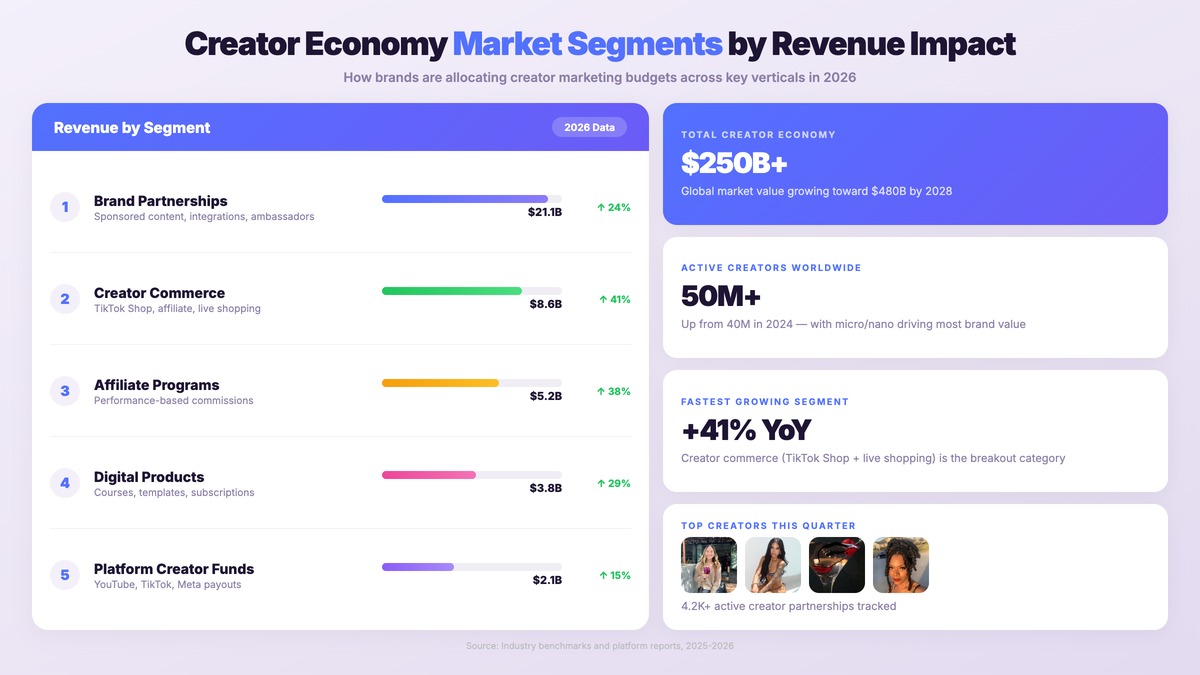
The numbers tell a story of acceleration, not just growth. The global creator economy was valued at approximately $250 billion in 2025, and industry analysts project it will exceed $480 billion by 2028. That trajectory isn’t speculative — it’s being driven by structural shifts in advertising spend, consumer behavior, and platform economics.
Market Size Breakdown
The creator economy in 2026 is no longer synonymous with “influencer marketing.” It encompasses multiple revenue streams that compound: brand partnerships, affiliate commissions, digital product sales, subscription content, live commerce, and platform creator funds. The complete ROI measurement framework for these channels has become essential for any serious marketing team.
Key data points shaping the market:
- 50+ million people worldwide now identify as content creators, up from 40 million in 2024
- Influencer marketing spend alone is projected to reach $32.55 billion globally in 2026
- Creator-driven commerce (affiliate + social commerce + live shopping) now represents a growing share of total e-commerce revenue
- The average brand-creator partnership duration has increased by 40% since 2024, signaling a shift from transactional to relational models
Growth Drivers to Watch
Three forces are accelerating the creator economy beyond its historical trajectory:
1. Commerce integration. Every major platform now has native shopping features. TikTok Shop, Instagram Checkout, YouTube Shopping — creators aren’t just driving awareness anymore. They’re closing sales. Brands tracking creator affiliate links with proper attribution are seeing direct revenue impact that justifies larger allocations.
2. AI-powered operations. The operational bottleneck that limited creator programs to 10-20 partners has been broken. AI is enabling brands to scale creator programs from dozens to hundreds of active partnerships without proportionally scaling headcount.
3. Performance measurement maturity. Brands can now track creator impact from first impression through final purchase. Advanced attribution models have moved creator marketing from “brand awareness” budgets into performance marketing budgets — where the money is bigger and the accountability is higher.
Monetization Models That Are Actually Working
The creator economy in 2026 has moved decisively beyond flat-fee sponsorships. The most successful brand-creator partnerships now use performance-aligned compensation that rewards creators for driving measurable business outcomes.
Affiliate and Performance-Based Models
Performance-based influencer marketing has emerged as the fastest-growing compensation model. Instead of paying a flat fee for a post, brands pay creators based on conversions, clicks, or revenue generated. This aligns incentives: creators earn more when they drive results, and brands pay for outcomes rather than impressions.
The data on affiliate creator programs is compelling:
- Affiliate-driven creator partnerships deliver measurably higher ROI than flat-fee sponsorships across most verticals
- Creators with established affiliate relationships produce more authentic content because they have skin in the game — they earn when their audience actually buys
- Brands running well-structured affiliate programs report that affiliate creators generate a significant share of new customer acquisition
Hybrid Compensation Structures
The smartest brands aren’t choosing between flat fees and affiliate. They’re using hybrid models: a base fee that respects the creator’s time and production costs, plus performance bonuses that reward outcomes. This model has grown substantially among enterprise brands since 2024.
Why hybrids win: They attract higher-quality creators (who won’t work for affiliate-only deals) while maintaining performance accountability. The base fee covers content creation costs; the performance component funds scaling. Platforms like partnrUP automate the tracking and payout complexity that makes hybrid models operationally viable.
Creator-Led Commerce
Beyond brand partnerships, creators are building their own commerce operations. Creator commerce — where creators curate, white-label, or co-develop products — represents one of the fastest-growing segments. Brands that position themselves as the supply chain behind creator-led storefronts are accessing audiences they could never reach through traditional advertising.
The Platform Landscape: Where Creators and Brands Are Winning
The platform landscape in 2026 looks fundamentally different from even two years ago. The winners aren’t necessarily the biggest platforms — they’re the ones that have built the best creator monetization infrastructure.
TikTok: The Commerce Engine
TikTok Shop has become a primary commerce channel for creator-brand partnerships. The platform’s native checkout, combined with its algorithm’s ability to surface product content to high-intent audiences, has made it the go-to for brands pursuing creator-driven commerce. Key trends:
- Live shopping on TikTok has grown significantly year-over-year, with top creator-hosted lives regularly generating substantial revenue per session
- Shoppable video conversion rates on TikTok consistently outperform traditional social commerce benchmarks — brands applying shoppable video best practices see meaningfully higher returns
- TikTok’s creator marketplace has expanded to include performance data that helps brands identify creators based on actual sales history, not just follower counts
YouTube: Long-Form Value
YouTube remains the platform where creator content has the longest shelf life. A well-produced brand integration video continues generating views and conversions for months or years — something no Instagram Story or TikTok post can match. YouTube’s shopping features, including product shelves and affiliate links in descriptions, have matured substantially.
Instagram: The Middle Ground
Instagram continues to serve as the brand partnership hub — the platform where creator-brand deals are most commonly executed. But its role is evolving. Reels has captured short-form attention, while Broadcast Channels have given creators a direct communication line to their most engaged followers. Brands that treat Instagram as part of a multi-platform strategy (rather than their entire creator program) are seeing better results.
Micro and Nano Creators: The Performance Data
The most significant trend in the creator economy in 2026 isn’t about platforms or monetization — it’s about who’s actually driving results. The data overwhelmingly favors smaller creators.
Engagement Rate Advantages
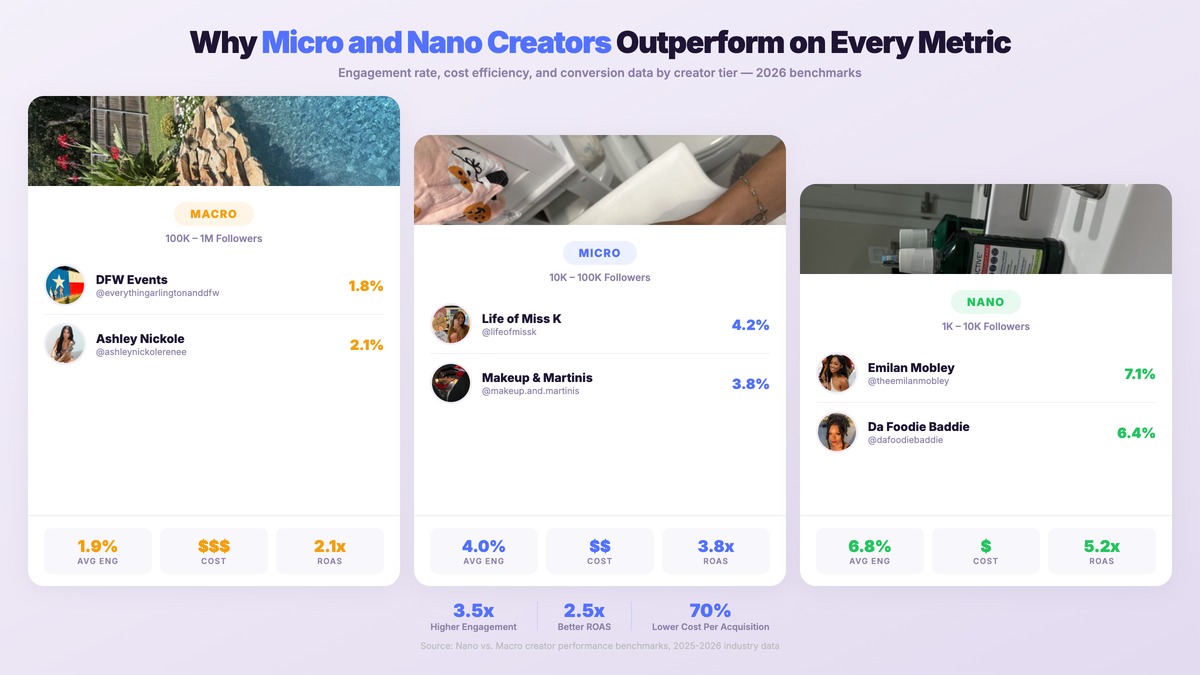
Nano-creators (1K-10K followers) and micro-creators (10K-100K followers) consistently outperform macro and mega-creators on engagement metrics. Industry benchmarks show:
- Nano-creators average engagement rates significantly higher than mega-influencers across platforms
- Micro-creators in niche verticals (fitness, cooking, sustainable fashion, pet care) often exceed general engagement benchmarks because their audiences are hyper-specific
- Comment quality — not just quantity — is measurably higher for smaller creators, indicating genuine audience interest rather than passive scrolling
Cost Efficiency and ROI
The ROI calculation for creator marketing increasingly favors volume over celebrity. Instead of spending a large budget on one macro-influencer post, brands are distributing that same budget across 20-50 nano and micro-creators and seeing substantially better results.
This is where operational infrastructure becomes critical. Managing 50 creator relationships manually is unsustainable. AI-powered creator matching tools allow brands to identify, vet, and activate the right micro-creators at scale — turning what used to be a research project into an automated workflow.
Trust and Authenticity Premium
Consumer trust in creator recommendations continues to diverge based on perceived authenticity. Audiences know when a mega-influencer is reading a script, and they respond accordingly. Micro-creators feel like peers — their product recommendations carry the weight of a friend’s suggestion. For brands in categories where trust is paramount (health, finance, childcare), this authenticity premium translates directly to conversion lift.
Brand Spending Trends and Budget Allocation
The most telling indicator of the creator economy’s maturity is where brands are moving budget. Not experimental dollars — core marketing budget.
Budget Migration
A majority of marketing leaders plan to increase creator marketing budgets in 2026. More importantly, creator spend is increasingly coming from performance marketing budgets rather than brand awareness — a signal that leaders view creator content as a revenue-generating channel, not a vanity play.
The KPIs brands are tracking in 2026 reflect this shift. Impressions and reach are table stakes. The metrics that matter now are ROAS, cost per acquisition, customer lifetime value from creator-acquired customers, and attributed revenue.
Enterprise Adoption Acceleration
Enterprise brands (those spending over $500K annually on creator marketing) represent the fastest-growing segment. These organizations are building dedicated creator marketing functions with headcount, technology stacks, and P&L ownership. They’re not experimenting — they’re operationalizing.
What’s driving enterprise adoption:
- Attribution technology maturity — enterprises can now prove creator impact to the CFO with the same rigor as paid media
- Platform consolidation — tools like partnrUP replace 3-5 point solutions (discovery, outreach, contracts, tracking, payments) with a single platform
- Content ROI — creator content outperforms brand-produced content on engagement and conversion across social channels, and brands are using content repurposing strategies to multiply the value of every creator deliverable
Vertical Variance
Creator economy investment varies significantly by industry. Beauty, fashion, and food remain the highest spenders in absolute terms, but the fastest growth is in B2B, financial services, and healthcare — verticals that historically avoided creator partnerships but now see niche micro-creators as their most efficient audience access channel.
Operational Infrastructure: From Manual to AI-Powered
The bottleneck in the creator economy has never been demand. It’s been operations. Brands know creator marketing works. They can’t scale it because the manual processes — discovery, vetting, outreach, negotiation, contracts, content approval, tracking, payments, reporting — collapse at scale.
The AI Operations Layer
AI-powered creator matching has transformed the discovery and activation phase. Instead of scrolling through Instagram or relying on outdated databases, brands can now define their ideal creator profile and let AI surface matches based on audience demographics, content style, brand affinity, and predicted performance.
But discovery is just the start. The full operational stack includes:
- Automated outreach and negotiation — templates personalized by AI based on creator history and brand fit
- Contract automation — standardized terms with dynamic compensation structures (base + performance)
- Content approval workflows — collaborative review with version tracking and compliance checks
- Real-time performance tracking — attribution and tracking tools that connect creator content to business outcomes
- Automated payments — affiliate commissions calculated and disbursed without manual reconciliation
Why Infrastructure Determines Winners
The brands winning in the creator economy aren’t the ones with the biggest budgets. They’re the ones with the best operational infrastructure. A brand with a $100K creator budget and an AI-powered platform will consistently outperform a brand with a $500K budget managed through spreadsheets and email chains.
This is the thesis behind platforms like partnrUP: reduce the operational cost per creator relationship so brands can scale from 10 partnerships to 100+ without adding headcount. AI handles the operational complexity — matching, tracking, attribution, payments — so marketing teams can focus on strategy and creative direction.
The Build vs. Buy Decision
For brands evaluating their creator economy infrastructure, the build-vs-buy decision has shifted decisively toward buy. The influencer marketing platform comparison for 2026 shows that purpose-built platforms now cover the full workflow at a fraction of the cost of cobbling together point solutions. And as the creative brief process becomes more standardized, the technology’s ability to templatize and streamline grows even more impactful.
Conclusion
The creator economy in 2026 is no longer an emerging trend — it’s a mature, data-driven marketing channel that rewards brands with the right strategy and infrastructure. The market is growing toward $480 billion, monetization models have shifted from flat fees to performance-aligned structures, and the platforms are building the commerce rails that turn creator content into direct revenue.
The brands that will win aren’t the ones spending the most. They’re the ones that have built operational systems to manage creator relationships at scale, measure impact with precision, and compound the value of every partnership over time.
If your team is ready to move from ad-hoc creator campaigns to a scalable, AI-powered program, explore what partnrUP’s platform can do — or book a demo to see how brands are scaling to 100+ creator partnerships without adding headcount.
Frequently Asked Questions
How big is the creator economy in 2026?
The global creator economy is projected to be worth over $250 billion as of 2025, growing toward an estimated $480 billion by 2028. This includes brand partnerships, affiliate commissions, creator commerce, platform creator funds, and digital product sales. Influencer marketing spend alone is forecast to reach $32.55 billion globally in 2026.
What is the fastest-growing monetization model in the creator economy?
Performance-based and hybrid compensation models are growing fastest. Rather than paying flat fees for content, brands are using affiliate structures where creators earn based on conversions and revenue they drive. Hybrid models — combining a base fee with performance bonuses — have become the preferred approach for brands that want high-quality content with built-in accountability.
Why are micro and nano creators outperforming larger influencers?
Smaller creators consistently deliver higher engagement rates, better comment quality, and stronger conversion metrics because their audiences perceive them as authentic and relatable. Their recommendations carry the weight of peer advice rather than celebrity endorsement. For brands, this translates to higher ROI per dollar spent — especially when they can activate 20-50 micro-creators for the cost of one macro-influencer.
Which social platforms are most important for the creator economy in 2026?
TikTok leads in creator-driven commerce with its native shopping features and algorithm-driven product discovery. YouTube remains dominant for long-form content with the longest shelf life and strongest SEO value. Instagram continues as the primary platform for brand partnership deals. The most successful brands run multi-platform strategies rather than concentrating on a single channel.
How are brands measuring creator marketing ROI in 2026?
Leading brands have moved beyond vanity metrics (impressions, reach) to track ROAS, cost per acquisition, attributed revenue, and customer lifetime value from creator-acquired customers. This is possible because attribution technology has matured — multi-touch models, UTM tracking, affiliate links, and platform pixel data now connect creator content to business outcomes with the same rigor as paid media measurement.
What operational challenges do brands face when scaling creator programs?
The biggest challenge is managing the complexity of multiple simultaneous creator relationships — discovery, vetting, outreach, negotiation, contracts, content approval, tracking, and payments. These processes break down at scale when managed manually. AI-powered platforms solve this by automating discovery and matching, standardizing contracts, tracking performance in real time, and automating payouts.
How can brands get started with a creator economy strategy in 2026?
Start by defining clear performance goals — not just awareness metrics but revenue targets and CPA thresholds. Then invest in operational infrastructure (a creator management platform) before hiring more headcount. Begin with 10-20 micro-creators in your core vertical using a hybrid compensation model. Measure relentlessly for 90 days, then scale what works. The key insight: the brands winning in 2026 invested in systems first and talent second.