Performance-based influencer partnerships now account for 43% of all influencer marketing spend, up from just 18% three years ago. The shift is unmistakable: brands are moving from paying for posts to paying for results, and affiliate influencer marketing is the model driving that transformation.
This guide is part of our Affiliate Influencer Marketing: The Complete Brand Playbook for 2026 — a comprehensive resource for brands looking to build effective creator partnerships at scale.
Affiliate influencer marketing merges the trust and authenticity of creator partnerships with the accountability of performance marketing. Instead of paying a flat fee for content and hoping it drives sales, brands compensate creators based on measurable outcomes — clicks, conversions, and revenue. The model aligns incentives for both parties and creates programs that scale with success rather than budgets.
Whether you’re building your first affiliate creator program or optimizing an existing one, understanding the mechanics, models, and operational requirements is essential. This guide walks through everything brands need to know about how affiliate influencer marketing actually works in practice. For the full strategic playbook, see our complete affiliate influencer marketing guide.
In this guide, you’ll learn:
- How the affiliate influencer model works from end to end
- The major commission and compensation structures
- Tracking and attribution methods for affiliate programs
- How to recruit and onboard affiliate creators
- Scaling strategies for high-performing programs
- Common pitfalls and how to avoid them
Table of Contents
- How Affiliate Influencer Marketing Works
- Commission and Compensation Models
- Tracking and Attribution Methods
- Recruiting and Onboarding Affiliate Creators
- Scaling Your Affiliate Creator Program
- Frequently Asked Questions
How Affiliate Influencer Marketing Works
At its core, affiliate influencer marketing is a performance partnership between a brand and a content creator. The creator promotes the brand’s products to their audience using trackable links or codes. When their audience makes a purchase through those links, the creator earns a commission. The brand pays only for actual results.
The End-to-End Flow
Here’s how a typical affiliate influencer campaign works from start to finish:
Step 1: Program setup. The brand establishes commission rates, tracking infrastructure (affiliate links, promo codes, or platform-native tools), and program terms. This includes cookie duration (how long after a click the creator gets credit for a purchase), payment schedules, and content guidelines.
Step 2: Creator recruitment. The brand identifies and recruits creators whose audiences align with their target customers. This can happen through direct outreach, affiliate networks, creator marketplaces, or platforms like partnrUP that use data-driven matching to identify high-potential affiliate partners.
Step 3: Content creation. Creators produce authentic content featuring the brand’s products — reviews, tutorials, hauls, comparisons, or integration into their regular content format. Each piece includes the creator’s unique affiliate link or promo code.
Step 4: Audience engagement. The creator’s audience discovers the product through the content, engages with the creator’s recommendation, and clicks through to the brand’s site or shop using the tracked link. For more on this topic, explore our guide to building a creator affiliate program.
Step 5: Conversion and attribution. When a viewer purchases, the tracking system attributes the sale to the specific creator. The brand receives the revenue, and the creator’s commission is recorded. For more on this topic, explore our essential guide to creator commerce.
Step 6: Payment. Creators receive their commission payment on the agreed schedule — typically monthly, with a reconciliation window for returns and chargebacks. For more on this topic, explore our State of Influencer Marketing 2026 report.
Why Performance-Based Models Are Growing
The growth of affiliate influencer marketing is driven by three converging forces. First, brand budgets are under increasing scrutiny — CMOs need to demonstrate measurable returns on every channel. Second, tracking technology has matured to the point where reliable attribution is accessible to brands of all sizes. Third, creators themselves are increasingly interested in performance-based compensation because top performers can earn significantly more through commissions than through flat fees. For more on this topic, explore our creator commerce and social shopping guide.
Commission and Compensation Models
The compensation structure you choose shapes your entire program — who you attract, how they create content, and what results you generate.
Pure Commission (Revenue Share)
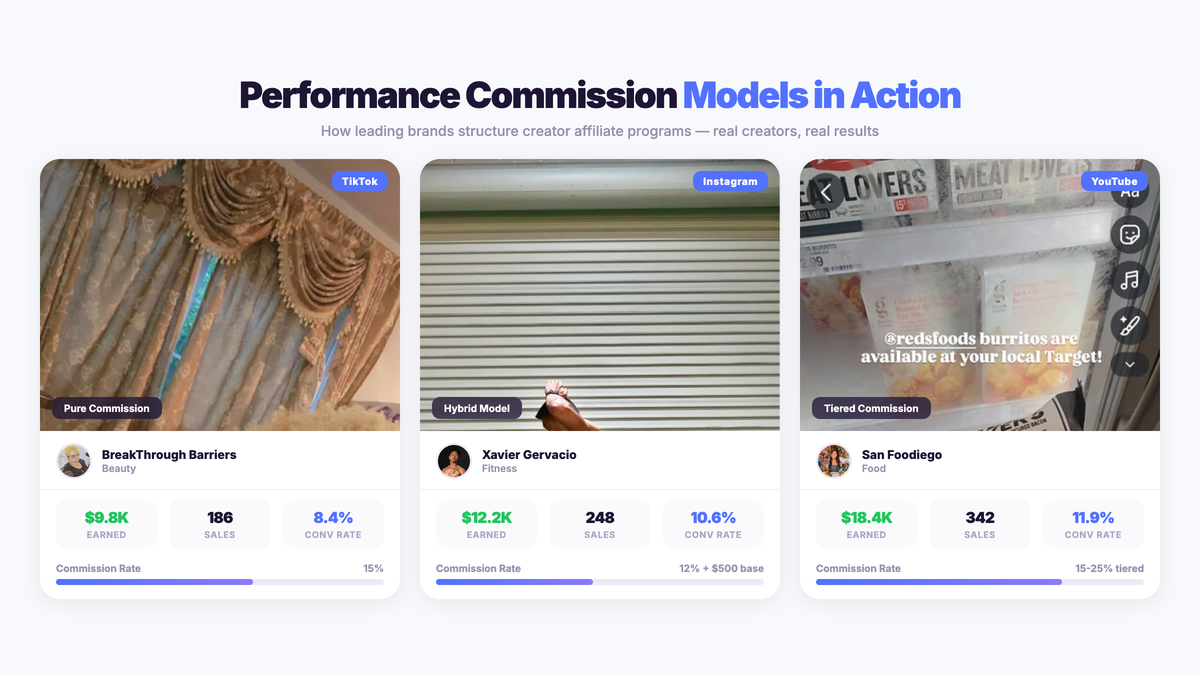
Creators earn a percentage of every sale they drive, with no upfront payment. Typical commission rates range from 10-30% depending on product margins, vertical, and creator tier. This model minimizes brand risk and attracts creators who are confident in their conversion ability. However, it can struggle to attract established creators who expect upfront compensation for their time and production costs.
Hybrid: Base Fee + Commission
The most effective model for most brands combines a modest base fee with performance commissions. The base fee (typically $500-$2,000 for mid-tier creators) covers the creator’s content production time. The commission component (8-20% of sales) incentivizes conversion-focused content. This structure attracts quality creators while maintaining performance alignment.
Tiered Commission Structures
Tiered models increase commission rates as creators hit sales thresholds. Example: 10% on the first $5,000 in sales, 15% on $5,001-$15,000, and 20% on everything above $15,000. Tiered structures motivate creators to push for higher volumes and create a sense of progression that increases engagement with the program over time.
Flat Fee Per Conversion (CPA)
Instead of a revenue percentage, creators earn a fixed amount per conversion — $10 per sale, $5 per email signup, or $2 per app download. CPA models work well when your product has a consistent price point and you want predictable unit economics. They’re less effective for brands with wide product assortments and varying price points.
Setting Competitive Rates
Research what competitors and adjacent brands are offering. If your commission rate is meaningfully below market, you’ll only attract creators who can’t get deals elsewhere — which typically means lower quality and lower performance. The brands running the most successful affiliate programs treat commission rates as a competitive investment, not a cost to minimize.
Tracking and Attribution Methods
Accurate tracking is the foundation of any affiliate program. Without reliable attribution, you can’t pay creators fairly, optimize your program, or calculate true ROI.
Unique Affiliate Links
Each creator receives a unique URL (typically generated through an affiliate platform) that tracks clicks and conversions. Modern affiliate links use UTM parameters for analytics integration and pixel-based tracking for cross-device attribution. This is the most reliable tracking method because it creates a direct, auditable connection between content and purchase.
Promo Codes
Unique discount codes (e.g., SARAH20 for 20% off) provide both tracking and purchase incentive. Promo codes work well for platforms where clickable links are difficult (podcast ads, YouTube verbal mentions) but have limitations: customers share codes with friends (inflating attribution), forget to use them (undercounting conversions), or apply codes they found on coupon sites rather than from the creator.
Platform-Native Tracking
TikTok Shop, Amazon Associates, and Instagram Shopping provide built-in affiliate tracking. These are highly accurate for on-platform purchases but don’t capture conversions that happen off-platform. If most of your sales come through your own website rather than social commerce platforms, native tracking alone will significantly undercount creator-driven revenue.
Cookie Windows and Attribution Rules
Cookie duration — how long after clicking an affiliate link the creator receives credit — significantly impacts your program’s attractiveness and fairness. Industry standard cookie windows range from 7-30 days. Shorter windows (7 days) undercount conversions for high-consideration products. Longer windows (30+ days) are more generous but can create attribution conflicts with other marketing channels.
Most brands settle on 14-day cookie windows as a reasonable balance. Products with longer purchase consideration cycles (electronics, SaaS, luxury goods) benefit from 30-day windows.
Recruiting and Onboarding Affiliate Creators
The quality of your creator roster determines program success more than any other factor. Recruiting the right affiliate creators requires a systematic approach.
Identifying High-Potential Affiliates
Look beyond follower counts to identify creators likely to drive conversions: engaged audiences that demonstrate purchase behavior (asking “where can I buy this?” in comments), content formats that naturally integrate product recommendations, audience demographics that overlap with your customer base, and track records with other affiliate programs (many creators list brand partnerships in their media kits).
Outreach That Converts
Creator inboxes are flooded with partnership requests. To stand out: personalize every outreach with specific references to the creator’s content, lead with what you’re offering (commission rates, product access, exclusivity) rather than what you want, include social proof from other creators in your program, and make the onboarding process friction-free.
Onboarding Essentials
Effective onboarding gives creators everything they need to succeed from day one: comprehensive product information and key selling points, their unique tracking links and promo codes, brand guidelines and content do’s and don’ts, access to the affiliate dashboard for real-time performance tracking, dedicated point of contact for questions, and product samples for firsthand experience.
Creators who receive thorough onboarding produce their first content 60% faster than those left to figure things out independently. Front-load the investment in onboarding — it pays for itself in faster time-to-revenue.
Ready to build a high-performing affiliate creator program? Book a demo with partnrUP to see how brands recruit, onboard, and manage affiliate creators at scale.
Scaling Your Affiliate Creator Program
Scaling from a handful of affiliate creators to a full program requires operational systems, not just more creators.
Automation and Tooling
Manual management works for 5-10 creators. Beyond that, you need systems for: automated link generation and distribution, real-time performance dashboards accessible to both brand team and creators, automated commission calculation and payment processing, content approval workflows that don’t bottleneck production, and creator communication at scale (newsletters, program updates, new product alerts). Tools like partnrUP’s platform help brands automate this at scale.
Creator Segmentation
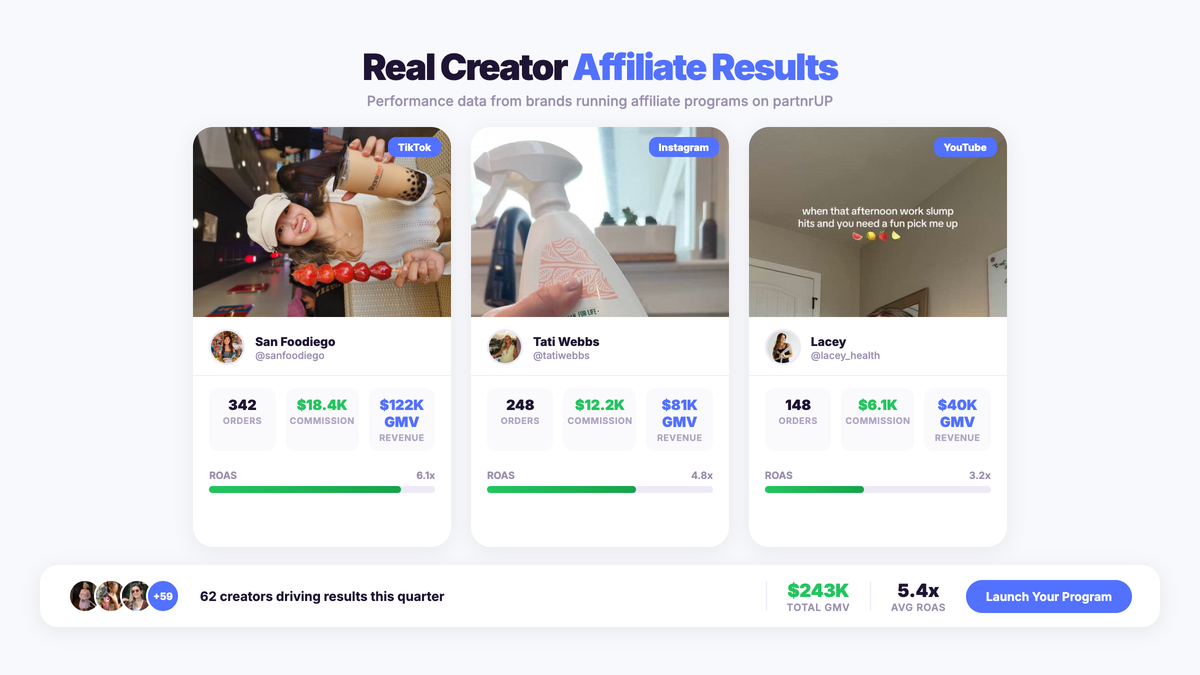
As your roster grows, segment creators by performance tier and adjust your investment accordingly. Top performers (top 10%) deserve higher commission rates, early product access, and co-creation opportunities. Mid-tier performers (next 30%) need optimization support — analyze their content to identify what’s working and provide coaching. Lower performers (bottom 60%) should receive standard support and be evaluated quarterly for continued participation.
Content Diversification
Avoid over-reliance on a single content format or platform. Scale by expanding across video reviews, comparison content, tutorial integration, unboxing content, and live shopping events. Each format attracts different audience segments and captures different stages of the purchase journey.
International Expansion
Once your domestic program is optimized, consider expanding to international markets. Affiliate influencer marketing scales well internationally because creators provide built-in localization — they speak the language, understand cultural context, and have trusted relationships with local audiences.
Frequently Asked Questions
What’s the difference between affiliate influencer marketing and traditional affiliate marketing?
Traditional affiliate marketing relies on website publishers, coupon sites, and deal blogs that drive traffic primarily through SEO and paid media. Affiliate influencer marketing uses content creators who drive purchases through authentic content and trusted audience relationships. The conversion mechanism is social proof and creator credibility rather than deal-seeking behavior.
How much commission should I offer affiliate creators?
Research your vertical’s standard rates and match or exceed them. General benchmarks: beauty/fashion 15-25%, consumer electronics 8-15%, health/wellness 12-20%, food/beverage 10-18%, SaaS/digital products 20-40%. Use higher rates for launch periods to attract quality creators, then adjust based on performance data.
Can I run an affiliate influencer program alongside traditional influencer campaigns?
Absolutely — and most successful brands do. Traditional campaigns (flat-fee, awareness-focused) work for brand building and product launches. Affiliate programs (performance-based) drive ongoing revenue. Many brands start creator relationships with a paid campaign and then transition successful partners into their ongoing affiliate program.
How do I prevent affiliate fraud or code sharing?
Use multi-layer tracking (links + codes + pixel-based attribution) so no single method can be gamed. Monitor for suspicious patterns: unusually high click volumes from single IP addresses, sudden spikes in code usage from coupon sites, or conversion patterns that don’t match the creator’s typical audience behavior. Most affiliate platforms include fraud detection tools.
What’s the minimum number of creators for a viable affiliate program?
Start with 10-20 creators to generate enough data for meaningful optimization. Fewer than 10 doesn’t provide sufficient volume for performance patterns to emerge. Plan to grow to 50-100+ active affiliates within the first year for programs targeting significant revenue contribution.
How long does it take for an affiliate creator program to become profitable?
Most programs reach profitability within 2-3 months. The initial investment in setup, recruitment, and onboarding is front-loaded, while revenue builds as creators publish content and refine their approach. Programs typically see a 3-5x improvement in per-creator revenue between month 1 and month 6 as creators learn what converts for their specific audience.
Should I use an affiliate network or build a direct program?
Affiliate networks (Impact, ShareASale, CJ Affiliate) provide infrastructure, tracking, and access to creator marketplaces but charge fees (typically 2-5% of revenue or monthly platform fees). Direct programs give you more control and keep margins higher but require more operational investment. Most mid-market brands start with a network for infrastructure and transition high-performing creators to direct relationships over time.