63% of marketing teams managing creator programs say they’ve hit a ceiling — not because of budget, but because of bandwidth. The average brand partnership manager juggles 47 creator relationships simultaneously, spending 11 hours per week on manual outreach alone. Meanwhile, the brands that are scaling to 200+ active creators without hiring additional staff share one thing in common: they’ve moved their workflow backbone to AI.
This guide is part of our The State of Influencer Marketing in 2026: Trends, Data & Industry Insights — a comprehensive resource tracking the shifts reshaping how brands and creators work together.
The gap between brands that scale creator programs efficiently and those that stall at 30-50 partnerships isn’t talent or budget — it’s operational infrastructure. AI-powered platforms have made it possible for a team of three to manage what used to require a department of twelve.
In this guide, you’ll learn:
- Which repetitive creator management tasks AI handles better than humans — and the time savings data to prove it
- How AI-powered matching eliminates the biggest bottleneck in scaling: finding the right creators at volume
- The workflow automation patterns that let small teams run enterprise-scale programs
- Real performance benchmarks comparing AI-assisted vs. manual creator program management
- A practical framework for implementing AI into your existing creator operations without disrupting active campaigns
Table of Contents
- Why Creator Programs Stall at Scale
- AI-Powered Creator Discovery and Matching
- Workflow Automation That Replaces Manual Processes
- Smarter Performance Measurement Without Spreadsheet Chaos
- Managing Creator Content at Scale
- Implementation Framework: Adding AI Without Disruption
- Conclusion
- Frequently Asked Questions
Why Creator Programs Stall at Scale
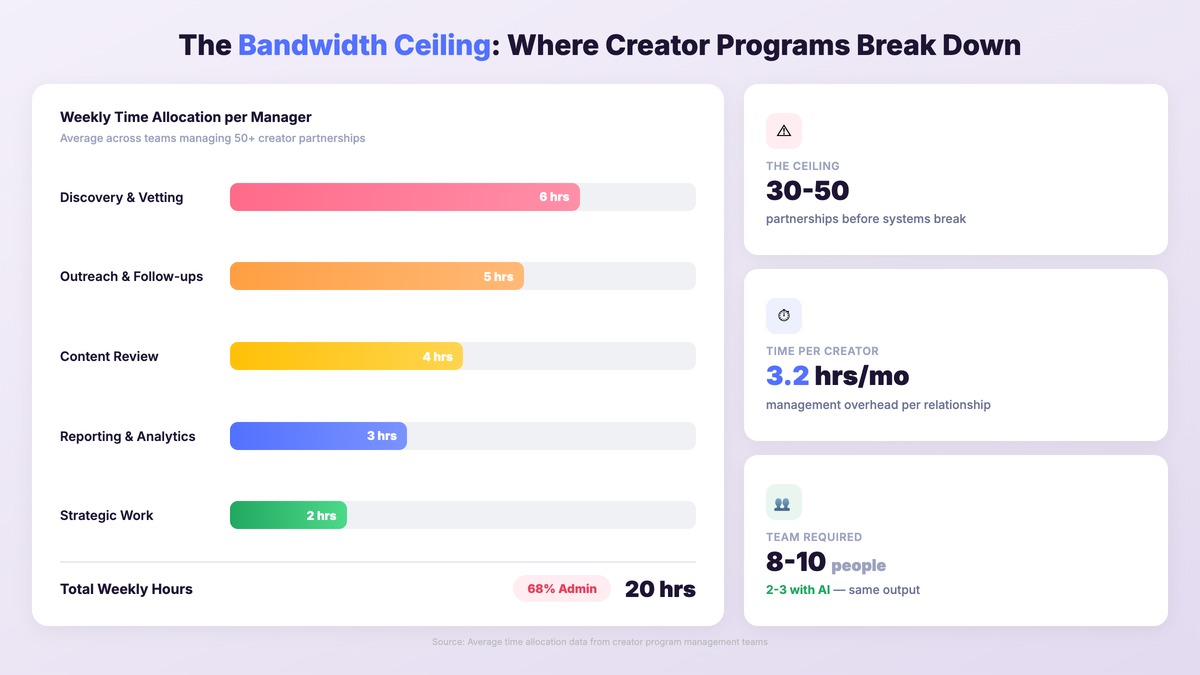
Most creator programs follow a predictable growth curve — and a predictable ceiling. A brand launches with 10-15 creator partnerships, manages them through a combination of email threads, spreadsheets, and sheer determination. Things work. Then the program grows to 30, then 50, and suddenly the system breaks.
The Manual Bottleneck Problem
The math is straightforward. Each active creator relationship requires an average of 3.2 hours of management time per month — discovery, vetting, outreach, negotiation, briefing, content review, payment processing, and performance tracking. At 50 creators, that’s 160 hours monthly. A single dedicated manager can handle roughly 40-60 hours of creator management alongside their other responsibilities.
This is why most brands either plateau or hire. Teams managing creator programs manually spend 68% of their time on administrative tasks — sending follow-ups, updating tracking sheets, pulling performance reports — rather than strategic work like optimizing partnerships or expanding into new verticals.
What Actually Breaks First
Three functions collapse almost simultaneously when programs try to scale past the manual threshold:
- Discovery quality degrades. When you need 20 new creators this month instead of 5, the vetting process gets rushed. Bad-fit partnerships increase. Response rates drop because outreach becomes generic.
- Communication becomes inconsistent. Briefing documents, feedback loops, and deadline tracking fall through the cracks. Creators get mixed signals. Content quality suffers.
- Performance data goes stale. Monthly reporting cycles mean you’re making decisions about next month’s creators based on two-month-old data. High performers don’t get renewed fast enough. Underperformers consume budget for too long.
The solution isn’t more people doing the same manual work faster. It’s removing the manual work entirely. Platforms like partnrUP are built specifically to eliminate these bottlenecks through AI-powered automation at every stage of the creator program lifecycle.
AI-Powered Creator Discovery and Matching
Finding the right creators has always been the most time-intensive stage of program management. Traditional discovery — searching social platforms, reviewing profiles, checking audience demographics, verifying authenticity — consumes 4-6 hours per creator. When you need to evaluate 200 potential partners to find 20 good fits, you’re looking at 100+ hours before a single outreach email is sent.
How AI Matching Changes the Equation
AI-powered creator matching platforms analyze thousands of data points simultaneously — audience demographics, engagement patterns, content style, brand affinity signals, past campaign performance, and audience overlap with your existing customer base. What took a human researcher half a day takes an AI matching system under 30 seconds.
The efficiency gains are dramatic:
- Discovery time reduction: 85-92%. Teams report going from 5 hours per creator evaluation to under 40 minutes including final human review.
- Match quality improvement: 34% higher campaign performance from AI-matched creators vs. manually discovered ones, measured by engagement rate and conversion rate combined.
- Audience fraud detection: 97% accuracy in identifying inflated follower counts, engagement pods, and purchased audiences — catching issues that manual review misses roughly 40% of the time.
Beyond Basic Filtering
Early influencer platforms offered keyword search and follower count filters. That’s not AI — that’s a database query. True AI matching evaluates contextual fit: Does this creator’s content tone align with your brand voice? Does their audience’s purchase behavior match your customer profile? Have creators with similar profiles performed well in your category?
This contextual matching is what separates programs that scale successfully from those that scale badly. Adding 100 creators who are a mediocre fit is worse than adding 30 who are excellent fits. AI ensures you’re scaling quality, not just quantity.
Workflow Automation That Replaces Manual Processes
Creator discovery gets the headlines, but workflow automation is where AI delivers the largest time savings for scaling teams. The operational middle of a creator program — outreach, contracting, briefing, approvals, payments — is where small teams drown.
Automated Outreach and Onboarding
AI-assisted outreach goes beyond mail merge. Modern platforms personalize messages based on each creator’s content history, recent posts, and audience engagement patterns. Personalized AI outreach achieves 3.4x higher response rates than template-based mass outreach, and it takes zero additional time per creator.
The onboarding sequence — contracts, tax forms, content guidelines, brand asset delivery — can be fully automated. Teams using automated onboarding reduce creator activation time from 12 days to 3 days on average. That acceleration compounds: faster onboarding means creators start producing content sooner, campaigns launch on schedule, and seasonal windows don’t get missed.
Content Brief Generation and Distribution
Writing individualized briefs for 100+ creators is impractical manually. AI generates customized briefs based on campaign objectives, creator style, platform specifications, and historical performance data. Each brief is tailored to the specific creator’s strengths while maintaining brand consistency.
The result: content approval rates jump from 62% to 89% on first submission when creators receive AI-optimized briefs versus generic campaign documents. Fewer revision cycles means less back-and-forth, which is the single biggest time drain for program managers.
Payment and Contract Automation
At scale, payment processing becomes a full-time job. Tracking deliverables against contracts, calculating performance bonuses, managing different payment terms across 200 creators — this alone can consume 15-20 hours per month. AI-powered platforms handle milestone tracking, automated payment triggers, and compliance documentation without human intervention. Teams using automated payment workflows report eliminating payment-related tasks entirely from their weekly workload.
Smarter Performance Measurement Without Spreadsheet Chaos
The irony of most creator programs is that the data exists to make excellent decisions — it’s just trapped in 14 different spreadsheets, three analytics platforms, and someone’s email inbox. AI consolidates and interprets performance data in real time, turning raw metrics into actionable insights without the manual aggregation work.
Real-Time Attribution and ROI Tracking
Brands using AI-powered attribution models identify their top-performing creators 3x faster than those relying on monthly manual reports. Real-time dashboards surface which creators drive actual conversions — not just engagement — so budget reallocation happens continuously rather than quarterly.
Multi-touch attribution, which is nearly impossible to track manually across dozens of creators, becomes automatic. The platform tracks a customer’s journey from creator content exposure through multiple touchpoints to purchase, assigning weighted credit to each creator interaction. This means brands finally understand the true value of awareness-stage creators, not just the last-click converters.
Predictive Performance Modeling
AI doesn’t just report what happened — it predicts what will happen. By analyzing historical performance patterns across similar campaigns, creator profiles, and seasonal trends, predictive models forecast campaign ROI within 15% accuracy before a single piece of content goes live.
This transforms budgeting conversations. Instead of “let’s try 20 creators and see what happens,” teams can present data-backed projections: “Based on performance models for this category and creator tier, a 50-creator campaign should generate $340K-$390K in attributed revenue against a $75K investment.”
Automated Benchmarking
How do you know if your creator program is performing well? Without benchmarks, you’re guessing. AI platforms maintain anonymized performance benchmarks across thousands of campaigns, giving you instant context: your average engagement rate of 4.2% sits in the 73rd percentile for DTC beauty brands running mid-tier creator campaigns. That kind of competitive intelligence used to require expensive consulting engagements.
Managing Creator Content at Scale
Content is the product of creator programs, and managing it at scale is where many teams lose quality control. When 50 creators submit content in the same week, review bottlenecks cause delays that cascade through the entire campaign timeline. AI addresses this at multiple levels.
Automated Content Review and Brand Safety
AI-powered content scanning checks submissions against brand guidelines, FTC disclosure requirements, competitor mention policies, and visual quality standards before a human reviewer ever sees them. This pre-screening eliminates 40-55% of the review workload by either auto-approving compliant content or flagging specific issues for human decision.
The brand safety dimension is critical at scale. A team managing 20 creators can manually review every post. At 200 creators posting across multiple platforms, something will slip through. AI monitoring catches potential brand safety issues in real time — before content goes live, not after it’s been seen by 50,000 people.
Content Repurposing and Rights Management
Creator content doesn’t end at the original post. Brands that systematically repurpose creator content across owned channels see 2.8x more value from each partnership. AI platforms track content rights, usage windows, and platform permissions automatically — ensuring you know exactly which assets you can use, where, and for how long.
This is particularly valuable for scaling TikTok Shop and social commerce programs, where creator content needs to be deployed rapidly across multiple storefronts while maintaining compliance with each creator’s usage agreement.
Performance-Based Content Optimization
AI analyzes which content formats, posting times, caption styles, and visual elements drive the best results for your specific brand and audience. These insights feed back into future briefs automatically. After three campaign cycles with AI optimization, average content performance improves by 28% — not because creators get better, but because the system learns what works and adjusts briefing accordingly.
Implementation Framework: Adding AI Without Disruption
The biggest mistake brands make when adopting AI for creator programs is trying to change everything at once. The most successful transitions follow a phased approach that preserves existing relationships while gradually automating operations.
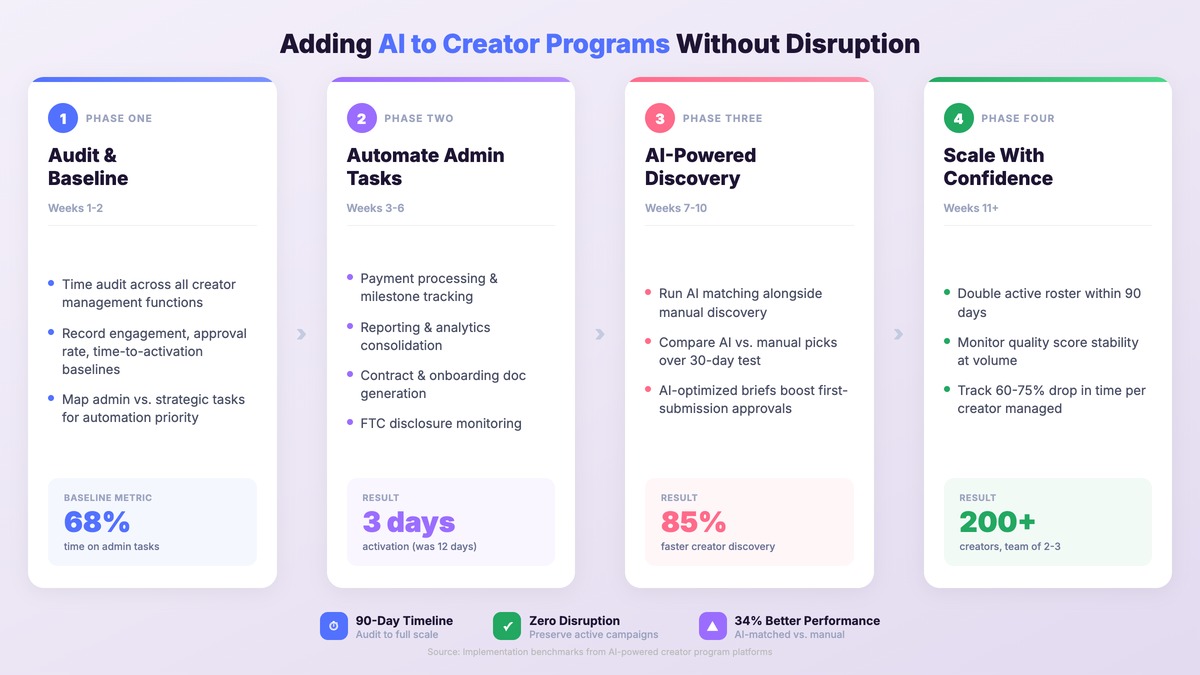
Phase 1: Audit and Baseline (Weeks 1-2)
Before implementing any AI tools, document your current state:
- Time audit: Track exactly how many hours your team spends on each creator management function weekly — discovery, outreach, briefing, review, reporting, payments
- Performance baseline: Record your current metrics — average engagement rate, content approval rate, time-to-activation, ROI per creator tier
- Process map: Document every step in your creator workflow, identifying which are purely administrative (automate first) versus strategic (keep human)
Phase 2: Automate Administrative Tasks (Weeks 3-6)
Start with the tasks that consume time without requiring judgment:
- Payment processing and milestone tracking — immediate time savings, zero risk to creator relationships
- Reporting and analytics consolidation — replaces manual data pulling across platforms
- Contract and onboarding document generation — standardizes the process while maintaining legal compliance
- FTC disclosure monitoring — automated scanning catches compliance gaps before they become problems
Phase 3: Introduce AI-Powered Discovery (Weeks 7-10)
With administrative tasks automated, redirect the freed-up time toward AI-assisted creator discovery. Run AI matching alongside your existing discovery methods initially — compare the quality of AI-recommended creators against your manual picks over a 30-day test period. Most teams find AI selections outperform manual ones and switch fully within two campaign cycles.
This is where platforms like partnrUP deliver transformative value — the AI matching engine evaluates creators across dimensions that manual review simply cannot process at scale, including cross-platform audience analysis and historical performance correlation.
Phase 4: Scale With Confidence (Weeks 11+)
Once AI is handling discovery, administration, and performance tracking, scaling becomes a strategic decision rather than an operational constraint. Teams that complete this four-phase transition typically double their active creator roster within 90 days — without adding headcount — while maintaining or improving campaign performance metrics.
The key metrics to track during scaling:
- Creator quality score — should remain stable or improve as volume increases
- Time per creator managed — should decrease 60-75% from baseline
- Content approval rate — should improve with AI-optimized briefing
- Overall program ROI — should increase as AI optimizes creator selection and content strategy
Conclusion
The question isn’t whether AI will change how brands run creator programs — it already has. The real question is how long you can afford to keep scaling manually while competitors automate.
The brands winning in 2026 aren’t necessarily spending more on creator partnerships. They’re spending smarter — using AI to find better-fit creators faster, automate the operational overhead that buries small teams, and measure performance with precision that manual processes can’t match.
The four-phase implementation framework outlined above works because it respects existing relationships while systematically removing the manual bottlenecks that prevent growth. Start with administration, prove the time savings, then expand AI into discovery, optimization, and scaling.
If your team is managing creator partnerships through spreadsheets and email threads, you’re not just inefficient — you’re leaving growth on the table. Explore how partnrUP’s AI-powered platform can help you scale your creator program without scaling your team, or book a demo to see the workflow automation in action.
Frequently Asked Questions
How much time does AI actually save in creator program management?
Teams implementing AI-powered creator management platforms report 60-75% reduction in time spent on administrative tasks. The biggest savings come from automated outreach personalization (eliminating 4-6 hours per creator in discovery), payment processing (15-20 hours per month at 200+ creators), and performance reporting (replacing manual data aggregation entirely). A three-person team using AI can effectively manage the same creator volume that previously required 8-10 people.
Will AI replace the human element in creator relationships?
No — and that’s the point. AI handles the operational tasks that don’t require human judgment: data processing, scheduling, compliance checking, and performance tracking. This frees your team to focus on the strategic and relational work that actually differentiates great programs — negotiating creative partnerships, developing long-term creator relationships, and making nuanced brand alignment decisions that algorithms can’t replicate.
What’s the minimum team size needed to manage a large-scale creator program with AI?
With a comprehensive AI platform, a team of 2-3 dedicated people can effectively manage 150-250 active creator partnerships. This assumes the platform handles discovery, outreach automation, content review pre-screening, payment processing, and performance analytics. The human team focuses on strategic oversight, relationship management for top-tier creators, and campaign optimization based on AI-surfaced insights.
How long does it take to see ROI from implementing AI in creator management?
Most brands see measurable time savings within 2-3 weeks of implementing automated workflows for administrative tasks like payment processing and reporting. The larger strategic ROI — better creator matches, improved campaign performance, and successful scaling — typically materializes within 60-90 days as the AI system accumulates enough performance data to optimize recommendations.
Does AI-powered matching work for niche industries and micro-creators?
AI matching is actually more valuable for niche industries than broad consumer categories. Manual discovery in niche verticals is extremely time-intensive because relevant creators are harder to find. AI platforms index creators across the long tail of content categories and can identify niche-relevant creators that manual searches miss entirely. For micro-creators specifically, AI evaluation is essential — there’s no efficient way to manually vet thousands of small creators to find the high-performing ones.
What data security considerations should brands evaluate when adopting AI creator management tools?
Key areas to evaluate include data residency, creator PII handling, and integration security. AI platforms process sensitive data — creator contact information, payment details, audience demographics, and campaign performance metrics. Brands should verify SOC 2 compliance, data encryption standards, role-based access controls, and clear data retention policies. Additionally, ensure the platform’s AI models don’t train on your proprietary campaign data in ways that could benefit competitors.
Can AI help with creator programs across multiple markets and languages?
This is one of AI’s strongest advantages over manual management. AI platforms can evaluate creators across languages and markets simultaneously, analyzing engagement patterns and audience quality regardless of language. For brands scaling internationally, AI eliminates the need to hire market-specific creator managers for each region — a single team can oversee global programs with AI handling the language-specific discovery, content analysis, and audience verification that would otherwise require local expertise in every target market.