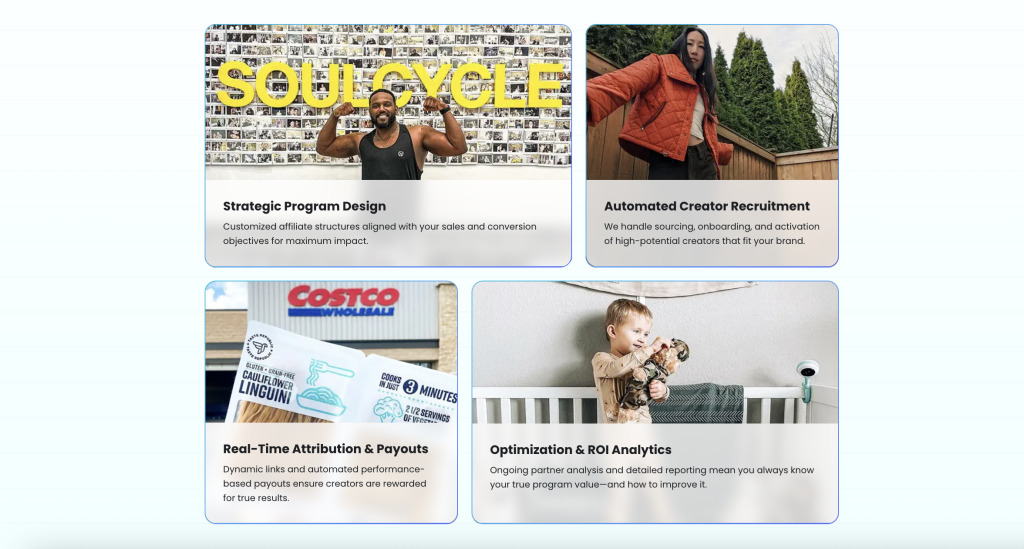
Affiliate marketing through influencers is no longer optional, it’s essential for brands that want measurable, scalable growth. But managing creator relationships, tracking attribution, and scaling affiliate campaigns manually can consume massive amounts of time and resources. That’s where specialized influencer marketing agencies come in.
The best influencer marketing agency for affiliate marketing combines deep expertise in creator partnerships with sophisticated performance tracking, enabling brands to drive real revenue while maintaining authentic influencer relationships. This guide breaks down exactly what to look for, how top agencies structure campaigns, and what you should expect when investing in professional influencer affiliate management.
Whether you’re a startup testing your first creator partnerships or an enterprise brand scaling affiliate programs across hundreds of influencers, you’ll learn how to identify the agency that fits your goals and delivers measurable ROI.
What Makes an Influencer Marketing Agency Effective for Affiliate Marketing?
The best influencer marketing agencies for affiliate marketing operate at the intersection of authentic creator relationships and performance-driven revenue goals. They understand that affiliate marketing isn’t just about posting discount codes, it’s about building strategic partnerships that drive conversions while maintaining brand integrity.
Top agencies bring specialized capabilities that most in-house teams lack. They leverage sophisticated tracking technology to attribute sales accurately across multiple touchpoints, ensuring you know exactly which creators drive revenue. They maintain extensive networks of vetted influencers across niches, platforms, and audience demographics, saving you months of manual outreach and relationship building.
What separates elite agencies from average ones is their ability to balance brand awareness with conversion-focused goals. They don’t just chase clicks, they identify creators whose audiences have genuine purchase intent and align with your target customer profile. This strategic vetting process means higher conversion rates and better return on ad spend.
The best agencies also provide transparent, real-time reporting that connects every dollar spent to measurable outcomes. You’ll see which creators generate the most revenue, which content types convert best, and where to allocate budget for maximum impact. This data-driven approach eliminates guesswork and enables continuous optimization.
Modern agencies increasingly use AI-powered automation to scale campaigns without sacrificing quality. Platforms like partnrUP reduce coordination time by 70% through automated creator discovery, outreach, and campaign management, enabling brands to run affiliate programs with enterprise-level sophistication but without enterprise-level overhead.
What Should You Look for in an Influencer Marketing Agency for Affiliate Programs?
Finding the right agency requires evaluating several critical capabilities that directly impact campaign performance and long-term success.
Do They Have a Proven Track Record with Measurable Results?
Any agency can talk about strategy, top agencies show you the data. Look for documented case studies demonstrating revenue growth, conversion rate improvements, and positive ROI from affiliate influencer campaigns. Ask for specific metrics: How much revenue did they generate? What was the average creator conversion rate? How did performance improve over time?
The best agencies willingly share performance benchmarks and connect you with references who can speak to their results. If an agency is vague about outcomes or can’t provide concrete examples, that’s a red flag.
How Robust Is Their Influencer Network?
A strong creator network across relevant niches, platforms, and audience segments is non-negotiable. The best agencies maintain ongoing relationships with thousands of vetted influencers, enabling quick campaign launches without lengthy recruitment cycles.
Ask about their network composition: What platforms do they cover? What niches are they strongest in? How do they vet creators for authenticity and engagement quality? Agencies with deep networks can match you with creators who already align with your brand values and target audience.
What Tracking and Attribution Technology Do They Use?
Sophisticated tracking capabilities separate professional agencies from amateurs. Top agencies use advanced attribution technology that tracks the entire customer journey, from initial creator touchpoint through final purchase and beyond.
They should provide unique tracking links for each creator, monitor multi-touch attribution across channels, and integrate with your existing analytics infrastructure. The best agencies offer real-time dashboards where you can monitor campaign performance, creator-level metrics, and revenue attribution without waiting for monthly reports.
How Do They Manage Commission Structures and Compliance?
Professional agencies understand the complexities of affiliate commission management. They structure compensation models that incentivize creators while protecting your margins, whether that’s cost-per-acquisition (CPA), cost-per-sale (CPS), or hybrid arrangements.
They also ensure strict FTC compliance and disclosure requirements, protecting your brand from regulatory risk. Every sponsored post should include proper disclaimers, and the agency should have clear processes for reviewing and approving creator content before it goes live.
What’s Their Approach to Influencer-Audience Alignment?
The best agencies don’t just match you with creators who have large followings, they identify strategic alignment between creator audiences and your target customers. They analyze audience demographics, engagement patterns, purchase behavior, and content preferences to ensure maximum conversion potential.
This strategic matching process dramatically improves campaign performance. When creators genuinely resonate with your product and their audiences have real purchase intent, conversion rates soar compared to generic influencer partnerships.
How Do Top Agencies Structure Affiliate Influencer Campaigns?
Understanding how elite agencies plan and execute affiliate campaigns helps you evaluate their sophistication and set realistic expectations.
Campaign Planning and Influencer Selection Methodology
The best agencies start with strategic planning that aligns influencer selection with your specific business goals. They analyze your target audience, competitive landscape, and product positioning before identifying creators who can authentically promote your offerings.
Their selection process goes beyond follower counts, they evaluate engagement authenticity, audience demographics, content quality, brand safety, and historical campaign performance. Many top agencies use AI-powered discovery tools that analyze millions of creator profiles to identify optimal matches based on dozens of performance signals.
Once they identify potential creators, they conduct outreach using personalized, value-driven messaging that emphasizes mutual benefit. Agencies achieving 40% higher response rates understand that successful creator partnerships require authentic relationship building, not mass templated emails.
Commission Structures and Payment Models
Professional agencies design flexible commission structures tailored to your business model and campaign objectives. Common approaches include:
Cost-Per-Acquisition (CPA): Creators earn a fixed amount for each new customer they bring
Cost-Per-Sale (CPS): Creators earn a percentage of each transaction they generate
Hybrid Models: Combination of flat fees plus performance bonuses
Tiered Structures: Escalating commission rates as creators hit performance milestones
The best agencies balance attractive creator compensation with sustainable economics for your business, ensuring both parties benefit from long-term partnerships.
Content Creation and Approval Workflows
Top agencies establish clear content guidelines that maintain brand consistency while respecting creator authenticity. They provide briefs outlining key messaging, product features, and compliance requirements, then give creators creative freedom within those parameters.
Their approval workflows streamline review cycles without bottlenecking campaigns. Many use collaborative platforms where your team can review creator content, request revisions, and approve posts efficiently, reducing time-to-market while maintaining quality control.
Tracking Link Management and Attribution Setup
Professional agencies implement sophisticated tracking infrastructure from day one. Each creator receives unique tracking links (or codes) that capture attribution data across devices and sessions. They integrate with your e-commerce platform, CRM, and analytics tools to provide comprehensive performance visibility.
The best agencies also handle technical complexities like cookie duration, cross-device tracking, and multi-touch attribution modeling, ensuring accurate revenue attribution even in complex customer journeys.
Performance Monitoring and Optimization Strategies
Elite agencies don’t launch campaigns and hope for the best, they continuously monitor and optimize based on real-time data. They track metrics like click-through rates, conversion rates, average order value, and customer lifetime value at the creator level.
When they identify high-performing creators or content types, they double down with increased budget allocation. When campaigns underperform, they diagnose issues quickly and implement fixes, whether that’s adjusting messaging, testing different content formats, or replacing underperforming creators.
How Do They Ensure FTC Compliance and Brand Safety?
The best agencies treat compliance as non-negotiable. They educate creators on FTC disclosure requirements, review all sponsored content for proper disclaimers, and maintain documentation proving compliance in case of audits.
They also monitor for brand safety issues, ensuring creators don’t post controversial content, make false claims, or associate your brand with inappropriate material. This proactive approach protects your reputation while maintaining authentic creator relationships.
What Should You Expect to Invest When Hiring an Agency?
Understanding pricing models and cost structures helps you budget appropriately and evaluate agency proposals effectively.
Typical Agency Fee Structures
Influencer marketing agencies generally operate on one of three pricing models:
Retainer-Based: You pay a monthly fee for ongoing campaign management, strategy, and creator relationship oversight. Retainers typically range from $5,000 to $50,000+ monthly depending on campaign scope, creator volume, and level of service. This model works best for brands running continuous affiliate programs.
Performance-Based: The agency earns a percentage of revenue generated through influencer partnerships, often 15-30% of attributed sales. This aligns agency incentives with your success but may result in higher total costs for highly successful campaigns.
Hybrid Models: Combine a base retainer covering core services with performance bonuses tied to results. This balances predictable costs with performance incentives, ensuring agencies remain motivated to drive continuous improvement.
Many top agencies offer flexible arrangements based on your business stage and goals. Startups might start with performance-based models to minimize upfront risk, while established brands often prefer retainer models for predictable budgeting.
Influencer Compensation and Campaign Budgets
Beyond agency fees, you’ll invest in creator compensation, either through affiliate commissions or hybrid arrangements combining flat fees with performance incentives.
Affiliate commission rates vary by industry and product margins but typically range from 5-30% per sale. Digital products and high-margin offerings can support higher commission rates, while physical products with tighter margins require more conservative structures.
Total campaign budgets depend heavily on scale. A small test campaign with 10-20 micro-influencers might require $10,000-25,000 total monthly spend (agency fees plus creator compensation), while enterprise programs with hundreds of creators can exceed $100,000+ monthly.
Additional Platform and Technology Costs
Some agencies include tracking technology and platform fees in their retainer, while others pass these costs through separately. Expect $500-5,000+ monthly for sophisticated influencer management platforms, especially those offering AI-powered automation, advanced analytics, and integrated affiliate tracking.
The best agencies, like those using partnrUP’s AI-powered platform, integrate these capabilities into their service model, providing enterprise-grade technology without separate platform fees or complex technical setup.
ROI Expectations and Breakeven Timelines
Professional agencies should provide realistic ROI projections based on your industry, average order value, and target customer acquisition cost. While results vary, mature affiliate influencer programs often achieve 3:1 to 8:1 return on ad spend.
Expect to invest 2-3 months in campaign setup, creator recruitment, and initial optimization before seeing consistent results. Top-performing campaigns typically improve performance by 20-40% between months three and six as agencies refine creator selection and optimize messaging.
The best agencies set clear expectations upfront and provide detailed projections showing expected breakeven timelines and long-term performance potential.
How Do You Vet and Select the Right Agency for Your Business?
Choosing the right partner requires systematic evaluation across multiple dimensions, not just price or promises.
Essential Questions to Ask During Agency Evaluation
Ask these critical questions when evaluating potential agencies:
What specific experience do you have with affiliate influencer campaigns in our industry?
Can you share case studies with measurable revenue results similar to our goals?
What’s your process for identifying and vetting creators for affiliate partnerships?
What tracking and attribution technology do you use, and how does it integrate with our systems?
How do you structure creator compensation and ensure compliance with FTC guidelines?
What level of transparency and reporting will we receive, and at what frequency?
Who will be our primary point of contact, and what’s your team structure?
What happens if campaigns underperform, how do you troubleshoot and optimize?
Their responses reveal sophistication, accountability, and whether they’re truly equipped to deliver results.
Red Flags to Watch for in Agency Proposals
Be wary of agencies that:
Promise guaranteed results without understanding your business or market
Can’t provide concrete case studies or references
Use vague language about tracking and attribution capabilities
Propose unrealistically low pricing that suggests corner-cutting
Focus only on vanity metrics (followers, impressions) instead of revenue and conversions
Lack clear processes for FTC compliance and brand safety
Don’t ask detailed questions about your business goals and target audience
Professional agencies do thorough discovery before proposing solutions. If an agency provides a generic proposal without understanding your specific needs, that’s a major warning sign.
Case Study and Reference Review Best Practices
Always request and follow up on references. Ask previous clients:
What results did the agency deliver, and how did they compare to projections?
How responsive and communicative was the team?
Were there any unexpected costs or issues?
How well did they handle problems or campaign underperformance?
Would you hire them again for future campaigns?
Review detailed case studies looking for specifics: What was the strategy? How did they select creators? What were the actual performance metrics? How long did it take to see results?
Platform and Niche Specialization Considerations
Ensure the agency has relevant experience with your target platforms and audience. An agency excelling at TikTok creator campaigns may lack Instagram or YouTube expertise, and vice versa.
Similarly, niche specialization matters. Agencies experienced in beauty and fashion understand those audiences and creator ecosystems differently than agencies focused on SaaS or B2B products. Choose an agency with demonstrated success in your specific market.
What Metrics Define Success in Influencer Affiliate Marketing?
Understanding which KPIs matter helps you evaluate agency performance and optimize campaigns effectively.
Key Performance Indicators for Affiliate Influencer Campaigns
The best influencer marketing agencies track comprehensive metrics across the entire conversion funnel:
Awareness Metrics:
Reach and impressions generated by creator content
Unique visitors driven to your site via creator links
Brand mention volume and sentiment
Engagement Metrics:
Click-through rates on affiliate links
Time on site for creator-driven traffic
Content engagement rates (likes, comments, shares)
Conversion Metrics:
Conversion rate from creator traffic
Revenue per creator and per campaign
Average order value from affiliate purchases
Customer acquisition cost via influencer channel
Retention Metrics:
Repeat purchase rate from influencer-acquired customers
Customer lifetime value by acquisition source
Brand loyalty and engagement post-purchase
Elite agencies don’t just report vanity metrics, they connect creator activity to business outcomes and provide actionable insights for optimization.
Attribution Modeling and Tracking Methodologies
Professional agencies use sophisticated attribution models that credit influencers appropriately across complex customer journeys:
Last-Click Attribution: Credits the final touchpoint before purchase (simple but often incomplete)
First-Click Attribution: Credits the initial discovery touchpoint
Multi-Touch Attribution: Distributes credit across multiple touchpoints based on contribution
Data-Driven Attribution: Uses machine learning to assign credit based on actual conversion patterns
The best agencies discuss attribution methodology upfront and adjust models based on your sales cycle and customer behavior patterns.
Benchmarking Performance Against Industry Standards
Top agencies provide industry context for your campaign performance, helping you understand whether results are exceptional, average, or below par.
They share benchmark data for metrics like average conversion rates, typical commission structures, and expected ROI timelines in your specific industry. This context helps you set realistic expectations and identify optimization opportunities.
Common Challenges and How Elite Agencies Overcome Them
Even the best campaigns face obstacles, what separates top agencies is how they navigate challenges proactively.
Detecting and Preventing Influencer Fraud
Fake followers, engagement pods, and bot-driven metrics plague the influencer industry. Elite agencies use sophisticated fraud detection tools that analyze follower authenticity, engagement patterns, audience demographics, and growth trajectories to identify suspicious creators before partnerships begin.
They also monitor ongoing campaigns for anomalies like sudden engagement spikes or traffic patterns inconsistent with genuine human behavior. This protects your investment and ensures you partner with authentic creators who drive real business results.
Solving Attribution and Tracking Complexities
Multi-device customer journeys, cookie limitations, and privacy regulations make attribution challenging. The best agencies implement robust tracking infrastructure using first-party data, server-side tracking, and probabilistic matching to maintain accuracy despite these constraints.
They also set clear attribution windows, educate stakeholders on tracking limitations, and provide transparent reporting that acknowledges what can and cannot be measured with certainty.
Maintaining Compliance While Scaling Campaigns
As affiliate programs grow to dozens or hundreds of creators, maintaining FTC compliance becomes exponentially harder. Top agencies use automated compliance monitoring, templated disclosure language, and systematic content review workflows to ensure every post meets regulatory requirements.
They also maintain detailed documentation proving compliance efforts, protecting your brand in case of regulatory scrutiny.
Balancing Brand Safety with Creator Authenticity
Over-controlling creator content kills authenticity, but providing too much freedom risks brand safety issues. Elite agencies strike the right balance through clear guidelines that define guardrails while respecting creator voice and style.
They educate creators on brand values and non-negotiables, then trust them to create authentic content within those parameters. This approach maintains brand integrity while preserving the genuine creator voice that drives engagement and conversions.
Making the Right Choice for Long-Term Affiliate Marketing Success
Choosing the best influencer marketing agency for affiliate marketing isn’t just about finding someone to manage campaigns, it’s about selecting a strategic partner who understands your business, shares your goals, and brings the expertise and technology to deliver measurable results.
The right agency combines deep creator relationships with sophisticated performance tracking, enabling you to scale affiliate programs efficiently while maintaining quality and brand integrity. They provide transparency, accountability, and continuous optimization, treating your success as their own.
Key factors to prioritize: proven track record with measurable results, robust influencer network aligned with your niche, advanced tracking and attribution technology, experience with commission structures and compliance, and strategic approach to creator-audience matching.
For brands ready to scale creator affiliate programs without sacrificing control or drowning in manual coordination, AI-powered platforms like partnrUP offer the perfect combination of automation and expertise. With capabilities that reduce coordination time by 70% and achieve 40% higher creator response rates, partnrUP enables brands to run sophisticated affiliate influencer campaigns with less overhead and more measurable impact.
Ready to transform your influencer affiliate marketing? The right agency partner—equipped with modern AI automation and proven methodology—can turn creator relationships into your most profitable customer acquisition channel.