Brands running creator programs hit a wall around 15-20 active partnerships: content quality starts slipping, messaging drifts off-brand, and the team spends more time managing revisions than building relationships. A 2026 CreatorIQ benchmark report found that brands scaling beyond 25 creators per quarter saw a 34% increase in revision cycles — yet those that implemented structured creative systems maintained approval rates above 85% even at 100+ partnerships.
The tension between scale and authenticity isn’t inevitable. It’s a systems problem. And systems problems have systems solutions.
This guide is part of our Creator Content Strategy: Building a Scalable Creative Program for Your Brand — the complete framework for designing, executing, and measuring creator content programs that grow with your business.
In this guide, you’ll learn:
- Why creative production breaks down at scale — and the specific failure points to watch for
- How to build a creative framework that gives creators freedom within guardrails
- The content tiering system that matches production effort to business impact
- How to maintain brand voice consistency across 50+ creators simultaneously
- Measurement frameworks that catch quality drift before it becomes a problem
- Technology and workflow solutions that automate the operational burden without stripping authenticity
Table of Contents
- Why Creative Production Breaks at Scale
- Building a Scalable Creative Framework
- Content Tiering: Matching Effort to Impact
- Maintaining Brand Voice Across 50+ Creators
- The Creative Brief System That Scales
- Measuring Quality at Scale: Early Warning Systems
- Technology and Workflow Solutions
- Common Pitfalls That Derail Scaling Efforts
- Frequently Asked Questions
Why Creative Production Breaks at Scale
Understanding where creative production fractures is the first step toward building systems that prevent it. Most brands don’t fail because they chose bad creators — they fail because their processes weren’t designed for volume.
The Revision Death Spiral
Small programs rely on direct communication. A brand manager reviews each piece of content personally, provides nuanced feedback, and develops shorthand with each creator over time. This works beautifully with 5 creators. With 50, it becomes a bottleneck that produces one of two outcomes: either the brand manager becomes the constraint (slowing everything down) or quality review gets delegated without adequate training (letting quality slip).
The symptoms are predictable:
- Revision rates climb above 40% as new creators struggle to interpret vague brand guidelines
- Turnaround times stretch from days to weeks as review queues stack up
- Creator frustration increases — top performers leave for brands with clearer processes
- Content homogenization where everything starts looking the same because the safest path is copying what got approved before
The Authenticity Paradox
Here’s the counterintuitive finding: brands that give creators more structure often get more authentic content. Creators who know exactly what the brand needs — and what it doesn’t — have the confidence to bring their own voice. Without clear guardrails, creators play it safe. With them, they take creative risks because they know where the boundaries are.
The brands that scale creative production successfully treat their content programs like creative ecosystems, not assembly lines. They build frameworks that provide clarity without dictating execution.
Building a Scalable Creative Framework
A scalable creative framework has three layers: non-negotiables (what must be consistent), guidelines (what should be consistent), and creative space (what’s entirely up to the creator). Most brands collapse all three into a single document — and wonder why their content either feels robotic or chaotic.
Layer 1: Non-Negotiables (The Hard Rules)
These are the elements that must appear in every piece of content, no exceptions. Keep this list brutally short — typically 4-6 items:
- Product naming conventions — exact brand name spelling, product line names, never abbreviate “partnrUP” to “PU”
- Legal and compliance requirements — FTC disclosure placement, prohibited claims, required disclaimers
- Visual identity minimums — product must be clearly visible, correct color representation, no competitor products in frame
- Key messaging pillars — the 2-3 value propositions that must appear (not scripted, just present)
Layer 2: Guidelines (The Soft Rules)
These are preferences, not mandates. They help creators align with brand aesthetic without restricting creative expression:
- Tone descriptors — “confident but not aggressive,” “educational but not condescending,” “casual but not sloppy”
- Visual mood references — 5-10 example posts that capture the desired feel (not to copy, but to calibrate)
- Content structure preferences — hook-first on TikTok, story-driven on Instagram, data-led on LinkedIn
- Audience context — who they’re talking to, what that audience cares about, common objections
Layer 3: Creative Space (The Freedom Zone)
Everything not covered in Layers 1 and 2 is the creator’s domain. This should be explicitly stated — creators need to know that everything outside the hard rules is genuinely up to them. This is where authenticity lives.
Platforms like partnrUP help brands codify these layers into structured creative briefs that scale across dozens of partnerships simultaneously — ensuring every creator gets the same clarity without requiring individualized onboarding sessions.
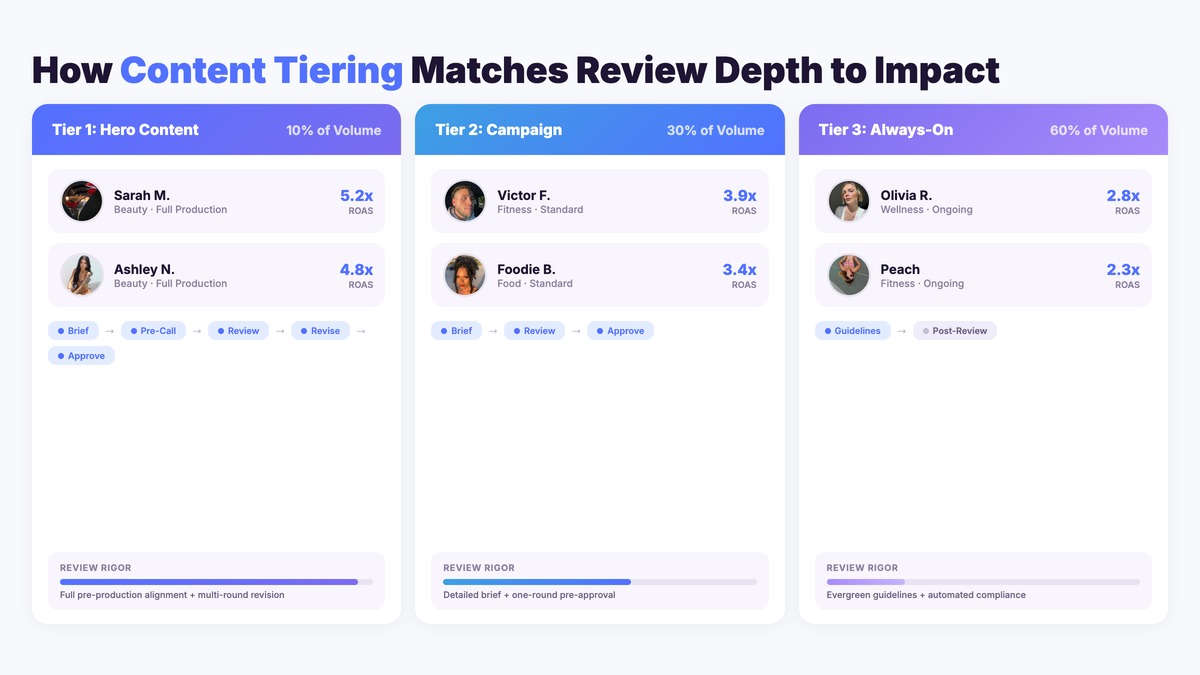
Content Tiering: Matching Effort to Impact
Not every piece of creator content deserves the same production investment. Brands that scale successfully implement a tiering system that matches creative effort — and review rigor — to business impact.
Tier 1: Hero Content (10% of Volume)
High-production collaborations with top-performing creators. These get:
- Full creative brief with mood board and reference assets
- Pre-production alignment call between brand and creator
- Multiple revision rounds built into the timeline
- Professional editing and post-production if applicable
- Cross-channel amplification with paid support
Hero content drives brand perception. It’s worth the investment in review cycles because the content has an extended shelf life and gets repurposed across owned channels.
Tier 2: Campaign Content (30% of Volume)
Standard campaign deliverables from your core creator roster. These get:
- Detailed creative brief (Layer 1 + Layer 2 guidelines)
- One round of revision if needed
- Brand approval before posting
- Performance tracking against campaign benchmarks
Tier 3: Always-On Content (60% of Volume)
Ongoing mentions, integrations, and organic posts from affiliate or ambassador partners. These get:
- Evergreen creative guidelines (Layer 1 only)
- Post-publication review (not pre-approval)
- Automated compliance checking for FTC and brand safety
- Quarterly calibration rather than per-post feedback
The key insight: Tier 3 content is where most authenticity lives. These are the posts where creators genuinely integrate your product into their daily content. Over-reviewing this tier kills the very authenticity you’re trying to preserve.
Teams using partnrUP’s automated tracking can monitor Tier 3 content at scale — flagging only posts that trigger compliance rules while letting everything else flow naturally.
Maintaining Brand Voice Across 50+ Creators
Brand voice consistency doesn’t mean every creator sounds the same. It means every piece of content feels like it comes from the same universe — even when the storytelling styles differ dramatically.
The Voice Spectrum Approach
Instead of defining one brand voice, define a spectrum with clear boundaries:
- Center of the spectrum: Your brand’s default tone — this is what your owned content sounds like
- Acceptable range: How far a creator’s voice can deviate while still feeling on-brand (e.g., more humorous, more technical, more emotional)
- Out of bounds: Specific tones that never work for your brand (e.g., sarcastic about the product category, dismissive of competitors, overly promotional)
Consistency Tools That Scale
Practical tools for maintaining voice consistency across large creator programs:
- Approved/rejected content gallery — a living library of examples with annotations explaining what worked and what didn’t. Update monthly.
- Voice calibration sessions — quarterly 30-minute calls with your top 10 creators to share what’s performing and why
- Creator peer review — pair new creators with experienced ones for their first 2-3 deliverables
- Automated sentiment analysis — flag content that skews significantly negative or off-tone before it posts
- Brand lexicon — a 1-page document listing preferred terms, avoided terms, and their alternatives
The most effective consistency tool is also the simplest: give creators access to your best-performing content. When creators see what resonates with your audience, they naturally calibrate their approach. This is a content repurposing strategy that feeds back into creative quality.
The Creative Brief System That Scales
Most creative briefs fail at scale because they’re either too detailed (no one reads 5-page documents) or too vague (creators guess wrong). The solution is a modular brief system with a consistent structure that adapts to content tier and platform.
The One-Page Brief Template
Every brief — regardless of tier — should answer these six questions on one page:
- What’s the goal? — One sentence. “Drive sign-ups for the free trial” or “Build awareness of the new feature.”
- Who’s watching? — Target audience in 2-3 sentences. Pain points, not demographics.
- What must be included? — Layer 1 non-negotiables only. If it’s not on this list, it’s optional.
- What does success look like? — 1-2 reference posts that capture the feel. Not to copy — to calibrate.
- What should they avoid? — 3-5 specific don’ts. “Don’t compare to competitors.” “Don’t use the word ‘cheap.'”
- What’s the timeline? — Draft due date, review window, publish date.
For guidance on building briefs that drive results, see our deep dive on how to write a creative brief for creator campaigns.
Scaling Briefs Without Scaling Headcount
The modular approach means 80% of the brief is templated per content tier and platform — only 20% changes per campaign. For a brand running 30 creator partnerships simultaneously:
- Tier 1 briefs: Custom-written. Worth the time investment for 3-5 hero collaborations.
- Tier 2 briefs: Template with campaign-specific fields filled in. Takes 10 minutes per brief.
- Tier 3 briefs: Evergreen guidelines document sent once at onboarding. No per-campaign brief needed.
This is exactly the kind of operational workflow that partnrUP automates — templated briefs that populate from campaign parameters, so brand managers write the campaign strategy once and the platform generates creator-ready briefs at scale.
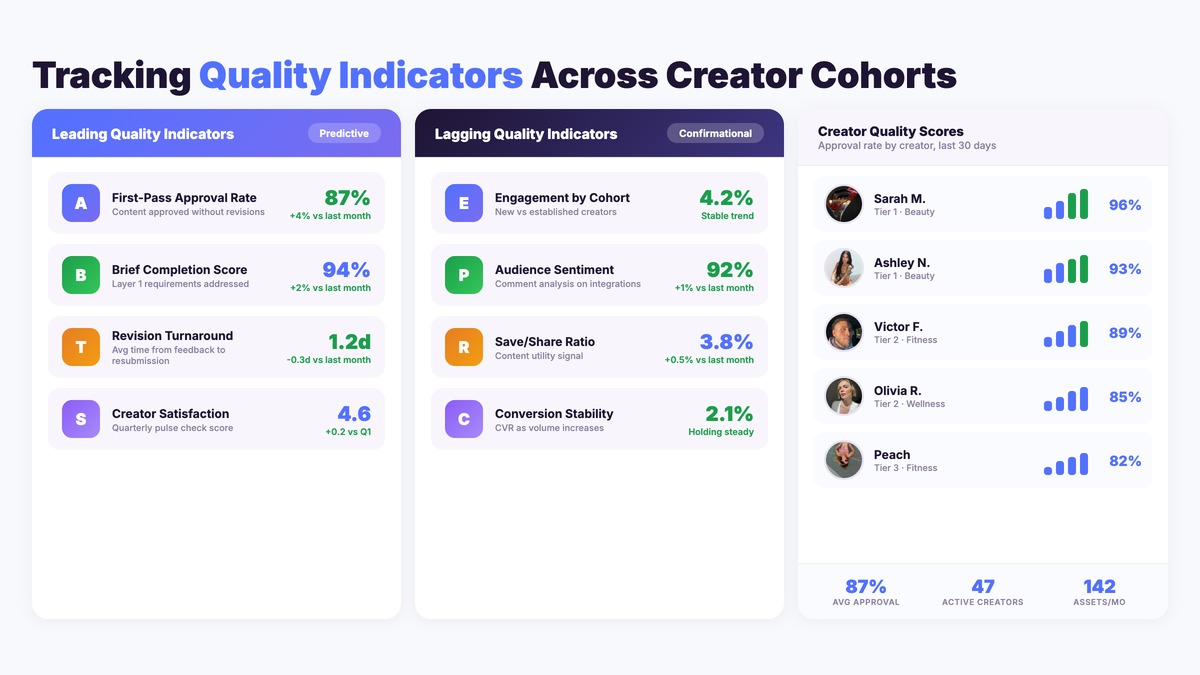
Measuring Quality at Scale: Early Warning Systems
You can’t manage what you don’t measure. At scale, quality monitoring shifts from subjective review of every piece to systematic tracking of quality indicators with human review triggered by exceptions.
Leading Quality Indicators
These metrics predict quality issues before they show up in performance data:
- First-pass approval rate: Percentage of content approved without revisions. Benchmark: 70%+ for Tier 2, 90%+ for Tier 3. If this drops below 60%, your briefs need work.
- Brief completion score: Did the creator address all Layer 1 requirements? Track compliance per element, not just pass/fail.
- Revision turnaround time: How long between feedback and resubmission? Lengthening turnaround signals creator confusion or disengagement.
- Creator satisfaction score: Quarterly pulse check. Creators who feel micromanaged produce worse content — track sentiment as a quality input.
Lagging Quality Indicators
Performance metrics that confirm whether content quality is holding:
- Engagement rate by creator cohort: Compare new creators vs. established ones. If new creators consistently underperform, onboarding needs improvement.
- Audience sentiment: Comment analysis on creator posts. Negative sentiment about the brand integration signals forced or inauthentic content.
- Content save/share ratio: High save rates indicate genuine value. If saves drop as you scale, content is becoming more promotional and less useful.
- Conversion rate stability: Track influencer marketing KPIs over time — a declining conversion rate alongside increasing volume is the clearest signal that quality is slipping.
Building Your Quality Dashboard
Consolidate these metrics into a weekly dashboard that answers one question: is quality keeping pace with volume? The most effective quality dashboards plot both metrics on the same time axis — when the volume line rises but quality indicators stay flat, you’re scaling successfully. When quality dips as volume rises, pause expansion and fix the process before adding more creators.
Technology and Workflow Solutions
Technology should handle the operational burden of scale — brief distribution, content collection, compliance checking, performance tracking — so humans can focus on the creative decisions that actually require judgment.
What to Automate
- Brief generation and distribution — templated briefs that populate from campaign parameters and deliver automatically to assigned creators
- Content collection and organization — centralized inbox for all creator submissions, auto-sorted by campaign, tier, and platform
- FTC compliance scanning — automated checks for disclosure language, prohibited claims, and required elements
- Performance data aggregation — pull metrics from all platforms into one view without manual exports
- Creator matching — AI-powered matching that identifies creators whose content style aligns with your brand voice, not just their follower demographics
What to Keep Human
- Final creative approval for Tier 1 and Tier 2 content — nuance matters here
- Relationship management — the personal touches that make top creators want to keep working with you
- Strategic direction — deciding what stories to tell, which cultural moments to engage, when to take creative risks
- Feedback and coaching — helping creators improve requires empathy and context that automation can’t replicate
The Right Platform Stack
Brands scaling creative production need platforms that handle the full lifecycle from creator discovery through content performance measurement. Key capabilities to evaluate:
- Creator database with audience overlap analysis — avoid saturating the same audience segments
- Campaign management with automated workflows — brief distribution, content review queues, approval routing
- Real-time attribution and ROI tracking — connect creator content to business outcomes without manual spreadsheet work
- Content rights management — track usage rights, expiration dates, and repurposing permissions across all creator assets
Book a demo with partnrUP to see how brands are managing 100+ creator partnerships with 2-person teams — without sacrificing the authenticity that makes creator content work.
Common Pitfalls That Derail Scaling Efforts
After working with hundreds of brands scaling their creator programs, these are the patterns that consistently cause problems — and how to avoid them.
Pitfall 1: Template Everything
The instinct when scaling is to standardize. But over-templating creative briefs produces homogeneous content that audiences recognize as sponsored in the first 2 seconds. Fix: template the structure, not the creative. Your brief format should be consistent; the creative direction within it should be unique per campaign.
Pitfall 2: Review Everything Equally
Applying Tier 1 review rigor to Tier 3 content creates bottlenecks and frustrates creators. It also signals that you don’t trust them — which undermines the authenticity of their content. Fix: match review depth to content tier. Post-publication review with quarterly calibration works for always-on content.
Pitfall 3: Optimize for Metrics, Not Moments
When every piece of content needs to “perform,” creators stop taking creative risks. The most viral, brand-building content usually comes from moments of genuine enthusiasm — which gets suppressed when creators feel pressure to hit specific KPIs on every post. Fix: measure performance at the program level, not the post level. Give individual posts room to experiment.
Pitfall 4: Scale Creators Before Scaling Systems
Adding more creators to a broken process makes it break faster. Brands that onboard 20 new creators before fixing their brief template, review workflow, or feedback loop end up with 20 confused creators producing inconsistent content. Fix: perfect your process with 10 creators, then scale. The process should work smoothly before you add volume.
Pitfall 5: Ignore Creator Feedback Loops
Creators are the closest observers of what resonates with audiences. Brands that don’t create channels for creators to share insights — what hooks are working, what audiences are asking for, what trends are emerging — miss their most valuable market research. Fix: build quarterly feedback sessions into your long-term creator partnership framework.
Conclusion
Scaling creative production without losing authenticity isn’t about choosing between quality and quantity. It’s about building systems that preserve what makes creator content valuable — the genuine human perspective — while removing the operational bottlenecks that limit growth.
The brands that do this well share a common approach: they invest in frameworks (not scripts), they tier their content (not one-size-fits-all), they measure quality systematically (not just performance), and they choose technology that automates the operational burden without inserting itself into the creative process.
Start with your creative framework. Define your three layers — non-negotiables, guidelines, and creative space. Then build your tiering system. Then instrument your quality metrics. Each layer compounds on the previous one, creating a system that gets better as it scales.
Ready to scale your creator content program without sacrificing authenticity? Book a demo with partnrUP to see how AI-powered creator matching and automated campaign management help brands run 100+ partnerships with lean teams — keeping every collaboration genuine, on-brand, and measurable.
Frequently Asked Questions
How many creators can a brand manage before quality starts declining?
Without structured systems, most brands see quality decline around 15-20 active creators. With a proper creative framework, content tiering, and the right platform tools, brands regularly manage 100+ creators while maintaining approval rates above 80%. The threshold isn’t about numbers — it’s about whether your processes were designed for scale.
Should creators see other creators’ content before producing their own?
Yes, but curate what they see. Share 3-5 top-performing examples as calibration references — not for copying, but for understanding tone and quality expectations. Avoid sharing content from creators in the same niche to prevent unintentional copying. An approved/rejected content gallery is one of the most effective tools for scaling quality.
How do I maintain authenticity when giving creators specific brand requirements?
Keep your non-negotiables list short (4-6 items) and make everything else genuinely optional. Creators produce their most authentic work when they know exactly where the boundaries are — it gives them confidence to bring their own perspective to everything else. The three-layer framework (non-negotiables, guidelines, creative space) is designed specifically for this.
What’s the right approval workflow for scaling creator content?
Match approval depth to content tier. Hero content (10% of volume) gets full pre-publication review with revision cycles. Campaign content (30%) gets one-round pre-approval. Always-on content (60%) gets post-publication review with compliance flagging. This prevents your review process from becoming the bottleneck that limits scaling.
How do I measure whether content authenticity is declining as we scale?
Track three leading indicators: first-pass approval rate (declining means briefs need improvement), content save/share ratio (declining means content is becoming more promotional), and audience sentiment in comments (increasing negative sentiment about brand integrations signals forced content). Plot these alongside your creator count over time.
Can AI tools help maintain creative quality at scale?
AI excels at the operational and analytical aspects of scaling — creator matching, compliance scanning, brief generation, performance aggregation. It should not be used to generate the creative content itself, since that undermines the authentic human perspective that makes creator content valuable. The best use of AI is removing the operational workload so humans can focus on creative strategy and relationship management.
What’s the biggest mistake brands make when scaling creative production?
Scaling creators before scaling systems. Adding 20 new creators to a process that was designed for 5 doesn’t produce 4x the content — it produces 4x the confusion. Perfect your creative framework, brief templates, review workflow, and quality metrics with your current roster before expanding. The process should feel effortless before you add volume to it.