Nearly 88% of marketers plan to increase their influencer budgets this year, according to the Influencer Marketing Hub 2026 Benchmark Report — yet most brands still lack a repeatable framework for turning creator partnerships into actual revenue. The gap isn’t enthusiasm. It’s execution. Creator commerce sits at the intersection of influencer marketing, social commerce, and performance marketing, and building a strategy from scratch requires more than picking creators and hoping products sell.
This guide is part of our Creator Commerce: How Brands Win in the New Social Shopping Era — the complete pillar resource covering how brands are leveraging creator-driven commerce across every major platform.
Whether you’re launching your first creator storefront, experimenting with affiliate-driven sales, or trying to systematize what’s been ad hoc, this guide walks you through the entire process — strategy, execution, measurement, and the pitfalls that derail most programs before they gain traction.
In this guide, you’ll learn:
- How to define your creator commerce model based on your product, margin structure, and team size
- The step-by-step process for recruiting creators who actually drive purchases — not just impressions
- Which platforms and tools to prioritize for launch vs. scale
- How to build compensation structures that align creator incentives with revenue goals
- The metrics that matter at each stage and how to avoid vanity KPI traps
Table of Contents
- What Is Creator Commerce (And Why Build a Strategy Now)?
- Choose Your Creator Commerce Model
- Build Your Foundation: Goals, Budget, and Infrastructure
- Recruit the Right Creators for Commerce
- Launch Your First Creator Commerce Campaigns
- Measure, Optimize, and Scale
- Common Mistakes That Derail Creator Commerce Programs
- Building a Creator Commerce Engine That Lasts
- Frequently Asked Questions
What Is Creator Commerce (And Why Build a Strategy Now)?
Creator commerce is the practice of using creators as direct sales channels — not just awareness drivers. Instead of paying for impressions and hoping conversions follow, brands embed creators into the purchase path through affiliate links, shoppable video, creator storefronts, and product seeding programs that generate measurable revenue.
The shift is structural, not trend-driven. 48% of creator ad buyers now consider creators a “must buy” — just behind paid search and social, according to the IAB. Meanwhile, 45.9% of brands use promo codes and 26% use affiliate links as their primary attribution methods (IMH 2026 Benchmark Report), signaling that commerce-first measurement is becoming the default.
Why Now Is the Inflection Point
Three forces are converging that make 2026 the right time to build:
- Platform commerce infrastructure matured. TikTok Shop, Instagram Shopping, YouTube Shopping, and Amazon’s creator programs all support native checkout — meaning creators can drive purchases without sending traffic off-platform.
- Attribution technology caught up. First-party tracking, UTM frameworks, and creator affiliate link tools now let brands trace revenue back to individual creators and content pieces.
- Budget allocation shifted. With 72.2% of marketers expecting budget increases of 50% or more (IMH 2026), the money is moving toward performance-measurable channels — and creator commerce is the most direct path from content to purchase.
If you’ve been running influencer campaigns focused purely on reach, you’re leaving revenue on the table. A structured creator commerce strategy turns every partnership into a measurable revenue channel.
Choose Your Creator Commerce Model
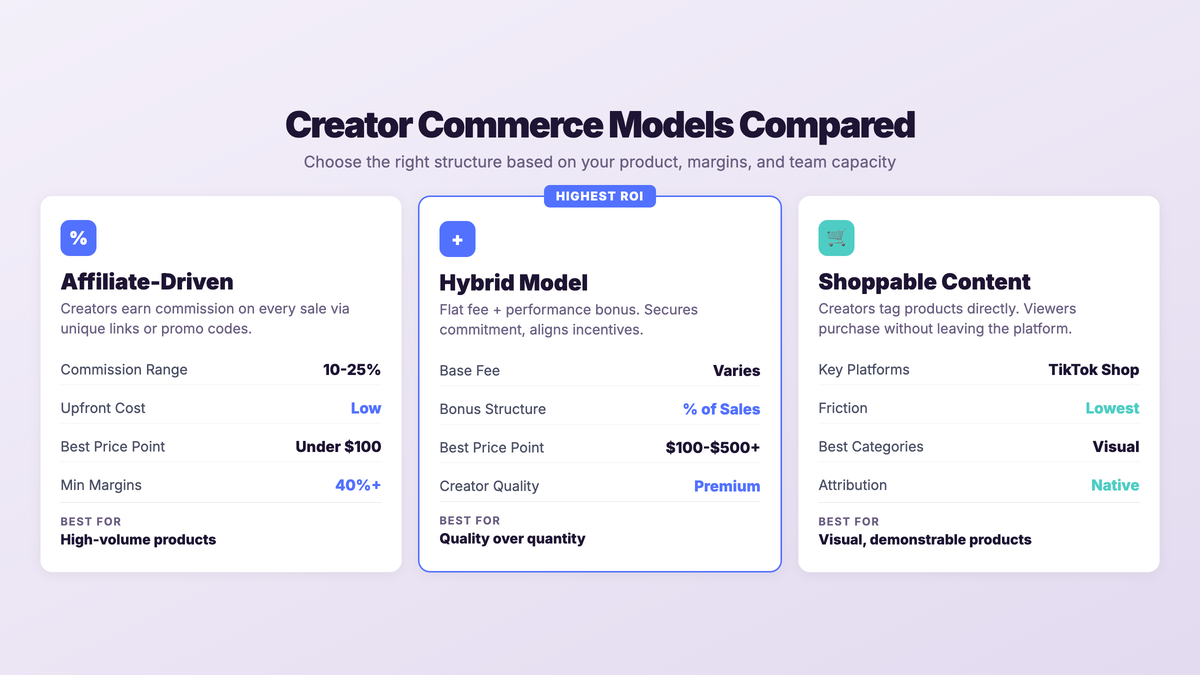
Not every brand should run the same type of creator commerce program. Your model depends on product price point, margin structure, sales cycle, and team capacity. Pick the wrong model and you’ll burn budget on a structure that doesn’t fit your economics.
Affiliate-Driven Commerce
Best for: Brands with products under $100, healthy margins (40%+), and high purchase frequency. Creators earn a commission on every sale they drive through unique links or promo codes.
- Commission range: Typically 10–25% of sale value, with top performers earning higher tiers
- Pros: Low upfront cost, pay-for-performance, scales with the right creators
- Cons: Slower creator buy-in (they bear more risk), requires robust tracking infrastructure
For a deeper dive into structuring affiliate programs, see our guide on how to structure creator affiliate programs that actually convert.
Shoppable Content and Creator Storefronts
Best for: Brands selling visual, demonstrable products (beauty, fashion, home, food) where seeing the product in use drives the purchase decision.
- Mechanism: Creators tag products in posts, stories, and live streams — viewers purchase without leaving the platform
- Key platforms: TikTok Shop, Instagram Shopping, YouTube Shopping
- Pros: Lowest friction path to purchase, native platform analytics
- Cons: Platform dependency, limited to categories with strong visual appeal
Hybrid Model: Flat Fee + Performance Bonus
Best for: Brands with higher price points ($100–$500+), longer consideration cycles, or products that need deeper creator education. The flat fee secures commitment; the performance bonus aligns incentives.
- Structure: Base fee for content creation (covers the creator’s time and production cost) plus a percentage-of-sales bonus that kicks in after a minimum threshold
- Pros: Attracts higher-quality creators who won’t gamble on pure commission, still drives commerce outcomes
- Cons: Higher upfront investment, requires clear performance benchmarks
The right model isn’t permanent. Many brands start with affiliate-driven programs to prove the concept, then layer in shoppable content and hybrid structures as they scale.
Build Your Foundation: Goals, Budget, and Infrastructure
Before recruiting a single creator, you need three things locked down: clear goals, realistic budget allocation, and the technical infrastructure to track results.
Set Commerce-Specific Goals
Generic “brand awareness” goals don’t work for creator commerce. You need metrics that connect directly to revenue:
- Revenue target: How much creator-driven GMV (gross merchandise value) do you want in the first 90 days?
- ROAS floor: What’s your minimum acceptable return on ad spend? Most mature creator commerce programs target 3–5x ROAS.
- Creator conversion rate: What percentage of creator-driven traffic should convert? Industry benchmarks sit between 1.5% and 4% depending on product category.
- Average order value lift: Are creators driving larger baskets through bundling or upsell content?
Allocate Budget Strategically
A common mistake is allocating 100% of the budget to creator fees and leaving nothing for tracking, tools, and product seeding. A practical breakdown for a first program:
- 60% creator compensation — fees, commissions, or hybrid payments
- 15% product and seeding — sending products for authentic reviews and content
- 15% tools and infrastructure — tracking platform, affiliate software, creator management platform
- 10% testing and iteration — A/B testing creative formats, trying new platforms, experimenting with creator tiers
Set Up Your Tracking Infrastructure
You cannot run a commerce-focused creator program without attribution. At minimum, you need:
- Unique affiliate links or UTM parameters per creator — see our tracking guide for implementation details
- Promo code system integrated with your ecommerce platform (Shopify, WooCommerce, BigCommerce)
- First-party data collection — post-purchase surveys asking “how did you hear about us?” as a backup signal
- Dashboard or reporting layer that aggregates creator performance across platforms in one view
Platforms like partnrUP handle the operational complexity — from automated tracking to payment processing — so brands can focus on strategy rather than spreadsheet management.
Recruit the Right Creators for Commerce
The biggest mistake brands make when building a creator commerce strategy is recruiting for reach instead of relevance. A creator with 500K followers and 0.3% engagement will drive fewer sales than a niche creator with 15K followers and a 7% engagement rate who talks about your product category daily.
Commerce-First Creator Selection Criteria
When evaluating creators for commerce programs, prioritize these signals over raw follower count:
- Audience purchase intent: Does their audience actively buy products they recommend? Look for comments asking “where did you get that?” and link-in-bio click patterns.
- Content-to-commerce track record: Have they driven sales for other brands? Ask for case studies or screenshots of affiliate dashboards.
- Product-category alignment: The creator’s niche should naturally overlap with your product. A fitness creator promoting kitchen gadgets won’t convert — even if the follower count is high.
- Engagement quality: High comment rates, saves, and shares indicate an audience that acts on recommendations — not just scrolls past.
- Platform match: If you’re building on shoppable video, prioritize creators who are strong on TikTok and YouTube Shorts over static-image Instagram creators.
Tiered Recruitment Strategy
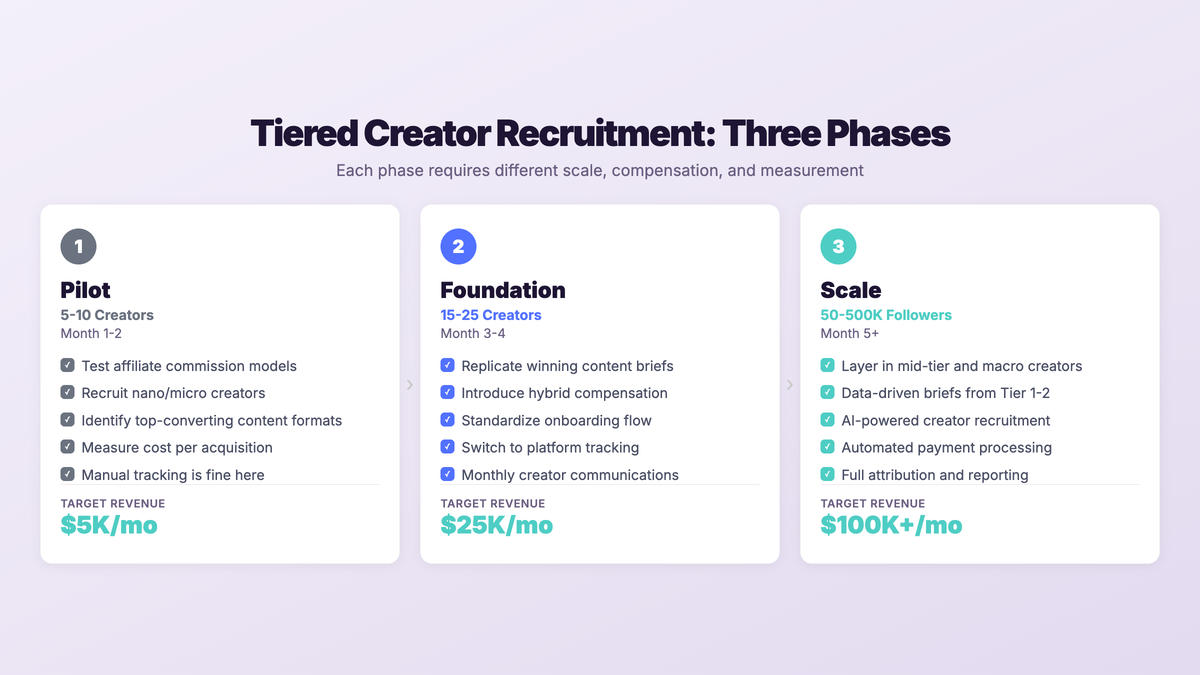
Don’t recruit all at once. Build in tiers:
- Tier 1 — Prove the model (Month 1–2): Recruit 5–10 nano/micro creators (1K–50K followers) on affiliate terms. Low cost, fast feedback loops. Identify what content formats and messaging drive the most conversions.
- Tier 2 — Scale what works (Month 3–4): Bring on 15–25 creators in the same tier that performed well. Replicate winning content briefs. Introduce hybrid compensation for top performers.
- Tier 3 — Add reach (Month 5+): Layer in mid-tier and macro creators (50K–500K) with proven commerce track records. Use data from Tier 1 and 2 to write sharper briefs and set realistic ROAS expectations.
AI-powered matching tools can accelerate this process significantly. Rather than manually scanning profiles, platforms like partnrUP use AI discovery agents that evaluate creators on fit, reach, and engagement and send personalized outreach — resulting in 40% higher creator response rates compared to manual cold outreach.
Launch Your First Creator Commerce Campaigns
Your first campaigns should be designed for learning, not perfection. The goal is to generate enough data to identify what works before scaling spend.
Content Brief Best Practices for Commerce
Commerce-focused briefs differ from awareness briefs. They need to include:
- Clear call-to-action: “Link in bio,” “Use code X,” “Tap to shop” — the viewer must know exactly how to buy
- Product hook in first 3 seconds: Video content that buries the product reveal at the 45-second mark won’t convert. Lead with the product.
- Authentic use case: Don’t script creators. Give them the product, key talking points, and the CTA — then let them create in their own voice.
- Format guidance: Specify whether you want a dedicated review, a “get ready with me” integration, an unboxing, or a day-in-the-life embed. Each format converts differently by category.
For a comprehensive framework on writing briefs that get results, see our guide on how to write a creative brief for creator campaigns.
Platform-Specific Launch Tactics
TikTok Shop: Start with 3–5 creators posting shoppable videos with product links pinned to the video. Monitor the “affiliate GMV” metric directly in TikTok Shop Seller Center. 31% of marketers include TikTok in their influencer plans — the highest platform selection rate in the IMH 2026 survey.
Instagram: Use Shopping tags in Reels and Stories. Pair with a swipe-up (or link sticker) promo code. Track via Instagram’s native commerce analytics plus your UTM layer.
YouTube: Longer-form reviews with affiliate links in descriptions perform well for higher-consideration purchases. YouTube Shopping integration lets creators tag products directly in videos.
Amazon Creator Connections: If you sell on Amazon, their creator program lets influencers link directly to your product pages with trackable attribution.
Set Realistic Timeline Expectations
Creator commerce doesn’t generate results overnight:
- Week 1–2: Product seeding, creator onboarding, brief distribution
- Week 3–4: First content goes live, initial data trickles in
- Month 2: Enough data to identify top-performing creators, content formats, and platforms
- Month 3: First optimization pass — double down on what works, cut what doesn’t
- Month 4+: Scale with confidence using proven playbooks
65.9% of marketers expect payback within one month (IMH 2026) — but building a sustainable creator commerce engine typically takes 60–90 days before the flywheel starts compounding.
Measure, Optimize, and Scale
Once campaigns are running, measurement discipline separates programs that scale from those that stall. The key is tracking both leading indicators (content performance, click-through rates) and lagging indicators (revenue, ROAS, customer lifetime value).
Core Commerce Metrics
Track these at the individual creator level, not just in aggregate:
- Creator-attributed GMV: Total revenue driven by each creator’s links, codes, or storefronts
- ROAS per creator: Revenue divided by total cost (fees + product + platform costs). Target 3x minimum for scaling decisions.
- Conversion rate: Clicks to purchases. Benchmark: 1.5–4% depending on category and price point.
- Average order value (AOV): Are certain creators driving larger baskets? This reveals upsell opportunities.
- Customer acquisition cost (CAC): Total program spend divided by new customers acquired. Compare against paid media CAC to validate the channel.
For a comprehensive breakdown of which metrics matter and which are vanity traps, see our guide on creator commerce metrics: what to track, what to ignore.
Optimization Levers
When data starts coming in, pull these levers:
- Double down on top performers: Move your highest-ROAS creators to hybrid or exclusive contracts. Increase their content cadence.
- Cut underperformers quickly: After 30 days of data, if a creator’s ROAS is below 1x with no trajectory improvement, reallocate their budget.
- Test content format variations: The same creator may drive 3x more revenue with a 60-second tutorial than a 15-second teaser. Run format experiments systematically.
- Expand platform presence: If TikTok Shop is driving 70% of GMV, don’t stop — but test Instagram Shopping and YouTube to diversify.
- Optimize commission structures: Introduce tiered commissions — higher percentages at higher volume thresholds — to incentivize your best creators to push harder.
Scaling the Program
Scaling creator commerce isn’t just “add more creators.” It requires:
- Systematized onboarding: Templated briefs, automated product seeding workflows, self-serve creator portals
- Automated tracking and payments: Manual spreadsheet tracking breaks at 20+ creators. You need platform-level automation for link generation, performance tracking, and payment processing
- Content repurposing: Top-performing creator content should feed into paid media, email, and product pages
- Always-on programs: Move from campaign-based bursts to continuous creator relationships. Long-term partnerships outperform one-off campaigns on both ROAS and creator quality.
When your program reaches 30+ active creators, operational complexity becomes the bottleneck — not strategy. That’s where platforms built for creator commerce become essential, handling everything from AI-powered discovery to automated tracking so your team can focus on scaling what works.
Common Mistakes That Derail Creator Commerce Programs
Most creator commerce programs don’t fail because of bad strategy — they fail because of operational blind spots that compound over time.
Mistake 1: Treating Creator Commerce Like Influencer Marketing
Traditional influencer marketing optimizes for impressions and brand lift. Creator commerce optimizes for revenue. If you’re measuring success by reach and CPM instead of ROAS and GMV, you’re running the wrong playbook.
Mistake 2: Over-Scripting Creator Content
Commerce content converts when it feels authentic. Audiences can spot a scripted ad in three seconds — and they scroll past it. Give creators product knowledge and a CTA, then trust their creative instincts.
Mistake 3: Ignoring Product-Market Fit With Creators
A $12 lipstick and a $3,000 enterprise software subscription require fundamentally different creator commerce strategies. Not every product is suited for impulse-buy shoppable video. Match your commerce model to your product’s natural buying behavior.
Mistake 4: Scaling Before Proving Unit Economics
Adding 50 creators before you’ve validated that creator-driven sales are profitable at the unit level is a fast way to burn budget. Prove the model with 5–10 creators first, then scale.
Mistake 5: No Feedback Loop Between Commerce Data and Creator Strategy
Your best-converting content formats, messaging angles, and creator profiles should feed back into your recruitment and briefing process. If you’re not updating briefs based on performance data every 30 days, you’re flying blind.
Building a Creator Commerce Engine That Lasts
Creator commerce isn’t a campaign tactic — it’s a revenue channel that compounds over time. The brands winning in 2026 aren’t the ones with the biggest influencer budgets. They’re the ones who built systems: systematic creator recruitment, systematic tracking, systematic optimization.
Start with a model that fits your economics. Recruit creators who drive purchases, not just impressions. Build the tracking infrastructure to prove what works. Then scale deliberately, using data — not gut feel — to guide every decision.
The tools exist to make this manageable even for lean teams. partnrUP’s AI-powered platform handles the operational complexity — creator discovery, automated outreach, tracking, and payments — so you can focus on the strategy that drives growth. Book a demo to see how brands are building creator commerce programs that deliver measurable ROI from day one.
Frequently Asked Questions
How much budget do I need to start a creator commerce program?
You can launch a meaningful pilot with $5,000–$15,000 spread across 5–10 nano/micro creators on affiliate terms, plus product seeding costs. The key is reserving 15% of budget for tracking tools and infrastructure — without attribution, you can’t measure what’s working.
What’s the difference between creator commerce and affiliate marketing?
Affiliate marketing is one model within creator commerce. Creator commerce is the broader discipline that includes affiliate links, shoppable video, creator storefronts, product seeding programs, and hybrid compensation models — all aimed at driving measurable revenue through creator partnerships.
Which platform should I launch on first?
Start where your target audience already shops. For impulse-buy products under $50, TikTok Shop offers the lowest friction. For higher-consideration purchases, YouTube long-form reviews drive better conversion rates. Instagram sits in between — strong for fashion, beauty, and lifestyle categories.
How long does it take to see ROI from creator commerce?
Expect the first meaningful data within 3–4 weeks of content going live. However, building a sustainable, profitable program typically takes 60–90 days as you iterate on creator selection, content formats, and commission structures.
How do I prevent creators from cannibalizing each other’s sales?
Use unique tracking links and promo codes per creator so attribution is clear. For overlapping audiences, stagger content drops by 48–72 hours. Also consider geographic or demographic segmentation — assign creators to specific audience segments rather than having everyone promote the same product simultaneously.
What commission rate should I offer creators?
Industry standard ranges from 10–25% of sale value, depending on your margins and product price point. Start at 15% for your pilot, then introduce tiered rates — higher percentages at higher volume thresholds — to incentivize top performers. Always factor in product cost + shipping + creator commission to ensure unit profitability.
How do I measure the impact of creator commerce beyond direct sales?
Track halo effects: branded search volume lifts during creator campaign windows, organic traffic increases to product pages, email signup rates from creator-driven landing pages, and customer lifetime value of creator-acquired customers vs. paid media customers. Many brands find creator-acquired customers have 20–30% higher LTV because the trust transfer from creator to brand carries through.