YouTube pays mid-roll ads only on videos that are 8 minutes or longer, while TikTok’s Creator Rewards Program only counts videos that are at least one minute long. Two platforms, two economic floors, two completely different creative mandates — and most brands send the same creative brief to creators on both.
That single brief is why so much creator content underperforms. A brief written for a 30-second hook produces a thin, padded eight-minute video. A brief written for a deep-dive review produces a Reel that loses its audience in the first three seconds. The creator is rarely the problem. The instructions are.
This guide is part of our Branded Content Creation: From Strategy to Production to Distribution pillar — the complete framework for planning, producing, and distributing creator content at scale.
If you need the fundamentals of brief construction first — objectives, audience, deliverables, usage rights — start with our guide on how to write a creative brief for creator campaigns. That piece covers the core sections every brief needs regardless of format. This one is the layer on top: how those sections change when the deliverable is a three-minute Short versus a twelve-minute YouTube feature.
What you’ll learn
- Why format, not platform, should drive your brief structure
- The verified technical and monetization thresholds that shape creator decisions
- How to write hook direction for short-form without scripting the creator into a corner
- What long-form briefs need that short-form briefs actively should not include
- How to brief a single concept across both formats without duplicating work
- Which success metrics belong in which brief
- How to handle revisions and approvals differently by format
Table of Contents
- Format Is the Variable, Not Platform
- The Platform Realities Your Brief Has to Respect
- How to Brief Short-Form Content
- How to Brief Long-Form Content
- The Shared Spine: Briefing One Concept Across Both
- Setting Format-Appropriate Success Metrics
- Revisions, Approvals, and Creative Control by Format
- Scaling Format-Specific Briefs Without Doubling Your Workload
Format Is the Variable, Not Platform
The most common briefing mistake is organizing by channel. Brands write a “TikTok brief,” an “Instagram brief,” and a “YouTube brief” as if the platform logo determines the creative approach. It doesn’t. Every major platform now hosts both formats.
YouTube runs Shorts alongside its traditional long-form library. Instagram carries Reels and multi-minute uploads. TikTok, once synonymous with quick clips, now structures its monetization program around videos over a minute. Briefing by platform means writing three documents that each need to cover two formats — and usually doing neither well.
What actually changes between formats
Short-form and long-form differ on four axes that matter to a brief:
- Attention contract. Short-form earns attention in the first second and re-earns it continuously. Long-form gets a grace period in exchange for a promise of depth.
- Information density. Short-form carries one idea. Long-form can carry five, but needs structure to do it.
- Production burden. Long-form requires scripting, B-roll, and editing time that short-form doesn’t.
- Discovery mechanics. Short-form is served to strangers. Long-form is largely watched by people who already chose the creator.
That last point reshapes everything. Short-form content is talking to someone who has never heard of your brand. Long-form is talking to someone who trusts the person holding the camera. A brief that ignores this difference will produce content that misfires on both ends.
The cost of the generic brief
When a brief is format-agnostic, creators fill the gaps with guesswork. Some pad short concepts to hit a length requirement. Others compress a genuinely complex product story into 15 seconds and lose the value proposition entirely. Neither outcome is a creator failure — both are briefing failures that show up later as weak campaign KPIs.
The Platform Realities Your Brief Has to Respect
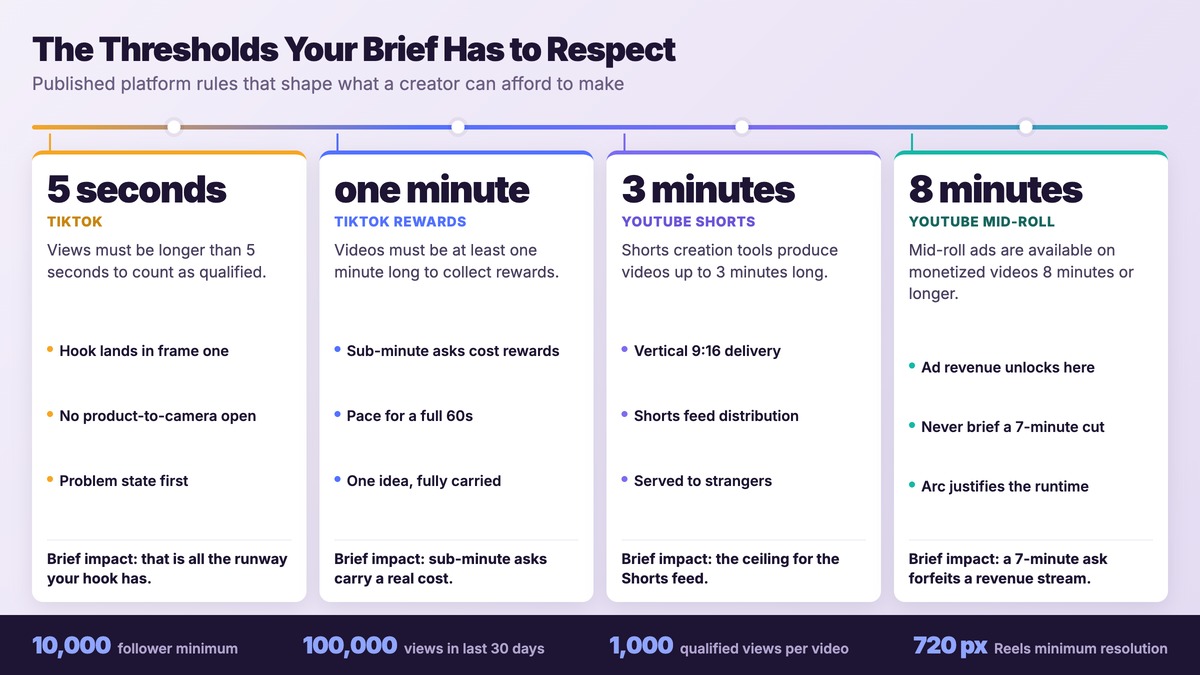
Before you write format direction, you need to know the constraints creators are actually operating under. These are published thresholds, not estimates.
YouTube: the 3-minute and 8-minute lines
YouTube’s Shorts creation tools produce short-form videos that are up to 3 minutes long, according to YouTube’s own Help Center. That’s the ceiling for the Shorts feed.
On the long-form side, YouTube states that mid-roll ads can be enabled on monetized videos that are 8 minutes or longer. This is the single most important number in creator economics on that platform. A creator making a video for you at 7 minutes is giving up an entire revenue stream. If your brief specifies a length, know which side of that line you’re putting them on — and price accordingly.
TikTok: the one-minute monetization floor
TikTok’s Creator Rewards Program requires that videos be at least one minute long to collect rewards. The program also requires creators to have at least 10,000 followers and at least 100,000 video views in the last 30 days, and each qualifying video needs at least 1,000 qualified views from the For You feed, with views counted only when they’re longer than 5 seconds.
Read that last detail again. A view under five seconds doesn’t count. That is the platform telling you, in policy language, exactly how much runway your hook has.
Instagram: the technical floor
Instagram accepts Reels with an aspect ratio between 1.91:1 and 9:16, and specifies a minimum frame rate of 30 FPS and a minimum resolution of 720 pixels. These belong in your brief’s deliverable specs, not in a follow-up email after a creator submits a file that gets downscaled.
What to do with these numbers
Put them in the brief as constraints, not as targets. “Minimum 720 pixels, 9:16” is a spec. “Make it 8 minutes” is a target that may fight the content. The best briefs state the technical floor and let the concept determine the length — unless there’s a business reason to force a threshold, in which case say so explicitly.
How to Brief Short-Form Content
A short-form brief should be shorter than the video is long to read. If a creator needs ten minutes to understand a 30-second deliverable, the brief has failed.
Lead with the single idea
Every short-form brief needs one sentence that states the one thing the video must communicate. Not three things ranked by priority — one. If your product has four differentiators, that’s four short-form videos, not one crowded video.
Write it as a takeaway from the viewer’s perspective: “After watching, someone should know that this dries in under a minute.” That framing prevents the feature-list brief that produces feature-list content.
Direct the hook without scripting it
This is where most brands overcorrect. Knowing the first seconds are decisive, they write the opening line themselves — and get flat, obviously-sponsored content. Brief the hook’s job, not its wording.
- Do: “Open on the problem state, not the product. We want someone to recognize their own situation before they see anything branded.”
- Do: “The first frame should be visually distinct from a typical ad — no product held up to camera in the opening.”
- Don’t: “Start by saying, ‘I found the best new product for busy moms.'”
The distinction matters because creators know their audience’s tolerance for a sales tone better than you do. Give them the strategic requirement and let them meet it in their own voice. This is the same principle that governs scaling creative production without losing brand authenticity — constrain the outcome, not the execution.
Keep mandatories brutally short
Short-form has no room for a four-item legal readout. Pick the one disclosure that’s legally required, the one brand mention that’s contractually required, and cut the rest. If your mandatory list is longer than five items, you’re writing a long-form brief by accident.
Specify the caption and on-screen text separately
In short-form, on-screen text often carries more weight than spoken audio — a large share of feed viewing happens with sound off or partially attended. Brief the on-screen text requirement explicitly rather than assuming it will mirror the voiceover.
How to Brief Long-Form Content
Long-form briefs invert almost every rule above. Here, more context genuinely helps, because the creator is building a structure rather than a moment.
Give them the narrative arc, not a shot list
Long-form content needs a beginning, a middle that earns the runtime, and a reason to stay past the midpoint. Your brief should propose an arc: what the setup is, what the turn is, and what the payoff is. Then let the creator fill it.
A useful structure to hand over:
- Setup: the question or problem the video answers
- Context: why the obvious answer is incomplete
- Demonstration: the section where your product actually appears in use
- Honest limits: where it isn’t the right fit
- Resolution: what the viewer should do or believe
That fourth bullet is the one brands cut, and it’s the one that makes long-form work. Audiences watching a twelve-minute video will not accept an unbroken infomercial. Building in permission to name a limitation buys credibility for everything else.
Provide depth material you’d never send for short-form
Long-form creators need raw material: technical specs, founder background, sourcing details, comparison data, and the reasoning behind product decisions. Send an appendix. A short-form creator will never open it, and a long-form creator will build twenty minutes of content from it.
Brief the placement, not just the mention
In an eight-minute video, where your segment sits determines its performance. Specify whether you want an integrated segment (woven through), a dedicated block (a clearly marked section), or a pre-roll read. Each has different completion characteristics, and creators price them differently.
Address the 8-minute economics directly
If you want a video that clears YouTube’s 8 minutes or longer mid-roll threshold, say so and acknowledge what you’re asking for. If your concept honestly supports only five minutes, don’t force it — a padded eight-minute video performs worse than a tight five-minute one, and audience retention is the metric the algorithm actually reads.
The Shared Spine: Briefing One Concept Across Both
Most campaigns need both formats. The efficient approach isn’t two unrelated briefs — it’s one strategic core with two execution layers.
What stays identical
- Campaign objective and the business outcome behind it
- Target audience definition
- Brand positioning and tone guardrails
- Legal and disclosure requirements
- Usage rights, exclusivity windows, and timelines
- Approval workflow and contacts
What forks
- Message scope: one idea for short-form, a full argument for long-form
- Opening direction: hook mechanics versus premise setup
- Supporting material: a one-pager versus a full appendix
- Deliverable specs: aspect ratio, resolution, length range
- Success metrics: reach and completion versus retention and conversion
- Revision expectations: fast and light versus staged
Structuring it this way also makes your content library more reusable. When the strategic core is shared, long-form footage becomes a legitimate source for short-form cutdowns — which is the foundation of any real content repurposing strategy for creator assets. Brief the long-form shoot with the cutdowns in mind and you get both formats from one production day.
On the partnrUP platform, this shared-spine structure is how campaign briefs are organized by default: a single strategic layer with format-specific deliverable requirements attached per creator, so the core message stays consistent while the execution direction adapts.

Setting Format-Appropriate Success Metrics
Judging both formats by the same scorecard is how good content gets killed. The two do different jobs.
Short-form metrics
- Watch-through rate — the cleanest signal of hook quality
- Reach and impressions — short-form’s actual job is distribution to strangers
- Shares and saves — stronger intent signals than likes
- Follower lift on the creator’s account — indicates genuine resonance
Long-form metrics
- Average view duration — the metric that governs distribution
- Retention at your segment — ask for the graph, not just the average
- Click-through from description and cards — long-form drives measurable action
- Assisted conversions — long-form frequently opens the consideration window rather than closing the sale
Expecting direct last-click conversions from short-form, or expecting viral reach from an eight-minute review, sets both up to fail. Getting attribution right across these formats is its own discipline — our influencer ROI attribution guide covers how to model multi-format contribution properly.
Revisions, Approvals, and Creative Control by Format
The review process should match the production cost of what you’re reviewing.
Short-form: approve the concept, not the cut
Short-form is cheap to produce and expensive to over-manage. Requiring frame-level approval on a 20-second video generates more email than value. Approve the concept in one line before the shoot, then review the finished piece against the mandatory list — not against taste.
Long-form: stage the approvals
Long-form deserves checkpoints, because a rework at the final-cut stage can cost a creator a full day of editing:
- Outline approval — confirm the arc before filming
- Segment script or talking points — check claims and disclosures before production
- Rough cut — verify placement and framing
- Final — confirmation only, not a new round of notes
Establishing this cadence up front is also what makes long-term creator partnerships workable. Creators who know the checkpoints will accept them; creators surprised by a fourth round of notes will not work with you twice.
Write the revision limit into the brief
State how many rounds are included. Two is standard for long-form, one for short-form. Ambiguity here is the single most common source of friction in creator relationships, and it costs nothing to resolve in a sentence.
Scaling Format-Specific Briefs Without Doubling Your Workload
Running two brief variants across dozens of creators is where this breaks down manually.
Build modular, not bespoke
Maintain one strategic core document per campaign and two format modules. When the campaign message changes, you edit one file. When a format spec changes, you edit one module. Nobody rewrites 40 briefs.
Match format to creator, not creator to format
Some creators are genuinely excellent at short-form and mediocre at long-form, and vice versa. Assigning format based on demonstrated performance rather than availability is one of the highest-leverage decisions in a campaign — and it starts during selection, which our guide to vetting creators for brand sponsorships covers in depth.
Track which format module produces results
Version your brief modules and tie outcomes back to them. Over a few campaigns you’ll learn which hook direction, which mandatory structure, and which approval cadence actually correlate with performance. That feedback loop is the difference between a brief template and a briefing system, and it’s central to building a durable creator content strategy.
Conclusion
Short-form and long-form are not two lengths of the same content. They operate under different attention contracts, different discovery mechanics, and — as YouTube’s 8-minute mid-roll threshold and TikTok’s one-minute rewards floor make explicit — different economics for the creator producing them.
Briefing them identically asks creators to resolve a strategic question you should have answered. Briefing them separately, from a shared strategic spine, produces content that fits where it lands.
Start by auditing your current brief template: mark every section that would need to change if the deliverable flipped from a 30-second Reel to a ten-minute review. Those sections are your format modules. Everything else is your core.
If you want to see how format-specific briefing works when it’s built into the workflow rather than managed in documents, book a demo — or explore how partnrUP’s platform handles multi-format campaign briefs and creator matching in one place.
Frequently Asked Questions
Should I send creators one brief or two when a campaign covers both formats?
Send one document with a shared strategic core and a clearly separated format module. Two entirely separate briefs create version drift, and a single merged brief forces creators to figure out which instructions apply to them. The modular structure gives you consistency and specificity at once.
How long should a short-form brief be?
One page, ideally less. If a creator needs more than a few minutes to understand a 30-second deliverable, the brief is competing with the work. Lead with the single message, the hook direction, the mandatories, and the specs — then stop.
Does the 8-minute YouTube threshold mean I should always request longer videos?
No. YouTube allows mid-roll ads on monetized videos that are 8 minutes or longer, which matters to the creator’s economics, but a padded video hurts retention and therefore distribution. Request the length the concept genuinely supports. If you want to clear the threshold, make sure there’s enough substance to fill it.
How much creative control should I keep over the hook?
Direct the hook’s job, not its script. Specify what the opening must accomplish — establish the problem, avoid an obvious ad framing, land the visual within the first frame — and let the creator write the actual line. Scripted hooks are the most reliable way to make sponsored content look sponsored.
Can I repurpose long-form footage into short-form deliverables?
Yes, and you should brief for it in advance. Ask the creator to shoot with cutdowns in mind and negotiate the usage rights up front. Retrofitting cutdown rights after a shoot is a renegotiation; including it in the original brief is a line item.
What technical specs belong in every brief?
At minimum, aspect ratio and resolution. Instagram accepts Reels with an aspect ratio between 1.91:1 and 9:16 and specifies a minimum frame rate of 30 FPS and a minimum resolution of 720 pixels. Stating floors like these prevents deliverables that get downscaled or cropped on upload.
How many revision rounds should a creator brief include?
One round for short-form and two for long-form is a reasonable standard, with the number stated explicitly in the brief. Long-form warrants staged checkpoints — outline, talking points, rough cut — because late-stage changes can cost a creator a full day of editing.