Nearly 88% of marketers plan to increase their influencer budgets in 2026, according to the Influencer Marketing Hub 2026 Benchmark Report — yet two-thirds of brands now run programs entirely in-house, according to the same report — meaning internal teams bear the full weight of scaling creative output while maintaining brand consistency. The gap between ambition and operational capacity is where most programs stall: more creators, more content, more channels, and brand voice slowly eroding with each new partnership.
This guide is part of our Creator Content Strategy: Building a Scalable Creative Program for Your Brand — a comprehensive resource covering every stage of building and scaling creator-driven content programs.
The challenge is not whether to scale — it is how to scale without diluting the identity that makes your brand recognizable. Every creator you onboard brings their own voice, visual style, and audience expectations. Multiply that across dozens or hundreds of partnerships, and brand consistency becomes a full-time job.
In this guide, you’ll learn:
- Why brand authenticity breaks down at scale — and the specific inflection points where it happens
- How to build brand guardrails that protect consistency without strangling creator creativity
- The framework for tiered creative freedom that matches creator trust levels to content flexibility
- Which quality control systems actually work when you are reviewing hundreds of assets per month
- How AI-powered matching and workflow automation eliminate the operational bottlenecks that force brands to choose between scale and quality
Table of Contents
- Why Brand Authenticity Breaks at Scale
- Building Brand Guardrails That Actually Work
- The Tiered Creative Freedom Model
- Quality Control Systems for High-Volume Content
- Using AI Matching to Protect Brand Alignment
- Measuring Brand Authenticity Across Creator Content
- Conclusion: Scale and Authenticity Are Not Opposites
- Frequently Asked Questions
Why Brand Authenticity Breaks at Scale
Brand authenticity does not disappear overnight. It erodes gradually as programs expand beyond what manual processes can sustain. Understanding the specific failure points is the first step toward preventing them.
The Creator Volume Inflection Point
Most brands can maintain consistent creative output with 5 to 10 active creator partners. At that scale, a single marketing manager can personally brief each creator, review every draft, and course-correct in real time. The problems start at 20+ concurrent partnerships, where personal oversight becomes mathematically impossible.
When a brand manager has 45 minutes per creator brief at the 10-creator level, that same manager has fewer than 10 minutes per creator at 50 partnerships. Briefs get templated. Reviews get rushed. Feedback loops disappear. The result is content that technically follows guidelines but lacks the brand-specific nuance that makes it effective.
The Telephone Game Effect
As teams grow and responsibility distributes across coordinators, agencies, and regional leads, brand voice mutates through each layer of interpretation. What started as “conversational and empowering” becomes “casual” in one coordinator’s briefing and “enthusiastic” in another’s. By the time it reaches the creator, the original brand intent is barely recognizable.
This is not a people problem — it is a systems problem. Without a structured creative brief process, brand voice becomes oral tradition rather than documented strategy.
Platform Fragmentation
Scaling creative production also means scaling across platforms. A creator’s TikTok content has fundamentally different requirements than their Instagram Reels, YouTube Shorts, or blog posts. Each platform’s native format, aspect ratio, caption structure, and audience behavior changes how brand messaging needs to be delivered — and most brand guidelines were not written with multi-platform creator content in mind.
Building Brand Guardrails That Actually Work
Effective brand guardrails are not 40-page documents that sit in a Google Drive folder. They are actionable, reference-ready tools that creators can use in the moment they are producing content. The best guardrails create a corridor of creativity — clear boundaries with wide-open space inside them.
The Non-Negotiable vs. Flexible Framework
Split every brand element into two categories:
Non-negotiable (hard boundaries):
- Brand name pronunciation and spelling (including capitalization: “partnrUP” not “PartnerUp”)
- Product claims that require legal review or regulatory compliance
- Visual elements that must appear exactly as specified (logos, trademark assets)
- Prohibited language, competitor mentions, or topic areas
- Required disclosures (FTC, platform-specific sponsorship tags)
Flexible (creative freedom zone):
- Tone and delivery style — how the creator integrates the message into their voice
- Visual composition and styling within the creator’s existing aesthetic
- Story structure and content flow
- Background, setting, and production choices
- Hook and opening approach
When creators know exactly what they cannot change, they gain confidence to creatively own everything else. This dual-lane approach eliminates the hesitation that produces generic, by-the-numbers content.
Living Brand Reference Kits
Replace static PDF brand guides with living reference kits that include:
- Do/Don’t video examples — curated clips showing approved creative approaches alongside rejected ones, with annotations explaining why
- Voice spectrum cards — rather than a single “brand voice,” provide 3 to 4 approved voice variations with examples (e.g., “expert educator,” “relatable friend,” “bold challenger”)
- Visual mood boards per platform — Instagram-specific, TikTok-specific, and YouTube-specific references that show how brand elements flex across formats
- A quick-reference one-pager — the 5 things every creator must get right, in bullet-point form, designed to be taped to a monitor or saved as a phone screenshot
Platforms like partnrUP centralize these reference materials within the creator workflow, so briefs, guidelines, and approved examples live where creators are already working — not buried in an email thread from three weeks ago.
The Tiered Creative Freedom Model
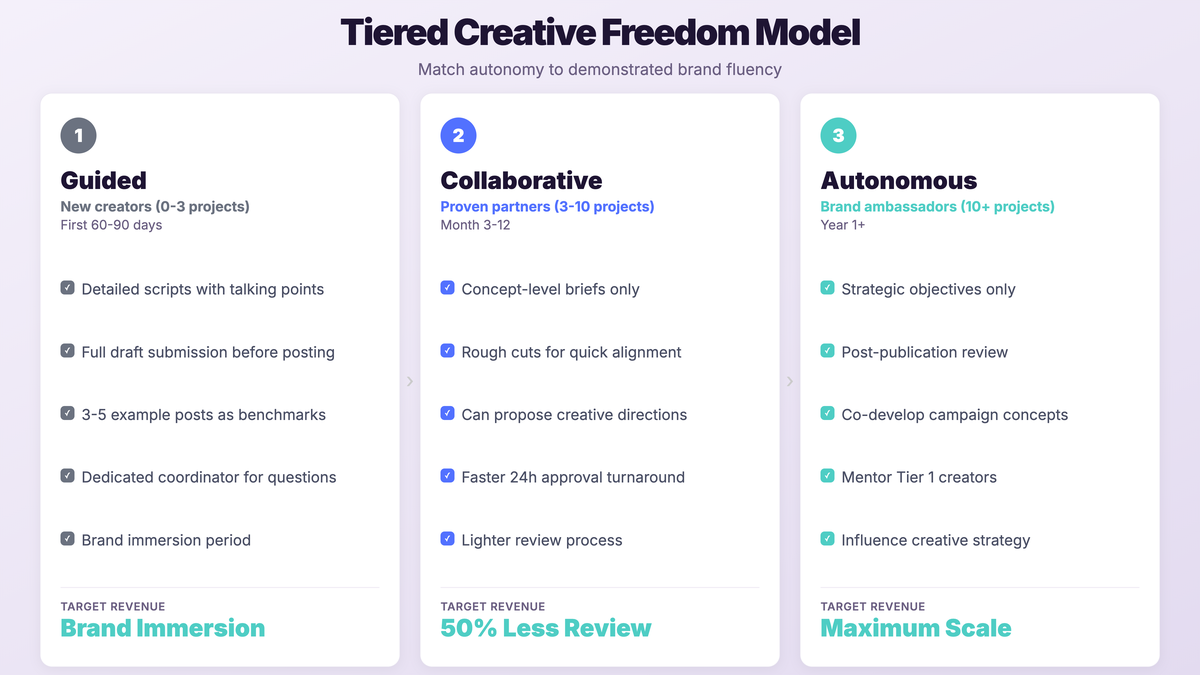
Not every creator should operate with the same level of autonomy. A tiered system matches trust and track record to creative latitude, letting proven partners push boundaries while newer creators work within tighter guardrails until they demonstrate brand fluency.
Tier 1: Guided (New Creators)
Creators who are new to your brand or have fewer than 3 completed partnerships. At this level:
- Provide detailed scripts or scene-by-scene outlines with specific talking points
- Require draft submission before posting — full review cycle with written feedback
- Share 3 to 5 example posts from Tier 2/3 creators as benchmarks
- Assign a dedicated coordinator for real-time questions during production
The goal is not micromanagement — it is brand immersion. Guided creators should emerge from their first 2 to 3 projects with enough context to confidently move to Tier 2.
Tier 2: Collaborative (Proven Partners)
Creators with 3 to 10 successful brand projects and demonstrated understanding of your voice. Collaborative-tier creators:
- Receive concept-level briefs rather than scene breakdowns — key messages, deliverable specs, and required elements, with creative approach left to the creator
- Submit thumbnails or rough cuts for quick alignment checks, not full draft reviews
- Can propose creative directions within campaign parameters
- Get faster approval turnarounds (24 hours rather than multi-day cycles)
Tier 3: Autonomous (Brand Ambassadors)
Creators with 10+ successful projects, consistently on-brand output, and deep understanding of your audience. These are your brand ambassadors:
- Receive strategic objectives only — “Launch this product line to your audience” rather than prescribed content formats
- Have post-publication review instead of pre-approval (unless the campaign involves regulated claims)
- Can co-develop campaign concepts and influence the creative strategy
- Mentor Tier 1 creators through shared content examples and brand voice workshops
This tiered approach lets you scale your creator program without adding proportional headcount to the review process. By the time 60% of your active roster reaches Tier 2 or higher, your review burden drops by roughly half.
Quality Control Systems for High-Volume Content
Manual quality control breaks at approximately 100 content assets per month. Beyond that threshold, brands need systems that standardize review without creating bottlenecks. Here are the operational frameworks that work at scale.
The Scorecard Review Method
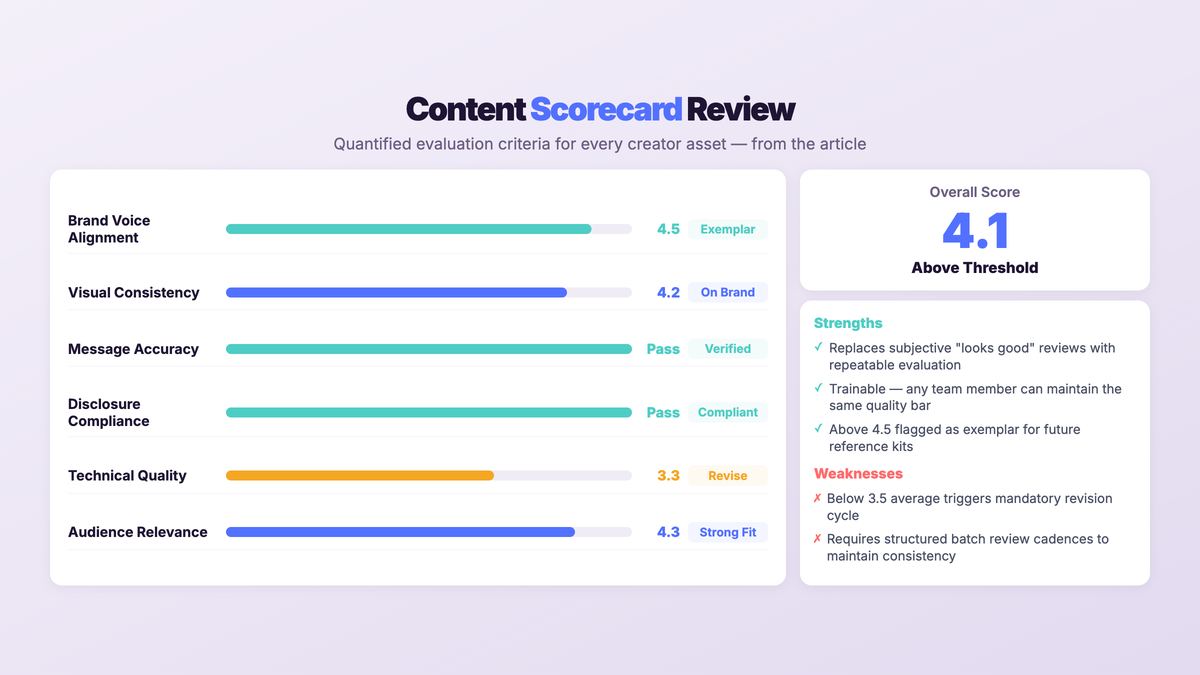
Replace subjective “looks good” reviews with a quantified scorecard that evaluates every piece of content against 5 to 7 specific criteria:
- Brand voice alignment (1-5 scale) — Does the tone match approved voice parameters?
- Visual consistency (1-5 scale) — Are brand colors, fonts, and logo usage correct?
- Message accuracy (pass/fail) — Are product claims and brand statements factually correct?
- Disclosure compliance (pass/fail) — FTC and platform-specific disclosures present and properly formatted?
- Technical quality (1-5 scale) — Resolution, audio clarity, lighting, editing quality
- Audience relevance (1-5 scale) — Will this resonate with the creator’s audience while serving your brand’s objectives?
Content scoring below a 3.5 average triggers a revision cycle. Content scoring above 4.5 gets flagged as an exemplar for future reference kits. This replaces gut-feel reviews with repeatable, trainable evaluation — essential when multiple team members need to maintain the same quality bar.
Automated Pre-Screening
Before human review even begins, automated checks can filter out obvious issues:
- Brand safety scans — flagging content that mentions competitors, uses prohibited language, or appears in problematic contexts
- Disclosure verification — checking for #ad, #sponsored, or platform-specific partnership labels
- Visual asset checks — confirming correct logo usage, resolution thresholds, and aspect ratios
- Hashtag and caption compliance — verifying required hashtags and campaign handles are present
Automated pre-screening can eliminate up to 30% to 40% of review workload by catching mechanical errors before they reach a human reviewer. The reviewer’s time is then spent on the subjective, brand-judgment decisions that actually require expertise.
Batch Review Cadences
Instead of reviewing content one piece at a time as it arrives, implement structured batch review windows:
- Daily 30-minute block for time-sensitive content (launches, trending moments)
- Twice-weekly deep review sessions for standard campaign content
- Monthly brand consistency audits reviewing a random sample of 20 to 30 published posts against the scorecard
Batch reviews are typically significantly faster per piece than ad-hoc reviews because the reviewer stays in “brand evaluation mode” rather than context-switching between unrelated tasks. Tools like partnrUP’s workflow automation can queue content into these review windows automatically, routing items based on creator tier and content type.
Using AI Matching to Protect Brand Alignment
The most effective scaling strategy is prevention: matching with creators who already align with your brand before a single piece of content is produced. This is where AI-powered discovery fundamentally changes the quality-at-scale equation.
Beyond Demographics: Value-Based Matching
Traditional influencer discovery focuses on surface metrics — follower count, engagement rate, audience demographics. AI-powered matching goes deeper, analyzing:
- Content tone and style patterns — Does this creator’s natural voice overlap with your brand’s approved voice spectrum?
- Visual aesthetic alignment — Do their production choices (lighting, color palette, editing style) complement your brand’s visual identity?
- Audience value alignment — Does their audience engage with topics and themes consistent with your brand positioning?
- Historical brand collaboration quality — How have they performed with similar brands? Do sponsored posts maintain their organic engagement rates?
When creators are pre-selected for brand alignment, the quality control burden shrinks dramatically. A creator whose organic content already sounds like your brand needs minimal guidance to produce on-brand sponsored content. partnrUP’s AI-powered discovery engine evaluates these alignment signals at scale — matching brands to creators who fit naturally rather than forcing a mismatch through heavy-handed briefs.
Audience Insight Reports for Pre-Vetting
Before committing to a partnership, audience intelligence reports reveal whether a creator’s community aligns with your target segments. Key pre-vetting data points include:
- Audience demographic overlap — age, geography, gender distribution versus your ICP
- Content affinity categories — what topics the audience actively engages with
- Purchasing behavior signals — affiliate link click-through patterns, product tagging engagement
- Brand safety indicators — audience sentiment patterns, controversial topic exposure
Spending 30 minutes on pre-vetting with accurate data saves hours of revision cycles with a misaligned creator later.
Measuring Brand Authenticity Across Creator Content
You cannot improve what you do not measure. Establishing clear metrics for brand authenticity transforms it from a subjective judgment into a trackable program KPI. According to the IMH 2026 Benchmark Report, brand awareness remains the most-selected KPI at 55.1% — but awareness without authenticity creates impressions that do not convert.
Brand Consistency Score
Aggregate scorecard reviews into a rolling Brand Consistency Score that tracks alignment across your entire creator roster:
- Per-creator scores — trending over time to identify creators who improve versus plateau
- Per-campaign scores — comparing consistency across different campaign types and objectives
- Per-platform scores — revealing which channels have the widest variance in brand alignment
- Cross-quarter trends — showing whether scaling is improving or degrading consistency
Target a Brand Consistency Score above 4.0 out of 5.0 across your active roster. Creators consistently below 3.5 need either additional support (moving down a tier) or off-boarding.
Engagement Quality Metrics
Authentic brand content does not just get views — it gets meaningful engagement. Track:
- Comment sentiment — are comments about the product/brand or just about the creator?
- Save and share rates — higher-intent actions that indicate the content delivered value
- Branded search lift — did the content drive people to search for your brand by name?
- Follower-to-site conversion — click-through rates on brand links and CTAs
When these KPIs are tracked systematically, you can directly correlate brand authenticity scores with business outcomes — proving that consistency is not just a brand exercise but a revenue driver.
Attribution Across the Content Ecosystem
Scaled creator content feeds multiple touchpoints: organic social, paid amplification, website landing pages, email campaigns, and retail partner sites. A robust attribution framework connects each creator’s contribution to downstream business results, helping you identify which creators and which creative approaches deliver both authenticity and performance.
Brands using structured UTM and affiliate tracking alongside brand lift studies find that the most authentic creator content outperforms generic sponsored posts by 2 to 3x on conversion metrics — reinforcing that authenticity and business results are aligned, not competing objectives.
Conclusion: Scale and Authenticity Are Not Opposites
Scaling creative production without losing brand authenticity is not about restricting creativity — it is about building the infrastructure that makes consistent creativity possible. The brands winning at scale in 2026 have three things in common:
- Clear, actionable guardrails that give creators a corridor of creative freedom within defined boundaries
- Tiered creator partnerships that match autonomy to demonstrated brand fluency
- AI-powered systems that automate the operational overhead so human attention is spent on strategy, not logistics
The difference between a 10-creator program that feels hand-crafted and a 100-creator program that feels mass-produced comes down to systems. When the right creators are matched, properly briefed, and supported by scalable workflows, every piece of content can carry the same brand integrity — regardless of volume.
Platforms like partnrUP are purpose-built for this challenge. With AI-powered creator matching that prioritizes brand alignment, automated workflow management that eliminates coordination bottlenecks, and built-in tracking that connects authenticity to ROI, scaling creative production becomes a systems problem with a systems solution.
Ready to scale your creator program without sacrificing brand authenticity? Book a demo to see how partnrUP’s AI matching and workflow automation keep your brand voice consistent — at any volume.
Frequently Asked Questions
How many creators can a brand manage before authenticity starts to slip?
Most brands hit their first quality inflection point between 15 and 25 active creator partnerships. This is the point where personal oversight from a single manager becomes unsustainable. The solution is not fewer creators but better systems — tiered creative freedom, structured briefs, and automated pre-screening can push that threshold well past 100 concurrent partnerships without quality degradation.
What is the biggest mistake brands make when scaling creative production?
Templating everything. When brands scale by giving every creator identical scripts and shot lists, the content becomes homogeneous and inauthentic. Audiences can tell when a creator is reading from a script they did not write. The better approach is to define boundaries, not blueprints — non-negotiable brand elements combined with wide creative latitude on everything else.
How do tiered creative freedom levels actually work in practice?
New creators (Tier 1) receive detailed briefs with specific talking points and submit full drafts for review. After 3 to 5 successful projects, they advance to Tier 2 with concept-level briefs and lighter review. Proven brand ambassadors (Tier 3) receive strategic objectives only, with post-publication review. Most brands find that 60% or more of their roster reaches Tier 2 within 6 months, dramatically reducing the review burden.
Can AI really assess brand voice alignment?
Modern AI matching analyzes content tone, visual aesthetic, audience engagement patterns, and historical brand collaboration quality to score alignment before a creator is ever briefed. This is not replacing human judgment — it is pre-filtering the discovery pool so brand managers only evaluate creators who already fit. The result is 40% higher creator response rates and significantly fewer revision cycles.
How should brands handle a creator who produces off-brand content?
First, assess whether the issue is a brief failure or a creator mismatch. If the creator understood the guidelines and simply interpreted them differently, provide specific feedback with examples and move them down a tier for the next project. If the content fundamentally conflicts with your brand values — tone-deaf humor, competitor endorsement, brand safety violation — that is a mismatch, and the partnership should not continue regardless of the creator’s audience size.
What metrics prove that brand authenticity drives business results?
Track engagement quality (saves, shares, branded search lift) alongside traditional volume metrics (views, reach). Content that scores high on Brand Consistency (4.0+) typically outperforms inconsistent content by 2 to 3x on conversion metrics. Additionally, monitor creator retention rates — brands that give creators creative freedom within guardrails see higher re-partnership rates, which compounds authenticity over time as creators develop deeper brand fluency.
How long does it take to build a scalable creative production system?
The foundational elements — brand guardrails framework, scorecard review process, and tiered creator structure — can be established in 4 to 6 weeks. Full implementation, including AI-powered matching integration and workflow automation through platforms like partnrUP, typically takes 8 to 12 weeks. The system continuously improves as more creator data and content performance insights feed back into the matching and review algorithms. Most brands see measurable quality improvements within the first quarter of implementation.