Why Brands Are Looking Beyond Aspire in 2026
Aspire (formerly AspireIQ) built its reputation as a go-to influencer marketing platform for mid-market and enterprise brands. But as the creator economy has evolved, many marketing teams are finding that Aspire’s approach—heavy on manual workflows, limited automation, and a pricing structure that scales aggressively—doesn’t match how modern teams actually work.
This guide is part of our Influencer Marketing Platform Comparison Guide: How to Choose the Right Tool in 2026 — a comprehensive resource for brands looking to build effective creator partnerships at scale.
Whether you’re hitting contract renewal and questioning the ROI, scaling your creator program and finding the platform can’t keep up, or just starting your search and want to evaluate all options, this guide breaks down seven strong Aspire alternatives that solve real problems for real teams.
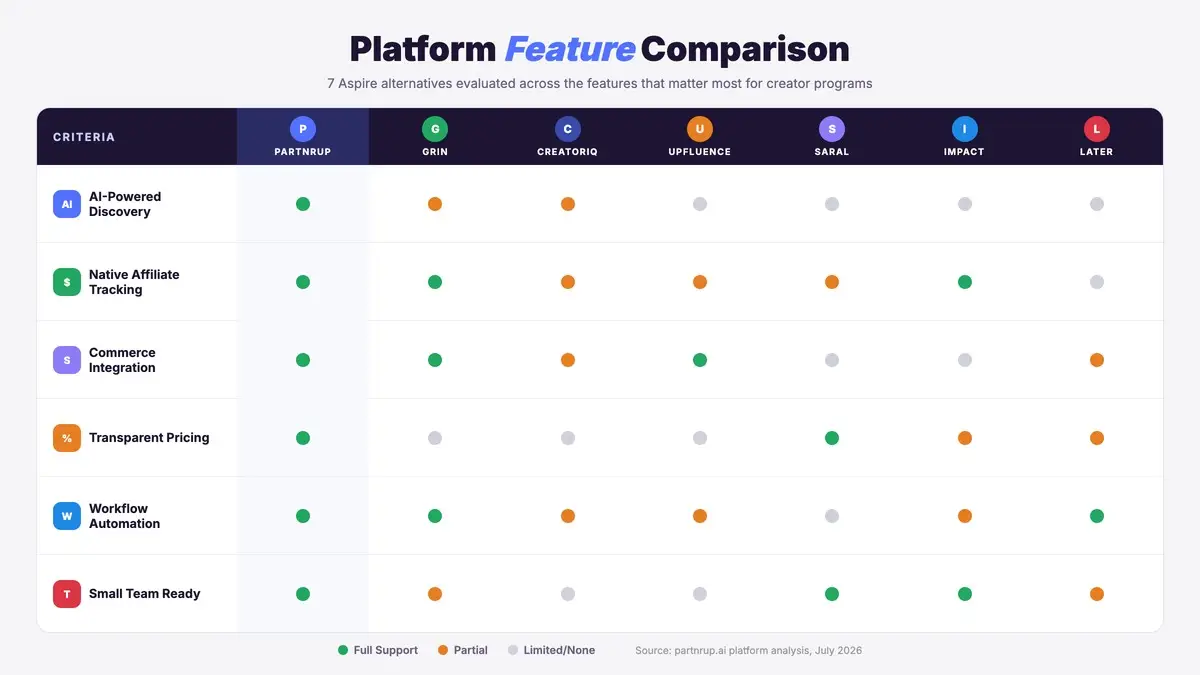
Each platform on this list takes a different approach to influencer marketing. Some prioritize AI-powered creator discovery. Others focus on affiliate and commerce integration. A few are built specifically for the challenges that Aspire users most frequently cite: workflow automation, transparent pricing, and measurable ROI across the full funnel.
For a broader look at how these platforms fit into the larger influencer marketing technology landscape, see our Influencer Marketing Platform Comparison Guide: How to Choose the Right Tool in 2026.
What to Look for in an Aspire Alternative
Before diving into specific platforms, it’s worth understanding what drives most teams away from Aspire—and what to prioritize in your next tool.
Creator Discovery That Actually Works
Aspire’s creator database is large, but discovery relies heavily on manual search and filters. Modern platforms use AI and behavioral data to match creators to brands based on audience overlap, content performance, and conversion potential—not just follower count and category tags.
Workflow Automation Beyond Basic Templates
Managing 50+ creator relationships through Aspire often means living in spreadsheets alongside the platform. The best alternatives automate outreach sequences, contract generation, content approvals, and payment processing without requiring your team to manually bridge gaps.
Commerce and Affiliate Integration
The line between influencer marketing and affiliate marketing has dissolved. If your platform treats them as separate functions, you’re managing two systems when one should handle both. Look for native affiliate link generation, commission tracking, and integration with platforms like Shopify and TikTok Shop.
Transparent, Predictable Pricing
Aspire’s enterprise pricing model means many growing brands get priced out as they scale. The alternatives worth considering offer clear pricing tiers, usage-based models, or flat rates that don’t penalize you for running more campaigns.
Reporting That Connects to Revenue
Engagement metrics matter, but leadership wants to know what creator partnerships actually drive in revenue. Platforms that connect influencer activity to conversions, track attribution across channels, and generate reports your CFO can understand are the ones worth investing in.
1. partnrUP — Best for AI-Powered Creator Matching and Full-Funnel Attribution
Best for: Brands that want to automate creator recruitment, run affiliate programs at scale, and connect every dollar of creator spend to measurable outcomes.
partnrUP takes a fundamentally different approach to influencer marketing. Instead of giving you a database to search through manually, the platform uses AI to analyze your brand, products, target audience, and existing customer data to identify creators who are most likely to drive conversions—not just engagement.
Key Advantages Over Aspire
- AI-powered matching: The platform analyzes creator content, audience demographics, engagement patterns, and historical conversion data to recommend partnerships. This eliminates the hours spent manually searching and vetting creators in Aspire’s database.
- Built-in affiliate infrastructure: partnrUP handles affiliate link generation, commission tracking, automated payouts, and performance leaderboards natively. No need to bolt on a separate affiliate network.
- Full-funnel attribution: Track creator impact from first touch through purchase, including multi-touch attribution that shows how different creators contribute to the same conversion path.
- Automated workflows: From creator outreach to content approval to payment, partnrUP automates the operational burden that keeps teams stuck in Aspire’s manual processes.
- Scalable pricing: Pricing that grows with your program without the enterprise-level jumps that Aspire is known for.
Where partnrUP Excels
The platform’s strength is connecting creator marketing directly to commerce outcomes. If you’re running a DTC brand on Shopify, selling through Amazon, or building a TikTok Shop presence, partnrUP’s integrations mean your creator program feeds directly into your sales infrastructure. For more on this topic, explore our platform comparison for 2026.
For teams migrating from Aspire, the transition typically involves importing existing creator relationships, setting up automated workflows to replace manual processes, and connecting attribution tracking to your existing analytics stack. For more on this topic, explore our AI-powered creator matching.
2. Grin — Best for DTC Ecommerce Brands with Large Creator Rosters
Best for: Established DTC brands managing 100+ creator relationships who need deep ecommerce integrations. For more on this topic, explore our State of Influencer Marketing 2026 report.
Grin positions itself as the “creator management platform for ecommerce” and delivers on that promise with robust Shopify, WooCommerce, and Magento integrations. The platform excels at managing the logistics of large-scale creator programs—product seeding, affiliate tracking, and content rights management. For more on this topic, explore our affiliate influencer marketing playbook.
Key Advantages Over Aspire
- Ecommerce-native: Product seeding workflows that sync with your inventory, automated discount code generation, and sales tracking tied to specific creators.
- Content management: A centralized library for all creator content with usage rights tracking and the ability to repurpose UGC across paid channels.
- Relationship management: CRM-style tools for tracking every interaction with each creator, from first outreach through ongoing partnerships.
Considerations
Grin’s pricing is enterprise-level, often starting at $25K+ annually. The platform is feature-rich but can feel overwhelming for smaller teams. Discovery capabilities have improved but still lag behind AI-powered alternatives like partnrUP. Best suited for brands already running mature influencer programs that need better operational infrastructure.
3. CreatorIQ — Best for Enterprise Brands and Agencies
Best for: Large enterprises and agencies managing influencer programs across multiple brands, regions, and campaign types.
CreatorIQ is the heavyweight of the influencer marketing platform space. Used by companies like Disney, Unilever, and AB InBev, the platform handles the complexity that comes with running influencer marketing at true enterprise scale.
Key Advantages Over Aspire
- Enterprise-grade infrastructure: Multi-brand management, role-based permissions, approval workflows, and compliance tools built for large organizations.
- Data and analytics: Proprietary data enrichment, audience authenticity scoring, and cross-platform analytics that go deeper than Aspire’s reporting.
- API-first architecture: Robust APIs that allow enterprise teams to integrate influencer data into existing BI tools, CRMs, and marketing stacks.
Considerations
CreatorIQ is priced for enterprise budgets (typically $50K+ annually) and requires significant onboarding investment. The platform’s depth can be overkill for brands running fewer than 50 campaigns per year. If you’re leaving Aspire because of cost, CreatorIQ likely won’t solve that problem—but if you’re leaving because of capability limitations, it will.
4. Upfluence — Best for Brands That Want to Turn Existing Customers into Creators
Best for: Ecommerce brands that want to identify influencers among their existing customer base and integrate influencer marketing with email and CRM workflows.
Upfluence takes a unique angle: instead of starting with a creator database, it starts with your existing customer data. The platform analyzes your customer list, email subscribers, and social followers to identify people who already love your brand and have the audience to promote it effectively.
Key Advantages Over Aspire
- Customer-to-creator identification: Integration with Shopify, Klaviyo, and other ecommerce tools to find influencers hiding in your existing customer base.
- Hybrid affiliate + influencer: Manage both paid influencer campaigns and affiliate programs from a single platform with unified reporting.
- Email integration: Built-in email outreach tools that connect with your existing email marketing workflows for seamless creator communication.
Considerations
Upfluence’s creator discovery outside your existing customer base is less robust than dedicated discovery platforms. The interface can feel dated compared to newer entrants. Pricing is mid-market (typically $15K-$30K annually), making it more accessible than Grin or CreatorIQ but still a significant investment for smaller teams.
5. SARAL — Best for Lean Teams and Startups
Best for: Small to mid-size brands with limited budgets and small marketing teams who need simplicity over feature depth.
SARAL (which stands for “Simple, Affordable, Results-focused Approach to influencer marketing at scaLe”) is purpose-built for teams that don’t have dedicated influencer marketing managers. The platform strips away the complexity that makes tools like Aspire overwhelming and focuses on the core workflows that actually drive results.
Key Advantages Over Aspire
- Approachable pricing: Plans starting under $5K annually, making it the most accessible option on this list.
- Simplified workflow: Creator discovery, outreach, and relationship management in a streamlined interface that doesn’t require training sessions to learn.
- Chrome extension: Find and save creator profiles while browsing social platforms, adding them directly to your SARAL pipeline.
Considerations
SARAL’s simplicity is both its strength and limitation. Teams managing complex, multi-market campaigns or needing advanced analytics will outgrow the platform. Limited integrations compared to more established tools. Best viewed as a starting platform for brands building their first structured influencer program.
6. Impact.com — Best for Performance-Focused Affiliate and Influencer Programs
Best for: Brands that want to unify their affiliate and influencer programs under a single performance marketing platform with advanced attribution.
Impact.com acquired Activate (a purpose-built influencer platform) and integrated it into their broader partnership management suite. The result is a platform that treats influencer marketing as a performance channel first, with the attribution and tracking infrastructure to back it up.
Key Advantages Over Aspire
- Partnership ecosystem: Manage influencers alongside traditional affiliates, brand ambassadors, and strategic partners in a single platform.
- Advanced attribution: Multi-touch attribution models, cross-device tracking, and incrementality testing that go far beyond what Aspire offers.
- Automated contracting: Dynamic commission structures, performance-based bonuses, and automated payment processing across global currencies.
Considerations
Impact.com’s strength in performance tracking comes with added complexity. The platform’s roots in affiliate marketing mean the influencer-specific features (content management, creative briefs, relationship tracking) aren’t as refined as dedicated influencer platforms. Pricing is usage-based and can scale quickly for high-volume programs.
7. Later (formerly Mavrck) — Best for Social-First Brands Focused on Content
Best for: Brands that prioritize social media content creation and want influencer management integrated with social publishing and analytics. Tools like partnrUP’s platform help brands automate this at scale.
Later acquired Mavrck in 2024, combining Mavrck’s influencer marketing capabilities with Later’s social media management tools. The result is a platform that connects influencer partnerships directly to social content strategy—something Aspire doesn’t attempt.
Key Advantages Over Aspire
- Content-first approach: Influencer content flows directly into your social media calendar, with scheduling, publishing, and analytics in the same platform.
- Micro-influencer focus: Strong tools for managing high-volume micro and nano influencer programs where content quantity matters as much as individual reach.
- Social commerce: Link-in-bio tools and shoppable content features that connect influencer partnerships to direct sales.
Considerations
The merger is still maturing, and some features feel like two platforms bolted together rather than a unified experience. Enterprise-level analytics and attribution don’t match dedicated performance platforms. Strongest for brands where social media content creation is the primary goal of their influencer program.
How to Choose the Right Aspire Alternative
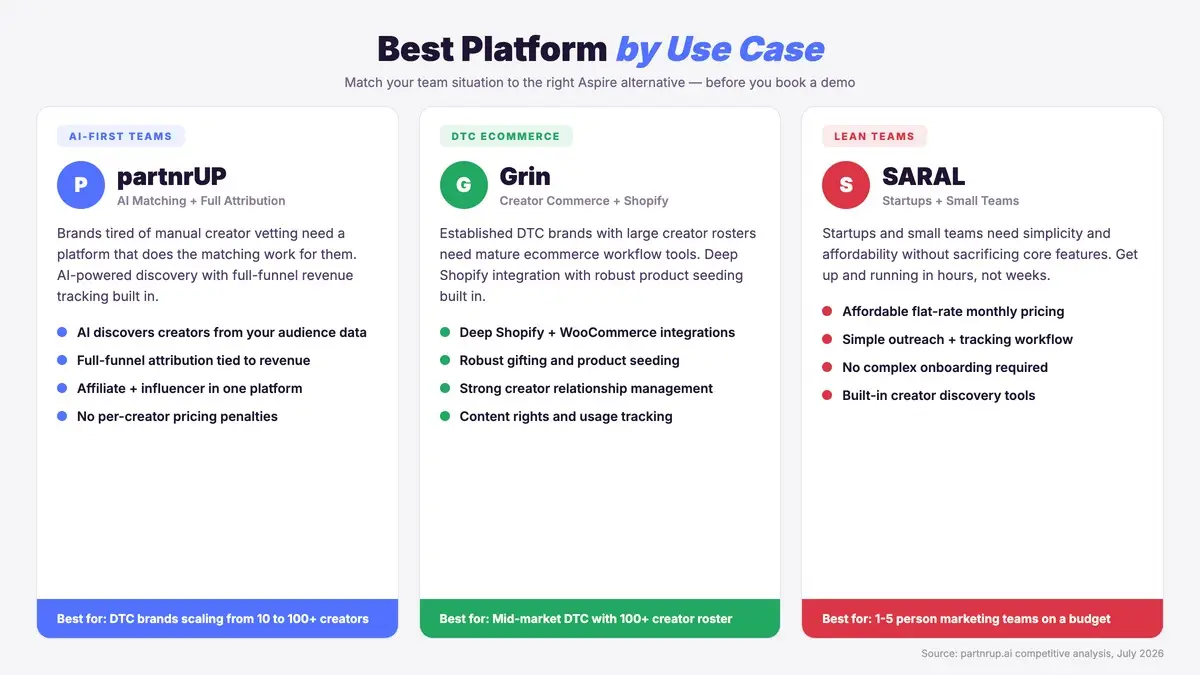
The right platform depends on three factors: your team size, your primary use case, and how you measure success.
If You’re a Small Team with Limited Budget
Start with SARAL for simplicity and affordability, or partnrUP if you want AI-powered matching that reduces the manual work a small team can’t afford to do. Explore the partnrUP platform to see how it handles discovery, tracking, and payouts in one place.
If You’re Running a Large DTC Ecommerce Program
Grin or partnrUP will serve you best. Grin for its mature ecommerce integrations and creator management tools. partnrUP for its AI-driven approach that automates the discovery and matching process your team is currently doing manually.
If You’re an Enterprise or Agency
CreatorIQ handles the complexity of multi-brand, multi-market programs. Impact.com is the right choice if you need to unify influencer and affiliate programs under performance marketing.
If Content Creation Is Your Primary Goal
Later connects influencer partnerships to your social content strategy. Upfluence excels at turning your existing customers into content creators.
If Full-Funnel Attribution Matters Most
partnrUP and Impact.com offer the strongest attribution capabilities, connecting creator activity to measurable revenue outcomes across the entire customer journey.
Making the Switch: Migration Considerations
Switching influencer marketing platforms isn’t trivial. Here’s what to plan for:
- Creator relationship data: Export your creator contacts, communication history, and performance data from Aspire before your contract ends. Most alternatives offer CSV import tools, and some provide dedicated migration support.
- Active campaign continuity: Time your switch between campaign cycles. Migrating mid-campaign creates tracking gaps and confuses creators who are mid-deliverable.
- Integration reconnection: Map out every integration (Shopify, social platforms, analytics tools) and confirm the new platform supports them before committing.
- Team training: Budget 2-4 weeks for your team to get comfortable with new workflows. Most platforms offer onboarding support, but real proficiency comes from running one or two campaigns through the system.
- Contract timing: Start evaluating alternatives 90 days before your Aspire renewal. Most platforms offer trial periods or pilot programs that let you test before committing.
The Bottom Line
Aspire is a capable platform, but the influencer marketing landscape has evolved significantly since it established its position. AI-powered creator matching, native affiliate infrastructure, and full-funnel attribution have gone from nice-to-have features to table stakes for brands serious about creator partnerships.
The seven alternatives in this guide each solve specific problems that Aspire users commonly face. Whether you prioritize automation, attribution, affordability, or enterprise scale, there’s a platform built for how your team actually works in 2026.
For teams that want to move beyond manual creator search and connect every creator partnership to measurable business outcomes, partnrUP’s AI-powered approach represents the direction the industry is heading—matching the right creators to the right brands based on data, not guesswork. Book a demo to see how leading brands are implementing this.
Frequently Asked Questions
Is Aspire still a good platform in 2026?
Aspire remains a solid platform for mid-market and enterprise brands that need robust campaign management and content approval workflows. However, its pricing has increased significantly, its creator discovery relies heavily on opt-in databases rather than AI matching, and newer platforms offer better affiliate tracking and commerce integrations out of the box. Whether it’s “good” depends on your specific needs — if you primarily need relationship management for creators you’ve already found, it works well. If you need discovery, attribution, and commerce in one place, there are better options.
How much does Aspire cost compared to alternatives?
Aspire’s pricing starts around $2,000-3,000/month for basic plans and scales to $6,000+/month for enterprise features, with annual contracts required. Most alternatives offer more flexible pricing: partnrUP and SARAL start significantly lower with month-to-month options, while enterprise tools like CreatorIQ price similarly to Aspire but include more features at each tier. Impact.com uses a performance-based model where costs scale with results rather than flat fees.
Can I migrate my creator data from Aspire to another platform?
Yes, but the process varies by platform. Most Aspire alternatives offer CSV import for creator lists and campaign history. The main challenge is migrating relationship context — notes, communication history, and content libraries. Plan for a 2-4 week transition period where you run both platforms in parallel. Some alternatives like partnrUP offer dedicated migration support to pull historical data.
Which Aspire alternative is best for small teams?
SARAL and partnrUP are the strongest options for lean teams (1-5 people managing creator programs). Both prioritize automation and self-serve workflows over enterprise complexity. SARAL focuses on outreach automation, while partnrUP emphasizes AI-powered discovery and affiliate tracking. If you’re spending more time on manual creator management than strategy, either will free up significant hours.
Do any Aspire alternatives include TikTok Shop integration?
partnrUP and Later (Mavrck) both offer native TikTok Shop integrations, including affiliate creator recruitment, commission management, and performance tracking within the TikTok Shop ecosystem. Grin has partial integration. Most other alternatives connect to TikTok for content tracking but don’t offer full Shop commerce features yet.
What’s the biggest limitation of Aspire that alternatives solve?
Creator discovery and affiliate attribution are Aspire’s two biggest gaps. Its discovery database requires creators to opt in, which limits the pool significantly. And its attribution tracking requires bolt-on tools for anything beyond basic promo code tracking. Newer platforms built with AI-native search (scanning all public creator content, not just opt-in profiles) and built-in multi-touch attribution solve both problems without extra tools or integrations.
Should I switch platforms mid-campaign or wait until a campaign ends?
Always wait until active campaigns conclude before migrating. Switching mid-campaign creates attribution gaps, confuses creators with new workflows, and risks losing performance data. The ideal migration window is between campaign cycles — use 2-3 weeks to set up the new platform, import creator data, and run a small test campaign before going full-scale. Most brands complete the transition within 30 days.