Brands that structure their creator affiliate programs with clear commission tiers, performance tracking, and dedicated creator support generate 3.2x more affiliate revenue than those running ad-hoc partnerships. Yet the majority of ecommerce teams still launch affiliate programs with flat-rate commissions, generic tracking links, and zero onboarding — then wonder why creators stop posting after week two.
This guide is part of our Affiliate Influencer Marketing: The Complete Brand Playbook for 2026 — the definitive resource for building performance-based creator partnerships that drive measurable revenue.
The difference between programs that convert and those that quietly die isn’t the commission rate or even the creators. It’s the structure — the systems, incentives, and workflows that keep creators motivated and revenue compounding month over month.
In this guide, you’ll learn:
- Why most creator affiliate programs fail within the first 90 days — and the structural fixes that prevent it
- How to design commission tiers that reward performance without destroying margins
- The creator onboarding framework that increases first-post rates by 60%+
- Which tracking and attribution models actually work for multi-platform affiliate content
- How to build a feedback loop that turns one-time affiliates into long-term revenue partners
Table of Contents
- Why Most Creator Affiliate Programs Fail
- Building Your Program Foundation: Goals, Unit Economics, and Creator Fit
- Commission Structures That Actually Motivate Creators
- Creator Recruitment and Onboarding That Sticks
- Tracking, Attribution, and the Tech Stack You Need
- Content Optimization: Helping Creators Sell Without Selling Out
- Scaling Your Program: From 10 Creators to 100+
- Conclusion
- Frequently Asked Questions
Why Most Creator Affiliate Programs Fail
The failure rate for creator affiliate programs is staggering. Over 60% of brand-launched affiliate programs see less than 10% of recruited creators produce any content within the first month. The problem isn’t lazy creators — it’s lazy program design.
The “Set It and Forget It” Trap
Most ecommerce managers treat affiliate programs like a vending machine: load in creators, hand out links, wait for revenue. But creators aren’t vending machines. They’re independent businesses making daily decisions about which brand partnerships deserve their time, audience trust, and creative energy.
When a creator joins your program and receives nothing but a tracking link and a 10% commission, here’s what they see: one of 47 identical offers sitting in their inbox. There’s no reason to prioritize your brand. No content guidance. No performance feedback. No escalation path for top performers. The program is structurally designed to produce indifference.
The Three Structural Failures
Programs that fail share three common breakdowns:
- No differentiation between creator tiers — Top performers get the same flat commission as newcomers, so they leave for brands that recognize their value.
- Zero onboarding infrastructure — No product samples, brand guidelines, content examples, or dedicated contact.
- Delayed or invisible attribution — Creators wait 30-60 days for commission reports with no idea which content types drive results. Without feedback, they stop trying.
Understanding these failure modes is the first step. The rest of this guide shows you how to build the opposite: a creator affiliate program built from zero to scale with structure at every level.
Building Your Program Foundation: Goals, Unit Economics, and Creator Fit
Before you recruit a single creator, you need three things locked: revenue targets, unit economics boundaries, and a creator-product fit thesis.
Define Your Revenue Model First
Start by answering one question: What does a successful affiliate conversion look like for your brand? This isn’t as obvious as it sounds. Some brands optimize for first-purchase acquisition. Others prioritize subscription signups, high-AOV orders, or repeat purchase rates.
Your conversion definition shapes everything downstream — commission rates, creator selection, content types, and attribution windows. A brand selling $200 skincare bundles with 70% margins can afford a 20% commission on first purchase. A brand selling $15 monthly subscriptions with 40% margins needs a completely different structure.
Map Your Unit Economics
Calculate these numbers before setting any commission rate:
- Customer Acquisition Cost (CAC) ceiling — The maximum you can spend to acquire a customer and remain profitable within 90 days
- Average Order Value (AOV) — Determines the absolute dollar amount a commission represents to creators
- Customer Lifetime Value (CLV) — High repeat rates justify higher upfront commissions
- Gross margin per order — Commissions can never exceed gross margin minus fulfillment costs
- Blended CPA target — How affiliate CPA compares to paid social, search, and other channels
The golden rule: your affiliate CPA should be 30-50% lower than your paid social CPA. If it’s not, either your commissions are too high or your creators aren’t converting efficiently enough — both structural problems with structural solutions. Platforms like partnrUP can surface these economics automatically by connecting creator content performance to downstream revenue data.
Define Creator-Product Fit
Not every creator is right for every product. Build a creator-product fit scorecard that evaluates:
- Audience overlap — Does the creator’s audience match your buyer persona demographics?
- Content format alignment — Does the creator produce the type of content (video reviews, tutorials, hauls) that converts for your category?
- Platform relevance — Is the creator active on the platforms where your customers discover and purchase?
- Brand affinity signals — Has the creator organically mentioned your brand, competitors, or product category?
- Commerce track record — Does the creator have documented affiliate or sales-driving history?
This scorecard prevents the most common recruitment mistake: prioritizing follower count over conversion potential. A creator with 15K highly engaged followers in your exact niche will outperform a 500K generalist every time. AI-powered creator matching accelerates this process by analyzing audience composition, content performance, and conversion propensity across thousands of creators simultaneously.
Commission Structures That Actually Motivate Creators
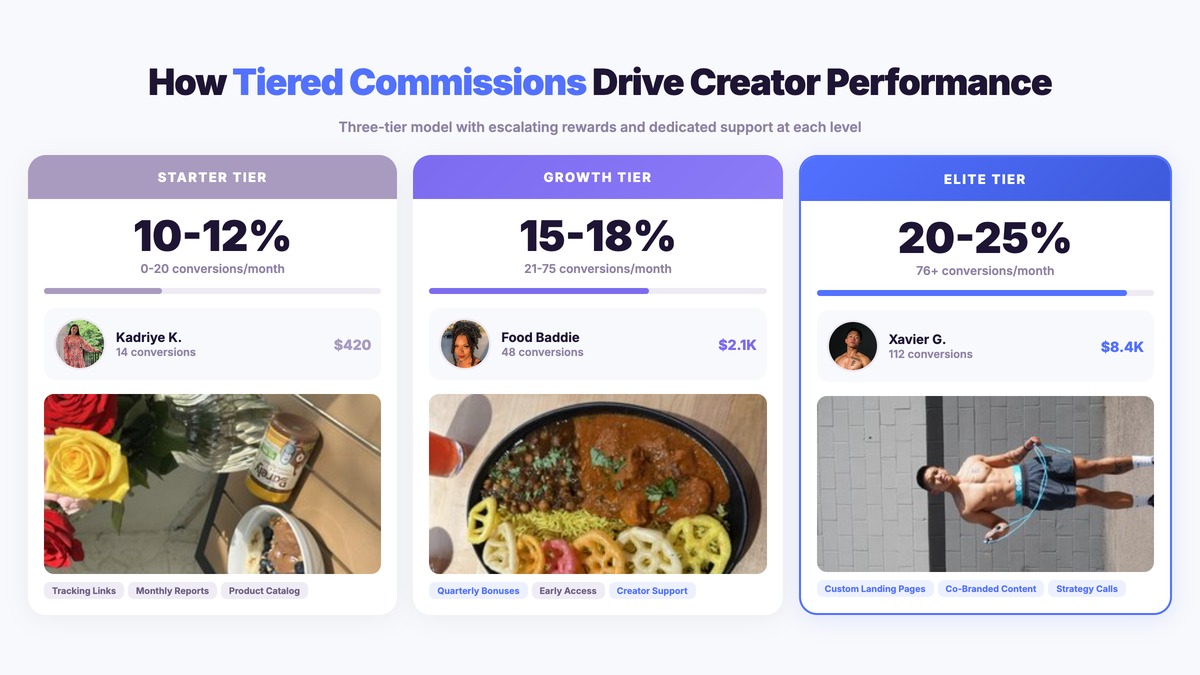
Flat-rate commissions are a participation trophy. They reward presence, not performance. The programs that convert use tiered structures that give creators a clear path from “new affiliate” to “top partner” with escalating rewards at each stage.
The Three-Tier Model
Structure your commissions into three performance tiers:
- Starter Tier (0-20 conversions/month): Base commission rate (e.g., 10-12%). Includes standard tracking, monthly reporting, and access to product catalog. This tier should be generous enough to be competitive but leaves room for meaningful upgrades.
- Growth Tier (21-75 conversions/month): Enhanced commission (e.g., 15-18%) plus bonus incentives. Add quarterly bonuses, early access to new products, and dedicated creator support. This tier is where creators start treating your program as a primary revenue stream.
- Elite Tier (76+ conversions/month): Premium commission (e.g., 20-25%) plus exclusive benefits. Custom landing pages, co-branded content opportunities, featured placement in brand channels, and monthly strategy calls. These creators are business partners, not affiliates.
Beyond Percentage: Bonus Structures That Drive Behavior
Commissions get creators in the door. Bonuses shape what they do once inside. The most effective bonus types: Activation bonuses ($50-$200 for first content within 14 days — solves the “sign up but never post” problem), Consistency bonuses (monthly rewards for 4+ content pieces), Platform diversification bonuses (extra commission for multi-platform posting — these creators drive more consistent performance), and High-AOV bonuses (incremental percentage on orders above a threshold).
Cookie Windows and Attribution Fairness
Your attribution window is a trust signal to creators. A 7-day cookie window tells creators you don’t value their contribution to the purchase journey. The standard is shifting toward 30-day windows, with best-in-class programs offering 60-90 days for high-consideration products. Short windows systematically under-credit creators and drive your best affiliates to competitors with fairer attribution models.
Creator Recruitment and Onboarding That Sticks
Recruitment is where most programs start. Onboarding is where most programs lose. The gap between “creator signs up” and “creator publishes converting content” is where structure matters most.
The 72-Hour Onboarding Window
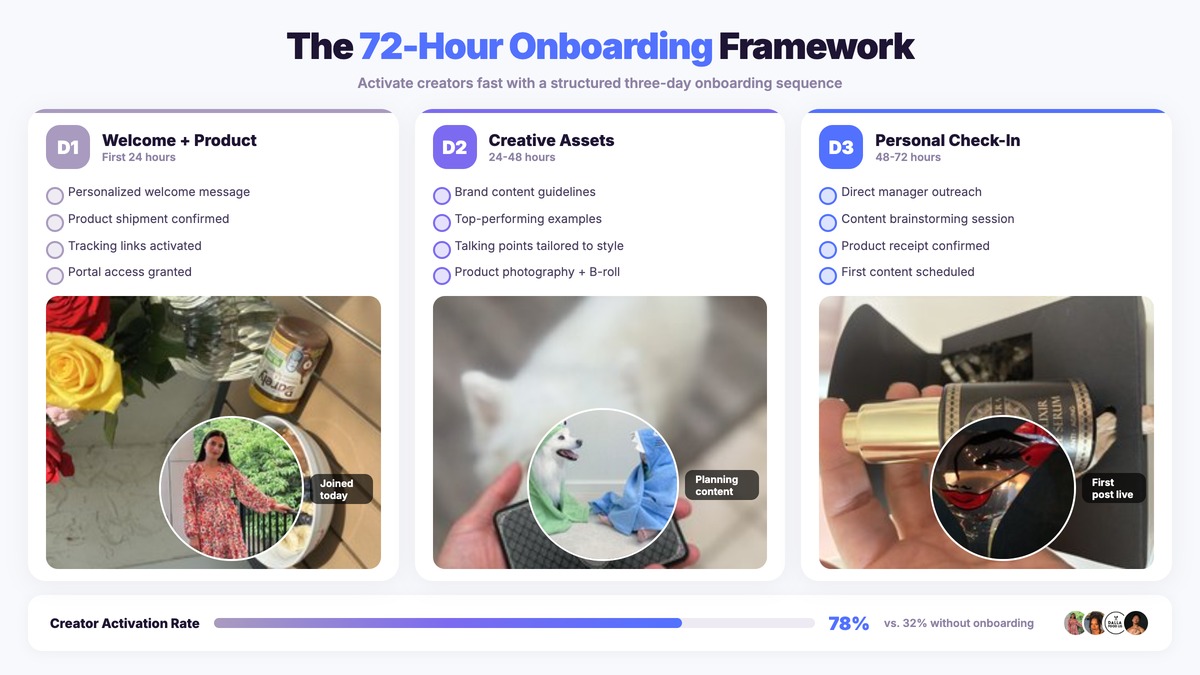
Creator motivation peaks at the moment they join your program. If you don’t activate them within 72 hours, the probability of first content drops by over 50%. Design your onboarding to deliver three things in the first three days:
- Day 1: Welcome + Product — Personalized welcome message, product shipment confirmation, and active tracking links in the creator portal.
- Day 2: Creative Assets + Guidelines — Brand guidelines, 3-5 examples of top-performing content, and talking points tailored to the creator’s style.
- Day 3: Personal Check-In — A direct message from their creator manager (human or AI-assisted through partnrUP) for Q&A, content brainstorming, and product receipt confirmation.
Creator Recruitment Channels That Convert
Not all recruitment channels are equal. Organic applicants (highest intent, best conversion rates) and customer-to-creator conversions (2x higher content authenticity) produce the strongest affiliates. Platform discovery tools offer the most scalable path — especially when paired with the right KPIs for evaluation. Creators currently promoting competitor products also convert well but typically require higher commissions to switch.
The Content Starter Kit
Give every new creator a Content Starter Kit — a packaged resource that eliminates the blank-page problem:
- 3 proven content angles with hooks, outlines, and example captions
- Product photography and B-roll ready to use in their content
- Key selling points ranked by conversion impact — the specific claims that drive clicks and purchases
- Compliance checklist and performance benchmarks — FTC requirements, brand guidelines, and what “good” looks like
Tracking, Attribution, and the Tech Stack You Need
If creators can’t see the impact of their content, they’ll stop creating it. Real-time tracking and transparent attribution aren’t nice-to-haves — they’re structural requirements for any program that wants to retain top performers.
Essential Tracking Infrastructure
Your tracking stack needs to handle four layers:
- Click tracking — Unique links per creator, per content piece — not just per creator. This identifies which formats and topics drive clicks.
- Conversion tracking — Server-side pixel or postback integration. Client-side cookies alone miss 20-40% of conversions due to ad blockers.
- Multi-touch attribution — Single-touch models systematically under-credit creator content. Multi-touch attribution distributes credit across the full customer journey.
- Cross-platform stitching — Connect a TikTok view to an Instagram click to a website conversion, all attributed to the same creator.
The Creator Dashboard
Top-performing programs give creators a real-time dashboard showing:
- Clicks, conversions, and revenue by content piece — updated daily, not monthly
- Commission earned and projected payout with tier progress (“12 conversions from Growth Tier”)
- Top-performing content with engagement and conversion metrics to guide future decisions
This transparency serves two purposes: it helps creators optimize their content, and it builds trust that they’re being credited fairly. Brands using platforms with real-time creator dashboards report 40% higher creator retention rates than those using monthly spreadsheet reports. A platform like partnrUP automates this entire tracking and reporting layer, giving both brands and creators live visibility into performance.
Content Optimization: Helping Creators Sell Without Selling Out
The best affiliate content doesn’t feel like affiliate content. It feels like a creator sharing a genuine recommendation with their audience. Your job isn’t to script creators — it’s to give them the information, assets, and feedback they need to create authentic content that converts.
Performance Feedback Loops
Most affiliate programs are a black box for creators. They post content and wait for commission reports. High-converting programs replace this with weekly performance syncs that include:
- Content-level performance breakdowns — which posts, videos, or stories drove the most conversions
- Content angle recommendations based on what’s working across the program
- Product update previews — launches, restocks, and promotions creators can plan around
This feedback transforms the creator-brand relationship from transactional to collaborative. Creators who receive regular performance feedback stay in programs 3x longer than those who don’t — and their content quality compounds over time as they learn what resonates.
Content Format Optimization by Platform
Different platforms demand different affiliate content strategies. TikTok favors product demonstrations and “day in my life” integrations — brands winning on TikTok Shop in 2026 lean into native shopping features. Instagram Stories convert better than feed posts for impulse purchases, while YouTube long-form reviews deliver the highest conversion rates of any platform. Blogs and newsletters drive the longest tail — a single well-ranking post can generate commissions for 12-24 months.
The Content Quality Guardrails
Set clear expectations without being controlling. Require FTC disclosure and accurate product claims. Encourage personal storytelling and honest pros-and-cons framing. Prohibit competitor bashing and fabricated reviews. Most importantly, give creators creative freedom — let them choose their own hooks, filming style, and narrative approach. The brands that over-script their affiliates produce content audiences immediately recognize as inauthentic.
Scaling Your Program: From 10 Creators to 100+
A program that works with 10 hand-picked creators will break at 50. Scaling requires replacing manual processes with systems — while preserving the personal touch that makes creator partnerships work.
Automation Without Losing the Human Touch
Automate the repetitive. Personalize the meaningful:
- Automate: Onboarding sequences, commission calculations, performance reports, tier upgrades, payment processing
- Personalize: Creator outreach, content strategy calls, performance coaching, partnership renewals
The threshold for most teams is around 25-30 active creators per manager. Beyond that, you need either more headcount or a platform that handles the operational complexity — tracking, reporting, payments, content approvals, and communication at scale. partnrUP is designed specifically for this inflection point, managing the operational layer so your team can focus on strategy and relationships.
Segmentation and Specialization
As your program grows, stop treating all creators the same. Segment by performance tier (different support and commission levels), content format (video, written, social-first creators need different resources), product category (match creators to the products their audience cares about), and lifecycle stage (new affiliates need onboarding; top partners need co-creation opportunities).
Program Health Metrics
Track these metrics monthly to gauge program health:
- Creator Activation Rate — Percentage publishing first content within 30 days (target: 60%+)
- Active Creator Rate — Percentage publishing in the last 30 days (target: 40%+)
- Revenue Per Active Creator (RPAC) — Total affiliate revenue divided by active creators
- Creator Retention Rate — Percentage still active after 90 days (target: 70%+)
- Blended Affiliate CPA — Total program cost divided by conversions (must stay below paid channel CPA)
Conclusion
Creator affiliate programs that convert aren’t built on higher commissions or bigger creator followings — they’re built on better structure. The brands seeing consistent, scalable affiliate revenue have invested in tiered commission models that reward performance, onboarding systems that activate creators fast, real-time tracking that enables optimization, and feedback loops that compound content quality over time.
The playbook is clear: define your unit economics, design incentives that shape behavior, build the operational infrastructure to support creators at scale, and measure relentlessly. Every structural investment you make today reduces your cost per acquisition tomorrow.
Ready to build a creator affiliate program with the structure to convert? Explore partnrUP’s platform to see how AI-powered creator matching, automated tracking, and performance analytics can accelerate your program from launch to scale. Or book a demo to talk strategy with the team.
Frequently Asked Questions
What commission rate should I offer for a creator affiliate program?
Most successful programs start at 10-15% for their base tier and scale to 20-25% for top performers. The key is ensuring your blended affiliate CPA stays 30-50% below your paid social CPA. Calculate your CAC ceiling based on gross margin and CLV before setting rates.
How many creators do I need to launch a successful affiliate program?
Start with 10-15 carefully selected creators who fit your creator-product fit scorecard. A smaller, highly aligned cohort outperforms a large, loosely recruited group every time. Focus on quality activation — getting those 10-15 creators publishing consistently — before expanding. Most programs should aim to add 5-10 new creators per month once the foundation is proven.
How long does it take for a creator affiliate program to generate meaningful revenue?
Well-structured programs see initial revenue within 30-45 days. Meaningful, scalable revenue typically takes 90-120 days. The compounding effect of multiple creators publishing regularly, combined with SEO benefits from long-form content, means growth accelerates after the first quarter.
Should I use unique codes or tracking links for creator affiliates?
Use both. Tracking links provide the most reliable attribution data and work across platforms. Unique discount codes serve as a backup attribution method and give creators a tangible offer to share with their audience. The combination ensures you capture conversions even when link tracking fails due to ad blockers or platform limitations. Server-side tracking adds a third layer of reliability.
How do I prevent creator affiliate fraud?
Build fraud detection into your program structure from day one. Monitor for unusual click-to-conversion ratios, geographic mismatches between creator audiences and converting customers, sudden spikes in self-referral patterns, and coupon code leakage to deal sites. Set clear terms of service that define prohibited behavior and establish a review process before paying out large commissions from new creators.
What’s the difference between a creator affiliate program and a traditional affiliate program?
Traditional affiliate programs rely on bloggers, coupon sites, and review aggregators who drive traffic through SEO and deal-seeking audiences. Creator affiliate programs center on social media content creators who drive conversions through audience trust, authentic recommendations, and native content formats. Creator programs typically have higher conversion rates per click, stronger brand affinity impact, and better customer quality — but require more relationship management and creative support.
How do I retain top-performing affiliate creators long-term?
Retention comes from competitive compensation (tiered commissions plus bonuses), transparent communication (regular performance feedback, early access to launches), and genuine partnership (co-creation opportunities, advisory roles). Creators who leave do so because they feel undervalued — not because a competitor offered 2% more commission.