Creator affiliate programs now drive 3-5x higher conversion rates than traditional affiliate networks — yet most brands still haven’t built one. They’re stuck between expensive influencer platforms that charge flat fees regardless of performance, generic affiliate networks designed for coupon sites, and manual outreach that doesn’t scale past a handful of creators.
This guide is part of our Affiliate Influencer Marketing: The Complete Brand Playbook for 2026 — the definitive resource for brands building performance-based creator programs.
The brands getting this right aren’t lucky. They’ve built systems: clear commission structures, repeatable recruitment processes, proper tracking infrastructure, and creator onboarding that actually produces results. The difference between a creator affiliate program that generates $10K/month and one that stalls at $500 comes down to how you structure the foundation.
In this guide, you’ll learn:
- Why creator affiliates outperform traditional affiliate channels
- How to design commission structures that attract quality creators
- A step-by-step framework for recruiting your first 25 creator affiliates
- The tracking and attribution setup that connects every sale to its source
- How to scale from pilot to a program generating consistent six-figure revenue
Table of Contents
- Why Creator Affiliates Outperform Traditional Networks
- Designing Your Commission Structure
- Recruiting Creator Affiliates Who Actually Convert
- Tracking, Attribution, and Technical Setup
- Scaling From Pilot to Program
- Conclusion
- Frequently Asked Questions
Why Creator Affiliates Outperform Traditional Networks
Traditional affiliate marketing was built for a different era. Coupon aggregators, cashback portals, and deal-comparison sites generate volume but attract discount-seeking customers with low lifetime value. The economics look fine on paper until you measure repeat purchase rates and contribution margin.
Creator affiliates flip that model. When a fitness creator demonstrates your protein powder in their morning routine, they’re not offering a discount — they’re transferring trust. Their audience buys because someone they follow genuinely uses and recommends the product. That trust translates directly into measurable differences:
- Click-through rates 3-5x higher than traditional affiliate banners
- Conversion rates of 8-12% compared to the industry average of 1-3%
- Average order values 25-40% higher because buyers aren’t motivated by discounts
- Customer lifetime value 2x+ since creator-referred customers buy on trust, not price
The other structural advantage: creator content is evergreen. A YouTube video reviewing your product continues generating affiliate revenue for months or years. A TikTok that resonates gets resurfaced by the algorithm indefinitely. Compare that to a coupon site where traffic disappears the moment you stop feeding new deals.
This is why brands investing in affiliate influencer marketing are seeing returns that make traditional channels look like a rounding error. The model works — the challenge is building the infrastructure correctly from the start.
Designing Your Commission Structure
Your commission structure is the single biggest factor in whether quality creators will join your program. Get it wrong and you’ll attract low-effort creators who paste links without context. Get it right and you’ll build a program that top creators actively want to participate in.
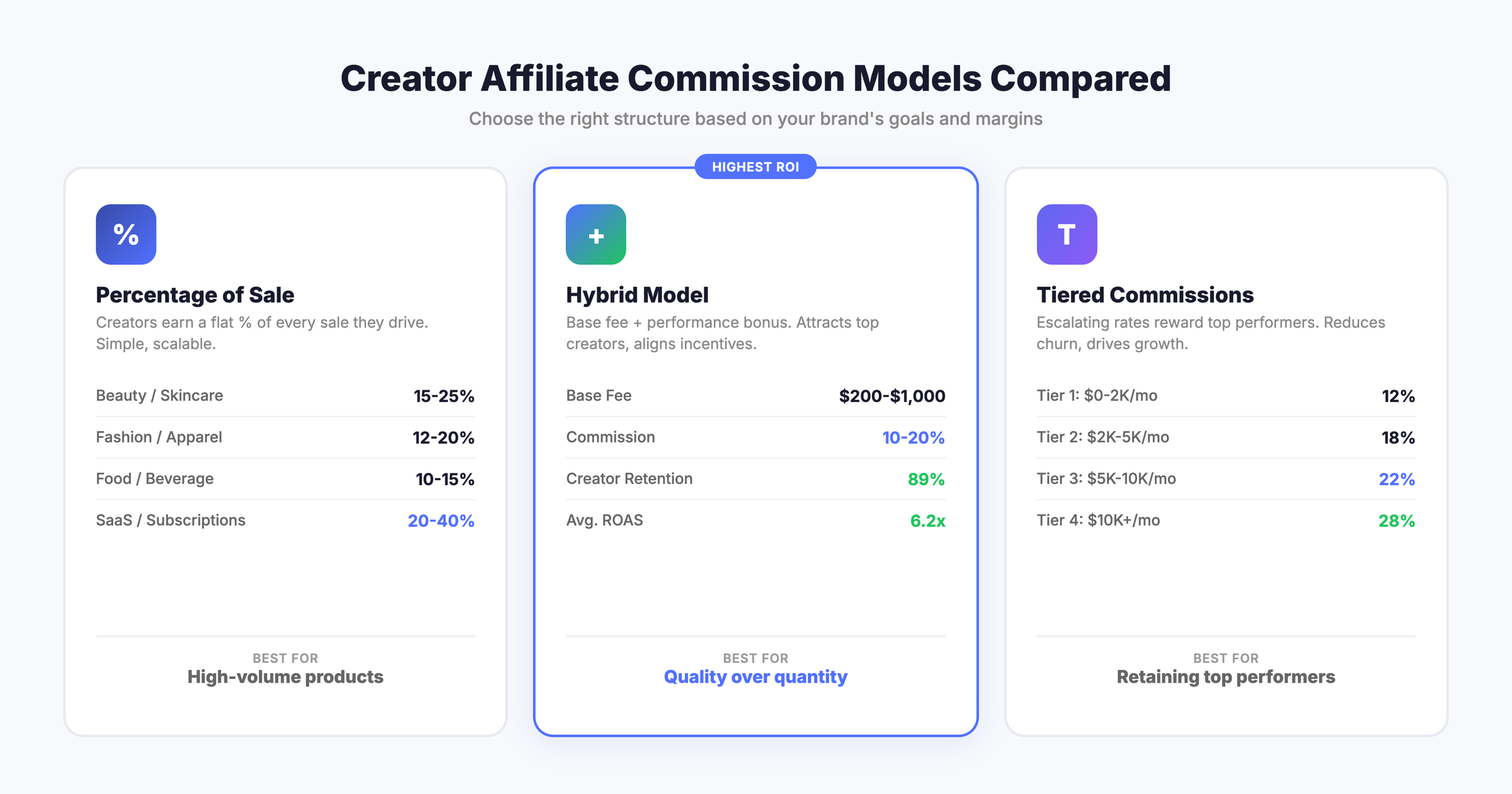
The Three Commission Models That Work
Percentage of Sale (Most Common)
The standard for most product-based brands. Creators earn a percentage of every sale they drive. Typical rates by category:
- Beauty and skincare: 15-25%
- Fashion and apparel: 12-20%
- Food and beverage: 10-15%
- Consumer electronics: 5-12%
- SaaS and subscriptions: 20-40% (often recurring)
Hybrid: Base Fee + Performance Bonus
This is the model driving the best results in 2026. You pay creators a smaller upfront fee ($200-$1,000 depending on audience size) to cover their content production cost, plus a performance commission on every sale. The base fee signals that you value their work; the commission aligns incentives around actual revenue.
Tiered Commissions
Reward your top performers. Start everyone at your base rate, then increase commission percentages as creators hit revenue thresholds. A creator who drives $5K/month should earn a higher percentage than one driving $500. This keeps your best affiliates motivated and reduces churn among high performers.
Setting Rates That Attract Quality Creators
Here’s the mistake most brands make: they set commissions based on what they can afford rather than what the market demands. A 5% commission on a $30 product means a creator earns $1.50 per sale. Even a high-converting creator driving 50 sales per month makes $75. That’s not enough to justify the effort of creating quality content.
The math needs to work for both sides. Calculate your customer acquisition cost from other channels, and use that as your ceiling. If you’re spending $40 per customer through paid ads, you can afford to pay a creator $30-$35 per referred customer and still come out ahead — because the customer quality is higher and the content has long-tail value.
Recruiting Creator Affiliates Who Actually Convert
The number one predictor of creator affiliate success isn’t follower count. It’s audience-product alignment. A creator with 15,000 highly engaged followers in your exact niche will outperform a creator with 500,000 followers in a broad lifestyle category every time.
Where to Find High-Converting Creator Affiliates
Your existing customer base. The most authentic affiliates are people who already buy and use your product. Search your customer database for accounts with social followings. These creators don’t need convincing — they’re already fans.
Competitor mentions. Creators reviewing or mentioning competing products have audiences primed for your category. They’ve already demonstrated willingness to create affiliate-style content in your space.
AI-powered matching. Platforms like partnrUP use machine learning to analyze audience demographics, content themes, engagement patterns, and historical conversion data to surface creators whose audiences match your customer profile — connections you’d never find through manual search.
Category-specific hashtags and communities. Go where your target customers consume content. Identify the creators who consistently appear in those spaces and whose content drives genuine engagement (comments asking for product links, not just likes).
The Outreach That Gets Responses
Creator inboxes are flooded with generic partnership requests. Your outreach needs to demonstrate three things immediately:
- You know their content. Reference a specific video or post. Show you’ve done more than pull their handle from a database.
- The economics work for them. Lead with what they’ll earn, not what you need. Be specific: “Based on your engagement rates, creators in our program with similar audiences earn $2,000-$4,000/month.”
- Low effort to start. Remove friction. Send them product immediately. Provide a one-page getting-started guide. Don’t require a 30-minute onboarding call before they’ve even decided they’re interested.
Vetting Creators Before You Commit
Not every creator who’s interested will perform. Before adding someone to your program, evaluate:
- Audience authenticity: Use tools that detect fake followers and engagement pods. A creator with 50% fake followers is worthless regardless of their headline metrics.
- Content consistency: Do they post regularly? Creators who publish once a month won’t generate consistent affiliate revenue.
- Commerce intent signals: Have they driven purchases before? Look for product links in bios, affiliate disclosures, and “link in bio” call-to-actions in past content.
- Brand safety: Review their content history for anything that conflicts with your brand values. This isn’t about policing opinions — it’s about protecting your brand’s reputation.
AI-powered creator matching platforms handle most of this vetting automatically, surfacing creators who score high across all these dimensions rather than requiring manual review of hundreds of profiles.
Tracking, Attribution, and Technical Setup
A creator affiliate program without proper tracking is just a sponsorship program with extra steps. You need infrastructure that connects every sale back to the creator who drove it — accurately, in real time, and across devices.
The Technical Stack You Need
Unique tracking links. Every creator gets their own parameterized links. UTM parameters alone aren’t enough — use dedicated tracking URLs that persist across sessions and devices. This is table stakes.
Promo codes as backup attribution. Not every customer clicks a link. Some hear about your product in a YouTube video, then Google your brand directly and buy. Unique promo codes per creator capture these “dark funnel” conversions that link tracking misses.
Cookie windows that match the buying cycle. A 24-hour cookie window makes sense for impulse purchases. For considered purchases ($100+), you need 30-60 day windows. Set your attribution window based on your average time-to-purchase, not an arbitrary default.
Multi-touch attribution. The most sophisticated programs don’t just credit the last click. They track the full journey: which creator introduced a customer to the brand, which one provided the social proof that built consideration, and which one’s link ultimately closed the sale. This data is essential for understanding which creators drive value at each funnel stage.
Platform vs. Build Your Own
You can cobble together tracking with UTMs, a Shopify affiliate app, and a spreadsheet. That works for your first 5-10 creators. Beyond that, the manual overhead becomes unsustainable: generating links, tracking payments, reconciling sales, and handling disputes.
Purpose-built platforms like partnrUP handle the full infrastructure: unique link generation, real-time conversion tracking, automated commission calculation, creator dashboards, and payment processing. The question isn’t whether you need a platform — it’s when the manual approach starts costing you more in time than the platform costs in dollars.
For most brands, that crossover point is around 15-20 active creator affiliates. Beyond that, you’re spending more time managing spreadsheets than managing relationships.
Reporting That Drives Decisions
Track these metrics weekly:
- Revenue per creator: Who’s actually driving sales? The distribution will be heavily skewed — your top 20% will drive 80% of revenue.
- Conversion rate by creator: High clicks but low conversions means content is driving interest but the landing page or offer isn’t closing. Low clicks but high conversion means the creator’s audience is small but perfectly targeted.
- Cost per acquisition: Compare your creator affiliate CPA against paid ads, organic, and other channels. This justifies scaling the program.
- Average order value by source: Creator-referred customers often spend more. Quantify this so you can make the business case for higher commissions.
- Creator churn rate: If creators are leaving, your program has a structural problem — usually commission rates or support quality.
See our full guide on measuring influencer marketing ROI for deeper attribution frameworks.
Scaling From Pilot to Program
The path from “we have 5 creator affiliates” to “we have 100+” isn’t linear growth — it’s a series of system upgrades. Each phase requires different infrastructure, different processes, and different management approaches.
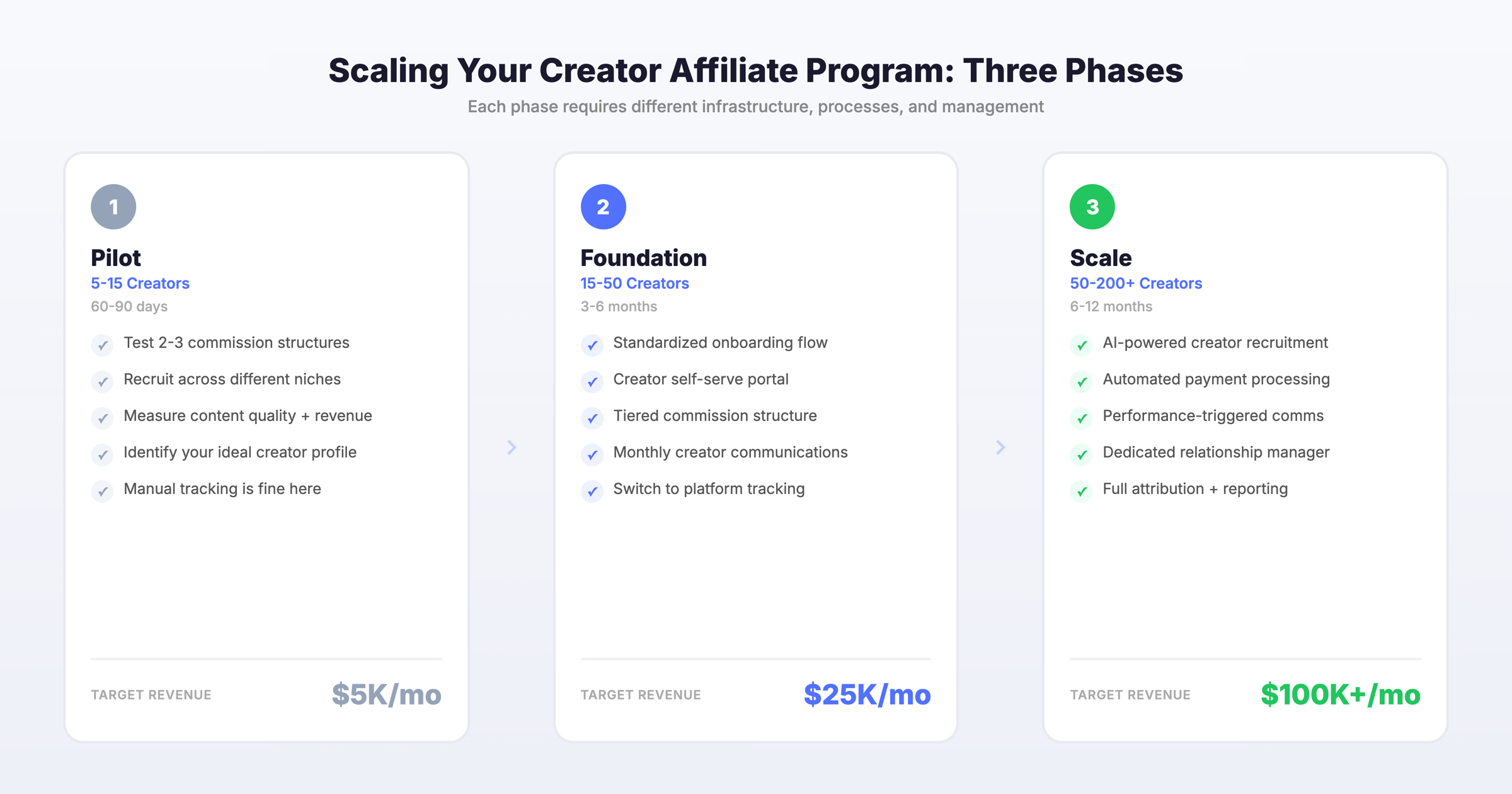
Phase 1: Pilot (5-15 Creators)
Goal: validate that creator affiliates work for your brand and identify what predicts performance.
- Recruit 5-15 creators across different audience sizes and content styles
- Test 2-3 commission structures simultaneously
- Measure everything: not just revenue, but content quality, creator responsiveness, and audience sentiment
- Identify your “creator profile” — the characteristics that predict high performance for your specific brand
Timeline: 60-90 days. You need at least 2 months of data before drawing conclusions.
Phase 2: Foundation (15-50 Creators)
Goal: build repeatable processes so growth doesn’t require proportionally more effort.
- Create standardized onboarding materials: welcome email sequences, content guidelines, asset libraries
- Implement a creator portal where affiliates can grab links, view earnings, and access brand assets self-serve
- Build a tiered commission structure that rewards performance and reduces top-performer churn
- Establish a regular communication cadence: monthly newsletters, product launch previews, top-performer shoutouts
Phase 3: Scale (50-200+ Creators)
Goal: automate everything that doesn’t require human judgment.
- Automate creator recruitment outreach based on performance criteria
- Use AI-powered matching to identify and recruit creators programmatically
- Build automated payment processing — manual PayPal payments don’t work at scale
- Create performance-triggered communications: congratulate creators on milestones, re-engage inactive affiliates, offer commission increases to high performers
- Hire or assign a dedicated creator relationship manager once you pass 75-100 active affiliates
Common Scaling Mistakes
Growing too fast without infrastructure. Adding 50 creators when your tracking is manual and your onboarding is a single email guarantees chaos. Build the systems first, then open the floodgates.
Treating all creators the same. Your top 10 performers need white-glove treatment: exclusive commissions, early product access, direct communication. Treat them like your best customers, because they are.
Ignoring creator feedback. Your affiliates are on the front lines with your customers. They know what questions people ask, what objections come up, and what content resonates. Build feedback loops that capture this intelligence.
No content guidelines. Freedom without direction produces inconsistent results. Provide clear guidance on what to include (key product benefits, specific CTAs) and what to avoid (competitor mentions, unsubstantiated claims), while leaving creative execution to the creator.
Conclusion: Build the System, Then Scale
Creator affiliate programs aren’t complicated. They require clear thinking about four things: what you’ll pay, who you’ll recruit, how you’ll track, and how you’ll scale. Most brands that fail at creator affiliate marketing didn’t fail at any of these individually — they skipped the foundational work and tried to scale a program that never had proper infrastructure.
Start with your commission structure. Make it generous enough to attract quality creators. Recruit 10-15 creators who genuinely align with your brand. Set up tracking that connects every sale to its source. Measure for 60-90 days. Then scale what works.
The brands running profitable creator affiliate programs in 2026 aren’t doing anything magical. They built systems that make it easy for creators to sell, easy for customers to buy, and easy for the brand to measure what’s working. That’s the entire playbook.
partnrUP helps brands build and scale creator affiliate programs with AI-powered creator matching, automated tracking and attribution, and integrated payment management — so you can focus on creator relationships instead of spreadsheet management. Explore the platform or book a demo to see how it works.
Frequently Asked Questions
How much does it cost to start a creator affiliate program?
The upfront cost is minimal compared to traditional influencer campaigns. You need product to seed (send to creators for review), tracking infrastructure (free with most affiliate platforms at small scale, $100-500/month for dedicated tools), and your first commission payouts (variable based on sales). Most brands can launch a pilot for under $2,000 in direct costs, excluding product value.
How many creators do I need for a successful program?
Quality matters more than quantity. Five highly aligned creators who consistently produce content will outperform 50 disengaged affiliates who signed up and never posted. Start with 10-15 for your pilot, aim for 50+ within 6 months, and scale to 100-200 once your systems can support it. The key is active participation rate — industry benchmarks suggest 30-40% of enrolled affiliates will be consistently active.
What’s a good commission rate for creator affiliates?
It depends on your margins and average order value. The general principle: commissions should be high enough that a creator can earn meaningful income ($1,000+/month) from reasonable sales volume. For most consumer brands, that means 15-25% on products with $50+ average order values. If your math shows creators earning less than $500/month at realistic conversion rates, your commission is too low to attract quality partners.
How long does it take for a creator affiliate program to generate meaningful revenue?
Expect 60-90 days before you have reliable performance data. The first month is onboarding and initial content creation. Month two is when content starts gaining traction and you see your first consistent sales. By month three, you should be able to identify your top performers and make informed decisions about scaling. Brands that expect immediate results from day one typically set commission windows too short and kill the program before it has time to work.
Should I use a platform or build my own tracking?
Start simple and add infrastructure as you grow. For your first 5-10 creators, a combination of unique discount codes and UTM links with manual tracking is fine. Once you pass 15-20 active creators, the manual overhead starts consuming more time than the platform would cost. Purpose-built platforms handle link generation, real-time attribution, commission calculation, and creator dashboards — freeing you to focus on relationships and strategy rather than spreadsheet management.
What’s the difference between a creator affiliate program and a traditional influencer campaign?
Traditional influencer campaigns pay a flat fee for content, regardless of whether it drives sales. Creator affiliate programs pay primarily (or entirely) based on performance — creators earn when their audience buys. This aligns incentives: creators are motivated to create content that actually converts, not just content that looks good in a brand’s campaign recap. The trade-off is that creators bear more risk, which is why commission rates need to be generous enough to compensate for that risk.
How do I prevent brand dilution with many affiliates promoting my product?
Content guidelines solve this without stifling creativity. Provide clear dos and don’ts: approved claims, required disclosures, tone parameters, and visual standards. But leave the creative execution to the creator — their audience follows them for their voice, not yours. Review the first piece of content from each new affiliate before it goes live, provide feedback, and then trust the process. The brands that micromanage every post lose their best creators to programs that give them creative freedom.