Enterprise influencer software pricing is one of the least transparent topics in martech — and GRIN is no exception. A 2024 Forrester survey found that 67% of marketing technology buyers list “lack of transparent pricing” as their top frustration with SaaS vendors. When it comes to influencer marketing platforms, that problem is even more pronounced: almost every vendor hides their actual cost behind a “contact sales” wall.
This guide is part of our Influencer Marketing Platform Comparison Guide: How to Choose the Right Tool in 2026 — the definitive resource for evaluating and selecting the right influencer marketing stack.
GRIN is a powerful creator management platform used by hundreds of DTC brands. But “powerful” doesn’t always mean “worth it” — especially if you’re paying for capabilities you don’t use, locked into an annual contract, or hitting feature ceilings that require costly add-ons.
In this guide, you’ll learn:
- What GRIN’s actual pricing tiers look like in 2026 (based on publicly available information and buyer reports)
- What’s included — and what costs extra
- Where brands consistently hit the ceiling with GRIN
- How partnrUP compares as an ROI-focused alternative with transparent pricing
- Which platform makes sense for your brand’s stage and goals
- How to evaluate any influencer platform purchase without the sales runaround
Table of Contents
- GRIN Pricing 2026: What We Know
- What’s Actually Included
- Where Brands Hit the Ceiling
- Contract Terms and the Lock-In Risk
- partnrUP: The ROI-Focused Alternative
- How to Choose Between GRIN and partnrUP
- Conclusion
- Frequently Asked Questions
GRIN Pricing 2026: What We Know
GRIN does not publish pricing on its website. Like most enterprise influencer platforms, it uses a custom quote model that varies based on your brand’s creator headcount, team size, feature requirements, and negotiating leverage.
Based on publicly available buyer reviews on G2, Capterra, and software comparison forums, here’s what brands are actually reporting paying for GRIN in 2025–2026:
Entry-Level (Small Brands, Under 50 Creators)
Reported range: $1,500–$2,500/month
At this tier, brands typically get access to core creator discovery, basic campaign management, and gifting/seeding workflows. Payment functionality is available but limited in creator volume. G2 reviewers at this tier frequently cite the platform feeling “overbuilt” for their actual needs.
Mid-Market Tier (50–200 Creators)
Reported range: $2,500–$5,000/month
This is where GRIN’s feature set starts to deliver value — affiliate tracking, content management, more robust analytics, and integration with Shopify and WooCommerce. Most mid-market DTC brands land here. Annual commitment is typically required at this level.
Enterprise Tier (200+ Creators, Custom)
Reported range: $5,000–$10,000+/month
Large brands with complex programs — multi-channel attribution, custom reporting, enterprise SSO, dedicated CSM support — operate at this level. At scale, GRIN can be cost-justified, but the ROI math requires high creator velocity and strong internal team bandwidth to run the platform effectively.
Implementation and Onboarding
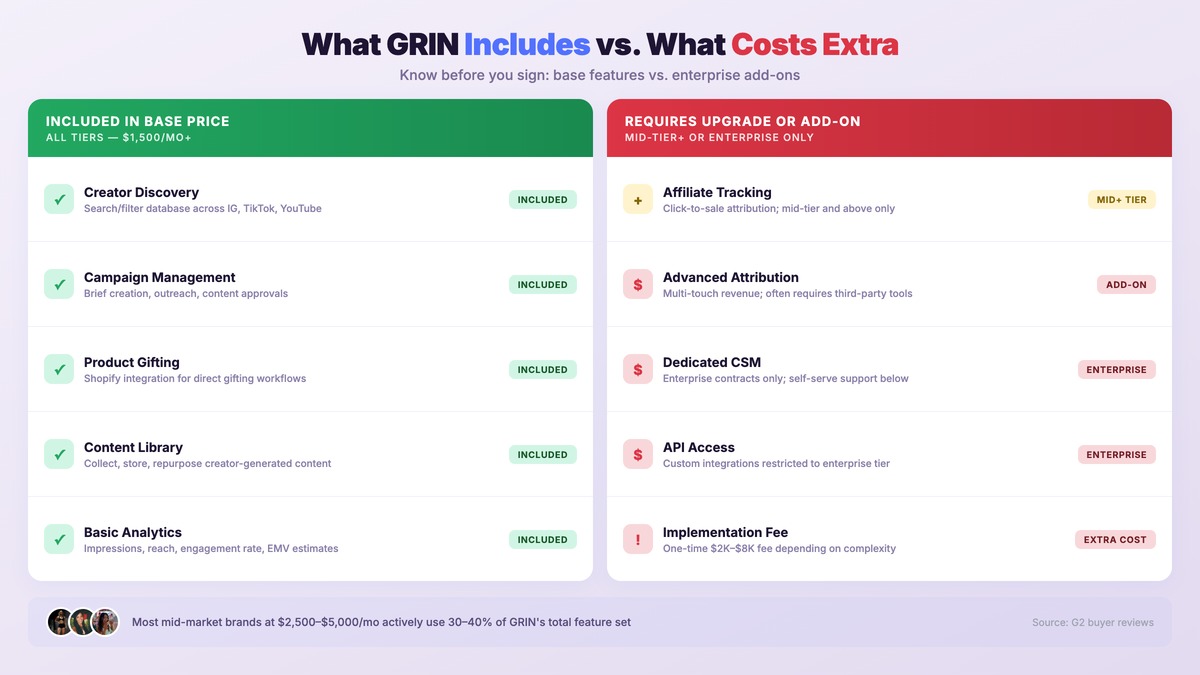
GRIN also charges implementation fees for enterprise onboarding, typically ranging from $2,000–$8,000 depending on integration complexity (ERP, custom Shopify setups, multi-brand configurations). This is a one-time cost, but it’s rarely surfaced until late in the sales process.
Want to see how GRIN stacks up against other platforms head-to-head? Our Influencer Marketing Platform Comparison Guide covers the full competitive landscape.
What’s Actually Included in GRIN
To evaluate whether GRIN’s price is worth it, you need to know what’s actually in the box — and what requires an add-on or manual workaround.
Core Features (All Tiers)
- Creator Discovery: Search and filter from GRIN’s database of influencers across Instagram, TikTok, YouTube, and more. Quality is solid, especially for lifestyle and DTC verticals.
- Campaign Management: Brief creation, creator outreach, content approval workflows, and deadline tracking.
- Product Gifting: Integration with Shopify to send gifted products directly from the dashboard without manual fulfillment coordination.
- Content Collection: Centralized library for collecting, storing, and repurposing creator-generated content.
- Basic Reporting: Impressions, reach, engagement rate, estimated media value (EMV). Standard influencer metrics.
What Costs More or Requires Upgrades
- Affiliate and commission tracking: Available on mid-tier and above. Deep affiliate attribution (multi-touch, click-to-sale) often requires a custom configuration.
- Advanced analytics and attribution: GRIN’s native attribution modeling is limited compared to purpose-built attribution tools. Brands running complex omnichannel programs often need a separate analytics stack.
- Dedicated customer success: At entry and mid tiers, support is largely self-serve. A dedicated CSM typically requires enterprise contracts.
- API access: Custom integrations and API access are enterprise-tier features.
- White-glove creator recruitment: GRIN is a software platform, not a managed service. Finding and recruiting creators is your team’s job — the platform provides tools, not strategy.
If you’re evaluating platforms primarily for affiliate-style performance tracking, the Creator Affiliate Tracking guide covers what to look for in a platform’s attribution setup — a critical factor many brands underweight at purchase time.
The Hidden Cost: Team Bandwidth
GRIN is a feature-rich platform. That’s both its strength and its liability. To extract full value from GRIN, you need a dedicated influencer marketing team — typically at least one full-time manager and ideally a coordinator or ops person.
Brands with lean marketing teams (1-2 people) frequently report that GRIN’s complexity creates more work than it saves. When you’re paying $2,500–$5,000/month for a platform and only using 30–40% of its features because your team doesn’t have bandwidth, the ROI math gets uncomfortable fast.
Where Brands Hit the Ceiling with GRIN
GRIN is genuinely good software. But based on buyer reviews and common customer journey patterns, there are predictable points where brands run into limitations — or discover that what they were sold doesn’t match their day-to-day reality.
Creator Volume Caps
Many GRIN contracts are priced by creator seat or active creator volume. As your program scales from 50 to 200 to 500+ creators, your cost scales with it — sometimes nonlinearly, depending on how your contract was structured. Brands that aggressively scaled their creator programs in 2024–2025 found themselves facing mid-contract renegotiations at significantly higher price points.
ROI Attribution Gaps
A common complaint in G2 reviews: “GRIN shows us engagement but not revenue.” The platform’s native analytics excel at awareness metrics but are less robust for revenue attribution. Brands running sales-oriented programs — affiliate-style commissions, creator storefronts, conversion-tracked campaigns — often need to layer in additional tools or spend significant time on manual data reconciliation.
Our guide on measuring influencer ROI covers the attribution approaches that work best for brands trying to connect creator content to actual revenue.
The Discovery Quality Problem at Scale
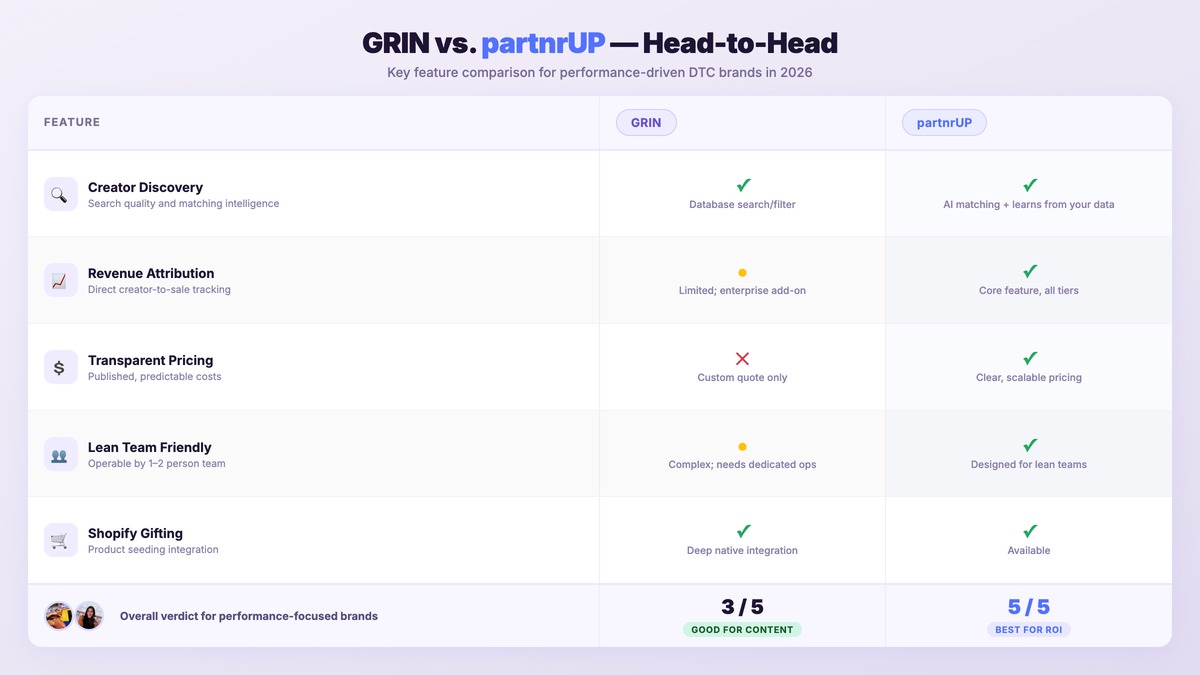
GRIN’s discovery is database-driven. For mid-market brands targeting mainstream lifestyle verticals, it works well. For niche verticals, emerging categories, or brands needing very specific audience demographics, the discovery quality can feel like a limitation. The platform doesn’t use AI-powered matching that learns from your campaign performance history — it’s fundamentally a search-and-filter tool.
Customer Support at Non-Enterprise Tiers
Multiple G2 reviews from mid-market GRIN customers mention that once the initial onboarding period ends, support becomes reactive and slow. Unless you’re on an enterprise tier with a dedicated CSM, getting hands-on help with complex issues can involve long support ticket queues.
Integration Complexity
GRIN integrates with Shopify natively and supports WooCommerce, but brands running on other e-commerce stacks (Magento, BigCommerce, custom builds) report significant integration friction. API access at lower tiers makes custom integrations difficult without developer resources.
Understanding where GRIN falls short is essential context for our full GRIN Review 2026, which covers the platform’s strengths and weaknesses in detail — including specific use cases where it excels and where it underperforms.
Contract Terms and the Lock-In Risk
Pricing is one thing. Contract structure is another — and in the influencer marketing software space, contract terms can create significant financial risk if your program or business circumstances change.
Annual Commitments Are the Norm
GRIN almost universally requires annual contracts. Monthly billing is either unavailable or offered at a significant premium (typically 20–40% higher than annual pricing). For brands that are growing rapidly, in early stages of their influencer program, or navigating budget uncertainty, annual commitments represent meaningful financial risk.
Mid-Contract Scaling Costs
If you start at an entry or mid-tier contract and your creator program scales beyond the contracted volume, you’ll be billed for overages. These are rarely cheap. The per-creator incremental cost mid-contract can be significantly higher than the per-creator rate you negotiated at contract signing.
Renewal Leverage Shifts
In year one, you have negotiating leverage — the vendor wants your business. At renewal, that leverage shifts. Brands report that GRIN renewal pricing frequently comes in 15–25% higher than initial contract pricing, especially if your usage has grown. At that point, migrating to a competitor platform requires data export, team retraining, and a migration window — giving the vendor significant pricing power at renewal.
What to Negotiate Before You Sign
- Overage caps: Get a written cap on per-creator overages if your program scales beyond contracted volume
- Price protection at renewal: Ask for a renewal price cap (e.g., no more than 10% increase at year 2)
- Data export rights: Confirm you own your creator relationship data and can export it
- Cancellation terms: Understand the exact conditions under which you can exit before contract end
- Implementation fees: Get clarity on whether onboarding costs are included or billed separately
partnrUP: The ROI-Focused Alternative
partnrUP is purpose-built for brands that want a direct line from creator content to revenue. While GRIN is primarily a creator management and content platform, partnrUP focuses on what matters most to modern performance-driven brands: measurable ROI, scalable affiliate and commission structures, and AI-powered creator matching that improves with every campaign.
Here’s how partnrUP approaches the areas where GRIN brands most commonly hit ceilings:
Transparent Pricing
partnrUP doesn’t hide pricing behind a sales call. Our platform is built around transparent, scalable pricing that grows with your program — not against it. You’re not paying for features you don’t use in year one, and you’re not surprised by overages when your creator program hits its stride.
Performance Attribution First
Where GRIN’s analytics focus on awareness metrics (impressions, EMV, engagement rate), partnrUP is built around performance attribution. Every creator partnership is tracked from content to conversion — affiliate links, commission structures, revenue attribution, and ROAS reporting are core features, not enterprise add-ons.
Brands using partnrUP can see which creators are driving actual sales, optimize commission structures based on performance data, and report ROI to leadership using real revenue numbers — not estimated media value approximations.
AI-Powered Creator Matching
Instead of a static database that requires manual search and filter, partnrUP’s matching engine learns from your brand’s performance history. As you run campaigns, the platform gets smarter about which creator profiles, content styles, and audience segments drive results for your specific products and verticals.
This matters for scaling: rather than requiring your team to spend hours on manual creator research, partnrUP surfaces candidates that are statistically likely to perform based on your actual campaign outcomes — not just follower count and niche tags.
Right-Sized for Lean Teams
partnrUP is designed to be operable by a team of one or two, without sacrificing program sophistication. The workflow is optimized for speed: creator outreach, brief delivery, content approval, commission setup, and analytics are all accessible without navigating a complex feature maze.
Brands that switched from GRIN to partnrUP frequently cite reduced time-per-campaign by 40–60% — time that goes back into strategy, creator relationships, and content ideation instead of platform management. If you’re building or scaling your program and want to see how it works, book a demo with our team.
Performance-Based Scaling
partnrUP’s pricing scales with your program’s performance — which means when your creator program is working, the economics stay favorable. You’re not penalized for growth with creator-seat overages; you’re rewarded for performance with better matching and optimization insights.
See how partnrUP compares in our 7 GRIN Alternatives roundup, which covers the full competitive landscape of creator management platforms for DTC brands in 2026.
How to Choose Between GRIN and partnrUP
No platform is right for every brand. Here’s a direct framework for deciding which fits your situation better — without the sales spin.
GRIN Makes Sense If:
- You have a large, established creator program (200+ active creators) with a dedicated team to manage it
- Your primary focus is content collection and brand awareness rather than performance/revenue attribution
- You need deep Shopify integration for product gifting at scale
- You have budget certainty and are comfortable with annual contract commitments
- You need enterprise features: SSO, custom API integrations, complex multi-brand configurations
partnrUP Makes More Sense If:
- You’re growing your creator program and need pricing that scales fairly with your growth
- Revenue attribution and ROAS are your primary success metrics — not impressions and EMV
- You want AI-powered creator discovery that improves based on your actual performance data
- Your team is lean (1-3 people) and needs a platform that doesn’t require dedicated ops bandwidth
- You’re prioritizing affiliate and commission-based creator relationships
- You want transparent, predictable pricing without mid-contract surprises
The Decision Framework in Practice
Ask your team two questions before making a platform decision:
- What does success look like at 12 months? If the answer is “more followers” or “better brand awareness,” GRIN’s content-focused feature set may serve you well. If the answer is “X% of revenue attributable to creators” or “Y% ROAS from our creator program,” you need a platform built around performance attribution from the ground up.
- What does your team look like? If you have 3+ people dedicated to influencer marketing, GRIN’s feature depth can pay off. If you’re a lean team wearing multiple hats, complexity is a liability, not a feature.
For more decision-making frameworks, our Influencer Marketing Platform Comparison Guide walks through how to evaluate any platform purchase with a structured rubric — including questions to ask in sales calls that surface pricing surprises before you sign.
Ready to see a platform built around transparent pricing and measurable ROI? Book a demo with partnrUP and we’ll walk you through exactly what you’d pay and what you’d get.
Conclusion
GRIN is a legitimate platform with a strong feature set — but its pricing is opaque, its contracts are restrictive, and its ROI reporting leaves brands that care about revenue attribution wanting more. For established teams running high-volume awareness programs with the bandwidth to manage platform complexity, GRIN can deliver.
For brands that need transparent pricing, performance attribution, and a platform that scales with their program rather than against it, partnrUP is the smarter alternative. Especially if you’re in a growth phase, running a lean team, or building an affiliate-style creator program where ROI is the primary success metric.
Don’t buy influencer marketing software on a 12-month contract without understanding exactly what you’re paying for — and exactly what you’re giving up. Use this guide as your due diligence checklist and go into every platform conversation with the right questions.
Explore partnrUP’s platform to see how transparent, performance-focused creator management works in practice — or book a demo to talk through your specific program needs.
Frequently Asked Questions
How much does GRIN cost per month in 2026?
GRIN doesn’t publish pricing publicly, but based on buyer reports and G2/Capterra reviews, brands typically pay between $1,500–$2,500/month at entry level, $2,500–$5,000/month at mid-market, and $5,000–$10,000+/month at enterprise tier. Implementation fees of $2,000–$8,000 may apply separately. Final pricing depends on creator volume, feature requirements, and contract negotiation — always request a detailed quote and ask about all-in cost including implementation and overages.
Does GRIN offer monthly billing or is it annual only?
GRIN primarily operates on annual contracts. Monthly billing is generally available at a significant premium (20–40% higher) and may not be available for all feature tiers. If billing flexibility is a priority, clarify this explicitly during the sales process before entering contract negotiations.
What’s not included in GRIN’s base pricing?
Common costs that are NOT included in GRIN’s base pricing include: enterprise-grade analytics and advanced attribution, dedicated customer success managers (available at enterprise tier), API access for custom integrations, white-glove creator recruitment services (GRIN is a software tool, not a managed service), and implementation/onboarding fees at initial contract. Ask your sales rep for a complete list of add-ons and enterprise-tier features before signing.
How does partnrUP pricing compare to GRIN?
partnrUP offers transparent, scalable pricing that doesn’t require a sales call to understand. Unlike GRIN’s opaque custom quote model, partnrUP’s pricing is designed to grow with your program performance — meaning the economics stay favorable as your creator program scales. For a direct comparison, book a demo and our team will walk you through pricing specifics relevant to your program size.
Can you negotiate GRIN pricing?
Yes — like most enterprise SaaS, GRIN’s pricing has negotiating room, especially at initial contract signing. Tactics that have worked for other brands include: requesting a multi-year deal for better annual rates, asking for implementation fees to be waived or reduced, getting a renewal price cap (e.g., no more than 10% increase at year 2), and negotiating overage caps to limit cost exposure if your creator program scales faster than expected. Renewal leverage is weaker than initial signing leverage — so front-load your negotiating at contract signing.
What influencer marketing platforms are alternatives to GRIN?
The main alternatives to GRIN in 2026 include partnrUP (performance-focused, AI-powered matching, transparent pricing), Aspire, Later Influence (formerly Mavrck), Traackr, and Upfluence. Each has a different strength: Aspire excels at gifting and UGC at scale; Traackr is strong for enterprise analytics; Upfluence integrates deeply with e-commerce platforms. Our 7 GRIN Alternatives guide covers each in detail with a direct comparison. For a broader platform overview, see our Influencer Marketing Platform Comparison Guide.
Is GRIN worth the cost for small brands?
For most small brands (under 50 active creators, lean teams, early-stage programs), GRIN’s cost-to-value ratio is difficult to justify. At $1,500–$2,500/month, you’re paying for enterprise-level complexity and feature depth that a small program won’t use. Small brands typically get better ROI from a more focused tool — either a simpler creator management platform at lower cost, or a performance-focused solution like partnrUP that doesn’t charge for features you won’t need until you’re at scale. The exception: if your brand is growing fast and you expect to have 100+ creators within 6–12 months, buying into a platform that scales with you can make sense — as long as you’ve negotiated fair creator-volume pricing upfront.