Brands lose an estimated 20-30% of their creator-driven revenue to poor attribution — sales that actually happened but were never tracked back to the creator who drove them. In a channel where proving ROI is already the top challenge, leaky tracking infrastructure turns a winnable argument into an unwinnable one.
This guide is part of our Affiliate Influencer Marketing: The Complete Brand Playbook for 2026 — a comprehensive resource for brands looking to build effective creator partnerships at scale.
Creator affiliate tracking has evolved far beyond simple coupon codes and UTM links. In 2026, the tracking landscape includes platform-native attribution, multi-touch models, server-side tracking that survives cookie deprecation, and AI-powered incrementality measurement. The brands capturing the most value from their creator programs are the ones investing in robust tracking infrastructure.
This guide covers the best tools, methods, and implementation strategies for tracking creator affiliate performance accurately and completely. For the full affiliate program strategy, explore our complete affiliate influencer marketing playbook.
In this guide, you’ll learn:
- The major creator affiliate tracking methods and when to use each
- Top tracking platforms and tools compared
- How to implement multi-touch attribution for creator programs
- Solving the cookie deprecation challenge
- Advanced tracking techniques for cross-platform campaigns
- Common tracking mistakes that cost brands revenue
Table of Contents
- Core Tracking Methods Compared
- Top Creator Affiliate Tracking Platforms
- Implementing Multi-Touch Attribution
- Tracking Beyond Cookies
- Cross-Platform Tracking Strategies
- Building a Creator Tracking Stack That Scales
- Frequently Asked Questions
Core Tracking Methods Compared
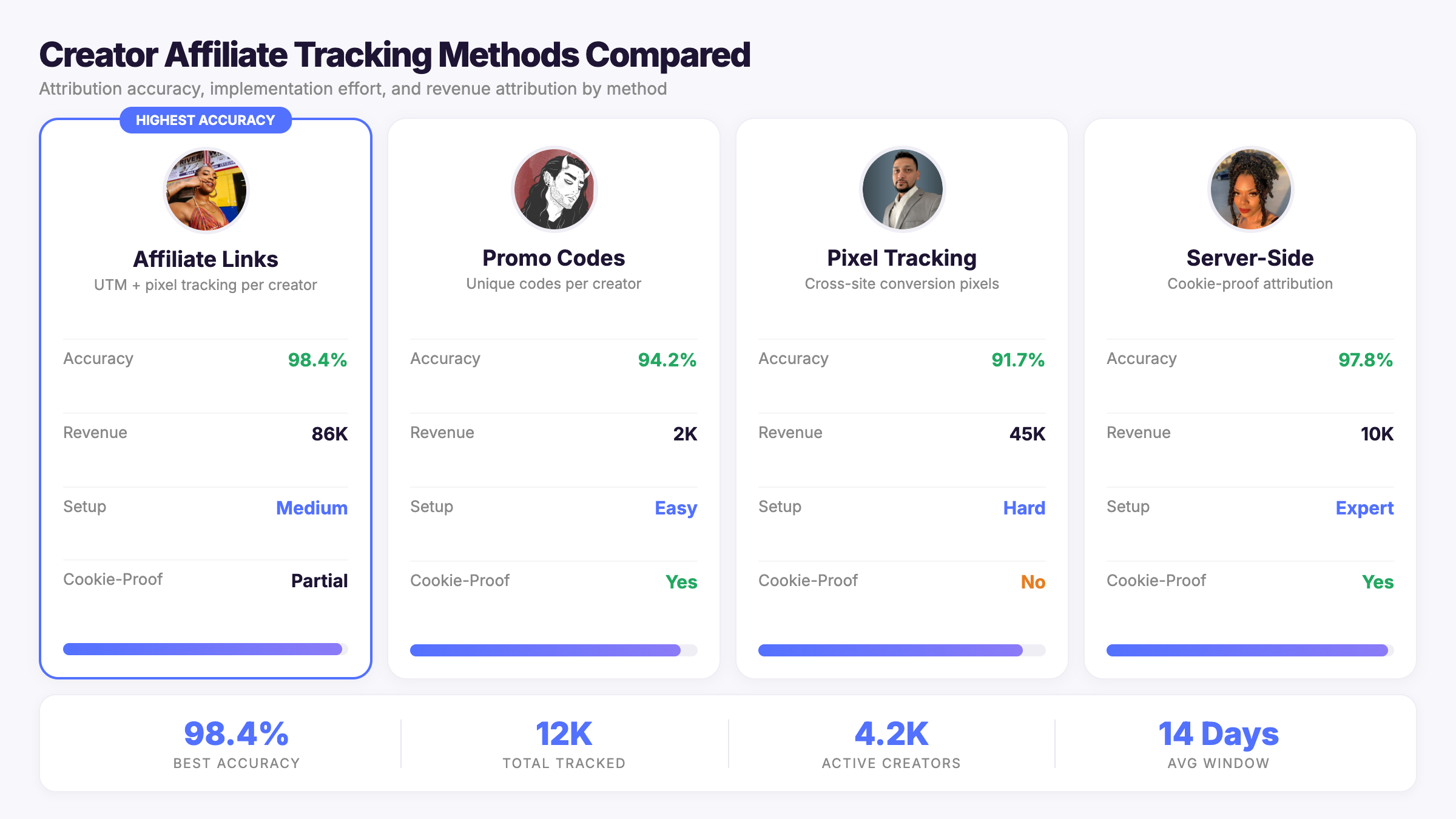
Each tracking method has distinct strengths and limitations. Understanding these tradeoffs is essential for building a tracking stack that captures the full picture of creator-driven revenue.
Unique Affiliate Links
Each creator receives a unique URL that includes tracking parameters. When a viewer clicks the link and makes a purchase, the conversion is attributed to that specific creator. This is the most reliable tracking method because it creates a direct, auditable connection between content and purchase.
Strengths: High accuracy, real-time tracking, works across devices (when users click directly), integrates with most analytics platforms. Limitations: Doesn’t capture verbal mentions (podcasts, live streams where viewers type URLs manually), affected by ad blockers and cookie restrictions, can be lost if users navigate away and return later through a different path.
Promo Codes
Unique discount codes assigned to each creator (e.g., SARAH20 for 20% off) track purchases when customers apply the code at checkout. Promo codes work in environments where clickable links aren’t available — podcasts, YouTube videos where viewers shop later, and in-person events.
Strengths: Works for offline-to-online conversion, unaffected by cookie restrictions, provides purchase incentive that can increase conversion. Limitations: Codes leak to coupon sites (inflating attribution), customers forget to apply codes (undercounting), and codes provide less data than link-based tracking (no click timestamps, no user journey data). For more on this topic, explore our guide to building a creator affiliate program.
Platform-Native Attribution
TikTok Shop, Instagram Shopping, Amazon Associates, and YouTube Shopping all provide built-in tracking for creator-driven sales on their platforms. These tools are highly accurate for on-platform transactions because they track the entire user journey within a closed ecosystem. For more on this topic, explore our influencer marketing platform comparison guide.
Strengths: Highest accuracy for on-platform purchases, no setup required beyond platform integration, captures view-through and assisted conversions within the platform. Limitations: Only tracks on-platform sales — misses all purchases that happen on your website or other channels. If most of your revenue comes through your own site, platform-native tracking alone significantly undercounts creator impact. For more on this topic, explore our State of Influencer Marketing 2026 report.
Pixel-Based Tracking
Conversion pixels (JavaScript code snippets placed on your website) fire when a user who clicked a creator link completes a purchase. Pixel-based tracking enables cross-device attribution, view-through measurement, and multi-touch journey mapping.
Strengths: Cross-device tracking, view-through attribution, integrates with broader marketing analytics. Limitations: Affected by ad blockers (10-30% of users block tracking pixels), privacy regulations (GDPR, CCPA require consent), and cookie deprecation (third-party cookies are being phased out by major browsers).
Top Creator Affiliate Tracking Platforms
Choosing the right tracking platform depends on your program size, technical resources, and channel mix.
Affiliate Networks
Impact.com: Enterprise-grade tracking with robust multi-touch attribution, cross-device measurement, and comprehensive partner management. Best for brands with 50+ active creators and complex attribution needs. Pricing is typically percentage-of-tracked-revenue plus platform fees.
ShareASale / CJ Affiliate: Established networks with large creator marketplaces. Good for brands looking to recruit affiliates through an existing marketplace while getting reliable tracking infrastructure. Lower setup complexity than Impact but fewer advanced attribution features.
Refersion: Popular with Shopify brands for its simple integration and creator-friendly dashboard. Ideal for DTC brands running mid-size affiliate programs (20-100 creators). Competitive pricing for small-to-mid market brands.
Influencer Marketing Platforms
Platforms like partnrUP combine creator discovery and relationship management with integrated tracking. This eliminates the need for separate tools for finding creators and measuring their performance. The advantage is end-to-end visibility — from creator matching through content production to revenue attribution — in a single platform.
UTM + Google Analytics
The simplest tracking approach: assign each creator a unique UTM-tagged URL and track conversions in Google Analytics. This works for small programs (under 20 creators) where budget doesn’t justify platform fees. The tradeoff is significant manual effort, limited multi-touch attribution, and no automated commission calculation.
Implementing Multi-Touch Attribution
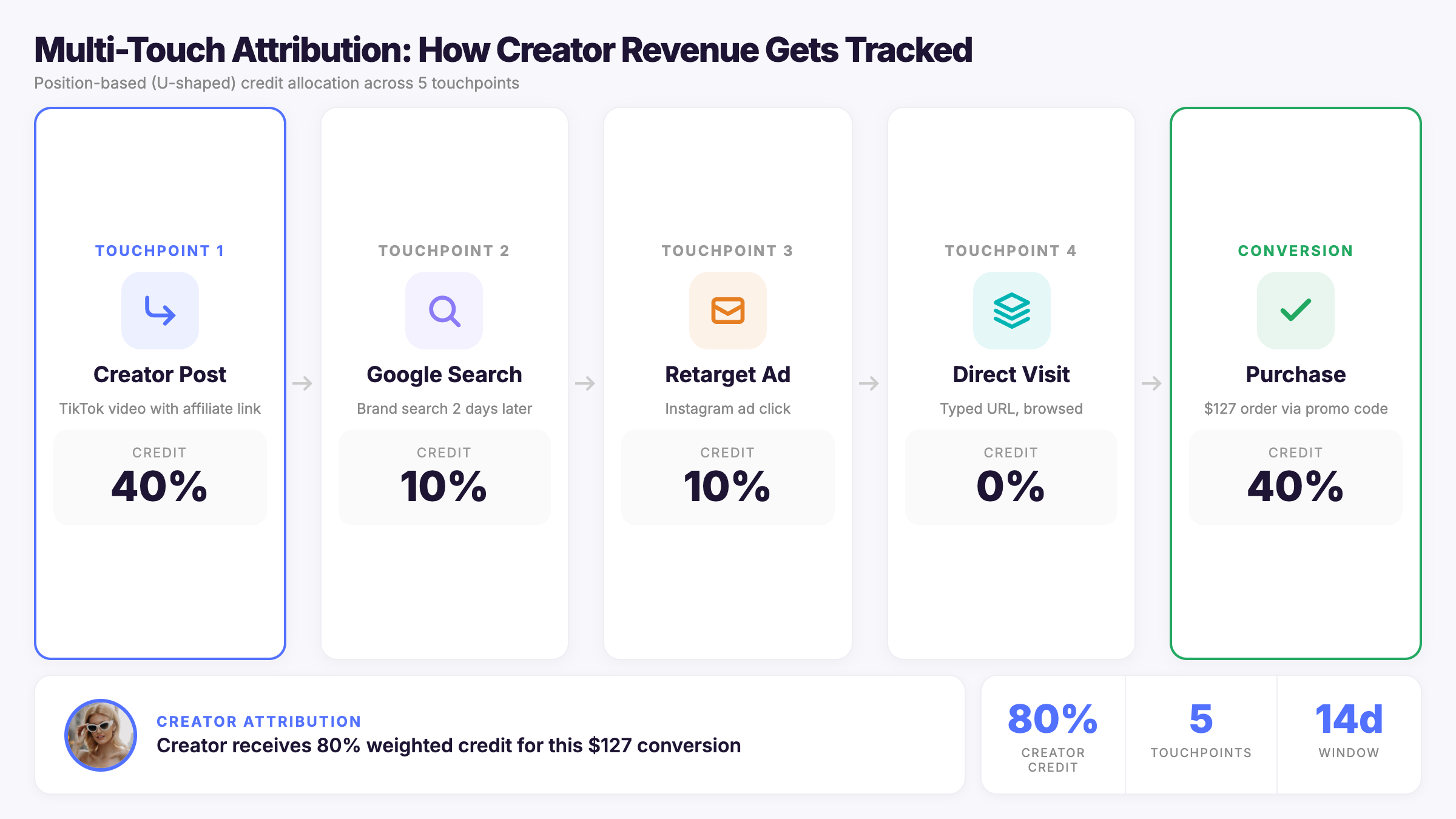
Single-touch attribution (first click or last click) systematically misattributes creator impact. Multi-touch attribution distributes credit across all touchpoints in the customer journey, giving a more accurate picture of each creator’s contribution.
Linear Attribution
Equal credit to every touchpoint. If a customer sees three creator posts before purchasing, each creator gets 33% credit. Simple and fair, but doesn’t distinguish between touchpoints that had more or less influence on the purchase decision.
Time-Decay Attribution
More credit to touchpoints closer to the purchase. This model recognizes that the final creator interaction before purchase likely had the most direct influence on the buying decision, while earlier touchpoints played a supporting role. Time-decay models are the most popular for e-commerce affiliate programs.
Position-Based (U-Shaped) Attribution
40% credit to first touch, 40% to last touch, 20% distributed among middle touches. This model recognizes both the creator who introduced the customer to your brand (discovery value) and the creator who drove the final conversion (closing value). It’s particularly useful for programs that separate awareness creators from conversion-focused affiliates.
Data-Driven Attribution
Machine learning models analyze your historical conversion data to determine how much credit each touchpoint deserves. This is the most accurate approach but requires significant data volume (typically 1,000+ conversions per month) and technical resources to implement. Available through Google Analytics 4, some enterprise affiliate platforms, and custom analytics implementations.
Tracking Beyond Cookies
With third-party cookies being deprecated by major browsers, brands need tracking methods that don’t rely on cookie-based attribution.
Server-Side Tracking
Instead of relying on browser-based cookies, server-side tracking sends conversion data directly from your server to your tracking platform. This approach is unaffected by ad blockers, browser privacy settings, or cookie deprecation. Implementation requires developer resources but provides the most future-proof tracking infrastructure.
First-Party Data Strategies
Build direct relationships between creator traffic and your own first-party data. When a user clicks a creator link and creates an account or provides an email, you can track their entire customer journey through your own systems — independent of third-party tracking technology. First-party data strategies require larger up-front investment but create durable, privacy-compliant tracking.
Probabilistic Matching
When deterministic tracking (exact user identification) isn’t possible, probabilistic models use signals like device type, location, and timing to estimate which creator likely drove a conversion. Less precise than deterministic methods but captures conversions that would otherwise go unattributed. Most enterprise affiliate platforms include probabilistic matching as a supplement to deterministic tracking.
Cross-Platform Tracking Strategies
Creators operate across multiple platforms — a single creator might post about your product on TikTok, Instagram, and YouTube. Tracking performance across platforms requires unified measurement infrastructure.
Unified Creator IDs
Assign each creator a single identifier that persists across platforms. This enables you to see a creator’s total impact across TikTok, Instagram, YouTube, and blog content — rather than treating each platform as a separate relationship. The aggregate view often reveals that creators who appear average on any single platform are actually driving significant total value across their full content ecosystem. Tools like partnrUP’s platform help brands automate this at scale.
Cross-Platform Attribution Windows
A consumer might discover your product through a TikTok creator, research it through a YouTube review by a different creator, and purchase through an Instagram affiliate link from a third creator. Cross-platform attribution assigns appropriate credit to each creator in this multi-platform journey. Without it, only the last-touch creator gets credit — and your discovery and consideration creators appear to generate zero value.
Centralized Reporting
Build a single dashboard that aggregates tracking data from all platforms and tracking methods. This centralized view enables apples-to-apples comparison of creator performance regardless of where their content lives. Without centralized reporting, you’re making budget allocation decisions based on fragmented, platform-specific data.
Ready to build tracking infrastructure that captures the full value of your creator program? Book a demo with partnrUP to see how brands achieve unified creator attribution across platforms.
Building a Creator Tracking Stack That Scales
The difference between brands that scale creator affiliate programs and those that plateau comes down to tracking infrastructure. Without accurate, cross-platform attribution, you cannot identify your top-performing creators, optimize commission structures, or justify increased investment to leadership.
Start with the fundamentals: unique affiliate links and promo codes for every creator, server-side tracking to survive browser privacy changes, and a centralized dashboard that aggregates performance across TikTok, Instagram, YouTube, and your owned channels. Layer on multi-touch attribution once your program exceeds 20 active creators, and implement cross-platform tracking when you expand beyond a single social channel.
The brands generating the highest creator-driven ROAS in 2026 share one trait: they treat tracking as a strategic investment, not an afterthought. Your tracking stack determines your ability to recruit better creators, negotiate smarter commissions, and compound affiliate revenue quarter over quarter. Explore how partnrUP helps brands build attribution infrastructure that scales with their creator programs.
Frequently Asked Questions
What’s the most accurate creator affiliate tracking method?
Server-side tracking combined with unique affiliate links provides the highest accuracy. This combination resists ad blockers, survives cookie deprecation, and creates an auditable trail from click to conversion. If server-side implementation isn’t feasible, unique affiliate links with pixel-based backup tracking is the next best option.
How do I track creator-driven sales when customers don’t use tracking links?
Use a combination of promo codes (for offline mentions), post-purchase surveys asking “how did you hear about us?”, branded search lift analysis (Google Trends/Search Console data during campaigns), and incrementality testing (comparing sales in markets with active creator campaigns versus holdout markets). No single method captures everything, but combined they provide a reasonably complete picture.
What cookie window should I set for creator affiliate programs?
14 days is the industry standard starting point. For impulse products (under $30), 7 days captures most conversions. For considered purchases ($100+), extend to 30 days. Test different windows with your actual data — shorten the window if you see minimal conversions after day 7; extend it if significant revenue arrives in the 15-30 day range.
How do I prevent promo code leakage to coupon sites?
Use time-limited codes that expire within 48-72 hours, monitor coupon aggregator sites for your codes and issue DMCA takedowns, consider using unique single-use codes per creator post rather than persistent codes, and implement anti-fraud rules that flag unusually high code usage from non-creator traffic sources.
Do I need separate tracking for TikTok Shop vs. my own website?
Yes. TikTok Shop provides its own robust analytics for on-platform purchases, but these don’t capture purchases that start on TikTok and complete on your website. Run parallel tracking — TikTok Shop analytics for on-platform sales, plus your own affiliate tracking infrastructure for off-platform conversions. Combine both in a unified dashboard for the complete picture.
How much should I budget for tracking infrastructure?
Small programs (under 20 creators): UTM links + Google Analytics is free but requires manual effort. Mid-size programs (20-100 creators): Affiliate platform fees typically run $500-$2,000/month. Enterprise programs (100+ creators): Expect $2,000-$10,000/month for comprehensive tracking with multi-touch attribution, fraud detection, and cross-platform measurement.
What’s the biggest tracking mistake brands make?
Relying on a single tracking method. Every tracking approach has blind spots — links miss verbal mentions, codes leak to coupon sites, pixels are blocked by ad blockers, and platform analytics miss off-platform sales. The most accurate programs layer multiple tracking methods and triangulate between them to capture the fullest possible picture of creator-driven revenue.