Brands using shoppable video report conversion rates 3-5x higher than traditional product pages, yet 72% of marketing teams say they’re still experimenting with the format rather than running optimized programs. The gap between early adopters and everyone else is widening — and the playbook for what actually converts has become clearer than ever.
This guide is part of our Shoppable Video & Social Commerce: The Complete Guide for Brands in 2026 — a comprehensive resource for brands looking to build effective creator partnerships at scale.
Shoppable video transforms passive viewing into active purchasing by embedding product links, tags, and checkout flows directly into video content. But not all shoppable video performs equally. The difference between a video that generates views and one that generates revenue comes down to specific creative choices, platform optimization, and measurement discipline.
This guide breaks down what’s actually working in 2026 — based on platform data, brand case studies, and the patterns emerging across thousands of shoppable video campaigns. For a deeper dive into how shoppable video fits into your broader commerce strategy, see our complete guide to shoppable video and social commerce.
In this guide, you’ll learn:
- The shoppable video formats driving the highest conversion rates in 2026
- Platform-specific best practices for TikTok Shop, Instagram, and YouTube
- Creative techniques that turn viewers into buyers
- How to structure creator briefs for shoppable content
- Measurement frameworks for shoppable video ROI
- Common mistakes that kill conversion rates
Table of Contents
- Why Shoppable Video Is Dominating Commerce
- The Formats That Actually Convert
- Platform-Specific Best Practices
- Creative Techniques That Drive Purchases
- Measuring Shoppable Video Performance
- Frequently Asked Questions
Why Shoppable Video Is Dominating Commerce in 2026
The rise of shoppable video isn’t a trend — it’s a structural shift in how consumers prefer to discover and buy products. Video commerce in China already accounts for over $500 billion in annual GMV, and Western markets are rapidly catching up. In the U.S., social commerce (led heavily by shoppable video) is projected to surpass $80 billion in 2026.
The Psychology Behind Video Commerce
Shoppable video works because it compresses the entire purchase funnel into a single experience. Traditional e-commerce separates discovery (social media), research (review sites), and purchase (product pages) into distinct steps, losing customers at each transition. Shoppable video collapses these stages — a viewer discovers a product, sees it demonstrated, hears a trusted creator’s recommendation, and purchases without leaving the content.
Neuroscience research supports this: video activates both visual and auditory processing, creating stronger memory encoding than static images. When combined with social proof (a creator’s endorsement) and reduced friction (in-app checkout), the result is significantly higher purchase intent and conversion rates.
The Platform Investment Wave
Every major social platform has invested heavily in shoppable video infrastructure in 2025-2026. TikTok Shop’s U.S. GMV grew over 200% year-over-year. Instagram expanded product tags to all Reels formats. YouTube launched Shopping Collections and enhanced its product shelf. These platforms are competing to own the commerce layer of social media, and brands that learn to operate in this environment gain an outsized advantage.
The Shoppable Video Formats That Actually Convert
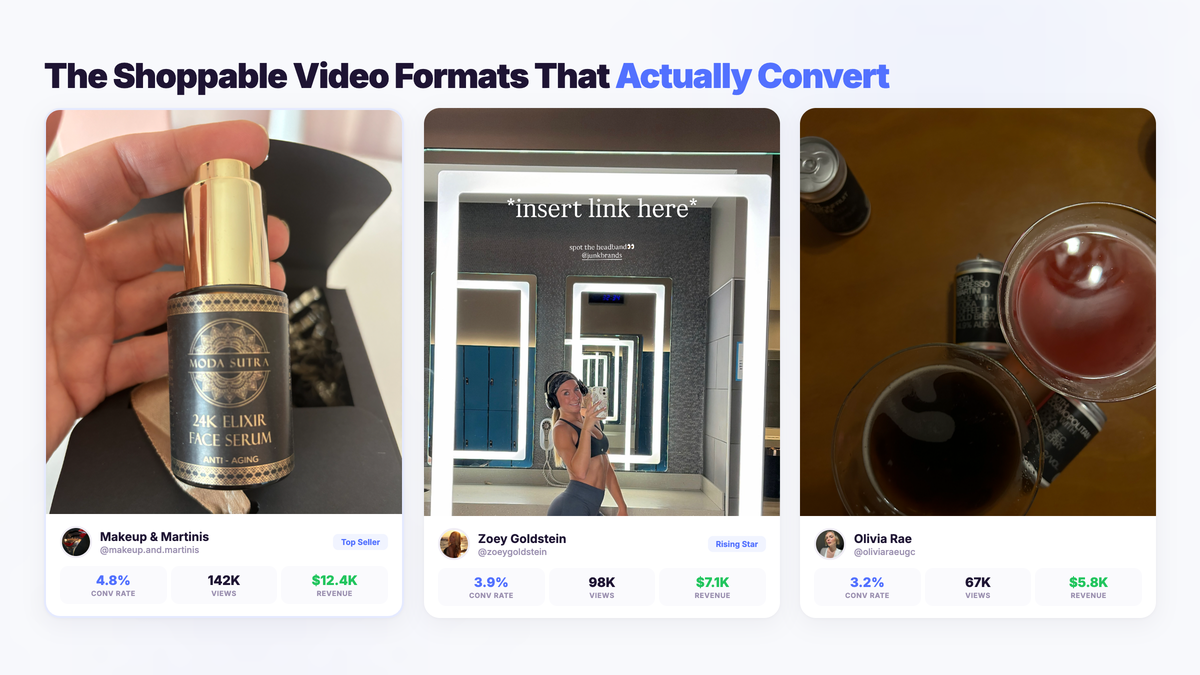
Not all shoppable video formats perform equally. Data from thousands of campaigns reveals clear winners — and formats that look impressive but rarely drive purchases. For more on this topic, explore our essential guide to creator commerce.
1. Product Demonstration Videos (Highest Conversion Rate)
Straightforward product demonstrations consistently outperform other formats for conversion. When a creator shows exactly how a product works, addresses common objections in real-time, and provides honest assessment, viewers convert at 2-4x the rate of lifestyle or aesthetic content. For more on this topic, explore our creator commerce and social shopping guide.
Key elements of high-performing demos: start with the problem the product solves, show the product in use within the first 5 seconds, address the most common objection proactively, and include a clear call-to-action with the shopping link. For more on this topic, explore our State of Influencer Marketing 2026 report.
2. Before-and-After Transformations
Transformation content creates emotional engagement that drives purchases. Whether it’s skincare results, home organization, or fitness equipment, showing a clear before-and-after gives viewers concrete evidence of product value. These videos generate high save rates and return visits — viewers who save transformation content purchase at a 40% higher rate than those who simply like or comment. For more on this topic, explore our digital shelf optimization guide.
3. Comparison and “Honest Review” Content
Videos that compare products or provide genuinely balanced reviews build trust that converts. Counterintuitively, creators who mention minor drawbacks alongside benefits see higher conversion rates than those who present only positive attributes. Audiences can detect promotional inauthenticity, and balanced reviews signal credibility.
4. Live Shopping Events
Live shopping combines real-time interaction with urgency. Viewers can ask questions, see products demonstrated on demand, and respond to limited-time offers. Average conversion rates for live shopping events range from 10-30% of viewers — dramatically higher than pre-recorded content. The format works particularly well for product launches, exclusive drops, and high-consideration purchases where buyers have questions.
5. “Get Ready With Me” and Routine Content
Routine-format videos (GRWM, morning routines, cooking sessions) embed product recommendations naturally into relatable daily scenarios. These tend to generate lower immediate conversion rates but higher click-through rates and stronger long-term brand affinity. They work best as part of an always-on shoppable content strategy rather than campaign bursts.
Platform-Specific Shoppable Video Best Practices
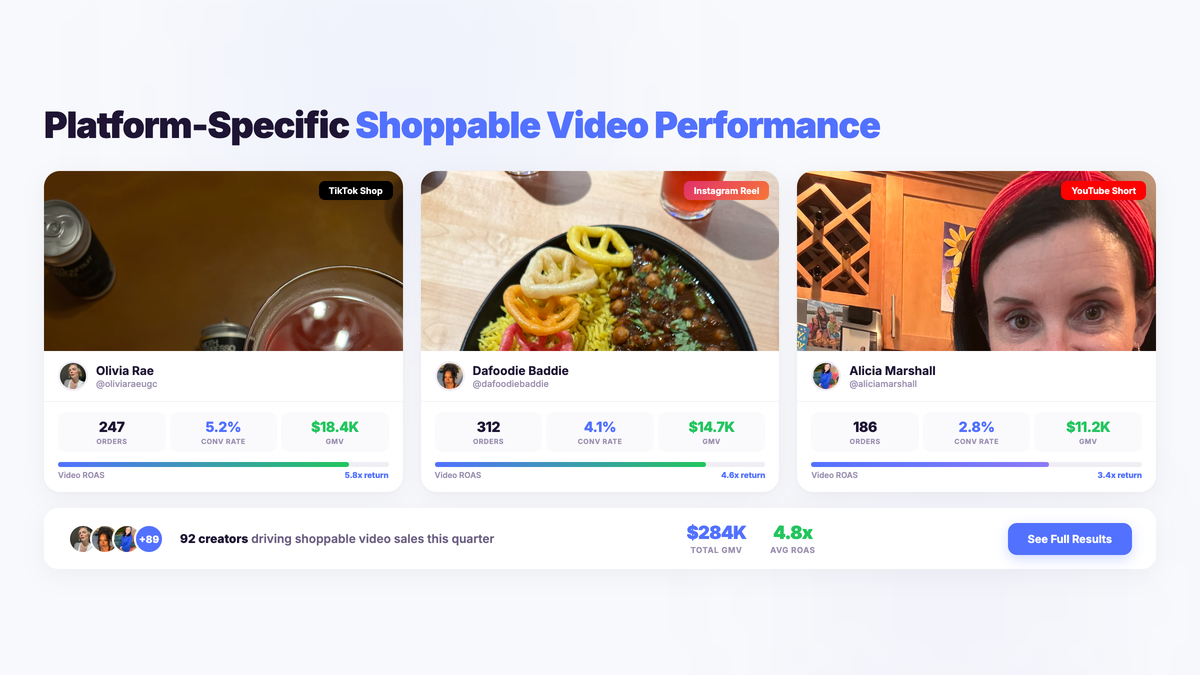
Each platform has distinct algorithms, audience behaviors, and commerce features. Optimizing for each platform separately — rather than cross-posting identical content — dramatically improves performance.
TikTok Shop
Hook in the first 1-2 seconds. TikTok’s swipe-based format means you have roughly 1.5 seconds before a viewer decides to stay or scroll. Open with a visual surprise, a bold claim, or an irresistible product demo moment — not a logo or introduction.
Leverage TikTok Shop’s native product links. Videos with orange shopping basket icons perform significantly better than those that drive traffic off-platform. TikTok’s algorithm actively promotes Shop-enabled content because it keeps users on the platform.
Optimal video length: 30-90 seconds. This window provides enough time for a complete product story without losing viewer attention. Videos under 30 seconds lack enough information to drive purchase confidence. Videos over 90 seconds see significant drop-off.
Use trending sounds strategically. Trending audio boosts initial distribution, but ensure the sound doesn’t overwhelm your product messaging. Some brands are finding success with original audio that becomes associated with their products over time.
Instagram Reels and Shopping
Tag products in Reels, not just feed posts. Reels with product tags receive 5x more shopping-related engagement than tagged feed posts. Instagram’s algorithm gives Reels broader distribution, and the shopping integration feels more natural in the video format.
Use the Collab feature with creators. When a creator and brand co-author a Reel using Instagram’s Collab feature, the content appears in both audiences’ feeds with product tags. This doubles distribution and adds brand credibility through the creator’s endorsement.
Optimal length: 15-30 seconds for conversion, 60-90 seconds for education. Short Reels work for impulse products; longer Reels work for products that require explanation or demonstration.
YouTube Shopping
Add product shelf to long-form reviews. YouTube Shopping’s product shelf appears below videos and links directly to product pages. For review and tutorial content, this is extremely effective — viewers who watch 50%+ of a review video and then click the product shelf convert at 8-12%.
Pin products in live streams. During YouTube Live shopping events, pinning featured products creates persistent visibility throughout the stream. Time product pins to coincide with demonstration moments for maximum impact.
Platforms like partnrUP help brands manage creator relationships and shoppable content across all these platforms from a single dashboard — eliminating the operational complexity of multi-platform commerce.
Creative Techniques That Drive Purchases
Beyond platform optimization, specific creative techniques consistently improve shoppable video conversion rates.
The “Problem-Solution-Proof” Framework
The highest-converting shoppable videos follow a simple three-act structure: identify a relatable problem (first 3 seconds), introduce the product as the solution (seconds 3-15), and provide proof it works (remaining time). This framework works because it mirrors the customer’s internal decision-making process.
Social Proof Stacking
Layer multiple forms of social proof within a single video: creator endorsement, user comments displayed on screen, star ratings mentioned verbally, and “X units sold” callouts. Each layer reduces purchase anxiety incrementally. Videos with 3+ social proof elements convert at nearly double the rate of those with only creator endorsement.
Urgency Without Manipulation
Genuine urgency drives action. Limited edition products, seasonal availability, and exclusive creator discount codes create real time pressure. Avoid manufactured urgency (“only 3 left!” when you have warehouses full) — audiences, especially younger demographics, quickly detect and punish dishonest scarcity claims.
Creator Briefs for Shoppable Content
When briefing creators for shoppable video, provide specific guidance on: the one key product benefit to emphasize (don’t dilute with multiple messages), the primary objection to address, the exact CTA language to use, and any compliance requirements (FTC disclosure, platform rules). Then give creators creative freedom on format, tone, and storytelling approach. The best shoppable content feels authentic, not scripted.
Ready to scale your shoppable video strategy with the right creator partners? Book a demo with partnrUP to see how brands are driving measurable commerce through creator video.
Measuring Shoppable Video Performance
Effective measurement goes beyond tracking clicks and sales. Build a comprehensive framework that captures the full value of shoppable video content. Tools like partnrUP’s platform help brands automate this at scale.
Primary Commerce Metrics
View-to-purchase rate: The percentage of video viewers who complete a purchase. Benchmark: 1-3% for feed content, 10-30% for live shopping. This is your north star metric for content optimization.
Average order value (AOV): Track AOV from shoppable video separately from other channels. Video-driven AOV tends to be 15-25% higher than standard e-commerce because the content provides context for premium positioning and cross-selling.
Revenue per video: Calculate total attributed revenue for each piece of shoppable content. This metric helps you identify which content formats, creators, and products generate the highest return and deserve more investment.
Content Performance Metrics
Watch-through rate to product click: What percentage of viewers watch enough to click the product link? If watch-through is high but clicks are low, your CTA placement or product tagging needs work. If watch-through is low, the creative hook needs improvement.
Save-to-purchase rate: Users who save a shoppable video are signaling purchase intent for later. Track how many saved-video users convert within 7, 14, and 30 days. This delayed conversion data often reveals significant revenue that isn’t captured in immediate post-view metrics.
Attribution and Incrementality
Run incrementality tests to measure the true lift from shoppable video. Compare conversion rates in markets with active shoppable video campaigns against holdout markets. Most brands find that shoppable video drives 20-40% incremental lift over their baseline e-commerce performance — revenue that wouldn’t have occurred without the content.
Frequently Asked Questions
What makes shoppable video different from regular product videos?
Shoppable video includes embedded commerce functionality — product tags, checkout links, or integrated purchasing — that lets viewers buy without leaving the content. Regular product videos require viewers to navigate separately to a product page or website to complete a purchase, introducing friction that reduces conversion rates.
Which platforms support shoppable video in 2026?
TikTok Shop, Instagram (Reels, Stories, and feed), YouTube Shopping, Amazon Live, Pinterest, and Snapchat all support various forms of shoppable video. TikTok Shop and Instagram currently lead in adoption and conversion performance for most consumer brands.
How much does it cost to produce shoppable video content?
Creator-produced shoppable video typically costs $500-$5,000 per piece depending on creator tier, production complexity, and usage rights. Many brands find that authentic, lower-production creator content outperforms expensive studio productions. Start with micro-creators at lower cost to establish what works before investing in higher-tier partnerships.
What’s the ideal length for shoppable videos?
Optimal length varies by platform and product complexity. For TikTok: 30-90 seconds. For Instagram Reels: 15-30 seconds for impulse products, 60-90 seconds for complex products. For YouTube: 5-15 minutes for detailed reviews with product shelf. Live shopping events can run 30-120 minutes effectively.
How do I measure the ROI of shoppable video campaigns?
Track view-to-purchase rate, revenue per video, ROAS (total revenue divided by creator and production costs), and customer LTV from shoppable video-acquired customers. Use platform analytics for direct attribution and run incrementality tests to measure true lift above baseline e-commerce performance.
Can B2B brands use shoppable video effectively?
B2B shoppable video is emerging but works differently than B2C. Instead of direct product purchases, B2B shoppable video typically drives demo requests, free trial signups, or resource downloads. LinkedIn video with embedded CTAs and YouTube tutorials with product shelf links are the most effective formats for B2B commerce.
Should I use creators or produce shoppable video in-house?
Both approaches work, but creator-produced shoppable video consistently outperforms brand-produced content on conversion metrics. Creator content benefits from audience trust, authentic tone, and platform-native formatting. The most effective programs combine creator-produced content for distribution with brand-produced content for product pages and retargeting.