Creator commerce is projected to drive over $32 billion in U.S. retail sales by the end of 2026, yet most brands still treat creator partnerships as a top-of-funnel awareness play rather than a direct revenue channel. That disconnect is costing them market share — and fast.
Creator commerce sits at the intersection of influencer marketing and e-commerce, transforming the way consumers discover, evaluate, and purchase products. Instead of relying on traditional advertising funnels, brands that embrace creator commerce put purchasing power directly into the hands of the creators their audiences already trust.
Whether you’re a DTC brand exploring affiliate creator programs or an enterprise team looking to scale shoppable content across platforms, understanding creator commerce fundamentals is essential to competing in 2026’s digital landscape. For a comprehensive look at how this fits into the broader social shopping ecosystem, explore our complete guide to creator commerce and social shopping.
In this guide, you’ll learn:
- What creator commerce actually means and how it differs from traditional influencer marketing
- The core models driving creator-led revenue in 2026
- How to evaluate whether your brand is ready for creator commerce
- Platform-by-platform breakdown of creator commerce capabilities
- How to measure ROI from creator commerce programs
- Common mistakes brands make and how to avoid them
Table of Contents
- What Is Creator Commerce?
- Creator Commerce vs. Traditional Influencer Marketing
- The Core Models of Creator Commerce
- Platform-by-Platform Landscape
- Building Your Creator Commerce Strategy
- Measuring Creator Commerce ROI
- Frequently Asked Questions
What Is Creator Commerce?
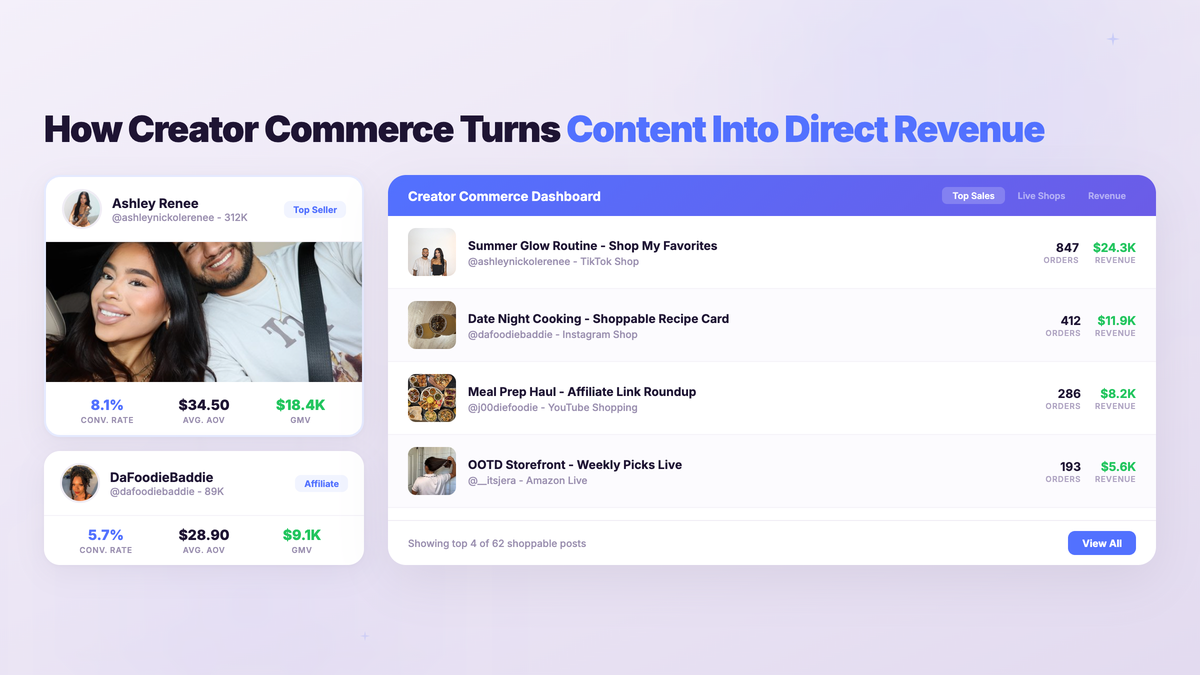
Creator commerce refers to any transaction where a content creator directly facilitates a purchase — whether through affiliate links, shoppable posts, live shopping events, or integrated storefronts. Unlike traditional advertising where creators simply generate awareness, creator commerce creates a measurable path from content to conversion.
The Evolution from Awareness to Revenue
The influencer marketing industry spent over a decade optimizing for reach and engagement metrics. Brands paid creators for posts, measured impressions, and hoped those impressions translated into sales somewhere down the funnel. Creator commerce flips that model entirely.
Today’s creator commerce ecosystem includes direct attribution, real-time sales tracking, and performance-based compensation models. When a creator posts a shoppable video on TikTok Shop or shares an affiliate link through their Instagram Stories, brands can trace the exact revenue generated from that piece of content.
Why 2026 Is the Inflection Point
Several forces are converging to make creator commerce a critical channel this year. As our State of Influencer Marketing report highlights, the shift from awareness to performance is accelerating across the industry. Social platforms have invested heavily in native commerce features — TikTok Shop, Instagram Checkout, YouTube Shopping, and Amazon Live now offer seamless in-app purchasing. Payment infrastructure has matured. And consumer behavior has shifted: 67% of Gen Z and Millennial shoppers report purchasing products directly through creator recommendations in the past six months.
The brands winning in this environment treat creators not as media buys but as distribution partners. Platforms like partnrUP help brands identify, activate, and manage these partnerships at scale — turning creator relationships into predictable revenue channels.
Creator Commerce vs. Traditional Influencer Marketing
Understanding the distinction between creator commerce and traditional influencer marketing is essential for structuring your programs correctly. While they share common elements, the business model, measurement approach, and creator relationships differ significantly.
Compensation Models
Traditional influencer marketing typically operates on flat-fee or CPM-based compensation. A brand pays a creator $5,000 for a sponsored post regardless of whether it drives any sales. Creator commerce, by contrast, introduces performance-based elements: affiliate commissions, revenue sharing, and hybrid models that combine a base fee with performance bonuses.
This shift fundamentally changes creator incentives. When creators earn a percentage of sales they drive, they naturally optimize their content for conversion rather than just engagement. They test different hooks, refine their product demonstrations, and invest in content that actually moves inventory.
Attribution and Measurement
In traditional influencer marketing, attribution is notoriously difficult. Brands rely on proxy metrics — engagement rates, impressions, estimated media value — to gauge campaign effectiveness. Creator commerce provides direct attribution through tracked links, platform-native analytics, and pixel-based measurement that connects content to purchases.
This clarity changes how brands allocate budgets. Instead of debating whether a $50,000 creator campaign “probably” drove results, marketing teams can show exact ROAS figures and scale spending accordingly.
Relationship Duration
Traditional campaigns tend to be transactional: a brand books a creator for one post or a short campaign window, then moves on. Creator commerce programs favor long-term partnerships because the performance data improves over time. Creators learn what resonates with their audience for a given brand, conversion rates increase, and both parties benefit from compounding returns.
The Core Models of Creator Commerce
Not all creator commerce looks the same. Understanding the primary models helps brands choose the right approach — or combine multiple models — for their specific goals and product categories.
1. Affiliate Creator Programs
Affiliate programs give creators unique tracking links or discount codes. For a deeper dive into structuring these programs, see our complete affiliate influencer marketing playbook. They earn a commission (typically 10-30%) on every sale attributed to their content. This is the most accessible entry point for brands new to creator commerce because it requires minimal upfront investment and directly ties spend to revenue.
Key considerations: Commission rates need to be competitive enough to attract quality creators. Typical ranges vary by vertical — beauty and fashion run 15-25%, while electronics and SaaS often sit at 8-15%. Cookie windows (how long after a click the creator gets credit) typically range from 7-30 days.
2. Shoppable Content and Live Shopping
Shoppable content embeds product links directly into video, images, or livestreams. Our shoppable video and social commerce guide covers platform-specific best practices in detail. TikTok Shop, Instagram Shopping, and YouTube Shopping all enable this natively. Live shopping adds real-time interaction — creators demonstrate products, answer questions, and viewers purchase without leaving the stream.
Live shopping conversion rates consistently outperform static content, with some brands reporting 10-20x higher conversion rates during live events compared to standard product pages. The immediacy and social proof of live audiences create purchasing urgency that traditional e-commerce can’t replicate.
3. Creator Storefronts
Some platforms enable creators to build branded storefronts — curated collections of products they recommend. Amazon’s Influencer Program storefronts and LTK (formerly LIKEtoKNOW.it) pages are the most established examples. Storefronts turn creators into ongoing distribution channels rather than one-time content producers.
4. Co-Created and White-Label Products
At the deepest level of creator commerce, brands and creators co-develop products or give creators their own branded lines. This model creates maximum alignment — the creator’s reputation is directly tied to product quality, and the brand benefits from authentic advocacy that no sponsored post can replicate.
Platform-by-Platform Creator Commerce Landscape
Each major social platform has developed distinct creator commerce capabilities. Choosing the right platform — or the right mix — depends on your product category, target audience, and operational readiness.
TikTok Shop
TikTok Shop has emerged as the fastest-growing creator commerce channel in 2026. Its integrated shopping experience keeps users inside the app from discovery to checkout. The algorithm’s ability to surface product content to high-intent audiences makes it particularly effective for impulse purchases and trend-driven products.
Key stats: Average order value on TikTok Shop has grown 34% year-over-year. Creator-driven listings convert at 3-5x the rate of brand-direct listings. The platform’s affiliate marketplace connects brands with creators at scale.
Instagram Shopping and Reels
Instagram’s commerce features have matured significantly, with product tags available in Reels, Stories, and feed posts. The platform’s older demographic (compared to TikTok) and higher average household income make it ideal for premium and mid-market products.
YouTube Shopping
YouTube’s integration with Shopify and its native product shelf allow creators to tag products in long-form videos. The platform’s strength is consideration-phase content — detailed reviews, comparisons, and tutorials that drive high-value purchases. YouTube creator commerce tends to generate higher AOV but lower volume compared to short-form platforms.
Amazon Live and Influencer Program
Amazon’s creator commerce ecosystem benefits from the world’s most frictionless checkout experience. Creator storefronts and Amazon Live streams convert at exceptional rates because purchase intent is already high — shoppers are on Amazon to buy. The tradeoff is lower brand control and visibility into the customer relationship.
Building Your Creator Commerce Strategy
Moving from traditional influencer marketing to creator commerce requires operational changes, not just strategic ones. Here’s how to build a program that scales.
Step 1: Define Your Commerce Model
Start by choosing which creator commerce model fits your current capabilities. If you’ve never run performance-based creator programs, begin with affiliate links before investing in live shopping infrastructure. Match your model to your product category — high-consideration products benefit from YouTube reviews with affiliate links, while impulse-buy products thrive on TikTok Shop.
Step 2: Build Your Creator Roster
Creator commerce requires different creator profiles than awareness campaigns. Look for creators with demonstrated conversion ability — not just high follower counts. Key indicators include: engaged comment sections with purchase-intent questions, existing affiliate performance data, product review expertise, and audience demographics that match your customer profile.
Tools like partnrUP’s creator matching platform help brands identify creators whose audiences align with their target customers, using data beyond vanity metrics to predict actual commerce performance.
Step 3: Set Commission and Compensation Structures
The most effective creator commerce programs use hybrid compensation: a modest base fee that respects the creator’s time and production costs, plus performance-based commissions that reward results. This structure attracts quality creators (who won’t work for commission-only) while maintaining performance incentives.
Benchmark your commission rates against competitors in your vertical. If every other beauty brand offers 15% commissions and you’re offering 8%, you’ll struggle to attract top creators.
Step 4: Provide Commerce-Ready Assets
Creators need more than a brief and product samples. For effective creator commerce, provide: high-quality product images and B-roll, key selling points and feature comparisons, promotional codes or custom landing pages, real-time inventory availability (nothing kills trust faster than promoting out-of-stock items), and competitive positioning data.
Step 5: Measure, Iterate, Scale
Track unit economics from day one. Know your blended CAC across creator commerce vs. other channels, identify your highest-performing creators and content formats, and reinvest accordingly. Most brands find that 20% of their creator roster drives 80% of commerce revenue — double down on those relationships.
Measuring Creator Commerce ROI
The measurement advantage of creator commerce over traditional influencer marketing is significant (our complete guide to influencer marketing ROI covers the full attribution framework), but it requires proper tracking infrastructure.
Core Metrics to Track
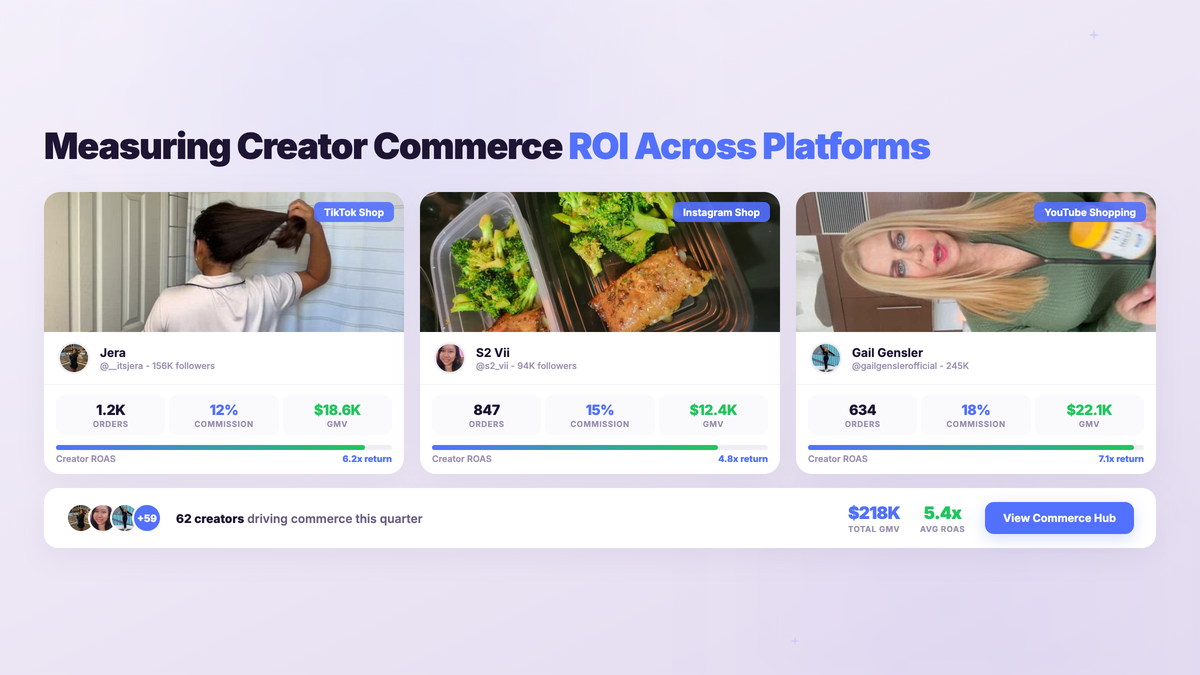
Revenue per creator: Total attributed sales divided by total compensation (including product costs). This is your most important unit economic.
ROAS (Return on Ad Spend): While creator commerce isn’t technically “ad spend,” calculating ROAS using total creator costs gives you a direct comparison against paid media channels.
Conversion rate by content format: Compare how different content types (reviews, tutorials, hauls, live shopping) convert for your specific products. This data should drive your content briefs and format requirements.
Customer lifetime value (LTV) from creator-acquired customers: Early data suggests creator-acquired customers have 15-25% higher LTV than paid social-acquired customers, likely because the trust transfer from creator to brand creates stronger initial brand affinity.
Incrementality: The gold standard — would these sales have happened without the creator? Run holdout tests and geo-experiments to measure true incremental lift.
Attribution Challenges
Even with direct tracking, creator commerce attribution isn’t perfect. Multi-touch journeys mean a customer might see a creator’s TikTok, Google the product later, and purchase through the brand’s website. Proper attribution requires a multi-touch model that gives creators appropriate credit across the journey.
Ready to build a creator commerce program that drives measurable revenue? Book a demo with partnrUP to see how leading brands are scaling creator-driven sales.
Frequently Asked Questions
What is the difference between creator commerce and social commerce?
Social commerce is the broader category of buying and selling through social media platforms. Creator commerce is a subset that specifically involves content creators facilitating transactions. All creator commerce is social commerce, but not all social commerce involves creators — brands can sell directly through social shops without creator involvement.
How much should brands budget for creator commerce programs?
Most brands allocate 15-30% of their influencer marketing budget to performance-based creator commerce programs. Start with a pilot budget of $10,000-$25,000 to test models and establish baseline metrics before scaling. Because creator commerce is performance-based, budgets can scale proportionally with revenue.
Which product categories perform best in creator commerce?
Beauty, fashion, health and wellness, food and beverage, and consumer electronics consistently lead in creator commerce performance. However, any product that benefits from demonstration, explanation, or social proof can work — including B2B SaaS, home goods, and financial products.
Do I need a large follower base to start creator commerce?
Brands don’t need to be large to start creator commerce — and neither do the creators they work with. Micro-creators (10K-50K followers) often outperform macro-influencers on conversion metrics because their audiences are more engaged and trusting. Start with 10-20 aligned micro-creators rather than 2-3 expensive macro-influencers.
How long does it take to see ROI from creator commerce?
Most brands see initial sales data within the first 2-4 weeks of launching a creator commerce program. However, meaningful optimization — identifying top performers, refining commission structures, and scaling proven formats — typically takes 2-3 months. Plan for a 90-day pilot before making major budget allocation decisions.
What’s the biggest mistake brands make with creator commerce?
Treating creator commerce like traditional influencer marketing — paying flat fees for content without performance incentives, optimizing for reach instead of conversion, and evaluating success by engagement metrics rather than revenue. The second biggest mistake is setting commission rates too low to attract quality creators who can actually drive sales.
Can creator commerce replace traditional paid advertising?
Creator commerce won’t fully replace paid advertising for most brands, but it’s increasingly absorbing budget from traditional paid social. Brands report that creator commerce delivers 2-4x the ROAS of Meta and Google ads for consideration and conversion objectives. The most effective strategies use paid media for broad awareness and creator commerce for mid-funnel and lower-funnel conversion.