Creator commerce isn’t just influencer marketing with a new name — it’s a fundamental shift in how products get discovered, evaluated, and purchased. And if your brand hasn’t started paying attention, you’re already playing catch-up.
Here’s the reality: consumers don’t start their purchase journey on Google or Amazon anymore. They start it on TikTok, Instagram Reels, and YouTube Shorts. A creator pops up in their feed, demonstrates a product in 45 seconds, and a purchase happens before the video ends. No search intent required. No comparison shopping. No banner ads to ignore. Just trust transferred from creator to brand, in real time.
Traditional influencer marketing was about reach — pay a creator to broadcast your message to their audience, measure impressions, call it brand awareness. Creator commerce is about conversion. Creators function as distribution channels rather than megaphones, with native checkout, affiliate links, and storefront features baked directly into the platform.
The brands winning in 2026 aren’t the ones with the biggest ad budgets. They’re the ones who built systems for finding the right creators, briefing them for conversion, and scaling what works. This guide breaks down everything you need to understand and execute a creator commerce strategy — from platform mechanics to measurement to building a program that compounds over time. If you want the supporting data, check out our roundup of influencer marketing data and statistics that every brand should know.
What Is Creator Commerce?
Creator commerce sits at the intersection of the creator economy and ecommerce. In practical terms, it means products are discovered, recommended, and purchased through creator content rather than through traditional retail or advertising channels.
Here’s the working definition: creator commerce encompasses any transaction where a creator — whether a micro-influencer with 8,000 followers or a mega-creator with 5 million — is a meaningful part of the customer acquisition path. If a creator’s recommendation (video, post, storefront) contributed to the purchase, that’s creator commerce.
How It Differs from Traditional Influencer Marketing
Traditional influencer marketing was designed for awareness. A brand pays a creator to post sponsored content. The creator’s job is to expose the brand to their audience. Success got measured in reach, impressions, and estimated earned media value — metrics that were notoriously hard to tie to actual revenue.
Creator commerce shifts the model in three concrete ways:
- Commerce infrastructure is native to the platform. TikTok Shop, Instagram Shopping, and YouTube Shopping let creators tag products directly in their content. Viewers purchase without ever leaving the app. The friction that used to kill conversions — “swipe up to shop,” “link in bio” — is largely gone.
- Attribution is built in. Affiliate links, promo codes, and platform-native tracking mean you can tie creator content directly to revenue. No more guessing.
- The creator is a distribution partner, not just an amplifier. The best creator commerce relationships treat creators like channel partners — with inventory access, exclusive launches, and performance-based incentives — not one-time campaign placements.
The Key Shift: Creators as Storefronts
Think about what a storefront does: it curates products, presents them in a compelling environment, and makes purchasing frictionless. In creator commerce, the creator IS the storefront. Their audience is their foot traffic. Their content is the merchandising. Their recommendation is the sales associate.
This shift is visible across every vertical. Beauty brands launch new SKUs through creator commerce before retail. DTC food brands use TikTok Shop creators to drive first-time purchases. Software companies run affiliate-driven signups through creator networks. The playbook looks different by category, but the logic is the same: trust flows through people, not ads. For a foundational look at how this plays out in ecommerce specifically, see our guide on influencer marketing for e-commerce.
The Creator Commerce Ecosystem in 2026
Creator commerce runs on three overlapping layers: platform-native commerce tools, creator-native commerce (creators selling their own products), and brand-creator partnerships. As a brand, the third category is your focus — but understanding all three helps you see where the market is headed.
Platform-Level Commerce
TikTok Shop is the most mature creator commerce platform in the U.S. as of 2026. Creators tag products in videos and live streams; purchases happen without leaving TikTok. The platform has invested heavily in creator incentives, making it the go-to channel for brand-creator commerce partnerships at scale. TikTok Shop’s affiliate program lets your brand recruit creators to promote products on a commission basis — a model producing some of the strongest ROAS numbers in social commerce right now.
Instagram Shopping allows product tags in feed posts, Reels, and Stories. The Instagram affiliate program lets creators earn commissions when their followers purchase tagged products. For fashion, beauty, and lifestyle brands, Instagram remains the highest-intent discovery channel outside TikTok.
YouTube Shopping has expanded significantly, with creators tagging products in videos, Shorts, and live streams. YouTube’s longer-form format makes it especially effective for considered purchases — software, electronics, home goods — where the creator has time to demonstrate real value before the viewer converts.
Pinterest remains an underutilized creator commerce channel, particularly for home, wedding, and food categories where purchase intent is high and content has a long shelf life.
The $100B+ Creator Economy Context
The creator economy has crossed the $100 billion valuation mark, with projections pointing toward $500 billion by 2030. Creator commerce is the fastest-growing segment within it, driven by platform investment in native checkout, creator monetization tools, and brand partnership infrastructure. The shift from “watch” to “watch and buy” is happening at the platform level. Brands that build creator commerce capabilities now are positioning for where consumer behavior is already going. You can track the broader picture in our ecommerce influencer trends for 2026.
Why Brands Need a Creator Commerce Strategy
The case for creator commerce isn’t aspirational — it’s structural. Consumer behavior has already shifted. The question is whether your brand is capturing that behavior or leaving it to competitors.
Discovery Happens on Social, Not Search
Gen Z consumers are significantly more likely to discover products through social media than through search engines. For younger Millennials, it’s near-parity. The purchase journey that used to start with a Google search now often starts with a TikTok video. That’s not a trend — it’s a durable shift in how people consume information and make purchase decisions.
Search engine optimization still matters for intent-driven traffic. But for brands targeting 18–35-year-olds, social-first discovery is no longer optional. If you’re not showing up in creator content on the platforms where your audience spends time, you’re invisible during the awareness and consideration phases of the purchase journey.
Trust Economics: Creators vs. Brand Ads
Consumers trust recommendations from people they follow. Word-of-mouth has always been the most effective form of marketing — what’s new is the scale and efficiency of creator-mediated trust. A creator with 80,000 engaged followers can introduce your product to tens of thousands of qualified buyers who already trust that creator’s judgment in your category.
Compare that to a display ad. The viewer has no relationship with your brand, no social proof, and a deeply conditioned reflex to ignore or block it. The trust gap between creator content and brand advertising has never been wider. For real-world proof, see how UGC for paid social transformed Lifeboost Coffee’s results.
ROAS Comparison: Creator Commerce vs. Traditional Ads
Creator commerce consistently outperforms traditional paid social on ROAS — often by 2–4x for brands that have built mature programs. The structural reasons:
- Creator content is native to the feed; it doesn’t trigger ad-blindness
- Creator audiences are self-selected by interest and trust
- Platform algorithms favor organic and creator content over paid placement
- Affiliate and commission structures align creator incentives with brand outcomes
For a deeper analysis of how to measure ROI across influencer and creator channels, see our influencer platform ROI guide.
Content That Compounds
One underappreciated advantage of creator commerce: the content doesn’t expire. A creator’s product review video keeps accumulating views — and generating affiliate sales — for months or years after it’s posted. Unlike a paid ad that stops delivering the moment you stop paying, creator content functions as a persistent sales asset. The brands that invested in creator commerce programs in 2022 are still seeing revenue from that content today.
This compounding effect means the true ROI of creator commerce programs improves significantly when measured over 12–18 months versus a 30-day campaign window. For the full attribution playbook, see our Influencer Marketing ROI complete guide.
The 4 Types of Brand-Creator Commerce Relationships
Not all creator commerce partnerships work the same way. The right model depends on your brand’s commerce objective, your product category, and the type of creator relationship you’re trying to build. Here are the four main structures you’ll encounter.
1. Paid Partnerships
The brand pays a flat fee (or package rate) for the creator to produce and post content featuring your product. This is the most familiar model — closest to traditional influencer marketing — but in creator commerce, the brief is conversion-optimized rather than awareness-focused. Paid partnerships work best for product launches, seasonal pushes, and situations where you need guaranteed content delivery on a specific timeline.
Pros: Predictable content; creator is incentivized regardless of performance.
Cons: No performance alignment; higher upfront cost; creator may not be motivated to optimize for sales.
2. Affiliate / Commission Partnerships
The creator earns a percentage of sales generated through their unique link or promo code. This is the highest-alignment model: the creator only earns when they drive sales, so their incentive is to produce content that actually converts.
TikTok Shop’s affiliate program has made this model accessible at scale. Brands set commission rates, and TikTok surfaces participating products to creators who are actively looking for products to promote in their category. For brands with strong product-market fit in a visually demonstrable category, TikTok Shop affiliate is one of the highest-ROAS acquisition channels available right now.
Pros: Performance-aligned; low upfront cost; scalable across many creators.
Cons: Top creators may demand hybrid (flat + commission) deals; less control over content timing and volume.
For a comprehensive breakdown of affiliate influencer structures and how to set them up, see our Affiliate Influencer Marketing playbook.
3. Co-Created Products
The creator becomes a true product partner — collaborating on development, owning a SKU or collection, and serving as the face of that product line. This model is most common in beauty and fashion but is expanding into food, supplements, and consumer tech accessories.
Co-creation works when the creator has genuine expertise or credibility in the category, and when the brand can manufacture at a scale the creator’s audience will support. The upside is massive: the creator has deep personal investment in driving sales. The downside is complexity — product development timelines, inventory risk, and the reputational stakes of a creator’s public persona.
Pros: Maximum creator investment; powerful launch moments; strong PR angles.
Cons: Long lead times; inventory risk; reputational exposure to creator’s off-brand actions.
4. Creator Storefronts
The creator curates a personalized storefront — on TikTok Shop, Instagram, or an independent platform — where your brand’s products are featured alongside other curated items. The creator’s audience shops their storefront as a trusted source of recommendations.
This model works exceptionally well for lifestyle brands and multi-SKU catalogs. Instead of a one-video campaign, your brand gets persistent placement in a creator’s commerce ecosystem. As the creator grows their storefront audience, your brand grows with them.
Pros: Persistent presence; works across multiple products; low maintenance once established.
Cons: Requires active storefront creators; less brand exclusivity than paid partnerships.
Building Your Creator Commerce Strategy
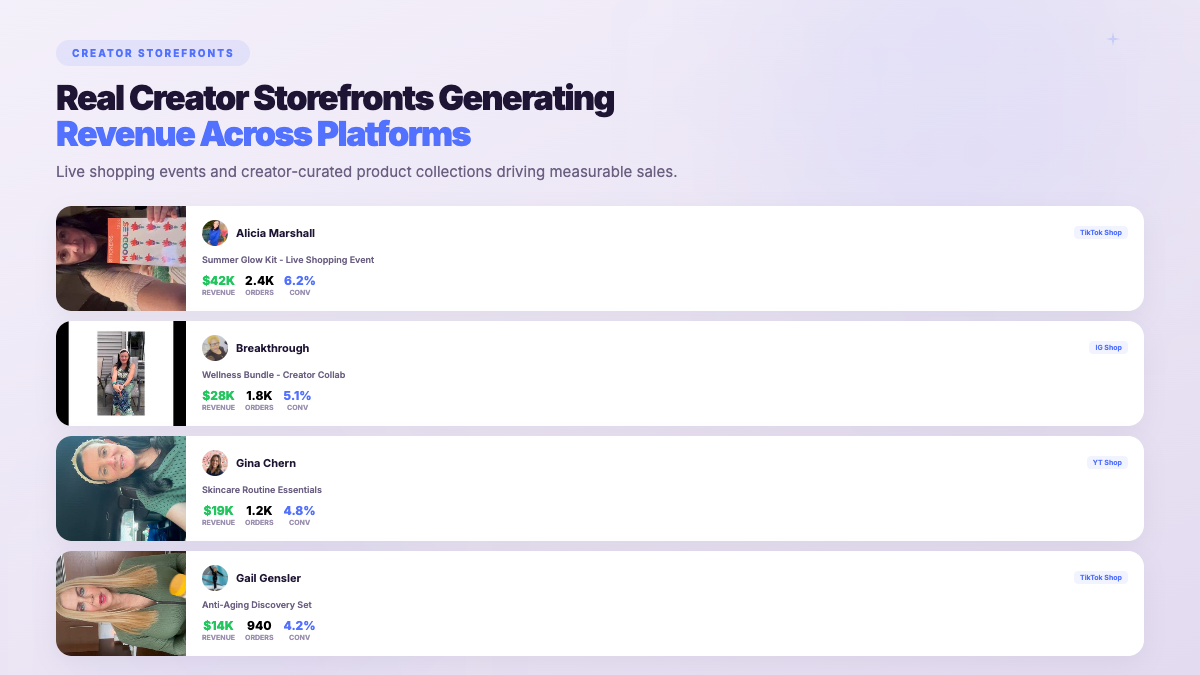
Most brands approach creator commerce the same way they approached influencer marketing — find big creators, pay for posts, measure impressions. That playbook is obsolete. Commerce requires a different strategic framework, and if you want to avoid the pitfalls, read our guide on common creator commerce mistakes brands make before you get started.
Define Your Commerce Objective
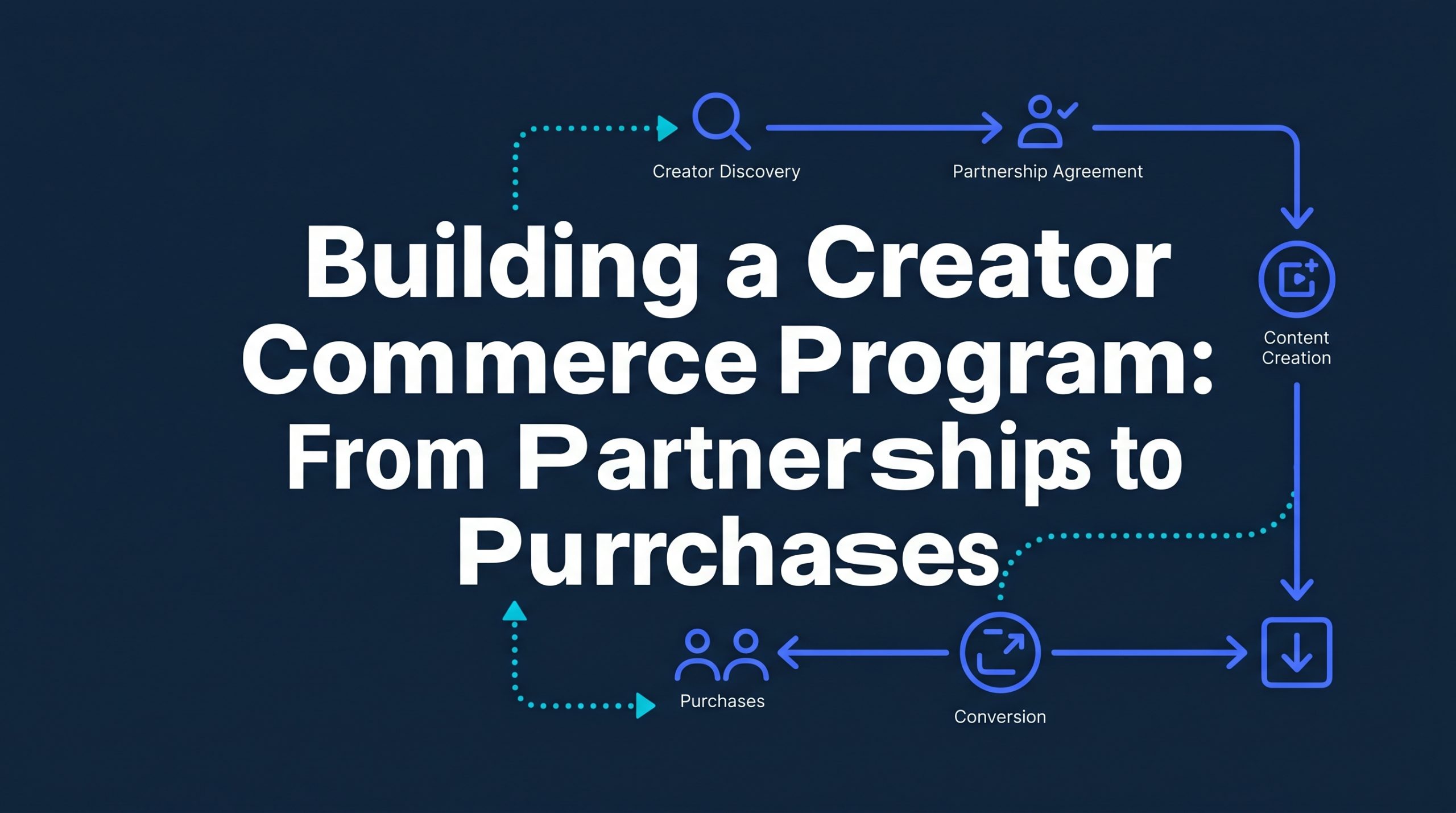
Before you build anything, get clear on what you’re trying to accomplish. Creator commerce can serve three distinct objectives, and each requires a different approach:
- Awareness → Conversion: Getting new customers who’ve never heard of your brand to purchase for the first time. Requires broad creator reach plus strong conversion-optimized content.
- Retention → Repeat Purchase: Re-engaging existing customers through creator content that reminds and incentivizes repeat purchase. Requires creator content that speaks to your existing customer base.
- Category Ownership: Establishing your brand as the go-to recommendation in a category, so when a creator talks about your space, your brand is the default mention. Requires long-term creator relationships and content volume.
Platform Selection
Platform follows audience. Don’t start on TikTok Shop because it’s hot — start where your target customer actually spends time and makes purchasing decisions.
- TikTok: Ages 18–35, impulse-friendly categories (beauty, food, gadgets, clothing), high purchase frequency
- Instagram: Ages 25–40, aspirational categories (fashion, travel, home, fitness), higher AOV
- YouTube: Ages 25–45, considered purchases (electronics, software, health, education), review-driven
- Pinterest: Ages 25–50, planning-oriented categories (home, wedding, DIY), high purchase intent
For category-specific strategy examples, check out our guides on ecommerce influencer strategies and fashion creator commerce.
Budget Allocation
A mature creator commerce budget typically follows a tiered structure:
- 40–50% to affiliate/performance creators: Low cost per activation, high volume, performance-aligned
- 30–40% to mid-tier paid partnerships (50K–500K followers): The ROAS sweet spot — large enough audience, high engagement, authentic feel
- 10–20% to hero/macro creators: Primarily for launch moments, credibility signaling, and large audience reach
Creator Discovery for Commerce
Finding creators who will actually drive sales is harder than it looks. The traditional metrics — follower count, engagement rate, niche alignment — are necessary but not sufficient for creator commerce. You need to go deeper.
Why Traditional Influencer Metrics Fail for Commerce
A creator with 500,000 followers and a 4% engagement rate looks great on paper. But if their audience is mostly teenagers with no disposable income, and their content has never featured a product purchase recommendation, that creator isn’t going to move product for you.
Traditional influencer selection optimizes for reach and engagement. Creator commerce selection needs to optimize for conversion signals. That’s a fundamentally different filter.
What to Look For: Commerce-Specific Signals
Comment quality: Are followers asking where to buy? Saying “I just bought this!”? Asking about pricing? Comments like these indicate an audience that acts on creator recommendations.
Product affinity: Has the creator promoted similar products before? What was the engagement quality on those posts specifically — not just the overall account?
Audience demographics: Age, income level, and geographic distribution matter for commerce. A creator whose audience matches your ideal customer profile will always outperform a larger creator whose audience doesn’t.
Platform commerce history: On TikTok Shop, you can see creator affiliate performance data. On Instagram, high Reels watch rates signal algorithm performance that will help your product content get discovered.
Content format fit: Does the creator do demos, tutorials, reviews, or hauls? These formats consistently outperform pure lifestyle or aesthetics content for driving purchase intent.
AI-Powered Creator Matching
Manual creator discovery at scale is essentially impossible. A brand running a serious creator commerce program needs to evaluate hundreds or thousands of creators across multiple platforms. AI-powered creator matching tools analyze creator performance data, audience demographics, content themes, and historical brand collaboration performance to surface the creators most likely to drive results for your specific brand and objective — going far beyond simple keyword matching to model predicted performance based on conversion signals and category authority.
For a comprehensive look at how to set up these partnerships from scratch, see our guide on creator partnerships.
Content That Converts in Creator Commerce
The brief you give a creator for a commerce campaign is fundamentally different from a brand awareness brief. You’re not asking for a beautiful lifestyle shot — you’re asking for a video that makes someone reach for their credit card.
Best Performing Formats
Tutorial/How-To: The creator uses the product to accomplish something specific. Works for anything with a demonstrable benefit — skincare, kitchen tools, software, fitness equipment. Tutorials work because they show the product solving a real problem, not just existing.
Demo: Similar to tutorial but focused on features and results. Before/after demos are particularly effective for beauty, fitness, and home improvement categories.
Review: Honest creator reviews — including what they like and what could be better — convert better than unqualified praise because they’re more credible. Teach your creators that nuance makes them more trustworthy, not less.
Haul: The creator shows multiple products together with brief commentary on each. Effective for driving volume across a catalog. Best for fashion, beauty, and lifestyle categories.
Unboxing: First-impression content that shows the product as the audience would experience receiving it. Builds excitement and normalizes purchase.
The First 3 Seconds Rule
On TikTok and Reels, you have roughly 3 seconds to prevent the viewer from swiping. Creator commerce content that performs knows this: it leads with the hook, not the brand. The first frame should create curiosity, show a result, or pose a problem — not show a logo or an ad-style opening.
Brief your creators to lead with: “I tried X for 30 days and here’s what happened,” “The product that actually fixed my [problem],” or a visual result that makes the viewer want to watch long enough to find out how to get it.
Authentic vs. Polished — When Each Wins
Authentic, lo-fi content typically outperforms highly produced brand-style content on TikTok and Reels. Audiences are trained to recognize — and scroll past — content that looks like an ad. A creator filming in their bathroom with natural light often outperforms a studio shoot.
The exception: YouTube and Pinterest, where production quality correlates with credibility, especially for higher-AOV products. A tech creator reviewing a $500 gadget benefits from good lighting and clear audio. A TikTok creator recommending a $15 serum doesn’t.
The Creator Brief for Commerce
Your brief should cover:
- Product to feature and what you want viewers to do (purchase, visit link, use promo code)
- The angle — what problem does it solve, what result can the creator demonstrate
- Required elements — clear product shot, verbal mention of brand name, link/promo code placement
- Tone guidance — match the creator’s voice, not the brand’s voice
- What NOT to script — give creators latitude for authenticity; over-scripted content underperforms
What not to include: a word-for-word script, a requirement to use specific superlatives, or messaging that conflicts with how the creator naturally talks to their audience. The fastest way to kill creator commerce performance is to force creator content into a brand advertising mold. For a deeper dive on shoppable video commerce content strategy, we’ve got you covered.
Measurement and Attribution in Creator Commerce
Attribution is creator commerce’s most contested territory. Because the purchase path often spans platforms — viewer sees creator on TikTok, does a Google search, lands on your site, converts — no single attribution model captures the full picture. Here’s how to think about it.
Platform-Native Reporting
Start with what you can measure natively:
- TikTok Shop: GMV per creator, conversion rate, affiliate commission payouts, return rates
- Instagram: Affiliate sales via Instagram insights, promo code redemptions
- YouTube: Clicks on product links, affiliate conversions via platform tracking
Platform-native reporting underestimates creator commerce impact because it can’t capture cross-device or cross-platform conversions. But it’s the cleanest data you have, so start there and build up.
Promo Codes and UTM Tracking
Unique promo codes and UTM-tagged affiliate links are your primary attribution tools outside of platform-native reporting. They’re not perfect — buyers forget codes, share them, use them much later than the original creator exposure — but they provide clear signal on relative creator performance. Use them consistently from day one.
Incrementality Testing
The most rigorous way to measure creator commerce impact: run a holdout test. Activate creators in one geographic market; hold out a comparable market. Compare the difference in organic brand search volume, site traffic from social, and conversion rates between markets. This gives you an incrementality lift figure — how much of the conversion activity would not have happened without your creator program.
LTV of Creator-Acquired Customers
Here’s something most brands miss: creator commerce customers often have higher LTV than paid ad customers. The reason is counterintuitive — they came in via trust. A customer who bought because a trusted creator recommended your product starts the relationship with a positive brand association. This tends to produce higher retention, lower churn, and higher AOV on repeat purchases.
Track your creator cohorts separately from paid acquisition cohorts in your CRM. The LTV difference will justify higher CPAs for creator channels than you’d accept from Meta or Google. For the complete measurement framework, see our Influencer Marketing ROI guide.
Scaling Creator Commerce Programs
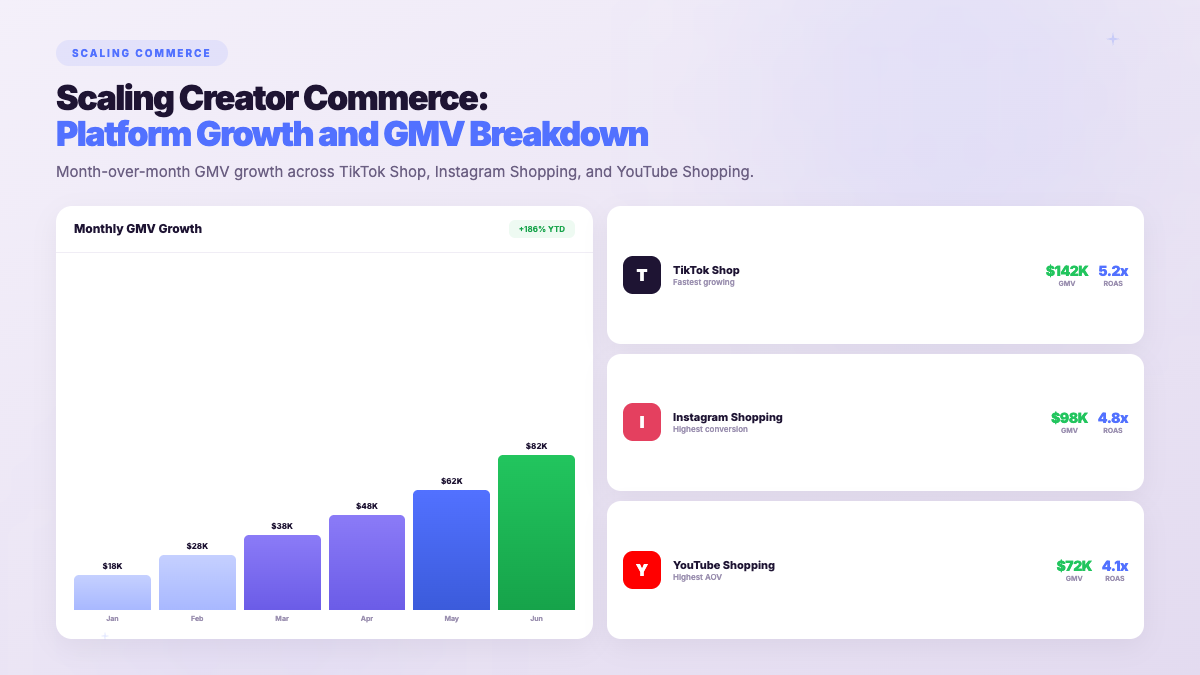
A one-off creator campaign is not a creator commerce program. The brands winning at creator commerce have built systems: for finding creators, briefing them, managing contracts and payments, and compounding what works over time.
Building a Network vs. One-Off Campaigns
The unit economics of creator commerce improve dramatically at scale. A brand working with 10 creators per month has limited data on what content, what creators, and what formats drive the best outcomes. A brand working with 100 creators per month has a performance dataset that lets it continuously optimize — double down on top performers, retire underperformers, and surface patterns in what makes content convert.
The goal is to move from “we do campaigns” to “we have a creator network.” This requires infrastructure: a discovery system, brief templates, contract management, payment automation, and performance reporting. Most brand marketing teams don’t have this built internally yet — and that’s exactly where platforms like partnrUP come in.
Creator Tiers: Hero vs. Micro Network
The hero creator model — one big creator, one big campaign — is a high-risk, low-frequency approach. The micro network model — hundreds of smaller creators, always-on program — is lower risk, higher frequency, and more scalable.
Best practice in 2026: use hero creators for launch moments and cultural credibility signaling. Use a micro-creator network for sustained commerce volume. The micro network produces the ROAS. The hero creators produce the brand moments.
Automation: Brief, Outreach, Contracts, Payments, Reporting
Manual management of a large creator program is a talent sink. Each step of the creator commerce workflow — discovery, outreach, briefing, contract signing, content review, payment, performance reporting — is a candidate for automation or AI assistance. Platforms that automate these workflows don’t just save time; they let you operate at a scale that’s simply impossible manually.
For shoppable video specifically, automation is the only way to scale shoppable video commerce. The content volume required for meaningful creator commerce impact — dozens to hundreds of new videos monthly — isn’t achievable with a spreadsheet-and-email workflow.
Identifying Top Performers and Doubling Down
In any creator commerce program, performance follows a power law: 20% of creators will drive 80% of results. The brands that win are the ones that identify that 20% quickly, invest in those relationships, and give them increasingly favorable terms — better commission rates, product exclusives, co-creation opportunities.
Build a 90-day review cadence into your program. At 30 days, cut underperformers. At 60 days, identify the top tier and offer them upgrades. At 90 days, review your brief and content format performance to update your standard operating procedure for the next cohort.
Creator Commerce in Action: Brand Examples
Botanica Skincare: TikTok Shop Affiliate → $2.1M in 90 Days
A DTC skincare brand with strong product reviews but limited paid media budget launched a TikTok Shop affiliate program targeting creators in the “skintok” niche. They set a 15% commission rate, provided free product to 200+ creators, and let the creators drive content strategy. Within 90 days, the top 25 creators had driven $2.1M in gross merchandise value. The brand’s CAC through TikTok Shop was 40% lower than their Meta campaigns. They’ve since shifted 60% of their acquisition budget to creator commerce.
RoamGear: YouTube Commerce for Considered Purchase
An outdoor gear brand selling $150–$400 products launched a YouTube creator partnership program, targeting outdoor and adventure creators with 50K–500K subscribers. They paid flat fees for review videos with affiliate links and gave creators full editorial freedom. Conversion rates from YouTube review traffic were 3x their sitewide average — customers arrived pre-sold because the creator had already addressed every objection in the video. The brand now treats YouTube creator content as their primary bottom-of-funnel asset.
Vero Foods: Instagram Storefront Network
A specialty food brand built an Instagram creator storefront network of 150+ food and lifestyle creators who feature their products in curated shopping posts. Each creator links to product pages from their storefront. The brand doesn’t run paid ads on Instagram — their entire Instagram acquisition strategy runs through the creator network at a blended commission cost lower than any paid channel they’ve tested.
Frequently Asked Questions
What’s the difference between creator commerce and social commerce?
Social commerce is the broader category: any commerce that happens on social platforms. Creator commerce is a specific mechanism within social commerce — transactions driven by creator recommendations and content. All creator commerce is social commerce, but not all social commerce is creator-driven (e.g., a brand’s own shoppable posts without creator involvement). See our complete guide to shoppable video and social commerce for a full breakdown.
How much does a creator commerce program cost to run?
Costs range from essentially zero (pure affiliate/commission program where you only pay on performance) to six figures per month (hero creator paid partnerships plus large affiliate network management). Most brands building a serious creator commerce program for the first time should budget $10K–$50K/month: $5K–$20K in creator payments/commissions, plus platform or agency costs for program management. Budget scales with the volume of creators you activate and the split between paid and commission-based partnerships.
What categories work best for creator commerce?
Categories with visual demonstration value, clear before/after benefits, or strong social proof dynamics perform best: beauty and skincare, fashion, food and beverage, fitness and wellness, home goods, consumer electronics, and pet products. Categories that are harder to make work: commodities with no differentiation, highly regulated categories (pharma, financial products), and B2B software where purchase decisions involve multiple stakeholders.
Do I need a creator commerce platform or can I manage manually?
For programs under 20 creators, manual management with spreadsheets and direct email outreach is feasible. Above 20 creators, you’ll need platform support for discovery, outreach automation, contract management, and reporting. Above 100 creators, you need dedicated software. The operational complexity of a 100+ creator program managed manually is a full-time job — and you’ll miss performance patterns that a platform surfaces automatically.
How do I find creators for creator commerce?
Start with platform-native tools: TikTok Creator Marketplace, Instagram’s Creator Marketplace, and YouTube’s BrandConnect. These are free and show you creator analytics within the platform. For more sophisticated discovery — filtering by audience demographics, performance history, and category authority — you need a dedicated influencer marketing platform with creator commerce features built in.
What commission rates are standard for creator commerce affiliate programs?
Standard commission rates range from 5–20% depending on category, margin, and creator tier. Beauty and fashion typically run 10–20%. Consumer electronics and higher-AOV products often run 5–10% due to margin constraints. Premium or exclusive products sometimes go higher to attract top creators. TikTok Shop affiliate programs are competitive — if your commission rate is at the low end for your category, creators will prioritize competing products.
How do I brief a creator for commerce without over-scripting them?
Give creators the “what” and the “why,” not the “how.” Tell them what product to feature, what result or benefit to highlight, and what action you want viewers to take. Don’t write a script. Don’t tell them exactly what to say. Creators who talk like themselves convert — creators reading brand copy don’t. Your brief should give enough structure to protect brand safety and message clarity, and enough freedom for the creator to be authentic.
How do I measure the ROI of creator commerce versus paid social?
At minimum, compare CPA (cost per acquisition) using promo codes or UTM-tagged affiliate links versus your Meta/Google CPA. For a fuller picture, track 90-day LTV for creator-acquired customers versus paid ad customers — the LTV difference often justifies a higher initial CPA for creator channels. Use incrementality testing (geo holdout experiments) to measure true lift attributable to the creator program.
What’s the biggest mistake brands make in creator commerce?
Treating creator commerce like a campaign rather than a program. Brands that run a “creator commerce campaign” — activate 5 creators for 30 days, measure results, move on — rarely see transformative results. Creator commerce compounds. The brands seeing 3–5x ROAS built programs over 6–12 months: testing formats, identifying top performers, building creator relationships, and reinvesting learnings into the next cohort.
How does creator commerce fit with shoppable video?
Shoppable video and creator commerce are deeply overlapping. Creator commerce content — product demos, reviews, tutorials — is the most effective format for shoppable video because it pairs authentic recommendation with frictionless purchase. Platform-native shoppable features (TikTok Shop product tags, Instagram Shopping) are what make creator commerce videos directly transactional. See our complete guide to shoppable video for platform-by-platform mechanics.
Start Building Your Creator Commerce Program
Creator commerce isn’t a future trend to prepare for — it’s the present reality of how consumer products get discovered and purchased by anyone under 40. Brands that build creator commerce capabilities now are establishing compounding advantages: creator relationships, content libraries, performance data, and audience trust that take time to build and are hard for competitors to replicate quickly.
The brands winning at creator commerce in 2026 didn’t start this year. They started two years ago with a small affiliate program, learned what worked, and scaled it. The best time to start was 2023. The second best time is today.
partnrUP is an AI-native platform built specifically for brand-creator commerce programs. From AI-powered creator matching to brief automation, contract management, and performance reporting — everything you need to run a serious creator commerce program is in one place.