78% of brands say they’ve switched influencer marketing platforms at least once — and most cite the same reason: the platform promised discovery, but couldn’t deliver execution.
Choosing the wrong influencer marketing platform doesn’t just waste your budget. It wastes months of onboarding, campaign setup, and creator outreach — only to leave you with a database of profiles and no clear path to branded video content that actually converts.
Want the broader framework first? Read our complete Influencer Marketing Platform Comparison Guide — it covers buying criteria, must-have features, pricing models, and how to shortlist vendors before you dive into specific platforms.
In 2026, the market is crowded. You have legacy enterprise tools, creator marketplaces, affiliate-heavy networks, and newer video-first platforms all competing for your media budget. Each one makes similar claims. Each one falls short in different ways.
This guide breaks down the top influencer marketing platforms by use case, budget, and content type — with an honest look at where each category of platform excels, where it struggles, and what brands consistently get wrong when they’re making the decision.
In this guide, you’ll learn:
- The five main categories of influencer marketing platforms in 2026
- Which platform types work best for which campaign goals
- The hidden costs and limitations brands discover after signup
- How AI-driven matching is changing what “discovery” actually means
- What to look for in a platform built specifically for branded video content
Table of Contents
1. The Five Categories of Influencer Marketing Platforms
2. Enterprise Platforms: Power vs. Price
3. Creator Marketplaces: Volume vs. Quality
4. Affiliate-First Networks: Performance vs. Brand Fit
5. Video-First Platforms: The New Standard for Branded Content
6. How to Choose the Right Platform for Your Brand
7. Conclusion: Stop Paying for Discovery You Don’t Use
The Five Categories of Influencer Marketing Platforms
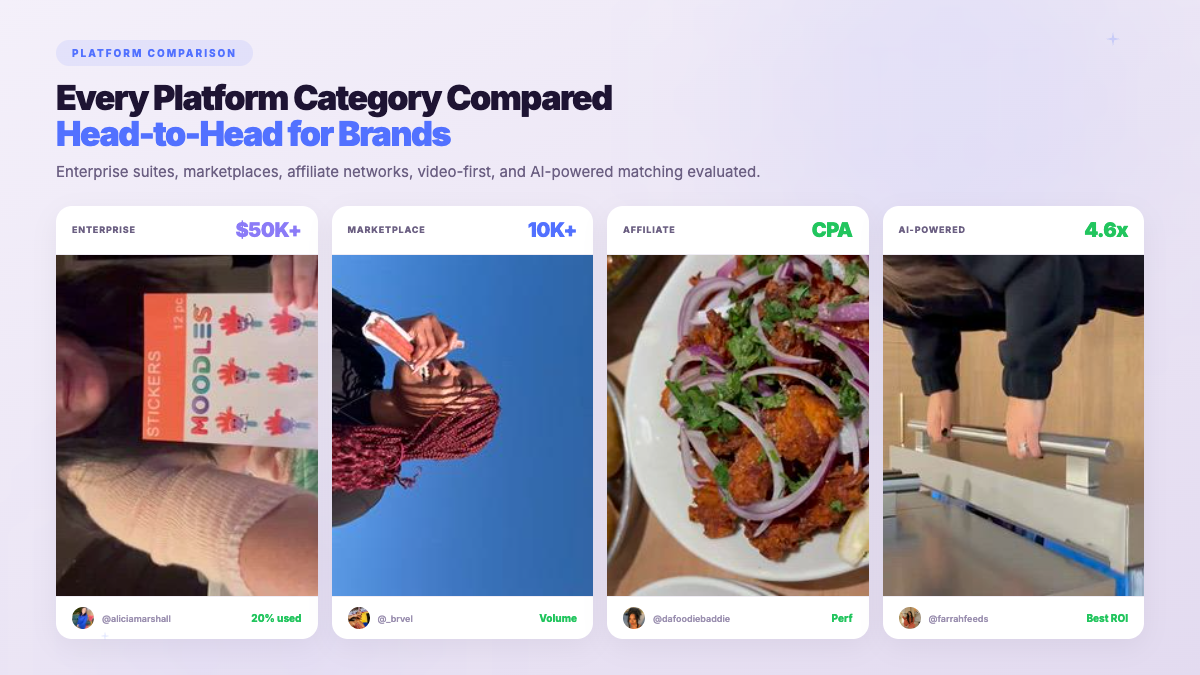
Before you can compare platforms, you need to understand what type of platform you’re actually looking at. The market breaks into five distinct categories — and conflating them is the #1 reason brands end up with a tool that doesn’t fit their workflow.
1. Enterprise Influencer Management Suites (Sprinklr, Brandwatch, Traackr)
These are full-stack platforms built for large marketing teams managing multiple campaigns across dozens of creators at once. They offer robust analytics, CRM-style creator management, and deep brand safety tooling. They’re also expensive — typically $30,000–$100,000+ annually — and require dedicated headcount to operate.
2. Creator Marketplaces (AspireIQ, Grin, Creator.co)
Marketplaces give brands access to opt-in creator databases with filtering tools. Creators have self-registered, so engagement tends to be more genuine than cold outreach. These platforms work well for mid-market brands running always-on programs, but quality control varies significantly and the vetting process is largely manual.
3. Affiliate-First Networks (Impact, ShareASale, Rakuten)
These platforms originated in performance marketing. Influencer functionality was added later. They excel at tracking conversions and paying commissions, but they’re not built for brand storytelling or high-quality video content. If your KPI is direct-response ROAS, these can work. If you need branded content that builds equity, they’ll frustrate you.
4. Social-Native Tools (Meta Creator Marketplace, TikTok Creator Marketplace)
Platform-owned marketplaces solve the discovery problem — but only within their ecosystem. Meta’s tools are excellent for Meta campaigns. TikTok’s marketplace is genuinely useful for short-form video. The limitation: your influencer strategy becomes siloed by platform, and you lose the ability to run multi-platform campaigns from a single workflow.
5. Video-First Branded Content Platforms (partnrUP and similar)
This is the newest category — purpose-built for brands that need high-quality video content at scale, not just profile databases. These platforms lead with creator quality over quantity, with AI-driven matching that goes beyond follower count to match on content style, audience alignment, and historical performance with similar brand categories.
Enterprise Platforms: Power vs. Price
Enterprise influencer suites like Traackr, Sprinklr, and Brandwatch were built in an era when influencer marketing meant “find the biggest accounts and pay them.” They’ve evolved, but their DNA still shows.
Where they excel:
- Deep analytics and competitive benchmarking
- Brand safety scoring and compliance workflows
- Multi-country campaign management
- Integration with broader martech stacks (Salesforce, Marketo, etc.)
Where they struggle:
- Setup time typically runs 30–90 days before you’re running campaigns
- Most require a dedicated internal platform manager
- Creator relationships are stored in databases, not nurtured in-platform
- Video content workflows remain clunky — most were designed around static posts
The hidden cost problem:
Enterprise platforms charge for seats, API calls, creator data exports, and often for access to the creator database itself. A $50,000/year contract can quietly become $75,000+ once you factor in add-ons and professional services for onboarding.
For large CPG or retail brands with a 5-person influencer team and six-figure campaign budgets, these tools make sense. For brands spending $50,000–$200,000 annually on creator content, the overhead is usually more than the platform can justify.
Creator Marketplaces: Volume vs. Quality
Platforms like AspireIQ, Grin, and Creator.co popularized the marketplace model: creators opt-in, brands browse, campaigns get launched. This model made influencer marketing accessible to mid-market brands who couldn’t afford enterprise tools or full-service agencies.
The core promise is discovery at scale — and these platforms deliver on that promise. Most maintain databases of 150,000 to 500,000 creators across all major platforms.
The quality problem:
Volume creates noise. A database of 300,000 creators sounds powerful until you’re on page 47 of search results trying to find someone who can actually produce the kind of video content your brand needs. Many marketplace creators have never produced a polished brand video — they’ve done sponsored Instagram posts, unboxing content, or lifestyle photos.
Manual vetting is the hidden labor cost:
Marketplace platforms surface profiles. They don’t verify content quality, communication reliability, or whether the creator has experience with your specific product category. Brands typically spend 15–25 hours per campaign just vetting shortlisted creators before a single brief is sent.
What marketplace platforms get right:
- Transparent pricing in some cases (creators list their rates)
- Large enough databases to find niche creators with genuine audiences
- Built-in contract and payment tools
- Performance reporting at the individual creator level
If you’re running always-on gifting programs or building a large affiliate creator network, marketplaces can work well. For high-production branded video campaigns, you’ll hit the quality ceiling quickly.
Ready to move beyond manual vetting? See how partnrUP’s matching works on the platform →
Affiliate-First Networks: Performance vs. Brand Fit
Impact.com, ShareASale, and Rakuten are performance marketing platforms at heart. They track clicks, attribute conversions, and automate commission payments. Adding “influencers” to these networks means treating creators like performance affiliates — which works for some campaigns and completely misaligns with others.
When affiliate platforms make sense:
- DTC brands with clear conversion tracking
- Brands where the primary KPI is tracked revenue, not content quality
- Campaigns built around discount codes and trackable links
- Programs that need to scale to hundreds or thousands of micro-creators
Where they break down for branded content:
The affiliate mindset is transactional. Creators on these networks are optimized for clicks, not for craft. You’ll get a lot of “swipe up to save 20%” and very little of the storytelling that builds actual brand equity. If you’ve seen a creator post read like a coupon code with a caption, that’s affiliate-network thinking applied to content.
The other problem: brand safety on affiliate networks is limited. When you’re working with 500 micro-creators simultaneously, ensuring brand consistency across every piece of content becomes nearly impossible without a separate content review layer.
Video-First Platforms: The New Standard for Branded Content
The newest category in the market addresses a gap that all the above platforms leave open: what happens after discovery?
Finding a creator is only about 20% of the work. The other 80% is briefing, production oversight, asset delivery, revision cycles, rights management, and distribution — and most legacy platforms leave all of that to spreadsheets, email chains, and Slack threads.
What video-first platforms are built to do differently:
- Match brands with creators based on content quality, not just audience size
- Manage the full production workflow from brief to final asset delivery
- Handle rights management and usage licensing within the platform
- Enable brands to build a consistent library of branded video assets across multiple campaigns
AI matching vs. keyword search:
The difference between a keyword-filtered database and AI-powered matching is significant. Traditional platforms let you search “fitness” + “500K-1M followers” and return 847 results. AI matching analyzes a creator’s actual content — production style, pacing, voiceover quality, engagement authenticity, and category experience — to surface the specific 8–12 creators who are genuinely right for your campaign.
This shifts the workflow from “search and vet” to “review and select” — reducing campaign setup time dramatically.
Explore how partnrUP’s platform handles creator matching, briefing, and delivery →
How to Choose the Right Platform for Your Brand
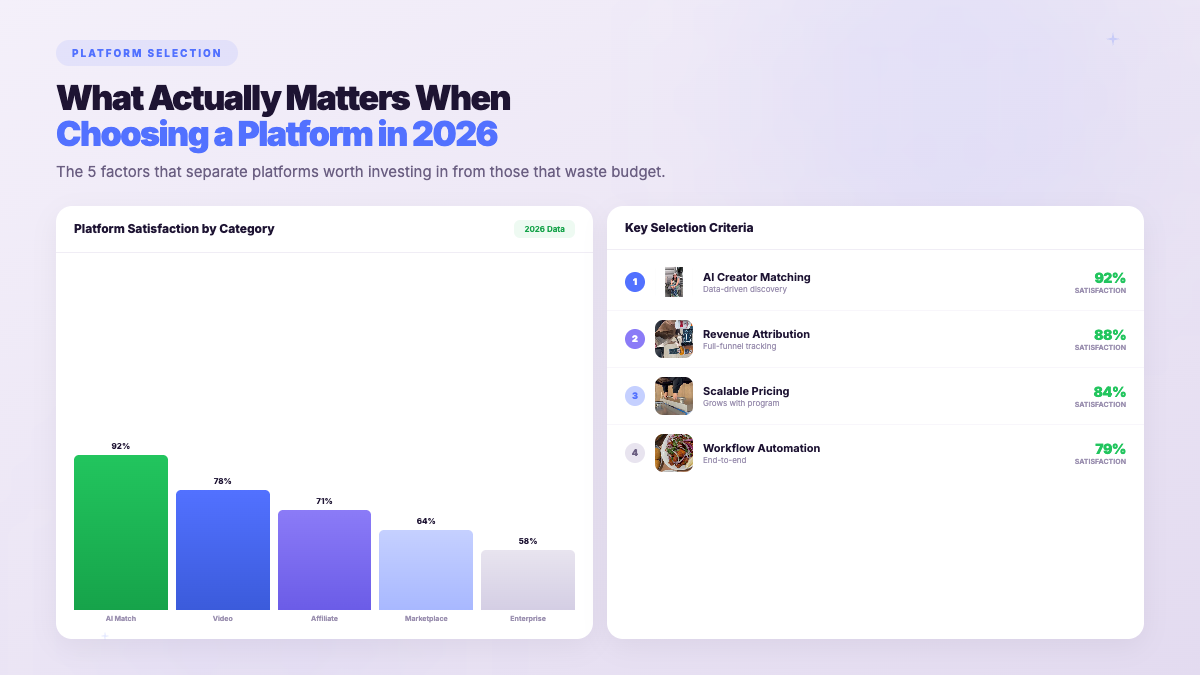
There’s no single “best” influencer marketing platform. There’s only the best platform for your specific situation. Here are the questions that actually determine which category fits:
1. What is your primary content format?
If your brand needs high-quality video — whether for paid social, YouTube, connected TV, or organic — you need a platform built around video production workflows. If you’re primarily doing Instagram photo posts or blog placements, a marketplace will serve you adequately.
2. What’s your annual influencer budget?
- Under $25K: Social-native marketplaces or micro-creator networks
- $25K–$150K: Creator marketplace or video-first platform
- $150K+: Enterprise suite or specialized platform depending on content type
3. How much in-house bandwidth do you have?
Enterprise platforms require dedicated operators. Marketplaces require manual vetting. If you have a lean team (1–2 people managing influencer strategy alongside other responsibilities), you need a platform that reduces friction rather than adding configuration complexity.
4. Do you need content rights and licensing?
This is where many brands get burned. A creator posts a video, the campaign ends, and six months later the brand wants to repurpose the asset for a paid ad — and discovers they have no usage rights. Video-first platforms typically include licensing and rights management as core features. Marketplaces and enterprise suites often treat it as an add-on.
5. How important is brand consistency to you?
If your brand has strict visual guidelines, tone-of-voice requirements, or regulated content requirements (finance, healthcare, alcohol), you need a platform with built-in review workflows and content approval stages — not just a delivery inbox.
Want to see how partnrUP addresses all five criteria? Book a demo →
Conclusion: Stop Paying for Discovery You Don’t Use
The influencer marketing platform market has a fundamental misalignment: most platforms were built to solve discovery, but brands consistently report that discovery isn’t actually where campaigns break down.
Campaigns break down in execution. In the gap between “we found a great creator” and “we have a final video asset we can actually use.”
In 2026, the brands winning at creator partnerships aren’t necessarily the ones with the biggest influencer databases. They’re the ones who’ve invested in the right workflow infrastructure — platforms that take them from brief to publishable asset without a maze of email threads, revision cycles, and rights confusion.
The question isn’t which platform has the most creators in its database. It’s which platform can take your brief and turn it into content that moves your business forward.
See how partnrUP is built for the full workflow, not just discovery →
Frequently Asked Questions
Q: What is the best influencer marketing platform for small brands in 2026?
A: For brands with budgets under $25,000, social-native tools like TikTok Creator Marketplace or Instagram’s creator tools offer accessible entry points without platform fees. For brands focused on video content who want quality over volume, a video-first platform like partnrUP offers better ROI than large marketplaces where small budgets get deprioritized by top-tier creators.
Q: How much do influencer marketing platforms cost?
A: Costs vary widely. Enterprise suites like Traackr or Sprinklr run $30,000–$100,000+ annually. Creator marketplaces like AspireIQ and Grin typically range from $1,500–$5,000/month. Affiliate networks often charge performance-based fees (10–30% of payouts). Video-first platforms typically charge based on campaigns managed or creator volume. Always factor in professional services fees, which can add 20–40% to enterprise contract costs.
Q: What’s the difference between an influencer marketplace and an influencer management platform?
A: A marketplace is primarily a discovery and matching tool — it connects brands with creators who have opted into the network. A management platform adds workflow tooling: contract templates, brief delivery, content review, payment processing, and performance reporting. Many modern platforms combine both, but the depth of each capability varies significantly.
Q: Can I use multiple influencer platforms at once?
A: Yes, and many larger brands do. A common setup is using a social-native marketplace for always-on gifting campaigns while using a specialized platform for high-production branded video campaigns. The risk is workflow fragmentation — creator data, content assets, and performance data end up siloed across multiple tools.
Q: What should I look for in an influencer platform for video content specifically?
A: Prioritize: (1) content quality filtering — not just follower count but actual video production quality; (2) production workflow management — brief delivery, revision tracking, final asset delivery; (3) usage rights and licensing built into the platform; (4) AI matching capabilities that go beyond keyword search; and (5) a dedicated team or managed service option for brands that don’t have in-house expertise.
Q: Are influencer marketing platforms worth it, or should I hire an agency instead?
A: It depends on your strategy. Agencies offer expertise and relationships but charge 20–30% of campaign spend. Platforms give you control and transparency but require internal bandwidth. Many brands use platforms for always-on programs and agencies for high-stakes campaign executions. Video-first platforms like partnrUP are designed to split the difference — giving you platform-level control with built-in expertise through the creator matching process.
Q: How do I measure ROI from influencer marketing platform investments?
A: Beyond the usual vanity metrics (reach, impressions), focus on: cost-per-piece of content produced, content usage rights obtained (so you can run paid amplification), repeat creator engagement rates (high repeats indicate relationship quality), and downstream conversion attribution where trackable. The platforms that make this easy to measure — without requiring manual spreadsheet work — are the ones worth paying for.
Next step: Pair this comparison with our Influencer Marketing Platform Comparison Guide to build an evaluation framework tailored to your brand’s scale and budget.