Marketers expect their influencer budgets to grow this year, and 72.2% of them expect that growth to be 50% or more. But when the same survey asks how they measure success, brand awareness is the most selected KPI at 55.1% — while 65.9% expect their creator spend to pay back within a single month.
Those two facts cannot both drive the same program. A brand awareness objective is not something you can settle in 30 days, and a 30-day payback expectation is not something an awareness metric can answer. That gap — between the money going in and the instrumentation measuring it — is the defining story of influencer marketing in the second half of 2026.
This guide is part of our State of Influencer Marketing in 2026 pillar, which tracks the trends, data, and structural shifts reshaping creator partnerships.
This mid-year report reads the H2 2026 data for what it says about execution rather than sentiment. Where the numbers agree, there is a real playbook. Where they contradict each other, there is a warning about which programs are about to get audited.
What you’ll learn:
- Why record budget growth and thin measurement adoption are showing up in the same programs
- What the platform concentration data reveals about where brands are actually placing bets
- Why creator tier expansion is running toward nano, micro, and UGC creators simultaneously
- Which operational functions brands keep in-house and which they hand off
- How to structure an H2 plan that survives a budget review
Table of Contents
- The Money Signal: Budgets Are Growing Faster Than the Systems Around Them
- The Central Contradiction in the H2 2026 Data
- Platform Concentration: The Single-Bet Market
- Creator Tiers: Everyone Is Going Smaller at Once
- Operations: What Brands Keep and What They Outsource
- What’s Actually Working Right Now
- Building an H2 Plan That Survives a Budget Review
- Frequently Asked Questions
The Money Signal: Budgets Are Growing Faster Than the Systems Around Them
Start with the least ambiguous data in the industry. The global influencer marketing industry reached an estimated $32.55 billion in 2025, according to Influencer Marketing Hub — close to double the $16.4 billion estimated for 2022.
The forward-looking number is larger. IAB forecasts US creator ad spend will reach $44 billion in 2026, following a projected $37 billion in 2025. That represents 26% year-over-year growth, roughly four times the growth rate of the wider media industry. The same channel accounted for $13.9 billion in 2021 and $29.5 billion in 2024.
Creators moved from experimental line item to core plan
Spending growth alone would just mean more of the same activity. The classification change matters more. According to IAB, 48% of creator ad buyers now consider creators a “must buy” — placing the channel just behind paid search and social media.
A must-buy channel gets considered during budget allocation and audience planning, not handed leftover experimental money after the larger media decisions are settled. That is a structural promotion, and it comes with structural scrutiny.
The increases are large enough to break existing processes
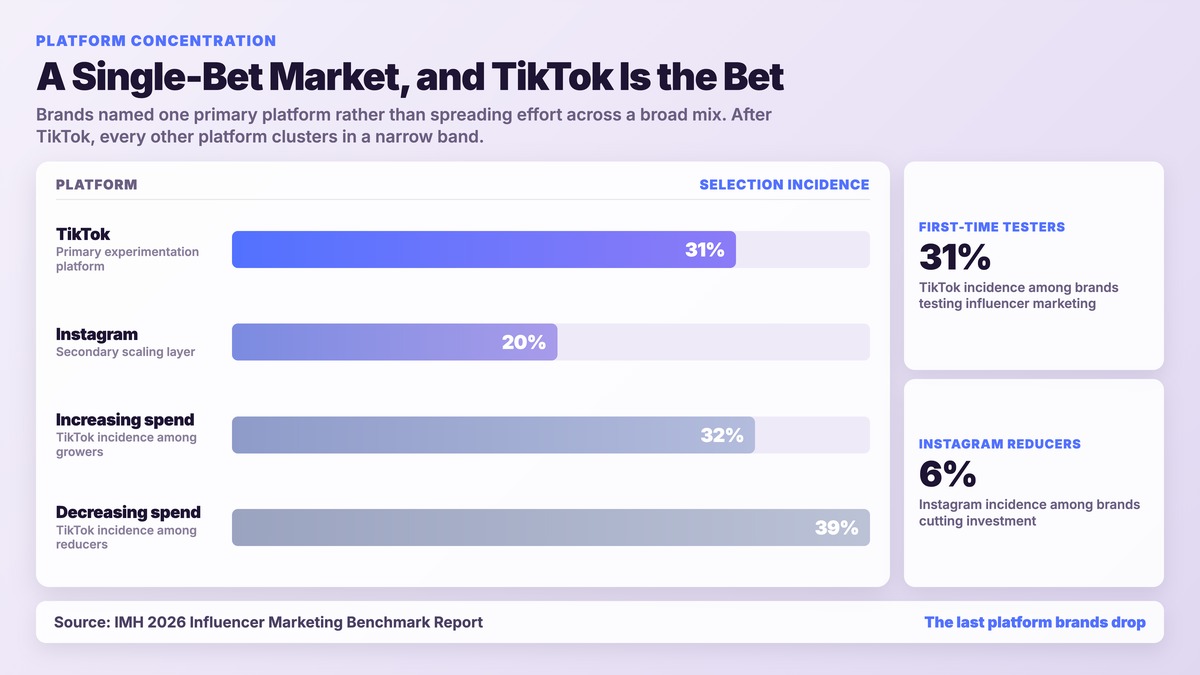
In the 2026 Influencer Marketing Benchmark Report, 87.49% of respondents expected their influencer budgets to increase, with only 5.55% anticipating a decrease. More striking is the magnitude: 72.2% anticipate increases of 50% or more.
CreatorIQ found that average annual influencer marketing budgets increased 171% year over year, with 71% of surveyed organizations reporting they had increased investment. Nearly two-thirds of that additional money came out of paid media budgets — meaning creator marketing is winning funding against established channels, not simply riding a rising total marketing budget.
A 50% budget increase is not something an existing workflow absorbs quietly. It means more creators, more briefs, more contracts, more approval cycles, and more payments. Teams that scale spend without scaling their creator operations infrastructure tend to discover the ceiling the hard way — usually in the quarter after the money arrives.
The Central Contradiction in the H2 2026 Data
Here is where the survey data stops agreeing with itself, and where the most useful insight for H2 planning lives.
Awareness objectives, revenue timelines
Brand awareness is the most frequently selected KPI at 55.1%, with revenue and sales KPIs selected less often. At the same time, 65.9% of respondents expect payback within one month — and 48.4% expect it within two weeks.
Those expectations are structurally incompatible. Awareness accrues over quarters and is measured through brand lift studies, survey panels, and share-of-voice tracking. Two-week payback is a direct response expectation, measured through codes, links, and attributed revenue. A program cannot be optimized for both without deciding which one arbitrates the budget.
Measurement adoption is thinner than the spending implies
The measurement stack backs this up. Promo and discount codes lead adoption at 45.9%, followed by affiliate links at 26.0% and native shop features at 25.0%.
Read those numbers carefully. Fewer than half of programs use the single most common attribution method, and roughly a quarter use affiliate tracking. The benchmark report notes that the strongest budget scalers slightly under-index on measurement-tool breadth relative to their share of planned budget growth — the brands adding the most money are not the ones adding the most instrumentation.
Why this matters for H2 specifically
Budget increases granted at the start of a year get reviewed at the end of it. A program that took a 50% increase on an awareness rationale, then gets asked for a revenue accounting in Q4, has a problem it cannot solve retroactively. Attribution has to be installed before the spend, not reconstructed after it.
The practical fix is unglamorous: decide which KPI arbitrates budget decisions, install the tracking that answers it, and keep the secondary metrics as context rather than justification. Our guide to influencer marketing metrics that actually matter breaks down how to separate the metrics that drive decisions from the ones that just fill dashboards.
Platform Concentration: The Single-Bet Market
The platform data contains one of the more counterintuitive findings in the H2 2026 numbers.
TikTok leads, and the gap is the story
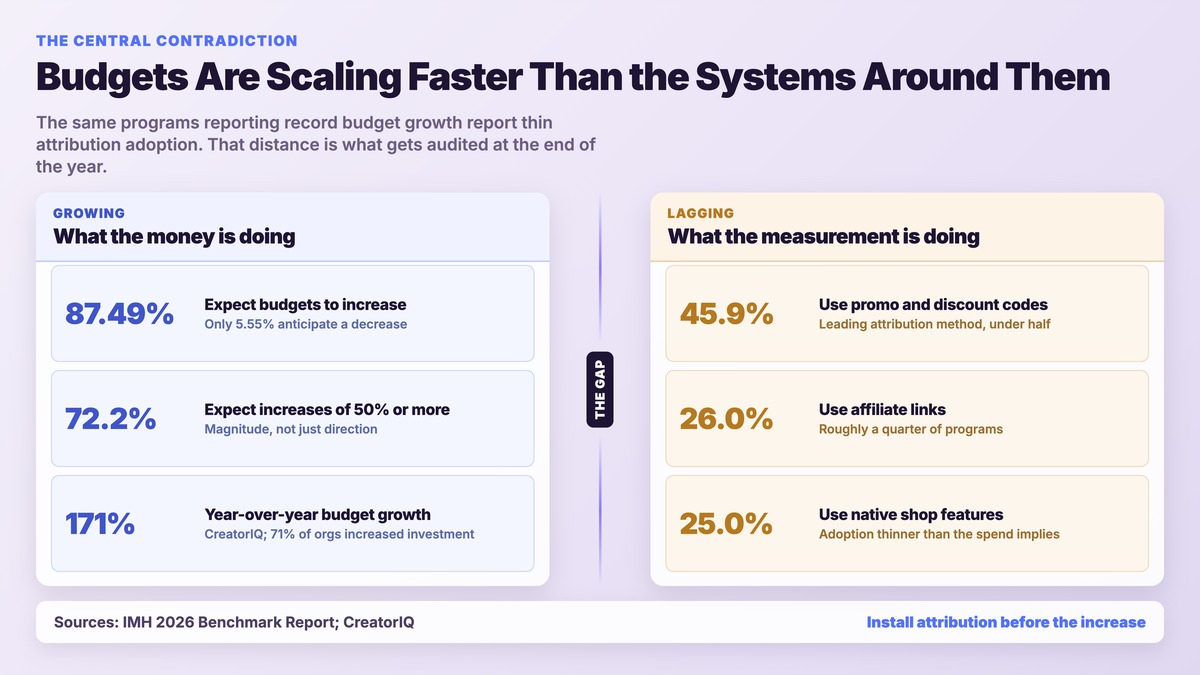
In the 2026 benchmark survey, 31% of respondents included TikTok in their influencer plans, making it the most frequently selected platform for investment intent. Every other platform clusters in a narrow band of roughly 8-15%.
Because respondents could select multiple platforms, the meaningful detail is that total selections stayed relatively close to the number of respondents. Most teams are naming one primary platform rather than spreading effort across a broad mix. The benchmark report describes it as a “single primary platform bet” environment.
The platform brands keep even when cutting
TikTok is the highest-incidence platform among brands increasing investment at 32%, and among brands testing influencer marketing for the first time at 31%. It is also the highest among brands planning to decrease investment, at 39%.
That last figure is the interesting one. When brands cut, TikTok is the platform still in the plan. It functions as the default performance and experimentation arena — the last thing to go rather than the first. For teams building on TikTok Shop and creator commerce, that concentration means competitors are iterating in the same place, at higher volume.
Instagram is the scaling layer
Instagram’s incidence rises most clearly among brands increasing investment at 20%, sits lower among first-time testers at 13%, and is especially low among reducers at 6%.
The pattern reads as a sequencing signal rather than a preference ranking. Brands test creative on TikTok, then expand what works to Instagram once they have a repeatable production workflow. Treating Instagram as the experimentation surface inverts the order most of the market is following.
Format consensus is clearer than platform consensus
Short-form and long-form video lead clearly as the most effective formats. Live shopping ranks third but appears polarized — high upside in some contexts, low consensus overall. Social commerce adoption is not universal, but where it exists it is TikTok-first, with TikTok Shop the most selected social commerce feature and adoption higher among brands increasing budgets.
Creator Tiers: Everyone Is Going Smaller at Once
The creator tier data shows an unusually one-directional trend.
Nano, micro, and UGC creators are all expanding
- Nano creators: 51.43% of marketers plan to increase use or begin working with them; only 10% expect to reduce or stop
- Micro creators: a combined 52.83% plan to increase use or start working with them; 7.55% plan to reduce, and none said they intended to stop entirely
- UGC creators: half of respondents plan to increase use or begin working with them, with none reporting plans to reduce or stop
Three tiers expanding simultaneously, with near-zero abandonment in any of them, is not a rotation between creator types. It is an overall shift toward volume — more partners, smaller individual deals, more content variations.
The cost pressure that comes with it
Rising creator costs are the leading challenge for 35.4% of marketers, well ahead of any other single issue. That coexists with the smaller-creator shift rather than contradicting it, because the cost problem is not only rate cards. It includes usage rights, revisions, category exclusivity, paid amplification, and the internal cost of managing each relationship.
On the accessible end, roughly 80% of UGC creator cost ranges in the 2026 survey fell below $500. The unit economics of a single UGC piece are manageable. The economics of running 80 of them through manual briefing, approval, and payment cycles are what breaks.
Volume is an operations problem, not a sourcing problem
What looks inexpensive at the creator level becomes operationally demanding once a program includes dozens or hundreds of briefs, contracts, approvals, and payments. This is the practical reason the smaller-creator shift stalls in so many programs — not an inability to find creators, but an inability to run that many relationships without the coordination cost eating the savings.
partnrUP reports 70% less time spent on internal coordination and admin through workflow automation, and 100% creator payment accuracy and compliance. Those are the two costs that scale linearly with partner count, which is exactly why they determine whether a nano and micro strategy is viable past the pilot.
Operations: What Brands Keep and What They Outsource
The H2 2026 data shows influencer marketing settling into an internally owned function with selective outside support.
Two-thirds run entirely in-house
In the benchmark survey, 66.3% report running their programs entirely in-house. Another 10.71% use a hybrid arrangement, and the same share relies entirely on a dedicated influencer marketing agency.
Internal ownership gives brands direct control over creator relationships, performance data, and the definition of success. It also transfers the full operational load — sourcing, contracts, content approval, deliverable tracking, payments, and reporting — onto teams that in most cases did not grow proportionally with the budget.
The outsourcing pattern reveals where the load is heaviest
Creator discovery and vetting is the most commonly outsourced function at 19.44%, followed by content production at 15.28%. Paid amplification, authenticity checks, and long-term creator management each account for 12.5% of outsourcing selections. Reporting and analytics ranks last at 6.9%.
The ranking is a labor map. Brands hand off the work that is time-intensive and repetitive, and keep the work that determines how performance gets judged. Discovery topping the list is consistent with the tier data — a program adding nano and micro creators needs to evaluate far more candidates than one running a handful of macro partnerships. Our creator vetting guide covers how to make that screening repeatable in-house.
AI has become operational, not experimental
Only 10.56% of respondents selected “not using AI” at all, and AI is most frequently used for creator discovery — the same function that tops the outsourcing list. Teams are solving the same bottleneck two ways, either buying the labor or automating it.
That convergence is worth noting for anyone evaluating AI agents in creator workflows. The discovery bottleneck is where the market has independently concluded the constraint sits.
What’s Actually Working Right Now
Reading the H2 2026 data across all four dimensions, a consistent profile emerges for programs that are scaling without breaking.
One named primary platform, with defined roles for the rest
The concentration data suggests the market is not rewarding broad multi-channel expansion. Naming a primary platform and assigning the others explicit roles — scaling proven concepts, supporting conversion, extending reach — produces tighter creative cycles than treating every channel as an equal test surface.
Attribution installed before the spend increase
Given that promo codes sit at 45.9% adoption and affiliate links at 26.0%, tracking infrastructure is a genuine differentiator rather than table stakes. Programs that can produce attributed revenue on demand are in a materially different position at budget review than programs presenting reach and engagement. Our breakdown of creator affiliate tracking tools and methods covers the setup.
Volume strategies backed by automation, not headcount
The smaller-creator shift only pays off if per-partner coordination cost falls as partner count rises. That is an automation question. partnrUP reports 40% higher creator response rates from automated, personalized outreach — the kind of efficiency that determines whether a 60-creator program is feasible for a three-person team.
A single KPI that arbitrates budget
The awareness-versus-payback contradiction resolves the moment a team decides which metric settles disagreements. Everything else stays as context. Programs without that decision tend to report whichever number looks best that quarter, which is the reporting pattern that invites an audit.
For teams working through the revenue side of that decision, our step-by-step influencer marketing ROI formula covers the calculation and the inputs it depends on.
Building an H2 Plan That Survives a Budget Review
A practical sequence for the remainder of 2026, drawn from where the data agrees rather than where it is aspirational.
Audit the gap between your KPI and your timeline
Write down the metric your program is judged on and the timeline your leadership expects results in. If those are awareness and 30 days, that mismatch is the first thing to fix — either by changing the metric or by resetting the timeline expectation before Q4.
Instrument before you scale
If a budget increase is coming, the tracking should land first. Codes, links, and shop-feature attribution are all cheaper to install ahead of a spend increase than to retrofit onto campaigns already in flight.
Right-size the operational model to the partner count
A program going from 8 creators to 60 is a different operation, not a bigger version of the same one. Decide in advance whether the added coordination gets absorbed by headcount, an agency, or workflow automation — because it will get absorbed by someone, and the default is usually an already-stretched internal team.
Concentrate creative testing where the volume is
If the market is placing single-platform bets and TikTok is receiving most of them, creative testing velocity on that platform is where competitive pressure is highest. Building a repeatable cycle — brief, publish, learn, adjust — matters more than adding channels.
For a broader view of how these dynamics developed, our analysis of the creator economy in 2026 covers the market-level context behind these operational shifts.
The H2 2026 Bottom Line
The money is real and it is growing. Nearly 88% of marketers expect budget increases, 72.2% expect those increases to exceed 50%, and creator ad spend in the US is forecast to reach $44 billion this year. Creators have moved into the core media plan.
What has not kept pace is the measurement and operational infrastructure around that spend. Fewer than half of programs use the most common attribution method. The most-cited KPI answers a question on a different timeline than leadership is asking about. Two-thirds of programs run entirely in-house while budgets grow by half.
The brands that come out of H2 2026 well will not be the ones that spent the most. They will be the ones that could explain what the spending produced.
If your creator program is scaling faster than the systems around it, book a demo to see how partnrUP handles discovery, outreach, coordination, and payments as one workflow — or explore the platform to see where the automation fits your current stack.
Frequently Asked Questions
How big is the influencer marketing industry in 2026?
The global influencer marketing industry reached an estimated $32.55 billion in 2025 according to Influencer Marketing Hub, nearly double the $16.4 billion estimated for 2022. Separately, IAB forecasts US creator ad spend will reach $44 billion in 2026, up from a projected $37 billion in 2025 — 26% year-over-year growth, roughly four times the growth rate of the wider media industry.
Are brands increasing influencer marketing budgets in the second half of 2026?
Yes, and substantially. In the 2026 Influencer Marketing Benchmark Report, 87.49% of respondents expected their influencer budgets to increase and only 5.55% expected a decrease. Of those expecting growth, 72.2% anticipate increases of 50% or more. CreatorIQ separately found average annual creator budgets rose 171% year over year.
Which platform are brands prioritizing for influencer marketing right now?
TikTok. It was included in 31% of respondents’ influencer plans, more than double Instagram’s incidence, while every other platform clustered in a roughly 8-15% band. TikTok is also the highest-incidence platform among brands planning to decrease investment at 39%, meaning it is the platform brands hold onto when budgets tighten.
Why are brands shifting toward nano and micro creators?
Access and volume. Some 51.43% of marketers plan to increase or begin nano creator use, 52.83% plan to increase or start with micro creators, and half plan to expand UGC creator partnerships — with near-zero abandonment in any tier. Smaller creators offer focused communities and lower individual cost, but the tradeoff is coordination load across many more relationships.
What is the biggest challenge facing influencer marketers in 2026?
Rising creator costs, cited by 35.4% of marketers as their leading challenge — well ahead of any other single issue. The cost picture includes more than rate cards: usage rights, revisions, category exclusivity, paid amplification, and the internal cost of managing each relationship all contribute.
How are most brands measuring influencer marketing performance?
Thinly, relative to spend. Promo and discount codes lead attribution adoption at 45.9%, followed by affiliate links at 26.0% and native shop features at 25.0%. Brand awareness is the most selected KPI at 55.1%, even though 65.9% of respondents expect payback within one month — a mismatch between what programs measure and the timeline they are judged on.
Should influencer marketing be run in-house or through an agency?
The market has largely settled on in-house with selective support: 66.3% run programs entirely in-house, with 10.71% hybrid and 10.71% fully agency-managed. The most commonly outsourced function is creator discovery and vetting at 19.44%, followed by content production at 15.28%. Reporting and analytics is outsourced least at 6.9%, suggesting brands prefer to keep control of how performance gets judged.