The influencer marketing industry surpassed $24 billion in 2024 according to Influencer Marketing Hub — and choosing the wrong one can lock your team into 12-month contracts with tools that don’t match your workflow. When you’re evaluating Captiv8 vs CreatorIQ, the differences aren’t obvious from feature pages alone. Both platforms target enterprise brands, both claim AI-powered discovery, and both come with price tags that demand executive approval.
This guide is part of our Influencer Marketing Platform Comparison Guide: How to Choose the Right Tool in 2026 — a comprehensive breakdown of how to evaluate, compare, and select the right creator management platform for your brand.
But the similarities end at the surface. Captiv8 — which was acquired by Influential in 2025 and now operates as part of that platform — leans heavily into paid media amplification and social commerce integrations, while CreatorIQ has built its reputation on data infrastructure and CRM-style relationship management. And then there’s the question neither platform fully answers: what happens when you need AI-driven creator matching, full-funnel attribution, and affiliate commerce in one system?
In this guide, you’ll learn:
- How Captiv8 and CreatorIQ differ on creator discovery, campaign management, and analytics
- Where each platform excels — and where critical gaps emerge for growing brands
- Real pricing considerations that enterprise sales teams won’t tell you upfront
- How attribution and commerce capabilities compare across all three platforms
- Which platform fits your specific team size, budget, and growth stage
Table of Contents
- Creator Discovery and Matching
- Campaign Management and Workflows
- Analytics and Attribution
- Commerce and Affiliate Capabilities
- Pricing, Contracts, and Total Cost
- Best Fit Scenarios: Which Platform Matches Your Brand
- Conclusion
- Frequently Asked Questions
Creator Discovery and Matching
The foundation of any influencer marketing platform is how well it helps you find the right creators. This is where Captiv8 vs CreatorIQ shows the first major divergence in philosophy — and where a third option changes the equation entirely.
Captiv8’s Discovery Approach
Captiv8 (now part of Influential) provides access to over 15 million creator profiles across Instagram, TikTok, YouTube, and emerging platforms. The platform uses demographic and psychographic filters — audience age, interests, location, brand affinity — to narrow results. Where Captiv8 differentiates is its branded content marketplace, which lets creators apply to your campaigns directly, flipping the discovery model from outbound search to inbound applications.
The marketplace approach works well for brands running high-volume, short-term activations. But it introduces a self-selection bias: you’re limited to creators actively seeking brand deals, which often skews toward mid-tier creators optimizing for sponsorship revenue rather than authentic audience engagement.
CreatorIQ’s Discovery Approach
CreatorIQ takes a data-infrastructure-first approach. The platform is powered by the Creator Graph, CreatorIQ’s proprietary intelligence infrastructure that maps creator relationships, audience data, and performance signals across platforms. CreatorIQ’s brand safety tools flag fake followers, bot engagement, and audience overlap. CreatorIQ’s discovery filters go deeper into audience demographics — household income, purchase intent, and brand affinity overlap with your existing customers.
The strength here is data quality over data volume. CreatorIQ’s audience composition analysis is among the most granular in the industry, making it the preferred choice for brands where audience verification is non-negotiable (pharma, financial services, luxury). The trade-off: discovery is manual and filter-driven, requiring your team to know exactly what they’re looking for.
How partnrUP Approaches Creator Matching Differently
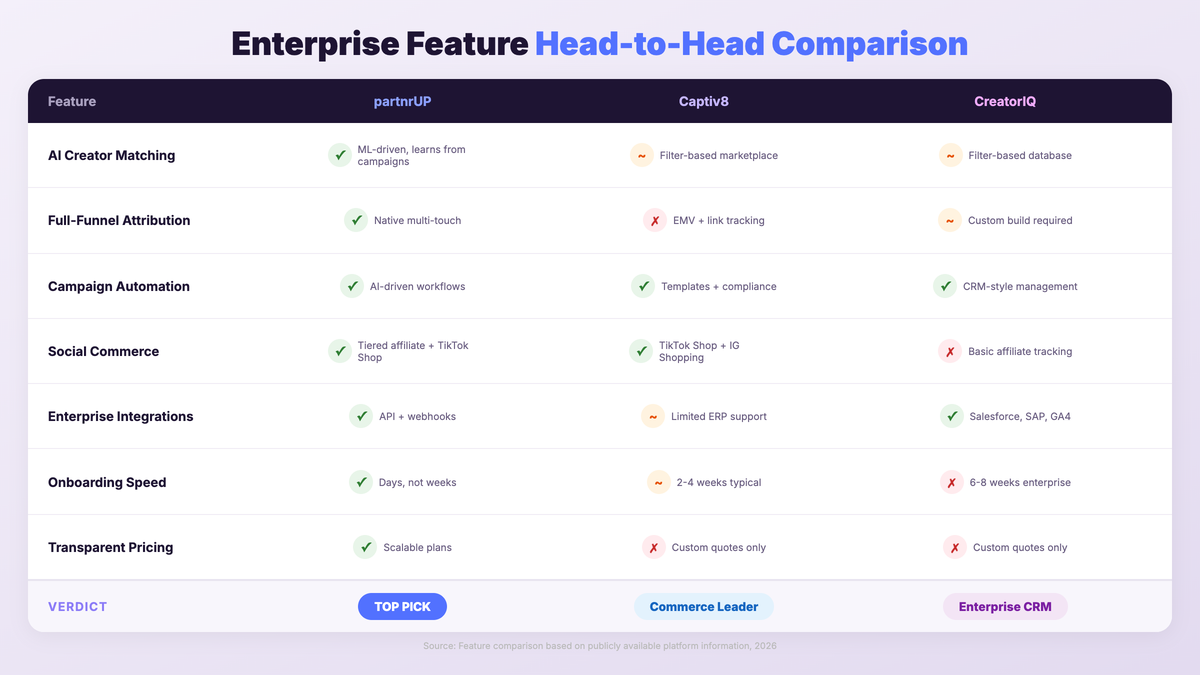
Where both Captiv8 and CreatorIQ rely on your team to define search parameters, partnrUP’s AI matching engine inverts the process. Instead of filtering a database, partnrUP analyzes your brand’s content DNA — visual style, messaging tone, audience overlap, past campaign performance — and surfaces creators who are statistically likely to drive results. The system learns from every campaign, improving match quality over time.
This matters most for brands scaling from 20 to 200+ creator relationships. Manual discovery that works at 20 creators becomes a full-time job at 200. AI-powered matching can significantly reduce creator discovery time while improving campaign performance by matching on conversion signals rather than vanity metrics. Learn more about how this works in our breakdown of AI creator matching vs. manual influencer discovery.
Campaign Management and Workflows
Finding creators is step one. Managing 50+ simultaneous creator relationships — contracts, content approval, payments, communications — is where platforms either save your team hours or create new bottlenecks.
Captiv8’s Campaign Tools
Captiv8 offers end-to-end campaign management with built-in content calendars, approval workflows, and automated payment processing. The platform excels at managing paid amplification alongside organic creator content — you can boost top-performing creator posts directly from the campaign dashboard without switching to Meta Ads Manager or TikTok Ads.
Campaign briefs in Captiv8 include mood boards, content guidelines, and automated compliance checks for FTC disclosure requirements. For brands running regulated campaigns (alcohol, finance, healthcare), the built-in compliance layer is a genuine differentiator.
The limitation: Captiv8’s workflow automation is relatively rigid. Campaign templates follow predefined structures, and customizing approval flows beyond the standard review-approve-publish sequence requires working with their customer success team. Brands with highly unique workflows often find themselves adapting to the platform rather than the other way around.
CreatorIQ’s Campaign Tools
CreatorIQ treats campaign management as a CRM problem. Every creator interaction — emails, content submissions, payment history, performance data — feeds into a unified relationship record. This CRM-first approach makes CreatorIQ exceptionally strong for brands managing long-term ambassador programs where the creator relationship extends across multiple campaigns and quarters.
The platform integrates with enterprise systems like Salesforce, SAP, and major ERP platforms, making it the natural choice for Fortune 500 marketing teams that need influencer data flowing into existing business intelligence stacks. For a deeper look at why ongoing relationships outperform one-off deals, see our analysis of long-term creator partnerships vs. one-off campaigns.
The downside: CreatorIQ’s complexity is its own barrier. The learning curve for enterprise-grade platforms means your team may not reach full productivity for several weeks to months depending on your integration requirements. For lean marketing teams, that ramp time is a real cost.
How partnrUP Streamlines Workflows
partnrUP automates the campaign lifecycle from brief to payment with AI-driven workflow orchestration. Rather than building rigid templates, the platform adapts workflows based on campaign type — a TikTok Shop activation uses different approval gates and payment triggers than a long-form YouTube integration.
The platform’s automated content matching pairs incoming creator submissions with brief requirements, flagging mismatches before they reach your review queue. For brands running 100+ creator campaigns monthly, this alone eliminates hours of manual content review each month. You can see how top brands are operationalizing this in our guide to scaling creator programs without adding headcount.
Analytics and Attribution
Enterprise brands don’t just want engagement metrics — they need to prove that influencer spend drives measurable business outcomes. This is where the Captiv8 vs CreatorIQ comparison gets most interesting, because both platforms approach attribution from fundamentally different angles.
Captiv8’s Analytics
Captiv8 focuses on media value metrics — earned media value (EMV), social impressions, engagement rates, and sentiment analysis. The platform’s reporting dashboards are visually polished and designed for executive presentations, making it easy to communicate campaign impact to stakeholders who think in media buying terms.
Where Captiv8 falls short is bottom-funnel attribution. The platform tracks link clicks and promo code redemptions, but connecting creator content to actual purchase events requires integrating third-party attribution tools. For brands spending $500K+ annually on creator programs, this gap means you’re still guessing at true ROI.
CreatorIQ’s Analytics
CreatorIQ offers the deepest analytics infrastructure of the three platforms. Custom reporting, API access to raw data, and integration with Google Analytics and enterprise BI tools give data teams the flexibility to build attribution models tailored to their business. The platform’s audience overlap analysis helps prevent wasted reach by identifying when multiple creators in a campaign share the same audience segments.
However, CreatorIQ’s analytics power requires analytics expertise to unlock. Out-of-the-box reporting covers standard metrics, but the real value comes from custom configurations that typically require a dedicated analytics resource. If your team doesn’t have someone who can build custom GA4 integrations, you’ll underutilize the platform’s strongest feature.
How partnrUP Solves Full-Funnel Attribution
partnrUP’s attribution engine tracks the complete journey from first creator touchpoint to final purchase — including view-through conversions, multi-touch attribution across channels, and incrementality testing. The platform doesn’t just tell you a creator drove 500 clicks; it connects those clicks to actual revenue and blended ROAS across the full customer journey.
For a thorough breakdown of why attribution matters and how to implement it, our complete guide to measuring influencer marketing ROI covers every model from first-touch to algorithmic attribution. And if you need to understand which attribution model fits your brand, see our guide to influencer marketing attribution models.
Commerce and Affiliate Capabilities
Social commerce continues to grow rapidly in the US, and the platform you choose today determines whether you can capitalize on that growth or scramble to retrofit commerce capabilities later.
Captiv8 and Social Commerce
Captiv8 has invested heavily in social commerce integrations, particularly TikTok Shop and Instagram Shopping. The platform supports shoppable content tagging, affiliate link generation, and real-time sales tracking for creator-driven product listings. For brands already selling through social storefronts, Captiv8’s commerce layer is relatively mature.
The gap: Captiv8’s affiliate infrastructure is basic. Commission structures are flat-rate, and there’s limited support for tiered affiliate programs where top performers earn escalating rates. Brands running sophisticated affiliate-influencer hybrid programs often need to supplement with dedicated affiliate networks.
CreatorIQ and Commerce
CreatorIQ’s commerce capabilities are more nascent than Captiv8’s. The platform supports basic affiliate link tracking and integrates with major affiliate networks (Impact, ShareASale), but the commerce features feel bolted on rather than native. Product seeding workflows and gifting campaigns are well-supported, but real-time sales attribution through creator content requires third-party integrations.
For teams where commerce is a secondary objective and brand awareness is primary, this may not matter. But for DTC and ecommerce brands where every creator relationship needs to tie back to revenue, CreatorIQ’s commerce gaps become a meaningful limitation.
partnrUP’s Commerce-First Architecture
partnrUP was built with commerce at the core, not as an afterthought. The platform supports tiered affiliate commission structures, automated creator storefronts, TikTok Shop integration, and real-time GMV tracking — all connected to the same attribution engine that powers campaign analytics.
This matters for brands pursuing creator commerce strategies where the line between “influencer marketing” and “performance marketing” is disappearing. When your affiliate program and your influencer program live in the same platform with shared attribution, you eliminate the data silos that make ROI impossible to prove. For brands exploring how to operationalize this, our guide to structuring creator affiliate programs that convert breaks down the tactical approach.
Pricing, Contracts, and Total Cost
Neither Captiv8 nor CreatorIQ publishes transparent pricing — both require sales calls and custom quotes. Here’s what enterprise buyers should expect based on publicly available information and industry benchmarks.
Captiv8 Pricing
Captiv8 (Influential) does not publish transparent pricing and requires a sales conversation for custom quotes. Industry sources have historically reported mid-market plans in the range of $2,000-$3,000/month, with enterprise contracts reaching $50,000 to $150,000+ annually, though these figures may have changed since the Influential acquisition. Contracts are typically annual with auto-renewal clauses.
Hidden costs to watch: Paid amplification budgets are managed through Captiv8 but charged separately. Some advanced analytics dashboards require premium tier access. Onboarding and training are included at enterprise tier but may be extra at lower tiers.
CreatorIQ Pricing
CreatorIQ targets the upper end of the market and does not publish pricing publicly. Industry estimates have placed annual contracts starting around $36,000, with enterprise agreements for global brands reaching significantly higher, though CreatorIQ requires a demo call for current pricing. The platform’s pricing reflects its positioning as enterprise infrastructure — this isn’t a tool for a two-person marketing team testing influencer partnerships.
Hidden costs to watch: Implementation fees and onboarding timelines vary based on CRM integrations and custom requirements. Custom API access and advanced reporting modules may require additional licensing. Enterprise implementations typically require several weeks of onboarding before reaching full utilization.
partnrUP’s Pricing Model
partnrUP offers transparent, scalable pricing designed for brands at every growth stage — from emerging DTC brands to enterprise teams managing hundreds of creator relationships. Unlike platforms that lock critical features behind enterprise tiers, partnrUP includes AI matching, full-funnel attribution, and commerce tools across all plans.
The total cost of ownership calculation matters most here. A platform that appears cheaper upfront but requires two additional tools (an affiliate network + an attribution platform) to match the same capabilities ends up costing more in dollars, integration maintenance, and team bandwidth. To compare pricing structures and understand what you’ll actually pay, book a demo with the partnrUP team.
Best Fit Scenarios: Which Platform Matches Your Brand
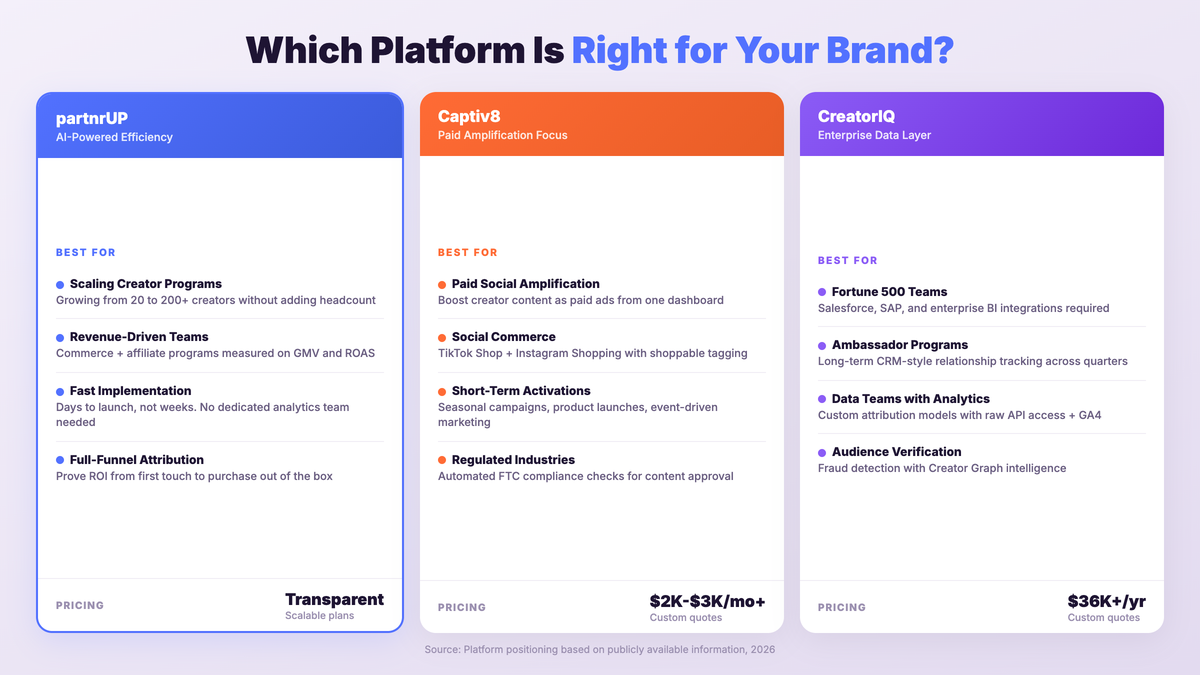
The right platform depends less on which has “more features” and more on which matches your team’s specific operating model.
Choose Captiv8 If:
- Paid amplification is core to your strategy — you regularly boost creator content as paid social ads and want that managed alongside organic campaigns
- You run high-volume, short-term activations — seasonal campaigns, product launches, and event-based marketing where speed-to-market matters more than long-term relationship building
- Social commerce is a primary channel — you’re already selling through TikTok Shop or Instagram Shopping and need a platform that supports shoppable creator content natively
- Compliance is non-negotiable — regulated industries where automated FTC disclosure checks and content compliance workflows save legal review time
Choose CreatorIQ If:
- You’re a Fortune 500 with existing enterprise systems — Salesforce, SAP, and enterprise BI integrations are requirements, not nice-to-haves
- Long-term ambassador programs are your primary model — you manage 50+ ongoing creator relationships across quarters and need CRM-grade relationship tracking
- Data depth matters more than ease of use — your team includes analytics resources who can build custom attribution models and reporting dashboards
- Audience verification is critical — industries where fake followers or audience misrepresentation creates brand safety risks
Choose partnrUP If:
- You need AI-powered efficiency without enterprise complexity — automated creator matching, workflow orchestration, and attribution without lengthy enterprise implementation timelines
- Commerce and affiliate revenue are key success metrics — your creator program is measured on GMV, ROAS, and conversion rates, not just impressions and engagement
- You’re scaling rapidly — growing from a handful of creators to hundreds and need a platform that scales with you without requiring proportional headcount increases
- Full-funnel attribution is non-negotiable — you need to prove ROI from first touch to purchase without stitching together multiple tools
- You want transparent pricing — no hidden implementation fees, no features locked behind enterprise tiers, no surprises at renewal. See how partnrUP works
Conclusion
The Captiv8 vs CreatorIQ comparison ultimately comes down to operational philosophy. Captiv8 optimizes for media amplification and social commerce in a marketer-friendly package. CreatorIQ builds enterprise data infrastructure for teams with dedicated analytics resources. Both are strong platforms with legitimate enterprise credentials.
But both were built in an era when influencer marketing was a standalone channel. The brands winning in 2026 are the ones treating creator partnerships as a full-funnel revenue engine — where discovery, management, attribution, and commerce live in one system that gets smarter with every campaign.
That’s exactly what partnrUP was built to do. AI-powered matching, automated workflows, full-funnel attribution, and native commerce capabilities — all in one platform designed for brands that measure success in revenue, not impressions.
Ready to see how it compares for your specific use case? Book a demo with the partnrUP team and get a personalized walkthrough based on your brand’s creator program goals.
Frequently Asked Questions
What is the main difference between Captiv8 and CreatorIQ?
Captiv8 focuses on paid media amplification and social commerce, making it ideal for brands that regularly boost creator content as paid ads and sell through social storefronts. CreatorIQ focuses on enterprise data infrastructure and CRM-style relationship management, making it better for Fortune 500 teams managing long-term ambassador programs with deep analytics requirements. The core difference is operational philosophy: Captiv8 is a marketer’s campaign tool, CreatorIQ is a data team’s relationship platform.
How much do Captiv8 and CreatorIQ cost?
Neither platform publishes transparent pricing. Neither platform publishes transparent pricing. Industry estimates have placed Captiv8 (Influential) mid-market plans in the $2,000-$3,000/month range and CreatorIQ annual contracts starting around $36,000, though current pricing requires direct sales conversations with each platform. Always factor in the total cost of ownership, including implementation fees, integrations, and additional tools needed to fill feature gaps.
Which platform is better for TikTok Shop and social commerce?
Captiv8 has more mature social commerce integrations than CreatorIQ, particularly for TikTok Shop and Instagram Shopping. However, Captiv8’s affiliate capabilities are relatively basic (flat-rate commissions only). partnrUP combines commerce-native architecture with tiered affiliate programs and real-time GMV tracking, making it the strongest option for brands where creator-driven revenue is a primary KPI.
Can I use CreatorIQ if I don’t have a dedicated analytics team?
You can, but you’ll underutilize the platform’s strongest features. CreatorIQ’s deepest analytics capabilities require custom configuration, GA4 integration, and BI tool setup — work that typically requires a dedicated analytics resource. The out-of-box reporting covers standard metrics, but the premium value (custom attribution models, audience overlap analysis, cross-campaign trend reporting) needs technical expertise. If your team is under 5 people, consider a platform with stronger out-of-the-box analytics like partnrUP.
How does partnrUP’s AI matching compare to Captiv8 and CreatorIQ’s discovery tools?
Captiv8 and CreatorIQ both use filter-based discovery — you set parameters (audience demographics, engagement rates, platform, niche) and browse results. This works well when you know exactly what you’re looking for. partnrUP’s AI matching analyzes your brand’s content DNA — visual style, messaging tone, audience overlap, and past campaign performance — then surfaces creators statistically likely to drive results. The system learns from every campaign, continuously improving match quality without requiring manual filter adjustments.
What are the contract terms for Captiv8 and CreatorIQ?
Both platforms typically require annual contracts with auto-renewal clauses. CreatorIQ implementations typically require a longer onboarding period before reaching full utilization, given the platform’s enterprise complexity. Captiv8’s onboarding has historically been faster but enterprise tiers may require longer setup for custom integrations. Always negotiate performance benchmarks, exit clauses, and data portability terms before signing — many brands have been locked into underperforming platforms because they didn’t negotiate exit provisions.
Which platform is best for measuring influencer marketing ROI?
CreatorIQ offers the deepest raw analytics infrastructure, but requires your team to build the attribution models. Captiv8 provides polished EMV and engagement reporting but lacks native bottom-funnel attribution. partnrUP delivers full-funnel attribution out of the box — from first creator touchpoint to final purchase, including view-through conversions and multi-touch models. For brands that need to prove revenue impact without building custom analytics pipelines, partnrUP provides the most complete attribution solution. For a deeper look at attribution approaches, see our complete guide to measuring influencer ROI.