Nearly 88% of marketers plan to increase their influencer budgets in 2026 (Influencer Marketing Hub 2026 Benchmark Report), yet two-thirds of those programs are run entirely in-house — often by teams of three or fewer people. The math doesn’t work. More budget, more creators, and more content demand cannot scale on spreadsheets and manual outreach. That’s where AI agents are stepping in — not as chatbots answering questions, but as autonomous systems that execute the repetitive operational tasks that slow influencer programs down.
This guide is part of our The State of Influencer Marketing in 2026: Trends, Data & Industry Insights — a comprehensive pillar covering every major shift shaping the creator economy this year.
Unlike traditional automation that follows rigid if-then rules, AI agents can reason about context, adapt to new information, and handle multi-step processes without constant human oversight. In influencer marketing, that means an agent can source creators from live social data, evaluate audience quality, draft outreach, manage follow-ups, and flag top candidates — all before a human reviews a single profile.
In this guide, you’ll learn:
- What AI agents actually are and how they differ from basic automation tools
- The five operational bottlenecks AI agents are eliminating for influencer teams
- How agentic workflows handle discovery, outreach, content review, and payment
- Real adoption patterns from the 2026 benchmark data on AI in influencer marketing
- A practical framework for evaluating whether your team is ready for AI agents
Table of Contents
- What Are AI Agents in Influencer Marketing?
- The 5 Operational Bottlenecks AI Agents Solve
- AI Agents for Creator Discovery and Vetting
- AI Agents for Outreach and Recruitment
- AI Agents for Campaign Management and Content Review
- AI Agents for Measurement, Attribution, and Payment
- 2026 Adoption Patterns: How Teams Are Using AI Today
- Is Your Team Ready? A Practical Readiness Framework
- Conclusion
- FAQ
What Are AI Agents in Influencer Marketing?
An AI agent is a software system that can perceive its environment, make decisions, and take actions to achieve a goal — without requiring step-by-step human instruction for every task. In influencer marketing, this means systems that independently handle entire workflows: scanning social platforms for creators, evaluating audience quality, drafting personalized outreach, and tracking campaign deliverables.
How AI Agents Differ from Traditional Automation
Traditional marketing automation follows rigid if-then logic: “When a creator applies, send email template A. If no response in 3 days, send template B.” That’s useful but limited. AI agents operate on a fundamentally different level:
- Reason about context — An agent reviewing a creator’s profile doesn’t just check follower count. It evaluates content themes, audience engagement patterns, brand safety signals, and historical performance to determine fit.
- Adapt to new information — If a creator’s recent content shifts from fitness to wellness, the agent updates its assessment without a human reconfiguring rules.
- Handle multi-step processes — A single agent can source, evaluate, pitch, track responses, and escalate interested creators — all as one continuous workflow.
- Learn from outcomes — When a brand consistently approves certain creator profiles and rejects others, the agent refines its sourcing criteria over time.
The Shift from Tool to Teammate
The practical difference is that AI agents reduce the decision load on human operators. Instead of a marketing manager spending 15 hours per week manually searching Instagram and TikTok for creators, an AI agent handles sourcing and initial outreach autonomously. The human’s role shifts from execution to strategy and approval.
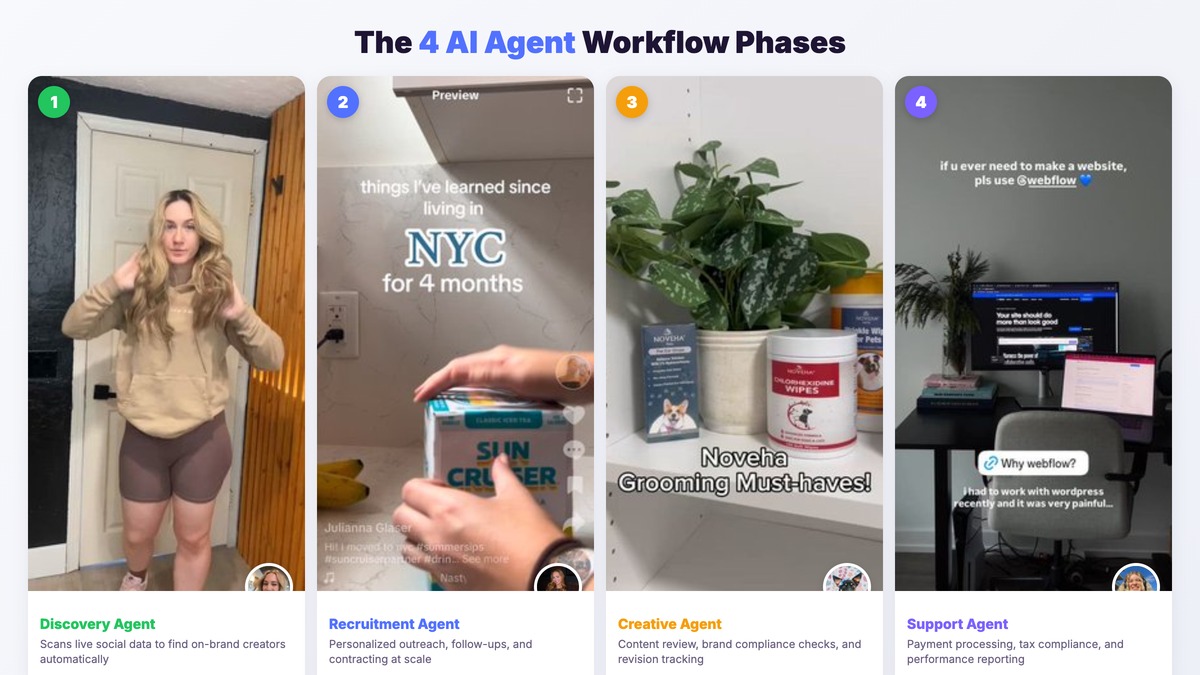
Platforms like partnrUP have built this model around named AI agents — Discovery, Recruitment, Creative, and Support — each responsible for a specific phase of the influencer lifecycle. According to the 2026 Influencer Marketing Benchmark Report, only 10.56% of respondents report not using AI at all in their influencer programs, meaning nearly 9 out of 10 teams have already integrated AI into at least one workflow.
The 5 Operational Bottlenecks AI Agents Solve
Influencer marketing has five structural bottlenecks uniquely suited for agentic AI. Understanding these bottlenecks explains why AI adoption in the channel is accelerating faster than in many other marketing functions.
1. Creator Discovery Is a Needle-in-a-Haystack Problem
Discovery and vetting is the most frequently outsourced function in influencer marketing (IMH 2026 Benchmark). Teams need creators who match brand values, have authentic audiences, create the right content style, and are available for collaboration — across multiple platforms. Manual searches hit diminishing returns quickly, and static databases become outdated the moment a creator’s content or audience shifts.
2. Outreach Volume Doesn’t Scale with Headcount
A typical campaign requires outreach to 200-500 creators to secure 15-25 partnerships. Each message needs personalization. Follow-ups need tracking. Negotiations happen across email, DMs, and platform messages. One person cannot manage this volume without cutting quality or quantity.
3. Content Review Creates Approval Bottlenecks
When 20+ creators submit draft content simultaneously, the review process becomes the single biggest throughput constraint — checking brand guidelines, FTC compliance, messaging accuracy, and creative quality for each piece.
4. Attribution Requires Real-Time Data Stitching
45.9% of teams use promo/discount codes for attribution, followed by affiliate links (26%) and native shop features (25%) (IMH 2026 Benchmark). Each method produces data in different formats, from different platforms, at different intervals. Stitching that into a coherent view of campaign ROI is a data engineering problem most marketing teams aren’t staffed to solve.
5. Payment and Compliance Are Operationally Heavy
Creator payments involve contracts, deliverable verification, tax documentation, multi-currency processing, and compliance tracking — pulling senior marketers away from strategy work.
AI Agents for Creator Discovery and Vetting
Discovery is where AI agents deliver the most immediate and measurable impact. The traditional approach — searching platform databases, applying filters, manually reviewing profiles — is inherently limited by database freshness and human processing speed.
How Agent-Driven Discovery Works
An AI discovery agent operates by:
- Ingesting the campaign brief — brand values, target demographics, content style preferences, budget range, platform priorities
- Scanning live social data — pulling directly from social APIs rather than relying solely on pre-indexed databases, catching emerging creators that static databases miss
- Evaluating multi-dimensional fit — audience demographics, engagement quality (not just rate), content themes, brand safety, and collaboration history
- Ranking and shortlisting — presenting prioritized candidates with reasoning for each recommendation
- Learning from decisions — adjusting criteria when brands approve or reject candidates
partnrUP’s Discovery Agent uses a proprietary algorithm to find influencers directly from social media and its growing creator network — not from recycled lists or dated databases. The system evaluates fit across reach, engagement, geography, and demographics, then surfaces candidates with full audience insight reports.
Why Audience Quality Verification Matters More Than Ever
When average creator marketing budgets increased 171% year-over-year (CreatorIQ, cited in IMH 2026 Benchmark), the cost of partnering with the wrong creator increases proportionally. AI agents can detect bot followers, engagement pods, and suspicious growth patterns — tasks virtually impossible to do manually at scale but critical for protecting campaign ROI.
For a deeper comparison, see our guide on AI Creator Matching vs. Manual Influencer Discovery.
AI Agents for Outreach and Recruitment
Once discovery identifies the right creators, the outreach phase is where most programs lose momentum. Personalization takes time. Follow-ups get forgotten. Negotiations stall. AI recruitment agents solve this by treating each creator relationship as an active case with defined next steps.
Personalized Outreach at Scale
An AI outreach agent drafts messages based on each creator’s content history, posting style, and collaboration preferences. This isn’t “mail merge with a first name” — it’s contextual messaging that references specific posts and proposes relevant campaign structures. partnrUP reports 40% higher creator response rates with automated, personalized outreach compared to manual methods.
Automated Follow-Up and Contracting
AI recruitment agents maintain conversation threads autonomously — sending contextually appropriate follow-ups, tracking every open and click in the campaign dashboard, and supporting negotiations within pre-set parameters. The most advanced agents handle the full onboarding flow: sending contracts, collecting signed agreements, verifying tax documentation, and confirming deliverable schedules. When a creator is approved, they’re already contracted and ready to create.
For teams building structured programs, our guide to creative briefs for creator campaigns covers setting clear expectations that AI agents can enforce.
AI Agents for Campaign Management and Content Review
Once creators are producing content, the challenge shifts to tracking deliverables, reviewing content, managing revisions, and ensuring compliance across dozens of relationships simultaneously.
Real-Time Status Visibility
AI management agents provide real-time dashboards showing exactly where every creator stands — who’s accepted the brief, whose content is pending review, what’s been approved, and what’s been published. Teams using partnrUP’s management tools report 70% less time on internal coordination and admin — time redirected to strategy and creative direction.
AI-Assisted Content Review
AI review agents can check brand guideline compliance, flag FTC disclosure issues, assess content quality signals (lighting, audio, production value), and route approvals to the right team member — reducing review cycle times without sacrificing quality.
For teams scaling their content operations, our guide on building a scalable creator content strategy provides the framework AI agents can help execute.
AI Agents for Measurement, Attribution, and Payment
The final lifecycle phase — measuring results and compensating creators — is where operational complexity peaks and AI agents provide the most back-office relief.
Cross-Platform Attribution
AI agents stitch together data from promo codes, affiliate links, and native shop features into unified campaign dashboards — mapping conversions back to individual creators and content pieces. This is particularly valuable for affiliate influencer marketing programs. Our complete attribution guide covers the full measurement framework.
Automated Payment Processing
AI payment agents handle deliverable verification, rate calculation across fee structures (flat fee, performance bonus, affiliate commission), tax compliance (W-9/W-8 collection, 1099 generation), and multi-currency processing. partnrUP delivers 100% creator payment accuracy and compliance — an operational requirement when working with creators who depend on timely, accurate payment.
2026 Adoption Patterns: How Teams Are Using AI Today
The 2026 Benchmark data reveals that AI adoption in influencer marketing has moved well past the experimental phase. Creator discovery is the most common AI use case, followed by content optimization, performance prediction, audience analysis, and fraud detection.
The In-House Advantage
With 66.3% of programs managed entirely in-house (IMH 2026 Benchmark), AI agents become a force multiplier for lean teams. A three-person team using AI agents can manage a program that would traditionally require six to eight people — not by working faster, but by offloading the 60-70% of time spent on operational tasks to autonomous systems.
This is why platforms that embed AI agents directly into the workflow — rather than offering AI as a separate add-on — are gaining adoption fastest. The value isn’t in having access to AI; it’s in having AI integrated into the operational flow so seamlessly that it reduces workload without adding new tools to manage.
For more on this topic, see our deep dive on how brands are using AI to scale without adding headcount.
Is Your Team Ready? A Practical Readiness Framework
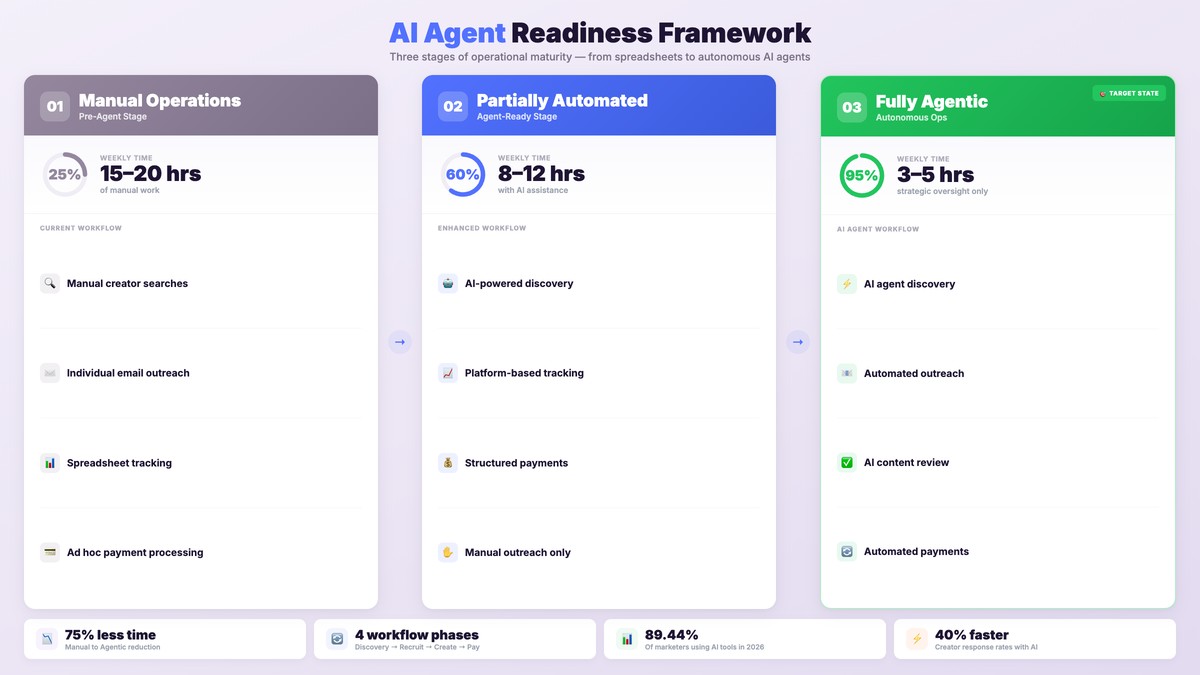
Not every team needs to deploy AI agents immediately. Use this framework to evaluate where your program sits and what the right next step is.
Level 1: Manual Operations (Pre-Agent)
You’re here if: Discovery is manual platform searches. Outreach is individual emails. Tracking lives in spreadsheets. Your bottleneck: You’re capped by team hours, not strategy quality. Next step: Start with AI-powered discovery — the highest-ROI first move because it addresses the most time-intensive task.
Level 2: Partially Automated (Agent-Ready)
You’re here if: You use a platform for discovery but handle outreach, negotiation, and content review manually. Your bottleneck: You can find creators but can’t scale relationship management. Next step: Add AI agents for outreach and recruitment — the phase where most programs leak the most time.
Level 3: Fully Agentic (Autonomous Operations)
You’re here if: AI agents handle discovery, outreach, content review, and payment — with humans setting strategy and approving key decisions. Your advantage: You can scale creator count and campaign volume without proportionally scaling headcount.
Platforms like partnrUP are designed around the Level 3 model, where named AI agents each own a lifecycle phase and humans focus on the strategic decisions that AI can’t make: brand positioning, creative direction, and ambassador-level relationship building.
Ready to see what this looks like in practice? Book a demo to explore how AI agents can transform your influencer operations.
Conclusion
AI agents aren’t replacing influencer marketers — they’re removing the operational ceiling that prevents good strategies from scaling. When nearly 88% of marketers plan budget increases and 72.2% expect increases of 50% or more, the teams that can absorb that growth without proportionally growing headcount will capture disproportionate value.
Start with discovery (the highest-impact AI use case), expand to outreach and recruitment (the biggest time sink), and build toward full-lifecycle automation where agents handle operational execution and your team focuses on strategy and relationships.
Explore partnrUP’s AI agent model or book a demo to see how named agents for Discovery, Recruitment, Creative, and Support can transform your influencer operations.
FAQ
What exactly is an AI agent in influencer marketing?
An AI agent is a software system that independently handles multi-step influencer marketing tasks — sourcing creators, sending outreach, tracking deliverables, and processing payments — without step-by-step human instruction. Unlike basic automation (rigid if-then rules), AI agents reason about context, adapt to new information, and learn from outcomes.
How do AI agents differ from the AI features in most influencer platforms?
Most platforms use AI for point tasks — recommending creators or suggesting posting times. AI agents own entire workflows end-to-end. Instead of suggesting creators to contact, an agent contacts them, tracks responses, manages follow-ups, handles negotiations within parameters, and only escalates when human judgment is required.
Will AI agents replace human influencer marketers?
No. AI agents handle operational execution — sourcing, outreach, tracking, and admin. Humans remain essential for strategy, creative direction, brand judgment, and high-value relationship management. Teams using AI agents don’t shrink — they scale output without proportionally growing headcount.
What percentage of influencer teams are already using AI?
According to the 2026 IMH Benchmark Report, only 10.56% of respondents report not using AI at all. AI is most commonly applied to creator discovery, with adoption spreading into content optimization, performance prediction, audience analysis, and fraud detection.
What should I automate first with AI agents?
Start with creator discovery and vetting — the most time-intensive task and most frequently outsourced function in influencer marketing. Once discovery is automated, expand into outreach and recruitment, then campaign management and payment processing.
How do AI agents handle outreach without sounding robotic?
Modern AI outreach agents analyze each creator’s content history, posting style, and past collaborations to draft contextual, personalized messages — not templated mail merges. They reference specific posts, identify genuine alignment points, and propose relevant campaign structures, resulting in significantly higher response rates compared to batch outreach.
What does a fully agentic influencer operation look like?
Named AI agents each own a lifecycle phase: a Discovery Agent scans for on-brand creators continuously, a Recruitment Agent handles personalized outreach and contracting, a Creative Agent manages content review and revision tracking, and a Support Agent processes payments and generates reporting. Humans set strategy, define campaign parameters, approve key decisions, and manage top-tier creator relationships — while agents handle the operational volume.