72% of creators say a poorly written brief is the number one reason campaign content misses the mark, according to a 2026 Creator Compensation & Workflow Report by IZEA. Yet most brand teams spend less than 15 minutes writing them — copying last quarter’s brief, swapping out product names, and hoping for the best.
The creative brief is the single most important document in any creator campaign. It’s the bridge between your brand’s vision and a creator’s authentic voice. Get it right, and you unlock content that performs across organic and paid. Get it wrong, and you waste budget on deliverables that sit in a shared drive, never to be used again.
This guide is part of our Creator Content Strategy: Building a Scalable Creative Program for Your Brand — the complete framework for building a creator content engine that scales without sacrificing quality.
In this guide, you’ll learn:
- The exact structure of a high-performing creative brief (with a fill-in framework)
- How to set creative boundaries without killing a creator’s authentic voice
- The 7 sections every brief needs — and the 3 most brands over-engineer
- Common brief mistakes that lead to revision cycles and off-brand content
- How to adapt your brief template for different campaign types and platforms
Table of Contents
- Why Most Creative Briefs Fail
- The Anatomy of an Effective Creative Brief
- The Step-by-Step Writing Process
- Setting Creative Boundaries Without Killing Authenticity
- Brief Templates by Campaign Type
- Common Brief Mistakes and How to Fix Them
- Scaling Your Brief Process Across Teams and Campaigns
- Frequently Asked Questions
Why Most Creative Briefs Fail
Most creative briefs fail for one of two reasons: they either over-prescribe every detail (turning creators into actors reading a script) or they under-specify expectations (leaving creators guessing about what the brand actually wants).
The Over-Prescribing Trap
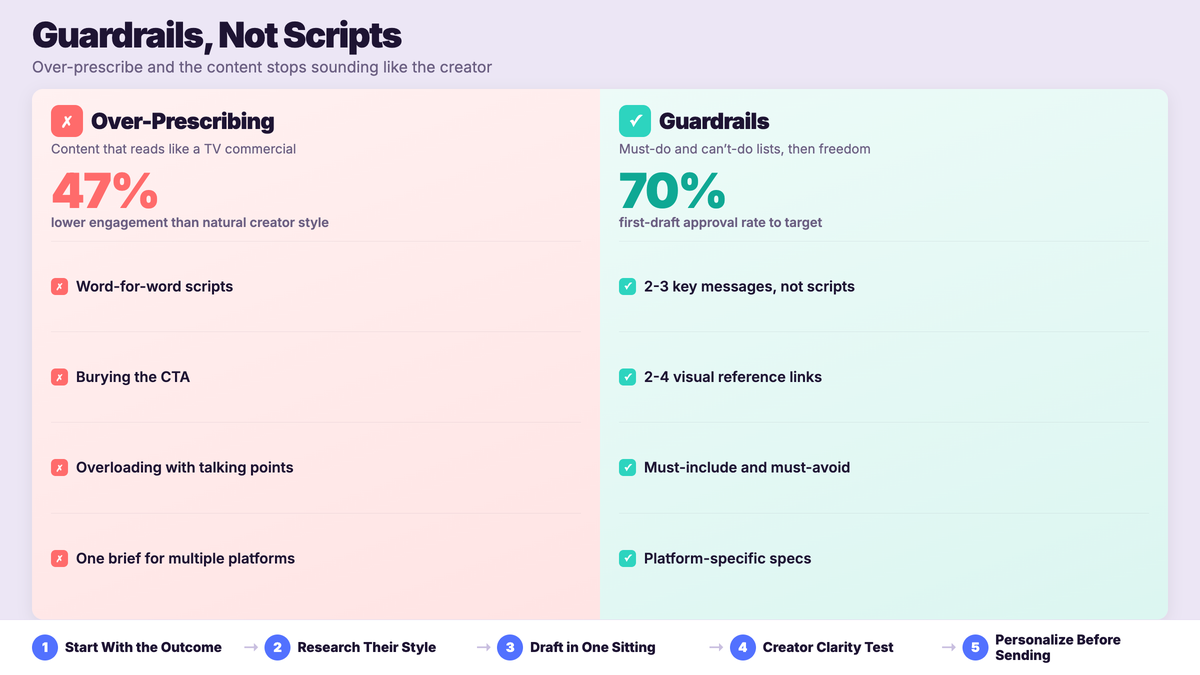
Brands that have been burned by off-brand content tend to swing toward hyper-detailed briefs. They script exact talking points, mandate specific camera angles, and dictate posting times. The result? Content that feels manufactured — and audiences can tell. Creator content that reads like a TV commercial gets 47% lower engagement than content where the creator’s natural style comes through, according to Influencer Marketing Hub’s 2026 benchmark data.
The Under-Specifying Problem
On the other end, some brands send a one-paragraph brief that says little more than “make a video about our product.” This leads to 3 to 5 revision rounds before the content is usable — each one costing time and straining the creator relationship.
The best briefs live in the middle ground: clear strategic framework for the “what” and “why,” with the “how” open to creative interpretation. Think guardrails on a highway — the creator knows the destination and lane boundaries, but they choose the route.
The Anatomy of an Effective Creative Brief
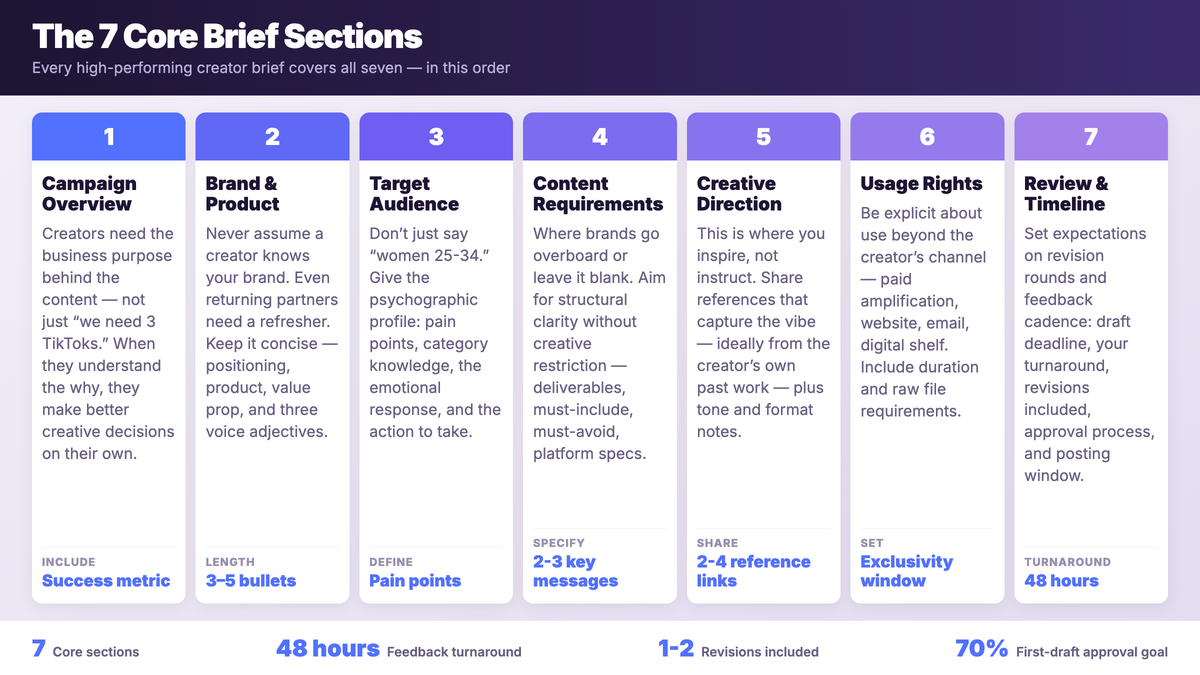
After analyzing briefs from 500+ brand-creator partnerships on the partnrUP platform, a clear pattern emerges: the highest-performing campaigns share 7 core brief sections.
1. Campaign Overview and Objectives
Start with context. Creators need to understand the business purpose behind the content — not just “we need 3 TikToks.” When creators understand the “why,” they make better creative decisions on their own.
Include:
- Campaign name — for tracking and reference
- Business objective — awareness, consideration, conversion, or retention
- Success metric — the one number that defines success (e.g., “drive 500 clicks to the landing page” or “generate 50 pieces of UGC for paid amplification”)
- Campaign timeline — content due date, review window, posting dates
- Why this creator — one sentence on why you chose them specifically (this builds investment in the project)
2. Brand and Product Context
Never assume a creator knows your brand. Even returning partners need a refresher, especially if your messaging has evolved. Keep this section concise — 3 to 5 bullet points, not a brand book download.
- Brand positioning statement — one line on who you are and what you stand for
- Product/service being featured — what it does, who it’s for, and what makes it different
- Key value proposition — the single most important thing a viewer should take away
- Brand voice descriptors — 3 adjectives (e.g., “bold, practical, no-nonsense”)
3. Target Audience
Don’t just say “women 25-34.” Creators need the psychographic profile: what pain points does the viewer have, what do they already know about your category, what emotional response should the content trigger, and what specific action should they take?
4. Content Requirements
This is where most brands either go overboard or leave too much blank. Aim for structural clarity without creative restriction: specify deliverables (number and type), 2-3 key messages (themes, not scripts), must-include elements (product visibility, brand mention, link/code), must-avoid elements (competitor mentions, restricted claims), and platform specifications (aspect ratio, length limits).
5. Creative Direction
This is where you inspire — not instruct. Share 2-4 reference links that capture the vibe you’re looking for (ideally from the creator’s own past work). Visual references are 3x more effective than written descriptions at communicating creative intent. Include tone and style notes, content format suggestions (“get ready with me,” “honest review”), and a link to a past campaign that nailed the brief.
6. Usage Rights and Deliverables
Be explicit about how content will be used beyond the creator’s channel — paid amplification, website, email, or digital shelf. Include usage duration, exclusivity window, and raw file requirements. This section prevents disputes down the road.
7. Review Process and Timeline
Set expectations on revision rounds and feedback cadence. Include draft submission deadline, your team’s feedback turnaround time (48 hours is standard), how many revisions are included (typically 1-2), final approval process, and the posting window. Additional revision rounds beyond what’s scoped should trigger additional compensation.
The Step-by-Step Writing Process
Knowing what goes in a brief is half the battle. The other half is the workflow that turns a blank document into a brief that gets results on the first draft submission.
Step 1: Start With the Business Outcome
Before you write a single word, answer this question: “What does success look like for this campaign?” Everything in the brief flows from this answer. If the goal is awareness, the brief should emphasize reach and storytelling. If the goal is conversion, the brief should emphasize product demonstration and clear CTAs.
Write the success metric first. Tape it to the top of the document. Every section you add should serve this metric.
Step 2: Research the Creator’s Content Style
Spend 20 minutes studying the creator’s recent content before writing. Note their editing style, humor patterns, and how they introduce products. Platforms like partnrUP’s AI-powered matching engine surface these insights automatically — engagement patterns, format preferences, audience demographics — so you can write briefs that align with each creator’s natural approach.
Step 3: Draft the Brief in One Sitting
Briefs written in fragments over a week are consistently worse than briefs written in a focused 45-minute session. When you write all at once, the tone, objectives, and creative direction naturally align. Patchwork briefs produce contradictory instructions that confuse creators.
Step 4: Run the “Creator Clarity Test”
Before sending, give the brief to someone unfamiliar with the campaign and ask three questions:
- “What is this campaign trying to achieve?” — If they can’t answer in one sentence, your objectives section needs work.
- “What kind of content would you create from this brief?” — If their description doesn’t match your expectations, your creative direction is too vague.
- “What questions do you still have?” — Every unanswered question is a potential revision cycle avoided.
Step 5: Personalize Before Sending
The final step is the one most teams skip: personalizing the brief for each creator. This doesn’t mean rewriting the whole document. It means adding 2-3 sentences that reference the creator’s specific content, explaining why you chose them, and adjusting the creative direction examples to match their style.
Personalized briefs see 34% fewer revision requests and significantly higher creator satisfaction scores, based on campaign data from brands managing 20+ concurrent partnerships on partnrUP.
Setting Creative Boundaries Without Killing Authenticity
The hardest part of brief writing isn’t deciding what to include — it’s deciding what to leave out. Scaling creative production while preserving authenticity demands a nuanced approach.
The “Guardrails, Not Scripts” Framework
Think of your brief as a set of creative guardrails. Guardrails define what the creator must do, can’t do, and gets to choose. Here’s how to structure each:
Must do (non-negotiable):
- Feature the product within the first 10 seconds
- Include the campaign hashtag and discount code
- Disclose the partnership per FTC guidelines
Can’t do (brand safety):
- Make health or efficacy claims not approved by legal
- Show the product alongside competitor products
- Use profanity or content that conflicts with brand values
Gets to choose (creative freedom):
- Hook style and opening approach
- Setting, lighting, and visual style
- Story arc and narrative structure
- Music selection
- CTA language and delivery
Calibrating Freedom by Creator Tier
Not every creator needs the same level of guidance. Macro creators (500K+ followers) typically have a well-developed content formula — give them more freedom and focus your brief on the “must do” and “can’t do” lists. Micro and nano creators (under 50K) often benefit from more creative direction — not more restrictions, but more inspiration, examples, and format suggestions.
The key is matching your brief’s detail level to the creator’s experience — something that tools like AI-powered creator matching can help calibrate by analyzing each creator’s content consistency and production quality.
When to Use Scripts vs. Frameworks
Scripted content has its place: legal disclaimers, regulated industries, and precision product demonstrations. For everything else, frameworks outperform scripts. A framework: “Start with a relatable problem → Show how our product addresses it → End with your honest take and a CTA.” The creator fills in the details with their own voice.
Brief Templates by Campaign Type
Different campaign types demand different brief structures. Here’s how to adapt the core 7-section framework for the most common campaign scenarios.
Product Launch Brief
Objective: Awareness and consideration. Product launch briefs need the most detailed product context. Creators are learning about the product for the first time — include key differentiators, target price point, where to buy, and the headline benefit. Add unboxing guidelines if the product is physical.
Evergreen Content Brief
Objective: Ongoing organic content and digital shelf optimization. Prioritize long shelf life over trend-riding — request timeless hooks with no seasonal references. Usage rights should extend to 6-12 months minimum since the content’s value is in reuse across website, paid ads, email, and product pages.
Affiliate / Performance Brief
Objective: Conversion and trackable sales. Affiliate program briefs shift the dynamic: creator compensation is tied to performance, so equip them to sell. Include conversion-focused talking points — price comparisons, free trial details, guarantee language, and exact link/promo code placement.
UGC / Paid Amplification Brief
Objective: Raw content for brand’s paid channels. UGC briefs are the most structured — content needs to work outside the creator’s channel. Include specific aspect ratios, hook requirements (first 3 seconds must grab attention without context), and lighting guidance since these affect ad performance.
Common Brief Mistakes and How to Fix Them
Even experienced marketing teams make these errors. Each one adds days to your campaign timeline and chips away at creator trust.
Mistake 1: Burying the CTA
Creators shouldn’t have to hunt through 5 pages to find out what action they want the viewer to take. Put the CTA in the campaign overview section — not just in the content requirements. The CTA should be the second thing a creator sees after the campaign objective.
Mistake 2: Sending One Brief for Multiple Platforms
A TikTok video and an Instagram Reel may look similar, but they perform differently. Hook timing, aspect ratio tolerances, caption strategies, and trending audio all vary by platform. If your campaign spans multiple platforms, create a platform-specific addendum for each — not a one-size-fits-all document. TikTok Shop campaigns, in particular, require unique brief elements around shopping features, product tagging, and live commerce integration.
Mistake 3: Overloading With Talking Points
If your brief has more than 3 key messages, the creator will either ignore most of them or try to cram them all in — producing content that feels like a rushed infomercial. Prioritize ruthlessly. One primary message, one supporting message, one CTA. That’s it.
Mistake 4: No Visual References
Words are imprecise. “Fun and energetic” means something different to every person. Include 3-5 reference videos or images that capture the tone you want — and when possible, reference the creator’s own past content.
Mistake 5: Vague Timelines
“We need this soon” is a recipe for missed deadlines. Include specific dates for every milestone: draft submission, feedback delivery, revision deadline, and posting window.
Mistake 6: Ignoring the Creator’s Audience
Your target customer and the creator’s audience overlap — but aren’t identical. Brief the creator on your target segment, then ask how their audience aligns. A creator who understands both can bridge the gap more effectively than one briefed only on your ICP.
Scaling Your Brief Process Across Teams and Campaigns
Writing one great brief is a skill. Writing 50 great briefs per quarter across multiple product lines, campaign types, and creator tiers is a system. Here’s how to build that system.
Create a Modular Template Library
Build a modular brief system with interchangeable sections. Brand context stays the same across all briefs. Content requirements swap based on campaign type. Creative direction personalizes per creator. This reduces brief writing from 45 minutes to 15 minutes per creator.
Build a Brief-to-Performance Feedback Loop
Track which brief elements correlate with high-performing content. Did briefs with video references produce higher engagement? Did shorter briefs lead to faster turnaround? Platforms like partnrUP connect campaign briefs to performance metrics, making it possible to track KPIs back to specific brief decisions and build a data-driven brief playbook that evolves with actual ROI data.
Assign Brief Ownership, Not Brief Committees
The worst briefs are written by committee. Every stakeholder adds their “must have,” and the brief balloons into a contradictory document. Assign one person as the brief owner — they write it, own the feedback process, and are accountable for the content outcome.
Use AI to Accelerate Brief Writing
AI tools can draft initial brief frameworks, generate creative direction suggestions, and identify gaps before the brief reaches the creator. But the personalization step — referencing the creator’s specific content and tailoring tone to their audience — still requires a human touch.
For brands managing 20+ partnerships simultaneously, automated workflow tools that integrate brief templates with creator communication and approval flows can reduce administrative overhead by up to 60%.
Conclusion
A great creative brief isn’t a document — it’s a communication tool that builds trust and unlocks creative potential. The framework covered here — starting with business outcomes, building 7 essential sections, calibrating creative freedom by creator tier, and adapting templates by campaign type — works whether you’re briefing one creator or one hundred.
Ready to streamline your creator campaign workflow? Explore partnrUP’s platform to see how AI-powered creator matching and performance tracking can help your team produce better campaigns. Or book a demo to see the brief-to-results pipeline in action.
Frequently Asked Questions
How long should a creative brief be?
Aim for 1-2 pages (500-800 words). Anything longer gets skimmed and critical information gets buried. The most effective briefs use bullet points, bold headers, and clear section breaks so creators can reference specific sections quickly.
Should I send the same brief to every creator in a campaign?
No. Use a modular approach: keep the campaign overview, brand context, and content requirements consistent, but personalize the creative direction for each creator. Reference their specific content style and explain why you chose them.
How many talking points should I include in a brief?
Three maximum — one primary message, one supporting point, and one CTA. Content trying to communicate more than three ideas underperforms on every metric. If you have more points, split them across multiple content pieces.
What’s the difference between a creative brief and a content brief?
A creative brief focuses on strategic and creative parameters — objectives, audience, tone, creative direction. A content brief is more tactical — deliverables, technical specs, posting schedules. The best creator campaign briefs combine both but lead with creative strategy.
How do I handle briefs for creator whitelisting and paid amplification?
Add a paid media addendum specifying which content may be amplified through creator whitelisting, what modifications the brand can make, and whether additional compensation applies. Include attribution model details so creators understand how performance will be measured.
What should I do if a creator pushes back on the brief?
Listen. Pushback usually signals the brief is too restrictive, deliverables don’t match compensation, or the direction doesn’t align with their audience. Open a dialogue — the best creative outcomes often emerge from briefs that evolve through collaboration. Their audience insight is part of what you’re paying for.
How can I measure whether my briefs are improving over time?
Track three proxy metrics: first-draft approval rate (percentage approved without revisions), average revision cycles (trending down = better briefs), and content performance relative to brief complexity. Over a quarter, first-draft approval rates should climb above 70%.