67% of brands plan to increase their influencer marketing budgets in 2026 — yet many are stuck on platforms that charge enterprise pricing for mid-market features. If your team has outgrown Aspire (formerly AspireIQ) or simply needs a better fit for your workflow and budget, you’re not alone.
This guide is part of our Influencer Marketing Platform Comparison Guide: How to Choose the Right Tool in 2026 — a comprehensive breakdown of how to evaluate, compare, and select the right influencer marketing platform for your brand’s goals and growth stage.
Aspire built its reputation on ecommerce-first influencer management, with deep Shopify integrations and a creator marketplace model. But brands frequently cite three friction points: opaque pricing that scales unpredictably, limited AI-powered discovery beyond basic filters, and attribution gaps that make it difficult to prove ROI across channels.
Whether you’re a startup stretching a tight creator budget, a mid-market brand scaling campaigns, or an enterprise team managing hundreds of partnerships, the right Aspire alternative can eliminate those bottlenecks — and often at a fraction of the cost.
In this guide, you’ll learn:
- Why brands leave Aspire — and the specific gaps each alternative fills
- How 9 platforms compare on discovery, automation, attribution, and pricing
- Which platforms work best for startups, mid-market, and enterprise budgets
- Where AI-powered creator matching outperforms manual search and filter workflows
- How to evaluate ROI tracking capabilities before you commit to a contract
Table of Contents
- Why Brands Switch from Aspire
- What to Look for in an Aspire Alternative
- Top 9 Aspire Alternatives for 2026
- Budget Tier Breakdown: Which Platform Fits Your Spend
- Feature Comparison Matrix
- How to Choose the Right Platform for Your Brand
- Conclusion
- FAQ
Why Brands Switch from Aspire
Aspire has carved out a solid position in the influencer marketing space, particularly for DTC and ecommerce brands. Its Shopify integration, product seeding workflows, and creator marketplace remain genuine strengths. But as brands scale, several limitations push teams to explore alternatives.
Pricing That Scales Unpredictably
Aspire does not publish transparent pricing on its website — all plans require a sales conversation. Brands on review sites like G2 and Capterra frequently note that costs increase significantly as team size and campaign volume grow. For teams managing more than a handful of campaigns, the lack of pricing predictability makes budgeting difficult, especially for mid-market brands trying to scale without enterprise budgets.
Discovery Limited to Filters, Not Intelligence
Aspire’s creator discovery relies primarily on keyword and category filters within its marketplace. While effective for surface-level searches, brands looking for audience overlap analysis, predictive performance scoring, or AI-driven matching often find these capabilities missing or limited compared to newer platforms. This becomes a bottleneck when teams need to find niche creators across multiple verticals quickly.
Attribution Gaps Across Channels
For brands investing heavily in influencer marketing attribution, Aspire’s tracking capabilities can feel basic compared to platforms offering multi-touch attribution, pixel-based conversion tracking, or real-time ROAS dashboards. When proving ROI to leadership is the priority, these gaps become deal-breakers.
Limited Automation for High-Volume Programs
Managing 50+ creator partnerships simultaneously requires automation — from outreach sequences to contract management to content approvals. Brands scaling beyond boutique campaigns report that Aspire’s workflow automation doesn’t keep pace with platforms purpose-built for high-volume creator programs.
What to Look for in an Aspire Alternative
Not every alternative will solve the same problem. Before evaluating platforms, clarify which of these five capabilities matters most to your team:
AI-Powered Creator Discovery
The best platforms go beyond basic filters. Look for behavioral analysis, audience authenticity scoring, and predictive performance matching that surfaces creators your competitors haven’t found yet. Platforms like partnrUP use machine learning to match brands with creators based on content style, audience demographics, and historical campaign performance — not just follower counts.
Transparent, Scalable Pricing
After dealing with opaque pricing, the last thing your team needs is another surprise invoice. Prioritize platforms that publish pricing tiers or offer fixed-rate plans that won’t penalize growth. Several alternatives on this list start under $500/month for small teams.
Full-Funnel Attribution
Can the platform track a creator’s impact from first impression through final conversion? Look for multi-touch attribution models, UTM tracking, promo code management, and real-time revenue dashboards — not just vanity engagement metrics.
Workflow Automation
The right platform should automate the repetitive parts: creator outreach, contract generation, content review, payment processing. Evaluate how many manual steps each platform eliminates — and whether automation covers your specific workflow.
Commerce Integration
If your brand sells through Shopify, Amazon, or TikTok Shop, the platform needs native integrations that connect creator content directly to purchase data. This is where several Aspire alternatives differentiate themselves.
Top 9 Aspire Alternatives for 2026
1. partnrUP — Best for AI-Powered Creator Matching and ROI Attribution
Best for: Mid-market and enterprise brands that want AI-driven discovery and measurable ROI without enterprise-tier pricing.
partnrUP was built to solve the exact problems that push brands away from Aspire: manual creator discovery, disconnected attribution, and pricing that penalizes growth. Its AI matching engine analyzes creator content style, audience quality, and historical performance data to surface high-fit partnerships — replacing hours of manual filtering with algorithmic precision.
The platform’s attribution infrastructure tracks creator impact across the full funnel, from awareness through conversion, giving brands a real-time view of which partnerships drive revenue. For teams managing influencer marketing KPIs across multiple campaigns, partnrUP’s dashboard consolidates everything into a single view.
Key strengths:
- AI-powered creator matching based on audience quality and content alignment
- Full-funnel attribution with real-time ROAS tracking
- Automated workflows for outreach, contracts, and content approvals
- Transparent pricing that scales with campaign volume
- Commerce integrations for Shopify and TikTok Shop
Pricing: Transparent tiers available on the website. Book a demo to see which tier fits your program size.
2. GRIN — Best for DTC Ecommerce Brands on Shopify
Best for: Ecommerce-first brands that need deep Shopify integration and product seeding at scale.
GRIN positions itself as the all-in-one creator management platform for DTC brands. Its Shopify integration is among the deepest in the space, enabling product seeding, affiliate link generation, and sales tracking directly within the platform. If your brand’s primary sales channel is Shopify and product gifting is a core strategy, GRIN handles that workflow well.
However, GRIN does not publish pricing and is generally positioned as an enterprise solution. Brands on G2 note that annual contracts can be substantial, making it a better fit for established brands with proven influencer budgets. For a detailed breakdown, see our GRIN Review 2026 and GRIN pricing analysis.
Key strengths:
- Deep Shopify integration for product seeding and sales tracking
- Content management and rights management tools
- Creator relationship management (CRM-style interface)
- Robust reporting on creator-driven revenue
Pricing: Does not publish pricing. Requires a sales conversation. Positioned as enterprise-tier.
3. CreatorIQ — Best for Enterprise-Scale Governance and Compliance
Best for: Large enterprises and agencies managing global influencer programs with strict compliance requirements.
CreatorIQ is the enterprise heavyweight. Its proprietary Creator Graph intelligence infrastructure powers discovery across a broad creator dataset, while SafeIQ provides brand safety and compliance monitoring that enterprise legal teams require. Named a Leader in the IDC MarketScape: Worldwide Influencer Marketing Platforms for Large Enterprises 2025–2026 assessment, CreatorIQ is purpose-built for organizations managing programs across multiple markets and brands.
The trade-off is complexity and cost. CreatorIQ requires significant onboarding, and its feature depth can overwhelm teams that don’t need enterprise-grade governance. For a side-by-side comparison, see our Captiv8 vs CreatorIQ analysis.
Key strengths:
- Creator Graph — proprietary intelligence infrastructure for discovery and evaluation
- SafeIQ for brand safety, compliance, and fraud detection
- Enterprise governance tools for multi-brand, multi-market programs
- Sprinklr integration for unified social measurement
- BenchmarkIQ for competitive intelligence
Pricing: Does not publish pricing. Annual contracts require a sales demo. Industry estimates place starting costs at $36K+/year. Always confirm directly with CreatorIQ.
4. Influential + Captiv8 (Publicis Groupe) — Best for Fortune 500 AI-Powered Campaigns
Best for: Large brands needing AI-driven campaign optimization with deep API integrations.
Influential and Captiv8 now operate as a combined entity under Publicis Groupe, which acquired Influential for $500 million in 2024 and Captiv8 for $150 million in May 2025. Powered by IBM Watson, the combined platform serves over 60% of the Fortune 500 with 15+ million creators in its network. Its AI analyzes psychographic data alongside demographics for more nuanced creator-brand matching.
The platform excels at large-scale campaign execution where AI optimization can materially improve performance. However, it’s firmly positioned at the enterprise tier — startups and mid-market brands will find the investment significant relative to their program size.
Key strengths:
- IBM Watson-powered AI for psychographic creator analysis
- 15+ million creator network
- Deep API integrations for custom workflows
- $1+ billion in influencer campaigns managed
- Strong Fortune 500 client base
Pricing: Does not publish pricing. Enterprise contracts require a sales engagement. Industry estimates vary widely — always confirm current pricing directly.
5. Upfluence — Best for Ecommerce Brands Needing Affiliate + Influencer Hybrid
Best for: Ecommerce brands that want to blend influencer marketing with affiliate marketing performance models.
Upfluence differentiates itself with a combined influencer and affiliate marketing approach. The platform identifies existing customers who are also influencers (what they call “organic influencers”), enabling brands to recruit their most authentic advocates. Its ecommerce integrations cover Shopify, WooCommerce, BigCommerce, and Magento.
The affiliate tools include unique coupon code generation, commission tracking, and automated payouts — making it a strong fit for brands running performance-based creator affiliate programs. Discovery relies on a large database with search filters, though it lacks the AI-powered matching depth of newer platforms.
Key strengths:
- Organic influencer identification from existing customer base
- Combined affiliate + influencer management
- Broad ecommerce platform integrations (Shopify, WooCommerce, BigCommerce, Magento)
- Automated affiliate payouts and commission tracking
Pricing: Does not publish fixed pricing. Third-party estimates place entry-level access around $478/month, with full-suite configurations ranging from $1,000–$1,600+/month. Annual contracts required. Book a demo for a custom quote.
6. Traackr — Best for Data-Driven Brand Strategy and Market Intelligence
Best for: Brands that prioritize competitive benchmarking and influencer spend optimization.
Traackr takes a data-first approach to influencer marketing, positioning itself as a strategic intelligence platform rather than just a campaign execution tool. Its Brand Vitality Score (VIT) metric gives brands a standardized way to measure influencer impact relative to competitors — a capability few other platforms offer.
The platform excels at budget optimization, helping teams allocate influencer spend across tiers, markets, and content types based on performance data. For brands that need to justify every dollar to the C-suite, Traackr’s analytics depth provides the evidence.
Key strengths:
- Brand Vitality Score (VIT) for competitive benchmarking
- Investment optimization across creator tiers and content types
- Market intelligence and share-of-voice analysis
- Spend tracking with ROI measurement
Pricing: Does not publish pricing. Positioned for mid-market to enterprise brands. Requires a demo.
7. Klear (by Meltwater) — Best for PR and Comms Teams Already on Meltwater
Best for: Brands using Meltwater’s media intelligence suite who want integrated influencer capabilities.
Klear, acquired by Meltwater, integrates influencer marketing into a broader media monitoring and PR intelligence stack. For teams already invested in Meltwater’s ecosystem, adding Klear means unified reporting across earned media, influencer, and PR campaigns without juggling separate tools.
The platform offers solid discovery with demographic and psychographic filters, campaign management tools, and performance analytics. Its strength is integration context — seeing influencer impact alongside traditional PR metrics. As a standalone influencer platform, however, it may lack the depth of purpose-built alternatives.
Key strengths:
- Native integration with Meltwater’s media intelligence suite
- Unified PR + influencer reporting
- Demographic and psychographic audience analysis
- FTC compliance monitoring
Pricing: Typically bundled with Meltwater subscriptions. Standalone pricing available but not published. Contact Meltwater for details.
8. Brandwatch (Influence) — Best for Social Listening + Influencer Marketing Integration
Best for: Brands that want influencer marketing embedded within a social listening and consumer intelligence platform.
Brandwatch merged with Falcon.io under parent company Cision (Falcon.io acquired 2019, Brandwatch acquired 2021, merged under the Brandwatch brand in 2022) and built its Influence module to sit within a comprehensive social media management and consumer research platform. The key differentiator is connecting social listening insights directly to influencer strategy — identifying trending conversations and then finding creators who drive those conversations.
For brands that already use Brandwatch for social listening, adding the Influence module creates a seamless workflow from trend identification to creator activation. The discovery database is substantial, with filters for audience demographics, engagement quality, and brand affinity.
Key strengths:
- Social listening integrated directly with influencer discovery
- Consumer intelligence for trend-based creator selection
- Content performance analytics with sentiment analysis
- Multi-platform campaign management
Pricing: Bundled with Brandwatch’s social suite or available as a standalone module. Enterprise pricing requires a demo.
9. #paid — Best for Content-First Creator Campaigns
Best for: Brands that prioritize high-quality creative content over volume-based influencer outreach.
#paid flips the traditional influencer marketplace model. Instead of brands searching for creators, creators pitch brands with content ideas — a “hand-raise” model that ensures alignment before a campaign starts. This content-first approach results in more authentic partnerships because creators self-select into campaigns they genuinely want to participate in.
The platform includes a Handraise™ marketplace, content approval workflows, and usage licensing tools for repurposing creator content across paid media. For brands focused on content quality over influencer scale, #paid offers a fundamentally different workflow than Aspire’s search-and-filter model.
Key strengths:
- Handraise™ model — creators pitch brands with content concepts
- Content licensing and whitelisting for paid media amplification
- Creative brief matching ensures content alignment
- Strong focus on mid-tier and micro-influencer content quality
Pricing: Tiered pricing published on third-party review sites. Plans start at $499/month (Just Content tier) or $449/month billed annually. Grow tier starts at $690/month, Advanced at $999/month. Creator fees are separate from platform subscriptions.
Budget Tier Breakdown: Which Platform Fits Your Spend
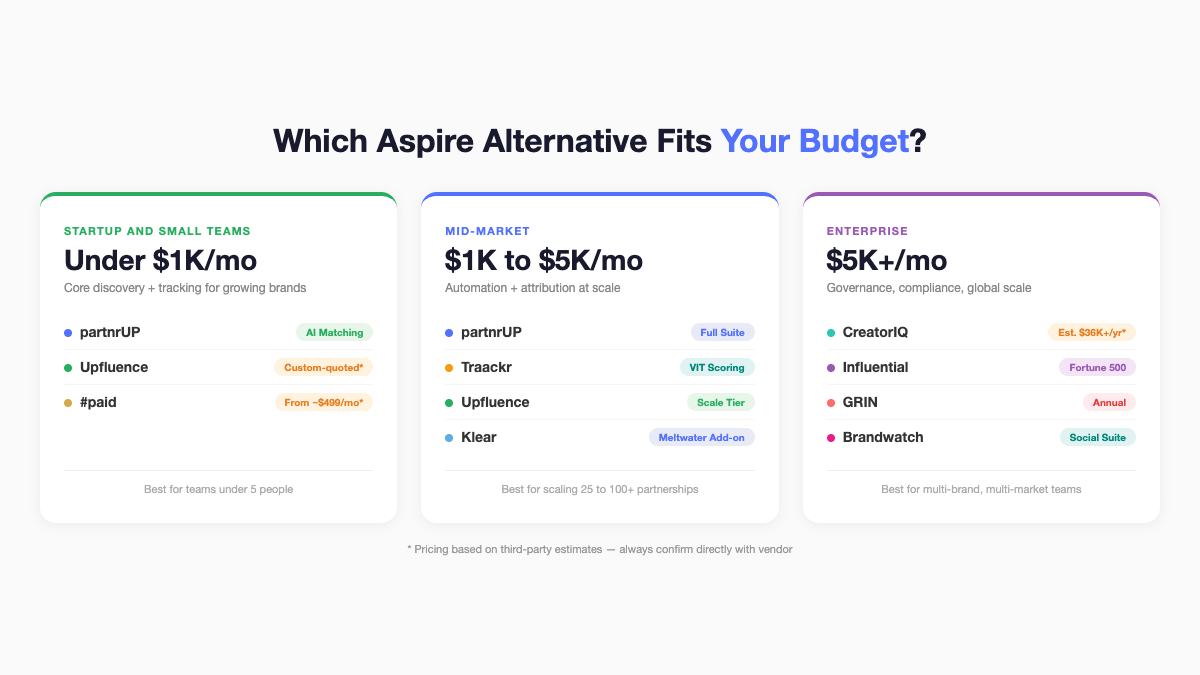
One of the biggest reasons brands leave Aspire is pricing uncertainty. Here’s how these 9 alternatives break down by budget tier, so you can shortlist based on what your team can actually invest:
Startup and Small Team Budget (Under $1,000/month)
Brands with limited budgets need platforms that deliver core functionality — discovery, outreach, and basic tracking — without enterprise overhead.
- partnrUP — Transparent pricing with tiers designed for growing teams. AI matching reduces the manual effort that typically requires hiring additional headcount.
- Upfluence — Third-party estimates place entry-level access around $478/month. Offers discovery + affiliate tools for ecommerce brands running performance-based programs. Pricing is custom-quoted.
- #paid — Content-first campaigns starting at $499/month ($449/month annual), ideal for brands prioritizing quality over scale. Creator fees are additional.
Mid-Market Budget ($1,000–$5,000/month)
This is where most Aspire users land — brands running consistent campaigns that need better automation and attribution as they scale.
- partnrUP — Full AI matching, attribution dashboards, and workflow automation. Book a demo to see pricing for your program size.
- Traackr — Competitive intelligence and spend optimization for brands with multiple campaigns in flight.
- Upfluence (Scale) — Expanded features for brands managing larger affiliate-influencer hybrid programs.
- Klear — Particularly cost-effective as a Meltwater add-on for teams already in that ecosystem.
Enterprise Budget ($5,000+/month)
Enterprise teams managing global programs across multiple brands and markets need governance, compliance, and scale.
- CreatorIQ — The enterprise standard for governance, compliance, and multi-market management. Budget $36K+/year based on industry estimates.
- Influential — Fortune 500-grade AI with IBM Watson integration. Enterprise contracts.
- GRIN — Deep Shopify integration at enterprise scale. Annual contracts.
- Brandwatch — Full social intelligence suite with influencer management. Enterprise pricing.
Feature Comparison Matrix
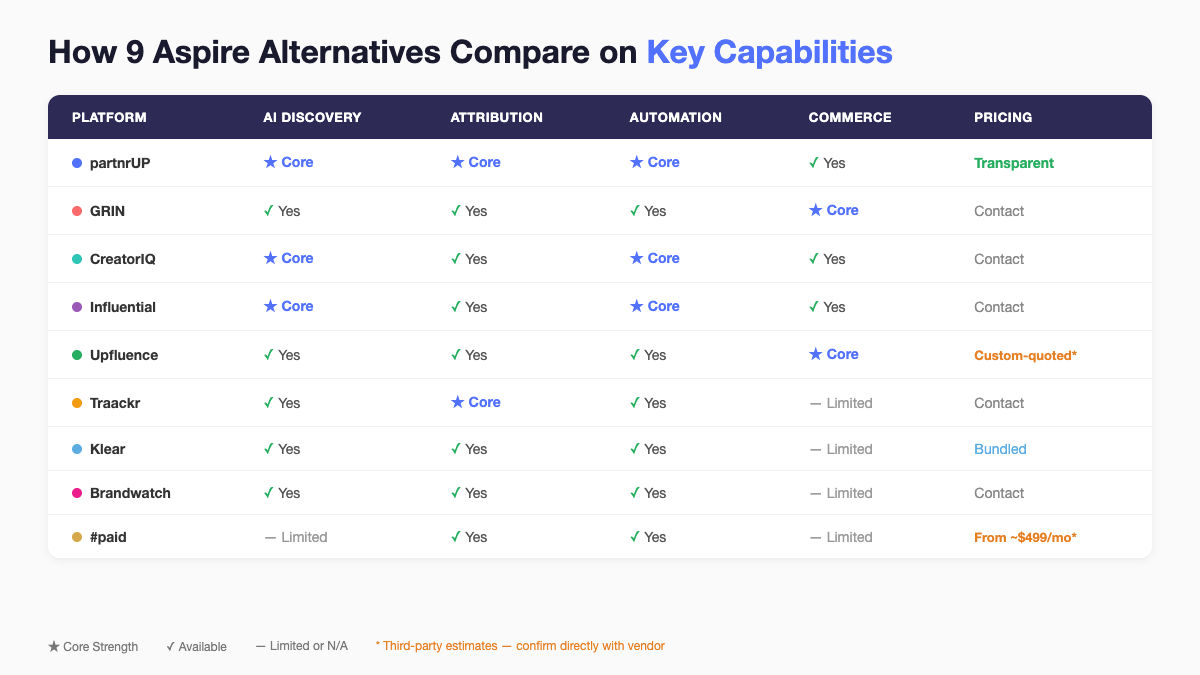
This comparison focuses on the five capabilities that matter most when replacing Aspire. Each platform is evaluated on whether the feature is a core strength, available, or limited/missing:
| Platform | AI Discovery | Attribution | Automation | Commerce | Pricing Transparency |
|---|---|---|---|---|---|
| partnrUP | Core strength | Core strength | Core strength | Available | Transparent |
| GRIN | Available | Available | Available | Core strength | Not published |
| CreatorIQ | Core strength | Available | Core strength | Available | Not published |
| Influential | Core strength | Available | Core strength | Available | Not published |
| Upfluence | Available | Available | Available | Core strength | Custom-quoted |
| Traackr | Available | Core strength | Available | Limited | Not published |
| Klear | Available | Available | Available | Limited | Bundled |
| Brandwatch | Available | Available | Available | Limited | Not published |
| #paid | Limited | Available | Available | Limited | Custom-quoted |
Key takeaway: If your primary reason for leaving Aspire is AI-powered discovery and attribution, partnrUP and CreatorIQ lead the field. If it’s ecommerce integration, GRIN and Upfluence are strongest. If it’s pricing transparency, partnrUP, Upfluence, and #paid are the only options that don’t require a sales call to learn what you’ll pay.
How to Choose the Right Platform for Your Brand
After evaluating all 9 alternatives, the right choice comes down to three questions:
What’s Your Primary Pain Point with Aspire?
Map your biggest frustration to the platform that solves it directly:
- Manual discovery taking too long? → partnrUP (AI matching) or CreatorIQ (Creator Graph)
- Can’t prove ROI? → partnrUP (full-funnel attribution) or Traackr (VIT benchmarking)
- Pricing too high or unpredictable? → partnrUP, Upfluence, or #paid (transparent pricing)
- Need deeper Shopify integration? → GRIN (native Shopify) or Upfluence (multi-platform ecommerce)
- Compliance and governance gaps? → CreatorIQ (SafeIQ, enterprise governance)
What’s Your Annual Influencer Budget?
Your budget determines your shortlist. Brands spending under $100K/year on influencer marketing should focus on platforms with transparent pricing and quick time-to-value. Brands spending $500K+ can justify enterprise platforms with longer implementation cycles but deeper capabilities.
How Many Creators Do You Manage?
Programs with fewer than 25 active creators can succeed with simpler tools. Programs managing 50-500+ creators need robust automation — workflow bottlenecks multiply fast without it. This is where platforms like partnrUP’s AI-powered scaling tools eliminate the need to hire additional headcount as your program grows.
Before committing to any platform, request a trial or demo that tests your specific use case — not a generic product walkthrough. Ask to run a real campaign or import your existing creator roster to evaluate how the platform handles your actual workflow.
Conclusion
Aspire remains a capable platform for ecommerce-first influencer programs, but brands outgrowing its discovery limitations, attribution gaps, or pricing structure have strong alternatives available at every budget tier.
For brands that want AI-powered creator matching, full-funnel ROI tracking, and pricing that doesn’t penalize growth, partnrUP directly addresses the most common reasons teams leave Aspire. Enterprise teams needing governance at scale should evaluate CreatorIQ. Ecommerce brands deeply invested in Shopify should look at GRIN. And brands on tight budgets can start with Upfluence or #paid for under $500/month.
The worst decision is staying on a platform that doesn’t fit because switching feels too complex. Most modern platforms offer migration support and can get your team running within weeks, not months.
Ready to see how AI-powered creator matching compares to your current workflow? Book a partnrUP demo and bring your hardest discovery challenge — we’ll show you how the matching engine handles it in real time.
Frequently Asked Questions
What is the biggest limitation of Aspire compared to its alternatives?
Aspire’s primary limitation is its reliance on manual, filter-based creator discovery rather than AI-powered matching. While its Shopify integration and product seeding tools are strong, brands scaling beyond small programs often find that the discovery workflow doesn’t surface enough high-quality, niche creators. Additionally, Aspire’s attribution capabilities are more basic than platforms like partnrUP or Traackr, which offer full-funnel tracking and competitive benchmarking.
How much do Aspire alternatives typically cost?
Costs vary significantly by tier. Budget-friendly options like Upfluence (third-party estimates around $478/month for entry-level access) and #paid ($499/month for Just Content tier, or $449/month annual) offer lower price points. Mid-market platforms like partnrUP offer transparent tiered pricing designed to scale with your program. Enterprise platforms like CreatorIQ and Influential require annual contracts — industry estimates place CreatorIQ starting around $36K/year, though you should always confirm current pricing directly with each vendor.
Can I migrate my existing creator relationships from Aspire to another platform?
Yes. Most modern influencer platforms support creator data import via CSV or API. You can typically export your creator roster, campaign history, and performance data from Aspire and import it into a new platform. Some alternatives, including partnrUP, offer migration support to ensure your historical data and active relationships transfer smoothly.
Which Aspire alternative is best for small teams with limited budgets?
For small teams under $1,000/month, partnrUP, Upfluence (Growth tier), and #paid are the strongest options. partnrUP’s AI matching is particularly valuable for small teams because it reduces the manual discovery effort that usually requires dedicated headcount — one person with AI tools can match the output of a three-person team using manual search. Upfluence is ideal if you need combined influencer + affiliate capabilities, while #paid works best for content-quality-focused brands.
Do any of these alternatives offer better Shopify integration than Aspire?
GRIN offers the deepest Shopify integration in the space, with native product seeding, affiliate link and tracking, and sales attribution directly within the platform. Upfluence also provides strong Shopify integration alongside WooCommerce, BigCommerce, and Magento support. If Shopify integration is your primary criterion, GRIN is the closest competitor to Aspire in this specific capability.
How long does it take to switch from Aspire to a new platform?
Most platform migrations take 4–6 weeks for mid-market teams and 8–12 weeks for enterprise programs with complex integrations. The timeline depends on data volume, integration complexity, and team training requirements. Cloud-based platforms with self-serve onboarding (like partnrUP and Upfluence) can get teams running active campaigns within days. Enterprise platforms like CreatorIQ typically require longer onboarding due to governance configuration and API integrations.
Is it worth switching platforms if Aspire is working “okay” for my team?
If your team is spending more than 10 hours per week on manual creator discovery, struggling to prove influencer marketing ROI to stakeholders, or losing creator opportunities because your platform can’t surface niche talent fast enough, then “okay” is costing you revenue. The opportunity cost of staying on a platform that limits your scaling capacity often exceeds the temporary disruption of switching. Calculate what you’d save in time and improved match quality before deciding — most brands find the ROI of switching is positive within the first quarter.