Influencer marketing used to be easier to define. A brand hired a creator, the creator made content, the content was published, and the campaign was measured.
That model is becoming less representative of how creator programs actually work.
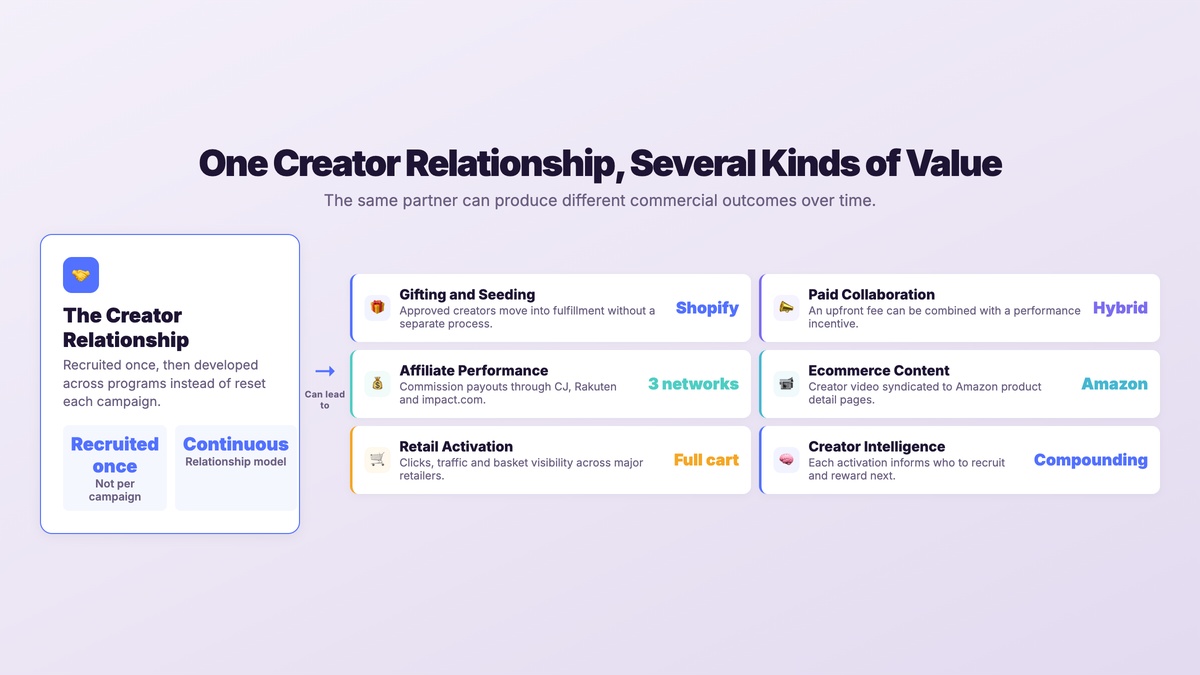
A creator may first encounter a brand through gifting. They may later participate in a paid campaign, join an affiliate program, produce content the brand reuses on ecommerce pages, and influence purchases that happen at a retailer rather than on the brand’s own site.
The relationship is continuous. The systems supporting it often are not.
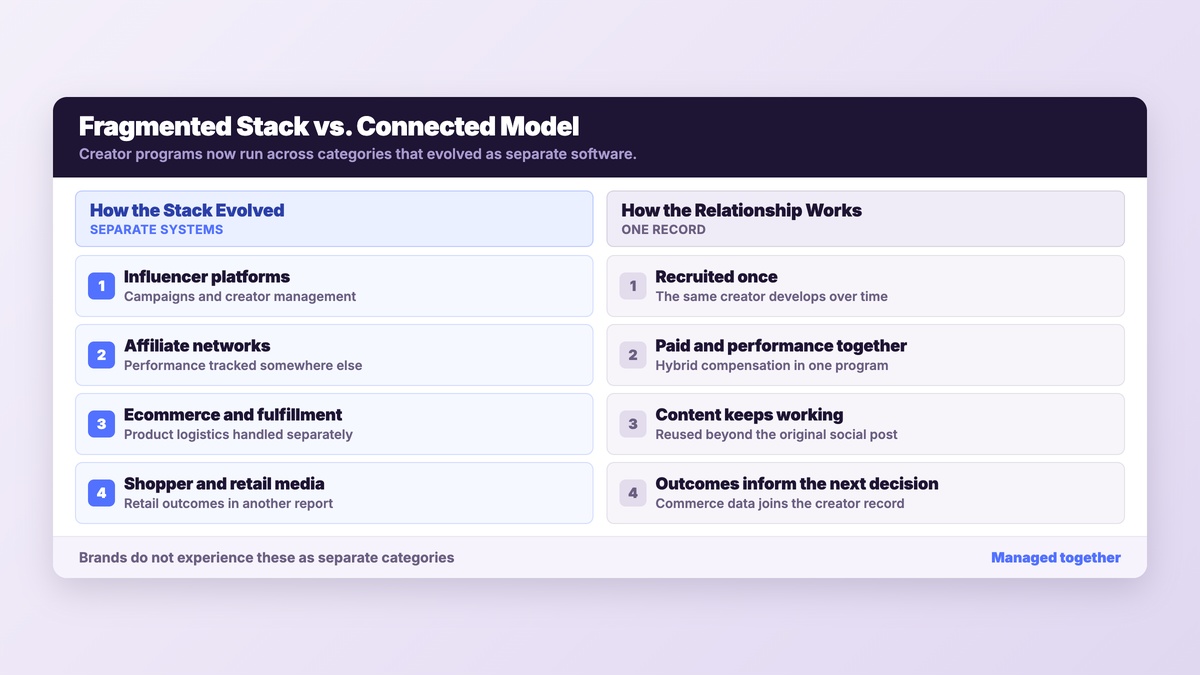
That fragmentation is becoming one of the central operating problems in creator marketing. Influencer platforms, affiliate networks, ecommerce systems, fulfillment tools and shopper marketing programs have generally evolved as separate categories. Brands are now trying to run creator programs across all of them.
The result is a growing mismatch between how creator relationships develop and how companies manage them.
partnrUP’s latest commerce expansion is built around that gap. The platform now connects creator programs with affiliate payouts through CJ, Rakuten and impact.com, Shopify product fulfillment, Amazon video syndication, and shopper marketing and retail sales tracking across retailers including Walmart, Target and Best Buy.
The more important story, however, is not the integrations themselves. It is what they suggest about where creator marketing is headed.
The creator relationship is becoming more valuable than the campaign
The traditional campaign model treats each activation as a discrete unit.
A creator is recruited for a brief, completes the work, gets paid and exits the workflow. If that same creator later becomes an affiliate or produces useful ecommerce content, the new activity is often managed somewhere else.
That structure makes sense when creator marketing is occasional. It becomes inefficient when brands are trying to build persistent communities.
The same creator may be useful for several different reasons over time. One person may be especially good at producing high-quality UGC. Another may drive unusually strong affiliate revenue. A third may generate content that performs well on Amazon product pages. Some will do all three.
The value is in understanding that history and deciding what to do next.
A creator relationship should become richer with every activation, not reset every time a new campaign begins.
Affiliate is increasingly part of the relationship, not a separate channel
The line between paid influencer marketing and affiliate marketing has already started to blur.
Brands are increasingly using hybrid compensation models that combine an upfront fee with a performance incentive. That makes sense because the two components reward different things.
The fixed payment compensates the creator for production, access to their audience and the work required to participate. The commission gives both sides an incentive to continue driving results after the initial deliverable is complete.
partnrUP’s integrations with CJ, Rakuten and impact.com are intended to make those models easier to operate within a broader creator program.
The more interesting implication is what happens after performance data starts accumulating.
A creator who repeatedly converts should not necessarily remain on the same economics as everyone else. Brands can use higher commissions, better opportunities or more frequent activations to retain creators who are producing meaningful commercial results.
That turns affiliate performance into a relationship-management signal.
For brands running large creator communities, this matters. The goal should not be to treat hundreds of creators identically. It should be to understand which relationships deserve more investment and why.
Product gifting only scales when fulfillment scales with it
Gifting and product seeding are often discussed as creator acquisition strategies, but the operational burden is easy to underestimate.
Sending a product to ten creators is simple. Sending product to hundreds of creators becomes a fulfillment operation.
Someone has to collect the correct information, approve the creator, coordinate the order, handle inventory and make sure the product is actually shipped.
That work is rarely the reason a marketing team decided to run a creator program, but it can become the constraint that determines how large the program can become.
Connecting Shopify fulfillment directly to creator workflows removes one of those handoffs.
The value is not simply that an order can be automated. It is that the brand can move a creator from approval to product receipt without creating a separate process outside the campaign.
That becomes increasingly important for micro-influencer programs, where scale is often part of the strategy. A brand may want to work with hundreds of smaller creators because their audiences are highly relevant, their content is useful, or their economics make a broader program possible.
The infrastructure has to support that ambition.
Creator content should not expire with the social post
One of the least efficient parts of influencer marketing is how much useful content is allowed to disappear after its initial distribution.
A creator may produce a strong product demonstration, tutorial or testimonial. The content performs on social for a period of time, then its value is treated as largely exhausted.
That is an unnecessarily narrow way to think about the asset.
For years, partnrUP’s micro-influencer agency business has helped enterprise brands including Pantene, Lenovo and Dole place creator video on Amazon product detail pages. In those programs, partnrUP has seen conversion-rate lifts of up to 20%.
That service is now being brought into the platform.
The strategic point is not simply that brands can syndicate video to Amazon. It is that creator content can continue working much farther down the purchase journey.
A strong creator asset may have value because of the creator’s audience, but it may also have value because it helps a shopper understand the product, see it used in context or feel more confident about buying it.
That distinction changes how brands should think about content production.
The question is no longer only, “How did the post perform?”
It becomes, “Where else can this asset create value?”
Retail measurement matters because consumers do not shop in a straight line
Creator marketing measurement often becomes distorted by where the transaction happens.
For a direct-to-consumer brand, the path from content to purchase may be relatively visible.
For a widely distributed consumer brand, it is much more complicated.
A shopper may see creator content on social, click through to a retailer, browse several products and complete the purchase on Walmart, Target, Best Buy or another retail site.
If measurement stops at social engagement or a DTC checkout, that behavior is missed.
partnrUP’s shopper marketing and retail sales tracking capabilities are designed to give brands more visibility into that journey.
Clicks and traffic to retailer destinations provide a measure of intent. Full-cart visibility adds another layer by showing what shoppers ultimately buy after engaging with creator content.
That is useful for several reasons.
The promoted product may convert. A related product may convert instead. The shopper may build a larger basket than expected. Different creators may generate very different patterns of traffic and purchase behavior.
Those signals can help brands evaluate creator programs with more sophistication than reach, engagement or last-click DTC attribution alone.
For companies with significant retail distribution, that is a much more realistic representation of how creator influence works.
Creator commerce changes how brands should evaluate creators
Once commerce data becomes part of the creator record, the criteria for identifying a valuable partner begin to change.
Follower count and engagement remain useful. So do audience fit, content quality and brand safety.
But they are no longer the whole picture.
A creator with modest reach may repeatedly drive purchase intent. Another may produce unusually strong ecommerce content. Someone else may become a high-performing affiliate despite average social engagement.
Those are commercially meaningful differences.
Over time, brands should be able to use those signals to make better decisions about who to recruit again, who deserves a higher commission, who should receive additional products and whose content should be reused elsewhere.
That is where creator intelligence becomes more valuable.
The system is not simply recording what happened. It is helping the brand understand what kind of value each creator tends to produce.
The next phase of creator marketing is less fragmented
The creator economy has developed through a series of adjacent categories: influencer marketing, UGC, affiliate, social commerce, retail media and shopper marketing.
Brands do not experience those categories as neatly as the software industry does.
A consumer may move across several of them in a single purchase journey. A creator may participate across several of them during a single brand relationship.
The operating model needs to catch up.
Creator commerce is one way to describe that shift. It is not a new label for affiliate marketing, and it is not simply influencer marketing with better attribution.
It is a more connected model in which creator relationships, content and commercial outcomes are managed together.
A creator can be recruited once and develop into several different kinds of partner. Content can be produced once and continue working across several environments. Performance data can inform the next decision instead of living in a separate report.
That is a more durable model for brands that want to move beyond one-off campaigns.
From campaigns to portfolios of creator relationships
The most useful way to think about a mature creator program may be as a portfolio.
Some creators will be valuable because they reach a specific audience. Some will produce exceptional content. Some will sell. Some will be especially effective at retail. Some will become long-term advocates for the brand.
A portfolio approach does not require every creator to perform the same function.
It requires the brand to understand the role each relationship is playing and to invest accordingly.
That is what the new commerce capabilities in partnrUP are intended to support.
Affiliate integrations make it easier to reward creators based on performance. Shopify fulfillment supports larger gifting and seeding programs. Amazon syndication extends the life of creator content. Retail tracking provides visibility into what happens when creator influence moves into the shopping environment.
Taken together, those capabilities point toward a more connected way of operating creator marketing.
The campaign is still important. It is just no longer the natural boundary of the relationship.
About partnrUP.ai
partnrUP.ai is an influencer marketing and creator commerce platform that helps brands recruit, activate, manage and measure creators at scale.
The platform combines creator discovery and recruitment, campaign management, creator communication, content workflows, affiliate capabilities, product fulfillment, ecommerce content syndication and retail activation to help brands operate larger, more continuous creator programs.