87.49% of marketers expect their influencer marketing budget to increase in 2026, and 72.22% plan increases of 50% or more (Influencer Marketing Hub 2026 Benchmark Report, 600+ respondents). At the same time, 66.3% run their programs entirely in-house. That combination is the whole story: dramatically more money flowing through influencer programs, managed by the same small teams using the same manual workflows they built when the channel was a pilot. Something has to give — and what is giving is the workflow itself.
This guide is part of our The State of Influencer Marketing in 2026: Trends, Data & Industry Insights — a comprehensive pillar covering every major shift shaping the creator economy this year.
AI agents are not simply making the old process faster. They are dissolving entire steps of it. The spreadsheet of prospect creators, the outreach mail-merge, the follow-up reminder calendar, the deliverable tracker, the end-of-campaign reporting scramble — these are not being optimized. They are being replaced by systems that execute the work continuously without a human queuing each step. This guide maps exactly which workflows disappear, which get rebuilt around human judgment, and the order in which to migrate.
In this guide, you’ll learn:
- Why traditional influencer marketing workflows break down at exactly the moment budgets expand
- A replaced / rebuilt / retained framework for auditing your own process
- The five specific workflows AI agents are eliminating, with 2026 adoption data for each
- Which parts of influencer marketing agents are demonstrably not replacing
- A migration sequence that avoids the most common failure mode of agentic adoption
Table of Contents
- Why Traditional Workflows Break at Scale
- Replaced, Rebuilt, Retained: The Audit Framework
- The Five Workflows Being Replaced
- What AI Agents Are Not Replacing
- The Migration Sequence
- Conclusion
- Frequently Asked Questions
Why Traditional Workflows Break at Scale
The traditional influencer workflow was designed for a channel that ran a handful of campaigns a year. It assumed a marketer could personally review every creator, write every email, and reconcile every deliverable. That assumption held when the program was small. It does not hold at a 50% budget increase.
The Linear Bottleneck Problem
Manual influencer workflows are strictly sequential. Discovery must finish before outreach starts. Outreach must resolve before briefing begins. Briefing must complete before content review. Each stage is gated by a human being available to advance it. Doubling the budget does not double throughput — it doubles the queue in front of the same bottleneck.
This is why teams that scale spend without changing their operating model tend to get variance rather than growth. As the 2026 benchmark report puts it, if you don’t rebuild the system as you’re scaling, bigger budgets typically just buy more variability.
The Payback Window Has Compressed
65.9% of marketers now expect payback within one month, and 48.4% expect it within two weeks. A workflow where creator sourcing alone consumes two weeks cannot serve a two-week payback expectation. The operational timeline and the financial timeline are in direct conflict, and manual process is the variable that has to move.
Small Teams, Expanding Mandates
With two-thirds of programs run entirely in-house, the constraint is rarely strategic capability — it is hours. The people who should be negotiating long-term creator relationships and shaping creative direction are instead reconciling promo codes in a spreadsheet. Our guide on scaling creator programs without adding headcount covers the economics of this tradeoff in detail.
Replaced, Rebuilt, Retained: The Audit Framework
Before adopting agents, categorize every step of your current process into one of three buckets. This prevents the two opposite failure modes: automating work that requires judgment, and manually protecting work that never needed a human.
Replaced
Tasks that are high-volume, rule-evaluable, and low-consequence per instance. Sourcing candidate creators, sending first-touch outreach, chasing a missed posting deadline, pulling post-level performance data. Errors here are cheap and correctable, and the volume is precisely what makes them intolerable for a human. These workflows do not get a faster version — they get deleted and rebuilt as continuous agent processes.
Rebuilt
Tasks that are judgment-dependent but preparation-heavy. Creator selection, brief writing, content feedback. An agent does the preparation — assembling audience data, drafting the brief structure, flagging content that misses stated requirements — and a human makes the actual call. The workflow survives, but the human enters it much later and with far better inputs.
Retained
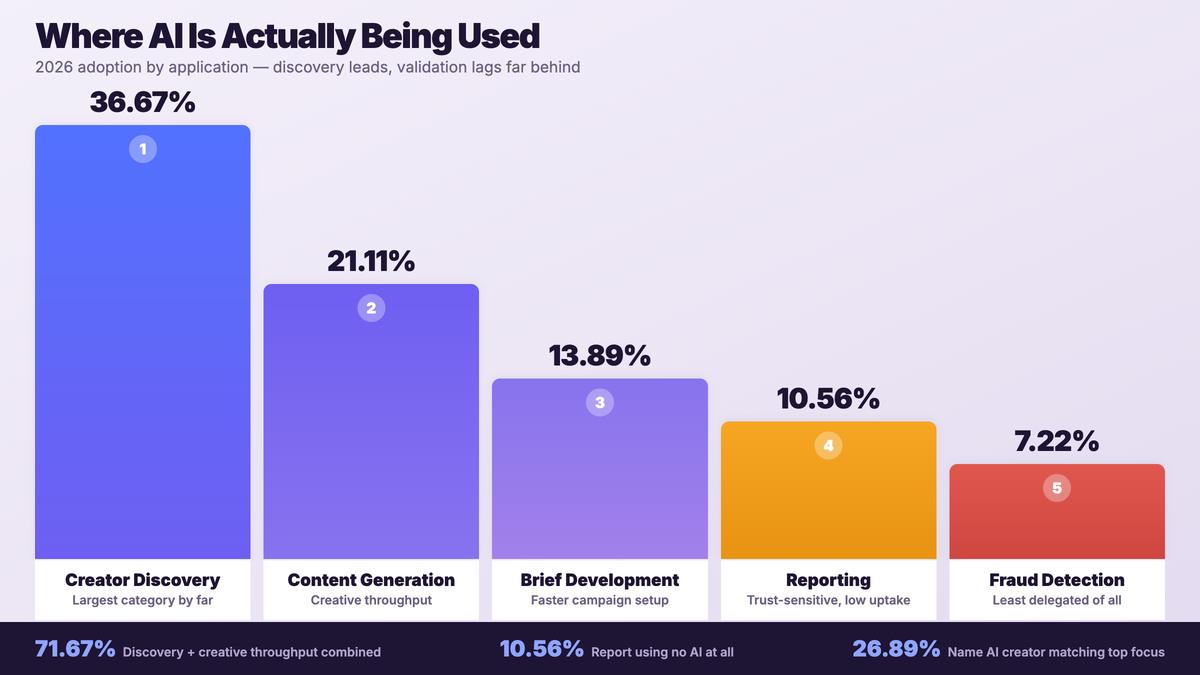
Tasks where the judgment is the deliverable. Brand positioning, creative strategy, relationship negotiation, crisis response. These stay fully human. Notably, the 2026 data supports this instinct: adoption drops sharply in areas where trust and accuracy are the product, with AI reporting at 10.56% and fraud detection at 7.22% of applications.
The Five Workflows Being Replaced
Adoption is not evenly distributed. AI is landing hardest where scaling pressure is most acute, and the benchmark data shows a clear ordering.
1. Creator Discovery and Sourcing
Creator discovery leads AI adoption at 36.67% of applications — the single largest category, and it is not close. It is also the top stated focus area for the year, with AI-driven creator matching cited by 26.89% of respondents.
The replaced workflow is the static prospect list. Traditional discovery means querying a database of pre-indexed profiles, exporting to a spreadsheet, and manually filtering. Agentic discovery sources candidates directly from live social activity against your campaign parameters and keeps running — surfacing creators who became relevant after your search would have ended. We break down the mechanics in AI creator matching vs. manual influencer discovery.
2. Vetting and Audience Quality Checks
Vetting is the clearest example of a rebuilt rather than replaced workflow. Agents can evaluate follower authenticity signals, growth curves, engagement depth, and brand-safety flags across hundreds of candidates in the time a human evaluates five. But the alignment judgment — whether this creator’s voice actually fits your brand — remains human. The agent’s job is to ensure the human only ever looks at qualified candidates. Our complete guide to vetting creators details the criteria worth encoding.
3. Outreach, Recruitment, and Follow-Up
This is the workflow most completely replaced. Traditional outreach is a mail-merge plus a reminder calendar, and its failure mode is silent: the third follow-up never gets sent because nobody had time. Agents run outreach as a continuous process — personalized to each creator, timed appropriately, and persistent through the full sequence without a human remembering to act.
Platforms built around this model report meaningful gains. partnrUP reports 40% higher creator response rates from automated, personalized outreach, and 70% less time spent on internal coordination and admin through workflow automation.
4. Briefing and Content Throughput
AI’s second role is creative throughput. Content generation is cited by 21.11% of respondents and brief development by 13.89%. Combined with discovery, these front-half applications account for 71.67% of all selections — confirming that AI currently functions as a productivity layer across the first half of the workflow, not a replacement for strategy.
The replaced task is the blank-page brief and the manual first-pass content check. An agent can assemble a structured brief from campaign parameters and check submitted content against stated requirements before a human reviews it. What it should not do is dictate creative execution — see how to write a creative brief for creator campaigns for where that line sits.
5. Coordination, Tracking, and Payment
Campaign coordination is pure operational overhead: who accepted, what is pending, which deadline slipped, who gets paid what. None of it requires judgment, and all of it consumes disproportionate time. Agents handle status tracking, automated creator reminders, and payment release on deliverable completion. partnrUP reports 100% creator payment accuracy and compliance through automated handling.
Measurement is the exception within this group. Reporting adoption sits at just 10.56%, and that caution is warranted — attribution requires methodological decisions an agent should not make unsupervised. Agents should assemble the data; humans should define what it means. Our influencer ROI attribution guide covers building that framework.
What AI Agents Are Not Replacing
The most expensive adoption mistakes come from over-delegation. Four areas should stay firmly human.
Brand Judgment and Creative Direction
An agent can tell you a creator’s audience matches your target demographic. It cannot tell you whether that creator’s sensibility is right for a brand repositioning. The benchmark data reflects this — teams are using AI to increase creative variations and shorten production cycles, not to hand over strategic decisions.
Relationship Depth
Automated outreach is effective at initiating contact at volume. It is not a substitute for the relationship work that converts a one-off collaborator into a long-term partner, which is where most of the compounding value in creator programs actually lives.
Validation-Heavy Tasks
With fraud detection at 7.22% adoption, the market has clearly not delegated verification to agents — and shouldn’t yet. Anything where a false positive damages a creator relationship or a false negative wastes budget needs human sign-off.
Measurement Interpretation
Agents assemble metrics. Deciding which metrics constitute success, what attribution window is defensible, and how upper-funnel impact gets valued are strategic choices. It is worth noting that 10.56% of respondents report using no AI at all in influencer marketing, which points to genuinely uneven market maturity rather than a settled consensus.
The Migration Sequence
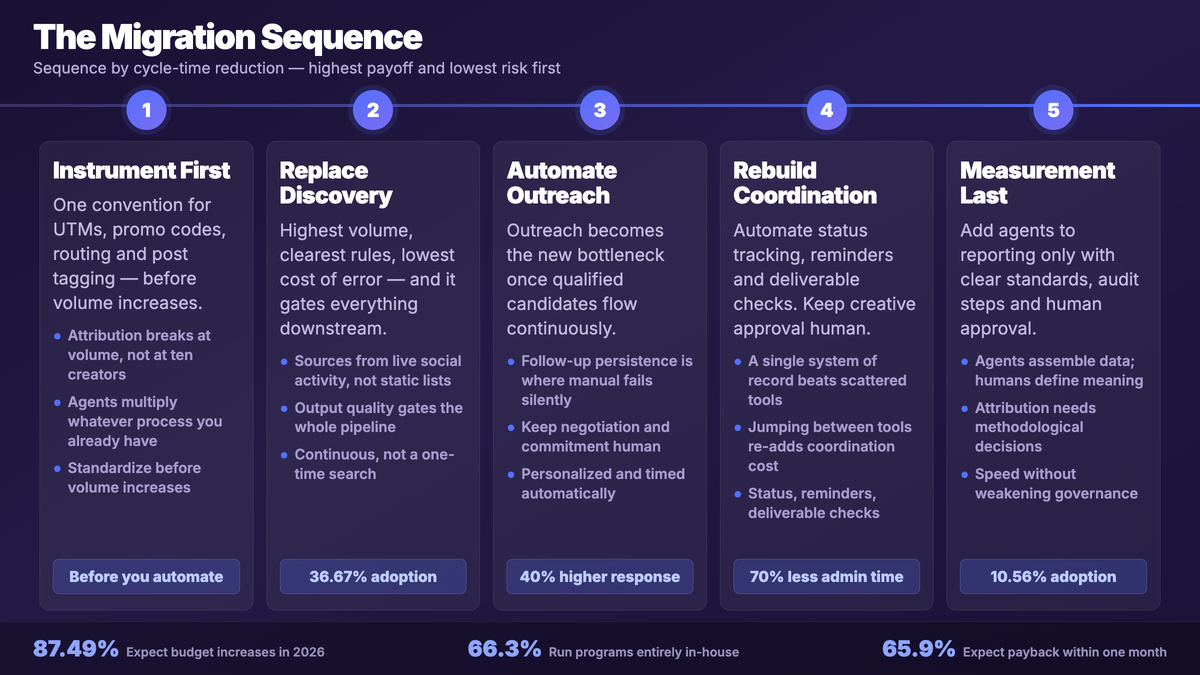
The dominant failure mode is attempting to replace the entire workflow simultaneously. Sequence the migration by cycle-time reduction, starting where the payoff is clearest and the risk is lowest.
Step 1: Instrument Before You Automate
Establish one convention for UTMs, promo codes, landing page routing, and post tagging before volume increases. The benchmark report flags a real risk here: the group planning 50%+ budget increases slightly under-indexes on measurement-tool adoption relative to its share of planned growth. Automating on top of broken instrumentation scales the noise.
Step 2: Replace Discovery First
Discovery has the highest adoption for good reason — the largest volume, the clearest rules, and the lowest cost of error. It is also the stage whose output quality determines everything downstream. Start here.
Step 3: Automate Outreach and Follow-Up
Once qualified candidates flow continuously, outreach becomes the new bottleneck. This is the highest-leverage second move because follow-up persistence is where manual processes fail most invisibly.
Step 4: Rebuild Briefing and Coordination
With sourcing and recruitment running continuously, coordination load rises sharply. Automate status tracking, reminders, and deliverable checks. Keep creative approval human. A single system of record matters more than any individual automation here — jumping between tools reintroduces the coordination cost you just removed, which is the core argument for consolidating on a unified influencer marketing platform.
Step 5: Add Measurement Automation Last
Introduce agents into reporting only with clear standards, audit steps, and human approval, so automation increases speed without weakening governance or trust. If you want to see how this sequencing works against a live program, book a demo and walk through it with your own campaign structure.
Conclusion
The traditional influencer marketing workflow is not being upgraded — it is being decomposed. High-volume, rule-evaluable tasks like sourcing, outreach, follow-up, and coordination are being handed to agents that run continuously. Judgment-dependent work is being rebuilt so humans enter later with better inputs. And genuinely strategic work — positioning, creative direction, relationship building, measurement interpretation — stays exactly where it was.
The 2026 data makes the direction unambiguous: 71.67% of AI applications sit in discovery and creative throughput, while validation-heavy work remains human. Teams that match that pattern get the throughput gains without the governance risk. Teams that either automate everything or automate nothing tend to get the worst of both.
If your budget is growing faster than your headcount, the workflow is the constraint worth attacking first. See how agentic workflows handle sourcing, recruitment, coordination, and payment inside a single system on the partnrUP platform, or book a demo to map your current process against the replaced / rebuilt / retained framework. For broader context on how these shifts fit the wider market, our guide to AI agents transforming influencer marketing operations covers the operational picture in depth.
Frequently Asked Questions
What is the difference between an AI agent and standard marketing automation?
Standard automation executes fixed if-then rules — send email B three days after email A. An AI agent reasons about context and handles multi-step processes without a human queuing each step: evaluating whether a creator fits your parameters, deciding whether a follow-up is warranted, and adapting as new information arrives. The practical difference is that automation requires you to anticipate every branch, while an agent handles branches you did not specify.
Which influencer marketing workflow should I automate first?
Creator discovery, which leads AI adoption at 36.67% of applications. It has the highest task volume, the clearest evaluation criteria, and the lowest cost per error. It also determines the quality of everything downstream, so improving it improves the whole pipeline. Automate measurement and fraud detection last.
Will AI agents replace influencer marketing managers?
The 2026 adoption data suggests otherwise. AI concentrates in discovery, content generation, and brief development — 71.67% of applications combined — while reporting and fraud detection sit at 10.56% and 7.22%. The pattern is agents absorbing operational load so managers can spend time on strategy, creative direction, and creator relationships. The role shifts from executing tasks to setting parameters and making judgment calls.
How much time do AI agents actually save on influencer campaigns?
Results vary by program maturity and how much of the workflow is delegated. As a published example, partnrUP reports 70% less time spent on internal coordination and admin through workflow automation, and 40% higher creator response rates from automated, personalized outreach. Evaluate any platform’s claims against your own baseline before committing.
Is it safe to let an AI agent handle creator outreach?
Outreach is one of the safest workflows to delegate because errors are low-consequence and correctable. The important controls are approval over messaging templates, a defined follow-up cadence so persistence does not become spam, and human review before contracts are issued. Automate initiation and follow-up; keep negotiation and commitment human.
What should I have in place before adopting AI agents?
Consistent measurement instrumentation. Standardize UTM conventions, promo codes, landing page routing, and post tagging before increasing volume. Agents multiply whatever process you already have — if attribution is inconsistent at ten creators, it will be unusable at a hundred. The benchmark data shows the most aggressive budget scalers slightly under-index on measurement tooling, which is exactly the gap to close first.
Do AI agents work for small in-house influencer teams?
They are arguably most valuable there. With 66.3% of programs run entirely in-house and many teams under five people, the constraint is hours rather than strategic capability. Agents remove the coordination and sourcing load that consumes the majority of a small team’s week, which is why teams of three can run programs that previously required a full department or an agency retainer.