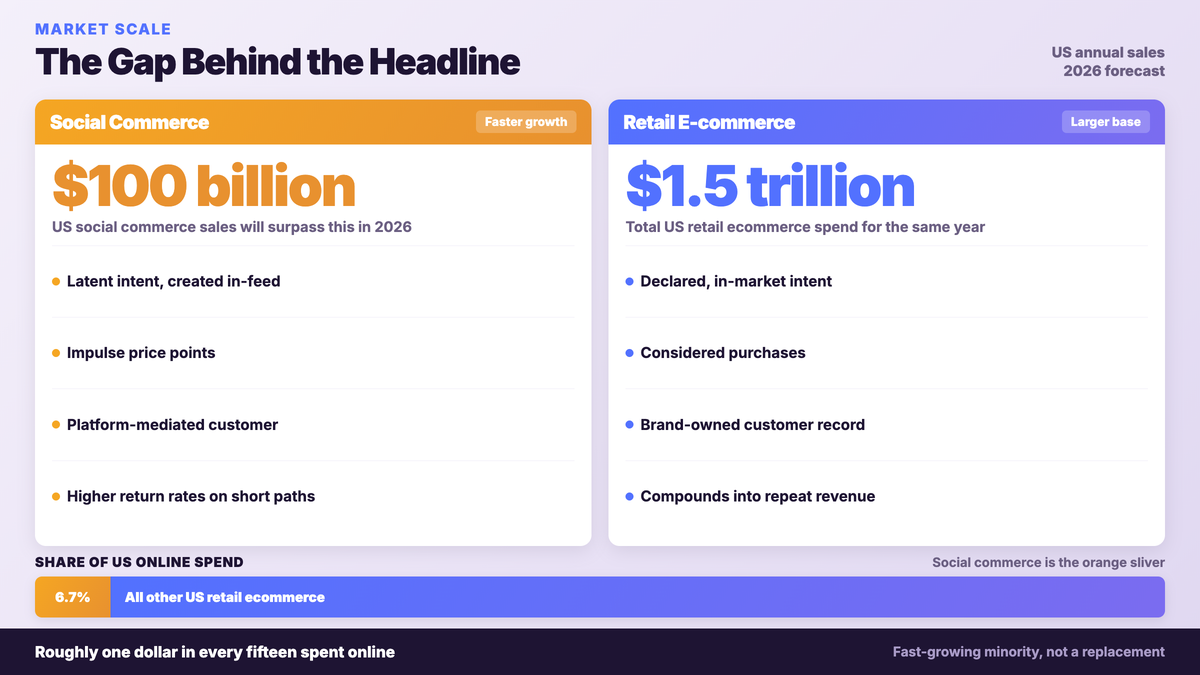
US social commerce sales will surpass $100 billion in 2026 — a milestone that sounds enormous until you set it beside the $1.5 trillion Americans will spend on retail ecommerce overall. Social commerce is growing far faster, but it is still roughly one dollar in every fifteen spent online. That gap is the single most misunderstood fact in ecommerce strategy right now, and it explains why the “social is replacing your website” pitch keeps failing brands that believe it.
The real question is not which channel wins. It is which parts of your catalog, margin structure, and customer journey belong in each — and how you connect them so a discovery on TikTok and a purchase on your own site are recognized as the same customer.
This guide is part of our Creator Commerce: How Brands Win in the New Social Shopping Era — the pillar resource on building revenue through creator-led shopping experiences.
What you’ll learn
- How social commerce and traditional ecommerce actually differ across discovery, conversion, data ownership, and margin
- Why the two channels have fundamentally different unit economics — and how to model them honestly
- What Meta’s 2025 removal of native checkout means for your channel strategy
- A category-by-category framework for deciding which products belong where
- How attribution breaks between channels, and what to do about it
- The operating model that treats both as one system instead of competing budgets
Table of Contents
- Defining the Two Models
- Head-to-Head: Seven Dimensions That Matter
- The Unit Economics Nobody Models Correctly
- The Checkout Shift That Changed the Math
- Which Products Belong Where
- The Attribution Problem Between Channels
- Building One Operating Model, Not Two
- Frequently Asked Questions
Defining the Two Models
Before comparing them, it is worth being precise, because “social commerce” gets used to describe at least three different things and the distinction changes every downstream decision.
Traditional ecommerce
A brand-owned destination — your Shopify store, your Amazon storefront, your custom platform. The defining characteristic is not the technology. It is that you own the environment, the customer data, and the merchandising logic. Traffic arrives from somewhere else (search, email, ads, referral), and your job is to convert it against a catalog you fully control.
Native social commerce
Transactions that complete inside the social platform. TikTok Shop is the clearest current example in the US: product discovery, cart, and checkout all happen without the user leaving the app. The platform owns the customer relationship and takes a cut of every sale.
Social-referred commerce
The category most brands are actually running, often without labeling it. Discovery and persuasion happen on social — a creator video, a tagged post, a live session — but the transaction completes on the brand’s own site. As of September 2025, this is what Instagram and Facebook Shops are: Meta retired native in-app checkout and moved Shops to website checkout, sending shoppers to the retailer’s own site to complete purchases.
That third category matters enormously. If you treat Instagram as “social commerce” while it functions as a referral channel, you will measure it against the wrong benchmarks and likely underfund it.
Head-to-Head: Seven Dimensions That Matter
1. Intent at the moment of exposure
Traditional ecommerce almost always catches declared intent. Someone searched, clicked an ad for a category they were considering, or returned to a site they already know. The buyer arrived because they were already in-market.
Social commerce catches latent intent. Nobody opens TikTok to buy a countertop ice maker. They encounter one, and the content manufactures the desire in about eleven seconds. This is the genuine structural advantage of social: it expands the market rather than competing for its existing demand.
The strategic consequence is that these two channels are not substitutes. Social creates demand that search later captures — which is exactly why brands that cut social spend often watch branded search volume decline a quarter later and blame the wrong variable.
2. Product discovery mechanics
On your own site, discovery is navigational: categories, filters, search, recommendation modules. The shopper directs it. Your merchandising team optimizes it.
On social, discovery is algorithmic and creator-mediated. You do not choose which product gets shown to whom. A creator picks something from your catalog, the algorithm decides who sees it, and your bestseller can be a product your own merchandising team deprioritized. Brands consistently report that social surfaces unexpected winners — a real benefit, but only if your inventory and ops can respond to demand you did not forecast.
3. Conversion path length
Native social commerce compresses discovery-to-purchase into a single session. Traditional ecommerce typically involves multiple sessions across several days, especially above roughly $75 in cart value.
Shorter paths mean higher impulse conversion — and also higher return rates. Purchases made in under a minute involve less deliberation, less spec-checking, and more post-purchase regret. Any model comparing the two channels on gross conversion rate without adjusting for returns is comparing the wrong number.
4. Customer data ownership
This is the most consequential difference and the least discussed in the strategy meeting.
On your own store, you get the email, the full order history, the browsing behavior, and the ability to build lifetime value through retention marketing you control. On native social commerce, the platform mediates the relationship. You may receive limited order data for fulfillment, but you generally do not get the durable, marketable customer record that underpins repeat purchase economics.
For a brand whose model depends on repeat purchase — consumables, subscriptions, replenishables — a native social sale is worth materially less than an identical-revenue sale on your own site, because it may not create a retainable customer. That is not an argument against social. It is an argument for pricing the difference into your channel targets.
5. Margin structure
Traditional ecommerce carries platform fees, payment processing, and customer acquisition cost. Native social commerce carries platform commission, creator commission, payment processing, and typically promotional discounting expected by the format.
The creator commission is the line most often underestimated. In affiliate-driven social selling, creator commissions stack on top of platform fees rather than replacing acquisition cost — and they recur on every sale rather than amortizing across a customer’s lifetime the way a one-time CAC does.
6. Content requirements
Traditional ecommerce needs a finite, reusable asset set: clean product photography, a spec sheet, lifestyle images, reviews. Produce it once, refresh it seasonally.
Social commerce needs continuous, varied, native-feeling content — and it decays fast. What performed last month stops performing, not because the product changed but because the format fatigued. This is a fundamentally different production model, and it is the reason brands scale creator partnerships rather than trying to produce it in-house. Our guide to building a creator commerce strategy from scratch covers how to structure that supply.
7. Failure modes
When traditional ecommerce underperforms, the causes are diagnosable and fixable: traffic quality, page speed, checkout friction, pricing, assortment. You control every variable.
When social commerce underperforms, the cause is frequently outside your control: an algorithm change, a creator whose audience shifted, a format the platform stopped favoring. Concentration risk is the defining hazard of social commerce — a brand doing most of its volume through one platform’s algorithm has built its revenue on rented land.
The Unit Economics Nobody Models Correctly
Most channel comparisons stop at revenue and conversion rate. That comparison is close to meaningless, because the two channels have different cost stacks and different customer values.
The four adjustments that change the answer
- Adjust for returns, not gross sales. Impulse-driven, short-deliberation purchases return at higher rates than considered ones. Compare net revenue after returns, or you will systematically overstate social.
- Adjust for retained customer value. If a channel does not give you a marketable customer record, its sales cannot compound into repeat revenue. Value a native social sale at its first-order margin unless you can prove otherwise.
- Adjust for content amortization. Social content has a short half-life; product photography does not. Content cost per dollar of revenue is structurally higher and ongoing in social.
- Adjust for demand creation credit. Cutting against the above: social generates branded search and direct traffic that last-click attribution assigns to other channels. Ignoring this understates social as badly as the first three overstate it.
Run all four and most brands land in the same place: social commerce is an excellent demand-creation and trial channel with thinner per-order economics, and owned ecommerce is a superior retention and margin channel with weaker top-of-funnel reach. They are complements with different jobs, and a budget process that pits them against each other is asking the wrong question.
Where the math genuinely favors social
- New product launches with no existing search volume to capture
- Visually demonstrable products where seeing use drives the purchase
- Impulse price points, roughly under $50, where deliberation is minimal
- Categories with young, mobile-native buyers
- Brands with no established organic search authority
Where the math genuinely favors owned ecommerce
- Considered purchases where buyers compare specifications
- High-AOV products where margin absorbs acquisition cost
- Subscription and replenishment models built on customer records
- Catalogs deep enough that navigation and filtering beat algorithmic surfacing
- Categories with strong existing search demand
The Checkout Shift That Changed the Math
A structural change deserves specific attention because many channel strategies still assume the old world.
As of September 2025, Shops on Facebook and Instagram use website checkout. Meta confirmed the change in its own business documentation: brands whose shops previously used checkout on Facebook or Instagram had their checkout method changed to their website. Tapping a product tag now sends the shopper to the retailer’s own site.
The implications are direct:
- Meta is now a demand-generation channel, not a transaction channel. Evaluate it on qualified traffic and assisted conversions, not on in-app GMV.
- Your product detail pages carry the conversion load again. Traffic arriving from a creator video lands on your site — page speed, mobile UX, and message-match between the content and the landing page now determine whether that demand converts.
- You keep the customer data. The purchase happens on your infrastructure, so a Meta-sourced sale creates a retainable customer in a way a native TikTok Shop sale may not.
- Native and referred social are no longer interchangeable. TikTok Shop and Instagram now sit in different strategic categories despite both being “social commerce,” and modeling them as one line item hides which is actually working.
The broader lesson is that platform commerce features are not stable infrastructure. Instagram removed its dedicated Shop tab in 2023 and wound down native checkout by 2025. A channel strategy that depends on a specific platform feature persisting is fragile by construction — which is the strongest available argument for keeping owned ecommerce as the destination and treating social as the engine that feeds it.
Which Products Belong Where
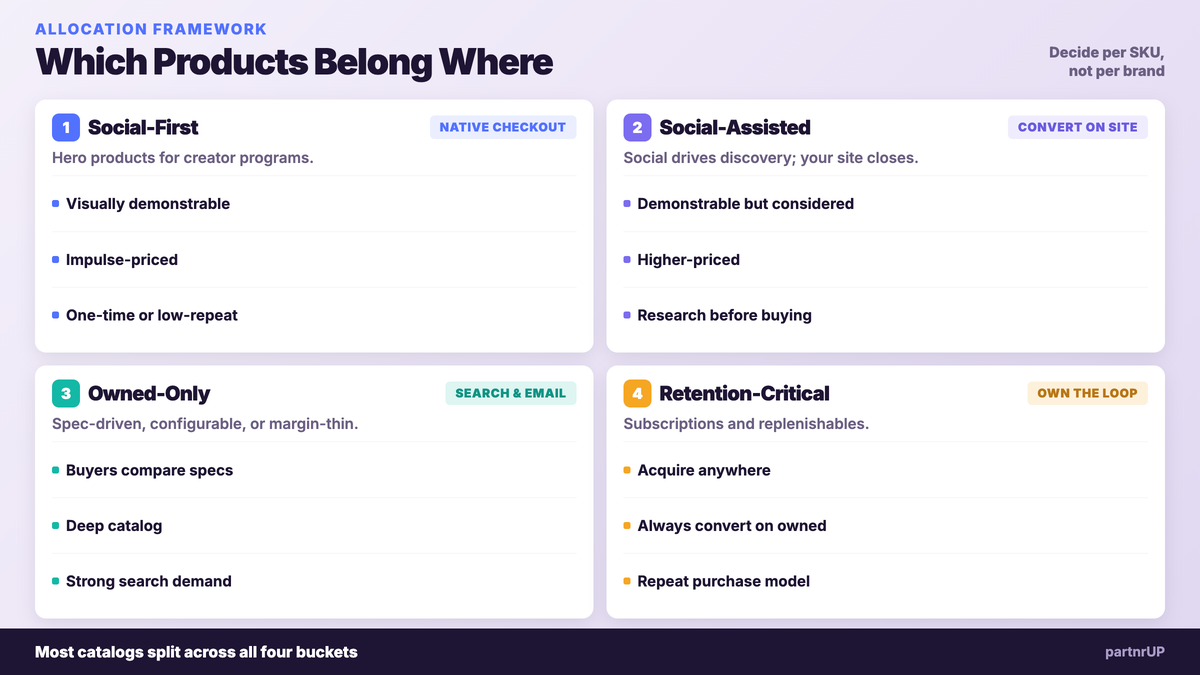
The productive version of this decision is per-SKU, not per-brand. Four questions resolve most of it.
Question 1: Can someone understand the value in under fifteen seconds of video?
If a creator can demonstrate the benefit visually and quickly, social commerce works. If the value requires reading specifications, comparing configurations, or understanding compatibility, it does not — that shopper needs a product page.
Question 2: Does the price point survive an impulse decision?
Under roughly $50, impulse purchasing is normal and the short path is an advantage. Above roughly $150, buyers research regardless of where they discovered the product — so social’s job becomes generating the search, not closing the sale.
Question 3: Does your margin absorb stacked commissions?
Platform commission plus creator commission plus processing plus expected promotional discounting is a meaningful stack. Products at thin margin cannot carry it. Products at healthy margin can, and should — the customer acquisition value is real.
Question 4: Do you need the customer back?
One-time purchases lose little from a platform-mediated relationship. Replenishables and subscriptions lose a great deal, because the entire model depends on owning the retention loop.
The resulting portfolio
- Social-first SKUs: visually demonstrable, impulse-priced, healthy margin, one-time or low-repeat. Hero products for creator programs.
- Social-assisted SKUs: demonstrable but considered or higher-priced. Social drives discovery; conversion happens on your site.
- Owned-only SKUs: spec-driven, configurable, or margin-thin. Search, email, and retargeting.
- Retention-critical SKUs: subscriptions and replenishables. Acquire anywhere, but always convert on owned infrastructure.
Most brands find their catalog splits across all four. That is the correct outcome — the failure is applying one channel strategy uniformly across products with completely different buying dynamics. Our breakdown of creator commerce metrics worth tracking covers how to measure each of these segments differently.
The Attribution Problem Between Channels
Everything above assumes you can tell what is working. In practice, the boundary between social and owned ecommerce is exactly where measurement breaks.
Why last-click systematically misreads this
A shopper sees a creator video Tuesday, searches your brand Thursday, buys Saturday from an email. Last-click credits email. Search gets partial credit in some models. The creator video that created the demand gets nothing — so the channel that generated the customer looks like the channel that performed worst.
This is not a minor distortion. It is the reason creator budgets get cut in exactly the quarters they are working, and the reason brands over-invest in retargeting that harvests demand other channels created.
What actually works
- Creator-specific codes and links — imperfect, since not every influenced buyer uses them, but they establish a directional floor.
- Post-purchase surveys — asking “where did you first hear about us” at checkout captures influence that click-tracking cannot see.
- Branded search as a social KPI — a reliable leading indicator that social is creating demand, and one of the few metrics visible across the channel boundary.
- Geo or time-based holdouts — pausing creator activity in a matched market and measuring total revenue difference is the closest thing to a clean read.
- Unified creator and commerce data — connecting creator activity to downstream site behavior in one system rather than reconciling exports.
That last point is where most teams stall: creator performance lives in one tool, site analytics in another, and nobody owns the join. The partnrUP platform connects creator matching and campaign activity to full-funnel attribution, so the demand a creator generates stays traceable through to the purchase — regardless of which channel closes it.
Building One Operating Model, Not Two
The brands doing this well stopped running social commerce and ecommerce as separate programs with separate targets.
1. One revenue target, channel-agnostic
Separate targets create internal competition and incentivize both teams to claim the same sale. A shared target forces the honest question: what is the most efficient path to this customer, wherever they buy?
2. Shared merchandising intelligence
Social surfaces demand signals your site cannot — a product taking off on TikTok should trigger homepage placement, inventory reallocation, and search budget. That feedback loop is fast, valuable, and usually missing entirely.
3. Content that flows in both directions
Creator content that performs socially belongs on product pages, in email, and in paid ads. Brands consistently find creator content outperforms studio content on their own product pages — it is more credible and shows real use. Getting usage rights up front makes this possible; not negotiating them wastes the asset.
4. A creator supply chain, not one-off campaigns
Continuous content demand cannot be met by quarterly campaigns. It requires an always-on roster, systematic matching, and enough volume that no single creator’s performance dictates the quarter. This is an operational capability, not a media buy — and it is the piece brands most often underestimate.
5. Honest channel-level P&Ls
Fully loaded costs including creator commissions, content production, platform fees, and returns. Most brands discover social commerce is less profitable per order than assumed and more valuable for acquisition than assumed. Both corrections matter, and neither is visible without the real numbers.
If your team is under five people, building this from scratch is not realistic — the matching, briefing, tracking, and attribution work is what platforms exist to absorb. Book a demo to see how partnrUP handles creator matching and cross-channel attribution in one system.
Frequently Asked Questions
Is social commerce replacing traditional ecommerce?
No. US social commerce sales will surpass $100 billion in 2026, while total US retail ecommerce sits in the $1.5 trillion range — social is a fast-growing minority of online spend, not a replacement. The trend is convergence: social increasingly drives discovery while owned sites handle conversion and retention, especially after Meta moved Shops to website checkout in September 2025.
Should I sell on TikTok Shop or drive traffic to my own site?
It depends on the SKU. Impulse-priced, visually demonstrable, healthy-margin products with low repeat rates perform well in native social checkout. Considered purchases, high-AOV items, and anything subscription-based should convert on your own site so you retain the customer record. Most brands run both across different parts of the catalog.
Why did Instagram remove native checkout?
Meta confirmed that as of September 2025, Shops on Facebook and Instagram use website checkout, changing shops that previously used in-app checkout over to the retailer’s website. Practically, it means Instagram now functions as a demand-generation channel rather than a transaction channel — and brands keep the customer data because the purchase completes on their own infrastructure.
How do I compare ROI between social commerce and my website?
Do not compare gross conversion rates. Adjust for returns, retained customer value, ongoing content cost, and the demand social creates that last-click assigns elsewhere. Comparing net revenue per order alongside the acquisition value of new customers gives a far more accurate picture than channel-level ROAS.
Does social commerce work for B2B or high-consideration products?
Rarely as a transaction channel — but often as a discovery channel. High-consideration buyers research before purchasing regardless of where they first encountered the product. For these categories, judge social on qualified traffic and branded search lift rather than direct sales.
What is the biggest risk of building on social commerce?
Concentration. Platform features change without notice — Instagram removed its Shop tab in 2023 and wound down native checkout by 2025. A brand doing most of its volume through one platform’s algorithm and feature set has no control over its own revenue. Diversifying across platforms while maintaining an owned destination is the standard mitigation.
How much content do I need for social commerce to work?
Substantially more than for traditional ecommerce, and continuously. Social content fatigues in weeks while product photography lasts seasons. This is why brands build creator rosters rather than producing in-house — the volume and variety required exceed what most internal teams can sustain.
The Real Decision
The framing of “social commerce versus traditional ecommerce” is itself the problem. They are not competing for the same job. Social creates demand that did not previously exist; owned ecommerce converts demand efficiently and retains the customer. A brand strong in one and absent in the other has a structural gap.
The practical work is unglamorous: decide per-SKU which channel fits, model the unit economics honestly including returns and retained value, and build attribution that survives the channel boundary so you can tell what is actually working. Brands that do this stop having the annual budget argument, because the data answers it.
If you are building the creator side of that system, see how partnrUP approaches creator matching and full-funnel attribution, or book a demo to talk through your specific channel mix. For the broader strategic context, start with our creator commerce pillar guide or our deep dive on shoppable video best practices.