A New Chapter for partnrUP and the Future of Video Commerce
We recently acquired Novel, a shoppable video app built for Shopify, to accelerate a vision we have been building toward for years: a commerce ecosystem where creator content does not stop at discovery but continues to work where purchase decisions are actually made.
Brands invest millions in creator and UGC video, yet most of that content lives fleetingly across social platforms and paid ads. Once a campaign ends, the content disappears, even if it performed exceptionally well. By bringing Novel into partnrUP, we are changing that dynamic. High-impact creator video can now live on as an evergreen, automated part of the shopping experience, directly embedded into brand storefronts.
This acquisition represents a major step forward in closing the loop between influencer marketing and ecommerce. partnrUP has focused on helping brands discover creators, manage relationships, and activate content at scale. Novel extends that capability into on-site conversion, enabling brands to serve the right video to the right shopper at the moment it matters most.
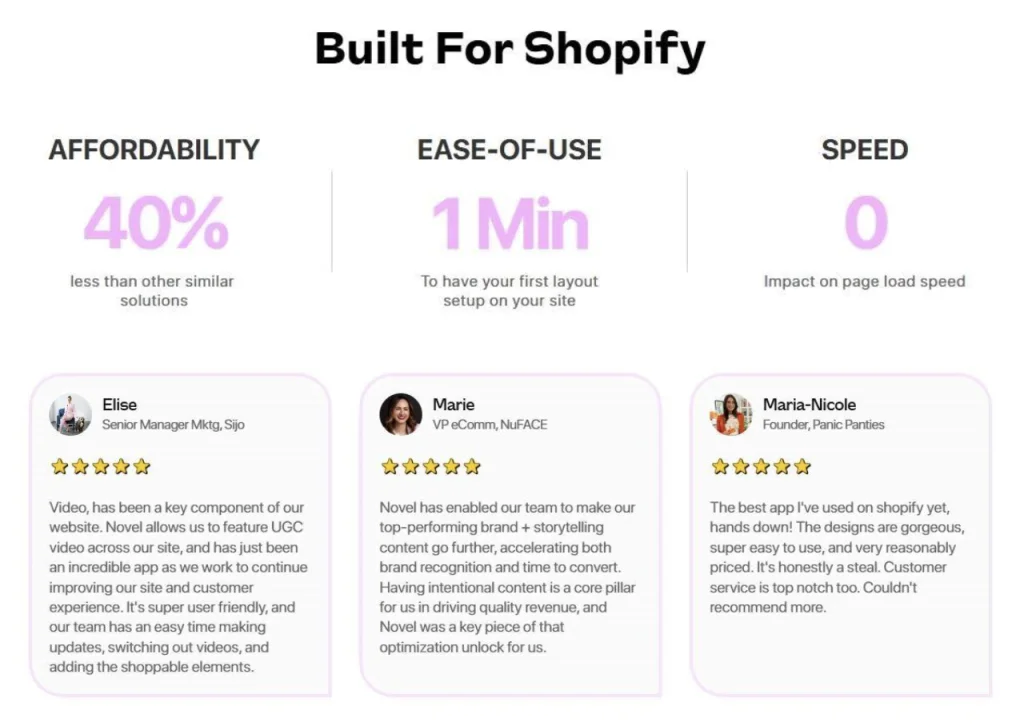
The impact is already measurable. Novel-powered videos influenced $41 million in brand revenue during BFCM, reinforcing what we believe to be true: when authentic video lives inside the buying journey, it builds confidence, reduces friction, and drives real business outcomes.
Together, partnrUP and Novel are building toward a future where video is not a one-off campaign asset, but an intelligent system that compounds value over time. The sections below unpack why shoppable video works, why automation is essential to scaling it, and how this shift is reshaping modern commerce.
TL;DR — Key Takeaways for Brands, Agencies, and Creator Economy Advisors
- Shoppable video has become one of the most effective conversion drivers in ecommerce because it builds trust, demonstrates value, and reduces purchase hesitation at the exact moment of decision.
- UGC and influencer video consistently outperform static imagery on product pages, especially in high-consideration categories.
- Most brands already have enough video content – the challenge is distributing, personalizing, and optimizing it at scale.
- Manual workflows prevent teams from unlocking the full value of on-site video and create gaps between creator marketing and ecommerce performance.
- By combining Novel’s shoppable video technology with partnrUP’s AI-powered influencer marketing platform, brands can automate how video content is managed, deployed, and measured across Shopify stores and off-site channels.
- Real-world results show meaningful conversion lift and millions in attributed revenue when video is embedded directly into the shopping experience.
- The future of commerce is video-first, automated, and performance-driven.
Ecommerce Doesn’t Have a Traffic Problem – It Has a Confidence Problem
For more than a decade, ecommerce growth strategies centered on traffic acquisition. Brands invested heavily in paid media, influencers, and audience expansion, assuming that more visitors would naturally lead to more sales.
Today, that assumption no longer holds.
Most ecommerce brands already generate sufficient traffic to their sites. The challenge is converting that traffic once it arrives. Shoppers land on product pages with hesitation, unanswered questions, and skepticism shaped by years of overpromising marketing.
They want reassurance. They want proof. They want to see products in real life, used by real people, in real situations.
Static images and product descriptions struggle to deliver that confidence. Video – especially authentic, creator-led video – succeeds where traditional ecommerce content (an AI generated content) falls short.
The issue is not whether video works. The issue is whether brands can deploy it in a way that actually scales.
Why Shoppable Video Works When Everything Else Stalls
Shoppable video succeeds because it mirrors how consumers already discover and evaluate products.
Modern shoppers don’t start their journey with search results or category pages. They start on social platforms like TikTok, Instagram and YouTube. They scroll. They watch. They listen to creators explain why something works, how it fits into their lives, and whether it’s worth the money.
Video answers questions faster than text and builds emotional connection faster than photography. It shows scale, texture, movement, and context. It demonstrates outcomes instead of describing them.
When that same format appears inside a Shopify store – not as an interruption, but as part of the browsing experience – it becomes a powerful conversion mechanism.
Shoppable video compresses the funnel. It moves shoppers from curiosity to confidence without forcing them to leave the site, search for reviews, or hunt for validation elsewhere.
But this only works when video is thoughtfully integrated into the store experience.

The Execution Gap Holding Brands Back
Despite overwhelming evidence that video improves performance, most ecommerce sites still rely primarily on static images.
That’s not because teams don’t believe in video — it’s because execution is difficult.
Brands face several compounding challenges:
- Creator and UGC video lives across ad accounts, social platforms, and internal drives
- Ecommerce teams lack easy tools to embed and manage video at scale
- Performance teams cannot attribute on-site results to specific videos
- Updating or testing video placements requires manual effort or developer resources
- Content selection is often subjective rather than data-driven
As a result, video is treated as an experiment instead of an always-on system. Brands test it briefly, see mixed results, and move on — not because it failed, but because it was never operationalized properly.
From Content Asset to Commerce System
The promise of shoppable video isn’t simply higher engagement. It’s the transformation of video into a repeatable, measurable conversion engine.
That requires a fundamental shift in how brands think about creator content.
Instead of asking, “Which videos should we put on the site?” brands need to ask, “How should video dynamically support the buying journey for each product?”
This shift turns video into infrastructure — not decoration.
By acquiring Novel, a shoppable video app purpose-built for Shopify, partnrUP brings this infrastructure directly into the influencer marketing ecosystem.
The result is a unified system where creators, content, storefronts, and revenue are connected end to end.

What Shoppable Video Actually Looks Like on High-Performing Stores
On high-converting Shopify stores, video does not replace product imagery — it complements it.
Common implementations include:
- Short-form video tiles embedded near the top of product pages
- UGC “stories” layouts that mirror familiar social interfaces
- Video carousels showcasing testimonials, demos, or use cases
- Shoppable overlays that allow users to add products to cart directly from the video
- Contextual video placements on collections and landing pages
The most effective setups are subtle. They feel native to the site rather than bolted on. Shoppers can watch when they want, ignore when they don’t, and interact without friction.
This balance is critical. Poorly implemented video can slow pages, distract users, or feel overly promotional. Well-implemented video enhances confidence without pressure.

Distribution Is More Important Than Creation
One of the biggest misconceptions in ecommerce is that brands need to create more video.
In reality, most brands already have a surplus of high-quality video content — especially from influencer campaigns and UGC ads.
The real problem is distribution.
Top-performing videos often remain locked inside paid media platforms, even after they’ve proven their ability to influence purchase decisions. When campaigns end, the content disappears from the conversion journey.
Shoppable video changes that dynamic.
Videos can be repurposed across:
- Product detail pages
- Bundles and collections
- Seasonal landing pages
- Email and SMS campaigns
- QR codes in retail or packaging
- Custom links shared by creators or affiliates
This extends the lifespan of creator content and increases return on investment without increasing production costs.
Why Automation Is Non-Negotiable
Manual video management does not scale.
As brands expand their catalogs and creator programs, the number of possible video-to-product combinations grows exponentially. Without automation, teams are forced to make subjective decisions and stick with them longer than they should.
Automation enables:
- Dynamic matching between videos and SKUs
- Continuous testing of different video placements
- Performance-driven prioritization of high-converting content
- Automatic deprecation of underperforming assets
- Faster iteration without additional headcount
Instead of asking teams to guess what works, automation allows data to decide.
This is where partnrUP’s AI-powered foundation becomes essential. Creator discovery, content ingestion, distribution, and measurement are no longer disconnected steps — they become part of a single intelligent workflow.
Real Revenue Impact: From Test to Proof
The impact of shoppable video is not theoretical.
During a major retail weekend, brands using Novel-powered video experiences generated over $10 million in attributed revenue across their websites. This demonstrates what happens when video is deployed at moments of high intent rather than confined to awareness campaigns.
But the impact is just as meaningful in everyday shopping scenarios.
In categories like parenting, wellness, beauty, and apparel — where trust is paramount — video acts as social proof at scale.
For brands like Dreamland Baby, embedding real parent testimonials and product demos directly on-site helped shoppers overcome hesitation and move confidently toward purchase. Conversion rate lift was not incremental — it was meaningful and repeatable.
Testing comparing pages with and without video consistently shows stronger performance when video is present, particularly when implemented in familiar “stories-style” layouts.
Authenticity Always Beats Polish
One of the most consistent learnings from video commerce is that authenticity outperforms perfection.
Highly produced brand videos can be effective for storytelling, but when it comes to conversion, real people win.
UGC succeeds because it feels honest. It reflects real homes, real routines, and real expectations. It addresses objections brands may not even realize exist.
When shoppers see someone like them using a product — and speaking candidly about it — trust accelerates.
This is why influencer and UGC video perform so well on-site. They replace skepticism with relatability.
Customization Without Sacrificing Brand Control
A major concern for brands adopting shoppable video is brand consistency.
Video experiences must adapt to each storefront’s visual identity and UX standards. Fonts, colors, layouts, and calls to action need to align seamlessly with existing design systems.
Customization ensures:
- Video feels native rather than third-party
- Page performance remains fast
- UX patterns remain consistent
- Brand equity is preserved rather than diluted
This flexibility allows video to enhance the brand experience instead of competing with it.
From One-Time Tests to Always-On Optimization
The evolution of video commerce mirrors the evolution of paid media.
Early adopters experimented. Winners automated.
With the right infrastructure, shoppable video becomes an always-on optimization layer. Brands can test variations continuously, learn from performance data, and deploy improvements without constant manual intervention.
This turns the storefront into a living system rather than a static destination.
Over time, the store improves itself.
Measuring What Matters: Revenue, Not Vanity Metrics
Traditional influencer marketing often relies on engagement metrics that don’t reflect business outcomes.
Shoppable video brings performance measurement back to fundamentals:
- Conversion rate
- Average order value
- Revenue attribution
- Incremental lift versus control experiences
By tying content directly to sales, brands can finally evaluate creators and content based on what matters most.
This accountability changes how budgets are allocated and how creator relationships are prioritized.
Closing the Loop on Creator Commerce
The long-term opportunity here is not better product pages — it’s system-level transformation.
When creator discovery, content activation, storefront experience, and revenue attribution are unified, brands gain clarity.
Marketing becomes measurable. Ecommerce becomes dynamic. Creators become revenue partners.
This is the future partnrUP is building toward.
The Next Era of Ecommerce Is Video-First and AI-Assisted
Static commerce experiences are no longer sufficient in a market shaped by social discovery and creator trust.
The next generation of winners will be brands that:
- Treat video as infrastructure, not garnish
- Automate distribution instead of managing manually
- Optimize continuously instead of guessing
- Connect creator content directly to revenue
Shoppable video is not a trend. It is the natural evolution of how people shop.
Automation is the only way to scale it.
And the brands that act now will define the standard others must follow.