Maximizing ROI from Pet Influencer Marketing: Full-Funnel Measurement, Attribution Strategy, and Execution Best Practices
The pet industry’s explosive growth in creator marketing presents a significant challenge: While approximately 63% of pet owners follow at least one pet influencer, most pet brands still struggle to answer the fundamental question—what’s the actual return on investment?
While competitors focus on vanity metrics like follower counts and engagement rates, leading pet brands are building sophisticated influencer marketing ROI frameworks that connect creator partnerships directly to revenue, customer lifetime value, and sustainable business growth. This comprehensive guide reveals how forward-thinking pet brands measure, optimize, and scale influencer campaigns that deliver measurable returns across the entire customer funnel.
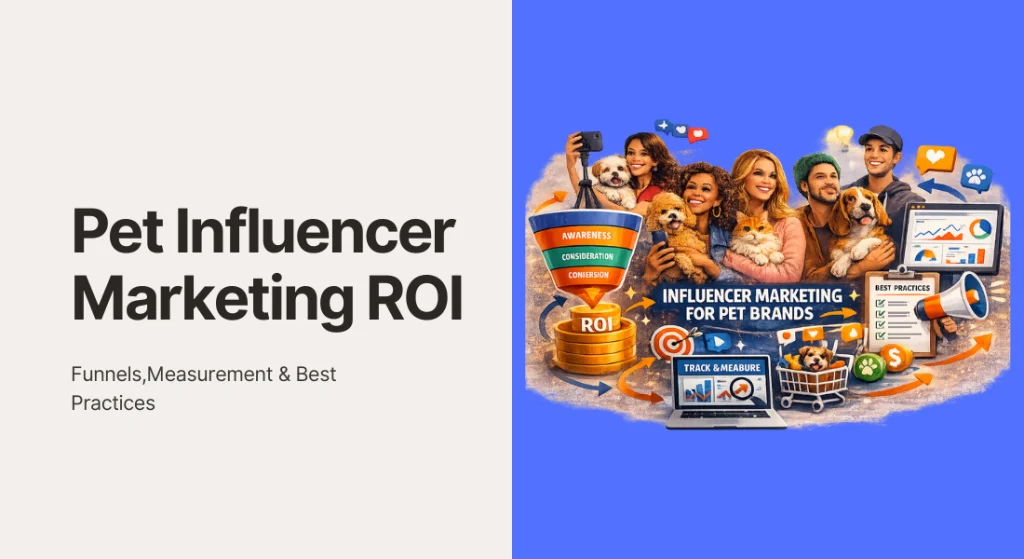
Understanding the Pet Influencer Marketing Funnel
Unlike traditional advertising channels with straightforward attribution, influencer marketing operates across multiple touchpoints, platforms, and conversion paths. Pet brands need a comprehensive funnel framework to measure impact accurately.
The Full-Funnel Framework for Pet Brands
Awareness Stage (Top of Funnel) – Potential customers discover your pet brand through creator content. Success metrics include reach, impressions, video views, branded search lift, social media follower growth, and website traffic from creator referrals.
Consideration Stage (Middle of Funnel) – Creator content educates and builds trust. Key indicators include engagement rates, content interaction depth, landing page visits, product page views, email signups, and retargeting audience building.
Conversion Stage (Bottom of Funnel) – Creator influence drives purchase decisions. Critical metrics include click-through rates, add-to-cart rates, conversion rates by creator, revenue per post, customer acquisition cost (CAC), and return on ad spend (ROAS).
Retention and Advocacy Stage (Post-Purchase) – Long-term value comes from repeat customers. Track customer lifetime value (LTV), repeat purchase rates, customer-generated content creation, referral participation, and Net Promoter Score by channel.
Understanding this complete framework allows pet brands to measure influencer marketing’s total impact rather than isolated engagement metrics.
Setting Up Measurement Infrastructure for Pet Influencer Campaigns
Accurate ROI measurement requires proper tracking infrastructure before launching creator partnerships.
Essential Tracking Mechanisms
Unique Creator Links and UTM Parameters – Every creator should receive custom tracking links with proper UTM parameters for campaign source, medium, name, and creator identifier. This granular tracking allows attribution to specific creators, platforms, and content pieces.
Creator-Specific Discount Codes – Unique promo codes serve dual purposes—incentivizing purchases while providing direct attribution. Use creator names in codes (e.g., FLUFFY15, PETMOM20) to enhance memorability.
Affiliate Tracking Platforms – For pet brands serious about influencer ROI, dedicated affiliate programs provide sophisticated attribution with last-click and multi-touch attribution models, cookie-based tracking, commission automation, and comprehensive reporting by creator.
First-Party Data and CRM Integration – Connect influencer campaigns to your customer data platform to measure which creators drive highest lifetime value customers, purchase behavior patterns, repeat purchase rates, and customer segment composition.
Implementing Full-Funnel Measurement Systems
Pet brands need integrated measurement across the entire customer journey. Full funnel management services provide multi-touch attribution modeling, cross-platform tracking consolidation, incremental revenue measurement, and attribution reporting dashboards. From first click to final sale, comprehensive tracking reveals which creators, content formats, and platforms drive the most valuable customers.
Calculating True ROI: Beyond Basic Metrics
Most pet brands make critical mistakes when calculating influencer marketing ROI. Here’s how to measure accurately.
The Complete ROI Formula for Pet Influencer Marketing
Total Revenue Generated:
- Direct sales from tracked links and codes
- Attributed sales from multi-touch attribution
- Incremental brand search and organic traffic revenue
- Repeat purchase value from acquired customers (first 12 months)
Total Investment Costs:
- Creator compensation (fees, commissions, product gifting)
- Platform and technology costs (influencer marketing platforms, analytics tools)
- Product fulfillment and shipping for influencer gifting campaigns
- Internal team time coordination
- Agency or managed service fees
Example: Pet Treat Brand Campaign ROI
Campaign Investment:
- 50 micro-influencers @ $300/post = $15,000
- Platform subscription = $500/month
- Product gifting (50 boxes @ $50) = $2,500
- Internal coordination (20 hours @ $50/hr) = $1,000
- Total Investment = $19,000
Campaign Revenue:
- Direct tracked sales = $45,000
- Attributed organic search increase = $8,000
- First repeat purchase value = $6,500
- Total Revenue = $59,500
ROI = ($59,500 – $19,000) / $19,000 × 100 = 213% ROI
Key Performance Indicators by Campaign Objective
Awareness Campaigns: Cost per thousand impressions (CPM), cost per video view, earned media value, brand lift studies, share of voice.
Engagement Campaigns: Cost per engagement, engagement rate relative to baseline, content save and share rates, landing page conversion rate, email capture cost.
Direct Response Campaigns: Customer acquisition cost, return on ad spend, revenue per creator, conversion rate by traffic source, average order value by channel.
Content Generation Campaigns: Cost per high-quality asset, content reusability, performance of repurposed content in paid ads, reduction in content production costs.
Advanced Attribution Models for Pet Influencer Marketing
Linear last-click attribution dramatically undervalues influencer marketing’s true impact. Pet brands need sophisticated attribution models.
Multi-Touch Attribution Approaches
Time-Decay Attribution – Gives more credit to touchpoints closer to conversion while balancing awareness contribution.
Position-Based Attribution (U-Shaped) – Allocates 40% credit to first and last touchpoints with remaining 20% distributed among middle interactions. Recognizes both awareness creation and conversion drivers.
Data-Driven Attribution – Uses machine learning to assign credit based on actual conversion probability impact. Most accurate but requires significant data volume.
For most pet brands, position-based or time-decay models provide practical compromise between accuracy and implementation complexity. Full-funnel measurement tools track customer journeys across social media platforms, paid advertising, organic search, direct traffic, email, and retargeting—revealing how creator content influences purchases days or weeks after initial exposure.
Optimizing Campaign Performance: Data-Driven Execution Best Practices
Measurement means nothing without action. Here’s how leading pet brands optimize based on performance data.
Creator Performance Segmentation
High-ROI Creators (Top 20%) – Increase collaboration frequency, offer exclusive product launches, build into long-term ambassador programs, negotiate preferential rates, and request testimonials.
Medium-ROI Creators (Middle 60%) – Test different content formats, provide clearer creative briefs, experiment with varied compensation structures, and monitor trends.
Low-ROI Creators (Bottom 20%) – Analyze underperformance, test alternative approaches if potential exists, or phase out consistent underperformers.
Content Format Testing and Optimization
High-performing formats for pet brands include product unboxing videos, before-and-after transformations, educational tutorials, day-in-the-life vlogs, comparison videos, and long-form YouTube reviews. Track performance by format using content performance analytics to identify what resonates.
Platform-Specific Optimization
Instagram – Leverage Stories for authenticity, use Reels for high engagement, deploy feed posts for evergreen content, and utilize Shopping tags for direct product linking.
TikTok – Focus on entertaining, trend-aligned content, prioritize native authentic creative, leverage trending sounds, and test video lengths.
YouTube – Invest in longer product reviews, partner with creators for dedicated spotlights, create tutorial series, and optimize titles for search discovery.
Scaling Pet Influencer Campaigns Profitably
Once you’ve proven ROI, scaling efficiently while maintaining performance is the next challenge.
Building a Scalable Operational Framework
AI-powered influencer platforms automate time-consuming tasks including creator discovery and matching, automated recruitment and outreach, campaign management tracking, content review workflows, and automated payment processing.
According to partnrUP customer data, brands using AI automation reduce campaign coordination time by 70% while achieving 40% higher creator response rates.
Budget Allocation Framework
70-20-10 Budget Strategy:
- 70% – Proven Winners: Invest majority in creators, formats, and channels with demonstrated ROI
- 20% – Scaling Experiments: Test new creators, platforms, and content approaches
- 10% – Innovation: Reserve budget for experimental campaigns and emerging opportunities
Maximizing Content Value: Repurposing Creator Assets
One of influencer marketing’s highest-ROI opportunities is content repurposing.
Strategic Content Syndication
E-Commerce Product Pages – Integrate creator content to provide social proof, demonstrate usage, increase conversion rates by 15-30%, and reduce return rates. Retail page syndication tools automate pushing creator content to product pages across Shopify, Amazon, Chewy, and other platforms.
Paid Advertising Creative – Repurpose top-performing organic creator content in Meta ads (30-50% better performance than brand-created), TikTok Spark Ads, YouTube TrueView ads, and Google Display campaigns.
Email Marketing Campaigns – Incorporate creator content into welcome series, product launches, abandoned cart recovery, and post-purchase education.
Building a Customer-Generated Content Engine
Customer user-generated content platforms turn satisfied customers into authentic advocates through post-purchase incentives, branded hashtag campaigns, photo/video contests, and loyalty program benefits for content creation.
Overcoming Common ROI Measurement Challenges
Long Purchase Consideration Cycles – Implement time-decay or position-based attribution models. Track branded search lift as indicator of consideration-stage influence.
Multi-Device Cross-Platform Behavior – Deploy customer identity resolution tools. Use first-party data matching and survey customers about discovery sources.
Organic Reach Beyond Tracked Links – Establish baseline metrics pre-campaign. Measure incremental lift in branded search volume, direct traffic, and organic social growth.
Budget Constraints for Measurement – Start with basic tracking (UTM parameters, promo codes). Use Google Analytics’ free multi-channel funnel reports. Prioritize measurement of highest-investment campaigns first.
Building Long-Term ROI Through Ambassador Programs
Strategic ambassador programs build compounding returns over time through authentic brand advocacy, content consistency, improved efficiency, audience trust building, cost efficiency, and product development insights.
Structuring Successful Ambassador Programs
Tiered Ambassador Levels:
- Platinum: Highest compensation, exclusive benefits, co-creation opportunities
- Gold: Monthly collaborations, preferential rates, early product access
- Silver: Quarterly partnerships, standard rates, first campaign access
Ambassador Benefits: Exclusive product launches, input on product development, featured placement on brand channels, invitations to brand events, professional development support, and higher commission rates.
Technology Stack for ROI-Driven Pet Influencer Marketing
partnrUP’s comprehensive platform provides AI-powered creator discovery, automated recruitment with 40% higher response rates, centralized campaign management, content review workflows, performance analytics dashboards, and automated payment processing.
Platform vs. Managed Services Decision
Choose Self-Service Platform when you have internal influencer marketing experience, sufficient execution resources, desire full control, and budget optimized toward creator fees. Explore partnrUP’s platform pricing.
Choose Managed Services when you lack internal expertise, have limited team bandwidth, desire strategic guidance, or prefer hands-off approach. Learn about partnrUP’s managed services.
Implementation Roadmap: 90-Day Launch Plan
Phase 1: Foundation (Days 1-30) – Define objectives and metrics, establish budget, set up tracking infrastructure, choose platform approach, create creator criteria, use AI discovery tools, and develop campaign briefs.
Phase 2: Campaign Launch (Days 31-60) – Finalize agreements, coordinate product gifting, provide product education, set up campaign workflows, review content, and track real-time performance.
Phase 3: Optimization (Days 61-90) – Analyze performance data, calculate comprehensive ROI, identify top performers, repurpose content, expand partnerships with high-ROI creators, and launch ambassador programs.
Key Takeaways: Pet Influencer Marketing ROI Best Practices
✅ Implement comprehensive tracking infrastructure before launching campaigns ✅ Measure full-funnel impact, not just last-click conversions ✅ Calculate total investment costs including platform fees and internal time ✅ Track customer lifetime value, not just initial purchase ✅ Leverage multi-touch attribution models ✅ Segment creators by performance and reallocate budget accordingly ✅ Repurpose creator content extensively across channels ✅ Build long-term ambassador relationships with top performers ✅ Use AI-powered automation to reduce coordination time by 70% ✅ Continuously test and optimize based on performance data
The pet industry’s emotional connection creates exceptional opportunities for authentic influencer partnerships. Brands that master ROI-focused measurement and execution will capture disproportionate market share in this rapidly growing category.
Ready to Build ROI-Driven Pet Influencer Campaigns?
partnrUP’s AI-powered platform and managed services help pet brands discover perfect-fit creators, automate campaign execution, measure comprehensive ROI, and scale efficiently.
For Startup Pet Brands: Get campaigns off the ground without overhead.
For Mid-Market Pet Brands: Streamline operations and test strategies.
For Enterprise Pet Companies: Automate across departments and markets.
For Agencies: Support more pet brand clients efficiently.
Launch your first campaign today or book a strategy call to explore what’s possible.
Explore platform case studies or visit our blog for ongoing insights.
For comprehensive pet industry influencer marketing strategies, read our complete pillar guide: Influencer Marketing for Pets Brands.
Data: Information synthesized from partnrUP platform content, industry research, and client performance benchmarks | Limitations: ROI examples represent typical client results but individual outcomes vary based on product, execution quality, and market conditions