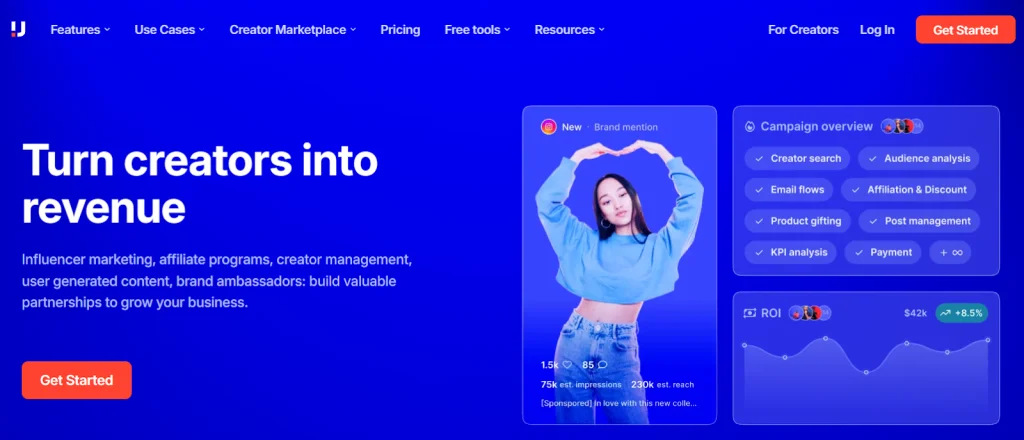
Upfluence has established itself as one of the most comprehensive influencer marketing platforms, with the company reporting over 1,600 clients worldwide using its approach to creator partnerships. With its vast influencer database, Creator Marketplace, advanced analytics, and deep e-commerce integrations, it proves to be the single solution for brands serious about influencer marketing at a large scale.
To create this Upfluence review, I’ve analyzed the platform extensively. I believe it’s the ideal choice if:
- You need a comprehensive influencer database with advanced search filters plus marketplace access
- You want deep e-commerce integrations for tracking sales and ROI
- You have dedicated resources for platform training and management
- You’re managing complex, multi-faceted influencer programs
- You value having extensive features and customization options
However, Upfluence might not be the best choice if:
- You need to get your first influencers applying within 30 minutes
- You prefer AI agents that source and recruit beyond any database limitations
- You’re looking for accessible pricing with a $0 starter tier
- You want AI to create your campaign brief in 20 seconds from just five inputs
- You need a platform you can master in hours rather than weeks
In this case, you should consider partnrUP. This is not a traditional influencer marketing platform, but an AI-powered solution that takes a different approach. Four specialized AI agents (Kyle, Lilly, Rachel, and Aaron) automate the entire campaign lifecycle through real-time creator sourcing that finds perfect candidates, whether they’re in any database or not, to automated payment processing, making influencer marketing accessible with the lowest barrier to entry possible.
Because of that, I’ve included a detailed look at partnrUP later in this Upfluence review, as the best alternative for brands seeking fresh, campaign-specific creator discovery over database dependency.
Table of contents:
- What is Upfluence?
- Upfluence Pros & Cons
- Upfluence Review: How it Works & Key Features
- Where Upfluence Falls Short
- Top Upfluence Alternative for Real-Time AI Sourcing: partnrUP
- Upfluence or partnrUP: Comparison Summary
- Final Verdict
What is Upfluence?
Upfluence was founded in 2013 by Vivien Garnès, Kevin Creusy, Alexis Montagne, and Yann Metz-Pasquier.
The founders discovered the power of influencer marketing firsthand when struggling to market their e-commerce necktie business. After finding success with influencer partnerships, they created Upfluence to help other businesses leverage this strategy.
Initially launched as an influencer marketplace, Upfluence pivoted in 2016 to become a comprehensive SaaS platform. Today, it positions itself as an all-in-one, data-driven influencer and affiliate marketing solution for brands of all sizes, with particular strength in e-commerce.
The platform offers three main discovery methods: a database with millions of influencer profiles across Instagram, TikTok, YouTube, Facebook, Twitter, Twitch, and blogs; a Creator Marketplace where influencers opt in to work with brands; and Live Capture technology that identifies influential customers from your own CRM and customer data.
Upfluence serves major brands including Amazon, Marriott, Asics, and Universal Pictures. The platform appears to target mid-market to enterprise companies, particularly in e-commerce, with dedicated marketing teams and substantial budgets for influencer marketing. Marketing agencies managing multiple client campaigns also represent a key customer segment.
Upfluence Pros & Cons
| Pros | Cons |
|---|---|
| ✅ Multiple discovery methods: database, marketplace, and customer identification | ❌ High cost barrier for small businesses |
| ✅ Powerful search with 20+ advanced filters | ❌ Steep learning curve requiring training |
| ✅ Deep e-commerce integrations (Shopify, WooCommerce) | ❌ Limited flexibility in contract terms |
| ✅ Live Capture identifies influential customers | ❌ Can be overwhelming for simple campaigns |
| ✅ Comprehensive analytics and ROI tracking | ❌ Database quality issues reported by some users |
| ✅ Automated outreach and follow-up capabilities | ❌ No free tier for main platform |
Upfluence Review: How it Works & Key Features
Influencer Discovery: Database, Marketplace & Customer Identification
Upfluence’s discovery features combine three approaches.
First, its algorithmic database indexes millions of influencer profiles. Users begin by entering keywords related to their industry or campaign theme, then apply filters from over 20 available options. These include influencer location, language, engagement rate, follower count, and audience demographics like age, gender, and location.
Second, the platform offers a Creator Marketplace where influencers can opt in to actively seek brand partnerships, providing another discovery avenue beyond the searchable database. This gives brands access to creators who are explicitly interested in collaborations.
Third, and particularly distinctive, is Live Capture technology which identifies influential individuals from a brand’s existing customer base. Through customizable pop-ups or checkout fields on websites, brands can collect social media handles from visitors. The system then analyzes these profiles to highlight customers with significant social influence who could become brand ambassadors, essentially turning CRM data into an influencer discovery tool.

Source: Upfluence
Each influencer profile provides detailed metrics including engagement rates, audience demographics broken down by country and city, follower authenticity percentages, and past brand collaborations. The system also shows posting habits, average engagement by publication time, and what percentage of content is sponsored or organic.
Campaign Management & Workflows
The campaign management system allows users to organize influencers into specific campaigns with defined objectives, deliverables, and timelines. Users can create campaign briefs outlining content requirements, messaging guidelines, and key talking points. The platform supports various campaign types including sponsored posts, product gifting, and affiliate marketing programs.
Once influencers are selected, Upfluence reaches out through customizable email templates with bulk messaging capabilities, allowing brands to contact thousands of influencers efficiently. The system supports automated follow-up sequences for influencers who don’t respond initially.

Source: Upfluence
Contract management happens within the platform, where users can upload legal documents. For product seeding campaigns, the platform integrates with e-commerce systems to facilitate one-click shipping after influencers select products from the brand’s catalog. Content approval workflows allow brands to review submissions, provide feedback, and approve content before publication.
Analytics & Reporting
Upfluence provides real-time analytics tracking reach, engagement, and conversions across campaigns.
The platform adds up data to show total revenue, ROI, average order value, and commissions owed to influencers. Through e-commerce integrations, it can directly attribute sales to specific influencer posts using unique tracking links and promo codes.

Source: Upfluence
Individual influencer performance analysis shows clicks on unique links, sales generated, and engagement rates for each creator. The social listening tool tracks brand mentions, hashtags, and keywords across platforms to gauge campaign reach beyond direct partnerships. Users can generate customizable reports merging content and sales data, which can be exported as PDFs for stakeholders.
E-commerce Integration & Affiliate Features
Deep integrations with Shopify, WooCommerce, Magento, BigCommerce, and Amazon enable seamless sales tracking and attribution. The platform can generate unique, trackable affiliate links and custom promotion codes for each influencer natively within these e-commerce systems. Commission structures can be customized individually for each affiliate.
The affiliate management system operates commission-free, meaning brands don’t pay Upfluence transaction fees on affiliate payouts. Automated commission calculations eliminate manual tracking, while the platform handles everything from generating promo codes to processing payments. The system supports both percentage-based and fixed-amount commission structures.
Integration with CRM systems like Klaviyo allows brands to match social data with customer purchase history, creating comprehensive profiles of influential customers. This connection between e-commerce and influencer data enables brands to identify high-value customers who could become effective brand advocates.
Where Upfluence Falls Short
While Upfluence is best at providing comprehensive features, several limitations become apparent for certain users. These constraints reveal a platform optimized for enterprise complexity rather than streamlined efficiency.
Cost and Accessibility Barriers: The platform’s pricing structure creates significant barriers for smaller businesses and startups. With no public pricing and a preference for annual contracts, brands must commit substantial resources before fully understanding if the platform meets their needs.
Users report that costs can be prohibitive, particularly as contact lists grow. While Upfluence offers some free tools like Chrome extensions and audit tools, the main platform lacks a free tier, meaning brands can’t test core features without financial commitment. This subscription-only model requires upfront investment regardless of actual usage or results.
Overwhelming Complexity: The extensive feature set that makes Upfluence powerful also makes it daunting for new users.
Multiple users report needing several meetings with the Upfluence team to master the platform’s features. For brands wanting to launch simple influencer campaigns and get their first creators applying within 30 minutes, the learning curve can delay time-to-value significantly. Simple tasks require navigating through multiple menus and options designed for enterprise-scale operations.
Database Dependency and Quality Concerns: Users report mixed experiences with the influencer database quality. Some encounter outdated information, inactive profiles, or low response rates to outreach efforts.
While the database is extensive and supplemented by the marketplace, it’s still a static pool that multiple brands tap into repeatedly. Keeping millions of profiles currently presents ongoing challenges that can impact campaign effectiveness, and brands are limited to creators already in the system rather than discovering fresh, emerging influencers in real-time.
These limitations aren’t failures but rather the result of building a comprehensive enterprise platform. However, they create opportunities for alternatives that prioritize automated real-time sourcing, accessibility with the lowest barrier to entry, and AI-powered efficiency over feature depth.
Top Upfluence Alternative for Real-Time AI Sourcing: partnrUP
partnrUP isn’t a classic influencer marketing platform. It is an AI-powered solution that redefines how brands discover and work with creators.

By using four specialized AI agents that source, recruit, manage, and report, partnrUP transforms what traditionally requires extensive manual work into streamlined, automated workflows that deliver results in 30 minutes, not days.
Four AI Agents That Source Beyond Database Limitations
partnrUP’s core innovation and biggest value lies in its AI-powered sourcing and recruitment that actively scours the web to find perfect candidates for each campaign, whether they’re in any existing database or not.
Kyle, the discovery agent, sources creators in real-time across Instagram, TikTok, and YouTube, analyzing audience data, content style, and engagement to identify relevant influencers as they emerge and grow on social platforms. This ensures fresh talent for every campaign rather than recycling the same pool of creators.
Lilly, the recruitment agent, personalizes outreach and manages onboarding automatically, pre-qualifying creators and streamlining the application process. Once a campaign is published, the system immediately starts identifying and emailing top quality leads, with creators beginning to apply within 30 minutes.
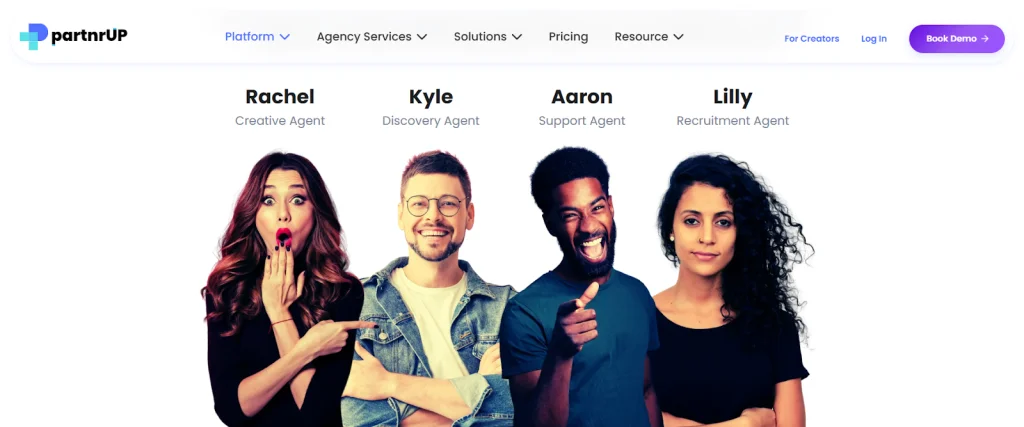
Rachel, the creative agent, generates complete campaign briefs and creative strategies in 20 seconds – not hours – based on just five pieces of information: campaign name, goal, channels, campaign type, and website/product link. This makes influencer marketing accessible for users new to the space or unsure how to structure campaigns.
Aaron, the campaign agent, oversees administrative tasks including communication threading, task management, and automated payments. A control system determines when creators have completed all requirements outlined in the program brief and manages payments automatically, while also giving brands the option to dispute if requirements weren’t fully met.
Fresh Discovery for Every Campaign, Not Database Recycling
Rather than forcing brands to work within a static database that every brand uses, partnrUP actively sources creators specifically for each campaign.
Kyle scans Instagram, TikTok, and YouTube in real-time, analyzing creators based on engagement rates, keywords, hashtags, lookalike profiles, follower ranges, audience demographics, and location.
Audience Insight Reports provide detailed analysis of each creator’s demographics, engagement rates, and past partnerships, but unlike traditional platforms, this analysis happens on fresh, campaign-specific discovery rather than pre-indexed profiles.
The platform focuses on finding authentic matches based on audience quality and relevance for your specific campaign needs, not just high-follower accounts from a database.
Democratizing Influencer Marketing with Zero Barrier to Entry
partnrUP eliminates traditional difficulties through AI automation and transparent, accessible pricing.
The centralized communication system combines all creator communications across channels (text, email, in-app messaging) into single threaded conversations. Aaron sends automated reminders to keep influencers on track without brands needing to manually follow up.
The platform enables teams to manage 50 or more creators per campaign without adding headcount. All submitted content flows into the platform with perpetual, royalty-free usage rights for standard campaigns, simplifying content rights management.
The pricing structure makes influencer marketing accessible to businesses of all sizes with the lowest barrier to entry possible.
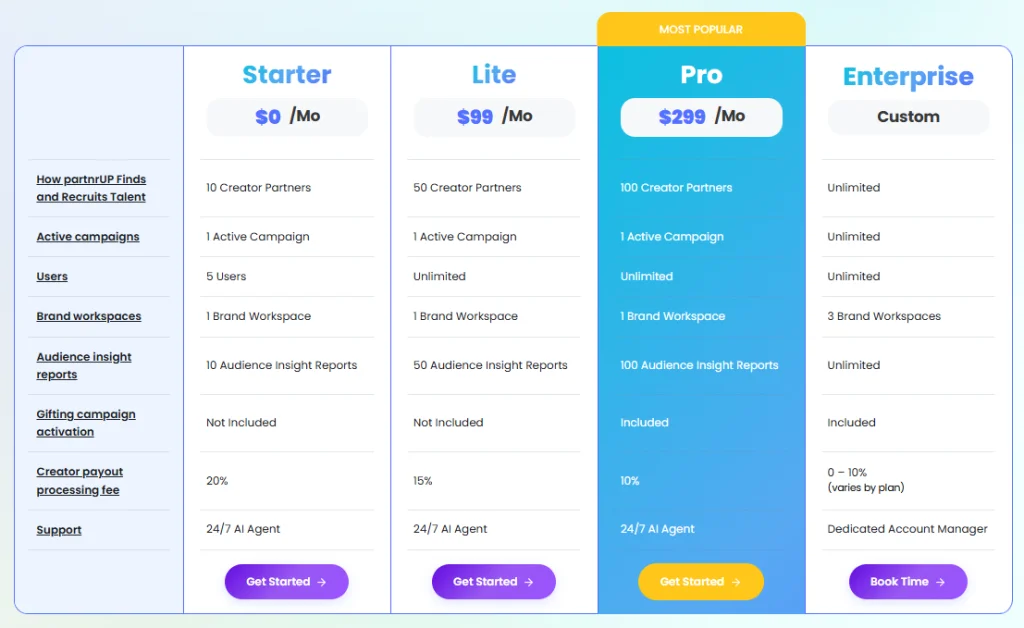
The Starter tier at $0 allows up to 10 creator partners and one active campaign with no credit card required. The Lite tier at $99 per month unlocks unlimited creators (though gifting campaigns are not included at this tier). The Pro tier at $299 per month supports three simultaneous campaigns with a 10% creator payout processing fee. Enterprise and agency plans offer custom configurations.
This usage-based model means pricing aligns with the outcomes brands receive. You only pay based on actual campaign activity and results, making it risk-free and outcome-aligned compared to subscription-only models.
Purpose-Built for Agencies with White Label Capabilities
partnrUP offers a fully white-labeled product specifically for agencies, eliminating the burden of handling payment processing between brands and creators; a common issue with traditional platforms.
The solution features multiple brand workspaces under one umbrella, customizable permissioning for what clients see, agency branding throughout the platform, and the ability to apply different credit card or ACH information for each brand workspace.
This allows agencies to manage invoicing on a brand-by-brand basis without acting as the middleman for payments. The system provides complete control within brand-specific environments through account-by-account workspace level management, protecting agencies from invoice management risks.
The partnership is flexible to accommodate the fluid nature of agency businesses, with brands coming on and off. These white label capabilities and flexible brand workspace management solutions don’t exist elsewhere in the market.
Upfluence or partnrUP: Comparison Summary
| Feature | Upfluence | partnrUP |
|---|---|---|
| Discovery Method | Database search, marketplace, customer identification | Real-time AI sourcing beyond database limitations |
| Speed to First Applicants | Hours to days depending on setup | 30 minutes from campaign launch |
| Campaign Brief Creation | Manual setup with templates | AI generates briefs in 20 seconds from 5 inputs |
| Automation Level | ⭐⭐⭐⭐ Automated outreach and workflows | ⭐⭐⭐⭐⭐ Four AI agents source, recruit, manage, report |
| Pricing Model | Custom quotes, prefers annual contracts, subscription required | Transparent tiers starting at $0, usage-based, outcome-aligned |
| Learning Curve | ⭐⭐ Steep, requires multiple training sessions | ⭐⭐⭐⭐ Intuitive, quick mastery |
| Agency Features | Multi-account support with white-label options | Purpose-built white label, eliminates payment processing burden |
| Creator Pool | Static database + marketplace that multiple brands use | Fresh, campaign-specific discovery for each campaign |
| E-commerce Integration | ⭐⭐⭐⭐⭐ Deep native integrations | ⭐⭐⭐ Product seeding capabilities |
| Best For | Enterprise teams with dedicated resources | Brands and agencies wanting AI-powered efficiency |
Final Verdict
The choice between Upfluence and partnrUP ultimately depends on your priorities: comprehensive features or AI-powered efficiency.
👉 Choose Upfluence if you need a comprehensive platform with extensive features, multiple discovery methods including database search, marketplace access, and customer identification through Live Capture.
It’s ideal for established businesses with dedicated marketing teams who can invest time in learning the platform and want full control over every aspect of their influencer programs. The advanced analytics and deep e-commerce integrations make it ideal for complex, multi-channel influencer strategies where you need maximum feature depth.
Get started with Upfluence here.
👉 Choose partnrUP if you value AI-powered automation and new creator discovery over database dependency. It’s designed for teams that want to get their first influencers applying within 30 minutes, prefer AI agents (Kyle, Lilly, Rachel, and Aaron) to source beyond database limitations and handle repetitive tasks, and need accessible pricing starting at $0 that aligns costs with outcomes.
The real-time sourcing, 20-second brief creation, and purpose-built agency features that eliminate payment processing burdens make it effective for brands and agencies that want to have access to influencer marketing with the lowest barrier to entry possible.
Get started with partnrUP here
Both platforms serve their audiences well. Upfluence provides the comprehensive toolkit for enterprise influencer marketing with its database, marketplace, and customer identification capabilities. partnrUP delivers something different, not a classic influencer marketing platform, but an AI-first solution that sources fresh creators for every campaign and makes influencer marketing accessible to all through automation and transparent, usage-based pricing.