Social Cat has carved out a distinct niche in the influencer marketing space by focusing specifically on connecting small businesses with micro-influencers for affordable collaborations. With over 50,000 vetted creators and a platform built for gifted, paid, and affiliate partnerships, it offers an accessible entry point into influencer marketing for brands with limited budgets. But as businesses grow and their influencer marketing needs become more advanced, the platform’s simplicity can become a constraint.
To create this Social Cat review, I’ve analyzed the platform extensively. I believe it’s the ideal choice if:
- You’re a small business focused primarily on micro-influencer partnerships
- You want to run gifted collaborations to generate user-generated content
- You need an affordable, straightforward platform without complex features
- You’re operating exclusively on Instagram and TikTok
- You prefer manually vetted creators over automated discovery
However, Social Cat might not be sufficient if:
- You need to work with creators across all follower tiers
- You want AI-powered automation for campaign management
- You require comprehensive analytics and performance tracking
- You’re ready to scale beyond manual processes
- You need advanced features like content syndication or agency white-labeling
In this case, you should consider partnrUP: an AI-powered influencer marketing platform that sources new creators for each campaign rather than relying on a static database, enabling businesses to scale their influencer marketing efforts while managing hundreds or thousands of creators efficiently.
Because of that, I’ve included a detailed look at partnrUP later in this Social Cat review, as the preferred solution for growing businesses and agencies. If you’re ready to explore automated influencer marketing at scale, you can learn more about partnrUP here.
Table of contents:
- What is Social Cat?
- Social Cat Pros & Cons
- Social Cat Review: How it Works & Key Features
- Where Social Cat Falls Short
- Top Social Cat Alternative for Growing Businesses: partnrUP
- Social Cat or partnrUP: Comparison Summary
- Final Verdict
What is Social Cat?
Social Cat was founded by Stefan Afrăsinei and Cezar Grigore with a clear mission: to level the playing field for small businesses by making influencer marketing accessible and affordable.

The founders recognized that many small companies struggle with the high costs of marketing tools priced for enterprises, and created a platform specifically tailored to smaller budgets and simpler needs.
The platform positions itself as “the Tinder for brands and creators,” emphasizing its matchmaking capabilities between businesses and micro-influencers. This focus on micro-influencers (typically 5,000 to 50,000 followers according to their definition) reflects the platform’s understanding that smaller, more engaged audiences often deliver higher ROI for niche brands.
Today, Social Cat serves over 2,000 brands through its network of 50,000+ manually vetted influencers. The platform operates exclusively on Instagram and TikTok, and is currently available in the USA, UK, Australia, and Canada.
Its core strength lies in facilitating gifted collaborations, where brands send products in exchange for content, though it also supports paid and affiliate partnerships, making influencer marketing possible even for businesses with varying budgets.
The ideal Social Cat users are small to medium-sized businesses, particularly in e-commerce, who want to generate authentic user-generated content and increase brand awareness without the complexity and cost of enterprise-level platforms.
Social Cat Pros & Cons
| Pros | Cons |
|---|---|
| ✅ Affordable pricing starting at $49/month | ❌ Limited to Instagram and TikTok only |
| ✅ Specialized in gifted collaborations | ❌ Geographic restrictions (US, UK, AU, CA) |
| ✅ Manually vetted influencer network | ❌ Limited post-campaign analytics capabilities |
| ✅ Simple, user-friendly interface | ❌ Basic reporting on lower-tier plans |
| ✅ Content usage rights included | ❌ Manual processes may limit scalability |
| ✅ Quick campaign setup (approximately 5 minutes) | ❌ Customer service issues reported by some users |
Social Cat Review: How it Works & Key Features
Influencer Marketplace & Search
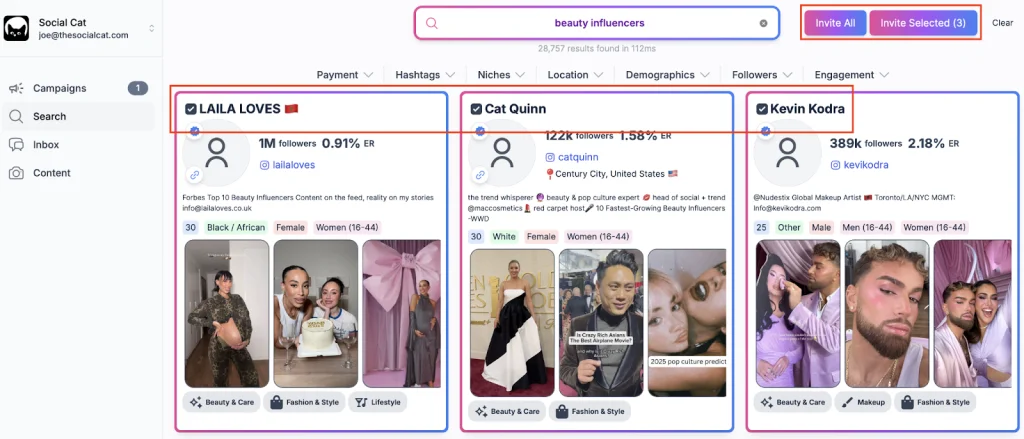
Social Cat’s marketplace contains over 50,000 vetted and approved influencer profiles.
The platform takes a selective approach with manual vetting that examines follower numbers, engagement rates, content quality, and indicators of account authenticity. Creators are encouraged to verify their Meta and TikTok accounts as part of the platform’s quality assurance process.
The discovery process operates through two methods.
First, the platform’s matchmaking algorithm automatically matches campaigns with suitable influencers based on criteria like niche, location, and collaboration preferences. Creators receive daily digests of brands looking for partnerships. Second, brands can manually search the database using filters for industry categories, hashtags, engagement rates, and audience demographics including age, gender, and ethnicity.
Source: Social Cat
Each influencer profile displays key metrics, audience insights, and reviews from other brands. The platform allows sorting by “Best Reviews,” helping businesses assess reliability before committing to partnerships. The platform specifically focuses on micro-influencers, recognizing their typically higher engagement rates and more authentic connections with niche audiences.
Campaign Management
The campaign creation process takes approximately 5-10 minutes.
Brands define their campaign type (gifted, paid, or affiliate), specify objectives, detail the product, and choose desired content formats like Instagram Reels, Stories, or TikTok videos. Once published, campaigns become visible to the influencer network.
Instead of brands conducting extensive outreach, interested influencers apply directly to campaigns, often including personal messages explaining their interest. This application-based model can save time compared to manual outreach. Brands can review profiles of applicants, including social media metrics and reviews from previous collaborations.

Source: Social Cat
Communication happens through the platform’s built-in messaging system, keeping conversations organized in one place. The platform also provides contract capabilities, helping ensure clear terms and deliverables before collaborations begin. However, campaigns are limited in scope: the Essentials plan allows only one campaign at a time with up to 5 creators monthly.
Influencer Gifting
Social Cat is a platform that facilitates gifted collaborations alongside paid and affiliate partnerships.
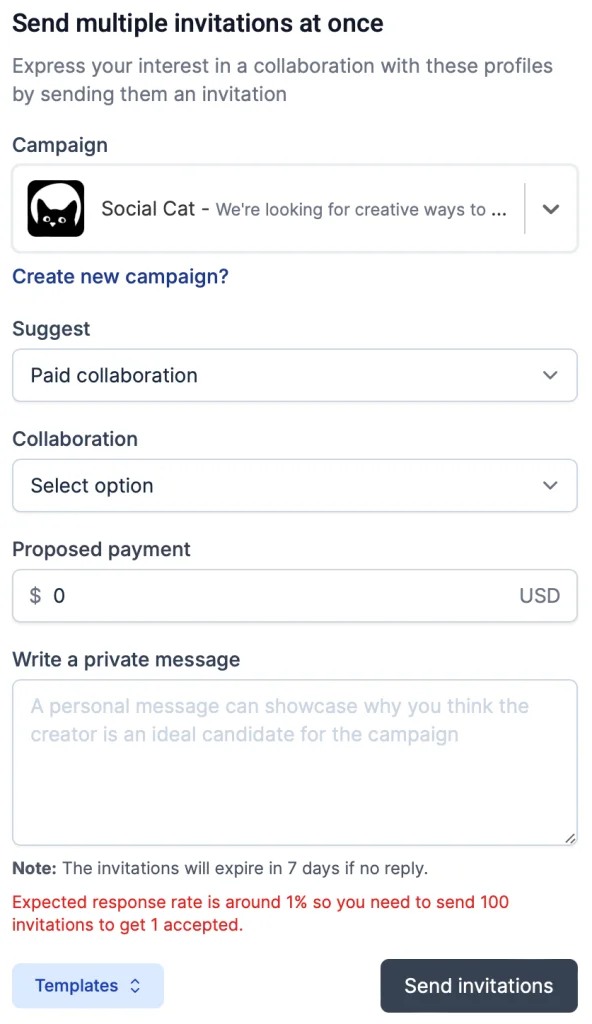
The gifting workflow begins with brands creating campaigns that specify products available for gifting and desired content outcomes. Influencers can either discover these opportunities organically or be invited directly by brands through the Search tool.
Source: Social Cat
The platform sets clear expectations for gifted collaborations, typically one piece of content per product received, as stated in their help documentation.
For gifted collaborations, creators customarily post content without prior brand approval, though paid collaborations usually include a review step. This structured approach to gifting campaigns aims to reduce common issues, though the platform explicitly states it cannot guarantee creators will always deliver and does not reimburse brands if creators fail to post.
Content Library & Rights Management
The Content Library serves as a centralized archive for all user-generated content from campaigns.
When influencers complete their content, they upload content directly to the platform through an “Upload Content” button in their collaboration history. This content is automatically added to the brand’s library.

Source: Social Cat
Brands receive perpetual, non-exclusive licenses to use all content generated through the platform. This includes rights to reuse the content across websites, social media, digital ads, and other marketing materials without additional fees or negotiations. The straightforward licensing terms help reduce legal complexity around content usage.
The library allows brands to view and download content from their collaborations. While specific organizational and search features within the library are not detailed in public documentation, it provides a functional system for managing the UGC generated through influencer partnerships.
Where Social Cat Falls Short
While Social Cat excels at simplifying micro-influencer collaborations for small businesses, several limitations reveal a platform deliberately optimized for simplicity over comprehensive functionality.
Limited Platform and Geographic Reach: The platform’s restriction to Instagram and TikTok means brands cannot run campaigns on YouTube, Facebook, or emerging platforms. Geographic limitations to four countries (US, UK, Australia, Canada) further restrict potential reach. For businesses with global ambitions or diverse platform strategies, these boundaries are constraining.
Limited Performance Analytics: According to Social Cat’s own help documentation from December 2024, the platform currently doesn’t offer post-collaboration metrics or insights, requiring brands to ask creators directly for performance data. While the platform may have some real-time tracking capabilities, the lack of comprehensive post-campaign analytics makes it difficult to measure ROI, optimize strategies, or justify continued investment in influencer marketing.
Manual Processes and Scale Considerations: While manual vetting ensures quality, it also creates potential setbacks. The platform’s reliance on manual processes for vetting and dispute resolution means businesses ready to grow may face operational constraints. Running dozens of simultaneous campaigns or managing hundreds of creators could become challenging without more automation.
Limited Agency Features: While Social Cat does serve agencies and claims to be trusted by over 250 agencies, the platform appears to lack advanced features like white-label capabilities or advanced multi-brand workspace management that larger agencies need. There’s no clear way to customize the platform with agency branding or manage multiple client accounts with separate billing.
Database Size: Social Cat’s database of 50,000 vetted creators, while quality-focused, means brands are working within a defined pool of influencers. Popular creators may become oversaturated with brand partnerships over time, potentially reducing authenticity and effectiveness.
These limitations aren’t failures; they reflect Social Cat’s deliberate focus on serving small businesses with simple needs. However, they create a clear gap for businesses whose influencer marketing ambitions extend beyond basic micro-influencer collaborations.
Top Social Cat Alternative for Growing Businesses: partnrUP
partnrUP takes a different approach to influencer marketing, emphasizing AI-powered automation and scalability through real-time creator sourcing rather than database limitations.

The platform employs four AI agents (Kyle for sourcing, Lilly for recruitment, Rachel for creative briefs, and Aaron for campaign management) designed to streamline the influencer marketing process from discovery through campaign completion, with creators starting to apply within 30 minutes of campaign launch.
AI-Powered Discovery Beyond Databases
The biggest differentiator for partnrUP is its AI-powered sourcing capability.
Unlike Social Cat’s fixed database of 50,000 pre-vetted creators, partnrUP’s Discovery Agent Kyle actively searches Instagram, TikTok, and YouTube in real-time to source fresh, relevant influencers for each specific campaign.

The system analyzes real-time platform data to identify creators that match specific campaign criteria, whether they’re in any existing database or not, ensuring brands aren’t limited to a preset pool of creators that every other brand is also tapping.
Recruitment Agent Lilly then automates the outreach process, sending personalized invitations, managing follow-ups, and handling creator onboarding.
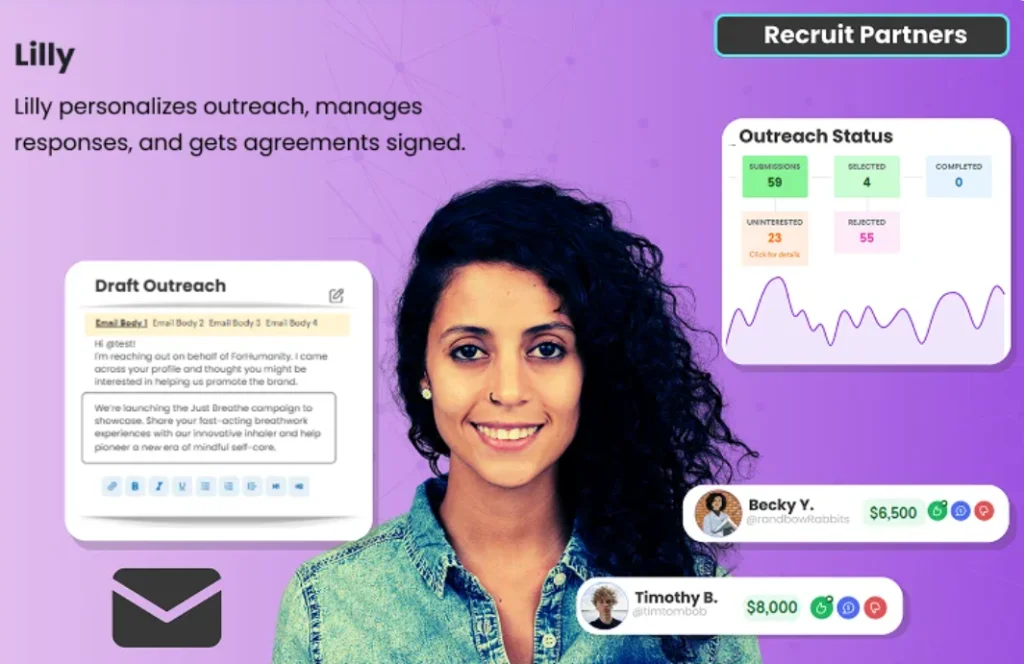
This automation allows brands to recruit and manage larger numbers of creators simultaneously, with the first influencers typically applying within 30 minutes of campaign publication. The system targets and sources the perfect candidates based on engagement rates, keywords, hashtags, lookalike profiles, follower ranges, audience demographics, and location.
Democratized Access with Flexible Pricing
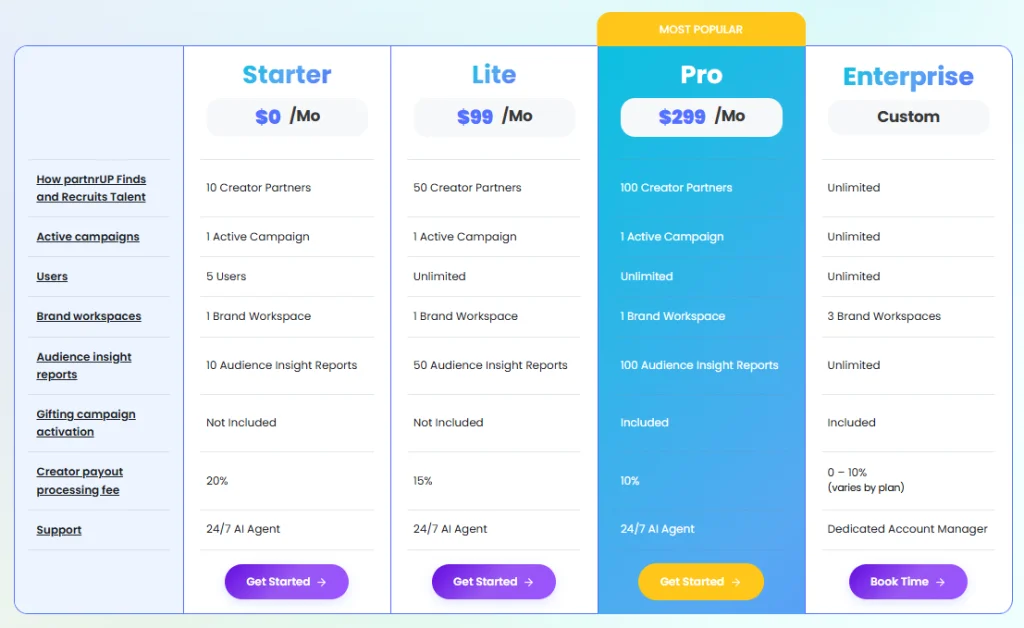
partnrUP offers a tiered pricing structure that includes a free Starter tier with no upfront costs, allowing brands to launch campaigns without initial investment.
The Starter plan operates on a usage-based model with a 20% processing fee on creator payments and supports up to 10 creators. Higher tiers (Lite at $99/month with 15% fees supporting unlimited creators, Pro at $299/month with 10% fees supporting unlimited creators) offer enhanced capabilities while maintaining outcome-aligned pricing.
The AI Campaign Builder, powered by Rachel, generates professional creative briefs and campaign strategies in just 20 seconds based on five key inputs: campaign name, goal, channels, campaign type, and website/product link. This makes influencer marketing accessible to users without extensive experience, ensuring professional-quality campaigns regardless of expertise level.

Campaign Manager Aaron handles automated payment processing via PayPal, merges all creator communications across channels into single threaded conversations, and automatically sends reminders to keep influencers on track. A control system determines when creators have completed requirements and manages payments automatically, while giving brands the option to dispute if requirements weren’t met.

Purpose-Built for Agencies
A key differentiator for partnrUP is its comprehensive agency feature that eliminates common challenges, particularly the burden of handling payment processing between brands and creators.
The platform offers fully white-labeled solutions with multiple brand workspaces under one umbrella, customizable permissioning, and agency branding throughout.
Crucially, agencies can apply different credit card or ACH information for each brand workspace, allowing invoicing on a brand-by-brand basis without acting as the middleman for payments.
This white-labeled collaboration workspace provides complete control within brand-specific environments through account-by-account workspace level management, protecting agencies from invoice management risks while maintaining full branding control for both advertisers and creators.
This purpose-built agency design contrasts sharply with Social Cat’s basic agency support, addressing the unique operational needs of agencies managing multiple client accounts simultaneously.
Advanced Analytics and Commerce Integration
Unlike Social Cat’s limited post-campaign analytics, partnrUP provides comprehensive real-time performance tracking across campaigns.
The platform’s dashboards track awareness metrics (reach, impressions), engagement (likes, comments, views), and conversions (clicks, sales) with updates as content goes live.
The platform delivers full-funnel measurement capabilities, industry benchmarking to compare performance against vertical standards, and exportable custom reports for stakeholders. These analytics features directly address one of the key limitations identified in Social Cat’s offering.
A unique feature is partnrUP’s product content syndication feature. Brands can push creator content directly to retail product pages on Amazon and Shopify, and the platform claiming this can achieve 25-35% increase in product page conversions (though this statistic comes from vendor marketing and should be evaluated accordingly).
Social Cat or partnrUP: Comparison Summary
| Feature | Social Cat | partnrUP |
|---|---|---|
| Target Market | Small businesses and agencies | Startups to enterprises and agencies |
| Influencer Sourcing | Pre-vetted database (50K+) | Real-time AI sourcing (fresh creators per campaign) |
| Creator Tiers | Primarily micro-influencers | Supports various tiers |
| Campaign Automation | Semi-automated with manual elements | AI agents source, recruit, manage, report |
| Monthly Creator Limit | 10-50 depending on plan | 10 (Starter), Unlimited (Lite/Pro) |
| Analytics | Basic real-time metrics, limited post-campaign | Comprehensive real-time and post-campaign tracking |
| Content Syndication | Not available | Direct to Amazon, Shopify, and more |
| Agency Features | Basic agency support | Full white-label with separate billing per brand |
| Pricing Model | $49-179/month subscription | $0 (Starter), $99 (Lite), $299 (Pro) per month |
| Processing Fees | None | 20% (Starter), 15% (Lite), 10% (Pro) |
| Time to First Applicants | Variable based on creator interest | 30 minutes after campaign launch |
| Support | Email and Instagram | Online chat/email support |
| Geographic Limits | US, UK, AU, CA | No stated restrictions |
Final Verdict
The choice between Social Cat and partnrUP ultimately depends on your business’s current scale and future ambitions in influencer marketing.
Choose Social Cat if you’re a small business taking your first steps into influencer marketing and value simplicity above all else.
Its focus on micro-influencers and gifted collaborations provides an affordable, low-risk way to generate authentic user-generated content. The manual vetting ensures quality connections, while the straightforward interface means you can launch your first campaign quickly without technical expertise.
Get started with Social Cat here
Choose partnrUP if you’re ready to expand your influencer marketing beyond manual processes and database limitations.
Its AI-powered agents actively source new creators for each campaign rather than relying on a static pool, while the platform’s free Starter tier with usage-based pricing allows you to begin without upfront investment. The comprehensive white-label features that eliminate payment processing burdens make it suitable for agencies, while the ability to get your first influencers applying within 30 minutes accelerates campaign momentum.
For businesses and agencies viewing influencer marketing as a core pillar of their growth strategy, partnrUP’s automated sourcing, recruiting, managing, and reporting capabilities provide the infrastructure needed for advanced programs.
Get started with partnrUP here
Both platforms serve their audiences well. Social Cat democratizes influencer marketing for small businesses through simplicity and affordability. partnrUP goes beyond traditional database-dependent platforms by using AI to actively source and recruit the perfect creators for each campaign, enabling businesses to grow efficiently without being limited to a preset pool of influencers.
Your choice depends on whether you need a simple tool for basic collaborations or comprehensive infrastructure for scaled influencer marketing operations powered by real-time creator discovery.